"> Sewage Treatment Plant - Equipment Database

Sewage Treatment Plant

medium IMO Required 148 models total

A sewage treatment plant breaks down and disinfects blackwater from toilets and greywater from galleys before discharge, using biological digestion or electrochemical treatment, and is inspected under MARPOL Annex IV rather than the oil record book regime that governs bilge water.

Read more — Sewage Treatment Plant explained

What defines a sewage treatment plant

A marine sewage treatment plant (STP) treats blackwater from toilets, and often greywater from galleys and laundries, to a standard that permits discharge closer to shore than untreated sewage would allow. It sits under a different regulatory regime from the oily water separator: MARPOL Annex IV governs sewage, with its own discharge distances, effluent standards and survey cycle, separate from the Annex I rules that cover oil in bilge water. Two treatment principles dominate the market -- biological plants that use aerobic bacteria to digest waste over a multi-stage retention period, and electrochemical plants that break down and disinfect waste using an electrolytic cell, typically generating disinfectant in situ from seawater. Biological plants need a stable feed and enough retention time to keep the bacterial culture alive; electrochemical plants respond faster to intermittent loads but consume more power and electrode life.

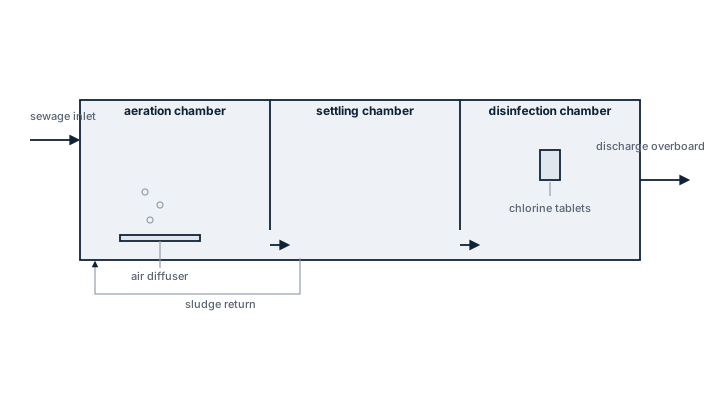
Sewage treatment plant flow scheme
Flow scheme of a three-chamber biological sewage treatment plant: inlet sewage is aerated in the first chamber, settles in the second chamber with sludge returned to the first, and is disinfected in the third chamber before discharge overboard.

Main components

Aeration or treatment chamber

On biological plants, a series of chambers -- aeration, settling, and often a final disinfection stage -- where an air blower keeps the bacterial culture aerobic and mixed with incoming waste.

Electrolytic cell

On electrochemical plants, a cell with plate or tube electrodes through which seawater or the effluent itself passes, generating disinfectant in situ rather than dosing a stored chemical.

Comminutor / macerator

A grinding stage ahead of treatment that reduces solids to a size the biological or electrochemical process can handle, and prevents rag and debris from blocking downstream pumps.

Effluent monitoring

A sample point, and on many installations a continuous monitor, for the parameters the discharge standard sets -- typically suspended solids, faecal coliform count and residual chlorine -- checked before the effluent is allowed overboard rather than to a holding tank.

Selection and sizing

  • Design population -- crew complement plus passengers where applicable -- against the plant's rated daily flow.
  • Peak load pattern: passenger vessels see sharp morning and evening peaks that a plant sized only on average daily flow cannot absorb.
  • Trading pattern: a ship spending long periods in port or in special areas needs enough holding capacity or treated-discharge capability to cover restricted zones.
  • Power consumption, particularly for electrochemical plants, against the electrical load budget of the vessel.
  • Space for retention time in biological designs -- undersizing the tankage is the most common design shortfall.

Regulations and class

MARPOL Annex IV requires an International Sewage Pollution Prevention (ISPP) certificate for ships above the size threshold it sets, backed by an initial and periodic survey of the plant and its discharge arrangements. The effluent standard the plant must meet, and the distance from land at which even treated sewage may be discharged, both come from Annex IV; special areas and some port state requirements are stricter than the baseline. Class surveys check the plant's operating log, the treatment performance against its type approval, and that the discharge piping correctly separates treated discharge from any direct overboard bypass -- a bypass valve left open or unsealed is one of the most common port state control deficiencies found on this equipment.

Typical faults

FaultCauseConsequence
Biological process failsBacterial culture killed by disinfectant or strong cleaning chemicals, or an extended low-load period with no feedEffluent quality out of spec, weeks needed to re-establish a healthy culture
Electrode wear on electrochemical cellsNormal consumption over operating hours, accelerated by low-salinity feed waterFalling disinfection performance, eventually failing effluent monitoring
Macerator blockageForeign objects such as wet wipes or rags entering the system despite do-not-flush noticesLoss of flow through the plant, backup into the sanitary system
Odour and foamingOverloading beyond design population, or aeration blower undersized or fouledCrew complaints, and often a sign the treatment is also failing to meet discharge standard

What to look for in a supplier

  • Type approval certificate under MARPOL Annex IV covering the effluent standard actually required for the vessel's trading area.
  • Rated capacity matched with margin to the vessel's actual population and peak load pattern, not just average daily flow.
  • Spare parts availability for electrodes, blower diaphragms or membranes specific to the model.
  • Clear operating and troubleshooting documentation the crew can follow, since this equipment is usually maintained by ship's staff rather than a specialist.

A biological plant that has sat unused during a long yard period needs to be reseeded and given time to re-establish its bacterial culture before sailing -- opening the discharge valve on day one, before the culture has recovered, is how an otherwise sound plant fails its first effluent check after a refit.

4000h
Service Interval
5 yr
Class Survey
15 yr
Typical Lifetime

Typical Manufacturers

Scanship DVZ Jets Hamworthy

18 manufacturers · 148 models

Evac

47 ✓ 20 verified
Evac 910
Ship-wide system, 10-2000 users · Marine Equipment · vacuum sewage treatment plant
Type
Vacuum Toilet System
Common Failures & Inspection Points
  • Scale, membrane fouling, biological growth or dirty optical surfaces reduce treatment capacity or water quality
  • Pump, vacuum, lamp, blower or power-supply faults cause low production, low treatment intensity or shutdown
  • Conductivity, salinity, level or treatment sensors drift and cause false acceptance, rejection or alarms
  • Seal, gasket or piping leakage causes loss of pressure, vacuum or visible water leakage
  • Pretreatment, strainer or discharge blockage causes unstable flow and poor process performance
Service: Inspect feed and discharge paths, strainers, pumps, treatment elements, monitoring and diverting arrangements. Trend production, pressure and water quality where applicable and keep pretreatment equipment clean. Prevent doubtful product water or inadequately treated effluent from entering the wrong system. Refer to the manufacturer documentation for the exact figure for pressure, cleaning, dosing and quality criteria.
Spare Parts: Carry filters, strainers, pump seals, membrane or UV parts where applicable, sensors, valve parts, blower service items and approved treatment consumables.
Strengths
  • Very low freshwater consumption compared with conventional gravity systems
  • Small footprint – suitable for vessels with limited space
  • Integrated pump and control panel simplify installation and operation
  • Meets MARPOL Annex IV discharge standards out of the box
  • Easy access to valves for routine cleaning
Weaknesses
  • Reliance on a single vacuum pump – failure can halt waste handling
  • Requires strict crew discipline to prevent foreign objects in toilets
  • Higher initial purchase price than basic gravity‑type systems
  • Periodic valve and line cleaning (every 3 months) adds maintenance workload
  • Power demand is higher than non‑vacuum solutions
Typical Vessels: Cruise shipFerryOffshore supply vesselNaval auxiliaryPassenger liner
Certifications: IMO Type Approval (Annex IV)DNV class approval
Decision Guide: Choose if the vessel needs a space‑saving, low‑water‑use sewage solution and can maintain regular vacuum‑system upkeep. Avoid if the ship cannot guarantee reliable power for the pump or lacks crew training to keep foreign objects out of the system.
Use Cases: Freshwater production, potable-water conditioning, hydrophore service and sewage treatment.
Evac MBR 50 unverified
· membrane bioreactor STP 50 PE
System description
membrane bioreactor STP 50 PE
Application
marine sanitary / water treatment
Person equivalent
50
Common Failures & Inspection Points
  • Reduced treatment performance caused by fouled filters, exhausted media, scaled membranes, aged lamps or contaminated process surfaces, resulting in poor water quality or increased pressure drop
  • Dosing, regeneration or process-control failure caused by empty consumables, pump faults or control errors, resulting in incorrect treatment conditions
  • Sensor or conductivity fault caused by fouling, calibration drift or wiring problems, resulting in implausible readings or alarms
  • Pump or valve failure caused by wear, blockage or electrical faults, resulting in low treatment flow or inability to route water correctly
  • Leakage caused by seal, housing, membrane, pressure-vessel or piping deterioration, resulting in water loss and unstable process conditions
Service: Inspect filters, membranes, lamps, dosing equipment, treatment vessels, pumps, valves, sensors and sample points as applicable to the installed process. Maintain hygienic conditions during opening of potable-water equipment. Trend pressure drop and water-quality indications and investigate abnormal values promptly. Verify alarms, regeneration, diversion or shutdown functions after maintenance. Store chemicals and treatment media according to approved procedures. Refer to the manufacturer documentation for the exact figure for dosing, replacement, cleaning and water-quality settings.
Spare Parts: Keep filter elements, membrane or lamp components, approved treatment media, dosing-pump service parts, seals, valves, sensors and sampling consumables recommended for the installed process. Chemicals must be approved for the intended water service.
Use Cases: It is used for freshwater, potable-water and sanitary treatment on merchant ships, passenger vessels, offshore units or other vessel types where this equipment category is fitted.
Evac MBR 100 unverified
· membrane bioreactor STP 100 PE
System description
membrane bioreactor STP 100 PE
Application
marine sanitary / water treatment
Person equivalent
100
Common Failures & Inspection Points
  • Reduced treatment performance caused by fouled filters, exhausted media, scaled membranes, aged lamps or contaminated process surfaces, resulting in poor water quality or increased pressure drop
  • Dosing, regeneration or process-control failure caused by empty consumables, pump faults or control errors, resulting in incorrect treatment conditions
  • Sensor or conductivity fault caused by fouling, calibration drift or wiring problems, resulting in implausible readings or alarms
  • Pump or valve failure caused by wear, blockage or electrical faults, resulting in low treatment flow or inability to route water correctly
  • Leakage caused by seal, housing, membrane, pressure-vessel or piping deterioration, resulting in water loss and unstable process conditions
Service: Inspect filters, membranes, lamps, dosing equipment, treatment vessels, pumps, valves, sensors and sample points as applicable to the installed process. Maintain hygienic conditions during opening of potable-water equipment. Trend pressure drop and water-quality indications and investigate abnormal values promptly. Verify alarms, regeneration, diversion or shutdown functions after maintenance. Store chemicals and treatment media according to approved procedures. Refer to the manufacturer documentation for the exact figure for dosing, replacement, cleaning and water-quality settings.
Spare Parts: Keep filter elements, membrane or lamp components, approved treatment media, dosing-pump service parts, seals, valves, sensors and sampling consumables recommended for the installed process. Chemicals must be approved for the intended water service.
Use Cases: It is used for freshwater, potable-water and sanitary treatment on merchant ships, passenger vessels, offshore units or other vessel types where this equipment category is fitted.
Evac MBR 200 unverified
· membrane bioreactor STP 200 PE
System description
membrane bioreactor STP 200 PE
Application
marine sanitary / water treatment
Person equivalent
200
Common Failures & Inspection Points
  • Reduced treatment performance caused by fouled filters, exhausted media, scaled membranes, aged lamps or contaminated process surfaces, resulting in poor water quality or increased pressure drop
  • Dosing, regeneration or process-control failure caused by empty consumables, pump faults or control errors, resulting in incorrect treatment conditions
  • Sensor or conductivity fault caused by fouling, calibration drift or wiring problems, resulting in implausible readings or alarms
  • Pump or valve failure caused by wear, blockage or electrical faults, resulting in low treatment flow or inability to route water correctly
  • Leakage caused by seal, housing, membrane, pressure-vessel or piping deterioration, resulting in water loss and unstable process conditions
Service: Inspect filters, membranes, lamps, dosing equipment, treatment vessels, pumps, valves, sensors and sample points as applicable to the installed process. Maintain hygienic conditions during opening of potable-water equipment. Trend pressure drop and water-quality indications and investigate abnormal values promptly. Verify alarms, regeneration, diversion or shutdown functions after maintenance. Store chemicals and treatment media according to approved procedures. Refer to the manufacturer documentation for the exact figure for dosing, replacement, cleaning and water-quality settings.
Spare Parts: Keep filter elements, membrane or lamp components, approved treatment media, dosing-pump service parts, seals, valves, sensors and sampling consumables recommended for the installed process. Chemicals must be approved for the intended water service.
Use Cases: It is used for freshwater, potable-water and sanitary treatment on merchant ships, passenger vessels, offshore units or other vessel types where this equipment category is fitted.
Evac MBR 500 unverified
· membrane bioreactor STP 500 PE
System description
membrane bioreactor STP 500 PE
Application
marine sanitary / water treatment
Person equivalent
500
Common Failures & Inspection Points
  • Reduced treatment performance caused by fouled filters, exhausted media, scaled membranes, aged lamps or contaminated process surfaces, resulting in poor water quality or increased pressure drop
  • Dosing, regeneration or process-control failure caused by empty consumables, pump faults or control errors, resulting in incorrect treatment conditions
  • Sensor or conductivity fault caused by fouling, calibration drift or wiring problems, resulting in implausible readings or alarms
  • Pump or valve failure caused by wear, blockage or electrical faults, resulting in low treatment flow or inability to route water correctly
  • Leakage caused by seal, housing, membrane, pressure-vessel or piping deterioration, resulting in water loss and unstable process conditions
Service: Inspect filters, membranes, lamps, dosing equipment, treatment vessels, pumps, valves, sensors and sample points as applicable to the installed process. Maintain hygienic conditions during opening of potable-water equipment. Trend pressure drop and water-quality indications and investigate abnormal values promptly. Verify alarms, regeneration, diversion or shutdown functions after maintenance. Store chemicals and treatment media according to approved procedures. Refer to the manufacturer documentation for the exact figure for dosing, replacement, cleaning and water-quality settings.
Spare Parts: Keep filter elements, membrane or lamp components, approved treatment media, dosing-pump service parts, seals, valves, sensors and sampling consumables recommended for the installed process. Chemicals must be approved for the intended water service.
Use Cases: It is used for freshwater, potable-water and sanitary treatment on merchant ships, passenger vessels, offshore units or other vessel types where this equipment category is fitted.
EcoTreat 2
Application
Compact marine sewage treatment plant
Common Failures & Inspection Points
  • Area: International Sewage Pollution Prevention Certificate (ISPPC) validity and authenticity
    Check: Verify ISPPC is valid, properly issued for vessel size (≥400GT or ≥15 persons), signed and endorsed by flag state authority, not expired
  • Area: Sewage treatment plant IMO type approval certificate missing or invalid
    Check: Confirm STP holds valid IMO MEPC 227(64) certificate (or MEPC 159(55) for older units), check certification class (STP type approval letter), verify not lapsed
  • Area: Direct sewage discharge valve not sealed or incorrectly secured
    Check: Inspect discharge valve seals, verify valve is sealed shut when in port or within 3 nautical miles from shore, confirm mechanical lock/weld, check pump discharge isolation
  • Area: Sewage treatment plant not operational or inadequate capacity for crew
    Check: Test plant start-up sequence, verify blower/pump operation, check aeration and treatment tank water levels, confirm adequate treatment time (typically 8-15 hours retention), measure actual vs. design capacity, review operational log
  • Area: Monthly effluent quality testing records missing or deficient (BOD, COD, TSS, E.coli)
    Check: Request last 12 months of effluent test reports, verify parameter compliance with MEPC 227(64) limits (BOD ≤25mg/L, COD ≤125mg/L, TSS ≤35mg/L, fecal coliform <250 CFU/100mL), check testing lab certification, confirm disposal location recorded

Typ-universelle Inspektionspunkte fuer Sewage Treatment Plant (verifiziert, 2026-06).

EcoTreat 5
Application
Marine sewage treatment plant
Common Failures & Inspection Points
  • Area: International Sewage Pollution Prevention Certificate (ISPPC) validity and authenticity
    Check: Verify ISPPC is valid, properly issued for vessel size (≥400GT or ≥15 persons), signed and endorsed by flag state authority, not expired
  • Area: Sewage treatment plant IMO type approval certificate missing or invalid
    Check: Confirm STP holds valid IMO MEPC 227(64) certificate (or MEPC 159(55) for older units), check certification class (STP type approval letter), verify not lapsed
  • Area: Direct sewage discharge valve not sealed or incorrectly secured
    Check: Inspect discharge valve seals, verify valve is sealed shut when in port or within 3 nautical miles from shore, confirm mechanical lock/weld, check pump discharge isolation
  • Area: Sewage treatment plant not operational or inadequate capacity for crew
    Check: Test plant start-up sequence, verify blower/pump operation, check aeration and treatment tank water levels, confirm adequate treatment time (typically 8-15 hours retention), measure actual vs. design capacity, review operational log
  • Area: Monthly effluent quality testing records missing or deficient (BOD, COD, TSS, E.coli)
    Check: Request last 12 months of effluent test reports, verify parameter compliance with MEPC 227(64) limits (BOD ≤25mg/L, COD ≤125mg/L, TSS ≤35mg/L, fecal coliform <250 CFU/100mL), check testing lab certification, confirm disposal location recorded

Typ-universelle Inspektionspunkte fuer Sewage Treatment Plant (verifiziert, 2026-06).

EcoTreat 11
Application
Marine sewage treatment plant
Common Failures & Inspection Points
  • Area: International Sewage Pollution Prevention Certificate (ISPPC) validity and authenticity
    Check: Verify ISPPC is valid, properly issued for vessel size (≥400GT or ≥15 persons), signed and endorsed by flag state authority, not expired
  • Area: Sewage treatment plant IMO type approval certificate missing or invalid
    Check: Confirm STP holds valid IMO MEPC 227(64) certificate (or MEPC 159(55) for older units), check certification class (STP type approval letter), verify not lapsed
  • Area: Direct sewage discharge valve not sealed or incorrectly secured
    Check: Inspect discharge valve seals, verify valve is sealed shut when in port or within 3 nautical miles from shore, confirm mechanical lock/weld, check pump discharge isolation
  • Area: Sewage treatment plant not operational or inadequate capacity for crew
    Check: Test plant start-up sequence, verify blower/pump operation, check aeration and treatment tank water levels, confirm adequate treatment time (typically 8-15 hours retention), measure actual vs. design capacity, review operational log
  • Area: Monthly effluent quality testing records missing or deficient (BOD, COD, TSS, E.coli)
    Check: Request last 12 months of effluent test reports, verify parameter compliance with MEPC 227(64) limits (BOD ≤25mg/L, COD ≤125mg/L, TSS ≤35mg/L, fecal coliform <250 CFU/100mL), check testing lab certification, confirm disposal location recorded

Typ-universelle Inspektionspunkte fuer Sewage Treatment Plant (verifiziert, 2026-06).

MBR 40
Application
Membrane bioreactor sewage treatment
Common Failures & Inspection Points
  • Area: International Sewage Pollution Prevention Certificate (ISPPC) validity and authenticity
    Check: Verify ISPPC is valid, properly issued for vessel size (≥400GT or ≥15 persons), signed and endorsed by flag state authority, not expired
  • Area: Sewage treatment plant IMO type approval certificate missing or invalid
    Check: Confirm STP holds valid IMO MEPC 227(64) certificate (or MEPC 159(55) for older units), check certification class (STP type approval letter), verify not lapsed
  • Area: Direct sewage discharge valve not sealed or incorrectly secured
    Check: Inspect discharge valve seals, verify valve is sealed shut when in port or within 3 nautical miles from shore, confirm mechanical lock/weld, check pump discharge isolation
  • Area: Sewage treatment plant not operational or inadequate capacity for crew
    Check: Test plant start-up sequence, verify blower/pump operation, check aeration and treatment tank water levels, confirm adequate treatment time (typically 8-15 hours retention), measure actual vs. design capacity, review operational log
  • Area: Monthly effluent quality testing records missing or deficient (BOD, COD, TSS, E.coli)
    Check: Request last 12 months of effluent test reports, verify parameter compliance with MEPC 227(64) limits (BOD ≤25mg/L, COD ≤125mg/L, TSS ≤35mg/L, fecal coliform <250 CFU/100mL), check testing lab certification, confirm disposal location recorded

Typ-universelle Inspektionspunkte fuer Sewage Treatment Plant (verifiziert, 2026-06).

Evac MBR 7K ✓ verified
Application
Marine Sewage Treatment (Black and Grey Water)
Common Failures & Inspection Points
  • Area: Membrane fouling and filter clogging in MBR/MBBR systems
    Check: Visual inspection of membrane status and pressure differential readings; verify EcoScreen pre-treatment is properly operated for BOD load reduction; inspect transmembrane pressure (TMP) recordings - should remain stable within design specifications
  • Area: Biological process upset and sludge accumulation in treatment reactors
    Check: Monthly biosolids level monitoring and sludge discharge procedures; verify mixed liquor suspended solids (MLSS) concentration matches design specifications; inspect sludge handling system for proper collection tank operation and maintenance
  • Area: Chemical depletion and overdosing in ORCA electrolytic systems
    Check: Verify 5% chlorine solution levels (ORCA II A) or electrolyte levels are within specifications; confirm automated dosing systems are functioning correctly; test effluent disinfection efficacy according to IMO MEPC 227(64) requirements
  • Area: Effluent quality non-compliance and nutrient overflow in restricted areas (Baltic Sea, River Rhine)
    Check: Quarterly sampling and testing of treated effluent for BOD, TSS, nitrogen and phosphorus levels; verify compliance with IMO MEPC 227(64) Chapter 4.2 requirements for passenger ships in special areas; maintain International Sewage Pollution Prevention Certificate documentation
  • Area: System operational failure and control panel malfunctions
    Check: Verify touchscreen control panel responsiveness; test automated shutdown procedures; confirm integration with ship's main automation system; check alarm and monitoring functions are properly logged and reviewed; ORCA IV B systems require 3-month maintenance interval verification

Typ-universelle Inspektionspunkte fuer Oily Water & Waste Systems (verifiziert, 2026-06).

Evac MBR 15K ✓ verified
Application
Marine Sewage Treatment (Black and Grey Water)
Common Failures & Inspection Points
  • Area: Membrane fouling and filter clogging in MBR/MBBR systems
    Check: Visual inspection of membrane status and pressure differential readings; verify EcoScreen pre-treatment is properly operated for BOD load reduction; inspect transmembrane pressure (TMP) recordings - should remain stable within design specifications
  • Area: Biological process upset and sludge accumulation in treatment reactors
    Check: Monthly biosolids level monitoring and sludge discharge procedures; verify mixed liquor suspended solids (MLSS) concentration matches design specifications; inspect sludge handling system for proper collection tank operation and maintenance
  • Area: Chemical depletion and overdosing in ORCA electrolytic systems
    Check: Verify 5% chlorine solution levels (ORCA II A) or electrolyte levels are within specifications; confirm automated dosing systems are functioning correctly; test effluent disinfection efficacy according to IMO MEPC 227(64) requirements
  • Area: Effluent quality non-compliance and nutrient overflow in restricted areas (Baltic Sea, River Rhine)
    Check: Quarterly sampling and testing of treated effluent for BOD, TSS, nitrogen and phosphorus levels; verify compliance with IMO MEPC 227(64) Chapter 4.2 requirements for passenger ships in special areas; maintain International Sewage Pollution Prevention Certificate documentation
  • Area: System operational failure and control panel malfunctions
    Check: Verify touchscreen control panel responsiveness; test automated shutdown procedures; confirm integration with ship's main automation system; check alarm and monitoring functions are properly logged and reviewed; ORCA IV B systems require 3-month maintenance interval verification

Typ-universelle Inspektionspunkte fuer Oily Water & Waste Systems (verifiziert, 2026-06).

Evac MBR 22K ✓ verified
Application
Marine Sewage Treatment (Black and Grey Water)
Common Failures & Inspection Points
  • Area: Membrane fouling and filter clogging in MBR/MBBR systems
    Check: Visual inspection of membrane status and pressure differential readings; verify EcoScreen pre-treatment is properly operated for BOD load reduction; inspect transmembrane pressure (TMP) recordings - should remain stable within design specifications
  • Area: Biological process upset and sludge accumulation in treatment reactors
    Check: Monthly biosolids level monitoring and sludge discharge procedures; verify mixed liquor suspended solids (MLSS) concentration matches design specifications; inspect sludge handling system for proper collection tank operation and maintenance
  • Area: Chemical depletion and overdosing in ORCA electrolytic systems
    Check: Verify 5% chlorine solution levels (ORCA II A) or electrolyte levels are within specifications; confirm automated dosing systems are functioning correctly; test effluent disinfection efficacy according to IMO MEPC 227(64) requirements
  • Area: Effluent quality non-compliance and nutrient overflow in restricted areas (Baltic Sea, River Rhine)
    Check: Quarterly sampling and testing of treated effluent for BOD, TSS, nitrogen and phosphorus levels; verify compliance with IMO MEPC 227(64) Chapter 4.2 requirements for passenger ships in special areas; maintain International Sewage Pollution Prevention Certificate documentation
  • Area: System operational failure and control panel malfunctions
    Check: Verify touchscreen control panel responsiveness; test automated shutdown procedures; confirm integration with ship's main automation system; check alarm and monitoring functions are properly logged and reviewed; ORCA IV B systems require 3-month maintenance interval verification

Typ-universelle Inspektionspunkte fuer Oily Water & Waste Systems (verifiziert, 2026-06).

Evac MBR 30K ✓ verified
Application
Marine Sewage Treatment (Black and Grey Water)
Common Failures & Inspection Points
  • Area: Membrane fouling and filter clogging in MBR/MBBR systems
    Check: Visual inspection of membrane status and pressure differential readings; verify EcoScreen pre-treatment is properly operated for BOD load reduction; inspect transmembrane pressure (TMP) recordings - should remain stable within design specifications
  • Area: Biological process upset and sludge accumulation in treatment reactors
    Check: Monthly biosolids level monitoring and sludge discharge procedures; verify mixed liquor suspended solids (MLSS) concentration matches design specifications; inspect sludge handling system for proper collection tank operation and maintenance
  • Area: Chemical depletion and overdosing in ORCA electrolytic systems
    Check: Verify 5% chlorine solution levels (ORCA II A) or electrolyte levels are within specifications; confirm automated dosing systems are functioning correctly; test effluent disinfection efficacy according to IMO MEPC 227(64) requirements
  • Area: Effluent quality non-compliance and nutrient overflow in restricted areas (Baltic Sea, River Rhine)
    Check: Quarterly sampling and testing of treated effluent for BOD, TSS, nitrogen and phosphorus levels; verify compliance with IMO MEPC 227(64) Chapter 4.2 requirements for passenger ships in special areas; maintain International Sewage Pollution Prevention Certificate documentation
  • Area: System operational failure and control panel malfunctions
    Check: Verify touchscreen control panel responsiveness; test automated shutdown procedures; confirm integration with ship's main automation system; check alarm and monitoring functions are properly logged and reviewed; ORCA IV B systems require 3-month maintenance interval verification

Typ-universelle Inspektionspunkte fuer Oily Water & Waste Systems (verifiziert, 2026-06).

Evac MBR 45K ✓ verified
Application
Marine Sewage Treatment (Black and Grey Water)
Common Failures & Inspection Points
  • Area: Membrane fouling and filter clogging in MBR/MBBR systems
    Check: Visual inspection of membrane status and pressure differential readings; verify EcoScreen pre-treatment is properly operated for BOD load reduction; inspect transmembrane pressure (TMP) recordings - should remain stable within design specifications
  • Area: Biological process upset and sludge accumulation in treatment reactors
    Check: Monthly biosolids level monitoring and sludge discharge procedures; verify mixed liquor suspended solids (MLSS) concentration matches design specifications; inspect sludge handling system for proper collection tank operation and maintenance
  • Area: Chemical depletion and overdosing in ORCA electrolytic systems
    Check: Verify 5% chlorine solution levels (ORCA II A) or electrolyte levels are within specifications; confirm automated dosing systems are functioning correctly; test effluent disinfection efficacy according to IMO MEPC 227(64) requirements
  • Area: Effluent quality non-compliance and nutrient overflow in restricted areas (Baltic Sea, River Rhine)
    Check: Quarterly sampling and testing of treated effluent for BOD, TSS, nitrogen and phosphorus levels; verify compliance with IMO MEPC 227(64) Chapter 4.2 requirements for passenger ships in special areas; maintain International Sewage Pollution Prevention Certificate documentation
  • Area: System operational failure and control panel malfunctions
    Check: Verify touchscreen control panel responsiveness; test automated shutdown procedures; confirm integration with ship's main automation system; check alarm and monitoring functions are properly logged and reviewed; ORCA IV B systems require 3-month maintenance interval verification

Typ-universelle Inspektionspunkte fuer Oily Water & Waste Systems (verifiziert, 2026-06).

Evac MBR 70K ✓ verified
Application
Marine Sewage Treatment (Black and Grey Water)
Common Failures & Inspection Points
  • Area: Membrane fouling and filter clogging in MBR/MBBR systems
    Check: Visual inspection of membrane status and pressure differential readings; verify EcoScreen pre-treatment is properly operated for BOD load reduction; inspect transmembrane pressure (TMP) recordings - should remain stable within design specifications
  • Area: Biological process upset and sludge accumulation in treatment reactors
    Check: Monthly biosolids level monitoring and sludge discharge procedures; verify mixed liquor suspended solids (MLSS) concentration matches design specifications; inspect sludge handling system for proper collection tank operation and maintenance
  • Area: Chemical depletion and overdosing in ORCA electrolytic systems
    Check: Verify 5% chlorine solution levels (ORCA II A) or electrolyte levels are within specifications; confirm automated dosing systems are functioning correctly; test effluent disinfection efficacy according to IMO MEPC 227(64) requirements
  • Area: Effluent quality non-compliance and nutrient overflow in restricted areas (Baltic Sea, River Rhine)
    Check: Quarterly sampling and testing of treated effluent for BOD, TSS, nitrogen and phosphorus levels; verify compliance with IMO MEPC 227(64) Chapter 4.2 requirements for passenger ships in special areas; maintain International Sewage Pollution Prevention Certificate documentation
  • Area: System operational failure and control panel malfunctions
    Check: Verify touchscreen control panel responsiveness; test automated shutdown procedures; confirm integration with ship's main automation system; check alarm and monitoring functions are properly logged and reviewed; ORCA IV B systems require 3-month maintenance interval verification

Typ-universelle Inspektionspunkte fuer Oily Water & Waste Systems (verifiziert, 2026-06).

Evac MBR 95K ✓ verified
Application
Marine Sewage Treatment (Black and Grey Water)
Common Failures & Inspection Points
  • Area: Membrane fouling and filter clogging in MBR/MBBR systems
    Check: Visual inspection of membrane status and pressure differential readings; verify EcoScreen pre-treatment is properly operated for BOD load reduction; inspect transmembrane pressure (TMP) recordings - should remain stable within design specifications
  • Area: Biological process upset and sludge accumulation in treatment reactors
    Check: Monthly biosolids level monitoring and sludge discharge procedures; verify mixed liquor suspended solids (MLSS) concentration matches design specifications; inspect sludge handling system for proper collection tank operation and maintenance
  • Area: Chemical depletion and overdosing in ORCA electrolytic systems
    Check: Verify 5% chlorine solution levels (ORCA II A) or electrolyte levels are within specifications; confirm automated dosing systems are functioning correctly; test effluent disinfection efficacy according to IMO MEPC 227(64) requirements
  • Area: Effluent quality non-compliance and nutrient overflow in restricted areas (Baltic Sea, River Rhine)
    Check: Quarterly sampling and testing of treated effluent for BOD, TSS, nitrogen and phosphorus levels; verify compliance with IMO MEPC 227(64) Chapter 4.2 requirements for passenger ships in special areas; maintain International Sewage Pollution Prevention Certificate documentation
  • Area: System operational failure and control panel malfunctions
    Check: Verify touchscreen control panel responsiveness; test automated shutdown procedures; confirm integration with ship's main automation system; check alarm and monitoring functions are properly logged and reviewed; ORCA IV B systems require 3-month maintenance interval verification

Typ-universelle Inspektionspunkte fuer Oily Water & Waste Systems (verifiziert, 2026-06).

Evac MBR 120K ✓ verified
Application
Marine Sewage Treatment (Black and Grey Water)
Common Failures & Inspection Points
  • Area: Membrane fouling and filter clogging in MBR/MBBR systems
    Check: Visual inspection of membrane status and pressure differential readings; verify EcoScreen pre-treatment is properly operated for BOD load reduction; inspect transmembrane pressure (TMP) recordings - should remain stable within design specifications
  • Area: Biological process upset and sludge accumulation in treatment reactors
    Check: Monthly biosolids level monitoring and sludge discharge procedures; verify mixed liquor suspended solids (MLSS) concentration matches design specifications; inspect sludge handling system for proper collection tank operation and maintenance
  • Area: Chemical depletion and overdosing in ORCA electrolytic systems
    Check: Verify 5% chlorine solution levels (ORCA II A) or electrolyte levels are within specifications; confirm automated dosing systems are functioning correctly; test effluent disinfection efficacy according to IMO MEPC 227(64) requirements
  • Area: Effluent quality non-compliance and nutrient overflow in restricted areas (Baltic Sea, River Rhine)
    Check: Quarterly sampling and testing of treated effluent for BOD, TSS, nitrogen and phosphorus levels; verify compliance with IMO MEPC 227(64) Chapter 4.2 requirements for passenger ships in special areas; maintain International Sewage Pollution Prevention Certificate documentation
  • Area: System operational failure and control panel malfunctions
    Check: Verify touchscreen control panel responsiveness; test automated shutdown procedures; confirm integration with ship's main automation system; check alarm and monitoring functions are properly logged and reviewed; ORCA IV B systems require 3-month maintenance interval verification

Typ-universelle Inspektionspunkte fuer Oily Water & Waste Systems (verifiziert, 2026-06).

Evac MBR 145K ✓ verified
Application
Marine Sewage Treatment (Black and Grey Water)
Common Failures & Inspection Points
  • Area: Membrane fouling and filter clogging in MBR/MBBR systems
    Check: Visual inspection of membrane status and pressure differential readings; verify EcoScreen pre-treatment is properly operated for BOD load reduction; inspect transmembrane pressure (TMP) recordings - should remain stable within design specifications
  • Area: Biological process upset and sludge accumulation in treatment reactors
    Check: Monthly biosolids level monitoring and sludge discharge procedures; verify mixed liquor suspended solids (MLSS) concentration matches design specifications; inspect sludge handling system for proper collection tank operation and maintenance
  • Area: Chemical depletion and overdosing in ORCA electrolytic systems
    Check: Verify 5% chlorine solution levels (ORCA II A) or electrolyte levels are within specifications; confirm automated dosing systems are functioning correctly; test effluent disinfection efficacy according to IMO MEPC 227(64) requirements
  • Area: Effluent quality non-compliance and nutrient overflow in restricted areas (Baltic Sea, River Rhine)
    Check: Quarterly sampling and testing of treated effluent for BOD, TSS, nitrogen and phosphorus levels; verify compliance with IMO MEPC 227(64) Chapter 4.2 requirements for passenger ships in special areas; maintain International Sewage Pollution Prevention Certificate documentation
  • Area: System operational failure and control panel malfunctions
    Check: Verify touchscreen control panel responsiveness; test automated shutdown procedures; confirm integration with ship's main automation system; check alarm and monitoring functions are properly logged and reviewed; ORCA IV B systems require 3-month maintenance interval verification

Typ-universelle Inspektionspunkte fuer Oily Water & Waste Systems (verifiziert, 2026-06).

Evac EcoTreat ✓ verified
Application
Marine Sewage Treatment (Black and Grey Water)
Common Failures & Inspection Points
  • Area: Membrane fouling and filter clogging in MBR/MBBR systems
    Check: Visual inspection of membrane status and pressure differential readings; verify EcoScreen pre-treatment is properly operated for BOD load reduction; inspect transmembrane pressure (TMP) recordings - should remain stable within design specifications
  • Area: Biological process upset and sludge accumulation in treatment reactors
    Check: Monthly biosolids level monitoring and sludge discharge procedures; verify mixed liquor suspended solids (MLSS) concentration matches design specifications; inspect sludge handling system for proper collection tank operation and maintenance
  • Area: Chemical depletion and overdosing in ORCA electrolytic systems
    Check: Verify 5% chlorine solution levels (ORCA II A) or electrolyte levels are within specifications; confirm automated dosing systems are functioning correctly; test effluent disinfection efficacy according to IMO MEPC 227(64) requirements
  • Area: Effluent quality non-compliance and nutrient overflow in restricted areas (Baltic Sea, River Rhine)
    Check: Quarterly sampling and testing of treated effluent for BOD, TSS, nitrogen and phosphorus levels; verify compliance with IMO MEPC 227(64) Chapter 4.2 requirements for passenger ships in special areas; maintain International Sewage Pollution Prevention Certificate documentation
  • Area: System operational failure and control panel malfunctions
    Check: Verify touchscreen control panel responsiveness; test automated shutdown procedures; confirm integration with ship's main automation system; check alarm and monitoring functions are properly logged and reviewed; ORCA IV B systems require 3-month maintenance interval verification

Typ-universelle Inspektionspunkte fuer Oily Water & Waste Systems (verifiziert, 2026-06).

Evac EcoOcean MBBR ✓ verified
Application
Marine Sewage Treatment (Cruise Ships, Large Vessels)
Common Failures & Inspection Points
  • Area: Membrane fouling and filter clogging in MBR/MBBR systems
    Check: Visual inspection of membrane status and pressure differential readings; verify EcoScreen pre-treatment is properly operated for BOD load reduction; inspect transmembrane pressure (TMP) recordings - should remain stable within design specifications
  • Area: Biological process upset and sludge accumulation in treatment reactors
    Check: Monthly biosolids level monitoring and sludge discharge procedures; verify mixed liquor suspended solids (MLSS) concentration matches design specifications; inspect sludge handling system for proper collection tank operation and maintenance
  • Area: Chemical depletion and overdosing in ORCA electrolytic systems
    Check: Verify 5% chlorine solution levels (ORCA II A) or electrolyte levels are within specifications; confirm automated dosing systems are functioning correctly; test effluent disinfection efficacy according to IMO MEPC 227(64) requirements
  • Area: Effluent quality non-compliance and nutrient overflow in restricted areas (Baltic Sea, River Rhine)
    Check: Quarterly sampling and testing of treated effluent for BOD, TSS, nitrogen and phosphorus levels; verify compliance with IMO MEPC 227(64) Chapter 4.2 requirements for passenger ships in special areas; maintain International Sewage Pollution Prevention Certificate documentation
  • Area: System operational failure and control panel malfunctions
    Check: Verify touchscreen control panel responsiveness; test automated shutdown procedures; confirm integration with ship's main automation system; check alarm and monitoring functions are properly logged and reviewed; ORCA IV B systems require 3-month maintenance interval verification

Typ-universelle Inspektionspunkte fuer Oily Water & Waste Systems (verifiziert, 2026-06).

Evac ORCA II A ✓ verified
Application
Marine Sewage Treatment (Electrolytic)
Common Failures & Inspection Points
  • Area: Membrane fouling and filter clogging in MBR/MBBR systems
    Check: Visual inspection of membrane status and pressure differential readings; verify EcoScreen pre-treatment is properly operated for BOD load reduction; inspect transmembrane pressure (TMP) recordings - should remain stable within design specifications
  • Area: Biological process upset and sludge accumulation in treatment reactors
    Check: Monthly biosolids level monitoring and sludge discharge procedures; verify mixed liquor suspended solids (MLSS) concentration matches design specifications; inspect sludge handling system for proper collection tank operation and maintenance
  • Area: Chemical depletion and overdosing in ORCA electrolytic systems
    Check: Verify 5% chlorine solution levels (ORCA II A) or electrolyte levels are within specifications; confirm automated dosing systems are functioning correctly; test effluent disinfection efficacy according to IMO MEPC 227(64) requirements
  • Area: Effluent quality non-compliance and nutrient overflow in restricted areas (Baltic Sea, River Rhine)
    Check: Quarterly sampling and testing of treated effluent for BOD, TSS, nitrogen and phosphorus levels; verify compliance with IMO MEPC 227(64) Chapter 4.2 requirements for passenger ships in special areas; maintain International Sewage Pollution Prevention Certificate documentation
  • Area: System operational failure and control panel malfunctions
    Check: Verify touchscreen control panel responsiveness; test automated shutdown procedures; confirm integration with ship's main automation system; check alarm and monitoring functions are properly logged and reviewed; ORCA IV B systems require 3-month maintenance interval verification

Typ-universelle Inspektionspunkte fuer Oily Water & Waste Systems (verifiziert, 2026-06).

Evac ORCA III ✓ verified
Application
Marine Sewage Treatment (Physical/Chemical)
Common Failures & Inspection Points
  • Area: Membrane fouling and filter clogging in MBR/MBBR systems
    Check: Visual inspection of membrane status and pressure differential readings; verify EcoScreen pre-treatment is properly operated for BOD load reduction; inspect transmembrane pressure (TMP) recordings - should remain stable within design specifications
  • Area: Biological process upset and sludge accumulation in treatment reactors
    Check: Monthly biosolids level monitoring and sludge discharge procedures; verify mixed liquor suspended solids (MLSS) concentration matches design specifications; inspect sludge handling system for proper collection tank operation and maintenance
  • Area: Chemical depletion and overdosing in ORCA electrolytic systems
    Check: Verify 5% chlorine solution levels (ORCA II A) or electrolyte levels are within specifications; confirm automated dosing systems are functioning correctly; test effluent disinfection efficacy according to IMO MEPC 227(64) requirements
  • Area: Effluent quality non-compliance and nutrient overflow in restricted areas (Baltic Sea, River Rhine)
    Check: Quarterly sampling and testing of treated effluent for BOD, TSS, nitrogen and phosphorus levels; verify compliance with IMO MEPC 227(64) Chapter 4.2 requirements for passenger ships in special areas; maintain International Sewage Pollution Prevention Certificate documentation
  • Area: System operational failure and control panel malfunctions
    Check: Verify touchscreen control panel responsiveness; test automated shutdown procedures; confirm integration with ship's main automation system; check alarm and monitoring functions are properly logged and reviewed; ORCA IV B systems require 3-month maintenance interval verification

Typ-universelle Inspektionspunkte fuer Oily Water & Waste Systems (verifiziert, 2026-06).

Evac ORCA IV B ✓ verified
Application
Marine Sewage Treatment (Electrolytic)
Common Failures & Inspection Points
  • Area: Membrane fouling and filter clogging in MBR/MBBR systems
    Check: Visual inspection of membrane status and pressure differential readings; verify EcoScreen pre-treatment is properly operated for BOD load reduction; inspect transmembrane pressure (TMP) recordings - should remain stable within design specifications
  • Area: Biological process upset and sludge accumulation in treatment reactors
    Check: Monthly biosolids level monitoring and sludge discharge procedures; verify mixed liquor suspended solids (MLSS) concentration matches design specifications; inspect sludge handling system for proper collection tank operation and maintenance
  • Area: Chemical depletion and overdosing in ORCA electrolytic systems
    Check: Verify 5% chlorine solution levels (ORCA II A) or electrolyte levels are within specifications; confirm automated dosing systems are functioning correctly; test effluent disinfection efficacy according to IMO MEPC 227(64) requirements
  • Area: Effluent quality non-compliance and nutrient overflow in restricted areas (Baltic Sea, River Rhine)
    Check: Quarterly sampling and testing of treated effluent for BOD, TSS, nitrogen and phosphorus levels; verify compliance with IMO MEPC 227(64) Chapter 4.2 requirements for passenger ships in special areas; maintain International Sewage Pollution Prevention Certificate documentation
  • Area: System operational failure and control panel malfunctions
    Check: Verify touchscreen control panel responsiveness; test automated shutdown procedures; confirm integration with ship's main automation system; check alarm and monitoring functions are properly logged and reviewed; ORCA IV B systems require 3-month maintenance interval verification

Typ-universelle Inspektionspunkte fuer Oily Water & Waste Systems (verifiziert, 2026-06).

Evac CSWE Series ✓ verified
Application
Marine Sewage Treatment (Merchant Vessels)
Common Failures & Inspection Points
  • Area: Membrane fouling and filter clogging in MBR/MBBR systems
    Check: Visual inspection of membrane status and pressure differential readings; verify EcoScreen pre-treatment is properly operated for BOD load reduction; inspect transmembrane pressure (TMP) recordings - should remain stable within design specifications
  • Area: Biological process upset and sludge accumulation in treatment reactors
    Check: Monthly biosolids level monitoring and sludge discharge procedures; verify mixed liquor suspended solids (MLSS) concentration matches design specifications; inspect sludge handling system for proper collection tank operation and maintenance
  • Area: Chemical depletion and overdosing in ORCA electrolytic systems
    Check: Verify 5% chlorine solution levels (ORCA II A) or electrolyte levels are within specifications; confirm automated dosing systems are functioning correctly; test effluent disinfection efficacy according to IMO MEPC 227(64) requirements
  • Area: Effluent quality non-compliance and nutrient overflow in restricted areas (Baltic Sea, River Rhine)
    Check: Quarterly sampling and testing of treated effluent for BOD, TSS, nitrogen and phosphorus levels; verify compliance with IMO MEPC 227(64) Chapter 4.2 requirements for passenger ships in special areas; maintain International Sewage Pollution Prevention Certificate documentation
  • Area: System operational failure and control panel malfunctions
    Check: Verify touchscreen control panel responsiveness; test automated shutdown procedures; confirm integration with ship's main automation system; check alarm and monitoring functions are properly logged and reviewed; ORCA IV B systems require 3-month maintenance interval verification

Typ-universelle Inspektionspunkte fuer Oily Water & Waste Systems (verifiziert, 2026-06).

Evac EcoScreen ✓ verified
Application
Marine Sewage Treatment (Pre-treatment Screening)
Common Failures & Inspection Points
  • Area: Membrane fouling and filter clogging in MBR/MBBR systems
    Check: Visual inspection of membrane status and pressure differential readings; verify EcoScreen pre-treatment is properly operated for BOD load reduction; inspect transmembrane pressure (TMP) recordings - should remain stable within design specifications
  • Area: Biological process upset and sludge accumulation in treatment reactors
    Check: Monthly biosolids level monitoring and sludge discharge procedures; verify mixed liquor suspended solids (MLSS) concentration matches design specifications; inspect sludge handling system for proper collection tank operation and maintenance
  • Area: Chemical depletion and overdosing in ORCA electrolytic systems
    Check: Verify 5% chlorine solution levels (ORCA II A) or electrolyte levels are within specifications; confirm automated dosing systems are functioning correctly; test effluent disinfection efficacy according to IMO MEPC 227(64) requirements
  • Area: Effluent quality non-compliance and nutrient overflow in restricted areas (Baltic Sea, River Rhine)
    Check: Quarterly sampling and testing of treated effluent for BOD, TSS, nitrogen and phosphorus levels; verify compliance with IMO MEPC 227(64) Chapter 4.2 requirements for passenger ships in special areas; maintain International Sewage Pollution Prevention Certificate documentation
  • Area: System operational failure and control panel malfunctions
    Check: Verify touchscreen control panel responsiveness; test automated shutdown procedures; confirm integration with ship's main automation system; check alarm and monitoring functions are properly logged and reviewed; ORCA IV B systems require 3-month maintenance interval verification

Typ-universelle Inspektionspunkte fuer Oily Water & Waste Systems (verifiziert, 2026-06).

Evac EcoTrap ✓ verified
Application
Marine Sewage Treatment (Grease Separator)
Common Failures & Inspection Points
  • Area: Membrane fouling and filter clogging in MBR/MBBR systems
    Check: Visual inspection of membrane status and pressure differential readings; verify EcoScreen pre-treatment is properly operated for BOD load reduction; inspect transmembrane pressure (TMP) recordings - should remain stable within design specifications
  • Area: Biological process upset and sludge accumulation in treatment reactors
    Check: Monthly biosolids level monitoring and sludge discharge procedures; verify mixed liquor suspended solids (MLSS) concentration matches design specifications; inspect sludge handling system for proper collection tank operation and maintenance
  • Area: Chemical depletion and overdosing in ORCA electrolytic systems
    Check: Verify 5% chlorine solution levels (ORCA II A) or electrolyte levels are within specifications; confirm automated dosing systems are functioning correctly; test effluent disinfection efficacy according to IMO MEPC 227(64) requirements
  • Area: Effluent quality non-compliance and nutrient overflow in restricted areas (Baltic Sea, River Rhine)
    Check: Quarterly sampling and testing of treated effluent for BOD, TSS, nitrogen and phosphorus levels; verify compliance with IMO MEPC 227(64) Chapter 4.2 requirements for passenger ships in special areas; maintain International Sewage Pollution Prevention Certificate documentation
  • Area: System operational failure and control panel malfunctions
    Check: Verify touchscreen control panel responsiveness; test automated shutdown procedures; confirm integration with ship's main automation system; check alarm and monitoring functions are properly logged and reviewed; ORCA IV B systems require 3-month maintenance interval verification

Typ-universelle Inspektionspunkte fuer Oily Water & Waste Systems (verifiziert, 2026-06).

Evac SGT ✓ verified
Application
Marine Sewage Treatment (Grease Separator)
Common Failures & Inspection Points
  • Area: Membrane fouling and filter clogging in MBR/MBBR systems
    Check: Visual inspection of membrane status and pressure differential readings; verify EcoScreen pre-treatment is properly operated for BOD load reduction; inspect transmembrane pressure (TMP) recordings - should remain stable within design specifications
  • Area: Biological process upset and sludge accumulation in treatment reactors
    Check: Monthly biosolids level monitoring and sludge discharge procedures; verify mixed liquor suspended solids (MLSS) concentration matches design specifications; inspect sludge handling system for proper collection tank operation and maintenance
  • Area: Chemical depletion and overdosing in ORCA electrolytic systems
    Check: Verify 5% chlorine solution levels (ORCA II A) or electrolyte levels are within specifications; confirm automated dosing systems are functioning correctly; test effluent disinfection efficacy according to IMO MEPC 227(64) requirements
  • Area: Effluent quality non-compliance and nutrient overflow in restricted areas (Baltic Sea, River Rhine)
    Check: Quarterly sampling and testing of treated effluent for BOD, TSS, nitrogen and phosphorus levels; verify compliance with IMO MEPC 227(64) Chapter 4.2 requirements for passenger ships in special areas; maintain International Sewage Pollution Prevention Certificate documentation
  • Area: System operational failure and control panel malfunctions
    Check: Verify touchscreen control panel responsiveness; test automated shutdown procedures; confirm integration with ship's main automation system; check alarm and monitoring functions are properly logged and reviewed; ORCA IV B systems require 3-month maintenance interval verification

Typ-universelle Inspektionspunkte fuer Oily Water & Waste Systems (verifiziert, 2026-06).

Evac HydroTreat ✓ verified
Application
Marine Organic Waste Treatment (Wet Waste)
Common Failures & Inspection Points
  • Area: Membrane fouling and filter clogging in MBR/MBBR systems
    Check: Visual inspection of membrane status and pressure differential readings; verify EcoScreen pre-treatment is properly operated for BOD load reduction; inspect transmembrane pressure (TMP) recordings - should remain stable within design specifications
  • Area: Biological process upset and sludge accumulation in treatment reactors
    Check: Monthly biosolids level monitoring and sludge discharge procedures; verify mixed liquor suspended solids (MLSS) concentration matches design specifications; inspect sludge handling system for proper collection tank operation and maintenance
  • Area: Chemical depletion and overdosing in ORCA electrolytic systems
    Check: Verify 5% chlorine solution levels (ORCA II A) or electrolyte levels are within specifications; confirm automated dosing systems are functioning correctly; test effluent disinfection efficacy according to IMO MEPC 227(64) requirements
  • Area: Effluent quality non-compliance and nutrient overflow in restricted areas (Baltic Sea, River Rhine)
    Check: Quarterly sampling and testing of treated effluent for BOD, TSS, nitrogen and phosphorus levels; verify compliance with IMO MEPC 227(64) Chapter 4.2 requirements for passenger ships in special areas; maintain International Sewage Pollution Prevention Certificate documentation
  • Area: System operational failure and control panel malfunctions
    Check: Verify touchscreen control panel responsiveness; test automated shutdown procedures; confirm integration with ship's main automation system; check alarm and monitoring functions are properly logged and reviewed; ORCA IV B systems require 3-month maintenance interval verification

Typ-universelle Inspektionspunkte fuer Oily Water & Waste Systems (verifiziert, 2026-06).

Evac Evac Dehydro
Evac Dehydro ✓ verified
Application
Marine Organic Waste Treatment (Wet Waste Dehydration)
Common Failures & Inspection Points
  • Area: Membrane fouling and filter clogging in MBR/MBBR systems
    Check: Visual inspection of membrane status and pressure differential readings; verify EcoScreen pre-treatment is properly operated for BOD load reduction; inspect transmembrane pressure (TMP) recordings - should remain stable within design specifications
  • Area: Biological process upset and sludge accumulation in treatment reactors
    Check: Monthly biosolids level monitoring and sludge discharge procedures; verify mixed liquor suspended solids (MLSS) concentration matches design specifications; inspect sludge handling system for proper collection tank operation and maintenance
  • Area: Chemical depletion and overdosing in ORCA electrolytic systems
    Check: Verify 5% chlorine solution levels (ORCA II A) or electrolyte levels are within specifications; confirm automated dosing systems are functioning correctly; test effluent disinfection efficacy according to IMO MEPC 227(64) requirements
  • Area: Effluent quality non-compliance and nutrient overflow in restricted areas (Baltic Sea, River Rhine)
    Check: Quarterly sampling and testing of treated effluent for BOD, TSS, nitrogen and phosphorus levels; verify compliance with IMO MEPC 227(64) Chapter 4.2 requirements for passenger ships in special areas; maintain International Sewage Pollution Prevention Certificate documentation
  • Area: System operational failure and control panel malfunctions
    Check: Verify touchscreen control panel responsiveness; test automated shutdown procedures; confirm integration with ship's main automation system; check alarm and monitoring functions are properly logged and reviewed; ORCA IV B systems require 3-month maintenance interval verification

Typ-universelle Inspektionspunkte fuer Oily Water & Waste Systems (verifiziert, 2026-06).

Evac Oy Advanced Waste Water Purification (AWP) System EcoOcean type: 90N, 120N
Advanced Waste Water Purification (AWP) System EcoOcean type: 90N, 120N
Per ship freshwater demand · Marine Equipment · Membrane bioreactor with UV disinfection
Common Failures & Inspection Points
  • Membrane fouling in reverse osmosis plants
  • UV-Lampe End-of-Life
  • Chemical dosing pump failure
  • Chlorinator-Fehlfunktion
Service: Membrane cleaning quarterly. UV lamp per operating hours. Check water quality daily.
Spare Parts: Spare parts via Evac Oy or authorized distribution partners. Lead time: 2–6 weeks.
Strengths
  • Compact modular design suitable for limited engine‑room space
  • High effluent quality (≤10 mg/L BOD, ≤1 mg/L total nitrogen) without heavy chemical dosing
  • Automatic membrane cleaning cycle reduces fouling risk
  • Integrated UV lamp provides reliable final disinfection
  • DNV and IMO type approval simplifies class certification
Weaknesses
  • Membrane modules require quarterly cleaning and periodic replacement, increasing O&M cost
  • UV lamp life is limited to operating‑hour thresholds; replacement adds downtime
  • Higher initial capital outlay compared with conventional biological treatment plants
  • Requires trained crew for membrane monitoring and chemical dosing system upkeep
Typical Vessels: Cruise shipsFerriesOffshore supply vesselsLNG carriers (zero‑discharge class)Container ships with strict environmental permits
Certifications: DNVIMO Type Approval (MARPOL Annex IV)
Decision Guide: Choose if: you need a compact system that delivers high‑quality effluent, operate in regions with stringent discharge limits, or prefer low chemical usage. Avoid if: budget constraints dominate the purchase decision, crew training for membrane handling is limited, or vessel space cannot accommodate the modular units.
Use Cases: The EcoOcean AWP is typically installed on passenger vessels and offshore support ships where regulatory pressure demands near‑zero sewage discharge, and on newbuilds seeking a future‑proof, low‑footprint treatment solution.
Evac Oy EcoOcean 90 Advanced Waste Water Purification (AWP) System
EcoOcean 90 Advanced Waste Water Purification (AWP) System
Per ship freshwater demand · Marine Equipment · Membrane‑bioreactor + RO + UV
Common Failures & Inspection Points
  • Membrane fouling in reverse osmosis plants
  • UV-Lampe End-of-Life
  • Chemical dosing pump failure
  • Chlorinator-Fehlfunktion
Service: Membrane cleaning quarterly. UV lamp per operating hours. Check water quality daily.
Spare Parts: Spare parts via Evac Oy or authorized distribution partners. Lead time: 2–6 weeks.
Strengths
  • Integrated multi‑stage treatment (MBR, RO, UV) delivers very low BOD5, nitrogen and pathogen levels, suitable for discharge in strict Emission Control Areas.
  • Small footprint and modular design allow installation on vessels with limited space.
  • Automated dosing and control system reduces crew workload; daily water‑quality checks are built‑in.
  • Quarterly membrane cleaning schedule is supported by manufacturer‑provided chemicals and procedures.
  • DNV approval confirms compliance with international classification society standards.
Weaknesses
  • Membrane fouling can increase maintenance frequency, especially on vessels with high organic loads.
  • UV lamp replacement must be tracked by operating hours; failure leads to immediate loss of disinfection capability.
  • Chemical dosing pumps are a single point of failure; redundancy is not standard and may require extra investment.
  • Chlorinator malfunction can affect final water quality if UV is offline, requiring manual intervention.
  • Higher capital cost compared with basic biological sewage plants.
Typical Vessels: Cruise shipsFerriesOffshore supply vesselsContainer ships operating in ECAsSpecialist tankers with zero‑discharge requirements
Certifications: DNVIMO MARPOL Annex IV compliance
Decision Guide: Choose if the vessel operates in Emission Control Areas, requires discharge of treated water that meets stringent quality limits, or needs a compact system with integrated UV disinfection. Avoid if budget constraints are tight, crew cannot commit to regular membrane cleaning, or redundancy for dosing pumps is mandatory.
Use Cases: The EcoOcean 90 AWP is typically installed on cruise liners and ferries that must discharge treated sewage in ports with strict environmental regulations, as well as on offshore supply vessels where zero‑discharge zones are common. It is also used on container ships transiting ECAs to avoid penalties for non‑compliant effluent.
Evac Oy Evac MBR 7KN
Evac MBR 7KN
Per ship freshwater demand · Marine Equipment · Membrane Bioreactor (MBR) sewage treatment
Common Failures & Inspection Points
  • Membrane fouling in reverse osmosis plants
  • UV-Lampe End-of-Life
  • Chemical dosing pump failure
  • Chlorinator-Fehlfunktion
Service: Membrane cleaning quarterly. UV lamp per operating hours. Check water quality daily.
Spare Parts: Spare parts via Evac Oy or authorized distribution partners. Lead time: 2–6 weeks.
Strengths
  • Produces effluent well below the 1 mg/L total suspended solids limit required by MARPOL Annex IV.
  • Small footprint compared with conventional activated‑sludge plants, suitable for space‑constrained vessels.
  • Low sludge production reduces handling and disposal requirements on board.
  • Automated control system with daily water‑quality monitoring and quarterly membrane cleaning schedule.
  • DNV‑GL approved design, providing recognized class society validation.
Weaknesses
  • Membrane fouling can increase operating costs; requires disciplined quarterly cleaning and occasional chemical cleaning.
  • Higher electrical power demand than simple biological systems due to pumps and UV lamp operation.
  • Reliance on UV lamps and chlorinator means critical components have limited service life and must be tracked by operating hours.
  • Chemical dosing pump failures can impair disinfection if not promptly addressed.
  • Initial capital cost is higher than basic septic‑tank style solutions.
Typical Vessels: Cruise shipsFerriesOffshore supply vesselsContainer ships (>5,000 GT)Large tankers with passenger accommodation
Certifications: IMO Type Approval (MARPOL Annex IV)DNV‑GL approval
Decision Guide: Choose if: you need a compact system that reliably meets strict effluent standards, have crew trained for membrane maintenance, and can budget for higher upfront cost and periodic chemical cleaning. Avoid if: the vessel operates on a very tight budget, has limited technical staff for regular membrane care, or primarily discharges in waters where less stringent treatment is acceptable.
Use Cases: The MBR 7KN is typically installed on passenger‑focused vessels such as cruise liners and ferries that generate large volumes of sewage and must comply with strict discharge regulations at every port. It is also used on offshore support ships and high‑capacity container or tanker vessels where deck space is premium and low sludge generation simplifies waste handling.
Evac Oy EVAK MBR 7K - 145K
EVAK MBR 7K - 145K
Per ship freshwater demand · Marine Equipment · Membrane Bioreactor (MBR) with UV disinfection
Common Failures & Inspection Points
  • Membrane fouling in reverse osmosis plants
  • UV-Lampe End-of-Life
  • Chemical dosing pump failure
  • Chlorinator-Fehlfunktion
Service: Membrane cleaning quarterly. UV lamp per operating hours. Check water quality daily.
Spare Parts: Spare parts via Evac Oy or authorized distribution partners. Lead time: 2–6 weeks.
Strengths
  • Delivers high‑quality effluent (<10 mg/L BOD, <1 mg/L total nitrogen) suitable for discharge in sensitive waters
  • Compact footprint compared with conventional septic tanks – advantageous on space‑constrained vessels
  • Integrated UV module provides reliable final disinfection without chemicals
  • Low sludge production reduces handling and storage requirements onboard
  • Automated control system with daily water‑quality monitoring
Weaknesses
  • Membrane fouling requires quarterly chemical cleaning, increasing O&M effort
  • UV lamp must be replaced according to operating hours; failure can compromise disinfection
  • Chemical dosing pumps have a known failure rate and need spare parts on board
  • Higher initial capital cost than simple gravity‑based treatment units
  • Requires trained crew for routine membrane maintenance and system diagnostics
Typical Vessels: Cruise shipFerryOffshore supply vesselContainer shipBulk carrier
Certifications: DNV
Decision Guide: Choose if the vessel needs high‑grade effluent to meet strict discharge regulations, has limited space for treatment equipment, and can support quarterly membrane cleaning and UV lamp replacement. Avoid if sewage volumes are low, budget constraints dominate, or crew lack the training for regular MBR maintenance.
Use Cases: Installed on passenger vessels, ferries and offshore supply ships that operate long voyages in emission‑control areas where MARPOL Annex IV discharge limits are enforced. Also used on large cargo carriers requiring a compact, high‑performance wastewater solution.
Models: 22K, 22KC, 30K, and 30KC
Per ship freshwater demand · Marine Equipment · Membrane bioreactor (MBR) with UV disinfection
Common Failures & Inspection Points
  • Membrane fouling in reverse osmosis plants
  • UV-Lampe End-of-Life
  • Chemical dosing pump failure
  • Chlorinator-Fehlfunktion
Service: Membrane cleaning quarterly. UV lamp per operating hours. Check water quality daily.
Spare Parts: Spare parts via Evac Oy or authorized distribution partners. Lead time: 2–6 weeks.
Strengths
  • Small footprint – suitable for vessels with limited space
  • Low power consumption compared with larger plant designs
  • Integrated UV lamp provides reliable final disinfection
  • Quarterly membrane cleaning schedule is straightforward
  • Meets international sewage discharge regulations (MARPOL Annex IV, USCG Type Approval)
Weaknesses
  • Maximum daily flow limited – best for small to medium vessels
  • Membrane fouling can increase maintenance effort if feed water quality is poor
  • UV lamp must be replaced according to operating hours, adding recurring cost
  • Optional chlorination module (KC versions) adds complexity and a potential failure point
  • No advanced nitrogen‑phosphorus removal – only basic BOD reduction
Typical Vessels: Passenger ferriesCoastal cargo vesselsOffshore supply shipsYachts / superyachtsSmall container or bulk carriers (up to ~10 000 gt)
Certifications: USCG Type ApprovalDNV GL Approved
Decision Guide: Choose if you need a compact, low‑energy sewage treatment solution that fits on medium‑size vessels and offers built‑in UV disinfection for MARPOL compliance. Avoid if the vessel has very high sewage flow rates, requires advanced nutrient removal, or prefers a fully redundant multi‑stage plant.
Use Cases: Typically installed on regional passenger ferries operating in EU waters, offshore supply vessels that need to meet strict discharge limits while preserving deck space, and luxury yachts where reliability and low noise are priorities.
Evac Oy Models: 2K, 2KC, 4K, and 4KC
Models: 2K, 2KC, 4K, and 4KC
Per ship freshwater demand · Marine Equipment · Biological‑membrane treatment with UV/Chlorine disinfection
Common Failures & Inspection Points
  • Membrane fouling in reverse osmosis plants
  • UV-Lampe End-of-Life
  • Chemical dosing pump failure
  • Chlorinator-Fehlfunktion
Service: Membrane cleaning quarterly. UV lamp per operating hours. Check water quality daily.
Spare Parts: Spare parts via Evac Oy or authorized distribution partners. Lead time: 2–6 weeks.
Strengths
  • Small footprint – can be installed on vessels with limited space
  • Fully automated control system reduces crew workload
  • Meets IMO and USCG sewage discharge regulations out of the box
  • Low power consumption compared with larger land‑based plants
  • Modular design allows scaling from 2K (≈200 m³/d) to 4K (≈400 m³/d)
Weaknesses
  • Membrane fouling requires quarterly cleaning and careful pretreatment
  • UV lamp life must be tracked; replacement adds operational cost
  • Chemical dosing pumps have a known failure rate, requiring spares on board
  • Maximum flow limited – not suitable for very high‑capacity tankers or bulk carriers
  • Chlorinator version (…C models) needs careful handling of chlorine chemicals
Typical Vessels: Passenger ferriesCruise ships (up to mid‑size)Offshore supply vesselsSmall tankers and product carriersRo‑Ro and container feeder vessels with limited deck space
Certifications: IMO MARPOL Annex IV complianceUSCG Type Approval (listed in CGMIX database)DNV Class approval (common for Evac BWMS installations)
Decision Guide: Choose if you need a compact, automated sewage treatment solution that fits on medium‑size vessels and must meet strict discharge limits with minimal crew intervention. Avoid if the vessel has very high sewage flow rates, limited maintenance capability for membrane cleaning, or if you prefer a purely mechanical system without UV/chlorine components.
Use Cases: Typically installed on passenger ferries operating short routes, cruise ships where deck space is at a premium, offshore supply vessels that require continuous compliance with discharge regulations, and small to medium cargo carriers that need an integrated BWMS without sacrificing cargo volume.
Evac Oy Models: 2K(C), 4K(C), 7K(C), 15K(C), 22K(C), 30K(C), and 45K(C) The models specified have been tested and found to meet the requirements of 33 CFR 159 and shall be labeled in accordance with 33 CFR 159.16.
Models: 2K(C), 4K(C), 7K(C), 15K(C), 22K(C), 30K(C), and 45K(C) The models specified have been tested and found to meet the requirements of 33 CFR 159 and shall be labeled in accordance with 33 CFR 159.16.
Per ship freshwater demand · Marine Equipment · Biological + UV disinfection sewage treatment plant
Common Failures & Inspection Points
  • Membrane fouling in reverse osmosis plants
  • UV-Lampe End-of-Life
  • Chemical dosing pump failure
  • Chlorinator-Fehlfunktion
Service: Membrane cleaning quarterly. UV lamp per operating hours. Check water quality daily.
Spare Parts: Spare parts via Evac Oy or authorized distribution partners. Lead time: 2–6 weeks.
Strengths
  • Compact, modular design suitable for vessels with limited space
  • Fully automated control panel; daily water‑quality monitoring built‑in
  • Meets IMO D‑2 and USCG Type‑Approval (33 CFR 159) requirements out of the box
  • Low power consumption compared with larger membrane‑based plants
  • Quarterly membrane cleaning schedule and UV‑lamp life tracking simplify maintenance
Weaknesses
  • Maximum flow capacity limited to the rating of each model; oversized loads may require multiple units
  • UV lamp must be replaced according to operating hours, adding recurring cost
  • Membrane fouling can occur if influent contains high solids or oil‑water emulsions
  • Optional chlorination adds chemical storage and handling requirements
  • Higher initial capital cost than simple macerators or basic bio‑filters
Typical Vessels: Offshore supply vesselPassenger ferryCruise ship (mid‑size)Fishing vessel / factory trawlerYacht / mega‑yachtSmall bulk carrier or tanker (30K/45K models)
Certifications: IMO D-2USCG Type Approval (33 CFR 159)ABS Approved
Decision Guide: Choose if: you need a compact, fully automated sewage plant that already complies with IMO Annex IV and USCG regulations, have limited installation space, and can commit to quarterly membrane cleaning and periodic UV‑lamp replacement. Avoid if: the vessel’s sewage flow exceeds the capacity of the selected model, budget constraints prohibit the higher upfront cost, or you prefer a low‑maintenance system without UV/chlorine components.
Use Cases: These plants are typically installed on vessels where space is at a premium but regulatory compliance is mandatory—e.g., offshore supply ships operating in US waters, passenger ferries serving coastal routes, mid‑size cruise ships, and high‑value yachts that require reliable, low‑maintenance wastewater treatment while meeting strict discharge standards.
Models: 45K and 45KC
Per ship freshwater demand · Marine Equipment · MBBR‑UV membrane bioreactor
Common Failures & Inspection Points
  • Membrane fouling in reverse osmosis plants
  • UV-Lampe End-of-Life
  • Chemical dosing pump failure
  • Chlorinator-Fehlfunktion
Service: Membrane cleaning quarterly. UV lamp per operating hours. Check water quality daily.
Spare Parts: Spare parts via Evac Oy or authorized distribution partners. Lead time: 2–6 weeks.
Strengths
  • Small footprint – fits vessels with limited engine room space
  • Low power consumption compared with larger plants
  • Integrated UV disinfection provides reliable pathogen kill
  • Quarterly membrane cleaning schedule is straightforward
  • Meets USCG and IMO type‑approval for sewage discharge
Weaknesses
  • Membrane fouling can increase pressure drop if pretreatment is inadequate
  • UV lamp must be replaced according to operating hours, adding recurring cost
  • Chemical dosing pump reliability has been reported as a weak point
  • Maximum flow capacity limits use on high‑capacity tankers or cruise ships
  • Daily water‑quality checks are required to maintain compliance
Typical Vessels: Offshore supply vesselFerryFeeder container shipSmall tankerFishing vesselPassenger tender
Certifications: USCG Type ApprovalIMO Type Approval (MARPOL Annex IV)
Decision Guide: Choose if you need a compact, low‑power sewage treatment solution for vessels up to ~200 m³/day discharge and can commit to quarterly membrane cleaning and regular UV lamp monitoring. Avoid if the vessel has very high sewage flow rates, limited crew time for daily water quality testing, or requires a system with minimal chemical dosing components.
Use Cases: Typically installed on medium‑size cargo ships, passenger ferries and offshore support vessels operating in ports with strict discharge regulations; used to treat blackwater before discharge in emission control areas or when shore reception facilities are unavailable.
Models: 7K, 7KC, 15K, and 15KC
Per ship freshwater demand · Marine Equipment · Biological + UV sewage treatment plant
Common Failures & Inspection Points
  • Membrane fouling in reverse osmosis plants
  • UV-Lampe End-of-Life
  • Chemical dosing pump failure
  • Chlorinator-Fehlfunktion
Service: Membrane cleaning quarterly. UV lamp per operating hours. Check water quality daily.
Spare Parts: Spare parts via Evac Oy or authorized distribution partners. Lead time: 2–6 weeks.
Strengths
  • Compact footprint suitable for vessels with limited space
  • Produces high‑quality effluent meeting strict discharge limits (MARPOL Annex IV)
  • Automatic quarterly membrane cleaning reduces fouling risk
  • Low power consumption compared to larger membrane‑RO systems
  • Modular design allows optional chlorination or chemical dosing
Weaknesses
  • Membrane fouling can occur if cleaning schedule is missed
  • UV lamp must be replaced based on operating hours, adding maintenance cost
  • Chemical dosing pumps have reported occasional failures
  • Maximum capacity (≈10 m³/d for 7K, ≈20 m³/d for 15K) limits use on very large vessels
  • Initial capital cost higher than simple macerators
Typical Vessels: Passenger ferryCruise shipOffshore supply vesselCoastal bulk carrierContainer feeder
Certifications: USCG Type ApprovalDNV Classification
Decision Guide: Choose if the vessel needs a compact, high‑performance sewage treatment solution that meets zero‑discharge zones and you can commit to regular membrane cleaning and UV lamp replacement. Avoid if the ship generates very large volumes of black water or lacks crew/maintenance capacity for quarterly membrane servicing.
Use Cases: Installed on EU coastal ferries operating in strict discharge areas, cruise ships requiring onboard treatment for passenger waste, and offshore supply vessels that need reliable compliance with MARPOL Annex IV while preserving deck space.
Evac Oy Models: MBR – 8 and 8C, 16 and 16C, 24 and 24C, 32 and 32C, 40 and 40C, 80 and 80C, 120 and 120C, 160 and 160C, and 240 and 240C.
Models: MBR – 8 and 8C, 16 and 16C, 24 and 24C, 32 and 32C, 40 and 40C, 80 and 80C, 120 and 120C, 160 and 160C, and 240 and 240C.
Per ship freshwater demand · Marine Equipment · Membrane bioreactor (MBR) sewage treatment
Common Failures & Inspection Points
  • Membrane fouling in reverse osmosis plants
  • UV-Lampe End-of-Life
  • Chemical dosing pump failure
  • Chlorinator-Fehlfunktion
Service: Membrane cleaning quarterly. UV lamp per operating hours. Check water quality daily.
Spare Parts: Spare parts via Evac Oy or authorized distribution partners. Lead time: 2–6 weeks.
Strengths
  • Produces high‑quality effluent (<10 mg/L BOD, <1 mg/L total nitrogen) compliant with strict regulations
  • Very small footprint; modular design fits vessels with limited space
  • Scalable capacity from 8 m³/d up to 240 m³/d using the same platform
  • Integrated UV disinfection eliminates need for chemical biocides
  • Low sludge production and simple waste handling
Weaknesses
  • Membrane fouling requires regular (quarterly) cleaning and monitoring
  • Higher initial capital cost compared with conventional activated‑sludge units
  • UV lamp must be replaced based on operating hours, adding maintenance expense
  • Energy consumption rises at high load; reliable power supply is essential
  • Chemical dosing pumps (if fitted) can fail, risking non‑compliance
Typical Vessels: Cruise shipFerryOffshore support vesselSupply tankerContainer feederResearch vessel
Certifications: IMO Type Approval (G8/3)USCG Type ApprovalDNV Classification Society approval
Decision Guide: Choose if: you need a compact, high‑efficiency sewage plant that can be scaled from small to large capacities and you value integrated UV disinfection with low sludge output. Avoid if: budget constraints prohibit higher upfront cost, or the vessel cannot accommodate regular membrane cleaning schedules and UV lamp maintenance.
Use Cases: Evac MBR units are typically installed on passenger vessels, offshore supply ships and large cargo carriers where space is at a premium but strict sewage discharge limits apply. They are favored for routes with frequent port calls and stringent local regulations, providing continuous compliance without the need for shore‑based treatment facilities.
Models: ORCA IIA – 12, 24, 36, 70, 165, 330, and 500
Per ship freshwater demand · Marine Equipment · Membrane bioreactor + UV disinfection
Common Failures & Inspection Points
  • Membrane fouling in reverse osmosis plants
  • UV-Lampe End-of-Life
  • Chemical dosing pump failure
  • Chlorinator-Fehlfunktion
Service: Membrane cleaning quarterly. UV lamp per operating hours. Check water quality daily.
Spare Parts: Spare parts via Evac Oy or authorized distribution partners. Lead time: 2–6 weeks.
Strengths
  • Modular capacity range allows sizing for small ferries to large cruise ships
  • Integrated UV system provides reliable final disinfection without chemicals
  • Automatic chemical dosing reduces operator workload and ensures consistent performance
  • Compact footprint fits in limited engine‑room spaces
  • IMO type‑approved, facilitating compliance on new builds and retrofits
Weaknesses
  • Membrane fouling requires quarterly cleaning and can increase O&M costs
  • UV lamp must be replaced according to operating hours, adding scheduled expense
  • Chemical dosing pumps add complexity and are a potential failure point
  • Higher initial capital cost compared with simpler biological plants
  • Requires trained personnel for routine monitoring and maintenance
Typical Vessels: Cruise shipFerryOffshore supply vesselContainer shipBulk carrier
Certifications: IMO Type Approval
Decision Guide: Choose if you need a proven, compact sewage plant with scalable capacity and UV disinfection for vessels that must meet strict MARPOL Annex IV limits and have the ability to perform regular membrane cleaning. Avoid if your crew lacks the training for membrane maintenance or if you require a low‑cost solution with minimal chemical handling.
Use Cases: Installed on passenger ferries, cruise liners, and offshore supply vessels to treat black water onboard, enabling compliance with discharge regulations in coastal waters and providing the option for water reuse where permitted. Frequently selected for retrofits where space is limited but high treatment performance is required.
Evac Oy Models: ORCA IVBA - 15, 35, 50, 65, 100, 200, and 300 The models specified have been tested and found to meet the requirements of 33 CFR 159 and shall be labeled in accordance with 33 CFR 159.16.
Models: ORCA IVBA - 15, 35, 50, 65, 100, 200, and 300 The models specified have been tested and found to meet the requirements of 33 CFR 159 and shall be labeled in accordance with 33 CFR 159.16.
Per ship freshwater demand · Marine Equipment · Membrane‑bioreactor with UV disinfection
Common Failures & Inspection Points
  • Membrane fouling in reverse osmosis plants
  • UV-Lampe End-of-Life
  • Chemical dosing pump failure
  • Chlorinator-Fehlfunktion
Service: Membrane cleaning quarterly. UV lamp per operating hours. Check water quality daily.
Spare Parts: Spare parts via Evac Oy or authorized distribution partners. Lead time: 2–6 weeks.
Strengths
  • Meets mandatory USCG 33 CFR 159 standards for sewage discharge
  • Modular design allows installation on vessels from 15 to 300 crew capacity
  • Combined membrane and UV treatment yields high-quality effluent with low odor
  • Compact footprint suitable for space‑constrained ships
  • Proven reliability in cruise ships, ferries and offshore supply vessels
Weaknesses
  • Membrane fouling requires quarterly chemical cleaning and skilled maintenance
  • UV lamp life is limited; replacement adds recurring cost and downtime
  • System depends on multiple dosing pumps; pump failure can impair treatment
  • Higher initial capital outlay compared with simple septic tanks
  • Requires daily water‑quality monitoring to verify compliance
Typical Vessels: Cruise shipsFerriesOffshore supply vesselsContainer ships (mid‑size)Tugboats and workboats with crew accommodations
Certifications: USCG Type Approval (33 CFR 159.16)IMO MARPOL Annex IV compliance
Decision Guide: Choose if: you need a compact, high‑performance sewage plant that guarantees compliance on vessels with limited space and a crew willing to perform regular membrane cleaning and UV lamp checks. Avoid if: the vessel operates on very low budgets, lacks trained personnel for routine maintenance, or can accept less stringent effluent quality.
Use Cases: The ORCA IVBA is typically installed on passenger‑focused ships (cruise liners, ferries) where odor control and strict discharge limits are mandatory, as well as on offshore supply vessels that must treat sewage onboard for extended periods between port calls. Its modular capacity range lets shipowners select a size matching crew numbers while staying within class society and flag state regulations.
Evac Oy Models: ORCA IV BAN - 15, 35, 50, 65, 100, 200, and 300 The models specified have been tested and found to meet the requirements of 33 CFR 159 and shall be labeled in accordance with 33 CFR 159.16.
Models: ORCA IV BAN - 15, 35, 50, 65, 100, 200, and 300 The models specified have been tested and found to meet the requirements of 33 CFR 159 and shall be labeled in accordance with 33 CFR 159.16.
Per ship freshwater demand · Marine Equipment · Membrane Bioreactor (MBR) with UV disinfection
Common Failures & Inspection Points
  • Membrane fouling in reverse osmosis plants
  • UV-Lampe End-of-Life
  • Chemical dosing pump failure
  • Chlorinator-Fehlfunktion
Service: Membrane cleaning quarterly. UV lamp per operating hours. Check water quality daily.
Spare Parts: Spare parts via Evac Oy or authorized distribution partners. Lead time: 2–6 weeks.
Strengths
  • Meets 33 CFR 159.16 labeling and discharge limits out‑of‑the‑box
  • Modular capacity range (15–300 m³/d) allows sizing to vessel crew/passenger load
  • High effluent quality – low BOD, nitrogen and pathogen levels
  • Small footprint compared with conventional septic tanks
  • Integrated UV unit provides chemical‑free final disinfection
Weaknesses
  • Membrane fouling requires quarterly cleaning and skilled operator oversight
  • UV lamp must be replaced on a defined operating‑hour schedule – adds OPEX
  • Chemical dosing pumps (pH, biocide) have documented failure rates in the field
  • Initial capital cost higher than simple gravity‑based systems
  • Requires reliable power supply and space for control panels
Typical Vessels: Cruise shipsFerriesOffshore supply vesselsContainer ships (large)Tankers with crew accommodationPassenger ferries
Certifications: USCG Type Approval (33 CFR 159.16)
Decision Guide: Choose if: the vessel operates in strict discharge zones, carries many passengers/crew, or must meet port reception facility requirements without relying on chemical disinfectants. Avoid if: budget constraints preclude higher capital cost, the crew lacks training for membrane maintenance, or space is insufficient for the modular plant and its ancillary equipment.
Use Cases: Deployed on vessels that need continuous, high‑quality sewage treatment for compliance with MARPOL Annex IV and US coastal regulations—e.g., cruise liners discharging in emission control areas, ferries serving densely populated ports, and offshore support ships where shore reception facilities are limited.
Evac Oy Panel Penetration for B-15 Bulkheads – Type: “Evac 910” or “Evac Optima” vacuum toilet pipe penetration (Evac 910 or Evac Optima)
Panel Penetration for B-15 Bulkheads – Type: “Evac 910” or “Evac Optima” vacuum toilet pipe penetration (Evac 910 or Evac Optima)
Per ship freshwater demand · Marine Equipment · vacuum toilet pipe penetration
Common Failures & Inspection Points
  • Membrane fouling in reverse osmosis plants
  • UV-Lampe End-of-Life
  • Chemical dosing pump failure
  • Chlorinator-Fehlfunktion
Service: Membrane cleaning quarterly. UV lamp per operating hours. Check water quality daily.
Spare Parts: Spare parts via Evac Oy or authorized distribution partners. Lead time: 2–6 weeks.
Strengths
  • Integrated sealing system minimizes risk of leaks through the bulkhead
  • Compact design fits within standard B-15 panel dimensions, saving space
  • Corrosion‑resistant materials suitable for marine environments
  • Easy to install and service without major structural modifications
  • Compatible with both Evac 910 and Evac Optima vacuum toilet lines
Weaknesses
  • Requires a dedicated vacuum pump system; not usable on non‑vacuum installations
  • Flow capacity limited to the specifications of the Evac vacuum system, unsuitable for very high‑throughput vessels
  • Potential for clogging if waste pre‑treatment (e.g., maceration) is inadequate
  • Higher initial procurement cost compared with simple gravity pipe penetrations
  • Regular inspection and maintenance of seals are mandatory to prevent failure
Typical Vessels: Passenger ferryCruise shipOffshore supply vesselRo‑Ro vesselContainer ship equipped with advanced sewage treatment
Certifications: DNVABS
Decision Guide: Choose if: the vessel already uses an Evac vacuum toilet system, space on the bulkhead is limited, and a leak‑tight, corrosion‑resistant connection is required. Avoid if: the ship relies on gravity‑driven sewage removal, has no vacuum pump infrastructure, or budget constraints preclude higher‑cost penetrations.
Use Cases: Typically installed in passenger vessels and cruise ships where high‑capacity vacuum toilet systems are standard, as well as offshore supply vessels that need compact, reliable waste handling to meet strict discharge regulations.
Shipboard incinerator, 2500 kW
Per ship freshwater demand · Marine Equipment · high‑temperature marine incinerator with integrated sewage treatment
Common Failures & Inspection Points
  • Membrane fouling in reverse osmosis plants
  • UV-Lampe End-of-Life
  • Chemical dosing pump failure
  • Chlorinator-Fehlfunktion
Service: Membrane cleaning quarterly. UV lamp per operating hours. Check water quality daily.
Spare Parts: Spare parts via Evac Oy or authorized distribution partners. Lead time: 2–6 weeks.
Strengths
  • High thermal output (2.5 MW) enables efficient energy recovery for ship services
  • Integrated sludge incineration eliminates the need for separate ash handling facilities
  • Compact footprint suitable for vessels with limited space
  • Meets IMO MARPOL Annex V discharge limits through complete combustion of sewage solids
  • DNV‑approved design assures compliance with class society standards
Weaknesses
  • Significant fuel consumption when operating at full capacity
  • Requires skilled personnel for safe operation and regular ash removal
  • Periodic maintenance of high‑temperature components (e.g., refractory linings) can be costly
  • Limited to sewage/sludge streams; cannot process oily or hazardous waste without pre‑treatment
  • Initial capital cost is higher than conventional biological sewage plants
Typical Vessels: Cruise shipsLarge passenger ferriesOffshore supply vesselsContainer ships with strict emission zonesNaval auxiliary vessels
Certifications: DNVIMO Type Approval (MARPOL Annex V)USCG Type Approval (where applicable)
Decision Guide: Choose if the vessel requires high‑capacity sewage treatment with on‑board sludge disposal, operates in emission‑controlled areas, and can accommodate the fuel penalty of a thermal incinerator. Avoid if the ship has limited crew expertise, tight fuel budgets, or only low‑volume sewage loads that can be handled by conventional biological systems.
Use Cases: Typically installed on cruise liners and large ferries where continuous passenger waste generation demands reliable, space‑efficient treatment and where ash disposal at port is impractical. Also used on offshore support vessels operating in environmentally sensitive regions that mandate zero liquid discharge of sewage solids.
Type NH 1400 - 2100 kW
Per ship freshwater demand · Marine Equipment · Membrane Bioreactor (MBR) with UV disinfection
Common Failures & Inspection Points
  • Membrane fouling in reverse osmosis plants
  • UV-Lampe End-of-Life
  • Chemical dosing pump failure
  • Chlorinator-Fehlfunktion
Service: Membrane cleaning quarterly. UV lamp per operating hours. Check water quality daily.
Spare Parts: Spare parts via Evac Oy or authorized distribution partners. Lead time: 2–6 weeks.
Strengths
  • High removal efficiency (>95 % BOD, >99 % pathogens) meeting strict MARPOL limits
  • Compact modular layout suitable for limited engine‑room space
  • Energy‑optimized design – power range 1400–2100 kW matches large vessel loads
  • Integrated automated control system with real‑time water‑quality monitoring
  • Quarterly membrane cleaning schedule reduces long‑term fouling risk
Weaknesses
  • Requires regular UV‑lamp replacement based on operating hours
  • Membrane fouling can increase chemical dosing if not cleaned as scheduled
  • Higher upfront capital cost compared with conventional septic tanks
  • Complex chemical dosing system demands trained operators
  • Spare‑part inventory (membranes, lamps) must be managed onboard
Typical Vessels: Cruise shipsRo‑Ro and passenger ferriesOffshore supply vesselsLarge container vessels with crew accommodationLNG carriers equipped with extensive crew facilities
Certifications: DNVIMO Type Approval (MARPOL Annex IV)ABS (typical for Evac M‑type plants)
Decision Guide: Choose if: you need a high‑capacity, low‑footprint sewage system that guarantees MARPOL compliance on large passenger or offshore vessels and can support regular membrane cleaning. Avoid if: the vessel operates with minimal crew, has limited budget for initial installation, or cannot accommodate scheduled UV‑lamp and membrane maintenance.
Use Cases: The NH series is commonly installed on cruise liners and ferries where large numbers of passengers generate significant sewage loads; it is also used on offshore support ships that must treat waste continuously while at sea to avoid discharge restrictions in sensitive waters.
Type NH 1400 - 2100 kW
Per ship freshwater demand · Marine Equipment · Membrane bioreactor (MBR)
Common Failures & Inspection Points
  • Membrane fouling in reverse osmosis plants
  • UV-Lampe End-of-Life
  • Chemical dosing pump failure
  • Chlorinator-Fehlfunktion
Service: Membrane cleaning quarterly. UV lamp per operating hours. Check water quality daily.
Spare Parts: Spare parts via Evac Oy or authorized distribution partners. Lead time: 2–6 weeks.
Strengths
  • Compact footprint for large-capacity vessels (1400–2100 kW)
  • Integrated UV disinfection provides reliable pathogen kill
  • Low sludge production thanks to membrane separation
  • Automated chemical dosing and monitoring reduces crew workload
  • Designed for compliance with MARPOL Annex IV discharge standards
Weaknesses
  • Membrane fouling requires quarterly cleaning and skilled maintenance
  • UV lamp life must be tracked by operating hours; replacement adds cost
  • Chemical dosing pumps have a known failure mode that may need redundancy
  • Relatively high power demand (up to 2100 kW) limits use on low‑power vessels
  • Initial capital cost higher than conventional biological treatment units
Typical Vessels: Cruise shipPassenger ferryOffshore support vesselLarge container shipBulk carrier
Certifications: DNV
Decision Guide: Choose if you need a compact, high‑capacity sewage plant with integrated UV that can handle >1 MW power and meet strict discharge limits. Avoid on vessels with limited power availability, low crew technical expertise, or where lower upfront cost is the primary driver.
Use Cases: Commonly installed on new builds of cruise ships, ferries and offshore supply vessels to satisfy MARPOL Annex IV requirements; also used in retrofits where existing treatment systems cannot meet tightened effluent standards.
Types NH 800 SG-S, NH 1600 SG-S & NH 1400-2100 kW
Per ship freshwater demand · Marine Equipment · membrane‑bioreactor + UV disinfection
Common Failures & Inspection Points
  • Membrane fouling in reverse osmosis plants
  • UV-Lampe End-of-Life
  • Chemical dosing pump failure
  • Chlorinator-Fehlfunktion
Service: Membrane cleaning quarterly. UV lamp per operating hours. Check water quality daily.
Spare Parts: Spare parts via Evac Oy or authorized distribution partners. Lead time: 2–6 weeks.
Strengths
  • Small footprint – suitable for vessels with limited space
  • Low power consumption relative to capacity (designed for 800–2100 kW engine power range)
  • Integrated UV unit provides reliable final disinfection without chemicals
  • Modular design allows scaling from 800 m³/d up to 2100 m³/d
  • DNV‑approved type and IMO Annex IV compliant out of the box
Weaknesses
  • Membrane fouling can increase maintenance intervals, especially with high oil/grease loads
  • UV lamp must be replaced based on operating hours; failure leads to non‑compliant discharge
  • Chemical dosing pumps (for pH control or chlorination backup) are a known point of failure
  • Limited redundancy – single‑line flow may require additional standby units for critical operations
Typical Vessels: Product tankersLNG carriersContainer ships up to 8 000 gtRo‑Ro vesselsOffshore supply vessels
Certifications: IMO D‑2 (Annex IV)DNV GL Type Approval
Decision Guide: Choose if you need a compact, low‑power sewage treatment solution that meets IMO Annex IV with built‑in UV disinfection and can be scaled across the 800–2100 kW power range. Avoid if your vessel operates in waters with high oil/grease content that would accelerate membrane fouling, or if you require full redundancy without adding a second unit.
Use Cases: The NH series is typically installed on medium‑size commercial vessels where space and fuel efficiency are at a premium. It is common on product tankers and LNG carriers that must treat black water continuously while cruising long distances, as well as on offshore supply ships that have limited deck area but still need to comply with strict discharge regulations.

ACO Marine

21 ✓ 12 verified
ACO Marine Clarimar MF 25 unverified
25 PE · membrane filtration
Treatment Type
membrane filtration
Person equivalent
25
Imo mepc
MEPC.227(64)
Application
marine sewage treatment
Common Failures & Inspection Points
  • Fouling or exhausted treatment media can reduce treatment effectiveness, seen as deteriorating outlet-water quality or rising differential pressure
  • Dosing-pump or chemical-feed faults can interrupt treatment, noticed as unstable readings, low dosing indication or quality alarms
  • Blocked strainers or restricted piping can reduce flow, seen as low throughput or abnormal pump loading
  • Sensor drift or contamination can give incorrect control feedback, noticed as implausible readings or unnecessary alarms
  • Valve, seal or hose leakage can cause loss of treatment fluid or water, seen as wetness around the skid and inability to maintain normal operation
Service: Check water quality indicators, strainers, dosing points, media condition, pumps, valves, sensors and leak tightness. Confirm the unit changes state correctly between service, regeneration, flushing or standby modes where fitted. For chemical concentration, flow limits or replacement criteria not stated in the source entry, refer to the manufacturer documentation for the exact figure.
Spare Parts: Carry the maker-recommended filter elements or treatment consumables, dosing-pump service parts, seals, hoses, sensor consumables and common electrical fuses.
Use Cases: Applied to potable-water production and conditioning, domestic-water systems and other shipboard water services on merchant, passenger and offshore vessels.
ACO Marine Clarimar MF 50 unverified
50 PE · membrane filtration
Treatment Type
membrane filtration
Person equivalent
50
Imo mepc
MEPC.227(64)
Application
marine sewage treatment
Common Failures & Inspection Points
  • Fouling or exhausted treatment media can reduce treatment effectiveness, seen as deteriorating outlet-water quality or rising differential pressure
  • Dosing-pump or chemical-feed faults can interrupt treatment, noticed as unstable readings, low dosing indication or quality alarms
  • Blocked strainers or restricted piping can reduce flow, seen as low throughput or abnormal pump loading
  • Sensor drift or contamination can give incorrect control feedback, noticed as implausible readings or unnecessary alarms
  • Valve, seal or hose leakage can cause loss of treatment fluid or water, seen as wetness around the skid and inability to maintain normal operation
Service: Check water quality indicators, strainers, dosing points, media condition, pumps, valves, sensors and leak tightness. Confirm the unit changes state correctly between service, regeneration, flushing or standby modes where fitted. For chemical concentration, flow limits or replacement criteria not stated in the source entry, refer to the manufacturer documentation for the exact figure.
Spare Parts: Carry the maker-recommended filter elements or treatment consumables, dosing-pump service parts, seals, hoses, sensor consumables and common electrical fuses.
Use Cases: Applied to potable-water production and conditioning, domestic-water systems and other shipboard water services on merchant, passenger and offshore vessels.
ACO Marine Clarimar MF 100 unverified
100 PE · membrane filtration
Treatment Type
membrane filtration
Person equivalent
100
Imo mepc
MEPC.227(64)
Application
marine sewage treatment
Common Failures & Inspection Points
  • Fouling or exhausted treatment media can reduce treatment effectiveness, seen as deteriorating outlet-water quality or rising differential pressure
  • Dosing-pump or chemical-feed faults can interrupt treatment, noticed as unstable readings, low dosing indication or quality alarms
  • Blocked strainers or restricted piping can reduce flow, seen as low throughput or abnormal pump loading
  • Sensor drift or contamination can give incorrect control feedback, noticed as implausible readings or unnecessary alarms
  • Valve, seal or hose leakage can cause loss of treatment fluid or water, seen as wetness around the skid and inability to maintain normal operation
Service: Check water quality indicators, strainers, dosing points, media condition, pumps, valves, sensors and leak tightness. Confirm the unit changes state correctly between service, regeneration, flushing or standby modes where fitted. For chemical concentration, flow limits or replacement criteria not stated in the source entry, refer to the manufacturer documentation for the exact figure.
Spare Parts: Carry the maker-recommended filter elements or treatment consumables, dosing-pump service parts, seals, hoses, sensor consumables and common electrical fuses.
Use Cases: Applied to potable-water production and conditioning, domestic-water systems and other shipboard water services on merchant, passenger and offshore vessels.
ACO Marine Clarimar MF 200 unverified
200 PE · membrane filtration
Treatment Type
membrane filtration
Person equivalent
200
Imo mepc
MEPC.227(64)
Application
marine sewage treatment
Common Failures & Inspection Points
  • Fouling or exhausted treatment media can reduce treatment effectiveness, seen as deteriorating outlet-water quality or rising differential pressure
  • Dosing-pump or chemical-feed faults can interrupt treatment, noticed as unstable readings, low dosing indication or quality alarms
  • Blocked strainers or restricted piping can reduce flow, seen as low throughput or abnormal pump loading
  • Sensor drift or contamination can give incorrect control feedback, noticed as implausible readings or unnecessary alarms
  • Valve, seal or hose leakage can cause loss of treatment fluid or water, seen as wetness around the skid and inability to maintain normal operation
Service: Check water quality indicators, strainers, dosing points, media condition, pumps, valves, sensors and leak tightness. Confirm the unit changes state correctly between service, regeneration, flushing or standby modes where fitted. For chemical concentration, flow limits or replacement criteria not stated in the source entry, refer to the manufacturer documentation for the exact figure.
Spare Parts: Carry the maker-recommended filter elements or treatment consumables, dosing-pump service parts, seals, hoses, sensor consumables and common electrical fuses.
Use Cases: Applied to potable-water production and conditioning, domestic-water systems and other shipboard water services on merchant, passenger and offshore vessels.
ACO Marine Clarimar Bio 25 unverified
25 PE · biological treatment
Treatment Type
biological treatment
Person equivalent
25
Imo mepc
MEPC.227(64)
Application
marine sewage treatment
Common Failures & Inspection Points
  • Fouling or exhausted treatment media can reduce treatment effectiveness, seen as deteriorating outlet-water quality or rising differential pressure
  • Dosing-pump or chemical-feed faults can interrupt treatment, noticed as unstable readings, low dosing indication or quality alarms
  • Blocked strainers or restricted piping can reduce flow, seen as low throughput or abnormal pump loading
  • Sensor drift or contamination can give incorrect control feedback, noticed as implausible readings or unnecessary alarms
  • Valve, seal or hose leakage can cause loss of treatment fluid or water, seen as wetness around the skid and inability to maintain normal operation
Service: Check water quality indicators, strainers, dosing points, media condition, pumps, valves, sensors and leak tightness. Confirm the unit changes state correctly between service, regeneration, flushing or standby modes where fitted. For chemical concentration, flow limits or replacement criteria not stated in the source entry, refer to the manufacturer documentation for the exact figure.
Spare Parts: Carry the maker-recommended filter elements or treatment consumables, dosing-pump service parts, seals, hoses, sensor consumables and common electrical fuses.
Use Cases: Applied to potable-water production and conditioning, domestic-water systems and other shipboard water services on merchant, passenger and offshore vessels.
ACO Marine Clarimar Bio 50 unverified
50 PE · biological treatment
Treatment Type
biological treatment
Person equivalent
50
Imo mepc
MEPC.227(64)
Application
marine sewage treatment
Common Failures & Inspection Points
  • Fouling or exhausted treatment media can reduce treatment effectiveness, seen as deteriorating outlet-water quality or rising differential pressure
  • Dosing-pump or chemical-feed faults can interrupt treatment, noticed as unstable readings, low dosing indication or quality alarms
  • Blocked strainers or restricted piping can reduce flow, seen as low throughput or abnormal pump loading
  • Sensor drift or contamination can give incorrect control feedback, noticed as implausible readings or unnecessary alarms
  • Valve, seal or hose leakage can cause loss of treatment fluid or water, seen as wetness around the skid and inability to maintain normal operation
Service: Check water quality indicators, strainers, dosing points, media condition, pumps, valves, sensors and leak tightness. Confirm the unit changes state correctly between service, regeneration, flushing or standby modes where fitted. For chemical concentration, flow limits or replacement criteria not stated in the source entry, refer to the manufacturer documentation for the exact figure.
Spare Parts: Carry the maker-recommended filter elements or treatment consumables, dosing-pump service parts, seals, hoses, sensor consumables and common electrical fuses.
Use Cases: Applied to potable-water production and conditioning, domestic-water systems and other shipboard water services on merchant, passenger and offshore vessels.
ACO Marine Clarimar Bio 100 unverified
100 PE · biological treatment
Treatment Type
biological treatment
Person equivalent
100
Imo mepc
MEPC.227(64)
Application
marine sewage treatment
Common Failures & Inspection Points
  • Fouling or exhausted treatment media can reduce treatment effectiveness, seen as deteriorating outlet-water quality or rising differential pressure
  • Dosing-pump or chemical-feed faults can interrupt treatment, noticed as unstable readings, low dosing indication or quality alarms
  • Blocked strainers or restricted piping can reduce flow, seen as low throughput or abnormal pump loading
  • Sensor drift or contamination can give incorrect control feedback, noticed as implausible readings or unnecessary alarms
  • Valve, seal or hose leakage can cause loss of treatment fluid or water, seen as wetness around the skid and inability to maintain normal operation
Service: Check water quality indicators, strainers, dosing points, media condition, pumps, valves, sensors and leak tightness. Confirm the unit changes state correctly between service, regeneration, flushing or standby modes where fitted. For chemical concentration, flow limits or replacement criteria not stated in the source entry, refer to the manufacturer documentation for the exact figure.
Spare Parts: Carry the maker-recommended filter elements or treatment consumables, dosing-pump service parts, seals, hoses, sensor consumables and common electrical fuses.
Use Cases: Applied to potable-water production and conditioning, domestic-water systems and other shipboard water services on merchant, passenger and offshore vessels.
ACO Marine Clarimar MF
Clarimar MF
Application
High-capacity marine biological sewage treatment
Common Failures & Inspection Points
  • Area: International Sewage Pollution Prevention Certificate (ISPPC) validity and authenticity
    Check: Verify ISPPC is valid, properly issued for vessel size (≥400GT or ≥15 persons), signed and endorsed by flag state authority, not expired
  • Area: Sewage treatment plant IMO type approval certificate missing or invalid
    Check: Confirm STP holds valid IMO MEPC 227(64) certificate (or MEPC 159(55) for older units), check certification class (STP type approval letter), verify not lapsed
  • Area: Direct sewage discharge valve not sealed or incorrectly secured
    Check: Inspect discharge valve seals, verify valve is sealed shut when in port or within 3 nautical miles from shore, confirm mechanical lock/weld, check pump discharge isolation
  • Area: Sewage treatment plant not operational or inadequate capacity for crew
    Check: Test plant start-up sequence, verify blower/pump operation, check aeration and treatment tank water levels, confirm adequate treatment time (typically 8-15 hours retention), measure actual vs. design capacity, review operational log
  • Area: Monthly effluent quality testing records missing or deficient (BOD, COD, TSS, E.coli)
    Check: Request last 12 months of effluent test reports, verify parameter compliance with MEPC 227(64) limits (BOD ≤25mg/L, COD ≤125mg/L, TSS ≤35mg/L, fecal coliform <250 CFU/100mL), check testing lab certification, confirm disposal location recorded

Typ-universelle Inspektionspunkte fuer Sewage Treatment Plant (verifiziert, 2026-06).

Maripur NF
Application
Advanced marine wastewater treatment
Common Failures & Inspection Points
  • Area: International Sewage Pollution Prevention Certificate (ISPPC) validity and authenticity
    Check: Verify ISPPC is valid, properly issued for vessel size (≥400GT or ≥15 persons), signed and endorsed by flag state authority, not expired
  • Area: Sewage treatment plant IMO type approval certificate missing or invalid
    Check: Confirm STP holds valid IMO MEPC 227(64) certificate (or MEPC 159(55) for older units), check certification class (STP type approval letter), verify not lapsed
  • Area: Direct sewage discharge valve not sealed or incorrectly secured
    Check: Inspect discharge valve seals, verify valve is sealed shut when in port or within 3 nautical miles from shore, confirm mechanical lock/weld, check pump discharge isolation
  • Area: Sewage treatment plant not operational or inadequate capacity for crew
    Check: Test plant start-up sequence, verify blower/pump operation, check aeration and treatment tank water levels, confirm adequate treatment time (typically 8-15 hours retention), measure actual vs. design capacity, review operational log
  • Area: Monthly effluent quality testing records missing or deficient (BOD, COD, TSS, E.coli)
    Check: Request last 12 months of effluent test reports, verify parameter compliance with MEPC 227(64) limits (BOD ≤25mg/L, COD ≤125mg/L, TSS ≤35mg/L, fecal coliform <250 CFU/100mL), check testing lab certification, confirm disposal location recorded

Typ-universelle Inspektionspunkte fuer Sewage Treatment Plant (verifiziert, 2026-06).

[08.08.2026] Datenblattlink entfernt (fehler 404): https://www.acomarine.com/fileadmin/user_upload/ACO_Data_Sheet_Clarimar_MF_EN_NEW.pdf
ACO Marine Clarimar MF-0.5
Clarimar MF-0.5 ✓ verified
Application
Marine black & grey water treatment
Common Failures & Inspection Points
  • Area: UV lamp degradation/loss of disinfection effectiveness
    Check: Measure UV lamp intensity using radiometer; verify it exceeds validated minimum threshold for current flow rate. Monitor lamp operating hours; schedule replacement at 65% output threshold (not at failure). Confirm all lamp positions are illuminated.
  • Area: Filter/membrane blockage and fouling reducing treatment capacity
    Check: For Clarimar MF: visually inspect 'Bio-Sword' filtration element for biological accumulation; verify pressure differential across filter within normal range. For Maripur NF: check membrane permeability via trans-membrane pressure (TMP); confirm clean-in-place (CIP) system functionality; inspect for organic/inorganic fouling deposits.
  • Area: Effluent discharge water quality non-compliance with IMO standards
    Check: Conduct monthly water quality testing: coliform bacteria count (limit ≤100/100ml), total suspended solids TSS (≤35 mg/l), biochemical oxygen demand BOD (≤25 mg/l), chemical oxygen demand COD (≤125 mg/l). Document results and compare against baseline performance test values.
  • Area: Electrical system vulnerability to ship vibration, humidity, and voltage fluctuations
    Check: Verify nominal voltage stability at 380-440V AC; confirm frequency stability (50 or 60 Hz). Test electrical systems under simulated ship motion conditions (vibration per MEPC.107(49)). Inspect enclosure sealing for humidity/moisture ingress; verify electrical continuity and grounding integrity.
  • Area: Structural degradation of tank materials leading to corrosion or leakage
    Check: For Clarimar MF composite tanks: inspect for surface cracks, discoloration, or delamination in ACO Composite PPFR GREY material. For Maripur NF stainless steel tanks: check for pitting, stress corrosion cracking, or scale accumulation. Inspect all weld seams (or bolted connections for modular units) for integrity; verify gaskets and dynamic seals for degradation.

Typ-universelle Inspektionspunkte fuer Oily Water & Waste Systems (verifiziert, 2026-06).

ACO Marine Clarimar MF-2.0
Clarimar MF-2.0 ✓ verified
Application
Marine black & grey water treatment
Common Failures & Inspection Points
  • Area: UV lamp degradation/loss of disinfection effectiveness
    Check: Measure UV lamp intensity using radiometer; verify it exceeds validated minimum threshold for current flow rate. Monitor lamp operating hours; schedule replacement at 65% output threshold (not at failure). Confirm all lamp positions are illuminated.
  • Area: Filter/membrane blockage and fouling reducing treatment capacity
    Check: For Clarimar MF: visually inspect 'Bio-Sword' filtration element for biological accumulation; verify pressure differential across filter within normal range. For Maripur NF: check membrane permeability via trans-membrane pressure (TMP); confirm clean-in-place (CIP) system functionality; inspect for organic/inorganic fouling deposits.
  • Area: Effluent discharge water quality non-compliance with IMO standards
    Check: Conduct monthly water quality testing: coliform bacteria count (limit ≤100/100ml), total suspended solids TSS (≤35 mg/l), biochemical oxygen demand BOD (≤25 mg/l), chemical oxygen demand COD (≤125 mg/l). Document results and compare against baseline performance test values.
  • Area: Electrical system vulnerability to ship vibration, humidity, and voltage fluctuations
    Check: Verify nominal voltage stability at 380-440V AC; confirm frequency stability (50 or 60 Hz). Test electrical systems under simulated ship motion conditions (vibration per MEPC.107(49)). Inspect enclosure sealing for humidity/moisture ingress; verify electrical continuity and grounding integrity.
  • Area: Structural degradation of tank materials leading to corrosion or leakage
    Check: For Clarimar MF composite tanks: inspect for surface cracks, discoloration, or delamination in ACO Composite PPFR GREY material. For Maripur NF stainless steel tanks: check for pitting, stress corrosion cracking, or scale accumulation. Inspect all weld seams (or bolted connections for modular units) for integrity; verify gaskets and dynamic seals for degradation.

Typ-universelle Inspektionspunkte fuer Oily Water & Waste Systems (verifiziert, 2026-06).

ACO Marine Clarimar MF-3.0
Clarimar MF-3.0 ✓ verified
Application
Marine black & grey water treatment
Common Failures & Inspection Points
  • Area: UV lamp degradation/loss of disinfection effectiveness
    Check: Measure UV lamp intensity using radiometer; verify it exceeds validated minimum threshold for current flow rate. Monitor lamp operating hours; schedule replacement at 65% output threshold (not at failure). Confirm all lamp positions are illuminated.
  • Area: Filter/membrane blockage and fouling reducing treatment capacity
    Check: For Clarimar MF: visually inspect 'Bio-Sword' filtration element for biological accumulation; verify pressure differential across filter within normal range. For Maripur NF: check membrane permeability via trans-membrane pressure (TMP); confirm clean-in-place (CIP) system functionality; inspect for organic/inorganic fouling deposits.
  • Area: Effluent discharge water quality non-compliance with IMO standards
    Check: Conduct monthly water quality testing: coliform bacteria count (limit ≤100/100ml), total suspended solids TSS (≤35 mg/l), biochemical oxygen demand BOD (≤25 mg/l), chemical oxygen demand COD (≤125 mg/l). Document results and compare against baseline performance test values.
  • Area: Electrical system vulnerability to ship vibration, humidity, and voltage fluctuations
    Check: Verify nominal voltage stability at 380-440V AC; confirm frequency stability (50 or 60 Hz). Test electrical systems under simulated ship motion conditions (vibration per MEPC.107(49)). Inspect enclosure sealing for humidity/moisture ingress; verify electrical continuity and grounding integrity.
  • Area: Structural degradation of tank materials leading to corrosion or leakage
    Check: For Clarimar MF composite tanks: inspect for surface cracks, discoloration, or delamination in ACO Composite PPFR GREY material. For Maripur NF stainless steel tanks: check for pitting, stress corrosion cracking, or scale accumulation. Inspect all weld seams (or bolted connections for modular units) for integrity; verify gaskets and dynamic seals for degradation.

Typ-universelle Inspektionspunkte fuer Oily Water & Waste Systems (verifiziert, 2026-06).

ACO Marine Clarimar MF-4.0
Clarimar MF-4.0 ✓ verified
Application
Marine black & grey water treatment
Common Failures & Inspection Points
  • Area: UV lamp degradation/loss of disinfection effectiveness
    Check: Measure UV lamp intensity using radiometer; verify it exceeds validated minimum threshold for current flow rate. Monitor lamp operating hours; schedule replacement at 65% output threshold (not at failure). Confirm all lamp positions are illuminated.
  • Area: Filter/membrane blockage and fouling reducing treatment capacity
    Check: For Clarimar MF: visually inspect 'Bio-Sword' filtration element for biological accumulation; verify pressure differential across filter within normal range. For Maripur NF: check membrane permeability via trans-membrane pressure (TMP); confirm clean-in-place (CIP) system functionality; inspect for organic/inorganic fouling deposits.
  • Area: Effluent discharge water quality non-compliance with IMO standards
    Check: Conduct monthly water quality testing: coliform bacteria count (limit ≤100/100ml), total suspended solids TSS (≤35 mg/l), biochemical oxygen demand BOD (≤25 mg/l), chemical oxygen demand COD (≤125 mg/l). Document results and compare against baseline performance test values.
  • Area: Electrical system vulnerability to ship vibration, humidity, and voltage fluctuations
    Check: Verify nominal voltage stability at 380-440V AC; confirm frequency stability (50 or 60 Hz). Test electrical systems under simulated ship motion conditions (vibration per MEPC.107(49)). Inspect enclosure sealing for humidity/moisture ingress; verify electrical continuity and grounding integrity.
  • Area: Structural degradation of tank materials leading to corrosion or leakage
    Check: For Clarimar MF composite tanks: inspect for surface cracks, discoloration, or delamination in ACO Composite PPFR GREY material. For Maripur NF stainless steel tanks: check for pitting, stress corrosion cracking, or scale accumulation. Inspect all weld seams (or bolted connections for modular units) for integrity; verify gaskets and dynamic seals for degradation.

Typ-universelle Inspektionspunkte fuer Oily Water & Waste Systems (verifiziert, 2026-06).

ACO Marine Clarimar MF-10
Clarimar MF-10 ✓ verified
Application
Marine black & grey water treatment
Common Failures & Inspection Points
  • Area: UV lamp degradation/loss of disinfection effectiveness
    Check: Measure UV lamp intensity using radiometer; verify it exceeds validated minimum threshold for current flow rate. Monitor lamp operating hours; schedule replacement at 65% output threshold (not at failure). Confirm all lamp positions are illuminated.
  • Area: Filter/membrane blockage and fouling reducing treatment capacity
    Check: For Clarimar MF: visually inspect 'Bio-Sword' filtration element for biological accumulation; verify pressure differential across filter within normal range. For Maripur NF: check membrane permeability via trans-membrane pressure (TMP); confirm clean-in-place (CIP) system functionality; inspect for organic/inorganic fouling deposits.
  • Area: Effluent discharge water quality non-compliance with IMO standards
    Check: Conduct monthly water quality testing: coliform bacteria count (limit ≤100/100ml), total suspended solids TSS (≤35 mg/l), biochemical oxygen demand BOD (≤25 mg/l), chemical oxygen demand COD (≤125 mg/l). Document results and compare against baseline performance test values.
  • Area: Electrical system vulnerability to ship vibration, humidity, and voltage fluctuations
    Check: Verify nominal voltage stability at 380-440V AC; confirm frequency stability (50 or 60 Hz). Test electrical systems under simulated ship motion conditions (vibration per MEPC.107(49)). Inspect enclosure sealing for humidity/moisture ingress; verify electrical continuity and grounding integrity.
  • Area: Structural degradation of tank materials leading to corrosion or leakage
    Check: For Clarimar MF composite tanks: inspect for surface cracks, discoloration, or delamination in ACO Composite PPFR GREY material. For Maripur NF stainless steel tanks: check for pitting, stress corrosion cracking, or scale accumulation. Inspect all weld seams (or bolted connections for modular units) for integrity; verify gaskets and dynamic seals for degradation.

Typ-universelle Inspektionspunkte fuer Oily Water & Waste Systems (verifiziert, 2026-06).

ACO Marine Maripur NF-25
Maripur NF-25 ✓ verified
Application
Advanced membrane bioreactor treatment for small marine vessels
Common Failures & Inspection Points
  • Area: UV lamp degradation/loss of disinfection effectiveness
    Check: Measure UV lamp intensity using radiometer; verify it exceeds validated minimum threshold for current flow rate. Monitor lamp operating hours; schedule replacement at 65% output threshold (not at failure). Confirm all lamp positions are illuminated.
  • Area: Filter/membrane blockage and fouling reducing treatment capacity
    Check: For Clarimar MF: visually inspect 'Bio-Sword' filtration element for biological accumulation; verify pressure differential across filter within normal range. For Maripur NF: check membrane permeability via trans-membrane pressure (TMP); confirm clean-in-place (CIP) system functionality; inspect for organic/inorganic fouling deposits.
  • Area: Effluent discharge water quality non-compliance with IMO standards
    Check: Conduct monthly water quality testing: coliform bacteria count (limit ≤100/100ml), total suspended solids TSS (≤35 mg/l), biochemical oxygen demand BOD (≤25 mg/l), chemical oxygen demand COD (≤125 mg/l). Document results and compare against baseline performance test values.
  • Area: Electrical system vulnerability to ship vibration, humidity, and voltage fluctuations
    Check: Verify nominal voltage stability at 380-440V AC; confirm frequency stability (50 or 60 Hz). Test electrical systems under simulated ship motion conditions (vibration per MEPC.107(49)). Inspect enclosure sealing for humidity/moisture ingress; verify electrical continuity and grounding integrity.
  • Area: Structural degradation of tank materials leading to corrosion or leakage
    Check: For Clarimar MF composite tanks: inspect for surface cracks, discoloration, or delamination in ACO Composite PPFR GREY material. For Maripur NF stainless steel tanks: check for pitting, stress corrosion cracking, or scale accumulation. Inspect all weld seams (or bolted connections for modular units) for integrity; verify gaskets and dynamic seals for degradation.

Typ-universelle Inspektionspunkte fuer Oily Water & Waste Systems (verifiziert, 2026-06).

ACO Marine Maripur NF-50
Maripur NF-50 ✓ verified
Application
Advanced membrane bioreactor treatment for medium marine vessels
Common Failures & Inspection Points
  • Area: UV lamp degradation/loss of disinfection effectiveness
    Check: Measure UV lamp intensity using radiometer; verify it exceeds validated minimum threshold for current flow rate. Monitor lamp operating hours; schedule replacement at 65% output threshold (not at failure). Confirm all lamp positions are illuminated.
  • Area: Filter/membrane blockage and fouling reducing treatment capacity
    Check: For Clarimar MF: visually inspect 'Bio-Sword' filtration element for biological accumulation; verify pressure differential across filter within normal range. For Maripur NF: check membrane permeability via trans-membrane pressure (TMP); confirm clean-in-place (CIP) system functionality; inspect for organic/inorganic fouling deposits.
  • Area: Effluent discharge water quality non-compliance with IMO standards
    Check: Conduct monthly water quality testing: coliform bacteria count (limit ≤100/100ml), total suspended solids TSS (≤35 mg/l), biochemical oxygen demand BOD (≤25 mg/l), chemical oxygen demand COD (≤125 mg/l). Document results and compare against baseline performance test values.
  • Area: Electrical system vulnerability to ship vibration, humidity, and voltage fluctuations
    Check: Verify nominal voltage stability at 380-440V AC; confirm frequency stability (50 or 60 Hz). Test electrical systems under simulated ship motion conditions (vibration per MEPC.107(49)). Inspect enclosure sealing for humidity/moisture ingress; verify electrical continuity and grounding integrity.
  • Area: Structural degradation of tank materials leading to corrosion or leakage
    Check: For Clarimar MF composite tanks: inspect for surface cracks, discoloration, or delamination in ACO Composite PPFR GREY material. For Maripur NF stainless steel tanks: check for pitting, stress corrosion cracking, or scale accumulation. Inspect all weld seams (or bolted connections for modular units) for integrity; verify gaskets and dynamic seals for degradation.

Typ-universelle Inspektionspunkte fuer Oily Water & Waste Systems (verifiziert, 2026-06).

ACO Marine Maripur NF-75
Maripur NF-75 ✓ verified
Application
Advanced membrane bioreactor treatment for cruise ships
Common Failures & Inspection Points
  • Area: UV lamp degradation/loss of disinfection effectiveness
    Check: Measure UV lamp intensity using radiometer; verify it exceeds validated minimum threshold for current flow rate. Monitor lamp operating hours; schedule replacement at 65% output threshold (not at failure). Confirm all lamp positions are illuminated.
  • Area: Filter/membrane blockage and fouling reducing treatment capacity
    Check: For Clarimar MF: visually inspect 'Bio-Sword' filtration element for biological accumulation; verify pressure differential across filter within normal range. For Maripur NF: check membrane permeability via trans-membrane pressure (TMP); confirm clean-in-place (CIP) system functionality; inspect for organic/inorganic fouling deposits.
  • Area: Effluent discharge water quality non-compliance with IMO standards
    Check: Conduct monthly water quality testing: coliform bacteria count (limit ≤100/100ml), total suspended solids TSS (≤35 mg/l), biochemical oxygen demand BOD (≤25 mg/l), chemical oxygen demand COD (≤125 mg/l). Document results and compare against baseline performance test values.
  • Area: Electrical system vulnerability to ship vibration, humidity, and voltage fluctuations
    Check: Verify nominal voltage stability at 380-440V AC; confirm frequency stability (50 or 60 Hz). Test electrical systems under simulated ship motion conditions (vibration per MEPC.107(49)). Inspect enclosure sealing for humidity/moisture ingress; verify electrical continuity and grounding integrity.
  • Area: Structural degradation of tank materials leading to corrosion or leakage
    Check: For Clarimar MF composite tanks: inspect for surface cracks, discoloration, or delamination in ACO Composite PPFR GREY material. For Maripur NF stainless steel tanks: check for pitting, stress corrosion cracking, or scale accumulation. Inspect all weld seams (or bolted connections for modular units) for integrity; verify gaskets and dynamic seals for degradation.

Typ-universelle Inspektionspunkte fuer Oily Water & Waste Systems (verifiziert, 2026-06).

ACO Marine Maripur NF-100
Maripur NF-100 ✓ verified
Application
Advanced membrane bioreactor treatment for commercial & cruise vessels
Common Failures & Inspection Points
  • Area: UV lamp degradation/loss of disinfection effectiveness
    Check: Measure UV lamp intensity using radiometer; verify it exceeds validated minimum threshold for current flow rate. Monitor lamp operating hours; schedule replacement at 65% output threshold (not at failure). Confirm all lamp positions are illuminated.
  • Area: Filter/membrane blockage and fouling reducing treatment capacity
    Check: For Clarimar MF: visually inspect 'Bio-Sword' filtration element for biological accumulation; verify pressure differential across filter within normal range. For Maripur NF: check membrane permeability via trans-membrane pressure (TMP); confirm clean-in-place (CIP) system functionality; inspect for organic/inorganic fouling deposits.
  • Area: Effluent discharge water quality non-compliance with IMO standards
    Check: Conduct monthly water quality testing: coliform bacteria count (limit ≤100/100ml), total suspended solids TSS (≤35 mg/l), biochemical oxygen demand BOD (≤25 mg/l), chemical oxygen demand COD (≤125 mg/l). Document results and compare against baseline performance test values.
  • Area: Electrical system vulnerability to ship vibration, humidity, and voltage fluctuations
    Check: Verify nominal voltage stability at 380-440V AC; confirm frequency stability (50 or 60 Hz). Test electrical systems under simulated ship motion conditions (vibration per MEPC.107(49)). Inspect enclosure sealing for humidity/moisture ingress; verify electrical continuity and grounding integrity.
  • Area: Structural degradation of tank materials leading to corrosion or leakage
    Check: For Clarimar MF composite tanks: inspect for surface cracks, discoloration, or delamination in ACO Composite PPFR GREY material. For Maripur NF stainless steel tanks: check for pitting, stress corrosion cracking, or scale accumulation. Inspect all weld seams (or bolted connections for modular units) for integrity; verify gaskets and dynamic seals for degradation.

Typ-universelle Inspektionspunkte fuer Oily Water & Waste Systems (verifiziert, 2026-06).

ACO Marine Maripur NF-150
Maripur NF-150 ✓ verified
Application
Advanced membrane bioreactor treatment for mega-yachts and large vessels
Common Failures & Inspection Points
  • Area: UV lamp degradation/loss of disinfection effectiveness
    Check: Measure UV lamp intensity using radiometer; verify it exceeds validated minimum threshold for current flow rate. Monitor lamp operating hours; schedule replacement at 65% output threshold (not at failure). Confirm all lamp positions are illuminated.
  • Area: Filter/membrane blockage and fouling reducing treatment capacity
    Check: For Clarimar MF: visually inspect 'Bio-Sword' filtration element for biological accumulation; verify pressure differential across filter within normal range. For Maripur NF: check membrane permeability via trans-membrane pressure (TMP); confirm clean-in-place (CIP) system functionality; inspect for organic/inorganic fouling deposits.
  • Area: Effluent discharge water quality non-compliance with IMO standards
    Check: Conduct monthly water quality testing: coliform bacteria count (limit ≤100/100ml), total suspended solids TSS (≤35 mg/l), biochemical oxygen demand BOD (≤25 mg/l), chemical oxygen demand COD (≤125 mg/l). Document results and compare against baseline performance test values.
  • Area: Electrical system vulnerability to ship vibration, humidity, and voltage fluctuations
    Check: Verify nominal voltage stability at 380-440V AC; confirm frequency stability (50 or 60 Hz). Test electrical systems under simulated ship motion conditions (vibration per MEPC.107(49)). Inspect enclosure sealing for humidity/moisture ingress; verify electrical continuity and grounding integrity.
  • Area: Structural degradation of tank materials leading to corrosion or leakage
    Check: For Clarimar MF composite tanks: inspect for surface cracks, discoloration, or delamination in ACO Composite PPFR GREY material. For Maripur NF stainless steel tanks: check for pitting, stress corrosion cracking, or scale accumulation. Inspect all weld seams (or bolted connections for modular units) for integrity; verify gaskets and dynamic seals for degradation.

Typ-universelle Inspektionspunkte fuer Oily Water & Waste Systems (verifiziert, 2026-06).

ACO Marine Maripur NF-200
Maripur NF-200 ✓ verified
Application
Advanced membrane bioreactor treatment for mega-yachts and large cruise vessels
Common Failures & Inspection Points
  • Area: UV lamp degradation/loss of disinfection effectiveness
    Check: Measure UV lamp intensity using radiometer; verify it exceeds validated minimum threshold for current flow rate. Monitor lamp operating hours; schedule replacement at 65% output threshold (not at failure). Confirm all lamp positions are illuminated.
  • Area: Filter/membrane blockage and fouling reducing treatment capacity
    Check: For Clarimar MF: visually inspect 'Bio-Sword' filtration element for biological accumulation; verify pressure differential across filter within normal range. For Maripur NF: check membrane permeability via trans-membrane pressure (TMP); confirm clean-in-place (CIP) system functionality; inspect for organic/inorganic fouling deposits.
  • Area: Effluent discharge water quality non-compliance with IMO standards
    Check: Conduct monthly water quality testing: coliform bacteria count (limit ≤100/100ml), total suspended solids TSS (≤35 mg/l), biochemical oxygen demand BOD (≤25 mg/l), chemical oxygen demand COD (≤125 mg/l). Document results and compare against baseline performance test values.
  • Area: Electrical system vulnerability to ship vibration, humidity, and voltage fluctuations
    Check: Verify nominal voltage stability at 380-440V AC; confirm frequency stability (50 or 60 Hz). Test electrical systems under simulated ship motion conditions (vibration per MEPC.107(49)). Inspect enclosure sealing for humidity/moisture ingress; verify electrical continuity and grounding integrity.
  • Area: Structural degradation of tank materials leading to corrosion or leakage
    Check: For Clarimar MF composite tanks: inspect for surface cracks, discoloration, or delamination in ACO Composite PPFR GREY material. For Maripur NF stainless steel tanks: check for pitting, stress corrosion cracking, or scale accumulation. Inspect all weld seams (or bolted connections for modular units) for integrity; verify gaskets and dynamic seals for degradation.

Typ-universelle Inspektionspunkte fuer Oily Water & Waste Systems (verifiziert, 2026-06).

ACO Marine Maripur NF-250
Maripur NF-250 ✓ verified
Application
Advanced membrane bioreactor treatment for largest mega-yachts and large cruise vessels
Common Failures & Inspection Points
  • Area: UV lamp degradation/loss of disinfection effectiveness
    Check: Measure UV lamp intensity using radiometer; verify it exceeds validated minimum threshold for current flow rate. Monitor lamp operating hours; schedule replacement at 65% output threshold (not at failure). Confirm all lamp positions are illuminated.
  • Area: Filter/membrane blockage and fouling reducing treatment capacity
    Check: For Clarimar MF: visually inspect 'Bio-Sword' filtration element for biological accumulation; verify pressure differential across filter within normal range. For Maripur NF: check membrane permeability via trans-membrane pressure (TMP); confirm clean-in-place (CIP) system functionality; inspect for organic/inorganic fouling deposits.
  • Area: Effluent discharge water quality non-compliance with IMO standards
    Check: Conduct monthly water quality testing: coliform bacteria count (limit ≤100/100ml), total suspended solids TSS (≤35 mg/l), biochemical oxygen demand BOD (≤25 mg/l), chemical oxygen demand COD (≤125 mg/l). Document results and compare against baseline performance test values.
  • Area: Electrical system vulnerability to ship vibration, humidity, and voltage fluctuations
    Check: Verify nominal voltage stability at 380-440V AC; confirm frequency stability (50 or 60 Hz). Test electrical systems under simulated ship motion conditions (vibration per MEPC.107(49)). Inspect enclosure sealing for humidity/moisture ingress; verify electrical continuity and grounding integrity.
  • Area: Structural degradation of tank materials leading to corrosion or leakage
    Check: For Clarimar MF composite tanks: inspect for surface cracks, discoloration, or delamination in ACO Composite PPFR GREY material. For Maripur NF stainless steel tanks: check for pitting, stress corrosion cracking, or scale accumulation. Inspect all weld seams (or bolted connections for modular units) for integrity; verify gaskets and dynamic seals for degradation.

Typ-universelle Inspektionspunkte fuer Oily Water & Waste Systems (verifiziert, 2026-06).

Hamworthy/Wartsila

19 ✓ 19 verified
STC0-23 ✓ verified
Application
Smallest compact sewage treatment plant for marine vessels
Common Failures & Inspection Points
  • Area: Blower and compressor motor operation and performance efficiency loss
    Check: Verify rotary blower functionality, measure air output pressure, inspect motor insulation and bearing condition, test for unusual vibration or noise indicating wear
  • Area: Aeration compartment fouling and biological sludge accumulation reducing treatment efficiency
    Check: Inspect aeration compartment for excessive sludge buildup, check fine-bubble diffuser clogging, verify settling rate and sludge removal procedures compliance
  • Area: Chemical disinfection and dechlorination system effectiveness (chlorine residual levels)
    Check: Test chlorine residual concentration in contact compartment, verify dechlorination chemical levels, check discharge effluent quality parameters per IMO MEPC 227(64)
  • Area: Discharge pump and motor degradation affecting overboard discharge capability
    Check: Inspect discharge pump casings for corrosion, verify motor seal integrity against saltwater ingress, test pump pressure and flow rate against design specifications
  • Area: Electrical system corrosion and control circuit failure in saltwater marine environment
    Check: Inspect 380-440V electrical connections and control panels for corrosion/moisture, verify 110V control voltage and safety interlocks functional, test emergency stop functionality

Typ-universelle Inspektionspunkte fuer Oily Water & Waste Systems (verifiziert, 2026-06).

STC-13 ✓ verified
Application
Small sewage treatment plant for marine vessels and offshore platforms
Common Failures & Inspection Points
  • Area: Blower and compressor motor operation and performance efficiency loss
    Check: Verify rotary blower functionality, measure air output pressure, inspect motor insulation and bearing condition, test for unusual vibration or noise indicating wear
  • Area: Aeration compartment fouling and biological sludge accumulation reducing treatment efficiency
    Check: Inspect aeration compartment for excessive sludge buildup, check fine-bubble diffuser clogging, verify settling rate and sludge removal procedures compliance
  • Area: Chemical disinfection and dechlorination system effectiveness (chlorine residual levels)
    Check: Test chlorine residual concentration in contact compartment, verify dechlorination chemical levels, check discharge effluent quality parameters per IMO MEPC 227(64)
  • Area: Discharge pump and motor degradation affecting overboard discharge capability
    Check: Inspect discharge pump casings for corrosion, verify motor seal integrity against saltwater ingress, test pump pressure and flow rate against design specifications
  • Area: Electrical system corrosion and control circuit failure in saltwater marine environment
    Check: Inspect 380-440V electrical connections and control panels for corrosion/moisture, verify 110V control voltage and safety interlocks functional, test emergency stop functionality

Typ-universelle Inspektionspunkte fuer Oily Water & Waste Systems (verifiziert, 2026-06).

[08.08.2026] Datenblattlink entfernt (fehler 404): https://www.wartsila.com/docs/default-source/product-files/water/waste/brochure-o-water-sewage-small-stc-13.pdf
STC-14 ✓ verified
Application
Large sewage treatment plant for marine vessels and offshore platforms
Common Failures & Inspection Points
  • Area: Blower and compressor motor operation and performance efficiency loss
    Check: Verify rotary blower functionality, measure air output pressure, inspect motor insulation and bearing condition, test for unusual vibration or noise indicating wear
  • Area: Aeration compartment fouling and biological sludge accumulation reducing treatment efficiency
    Check: Inspect aeration compartment for excessive sludge buildup, check fine-bubble diffuser clogging, verify settling rate and sludge removal procedures compliance
  • Area: Chemical disinfection and dechlorination system effectiveness (chlorine residual levels)
    Check: Test chlorine residual concentration in contact compartment, verify dechlorination chemical levels, check discharge effluent quality parameters per IMO MEPC 227(64)
  • Area: Discharge pump and motor degradation affecting overboard discharge capability
    Check: Inspect discharge pump casings for corrosion, verify motor seal integrity against saltwater ingress, test pump pressure and flow rate against design specifications
  • Area: Electrical system corrosion and control circuit failure in saltwater marine environment
    Check: Inspect 380-440V electrical connections and control panels for corrosion/moisture, verify 110V control voltage and safety interlocks functional, test emergency stop functionality

Typ-universelle Inspektionspunkte fuer Oily Water & Waste Systems (verifiziert, 2026-06).

[08.08.2026] Datenblattlink entfernt (fehler 404): https://www.wartsila.com/docs/default-source/product-files/water/waste/brochure-o-water-sewage-large-stc.pdf
ST2A ✓ verified
Application
Compact sewage treatment for small marine vessels
Common Failures & Inspection Points
  • Area: Blower and compressor motor operation and performance efficiency loss
    Check: Verify rotary blower functionality, measure air output pressure, inspect motor insulation and bearing condition, test for unusual vibration or noise indicating wear
  • Area: Aeration compartment fouling and biological sludge accumulation reducing treatment efficiency
    Check: Inspect aeration compartment for excessive sludge buildup, check fine-bubble diffuser clogging, verify settling rate and sludge removal procedures compliance
  • Area: Chemical disinfection and dechlorination system effectiveness (chlorine residual levels)
    Check: Test chlorine residual concentration in contact compartment, verify dechlorination chemical levels, check discharge effluent quality parameters per IMO MEPC 227(64)
  • Area: Discharge pump and motor degradation affecting overboard discharge capability
    Check: Inspect discharge pump casings for corrosion, verify motor seal integrity against saltwater ingress, test pump pressure and flow rate against design specifications
  • Area: Electrical system corrosion and control circuit failure in saltwater marine environment
    Check: Inspect 380-440V electrical connections and control panels for corrosion/moisture, verify 110V control voltage and safety interlocks functional, test emergency stop functionality

Typ-universelle Inspektionspunkte fuer Oily Water & Waste Systems (verifiziert, 2026-06).

[08.08.2026] Datenblattlink entfernt (nicht erreichbar): https://www.marine-dieselparts.com/sale-12172247-hamworthy-st-2a-st-3a-dlt-15-dlt-25-marine-sewage-plant-b50x50hc-go-95511-0102.html
ST3A ✓ verified
Application
Compact sewage treatment for small marine vessels
Common Failures & Inspection Points
  • Area: Blower and compressor motor operation and performance efficiency loss
    Check: Verify rotary blower functionality, measure air output pressure, inspect motor insulation and bearing condition, test for unusual vibration or noise indicating wear
  • Area: Aeration compartment fouling and biological sludge accumulation reducing treatment efficiency
    Check: Inspect aeration compartment for excessive sludge buildup, check fine-bubble diffuser clogging, verify settling rate and sludge removal procedures compliance
  • Area: Chemical disinfection and dechlorination system effectiveness (chlorine residual levels)
    Check: Test chlorine residual concentration in contact compartment, verify dechlorination chemical levels, check discharge effluent quality parameters per IMO MEPC 227(64)
  • Area: Discharge pump and motor degradation affecting overboard discharge capability
    Check: Inspect discharge pump casings for corrosion, verify motor seal integrity against saltwater ingress, test pump pressure and flow rate against design specifications
  • Area: Electrical system corrosion and control circuit failure in saltwater marine environment
    Check: Inspect 380-440V electrical connections and control panels for corrosion/moisture, verify 110V control voltage and safety interlocks functional, test emergency stop functionality

Typ-universelle Inspektionspunkte fuer Oily Water & Waste Systems (verifiziert, 2026-06).

[08.08.2026] Datenblattlink entfernt (nicht erreichbar): https://www.marine-dieselparts.com/sale-12172247-hamworthy-st-2a-st-3a-dlt-15-dlt-25-marine-sewage-plant-b50x50hc-go-95511-0102.html
ST4A ✓ verified
Application
Compact sewage treatment for small marine vessels
Common Failures & Inspection Points
  • Area: Blower and compressor motor operation and performance efficiency loss
    Check: Verify rotary blower functionality, measure air output pressure, inspect motor insulation and bearing condition, test for unusual vibration or noise indicating wear
  • Area: Aeration compartment fouling and biological sludge accumulation reducing treatment efficiency
    Check: Inspect aeration compartment for excessive sludge buildup, check fine-bubble diffuser clogging, verify settling rate and sludge removal procedures compliance
  • Area: Chemical disinfection and dechlorination system effectiveness (chlorine residual levels)
    Check: Test chlorine residual concentration in contact compartment, verify dechlorination chemical levels, check discharge effluent quality parameters per IMO MEPC 227(64)
  • Area: Discharge pump and motor degradation affecting overboard discharge capability
    Check: Inspect discharge pump casings for corrosion, verify motor seal integrity against saltwater ingress, test pump pressure and flow rate against design specifications
  • Area: Electrical system corrosion and control circuit failure in saltwater marine environment
    Check: Inspect 380-440V electrical connections and control panels for corrosion/moisture, verify 110V control voltage and safety interlocks functional, test emergency stop functionality

Typ-universelle Inspektionspunkte fuer Oily Water & Waste Systems (verifiziert, 2026-06).

ST6A ✓ verified
Application
Medium sewage treatment for marine vessels and small offshore platforms
Common Failures & Inspection Points
  • Area: Blower and compressor motor operation and performance efficiency loss
    Check: Verify rotary blower functionality, measure air output pressure, inspect motor insulation and bearing condition, test for unusual vibration or noise indicating wear
  • Area: Aeration compartment fouling and biological sludge accumulation reducing treatment efficiency
    Check: Inspect aeration compartment for excessive sludge buildup, check fine-bubble diffuser clogging, verify settling rate and sludge removal procedures compliance
  • Area: Chemical disinfection and dechlorination system effectiveness (chlorine residual levels)
    Check: Test chlorine residual concentration in contact compartment, verify dechlorination chemical levels, check discharge effluent quality parameters per IMO MEPC 227(64)
  • Area: Discharge pump and motor degradation affecting overboard discharge capability
    Check: Inspect discharge pump casings for corrosion, verify motor seal integrity against saltwater ingress, test pump pressure and flow rate against design specifications
  • Area: Electrical system corrosion and control circuit failure in saltwater marine environment
    Check: Inspect 380-440V electrical connections and control panels for corrosion/moisture, verify 110V control voltage and safety interlocks functional, test emergency stop functionality

Typ-universelle Inspektionspunkte fuer Oily Water & Waste Systems (verifiziert, 2026-06).

ST8A ✓ verified
Application
Medium-large sewage treatment for marine vessels and offshore platforms
Common Failures & Inspection Points
  • Area: Blower and compressor motor operation and performance efficiency loss
    Check: Verify rotary blower functionality, measure air output pressure, inspect motor insulation and bearing condition, test for unusual vibration or noise indicating wear
  • Area: Aeration compartment fouling and biological sludge accumulation reducing treatment efficiency
    Check: Inspect aeration compartment for excessive sludge buildup, check fine-bubble diffuser clogging, verify settling rate and sludge removal procedures compliance
  • Area: Chemical disinfection and dechlorination system effectiveness (chlorine residual levels)
    Check: Test chlorine residual concentration in contact compartment, verify dechlorination chemical levels, check discharge effluent quality parameters per IMO MEPC 227(64)
  • Area: Discharge pump and motor degradation affecting overboard discharge capability
    Check: Inspect discharge pump casings for corrosion, verify motor seal integrity against saltwater ingress, test pump pressure and flow rate against design specifications
  • Area: Electrical system corrosion and control circuit failure in saltwater marine environment
    Check: Inspect 380-440V electrical connections and control panels for corrosion/moisture, verify 110V control voltage and safety interlocks functional, test emergency stop functionality

Typ-universelle Inspektionspunkte fuer Oily Water & Waste Systems (verifiziert, 2026-06).

ST10A ✓ verified
Application
Large sewage treatment for marine vessels and offshore platforms
Common Failures & Inspection Points
  • Area: Blower and compressor motor operation and performance efficiency loss
    Check: Verify rotary blower functionality, measure air output pressure, inspect motor insulation and bearing condition, test for unusual vibration or noise indicating wear
  • Area: Aeration compartment fouling and biological sludge accumulation reducing treatment efficiency
    Check: Inspect aeration compartment for excessive sludge buildup, check fine-bubble diffuser clogging, verify settling rate and sludge removal procedures compliance
  • Area: Chemical disinfection and dechlorination system effectiveness (chlorine residual levels)
    Check: Test chlorine residual concentration in contact compartment, verify dechlorination chemical levels, check discharge effluent quality parameters per IMO MEPC 227(64)
  • Area: Discharge pump and motor degradation affecting overboard discharge capability
    Check: Inspect discharge pump casings for corrosion, verify motor seal integrity against saltwater ingress, test pump pressure and flow rate against design specifications
  • Area: Electrical system corrosion and control circuit failure in saltwater marine environment
    Check: Inspect 380-440V electrical connections and control panels for corrosion/moisture, verify 110V control voltage and safety interlocks functional, test emergency stop functionality

Typ-universelle Inspektionspunkte fuer Oily Water & Waste Systems (verifiziert, 2026-06).

Hamworthy/Wartsila ST13A
ST13A ✓ verified
Application
Large sewage treatment for marine vessels and offshore platforms
Common Failures & Inspection Points
  • Area: Blower and compressor motor operation and performance efficiency loss
    Check: Verify rotary blower functionality, measure air output pressure, inspect motor insulation and bearing condition, test for unusual vibration or noise indicating wear
  • Area: Aeration compartment fouling and biological sludge accumulation reducing treatment efficiency
    Check: Inspect aeration compartment for excessive sludge buildup, check fine-bubble diffuser clogging, verify settling rate and sludge removal procedures compliance
  • Area: Chemical disinfection and dechlorination system effectiveness (chlorine residual levels)
    Check: Test chlorine residual concentration in contact compartment, verify dechlorination chemical levels, check discharge effluent quality parameters per IMO MEPC 227(64)
  • Area: Discharge pump and motor degradation affecting overboard discharge capability
    Check: Inspect discharge pump casings for corrosion, verify motor seal integrity against saltwater ingress, test pump pressure and flow rate against design specifications
  • Area: Electrical system corrosion and control circuit failure in saltwater marine environment
    Check: Inspect 380-440V electrical connections and control panels for corrosion/moisture, verify 110V control voltage and safety interlocks functional, test emergency stop functionality

Typ-universelle Inspektionspunkte fuer Oily Water & Waste Systems (verifiziert, 2026-06).

ST15 ✓ verified
Application
Large sewage treatment for marine vessels and offshore platforms
Common Failures & Inspection Points
  • Area: Blower and compressor motor operation and performance efficiency loss
    Check: Verify rotary blower functionality, measure air output pressure, inspect motor insulation and bearing condition, test for unusual vibration or noise indicating wear
  • Area: Aeration compartment fouling and biological sludge accumulation reducing treatment efficiency
    Check: Inspect aeration compartment for excessive sludge buildup, check fine-bubble diffuser clogging, verify settling rate and sludge removal procedures compliance
  • Area: Chemical disinfection and dechlorination system effectiveness (chlorine residual levels)
    Check: Test chlorine residual concentration in contact compartment, verify dechlorination chemical levels, check discharge effluent quality parameters per IMO MEPC 227(64)
  • Area: Discharge pump and motor degradation affecting overboard discharge capability
    Check: Inspect discharge pump casings for corrosion, verify motor seal integrity against saltwater ingress, test pump pressure and flow rate against design specifications
  • Area: Electrical system corrosion and control circuit failure in saltwater marine environment
    Check: Inspect 380-440V electrical connections and control panels for corrosion/moisture, verify 110V control voltage and safety interlocks functional, test emergency stop functionality

Typ-universelle Inspektionspunkte fuer Oily Water & Waste Systems (verifiziert, 2026-06).

Hamworthy/Wartsila ST20
ST20 ✓ verified
Application
Extra-large sewage treatment for marine vessels and offshore platforms
Common Failures & Inspection Points
  • Area: Blower and compressor motor operation and performance efficiency loss
    Check: Verify rotary blower functionality, measure air output pressure, inspect motor insulation and bearing condition, test for unusual vibration or noise indicating wear
  • Area: Aeration compartment fouling and biological sludge accumulation reducing treatment efficiency
    Check: Inspect aeration compartment for excessive sludge buildup, check fine-bubble diffuser clogging, verify settling rate and sludge removal procedures compliance
  • Area: Chemical disinfection and dechlorination system effectiveness (chlorine residual levels)
    Check: Test chlorine residual concentration in contact compartment, verify dechlorination chemical levels, check discharge effluent quality parameters per IMO MEPC 227(64)
  • Area: Discharge pump and motor degradation affecting overboard discharge capability
    Check: Inspect discharge pump casings for corrosion, verify motor seal integrity against saltwater ingress, test pump pressure and flow rate against design specifications
  • Area: Electrical system corrosion and control circuit failure in saltwater marine environment
    Check: Inspect 380-440V electrical connections and control panels for corrosion/moisture, verify 110V control voltage and safety interlocks functional, test emergency stop functionality

Typ-universelle Inspektionspunkte fuer Oily Water & Waste Systems (verifiziert, 2026-06).

ST25 ✓ verified
Application
Extra-large sewage treatment for offshore platforms and large vessels
Common Failures & Inspection Points
  • Area: Blower and compressor motor operation and performance efficiency loss
    Check: Verify rotary blower functionality, measure air output pressure, inspect motor insulation and bearing condition, test for unusual vibration or noise indicating wear
  • Area: Aeration compartment fouling and biological sludge accumulation reducing treatment efficiency
    Check: Inspect aeration compartment for excessive sludge buildup, check fine-bubble diffuser clogging, verify settling rate and sludge removal procedures compliance
  • Area: Chemical disinfection and dechlorination system effectiveness (chlorine residual levels)
    Check: Test chlorine residual concentration in contact compartment, verify dechlorination chemical levels, check discharge effluent quality parameters per IMO MEPC 227(64)
  • Area: Discharge pump and motor degradation affecting overboard discharge capability
    Check: Inspect discharge pump casings for corrosion, verify motor seal integrity against saltwater ingress, test pump pressure and flow rate against design specifications
  • Area: Electrical system corrosion and control circuit failure in saltwater marine environment
    Check: Inspect 380-440V electrical connections and control panels for corrosion/moisture, verify 110V control voltage and safety interlocks functional, test emergency stop functionality

Typ-universelle Inspektionspunkte fuer Oily Water & Waste Systems (verifiziert, 2026-06).

ST30 ✓ verified
Application
Extra-large sewage treatment for major offshore platforms
Common Failures & Inspection Points
  • Area: Blower and compressor motor operation and performance efficiency loss
    Check: Verify rotary blower functionality, measure air output pressure, inspect motor insulation and bearing condition, test for unusual vibration or noise indicating wear
  • Area: Aeration compartment fouling and biological sludge accumulation reducing treatment efficiency
    Check: Inspect aeration compartment for excessive sludge buildup, check fine-bubble diffuser clogging, verify settling rate and sludge removal procedures compliance
  • Area: Chemical disinfection and dechlorination system effectiveness (chlorine residual levels)
    Check: Test chlorine residual concentration in contact compartment, verify dechlorination chemical levels, check discharge effluent quality parameters per IMO MEPC 227(64)
  • Area: Discharge pump and motor degradation affecting overboard discharge capability
    Check: Inspect discharge pump casings for corrosion, verify motor seal integrity against saltwater ingress, test pump pressure and flow rate against design specifications
  • Area: Electrical system corrosion and control circuit failure in saltwater marine environment
    Check: Inspect 380-440V electrical connections and control panels for corrosion/moisture, verify 110V control voltage and safety interlocks functional, test emergency stop functionality

Typ-universelle Inspektionspunkte fuer Oily Water & Waste Systems (verifiziert, 2026-06).

ST40 ✓ verified
Application
Very large sewage treatment for major offshore platforms and large accommodation units
Common Failures & Inspection Points
  • Area: Blower and compressor motor operation and performance efficiency loss
    Check: Verify rotary blower functionality, measure air output pressure, inspect motor insulation and bearing condition, test for unusual vibration or noise indicating wear
  • Area: Aeration compartment fouling and biological sludge accumulation reducing treatment efficiency
    Check: Inspect aeration compartment for excessive sludge buildup, check fine-bubble diffuser clogging, verify settling rate and sludge removal procedures compliance
  • Area: Chemical disinfection and dechlorination system effectiveness (chlorine residual levels)
    Check: Test chlorine residual concentration in contact compartment, verify dechlorination chemical levels, check discharge effluent quality parameters per IMO MEPC 227(64)
  • Area: Discharge pump and motor degradation affecting overboard discharge capability
    Check: Inspect discharge pump casings for corrosion, verify motor seal integrity against saltwater ingress, test pump pressure and flow rate against design specifications
  • Area: Electrical system corrosion and control circuit failure in saltwater marine environment
    Check: Inspect 380-440V electrical connections and control panels for corrosion/moisture, verify 110V control voltage and safety interlocks functional, test emergency stop functionality

Typ-universelle Inspektionspunkte fuer Oily Water & Waste Systems (verifiziert, 2026-06).

ST50C ✓ verified
Application
Large offshore platform sewage treatment system for harsh marine environments
Common Failures & Inspection Points
  • Area: Blower and compressor motor operation and performance efficiency loss
    Check: Verify rotary blower functionality, measure air output pressure, inspect motor insulation and bearing condition, test for unusual vibration or noise indicating wear
  • Area: Aeration compartment fouling and biological sludge accumulation reducing treatment efficiency
    Check: Inspect aeration compartment for excessive sludge buildup, check fine-bubble diffuser clogging, verify settling rate and sludge removal procedures compliance
  • Area: Chemical disinfection and dechlorination system effectiveness (chlorine residual levels)
    Check: Test chlorine residual concentration in contact compartment, verify dechlorination chemical levels, check discharge effluent quality parameters per IMO MEPC 227(64)
  • Area: Discharge pump and motor degradation affecting overboard discharge capability
    Check: Inspect discharge pump casings for corrosion, verify motor seal integrity against saltwater ingress, test pump pressure and flow rate against design specifications
  • Area: Electrical system corrosion and control circuit failure in saltwater marine environment
    Check: Inspect 380-440V electrical connections and control panels for corrosion/moisture, verify 110V control voltage and safety interlocks functional, test emergency stop functionality

Typ-universelle Inspektionspunkte fuer Oily Water & Waste Systems (verifiziert, 2026-06).

ST60 ✓ verified
Application
Very large offshore platform sewage treatment for major installations
Common Failures & Inspection Points
  • Area: Blower and compressor motor operation and performance efficiency loss
    Check: Verify rotary blower functionality, measure air output pressure, inspect motor insulation and bearing condition, test for unusual vibration or noise indicating wear
  • Area: Aeration compartment fouling and biological sludge accumulation reducing treatment efficiency
    Check: Inspect aeration compartment for excessive sludge buildup, check fine-bubble diffuser clogging, verify settling rate and sludge removal procedures compliance
  • Area: Chemical disinfection and dechlorination system effectiveness (chlorine residual levels)
    Check: Test chlorine residual concentration in contact compartment, verify dechlorination chemical levels, check discharge effluent quality parameters per IMO MEPC 227(64)
  • Area: Discharge pump and motor degradation affecting overboard discharge capability
    Check: Inspect discharge pump casings for corrosion, verify motor seal integrity against saltwater ingress, test pump pressure and flow rate against design specifications
  • Area: Electrical system corrosion and control circuit failure in saltwater marine environment
    Check: Inspect 380-440V electrical connections and control panels for corrosion/moisture, verify 110V control voltage and safety interlocks functional, test emergency stop functionality

Typ-universelle Inspektionspunkte fuer Oily Water & Waste Systems (verifiziert, 2026-06).

STA-C Series (Retrofit) ✓ verified
Application
Retrofit sewage treatment for existing marine vessels requiring cost-effective replacement
Common Failures & Inspection Points
  • Area: Blower and compressor motor operation and performance efficiency loss
    Check: Verify rotary blower functionality, measure air output pressure, inspect motor insulation and bearing condition, test for unusual vibration or noise indicating wear
  • Area: Aeration compartment fouling and biological sludge accumulation reducing treatment efficiency
    Check: Inspect aeration compartment for excessive sludge buildup, check fine-bubble diffuser clogging, verify settling rate and sludge removal procedures compliance
  • Area: Chemical disinfection and dechlorination system effectiveness (chlorine residual levels)
    Check: Test chlorine residual concentration in contact compartment, verify dechlorination chemical levels, check discharge effluent quality parameters per IMO MEPC 227(64)
  • Area: Discharge pump and motor degradation affecting overboard discharge capability
    Check: Inspect discharge pump casings for corrosion, verify motor seal integrity against saltwater ingress, test pump pressure and flow rate against design specifications
  • Area: Electrical system corrosion and control circuit failure in saltwater marine environment
    Check: Inspect 380-440V electrical connections and control panels for corrosion/moisture, verify 110V control voltage and safety interlocks functional, test emergency stop functionality

Typ-universelle Inspektionspunkte fuer Oily Water & Waste Systems (verifiziert, 2026-06).

[08.08.2026] Datenblattlink entfernt (fehler 404): https://www.wartsila.com/docs/default-source/product-files/water/waste/brochure-o-water-sewage-stc-retrofit.pdf
ST-C Series (Retrofit) ✓ verified
Application
Retrofit sewage treatment for existing marine vessels
Common Failures & Inspection Points
  • Area: Blower and compressor motor operation and performance efficiency loss
    Check: Verify rotary blower functionality, measure air output pressure, inspect motor insulation and bearing condition, test for unusual vibration or noise indicating wear
  • Area: Aeration compartment fouling and biological sludge accumulation reducing treatment efficiency
    Check: Inspect aeration compartment for excessive sludge buildup, check fine-bubble diffuser clogging, verify settling rate and sludge removal procedures compliance
  • Area: Chemical disinfection and dechlorination system effectiveness (chlorine residual levels)
    Check: Test chlorine residual concentration in contact compartment, verify dechlorination chemical levels, check discharge effluent quality parameters per IMO MEPC 227(64)
  • Area: Discharge pump and motor degradation affecting overboard discharge capability
    Check: Inspect discharge pump casings for corrosion, verify motor seal integrity against saltwater ingress, test pump pressure and flow rate against design specifications
  • Area: Electrical system corrosion and control circuit failure in saltwater marine environment
    Check: Inspect 380-440V electrical connections and control panels for corrosion/moisture, verify 110V control voltage and safety interlocks functional, test emergency stop functionality

Typ-universelle Inspektionspunkte fuer Oily Water & Waste Systems (verifiziert, 2026-06).

[08.08.2026] Datenblattlink entfernt (fehler 404): https://www.wartsila.com/docs/default-source/product-files/water/waste/brochure-o-water-sewage-stc-retrofit.pdf

Jowa

13 ✓ 10 verified
STP 2016-15
Application
Marine sewage treatment plant - small vessel
Common Failures & Inspection Points
  • Area: International Sewage Pollution Prevention Certificate (ISPPC) validity and authenticity
    Check: Verify ISPPC is valid, properly issued for vessel size (≥400GT or ≥15 persons), signed and endorsed by flag state authority, not expired
  • Area: Sewage treatment plant IMO type approval certificate missing or invalid
    Check: Confirm STP holds valid IMO MEPC 227(64) certificate (or MEPC 159(55) for older units), check certification class (STP type approval letter), verify not lapsed
  • Area: Direct sewage discharge valve not sealed or incorrectly secured
    Check: Inspect discharge valve seals, verify valve is sealed shut when in port or within 3 nautical miles from shore, confirm mechanical lock/weld, check pump discharge isolation
  • Area: Sewage treatment plant not operational or inadequate capacity for crew
    Check: Test plant start-up sequence, verify blower/pump operation, check aeration and treatment tank water levels, confirm adequate treatment time (typically 8-15 hours retention), measure actual vs. design capacity, review operational log
  • Area: Monthly effluent quality testing records missing or deficient (BOD, COD, TSS, E.coli)
    Check: Request last 12 months of effluent test reports, verify parameter compliance with MEPC 227(64) limits (BOD ≤25mg/L, COD ≤125mg/L, TSS ≤35mg/L, fecal coliform <250 CFU/100mL), check testing lab certification, confirm disposal location recorded

Typ-universelle Inspektionspunkte fuer Sewage Treatment Plant (verifiziert, 2026-06).

[08.08.2026] Datenblattlink entfernt (seite leer): https://jowa.com/products/waste-handling-system-oily-water-systems/stp-2010-sewage-treatment-plant/
STP 2016-50
Application
Marine sewage treatment plant - medium vessel
Common Failures & Inspection Points
  • Area: International Sewage Pollution Prevention Certificate (ISPPC) validity and authenticity
    Check: Verify ISPPC is valid, properly issued for vessel size (≥400GT or ≥15 persons), signed and endorsed by flag state authority, not expired
  • Area: Sewage treatment plant IMO type approval certificate missing or invalid
    Check: Confirm STP holds valid IMO MEPC 227(64) certificate (or MEPC 159(55) for older units), check certification class (STP type approval letter), verify not lapsed
  • Area: Direct sewage discharge valve not sealed or incorrectly secured
    Check: Inspect discharge valve seals, verify valve is sealed shut when in port or within 3 nautical miles from shore, confirm mechanical lock/weld, check pump discharge isolation
  • Area: Sewage treatment plant not operational or inadequate capacity for crew
    Check: Test plant start-up sequence, verify blower/pump operation, check aeration and treatment tank water levels, confirm adequate treatment time (typically 8-15 hours retention), measure actual vs. design capacity, review operational log
  • Area: Monthly effluent quality testing records missing or deficient (BOD, COD, TSS, E.coli)
    Check: Request last 12 months of effluent test reports, verify parameter compliance with MEPC 227(64) limits (BOD ≤25mg/L, COD ≤125mg/L, TSS ≤35mg/L, fecal coliform <250 CFU/100mL), check testing lab certification, confirm disposal location recorded

Typ-universelle Inspektionspunkte fuer Sewage Treatment Plant (verifiziert, 2026-06).

[08.08.2026] Datenblattlink entfernt (seite leer): https://jowa.com/products/waste-handling-system-oily-water-systems/stp-2010-sewage-treatment-plant/
STP 2016-100
Application
Marine sewage treatment plant - large vessel
Common Failures & Inspection Points
  • Area: International Sewage Pollution Prevention Certificate (ISPPC) validity and authenticity
    Check: Verify ISPPC is valid, properly issued for vessel size (≥400GT or ≥15 persons), signed and endorsed by flag state authority, not expired
  • Area: Sewage treatment plant IMO type approval certificate missing or invalid
    Check: Confirm STP holds valid IMO MEPC 227(64) certificate (or MEPC 159(55) for older units), check certification class (STP type approval letter), verify not lapsed
  • Area: Direct sewage discharge valve not sealed or incorrectly secured
    Check: Inspect discharge valve seals, verify valve is sealed shut when in port or within 3 nautical miles from shore, confirm mechanical lock/weld, check pump discharge isolation
  • Area: Sewage treatment plant not operational or inadequate capacity for crew
    Check: Test plant start-up sequence, verify blower/pump operation, check aeration and treatment tank water levels, confirm adequate treatment time (typically 8-15 hours retention), measure actual vs. design capacity, review operational log
  • Area: Monthly effluent quality testing records missing or deficient (BOD, COD, TSS, E.coli)
    Check: Request last 12 months of effluent test reports, verify parameter compliance with MEPC 227(64) limits (BOD ≤25mg/L, COD ≤125mg/L, TSS ≤35mg/L, fecal coliform <250 CFU/100mL), check testing lab certification, confirm disposal location recorded

Typ-universelle Inspektionspunkte fuer Sewage Treatment Plant (verifiziert, 2026-06).

[08.08.2026] Datenblattlink entfernt (seite leer): https://jowa.com/products/waste-handling-system-oily-water-systems/stp-2010-sewage-treatment-plant/
STP 2010-15 ✓ verified
Application
Marine Sewage Treatment Plant (15 persons equivalent)
Common Failures & Inspection Points
  • Area: Aeration System Functionality - Verify that the air blower operates normally, produces adequate air flow (measured in m³/h), and shows no unusual vibrations or
    Check: Operational test of blower unit; visual inspection of diffuser elements; measurement of air delivery pressure and flow rate; check for unusual noise or vibration
  • Area: Chlorine Disinfection and De-chlorination Chemical System - Verify chlorine dosing pump operational status and output rate (target 5%), monitor de-chlorination
    Check: Test chlorine dosing pump capacity and pressure; verify de-chlorination system activation; sampling of effluent for residual chlorine content; inspection of chemical storage and delivery lines
  • Area: Biofilm Reactor Integrity and Biological Process - Verify that the fixed-film structured matrix is intact, not collapsed or excessively fouled. Monitor tank for
    Check: Visual internal inspection of reactor matrix and tank walls; odor assessment; sludge level measurement; microbial activity verification; sediment sampling for COD/BOD parameters
  • Area: Vacuum/Gravity Feed System and Sewage Inlet Lines - Ensure vacuum unit (if installed) operates at correct pressure range, check all sewage inlet lines for leaks
    Check: Pressure gauge reading for vacuum system; visual inspection of all feed lines and connections; pressure/flow testing; valve function verification; check for odor leaks indicating line failures
  • Area: System Capacity and Load Compliance - Verify that actual crew/passenger count and wastewater generation rates do not exceed the rated P.E. capacity of the insta
    Check: Review vessel crew manifest and capacity records; sampling of influent sewage flow rate and BOD5 concentration; comparison with unit design specifications (1.05-4.20 m³/day for STP 2010; 15-100 P.E. for STP 2016)

Typ-universelle Inspektionspunkte fuer Oily Water & Waste Systems (verifiziert, 2026-06).

STP 2010-25 ✓ verified
Application
Marine Sewage Treatment Plant (25 persons equivalent)
Common Failures & Inspection Points
  • Area: Aeration System Functionality - Verify that the air blower operates normally, produces adequate air flow (measured in m³/h), and shows no unusual vibrations or
    Check: Operational test of blower unit; visual inspection of diffuser elements; measurement of air delivery pressure and flow rate; check for unusual noise or vibration
  • Area: Chlorine Disinfection and De-chlorination Chemical System - Verify chlorine dosing pump operational status and output rate (target 5%), monitor de-chlorination
    Check: Test chlorine dosing pump capacity and pressure; verify de-chlorination system activation; sampling of effluent for residual chlorine content; inspection of chemical storage and delivery lines
  • Area: Biofilm Reactor Integrity and Biological Process - Verify that the fixed-film structured matrix is intact, not collapsed or excessively fouled. Monitor tank for
    Check: Visual internal inspection of reactor matrix and tank walls; odor assessment; sludge level measurement; microbial activity verification; sediment sampling for COD/BOD parameters
  • Area: Vacuum/Gravity Feed System and Sewage Inlet Lines - Ensure vacuum unit (if installed) operates at correct pressure range, check all sewage inlet lines for leaks
    Check: Pressure gauge reading for vacuum system; visual inspection of all feed lines and connections; pressure/flow testing; valve function verification; check for odor leaks indicating line failures
  • Area: System Capacity and Load Compliance - Verify that actual crew/passenger count and wastewater generation rates do not exceed the rated P.E. capacity of the insta
    Check: Review vessel crew manifest and capacity records; sampling of influent sewage flow rate and BOD5 concentration; comparison with unit design specifications (1.05-4.20 m³/day for STP 2010; 15-100 P.E. for STP 2016)

Typ-universelle Inspektionspunkte fuer Oily Water & Waste Systems (verifiziert, 2026-06).

STP 2010-40 ✓ verified
Application
Marine Sewage Treatment Plant (40 persons equivalent)
Common Failures & Inspection Points
  • Area: Aeration System Functionality - Verify that the air blower operates normally, produces adequate air flow (measured in m³/h), and shows no unusual vibrations or
    Check: Operational test of blower unit; visual inspection of diffuser elements; measurement of air delivery pressure and flow rate; check for unusual noise or vibration
  • Area: Chlorine Disinfection and De-chlorination Chemical System - Verify chlorine dosing pump operational status and output rate (target 5%), monitor de-chlorination
    Check: Test chlorine dosing pump capacity and pressure; verify de-chlorination system activation; sampling of effluent for residual chlorine content; inspection of chemical storage and delivery lines
  • Area: Biofilm Reactor Integrity and Biological Process - Verify that the fixed-film structured matrix is intact, not collapsed or excessively fouled. Monitor tank for
    Check: Visual internal inspection of reactor matrix and tank walls; odor assessment; sludge level measurement; microbial activity verification; sediment sampling for COD/BOD parameters
  • Area: Vacuum/Gravity Feed System and Sewage Inlet Lines - Ensure vacuum unit (if installed) operates at correct pressure range, check all sewage inlet lines for leaks
    Check: Pressure gauge reading for vacuum system; visual inspection of all feed lines and connections; pressure/flow testing; valve function verification; check for odor leaks indicating line failures
  • Area: System Capacity and Load Compliance - Verify that actual crew/passenger count and wastewater generation rates do not exceed the rated P.E. capacity of the insta
    Check: Review vessel crew manifest and capacity records; sampling of influent sewage flow rate and BOD5 concentration; comparison with unit design specifications (1.05-4.20 m³/day for STP 2010; 15-100 P.E. for STP 2016)

Typ-universelle Inspektionspunkte fuer Oily Water & Waste Systems (verifiziert, 2026-06).

STP 2010-60 ✓ verified
Application
Marine Sewage Treatment Plant (60 persons equivalent)
Common Failures & Inspection Points
  • Area: Aeration System Functionality - Verify that the air blower operates normally, produces adequate air flow (measured in m³/h), and shows no unusual vibrations or
    Check: Operational test of blower unit; visual inspection of diffuser elements; measurement of air delivery pressure and flow rate; check for unusual noise or vibration
  • Area: Chlorine Disinfection and De-chlorination Chemical System - Verify chlorine dosing pump operational status and output rate (target 5%), monitor de-chlorination
    Check: Test chlorine dosing pump capacity and pressure; verify de-chlorination system activation; sampling of effluent for residual chlorine content; inspection of chemical storage and delivery lines
  • Area: Biofilm Reactor Integrity and Biological Process - Verify that the fixed-film structured matrix is intact, not collapsed or excessively fouled. Monitor tank for
    Check: Visual internal inspection of reactor matrix and tank walls; odor assessment; sludge level measurement; microbial activity verification; sediment sampling for COD/BOD parameters
  • Area: Vacuum/Gravity Feed System and Sewage Inlet Lines - Ensure vacuum unit (if installed) operates at correct pressure range, check all sewage inlet lines for leaks
    Check: Pressure gauge reading for vacuum system; visual inspection of all feed lines and connections; pressure/flow testing; valve function verification; check for odor leaks indicating line failures
  • Area: System Capacity and Load Compliance - Verify that actual crew/passenger count and wastewater generation rates do not exceed the rated P.E. capacity of the insta
    Check: Review vessel crew manifest and capacity records; sampling of influent sewage flow rate and BOD5 concentration; comparison with unit design specifications (1.05-4.20 m³/day for STP 2010; 15-100 P.E. for STP 2016)

Typ-universelle Inspektionspunkte fuer Oily Water & Waste Systems (verifiziert, 2026-06).

STP 2016-15 ✓ verified
Application
Marine Sewage Treatment Plant (15 persons equivalent)
Common Failures & Inspection Points
  • Area: Aeration System Functionality - Verify that the air blower operates normally, produces adequate air flow (measured in m³/h), and shows no unusual vibrations or
    Check: Operational test of blower unit; visual inspection of diffuser elements; measurement of air delivery pressure and flow rate; check for unusual noise or vibration
  • Area: Chlorine Disinfection and De-chlorination Chemical System - Verify chlorine dosing pump operational status and output rate (target 5%), monitor de-chlorination
    Check: Test chlorine dosing pump capacity and pressure; verify de-chlorination system activation; sampling of effluent for residual chlorine content; inspection of chemical storage and delivery lines
  • Area: Biofilm Reactor Integrity and Biological Process - Verify that the fixed-film structured matrix is intact, not collapsed or excessively fouled. Monitor tank for
    Check: Visual internal inspection of reactor matrix and tank walls; odor assessment; sludge level measurement; microbial activity verification; sediment sampling for COD/BOD parameters
  • Area: Vacuum/Gravity Feed System and Sewage Inlet Lines - Ensure vacuum unit (if installed) operates at correct pressure range, check all sewage inlet lines for leaks
    Check: Pressure gauge reading for vacuum system; visual inspection of all feed lines and connections; pressure/flow testing; valve function verification; check for odor leaks indicating line failures
  • Area: System Capacity and Load Compliance - Verify that actual crew/passenger count and wastewater generation rates do not exceed the rated P.E. capacity of the insta
    Check: Review vessel crew manifest and capacity records; sampling of influent sewage flow rate and BOD5 concentration; comparison with unit design specifications (1.05-4.20 m³/day for STP 2010; 15-100 P.E. for STP 2016)

Typ-universelle Inspektionspunkte fuer Oily Water & Waste Systems (verifiziert, 2026-06).

[08.08.2026] Datenblattlink entfernt (seite leer): https://jowa.com/wp-content/uploads/Brochure-Jowa-STP2016-Sewage-Treatment-Plant.pdf
STP 2016-25 ✓ verified
Application
Marine Sewage Treatment Plant (25 persons equivalent)
Common Failures & Inspection Points
  • Area: Aeration System Functionality - Verify that the air blower operates normally, produces adequate air flow (measured in m³/h), and shows no unusual vibrations or
    Check: Operational test of blower unit; visual inspection of diffuser elements; measurement of air delivery pressure and flow rate; check for unusual noise or vibration
  • Area: Chlorine Disinfection and De-chlorination Chemical System - Verify chlorine dosing pump operational status and output rate (target 5%), monitor de-chlorination
    Check: Test chlorine dosing pump capacity and pressure; verify de-chlorination system activation; sampling of effluent for residual chlorine content; inspection of chemical storage and delivery lines
  • Area: Biofilm Reactor Integrity and Biological Process - Verify that the fixed-film structured matrix is intact, not collapsed or excessively fouled. Monitor tank for
    Check: Visual internal inspection of reactor matrix and tank walls; odor assessment; sludge level measurement; microbial activity verification; sediment sampling for COD/BOD parameters
  • Area: Vacuum/Gravity Feed System and Sewage Inlet Lines - Ensure vacuum unit (if installed) operates at correct pressure range, check all sewage inlet lines for leaks
    Check: Pressure gauge reading for vacuum system; visual inspection of all feed lines and connections; pressure/flow testing; valve function verification; check for odor leaks indicating line failures
  • Area: System Capacity and Load Compliance - Verify that actual crew/passenger count and wastewater generation rates do not exceed the rated P.E. capacity of the insta
    Check: Review vessel crew manifest and capacity records; sampling of influent sewage flow rate and BOD5 concentration; comparison with unit design specifications (1.05-4.20 m³/day for STP 2010; 15-100 P.E. for STP 2016)

Typ-universelle Inspektionspunkte fuer Oily Water & Waste Systems (verifiziert, 2026-06).

[08.08.2026] Datenblattlink entfernt (seite leer): https://jowa.com/wp-content/uploads/Brochure-Jowa-STP2016-Sewage-Treatment-Plant.pdf
STP 2016-40 ✓ verified
Application
Marine Sewage Treatment Plant (40 persons equivalent)
Common Failures & Inspection Points
  • Area: Aeration System Functionality - Verify that the air blower operates normally, produces adequate air flow (measured in m³/h), and shows no unusual vibrations or
    Check: Operational test of blower unit; visual inspection of diffuser elements; measurement of air delivery pressure and flow rate; check for unusual noise or vibration
  • Area: Chlorine Disinfection and De-chlorination Chemical System - Verify chlorine dosing pump operational status and output rate (target 5%), monitor de-chlorination
    Check: Test chlorine dosing pump capacity and pressure; verify de-chlorination system activation; sampling of effluent for residual chlorine content; inspection of chemical storage and delivery lines
  • Area: Biofilm Reactor Integrity and Biological Process - Verify that the fixed-film structured matrix is intact, not collapsed or excessively fouled. Monitor tank for
    Check: Visual internal inspection of reactor matrix and tank walls; odor assessment; sludge level measurement; microbial activity verification; sediment sampling for COD/BOD parameters
  • Area: Vacuum/Gravity Feed System and Sewage Inlet Lines - Ensure vacuum unit (if installed) operates at correct pressure range, check all sewage inlet lines for leaks
    Check: Pressure gauge reading for vacuum system; visual inspection of all feed lines and connections; pressure/flow testing; valve function verification; check for odor leaks indicating line failures
  • Area: System Capacity and Load Compliance - Verify that actual crew/passenger count and wastewater generation rates do not exceed the rated P.E. capacity of the insta
    Check: Review vessel crew manifest and capacity records; sampling of influent sewage flow rate and BOD5 concentration; comparison with unit design specifications (1.05-4.20 m³/day for STP 2010; 15-100 P.E. for STP 2016)

Typ-universelle Inspektionspunkte fuer Oily Water & Waste Systems (verifiziert, 2026-06).

[08.08.2026] Datenblattlink entfernt (seite leer): https://jowa.com/wp-content/uploads/Brochure-Jowa-STP2016-Sewage-Treatment-Plant.pdf
STP 2016-50 ✓ verified
Application
Marine Sewage Treatment Plant (50 persons equivalent)
Common Failures & Inspection Points
  • Area: Aeration System Functionality - Verify that the air blower operates normally, produces adequate air flow (measured in m³/h), and shows no unusual vibrations or
    Check: Operational test of blower unit; visual inspection of diffuser elements; measurement of air delivery pressure and flow rate; check for unusual noise or vibration
  • Area: Chlorine Disinfection and De-chlorination Chemical System - Verify chlorine dosing pump operational status and output rate (target 5%), monitor de-chlorination
    Check: Test chlorine dosing pump capacity and pressure; verify de-chlorination system activation; sampling of effluent for residual chlorine content; inspection of chemical storage and delivery lines
  • Area: Biofilm Reactor Integrity and Biological Process - Verify that the fixed-film structured matrix is intact, not collapsed or excessively fouled. Monitor tank for
    Check: Visual internal inspection of reactor matrix and tank walls; odor assessment; sludge level measurement; microbial activity verification; sediment sampling for COD/BOD parameters
  • Area: Vacuum/Gravity Feed System and Sewage Inlet Lines - Ensure vacuum unit (if installed) operates at correct pressure range, check all sewage inlet lines for leaks
    Check: Pressure gauge reading for vacuum system; visual inspection of all feed lines and connections; pressure/flow testing; valve function verification; check for odor leaks indicating line failures
  • Area: System Capacity and Load Compliance - Verify that actual crew/passenger count and wastewater generation rates do not exceed the rated P.E. capacity of the insta
    Check: Review vessel crew manifest and capacity records; sampling of influent sewage flow rate and BOD5 concentration; comparison with unit design specifications (1.05-4.20 m³/day for STP 2010; 15-100 P.E. for STP 2016)

Typ-universelle Inspektionspunkte fuer Oily Water & Waste Systems (verifiziert, 2026-06).

[08.08.2026] Datenblattlink entfernt (seite leer): https://jowa.com/products/waste-handling-system-oily-water-systems/stp-2010-sewage-treatment-plant/
STP 2016-100 ✓ verified
Application
Marine Sewage Treatment Plant (100 persons equivalent)
Common Failures & Inspection Points
  • Area: Aeration System Functionality - Verify that the air blower operates normally, produces adequate air flow (measured in m³/h), and shows no unusual vibrations or
    Check: Operational test of blower unit; visual inspection of diffuser elements; measurement of air delivery pressure and flow rate; check for unusual noise or vibration
  • Area: Chlorine Disinfection and De-chlorination Chemical System - Verify chlorine dosing pump operational status and output rate (target 5%), monitor de-chlorination
    Check: Test chlorine dosing pump capacity and pressure; verify de-chlorination system activation; sampling of effluent for residual chlorine content; inspection of chemical storage and delivery lines
  • Area: Biofilm Reactor Integrity and Biological Process - Verify that the fixed-film structured matrix is intact, not collapsed or excessively fouled. Monitor tank for
    Check: Visual internal inspection of reactor matrix and tank walls; odor assessment; sludge level measurement; microbial activity verification; sediment sampling for COD/BOD parameters
  • Area: Vacuum/Gravity Feed System and Sewage Inlet Lines - Ensure vacuum unit (if installed) operates at correct pressure range, check all sewage inlet lines for leaks
    Check: Pressure gauge reading for vacuum system; visual inspection of all feed lines and connections; pressure/flow testing; valve function verification; check for odor leaks indicating line failures
  • Area: System Capacity and Load Compliance - Verify that actual crew/passenger count and wastewater generation rates do not exceed the rated P.E. capacity of the insta
    Check: Review vessel crew manifest and capacity records; sampling of influent sewage flow rate and BOD5 concentration; comparison with unit design specifications (1.05-4.20 m³/day for STP 2010; 15-100 P.E. for STP 2016)

Typ-universelle Inspektionspunkte fuer Oily Water & Waste Systems (verifiziert, 2026-06).

[08.08.2026] Datenblattlink entfernt (seite leer): https://jowa.com/wp-content/uploads/Brochure-Jowa-STP2016-Sewage-Treatment-Plant.pdf
BIO STP ✓ verified
Application
Marine Sewage Treatment Plant (Multi-type, automated)
Common Failures & Inspection Points
  • Area: Aeration System Functionality - Verify that the air blower operates normally, produces adequate air flow (measured in m³/h), and shows no unusual vibrations or
    Check: Operational test of blower unit; visual inspection of diffuser elements; measurement of air delivery pressure and flow rate; check for unusual noise or vibration
  • Area: Chlorine Disinfection and De-chlorination Chemical System - Verify chlorine dosing pump operational status and output rate (target 5%), monitor de-chlorination
    Check: Test chlorine dosing pump capacity and pressure; verify de-chlorination system activation; sampling of effluent for residual chlorine content; inspection of chemical storage and delivery lines
  • Area: Biofilm Reactor Integrity and Biological Process - Verify that the fixed-film structured matrix is intact, not collapsed or excessively fouled. Monitor tank for
    Check: Visual internal inspection of reactor matrix and tank walls; odor assessment; sludge level measurement; microbial activity verification; sediment sampling for COD/BOD parameters
  • Area: Vacuum/Gravity Feed System and Sewage Inlet Lines - Ensure vacuum unit (if installed) operates at correct pressure range, check all sewage inlet lines for leaks
    Check: Pressure gauge reading for vacuum system; visual inspection of all feed lines and connections; pressure/flow testing; valve function verification; check for odor leaks indicating line failures
  • Area: System Capacity and Load Compliance - Verify that actual crew/passenger count and wastewater generation rates do not exceed the rated P.E. capacity of the insta
    Check: Review vessel crew manifest and capacity records; sampling of influent sewage flow rate and BOD5 concentration; comparison with unit design specifications (1.05-4.20 m³/day for STP 2010; 15-100 P.E. for STP 2016)

Typ-universelle Inspektionspunkte fuer Oily Water & Waste Systems (verifiziert, 2026-06).

Detegasa

7 ✓ 6 verified
STP Model 2940
Application
Marine biological sewage treatment plant
Common Failures & Inspection Points
  • Area: International Sewage Pollution Prevention Certificate (ISPPC) validity and authenticity
    Check: Verify ISPPC is valid, properly issued for vessel size (≥400GT or ≥15 persons), signed and endorsed by flag state authority, not expired
  • Area: Sewage treatment plant IMO type approval certificate missing or invalid
    Check: Confirm STP holds valid IMO MEPC 227(64) certificate (or MEPC 159(55) for older units), check certification class (STP type approval letter), verify not lapsed
  • Area: Direct sewage discharge valve not sealed or incorrectly secured
    Check: Inspect discharge valve seals, verify valve is sealed shut when in port or within 3 nautical miles from shore, confirm mechanical lock/weld, check pump discharge isolation
  • Area: Sewage treatment plant not operational or inadequate capacity for crew
    Check: Test plant start-up sequence, verify blower/pump operation, check aeration and treatment tank water levels, confirm adequate treatment time (typically 8-15 hours retention), measure actual vs. design capacity, review operational log
  • Area: Monthly effluent quality testing records missing or deficient (BOD, COD, TSS, E.coli)
    Check: Request last 12 months of effluent test reports, verify parameter compliance with MEPC 227(64) limits (BOD ≤25mg/L, COD ≤125mg/L, TSS ≤35mg/L, fecal coliform <250 CFU/100mL), check testing lab certification, confirm disposal location recorded

Typ-universelle Inspektionspunkte fuer Sewage Treatment Plant (verifiziert, 2026-06).

DELTA STPN Series (STPN-250 through STPN-8400) ✓ verified
Application
Black and grey water treatment for marine vessels
Common Failures & Inspection Points
  • Area: Aeration System Performance and Pump Operation
    Check: Verify air blower functionality, check for abnormal noise or vibration, measure dissolved oxygen levels in aeration tanks (should maintain 2-4 mg/L), inspect air hoses for blockages or leaks
  • Area: Membrane Condition and Filtration Integrity (for MBR/FQM/PRM models)
    Check: Visual inspection of membrane module for fouling or damage, measure membrane pressure drop, verify permeate quality (suspended solids < 50 mg/L, BOD5 < 50 mg/L), test system backflushing effectiveness
  • Area: Disinfection System Chemical Dosing Accuracy
    Check: Verify chlorine/bisulphite dosing system calibration, check chemical storage levels and expiry dates, measure residual disinfectant in effluent, ensure coliform bacteria count < 200/100 ml per IMO standards
  • Area: Biological Process Stability and Odor/Gas Control
    Check: Monitor aerobic process conditions to prevent anaerobic degradation, check for methane or hydrogen sulfide odor, verify settling tank sludge level and solids accumulation, test for absence of anaerobic gas production
  • Area: Effluent Discharge Quality and Regulatory Compliance
    Check: Verify discharge pump operation and pressure, test effluent quality parameters (suspended solids, BOD5, coliform bacteria), confirm compliance with MARPOL 73/78 Annex IV discharge standards, check overboard discharge valve positioning

Typ-universelle Inspektionspunkte fuer Oily Water & Waste Systems (verifiziert, 2026-06).

Detegasa DELTA STPN-1260
DELTA STPN-1260 ✓ verified
Application
Black and grey water treatment for mega-yachts
Common Failures & Inspection Points
  • Area: Aeration System Performance and Pump Operation
    Check: Verify air blower functionality, check for abnormal noise or vibration, measure dissolved oxygen levels in aeration tanks (should maintain 2-4 mg/L), inspect air hoses for blockages or leaks
  • Area: Membrane Condition and Filtration Integrity (for MBR/FQM/PRM models)
    Check: Visual inspection of membrane module for fouling or damage, measure membrane pressure drop, verify permeate quality (suspended solids < 50 mg/L, BOD5 < 50 mg/L), test system backflushing effectiveness
  • Area: Disinfection System Chemical Dosing Accuracy
    Check: Verify chlorine/bisulphite dosing system calibration, check chemical storage levels and expiry dates, measure residual disinfectant in effluent, ensure coliform bacteria count < 200/100 ml per IMO standards
  • Area: Biological Process Stability and Odor/Gas Control
    Check: Monitor aerobic process conditions to prevent anaerobic degradation, check for methane or hydrogen sulfide odor, verify settling tank sludge level and solids accumulation, test for absence of anaerobic gas production
  • Area: Effluent Discharge Quality and Regulatory Compliance
    Check: Verify discharge pump operation and pressure, test effluent quality parameters (suspended solids, BOD5, coliform bacteria), confirm compliance with MARPOL 73/78 Annex IV discharge standards, check overboard discharge valve positioning

Typ-universelle Inspektionspunkte fuer Oily Water & Waste Systems (verifiziert, 2026-06).

[08.08.2026] Datenblattlink entfernt (fehler 404): https://detegasa.com/detegasa-will-install-a-stp-on-the-megayacht-leander/
Detegasa DELTA PRBN Series
DELTA PRBN Series ✓ verified
Application
Compact black water treatment for marine vessels
Common Failures & Inspection Points
  • Area: Aeration System Performance and Pump Operation
    Check: Verify air blower functionality, check for abnormal noise or vibration, measure dissolved oxygen levels in aeration tanks (should maintain 2-4 mg/L), inspect air hoses for blockages or leaks
  • Area: Membrane Condition and Filtration Integrity (for MBR/FQM/PRM models)
    Check: Visual inspection of membrane module for fouling or damage, measure membrane pressure drop, verify permeate quality (suspended solids < 50 mg/L, BOD5 < 50 mg/L), test system backflushing effectiveness
  • Area: Disinfection System Chemical Dosing Accuracy
    Check: Verify chlorine/bisulphite dosing system calibration, check chemical storage levels and expiry dates, measure residual disinfectant in effluent, ensure coliform bacteria count < 200/100 ml per IMO standards
  • Area: Biological Process Stability and Odor/Gas Control
    Check: Monitor aerobic process conditions to prevent anaerobic degradation, check for methane or hydrogen sulfide odor, verify settling tank sludge level and solids accumulation, test for absence of anaerobic gas production
  • Area: Effluent Discharge Quality and Regulatory Compliance
    Check: Verify discharge pump operation and pressure, test effluent quality parameters (suspended solids, BOD5, coliform bacteria), confirm compliance with MARPOL 73/78 Annex IV discharge standards, check overboard discharge valve positioning

Typ-universelle Inspektionspunkte fuer Oily Water & Waste Systems (verifiziert, 2026-06).

DELTA PRM Series (Membrane Bioreactor - PRN-50 tested model) ✓ verified
Application
Advanced black and grey water treatment with membrane filtration
Common Failures & Inspection Points
  • Area: Aeration System Performance and Pump Operation
    Check: Verify air blower functionality, check for abnormal noise or vibration, measure dissolved oxygen levels in aeration tanks (should maintain 2-4 mg/L), inspect air hoses for blockages or leaks
  • Area: Membrane Condition and Filtration Integrity (for MBR/FQM/PRM models)
    Check: Visual inspection of membrane module for fouling or damage, measure membrane pressure drop, verify permeate quality (suspended solids < 50 mg/L, BOD5 < 50 mg/L), test system backflushing effectiveness
  • Area: Disinfection System Chemical Dosing Accuracy
    Check: Verify chlorine/bisulphite dosing system calibration, check chemical storage levels and expiry dates, measure residual disinfectant in effluent, ensure coliform bacteria count < 200/100 ml per IMO standards
  • Area: Biological Process Stability and Odor/Gas Control
    Check: Monitor aerobic process conditions to prevent anaerobic degradation, check for methane or hydrogen sulfide odor, verify settling tank sludge level and solids accumulation, test for absence of anaerobic gas production
  • Area: Effluent Discharge Quality and Regulatory Compliance
    Check: Verify discharge pump operation and pressure, test effluent quality parameters (suspended solids, BOD5, coliform bacteria), confirm compliance with MARPOL 73/78 Annex IV discharge standards, check overboard discharge valve positioning

Typ-universelle Inspektionspunkte fuer Oily Water & Waste Systems (verifiziert, 2026-06).

[08.08.2026] Datenblattlink entfernt (fehler 404): https://detegasa.com/new-certificate-imo-mepc-227-64-two-families-membrane-sewage-treatment-plants/
DELTA FQM Series (Membrane Bioreactor - FQM-50 tested model) ✓ verified
Application
Advanced black and grey water treatment with membrane filtration
Common Failures & Inspection Points
  • Area: Aeration System Performance and Pump Operation
    Check: Verify air blower functionality, check for abnormal noise or vibration, measure dissolved oxygen levels in aeration tanks (should maintain 2-4 mg/L), inspect air hoses for blockages or leaks
  • Area: Membrane Condition and Filtration Integrity (for MBR/FQM/PRM models)
    Check: Visual inspection of membrane module for fouling or damage, measure membrane pressure drop, verify permeate quality (suspended solids < 50 mg/L, BOD5 < 50 mg/L), test system backflushing effectiveness
  • Area: Disinfection System Chemical Dosing Accuracy
    Check: Verify chlorine/bisulphite dosing system calibration, check chemical storage levels and expiry dates, measure residual disinfectant in effluent, ensure coliform bacteria count < 200/100 ml per IMO standards
  • Area: Biological Process Stability and Odor/Gas Control
    Check: Monitor aerobic process conditions to prevent anaerobic degradation, check for methane or hydrogen sulfide odor, verify settling tank sludge level and solids accumulation, test for absence of anaerobic gas production
  • Area: Effluent Discharge Quality and Regulatory Compliance
    Check: Verify discharge pump operation and pressure, test effluent quality parameters (suspended solids, BOD5, coliform bacteria), confirm compliance with MARPOL 73/78 Annex IV discharge standards, check overboard discharge valve positioning

Typ-universelle Inspektionspunkte fuer Oily Water & Waste Systems (verifiziert, 2026-06).

[08.08.2026] Datenblattlink entfernt (fehler 404): https://detegasa.com/new-certificate-imo-mepc-227-64-two-families-membrane-sewage-treatment-plants/
Detegasa DELTA PR-036 (Biological Series)
DELTA PR-036 (Biological Series) ✓ verified
Application
Small capacity black and grey water treatment
Common Failures & Inspection Points
  • Area: Aeration System Performance and Pump Operation
    Check: Verify air blower functionality, check for abnormal noise or vibration, measure dissolved oxygen levels in aeration tanks (should maintain 2-4 mg/L), inspect air hoses for blockages or leaks
  • Area: Membrane Condition and Filtration Integrity (for MBR/FQM/PRM models)
    Check: Visual inspection of membrane module for fouling or damage, measure membrane pressure drop, verify permeate quality (suspended solids < 50 mg/L, BOD5 < 50 mg/L), test system backflushing effectiveness
  • Area: Disinfection System Chemical Dosing Accuracy
    Check: Verify chlorine/bisulphite dosing system calibration, check chemical storage levels and expiry dates, measure residual disinfectant in effluent, ensure coliform bacteria count < 200/100 ml per IMO standards
  • Area: Biological Process Stability and Odor/Gas Control
    Check: Monitor aerobic process conditions to prevent anaerobic degradation, check for methane or hydrogen sulfide odor, verify settling tank sludge level and solids accumulation, test for absence of anaerobic gas production
  • Area: Effluent Discharge Quality and Regulatory Compliance
    Check: Verify discharge pump operation and pressure, test effluent quality parameters (suspended solids, BOD5, coliform bacteria), confirm compliance with MARPOL 73/78 Annex IV discharge standards, check overboard discharge valve positioning

Typ-universelle Inspektionspunkte fuer Oily Water & Waste Systems (verifiziert, 2026-06).

Wärtsilä

15
Hamworthy MBR 50
MBR 50
50 persons · 2.2 kW · Sewage · Membrane Bioreactor (MBR)
Common Failures & Inspection Points
  • Scale, membrane fouling, biological growth or dirty optical surfaces reduce treatment capacity or water quality
  • Pump, vacuum, lamp, blower or power-supply faults cause low production, low treatment intensity or shutdown
  • Conductivity, salinity, level or treatment sensors drift and cause false acceptance, rejection or alarms
  • Seal, gasket or piping leakage causes loss of pressure, vacuum or visible water leakage
  • Pretreatment, strainer or discharge blockage causes unstable flow and poor process performance
Service: Inspect feed and discharge paths, strainers, pumps, treatment elements, monitoring and diverting arrangements. Trend production, pressure and water quality where applicable and keep pretreatment equipment clean. Prevent doubtful product water or inadequately treated effluent from entering the wrong system. Refer to the manufacturer documentation for the exact figure for pressure, cleaning, dosing and quality criteria.
Spare Parts: Carry filters, strainers, pump seals, membrane or UV parts where applicable, sensors, valve parts, blower service items and approved treatment consumables.
Strengths
  • Compact footprint compared with conventional activated‑sludge plants
  • Produces effluent of very low BOD/COD, easily compliant with strict discharge limits
  • Low sludge production reduces handling and disposal requirements
  • Automated control system maintains MLSS concentration for stable operation
  • Proven marine heritage from Hamworthy, offering robust construction
Weaknesses
  • Membrane fouling can lead to permeability loss; requires regular cleaning cycles
  • Higher blower power consumption than simple oxidation units
  • Requires careful monitoring of mixed liquor suspended solids (MLSS)
  • Capacity limited to the design rating (≈50 m³/day), unsuitable for very large vessels with high sewage loads
  • Initial capital cost higher than basic septic‑tank solutions
Typical Vessels: TankerContainer shipBulk carrierCruise linerOffshore supply vessel
Decision Guide: Choose if: you need a space‑efficient system that reliably meets MARPOL Annex IV effluent limits, have sufficient power for blower operation, and can implement routine membrane cleaning. Avoid if: the vessel generates sewage volumes exceeding the MBR 50’s design capacity or operates on very limited electrical power where energy consumption is critical.
Use Cases: Freshwater production, potable-water conditioning, hydrophore service and sewage treatment.
Marine STP
10-200 persons · Marine Equipment · Aerobic biological STP
Type
Biological STP
Common Failures & Inspection Points
  • Scale, membrane fouling, biological growth or dirty optical surfaces reduce treatment capacity or water quality
  • Pump, vacuum, lamp, blower or power-supply faults cause low production, low treatment intensity or shutdown
  • Conductivity, salinity, level or treatment sensors drift and cause false acceptance, rejection or alarms
  • Seal, gasket or piping leakage causes loss of pressure, vacuum or visible water leakage
  • Pretreatment, strainer or discharge blockage causes unstable flow and poor process performance
Service: Inspect feed and discharge paths, strainers, pumps, treatment elements, monitoring and diverting arrangements. Trend production, pressure and water quality where applicable and keep pretreatment equipment clean. Prevent doubtful product water or inadequately treated effluent from entering the wrong system. Refer to the manufacturer documentation for the exact figure for pressure, cleaning, dosing and quality criteria.
Spare Parts: Carry filters, strainers, pump seals, membrane or UV parts where applicable, sensors, valve parts, blower service items and approved treatment consumables.
Strengths
  • MARPOL Annex IV compliant without chemical additives
  • Compact modular design for easy installation in limited spaces
  • Low operating cost due to reliance on biological processes
  • Optional UV disinfection provides high‑quality effluent
  • Proven reliability with long‑life blower and pump modules
Weaknesses
  • Requires regular monitoring and maintenance of bacterial culture
  • Aeration blower is a single point of failure unless redundancy is added
  • Sludge handling capacity limited; frequent removal may be needed on high‑load vessels
  • Performance can decline in very cold water temperatures without heating
  • Higher initial capital cost compared with simple chemical dosing systems
Typical Vessels: Cruise shipFerryOffshore supply vesselContainer ship (crew accommodation)Oil tanker (crew quarters)
Certifications: MARPOL Annex IVDNV GL Approved
Decision Guide: Choose if: you need a chemical‑free, MARPOL‑compliant sewage solution on vessels with moderate to high crew accommodation and have space for a compact modular unit; low operating cost and routine bacterial culture maintenance are acceptable. Avoid if: the vessel experiences very high peak black‑water loads, operates in extremely cold climates without heating provision, or requires fully redundant aeration beyond the standard configuration.
Use Cases: Freshwater production, potable-water conditioning, hydrophore service and sewage treatment.
Wärtsilä Hamworthy Membrane STP 25 unverified
25 PE · membrane bioreactor
Treatment Type
membrane bioreactor
Application
marine sewage treatment
Person equivalent
25
Common Failures & Inspection Points
  • Fouling or exhausted treatment media can reduce treatment effectiveness, seen as deteriorating outlet-water quality or rising differential pressure
  • Dosing-pump or chemical-feed faults can interrupt treatment, noticed as unstable readings, low dosing indication or quality alarms
  • Blocked strainers or restricted piping can reduce flow, seen as low throughput or abnormal pump loading
  • Sensor drift or contamination can give incorrect control feedback, noticed as implausible readings or unnecessary alarms
  • Valve, seal or hose leakage can cause loss of treatment fluid or water, seen as wetness around the skid and inability to maintain normal operation
Service: Check water quality indicators, strainers, dosing points, media condition, pumps, valves, sensors and leak tightness. Confirm the unit changes state correctly between service, regeneration, flushing or standby modes where fitted. For chemical concentration, flow limits or replacement criteria not stated in the source entry, refer to the manufacturer documentation for the exact figure.
Spare Parts: Carry the maker-recommended filter elements or treatment consumables, dosing-pump service parts, seals, hoses, sensor consumables and common electrical fuses.
Use Cases: Applied to potable-water production and conditioning, domestic-water systems and other shipboard water services on merchant, passenger and offshore vessels.
Wärtsilä Hamworthy Membrane STP 50 unverified
50 PE · membrane bioreactor
Treatment Type
membrane bioreactor
Application
marine sewage treatment
Person equivalent
50
Common Failures & Inspection Points
  • Fouling or exhausted treatment media can reduce treatment effectiveness, seen as deteriorating outlet-water quality or rising differential pressure
  • Dosing-pump or chemical-feed faults can interrupt treatment, noticed as unstable readings, low dosing indication or quality alarms
  • Blocked strainers or restricted piping can reduce flow, seen as low throughput or abnormal pump loading
  • Sensor drift or contamination can give incorrect control feedback, noticed as implausible readings or unnecessary alarms
  • Valve, seal or hose leakage can cause loss of treatment fluid or water, seen as wetness around the skid and inability to maintain normal operation
Service: Check water quality indicators, strainers, dosing points, media condition, pumps, valves, sensors and leak tightness. Confirm the unit changes state correctly between service, regeneration, flushing or standby modes where fitted. For chemical concentration, flow limits or replacement criteria not stated in the source entry, refer to the manufacturer documentation for the exact figure.
Spare Parts: Carry the maker-recommended filter elements or treatment consumables, dosing-pump service parts, seals, hoses, sensor consumables and common electrical fuses.
Use Cases: Applied to potable-water production and conditioning, domestic-water systems and other shipboard water services on merchant, passenger and offshore vessels.
Wärtsilä Hamworthy Membrane STP 100 unverified
100 PE · membrane bioreactor
Treatment Type
membrane bioreactor
Application
marine sewage treatment
Person equivalent
100
Common Failures & Inspection Points
  • Fouling or exhausted treatment media can reduce treatment effectiveness, seen as deteriorating outlet-water quality or rising differential pressure
  • Dosing-pump or chemical-feed faults can interrupt treatment, noticed as unstable readings, low dosing indication or quality alarms
  • Blocked strainers or restricted piping can reduce flow, seen as low throughput or abnormal pump loading
  • Sensor drift or contamination can give incorrect control feedback, noticed as implausible readings or unnecessary alarms
  • Valve, seal or hose leakage can cause loss of treatment fluid or water, seen as wetness around the skid and inability to maintain normal operation
Service: Check water quality indicators, strainers, dosing points, media condition, pumps, valves, sensors and leak tightness. Confirm the unit changes state correctly between service, regeneration, flushing or standby modes where fitted. For chemical concentration, flow limits or replacement criteria not stated in the source entry, refer to the manufacturer documentation for the exact figure.
Spare Parts: Carry the maker-recommended filter elements or treatment consumables, dosing-pump service parts, seals, hoses, sensor consumables and common electrical fuses.
Use Cases: Applied to potable-water production and conditioning, domestic-water systems and other shipboard water services on merchant, passenger and offshore vessels.
Wärtsilä Hamworthy Membrane STP 200 unverified
200 PE · membrane bioreactor
Treatment Type
membrane bioreactor
Application
marine sewage treatment
Person equivalent
200
Common Failures & Inspection Points
  • Fouling or exhausted treatment media can reduce treatment effectiveness, seen as deteriorating outlet-water quality or rising differential pressure
  • Dosing-pump or chemical-feed faults can interrupt treatment, noticed as unstable readings, low dosing indication or quality alarms
  • Blocked strainers or restricted piping can reduce flow, seen as low throughput or abnormal pump loading
  • Sensor drift or contamination can give incorrect control feedback, noticed as implausible readings or unnecessary alarms
  • Valve, seal or hose leakage can cause loss of treatment fluid or water, seen as wetness around the skid and inability to maintain normal operation
Service: Check water quality indicators, strainers, dosing points, media condition, pumps, valves, sensors and leak tightness. Confirm the unit changes state correctly between service, regeneration, flushing or standby modes where fitted. For chemical concentration, flow limits or replacement criteria not stated in the source entry, refer to the manufacturer documentation for the exact figure.
Spare Parts: Carry the maker-recommended filter elements or treatment consumables, dosing-pump service parts, seals, hoses, sensor consumables and common electrical fuses.
Use Cases: Applied to potable-water production and conditioning, domestic-water systems and other shipboard water services on merchant, passenger and offshore vessels.
Wärtsilä Hamworthy ECU 200 unverified
· electrochlorination
Treatment Type
electrochlorination
Application
marine sewage treatment
Common Failures & Inspection Points
  • Fouling or exhausted treatment media can reduce treatment effectiveness, seen as deteriorating outlet-water quality or rising differential pressure
  • Dosing-pump or chemical-feed faults can interrupt treatment, noticed as unstable readings, low dosing indication or quality alarms
  • Blocked strainers or restricted piping can reduce flow, seen as low throughput or abnormal pump loading
  • Sensor drift or contamination can give incorrect control feedback, noticed as implausible readings or unnecessary alarms
  • Valve, seal or hose leakage can cause loss of treatment fluid or water, seen as wetness around the skid and inability to maintain normal operation
Service: Check water quality indicators, strainers, dosing points, media condition, pumps, valves, sensors and leak tightness. Confirm the unit changes state correctly between service, regeneration, flushing or standby modes where fitted. For chemical concentration, flow limits or replacement criteria not stated in the source entry, refer to the manufacturer documentation for the exact figure.
Spare Parts: Carry the maker-recommended filter elements or treatment consumables, dosing-pump service parts, seals, hoses, sensor consumables and common electrical fuses.
Use Cases: Applied to potable-water production and conditioning, domestic-water systems and other shipboard water services on merchant, passenger and offshore vessels.
Wärtsilä Hamworthy ECU 500 unverified
· electrochlorination
Treatment Type
electrochlorination
Application
marine sewage treatment
Common Failures & Inspection Points
  • Fouling or exhausted treatment media can reduce treatment effectiveness, seen as deteriorating outlet-water quality or rising differential pressure
  • Dosing-pump or chemical-feed faults can interrupt treatment, noticed as unstable readings, low dosing indication or quality alarms
  • Blocked strainers or restricted piping can reduce flow, seen as low throughput or abnormal pump loading
  • Sensor drift or contamination can give incorrect control feedback, noticed as implausible readings or unnecessary alarms
  • Valve, seal or hose leakage can cause loss of treatment fluid or water, seen as wetness around the skid and inability to maintain normal operation
Service: Check water quality indicators, strainers, dosing points, media condition, pumps, valves, sensors and leak tightness. Confirm the unit changes state correctly between service, regeneration, flushing or standby modes where fitted. For chemical concentration, flow limits or replacement criteria not stated in the source entry, refer to the manufacturer documentation for the exact figure.
Spare Parts: Carry the maker-recommended filter elements or treatment consumables, dosing-pump service parts, seals, hoses, sensor consumables and common electrical fuses.
Use Cases: Applied to potable-water production and conditioning, domestic-water systems and other shipboard water services on merchant, passenger and offshore vessels.
Wärtsilä Hamworthy STP Bio 50 unverified
· biological STP
Treatment Type
biological STP
Application
marine water treatment
Common Failures & Inspection Points
  • Fouling or exhausted treatment media can reduce treatment effectiveness, seen as deteriorating outlet-water quality or rising differential pressure
  • Dosing-pump or chemical-feed faults can interrupt treatment, noticed as unstable readings, low dosing indication or quality alarms
  • Blocked strainers or restricted piping can reduce flow, seen as low throughput or abnormal pump loading
  • Sensor drift or contamination can give incorrect control feedback, noticed as implausible readings or unnecessary alarms
  • Valve, seal or hose leakage can cause loss of treatment fluid or water, seen as wetness around the skid and inability to maintain normal operation
Service: Check water quality indicators, strainers, dosing points, media condition, pumps, valves, sensors and leak tightness. Confirm the unit changes state correctly between service, regeneration, flushing or standby modes where fitted. For chemical concentration, flow limits or replacement criteria not stated in the source entry, refer to the manufacturer documentation for the exact figure.
Spare Parts: Carry the maker-recommended filter elements or treatment consumables, dosing-pump service parts, seals, hoses, sensor consumables and common electrical fuses.
Use Cases: Applied to potable-water production and conditioning, domestic-water systems and other shipboard water services on merchant, passenger and offshore vessels.
Wärtsilä Hamworthy STP Bio 100 unverified
· biological STP
Treatment Type
biological STP
Application
marine water treatment
Common Failures & Inspection Points
  • Fouling or exhausted treatment media can reduce treatment effectiveness, seen as deteriorating outlet-water quality or rising differential pressure
  • Dosing-pump or chemical-feed faults can interrupt treatment, noticed as unstable readings, low dosing indication or quality alarms
  • Blocked strainers or restricted piping can reduce flow, seen as low throughput or abnormal pump loading
  • Sensor drift or contamination can give incorrect control feedback, noticed as implausible readings or unnecessary alarms
  • Valve, seal or hose leakage can cause loss of treatment fluid or water, seen as wetness around the skid and inability to maintain normal operation
Service: Check water quality indicators, strainers, dosing points, media condition, pumps, valves, sensors and leak tightness. Confirm the unit changes state correctly between service, regeneration, flushing or standby modes where fitted. For chemical concentration, flow limits or replacement criteria not stated in the source entry, refer to the manufacturer documentation for the exact figure.
Spare Parts: Carry the maker-recommended filter elements or treatment consumables, dosing-pump service parts, seals, hoses, sensor consumables and common electrical fuses.
Use Cases: Applied to potable-water production and conditioning, domestic-water systems and other shipboard water services on merchant, passenger and offshore vessels.
Wärtsilä Hamworthy STP Bio 200 unverified
· biological STP
Treatment Type
biological STP
Application
marine water treatment
Common Failures & Inspection Points
  • Fouling or exhausted treatment media can reduce treatment effectiveness, seen as deteriorating outlet-water quality or rising differential pressure
  • Dosing-pump or chemical-feed faults can interrupt treatment, noticed as unstable readings, low dosing indication or quality alarms
  • Blocked strainers or restricted piping can reduce flow, seen as low throughput or abnormal pump loading
  • Sensor drift or contamination can give incorrect control feedback, noticed as implausible readings or unnecessary alarms
  • Valve, seal or hose leakage can cause loss of treatment fluid or water, seen as wetness around the skid and inability to maintain normal operation
Service: Check water quality indicators, strainers, dosing points, media condition, pumps, valves, sensors and leak tightness. Confirm the unit changes state correctly between service, regeneration, flushing or standby modes where fitted. For chemical concentration, flow limits or replacement criteria not stated in the source entry, refer to the manufacturer documentation for the exact figure.
Spare Parts: Carry the maker-recommended filter elements or treatment consumables, dosing-pump service parts, seals, hoses, sensor consumables and common electrical fuses.
Use Cases: Applied to potable-water production and conditioning, domestic-water systems and other shipboard water services on merchant, passenger and offshore vessels.
Cruise Ships
System benefits
Customer benefits
IMO certified
No compliance problems, future proof
Exceeds USCG, HELCOM and Alaska effluent discharge standards
Cruising with peace of mind. The system meets and exceeds the likely regulatory requirements for both new and existing installations
Simple design & operation compared to submerged membrane or hybrid systems
Save time with easy maintenance
Safe, reliable operation with no coagulation, flocculation, chemical oxidants, or pH neutralisation
Operational peace of mind, lower power consumption, and no system blocking
Compact design saving space and weight
Get more space for revenue generating areas such as cabins
Remote monitoring by specialists
Feeling secure, there is always an expert at hand
Totally integrated systems for wet and dry waste
No interface issues between wet and dry waste interface
Robust construction for long life and low maintenance
Lowest possible cost of ownership
Membrane integrity is visible and secured
Easily accessible when needed
No odour emissions due to biological process
More comfort for your personnel and passengers
Complete flexibility with newbuild, conversion and retrofit options
You can receive a complete total package according to your needs
One supplier, one complete system
One point of contact, easier communication
Common Failures & Inspection Points
  • Blocked screens, pipes or pumps caused by unsuitable waste entering the system, producing high levels, reduced flow or pump alarms
  • Loss of aeration or biological-process upset, producing poor treatment performance, odour or abnormal effluent quality
  • Dosing or disinfection faults, producing out-of-specification treated water or chemical alarms
  • Level-sensor, valve or automation faults, producing overflow risk, incorrect transfers or nuisance alarms
  • Sludge accumulation or poor sludge handling, producing reduced treatment volume, fouling or excessive solids carry-over
Service: Inspect tanks, pumps, blowers, screens, valves, dosing equipment and sensors for fouling, leakage and correct operation. Monitor the process indicators and effluent quality required by the approved operating procedure. Check biological-process condition where applicable and avoid chemicals or waste streams that can damage the treatment process. Verify alarms, high-level protections, transfer logic and disinfection equipment. Use the exact plant manual and vessel environmental procedures for sampling, maintenance and discharge criteria.
Spare Parts: Carry pump seals, level and process sensors, dosing-pump service parts, blower service items, valve actuators and other consumables identified by the installed plant's spare-parts list. Treatment chemicals and biological-process consumables should be stocked according to the approved operating plan. Model-specific membrane, UV or other treatment components should only be carried where fitted.
Use Cases: Cruise ships and other passenger vessels with large hotel wastewater loads requiring onboard sewage and wastewater treatment.
[08.08.2026] Datenblattlink entfernt (fehler 404): https://www.wartsila.com/waw/waste-treatment/cruise-ships
Vacuum Collection Systems
Design flexibility
system can be run in any orientation, around obstacles.
Type
Marine Waste / Wastewater Treatment
Approval
IMO MEPC.227(64) / .244(66) / .295(71)
Capacity Range
10 - 1000 persons
BOD5 Removal
> 90 %
Process
Biological / chemical / MBR / vacuum
Common Failures & Inspection Points
  • Air leaks at toilets, valves, pipe joints or tank connections cause excessive vacuum-pump running and low-vacuum alarms
  • Blocked piping or foreign objects cause toilets to stop evacuating and can produce local overflows
  • Failed interface or discharge valves cause continuous air leakage, poor flushing or inability to transfer waste
  • Vacuum-pump or ejector faults cause falling vacuum and widespread toilet unavailability
  • Level-sensor or control faults cause collection-tank high-level alarms, incorrect pump sequencing or shutdown
Service: Trend vacuum level and pump running time because increasing duty often reveals developing air leaks. Inspect toilet/interface valves, vacuum pumps or ejectors, collection tanks, non-return valves and piping joints for leakage and blockage. Function-test high-level alarms and transfer-pump interlocks and use only approved cleaning products that will not damage seals or downstream treatment biology. Exact vacuum settings and overhaul intervals must come from the manufacturer documentation.
Spare Parts: Carry toilet/interface-valve service kits, vacuum-pump seals and wear parts, non-return valves, level sensors, solenoid valves, control fuses, pipe seals and blockage-clearing tools approved for the system. Keep compatible sanitation consumables that will not attack elastomers or disrupt the downstream sewage plant.
Use Cases: Cruise ships, ferries, merchant vessels, naval ships and offshore accommodation units using low-water-consumption vacuum sanitary collection before sewage treatment or holding.
[08.08.2026] Datenblattlink entfernt (fehler 404): https://www.wartsila.com/waw/waste-treatment/wastewater/vacuum-collection-systems
Gm Series Grease Trap
Type
Marine Waste / Wastewater Treatment
Approval
IMO MEPC.227(64) / .244(66) / .295(71)
Capacity Range
10 - 1000 persons
BOD5 Removal
> 90 %
Process
Biological / chemical / MBR / vacuum
[08.08.2026] Datenblattlink entfernt (fehler 404): https://www.wartsila.com/waw/waste-treatment/wastewater/gm-series-grease-trap
Wärtsilä / Hamworthy (Finland/UK) Membrane BioReactor (MBR) Sewage System
Membrane BioReactor (MBR) Sewage System
10-200 Persons · Black/Grey Water Treatment
Voltage: 380-440V 3ph
Type
Membrane BioReactor (MBR) Sewage Treatment Plant
Size Range
  • MBR-10
  • MBR-50
  • MBR-100
  • MBR-200
Drive Type
Electric
Construction
Bioreactor tank, membrane filtration, UV disinfection, PLC control
Common Failures & Inspection Points
  • Membrane fouling requiring chemical cleaning
  • Aeration blower failure
  • UV lamp end-of-life
  • PLC control board failure
  • Sludge pump blockage from foreign objects
Service: Membrane cleaning (CIP) quarterly. UV lamp replacement annually. Aeration blower maintenance quarterly. Effluent quality sampling as per MARPOL Annex IV / IMO MEPC.227(64).
Spare Parts: Wärtsilä/Hamworthy. Lead time: 3-6 weeks. Membrane modules: 4-8 weeks. UV lamps: 2-3 weeks.

DVZ

6
DVZ BioSea 30
BioSea 30
30 persons · 1.5 kW · Sewage · biological sewage treatment with chlorination
Common Failures & Inspection Points
  • Scale, membrane fouling, biological growth or dirty optical surfaces reduce treatment capacity or water quality
  • Pump, vacuum, lamp, blower or power-supply faults cause low production, low treatment intensity or shutdown
  • Conductivity, salinity, level or treatment sensors drift and cause false acceptance, rejection or alarms
  • Seal, gasket or piping leakage causes loss of pressure, vacuum or visible water leakage
  • Pretreatment, strainer or discharge blockage causes unstable flow and poor process performance
Service: Inspect feed and discharge paths, strainers, pumps, treatment elements, monitoring and diverting arrangements. Trend production, pressure and water quality where applicable and keep pretreatment equipment clean. Prevent doubtful product water or inadequately treated effluent from entering the wrong system. Refer to the manufacturer documentation for the exact figure for pressure, cleaning, dosing and quality criteria.
Spare Parts: Carry filters, strainers, pump seals, membrane or UV parts where applicable, sensors, valve parts, blower service items and approved treatment consumables.
Strengths
  • Integrated biological and disinfection stages in one unit
  • Compact footprint suitable for medium‑size vessels
  • Automated control of aeration and chlorine dosing
  • Designed for continuous operation with low crew workload
Weaknesses
  • Chlorination tablet supply must be monitored to avoid exhaustion
  • Aeration capacity may be marginal on high‑load voyages
  • Effluent quality can deteriorate if bacterial colony health is not maintained
  • Limited redundancy; failure of the single aeration blower impacts performance
Typical Vessels: Bulk CarrierContainer ShipTankerGeneral Cargo VesselPassenger Ferry
Decision Guide: Choose if you need a compact, fully integrated sewage system that meets MARPOL Annex IV with minimal crew intervention and can tolerate moderate waste loads. Avoid if your vessel operates at very high sewage generation rates or requires built‑in redundancy for critical compliance periods.
Use Cases: Freshwater production, potable-water conditioning, hydrophore service and sewage treatment.
Marine STP
10-500 persons · Marine Equipment · MBR sewage treatment plant
Type
MBR Sewage Treatment
Common Failures & Inspection Points
  • Scale, membrane fouling, biological growth or dirty optical surfaces reduce treatment capacity or water quality
  • Pump, vacuum, lamp, blower or power-supply faults cause low production, low treatment intensity or shutdown
  • Conductivity, salinity, level or treatment sensors drift and cause false acceptance, rejection or alarms
  • Seal, gasket or piping leakage causes loss of pressure, vacuum or visible water leakage
  • Pretreatment, strainer or discharge blockage causes unstable flow and poor process performance
Service: Inspect feed and discharge paths, strainers, pumps, treatment elements, monitoring and diverting arrangements. Trend production, pressure and water quality where applicable and keep pretreatment equipment clean. Prevent doubtful product water or inadequately treated effluent from entering the wrong system. Refer to the manufacturer documentation for the exact figure for pressure, cleaning, dosing and quality criteria.
Spare Parts: Carry filters, strainers, pump seals, membrane or UV parts where applicable, sensors, valve parts, blower service items and approved treatment consumables.
Strengths
  • Produces effluent of very low BOD5 and pathogen levels, easily complying with the toughest discharge standards.
  • Compact module layout – membranes replace large secondary clarifiers, saving valuable deck space.
  • Reduced sludge production compared with conventional activated‑sludge systems, lowering disposal costs.
  • Automated membrane cleaning cycles (6–12 months) and built‑in integrity testing simplify operation.
  • Relatively low energy consumption per unit of treated water due to combined biological and filtration processes.
Weaknesses
  • Membrane fouling can increase maintenance frequency; periodic chemical cleaning or membrane replacement is required.
  • Higher upfront capital cost than simple aerobic treatment units.
  • Performance can be temperature‑sensitive; very warm sea water may accelerate fouling rates.
  • Requires trained personnel for routine monitoring of membrane integrity and control system diagnostics.
  • Spare‑part logistics for membranes and specialized pumps may be longer compared with conventional systems.
Typical Vessels: Cruise shipFerryOffshore supply vesselContainer shipTanker
Certifications: IMO Type Approval (MARPOL Annex IV)
Decision Guide: Choose if: you need consistently high effluent quality, have limited installation space, and can budget for higher capital cost with periodic membrane maintenance. Avoid if: the vessel operates in very warm waters where fouling risk is high, or if the operator lacks trained staff for MBR upkeep.
Use Cases: Freshwater production, potable-water conditioning, hydrophore service and sewage treatment.
DVZ SKA-M 25 unverified
25 PE · biological STP
Treatment Type
biological
Person equivalent
25
Origin
Germany
Application
marine sewage treatment
Common Failures & Inspection Points
  • Scale, exhausted media or dirty treatment surfaces reduce treatment effectiveness and cause poor water quality
  • Lamp, dosing pump, valve or power-supply faults cause loss of treatment and system alarms
  • Sensor, conductivity or dosing-control faults cause under-treatment, over-treatment or false indication
  • Filter or strainer blockage reduces flow and increases differential pressure
  • Seal, vessel or piping leakage causes water loss and may contaminate the treatment area
Service: Inspect treatment elements, filters, pumps, dosing equipment, sensors, valves and leakage according to the installed process. Trend water-quality results and replace or regenerate treatment media using approved procedures. Keep chemical and UV safety controls intact. Refer to the manufacturer documentation for the exact figure for dose, flow, regeneration and water-quality criteria.
Spare Parts: Carry filters, lamps or treatment media as applicable, pump seals, dosing tubing, sensors, valve parts and approved treatment consumables.
Use Cases: Potable-water disinfection, softening, mineral conditioning and domestic water treatment.
DVZ SKA-M 50 unverified
50 PE · biological STP
Treatment Type
biological
Person equivalent
50
Origin
Germany
Application
marine sewage treatment
Common Failures & Inspection Points
  • Scale, exhausted media or dirty treatment surfaces reduce treatment effectiveness and cause poor water quality
  • Lamp, dosing pump, valve or power-supply faults cause loss of treatment and system alarms
  • Sensor, conductivity or dosing-control faults cause under-treatment, over-treatment or false indication
  • Filter or strainer blockage reduces flow and increases differential pressure
  • Seal, vessel or piping leakage causes water loss and may contaminate the treatment area
Service: Inspect treatment elements, filters, pumps, dosing equipment, sensors, valves and leakage according to the installed process. Trend water-quality results and replace or regenerate treatment media using approved procedures. Keep chemical and UV safety controls intact. Refer to the manufacturer documentation for the exact figure for dose, flow, regeneration and water-quality criteria.
Spare Parts: Carry filters, lamps or treatment media as applicable, pump seals, dosing tubing, sensors, valve parts and approved treatment consumables.
Use Cases: Potable-water disinfection, softening, mineral conditioning and domestic water treatment.
DVZ SKA-M 100 unverified
100 PE · biological STP
Treatment Type
biological
Person equivalent
100
Origin
Germany
Application
marine sewage treatment
Common Failures & Inspection Points
  • Scale, exhausted media or dirty treatment surfaces reduce treatment effectiveness and cause poor water quality
  • Lamp, dosing pump, valve or power-supply faults cause loss of treatment and system alarms
  • Sensor, conductivity or dosing-control faults cause under-treatment, over-treatment or false indication
  • Filter or strainer blockage reduces flow and increases differential pressure
  • Seal, vessel or piping leakage causes water loss and may contaminate the treatment area
Service: Inspect treatment elements, filters, pumps, dosing equipment, sensors, valves and leakage according to the installed process. Trend water-quality results and replace or regenerate treatment media using approved procedures. Keep chemical and UV safety controls intact. Refer to the manufacturer documentation for the exact figure for dose, flow, regeneration and water-quality criteria.
Spare Parts: Carry filters, lamps or treatment media as applicable, pump seals, dosing tubing, sensors, valve parts and approved treatment consumables.
Use Cases: Potable-water disinfection, softening, mineral conditioning and domestic water treatment.
DVZ SKA-M 200 unverified
200 PE · biological STP
Treatment Type
biological
Person equivalent
200
Origin
Germany
Application
marine sewage treatment
Common Failures & Inspection Points
  • Scale, exhausted media or dirty treatment surfaces reduce treatment effectiveness and cause poor water quality
  • Lamp, dosing pump, valve or power-supply faults cause loss of treatment and system alarms
  • Sensor, conductivity or dosing-control faults cause under-treatment, over-treatment or false indication
  • Filter or strainer blockage reduces flow and increases differential pressure
  • Seal, vessel or piping leakage causes water loss and may contaminate the treatment area
Service: Inspect treatment elements, filters, pumps, dosing equipment, sensors, valves and leakage according to the installed process. Trend water-quality results and replace or regenerate treatment media using approved procedures. Keep chemical and UV safety controls intact. Refer to the manufacturer documentation for the exact figure for dose, flow, regeneration and water-quality criteria.
Spare Parts: Carry filters, lamps or treatment media as applicable, pump seals, dosing tubing, sensors, valve parts and approved treatment consumables.
Use Cases: Potable-water disinfection, softening, mineral conditioning and domestic water treatment.

RWO Water Technologies

3
RWO Water Technologies CS-BIO 02
CS-BIO 02
Application
Marine biological sewage treatment
Common Failures & Inspection Points
  • Area: International Sewage Pollution Prevention Certificate (ISPPC) validity and authenticity
    Check: Verify ISPPC is valid, properly issued for vessel size (≥400GT or ≥15 persons), signed and endorsed by flag state authority, not expired
  • Area: Sewage treatment plant IMO type approval certificate missing or invalid
    Check: Confirm STP holds valid IMO MEPC 227(64) certificate (or MEPC 159(55) for older units), check certification class (STP type approval letter), verify not lapsed
  • Area: Direct sewage discharge valve not sealed or incorrectly secured
    Check: Inspect discharge valve seals, verify valve is sealed shut when in port or within 3 nautical miles from shore, confirm mechanical lock/weld, check pump discharge isolation
  • Area: Sewage treatment plant not operational or inadequate capacity for crew
    Check: Test plant start-up sequence, verify blower/pump operation, check aeration and treatment tank water levels, confirm adequate treatment time (typically 8-15 hours retention), measure actual vs. design capacity, review operational log
  • Area: Monthly effluent quality testing records missing or deficient (BOD, COD, TSS, E.coli)
    Check: Request last 12 months of effluent test reports, verify parameter compliance with MEPC 227(64) limits (BOD ≤25mg/L, COD ≤125mg/L, TSS ≤35mg/L, fecal coliform <250 CFU/100mL), check testing lab certification, confirm disposal location recorded

Typ-universelle Inspektionspunkte fuer Sewage Treatment Plant (verifiziert, 2026-06).

CS-BIO 06
Application
Marine biological sewage treatment
Common Failures & Inspection Points
  • Area: International Sewage Pollution Prevention Certificate (ISPPC) validity and authenticity
    Check: Verify ISPPC is valid, properly issued for vessel size (≥400GT or ≥15 persons), signed and endorsed by flag state authority, not expired
  • Area: Sewage treatment plant IMO type approval certificate missing or invalid
    Check: Confirm STP holds valid IMO MEPC 227(64) certificate (or MEPC 159(55) for older units), check certification class (STP type approval letter), verify not lapsed
  • Area: Direct sewage discharge valve not sealed or incorrectly secured
    Check: Inspect discharge valve seals, verify valve is sealed shut when in port or within 3 nautical miles from shore, confirm mechanical lock/weld, check pump discharge isolation
  • Area: Sewage treatment plant not operational or inadequate capacity for crew
    Check: Test plant start-up sequence, verify blower/pump operation, check aeration and treatment tank water levels, confirm adequate treatment time (typically 8-15 hours retention), measure actual vs. design capacity, review operational log
  • Area: Monthly effluent quality testing records missing or deficient (BOD, COD, TSS, E.coli)
    Check: Request last 12 months of effluent test reports, verify parameter compliance with MEPC 227(64) limits (BOD ≤25mg/L, COD ≤125mg/L, TSS ≤35mg/L, fecal coliform <250 CFU/100mL), check testing lab certification, confirm disposal location recorded

Typ-universelle Inspektionspunkte fuer Sewage Treatment Plant (verifiziert, 2026-06).

RWO Water Technologies CS-MBR
CS-MBR
Application
Marine membrane bioreactor sewage treatment
Common Failures & Inspection Points
  • Area: International Sewage Pollution Prevention Certificate (ISPPC) validity and authenticity
    Check: Verify ISPPC is valid, properly issued for vessel size (≥400GT or ≥15 persons), signed and endorsed by flag state authority, not expired
  • Area: Sewage treatment plant IMO type approval certificate missing or invalid
    Check: Confirm STP holds valid IMO MEPC 227(64) certificate (or MEPC 159(55) for older units), check certification class (STP type approval letter), verify not lapsed
  • Area: Direct sewage discharge valve not sealed or incorrectly secured
    Check: Inspect discharge valve seals, verify valve is sealed shut when in port or within 3 nautical miles from shore, confirm mechanical lock/weld, check pump discharge isolation
  • Area: Sewage treatment plant not operational or inadequate capacity for crew
    Check: Test plant start-up sequence, verify blower/pump operation, check aeration and treatment tank water levels, confirm adequate treatment time (typically 8-15 hours retention), measure actual vs. design capacity, review operational log
  • Area: Monthly effluent quality testing records missing or deficient (BOD, COD, TSS, E.coli)
    Check: Request last 12 months of effluent test reports, verify parameter compliance with MEPC 227(64) limits (BOD ≤25mg/L, COD ≤125mg/L, TSS ≤35mg/L, fecal coliform <250 CFU/100mL), check testing lab certification, confirm disposal location recorded

Typ-universelle Inspektionspunkte fuer Sewage Treatment Plant (verifiziert, 2026-06).

Victor Marine

3
FBBR Mini
Application
Compact marine biological sewage treatment
Common Failures & Inspection Points
  • Area: International Sewage Pollution Prevention Certificate (ISPPC) validity and authenticity
    Check: Verify ISPPC is valid, properly issued for vessel size (≥400GT or ≥15 persons), signed and endorsed by flag state authority, not expired
  • Area: Sewage treatment plant IMO type approval certificate missing or invalid
    Check: Confirm STP holds valid IMO MEPC 227(64) certificate (or MEPC 159(55) for older units), check certification class (STP type approval letter), verify not lapsed
  • Area: Direct sewage discharge valve not sealed or incorrectly secured
    Check: Inspect discharge valve seals, verify valve is sealed shut when in port or within 3 nautical miles from shore, confirm mechanical lock/weld, check pump discharge isolation
  • Area: Sewage treatment plant not operational or inadequate capacity for crew
    Check: Test plant start-up sequence, verify blower/pump operation, check aeration and treatment tank water levels, confirm adequate treatment time (typically 8-15 hours retention), measure actual vs. design capacity, review operational log
  • Area: Monthly effluent quality testing records missing or deficient (BOD, COD, TSS, E.coli)
    Check: Request last 12 months of effluent test reports, verify parameter compliance with MEPC 227(64) limits (BOD ≤25mg/L, COD ≤125mg/L, TSS ≤35mg/L, fecal coliform <250 CFU/100mL), check testing lab certification, confirm disposal location recorded

Typ-universelle Inspektionspunkte fuer Sewage Treatment Plant (verifiziert, 2026-06).

FBBR 30
Application
Small vessel marine biological sewage treatment
Common Failures & Inspection Points
  • Area: International Sewage Pollution Prevention Certificate (ISPPC) validity and authenticity
    Check: Verify ISPPC is valid, properly issued for vessel size (≥400GT or ≥15 persons), signed and endorsed by flag state authority, not expired
  • Area: Sewage treatment plant IMO type approval certificate missing or invalid
    Check: Confirm STP holds valid IMO MEPC 227(64) certificate (or MEPC 159(55) for older units), check certification class (STP type approval letter), verify not lapsed
  • Area: Direct sewage discharge valve not sealed or incorrectly secured
    Check: Inspect discharge valve seals, verify valve is sealed shut when in port or within 3 nautical miles from shore, confirm mechanical lock/weld, check pump discharge isolation
  • Area: Sewage treatment plant not operational or inadequate capacity for crew
    Check: Test plant start-up sequence, verify blower/pump operation, check aeration and treatment tank water levels, confirm adequate treatment time (typically 8-15 hours retention), measure actual vs. design capacity, review operational log
  • Area: Monthly effluent quality testing records missing or deficient (BOD, COD, TSS, E.coli)
    Check: Request last 12 months of effluent test reports, verify parameter compliance with MEPC 227(64) limits (BOD ≤25mg/L, COD ≤125mg/L, TSS ≤35mg/L, fecal coliform <250 CFU/100mL), check testing lab certification, confirm disposal location recorded

Typ-universelle Inspektionspunkte fuer Sewage Treatment Plant (verifiziert, 2026-06).

FBBR 50
Application
Medium vessel marine biological sewage treatment
Common Failures & Inspection Points
  • Area: International Sewage Pollution Prevention Certificate (ISPPC) validity and authenticity
    Check: Verify ISPPC is valid, properly issued for vessel size (≥400GT or ≥15 persons), signed and endorsed by flag state authority, not expired
  • Area: Sewage treatment plant IMO type approval certificate missing or invalid
    Check: Confirm STP holds valid IMO MEPC 227(64) certificate (or MEPC 159(55) for older units), check certification class (STP type approval letter), verify not lapsed
  • Area: Direct sewage discharge valve not sealed or incorrectly secured
    Check: Inspect discharge valve seals, verify valve is sealed shut when in port or within 3 nautical miles from shore, confirm mechanical lock/weld, check pump discharge isolation
  • Area: Sewage treatment plant not operational or inadequate capacity for crew
    Check: Test plant start-up sequence, verify blower/pump operation, check aeration and treatment tank water levels, confirm adequate treatment time (typically 8-15 hours retention), measure actual vs. design capacity, review operational log
  • Area: Monthly effluent quality testing records missing or deficient (BOD, COD, TSS, E.coli)
    Check: Request last 12 months of effluent test reports, verify parameter compliance with MEPC 227(64) limits (BOD ≤25mg/L, COD ≤125mg/L, TSS ≤35mg/L, fecal coliform <250 CFU/100mL), check testing lab certification, confirm disposal location recorded

Typ-universelle Inspektionspunkte fuer Sewage Treatment Plant (verifiziert, 2026-06).

Wärtsilä Hamworthy

3
Wärtsilä Hamworthy Super Trident ST4A-C
Super Trident ST4A-C
Application
Marine sewage treatment plant
Common Failures & Inspection Points
  • Area: International Sewage Pollution Prevention Certificate (ISPPC) validity and authenticity
    Check: Verify ISPPC is valid, properly issued for vessel size (≥400GT or ≥15 persons), signed and endorsed by flag state authority, not expired
  • Area: Sewage treatment plant IMO type approval certificate missing or invalid
    Check: Confirm STP holds valid IMO MEPC 227(64) certificate (or MEPC 159(55) for older units), check certification class (STP type approval letter), verify not lapsed
  • Area: Direct sewage discharge valve not sealed or incorrectly secured
    Check: Inspect discharge valve seals, verify valve is sealed shut when in port or within 3 nautical miles from shore, confirm mechanical lock/weld, check pump discharge isolation
  • Area: Sewage treatment plant not operational or inadequate capacity for crew
    Check: Test plant start-up sequence, verify blower/pump operation, check aeration and treatment tank water levels, confirm adequate treatment time (typically 8-15 hours retention), measure actual vs. design capacity, review operational log
  • Area: Monthly effluent quality testing records missing or deficient (BOD, COD, TSS, E.coli)
    Check: Request last 12 months of effluent test reports, verify parameter compliance with MEPC 227(64) limits (BOD ≤25mg/L, COD ≤125mg/L, TSS ≤35mg/L, fecal coliform <250 CFU/100mL), check testing lab certification, confirm disposal location recorded

Typ-universelle Inspektionspunkte fuer Sewage Treatment Plant (verifiziert, 2026-06).

[08.08.2026] Datenblattlink entfernt (fehler 404): https://www.wartsila.com/waw/waste-treatment/wastewater/super-trident-sewage-treatment-plants-stp
Wärtsilä Hamworthy Super Trident ST10A-C
Super Trident ST10A-C
Application
Marine sewage treatment plant
Common Failures & Inspection Points
  • Area: International Sewage Pollution Prevention Certificate (ISPPC) validity and authenticity
    Check: Verify ISPPC is valid, properly issued for vessel size (≥400GT or ≥15 persons), signed and endorsed by flag state authority, not expired
  • Area: Sewage treatment plant IMO type approval certificate missing or invalid
    Check: Confirm STP holds valid IMO MEPC 227(64) certificate (or MEPC 159(55) for older units), check certification class (STP type approval letter), verify not lapsed
  • Area: Direct sewage discharge valve not sealed or incorrectly secured
    Check: Inspect discharge valve seals, verify valve is sealed shut when in port or within 3 nautical miles from shore, confirm mechanical lock/weld, check pump discharge isolation
  • Area: Sewage treatment plant not operational or inadequate capacity for crew
    Check: Test plant start-up sequence, verify blower/pump operation, check aeration and treatment tank water levels, confirm adequate treatment time (typically 8-15 hours retention), measure actual vs. design capacity, review operational log
  • Area: Monthly effluent quality testing records missing or deficient (BOD, COD, TSS, E.coli)
    Check: Request last 12 months of effluent test reports, verify parameter compliance with MEPC 227(64) limits (BOD ≤25mg/L, COD ≤125mg/L, TSS ≤35mg/L, fecal coliform <250 CFU/100mL), check testing lab certification, confirm disposal location recorded

Typ-universelle Inspektionspunkte fuer Sewage Treatment Plant (verifiziert, 2026-06).

[08.08.2026] Datenblattlink entfernt (fehler 404): https://www.wartsila.com/waw/waste-treatment/wastewater/super-trident-sewage-treatment-plants-stp
Wärtsilä Hamworthy Super Trident ST20-C
Super Trident ST20-C
Application
Marine sewage treatment plant
Common Failures & Inspection Points
  • Area: International Sewage Pollution Prevention Certificate (ISPPC) validity and authenticity
    Check: Verify ISPPC is valid, properly issued for vessel size (≥400GT or ≥15 persons), signed and endorsed by flag state authority, not expired
  • Area: Sewage treatment plant IMO type approval certificate missing or invalid
    Check: Confirm STP holds valid IMO MEPC 227(64) certificate (or MEPC 159(55) for older units), check certification class (STP type approval letter), verify not lapsed
  • Area: Direct sewage discharge valve not sealed or incorrectly secured
    Check: Inspect discharge valve seals, verify valve is sealed shut when in port or within 3 nautical miles from shore, confirm mechanical lock/weld, check pump discharge isolation
  • Area: Sewage treatment plant not operational or inadequate capacity for crew
    Check: Test plant start-up sequence, verify blower/pump operation, check aeration and treatment tank water levels, confirm adequate treatment time (typically 8-15 hours retention), measure actual vs. design capacity, review operational log
  • Area: Monthly effluent quality testing records missing or deficient (BOD, COD, TSS, E.coli)
    Check: Request last 12 months of effluent test reports, verify parameter compliance with MEPC 227(64) limits (BOD ≤25mg/L, COD ≤125mg/L, TSS ≤35mg/L, fecal coliform <250 CFU/100mL), check testing lab certification, confirm disposal location recorded

Typ-universelle Inspektionspunkte fuer Sewage Treatment Plant (verifiziert, 2026-06).

[08.08.2026] Datenblattlink entfernt (fehler 404): https://www.wartsila.com/waw/waste-treatment/wastewater/super-trident-sewage-treatment-plants-stp

Hamann

2
HL-CONT Compact 0125
Application
Compact marine sewage treatment plant
Common Failures & Inspection Points
  • Area: International Sewage Pollution Prevention Certificate (ISPPC) validity and authenticity
    Check: Verify ISPPC is valid, properly issued for vessel size (≥400GT or ≥15 persons), signed and endorsed by flag state authority, not expired
  • Area: Sewage treatment plant IMO type approval certificate missing or invalid
    Check: Confirm STP holds valid IMO MEPC 227(64) certificate (or MEPC 159(55) for older units), check certification class (STP type approval letter), verify not lapsed
  • Area: Direct sewage discharge valve not sealed or incorrectly secured
    Check: Inspect discharge valve seals, verify valve is sealed shut when in port or within 3 nautical miles from shore, confirm mechanical lock/weld, check pump discharge isolation
  • Area: Sewage treatment plant not operational or inadequate capacity for crew
    Check: Test plant start-up sequence, verify blower/pump operation, check aeration and treatment tank water levels, confirm adequate treatment time (typically 8-15 hours retention), measure actual vs. design capacity, review operational log
  • Area: Monthly effluent quality testing records missing or deficient (BOD, COD, TSS, E.coli)
    Check: Request last 12 months of effluent test reports, verify parameter compliance with MEPC 227(64) limits (BOD ≤25mg/L, COD ≤125mg/L, TSS ≤35mg/L, fecal coliform <250 CFU/100mL), check testing lab certification, confirm disposal location recorded

Typ-universelle Inspektionspunkte fuer Sewage Treatment Plant (verifiziert, 2026-06).

HL-CONT Plus 0125
Application
Marine sewage treatment plant - small to medium
Common Failures & Inspection Points
  • Area: International Sewage Pollution Prevention Certificate (ISPPC) validity and authenticity
    Check: Verify ISPPC is valid, properly issued for vessel size (≥400GT or ≥15 persons), signed and endorsed by flag state authority, not expired
  • Area: Sewage treatment plant IMO type approval certificate missing or invalid
    Check: Confirm STP holds valid IMO MEPC 227(64) certificate (or MEPC 159(55) for older units), check certification class (STP type approval letter), verify not lapsed
  • Area: Direct sewage discharge valve not sealed or incorrectly secured
    Check: Inspect discharge valve seals, verify valve is sealed shut when in port or within 3 nautical miles from shore, confirm mechanical lock/weld, check pump discharge isolation
  • Area: Sewage treatment plant not operational or inadequate capacity for crew
    Check: Test plant start-up sequence, verify blower/pump operation, check aeration and treatment tank water levels, confirm adequate treatment time (typically 8-15 hours retention), measure actual vs. design capacity, review operational log
  • Area: Monthly effluent quality testing records missing or deficient (BOD, COD, TSS, E.coli)
    Check: Request last 12 months of effluent test reports, verify parameter compliance with MEPC 227(64) limits (BOD ≤25mg/L, COD ≤125mg/L, TSS ≤35mg/L, fecal coliform <250 CFU/100mL), check testing lab certification, confirm disposal location recorded

Typ-universelle Inspektionspunkte fuer Sewage Treatment Plant (verifiziert, 2026-06).

Scanship

2
SAM-E 25
25 persons · 2.2 kW · Sewage · Membrane bioreactor (MBR) sewage treatment
Common Failures & Inspection Points
  • Scale, membrane fouling, biological growth or dirty optical surfaces reduce treatment capacity or water quality
  • Pump, vacuum, lamp, blower or power-supply faults cause low production, low treatment intensity or shutdown
  • Conductivity, salinity, level or treatment sensors drift and cause false acceptance, rejection or alarms
  • Seal, gasket or piping leakage causes loss of pressure, vacuum or visible water leakage
  • Pretreatment, strainer or discharge blockage causes unstable flow and poor process performance
Service: Inspect feed and discharge paths, strainers, pumps, treatment elements, monitoring and diverting arrangements. Trend production, pressure and water quality where applicable and keep pretreatment equipment clean. Prevent doubtful product water or inadequately treated effluent from entering the wrong system. Refer to the manufacturer documentation for the exact figure for pressure, cleaning, dosing and quality criteria.
Spare Parts: Carry filters, strainers, pump seals, membrane or UV parts where applicable, sensors, valve parts, blower service items and approved treatment consumables.
Strengths
  • Compact modular footprint suitable for limited engine‑room space
  • Consistently high effluent quality meeting MARPOL Annex IV limits
  • Low chemical dosing thanks to membrane filtration and biological treatment
  • Automated monthly chemical cleaning of membranes reduces manual intervention
  • Integrated UV disinfection provides final pathogen kill without additional chemicals
Weaknesses
  • Membrane fouling can increase maintenance frequency and spare‑part inventory
  • Higher electrical demand for aeration blower and membrane pumps compared with conventional biological plants
  • Initial capital cost is higher than simple septic‑tank style systems
  • Requires trained personnel to monitor cleaning cycles and UV lamp life
  • Replacement of membranes adds long‑term operating expense
Typical Vessels: Cruise shipsFerriesOffshore supply vesselsContainer ships with passenger accommodationsLNG carriers (crew accommodation areas)Research vessels
Certifications: IMO G8/15 (MARPOL Annex IV) complianceDNV GL Type Approval
Decision Guide: Choose if: the vessel operates in emission‑control areas or ports with strict sewage discharge limits, space is at a premium, and high‑quality effluent is required for environmental compliance. Avoid if: budget constraints dominate, sewage load is very low (making a simpler system sufficient), or crew expertise for membrane maintenance is unavailable.
Use Cases: Freshwater production, potable-water conditioning, hydrophore service and sewage treatment.
Scanship Marine STP
Marine STP
100-6000 persons · Marine Equipment · Advanced Wastewater Treatment
Type
Advanced Wastewater Treatment
Common Failures & Inspection Points
  • Scale, membrane fouling, biological growth or dirty optical surfaces reduce treatment capacity or water quality
  • Pump, vacuum, lamp, blower or power-supply faults cause low production, low treatment intensity or shutdown
  • Conductivity, salinity, level or treatment sensors drift and cause false acceptance, rejection or alarms
  • Seal, gasket or piping leakage causes loss of pressure, vacuum or visible water leakage
  • Pretreatment, strainer or discharge blockage causes unstable flow and poor process performance
Service: Inspect feed and discharge paths, strainers, pumps, treatment elements, monitoring and diverting arrangements. Trend production, pressure and water quality where applicable and keep pretreatment equipment clean. Prevent doubtful product water or inadequately treated effluent from entering the wrong system. Refer to the manufacturer documentation for the exact figure for pressure, cleaning, dosing and quality criteria.
Spare Parts: Carry filters, strainers, pump seals, membrane or UV parts where applicable, sensors, valve parts, blower service items and approved treatment consumables.
Strengths
  • Delivers >95% BOD/SS removal, complying with the strictest MARPOL Annex IV discharge standards
  • Compact, modular footprint suitable for limited engine‑room space on cruise ships
  • Proven reliability in long‑haul passenger operations with high load variability
  • Integrated sludge handling and automated control reduces crew workload
  • Scalable capacity options allow tailoring to vessel size and passenger count
Weaknesses
  • Electrode wear requires scheduled replacement based on operating hours, adding maintenance cost
  • Chemical dosing pump failures have been reported; redundancy may be needed for critical voyages
  • Process‑control faults can arise if the automation system is not regularly calibrated
  • Sludge handling system can become blocked if inlet screening is insufficient or waste streams are high in solids
  • Higher capital expenditure compared with basic biological sewage plants
Typical Vessels: Cruise shipFerryOffshore supply vesselLarge passenger linerHigh‑capacity coastal ro-ro
Certifications: IMO D-2 (MARPOL Annex IV)DNV class approval
Decision Guide: Choose if the vessel requires a compact, high‑efficiency system that meets the strictest discharge limits and operates under variable passenger loads; especially suitable for cruise ships where space is premium and crew training is available. Avoid if budget constraints dominate or if the operator cannot commit to regular electrode and sludge‑system maintenance.
Use Cases: Freshwater production, potable-water conditioning, hydrophore service and sewage treatment.

Selmar

2
BlueSea 2500
Application
Marine redox-process sewage treatment
Common Failures & Inspection Points
  • Area: International Sewage Pollution Prevention Certificate (ISPPC) validity and authenticity
    Check: Verify ISPPC is valid, properly issued for vessel size (≥400GT or ≥15 persons), signed and endorsed by flag state authority, not expired
  • Area: Sewage treatment plant IMO type approval certificate missing or invalid
    Check: Confirm STP holds valid IMO MEPC 227(64) certificate (or MEPC 159(55) for older units), check certification class (STP type approval letter), verify not lapsed
  • Area: Direct sewage discharge valve not sealed or incorrectly secured
    Check: Inspect discharge valve seals, verify valve is sealed shut when in port or within 3 nautical miles from shore, confirm mechanical lock/weld, check pump discharge isolation
  • Area: Sewage treatment plant not operational or inadequate capacity for crew
    Check: Test plant start-up sequence, verify blower/pump operation, check aeration and treatment tank water levels, confirm adequate treatment time (typically 8-15 hours retention), measure actual vs. design capacity, review operational log
  • Area: Monthly effluent quality testing records missing or deficient (BOD, COD, TSS, E.coli)
    Check: Request last 12 months of effluent test reports, verify parameter compliance with MEPC 227(64) limits (BOD ≤25mg/L, COD ≤125mg/L, TSS ≤35mg/L, fecal coliform <250 CFU/100mL), check testing lab certification, confirm disposal location recorded

Typ-universelle Inspektionspunkte fuer Sewage Treatment Plant (verifiziert, 2026-06).

BlueSea 12000
Application
Marine redox-process sewage treatment - large capacity
Common Failures & Inspection Points
  • Area: International Sewage Pollution Prevention Certificate (ISPPC) validity and authenticity
    Check: Verify ISPPC is valid, properly issued for vessel size (≥400GT or ≥15 persons), signed and endorsed by flag state authority, not expired
  • Area: Sewage treatment plant IMO type approval certificate missing or invalid
    Check: Confirm STP holds valid IMO MEPC 227(64) certificate (or MEPC 159(55) for older units), check certification class (STP type approval letter), verify not lapsed
  • Area: Direct sewage discharge valve not sealed or incorrectly secured
    Check: Inspect discharge valve seals, verify valve is sealed shut when in port or within 3 nautical miles from shore, confirm mechanical lock/weld, check pump discharge isolation
  • Area: Sewage treatment plant not operational or inadequate capacity for crew
    Check: Test plant start-up sequence, verify blower/pump operation, check aeration and treatment tank water levels, confirm adequate treatment time (typically 8-15 hours retention), measure actual vs. design capacity, review operational log
  • Area: Monthly effluent quality testing records missing or deficient (BOD, COD, TSS, E.coli)
    Check: Request last 12 months of effluent test reports, verify parameter compliance with MEPC 227(64) limits (BOD ≤25mg/L, COD ≤125mg/L, TSS ≤35mg/L, fecal coliform <250 CFU/100mL), check testing lab certification, confirm disposal location recorded

Typ-universelle Inspektionspunkte fuer Sewage Treatment Plant (verifiziert, 2026-06).

Deyuan Marine

1
SWCB Type STP
Application
IMO-certified marine biological sewage treatment
Common Failures & Inspection Points
  • Area: International Sewage Pollution Prevention Certificate (ISPPC) validity and authenticity
    Check: Verify ISPPC is valid, properly issued for vessel size (≥400GT or ≥15 persons), signed and endorsed by flag state authority, not expired
  • Area: Sewage treatment plant IMO type approval certificate missing or invalid
    Check: Confirm STP holds valid IMO MEPC 227(64) certificate (or MEPC 159(55) for older units), check certification class (STP type approval letter), verify not lapsed
  • Area: Direct sewage discharge valve not sealed or incorrectly secured
    Check: Inspect discharge valve seals, verify valve is sealed shut when in port or within 3 nautical miles from shore, confirm mechanical lock/weld, check pump discharge isolation
  • Area: Sewage treatment plant not operational or inadequate capacity for crew
    Check: Test plant start-up sequence, verify blower/pump operation, check aeration and treatment tank water levels, confirm adequate treatment time (typically 8-15 hours retention), measure actual vs. design capacity, review operational log
  • Area: Monthly effluent quality testing records missing or deficient (BOD, COD, TSS, E.coli)
    Check: Request last 12 months of effluent test reports, verify parameter compliance with MEPC 227(64) limits (BOD ≤25mg/L, COD ≤125mg/L, TSS ≤35mg/L, fecal coliform <250 CFU/100mL), check testing lab certification, confirm disposal location recorded

Typ-universelle Inspektionspunkte fuer Sewage Treatment Plant (verifiziert, 2026-06).

Headhunter Inc.

1
TidalWave HMX-301LP
Application
Marine sewage treatment plant - small vessel
Common Failures & Inspection Points
  • Area: International Sewage Pollution Prevention Certificate (ISPPC) validity and authenticity
    Check: Verify ISPPC is valid, properly issued for vessel size (≥400GT or ≥15 persons), signed and endorsed by flag state authority, not expired
  • Area: Sewage treatment plant IMO type approval certificate missing or invalid
    Check: Confirm STP holds valid IMO MEPC 227(64) certificate (or MEPC 159(55) for older units), check certification class (STP type approval letter), verify not lapsed
  • Area: Direct sewage discharge valve not sealed or incorrectly secured
    Check: Inspect discharge valve seals, verify valve is sealed shut when in port or within 3 nautical miles from shore, confirm mechanical lock/weld, check pump discharge isolation
  • Area: Sewage treatment plant not operational or inadequate capacity for crew
    Check: Test plant start-up sequence, verify blower/pump operation, check aeration and treatment tank water levels, confirm adequate treatment time (typically 8-15 hours retention), measure actual vs. design capacity, review operational log
  • Area: Monthly effluent quality testing records missing or deficient (BOD, COD, TSS, E.coli)
    Check: Request last 12 months of effluent test reports, verify parameter compliance with MEPC 227(64) limits (BOD ≤25mg/L, COD ≤125mg/L, TSS ≤35mg/L, fecal coliform <250 CFU/100mL), check testing lab certification, confirm disposal location recorded

Typ-universelle Inspektionspunkte fuer Sewage Treatment Plant (verifiziert, 2026-06).

[08.08.2026] Datenblattlink entfernt (fehler 404): https://www.headhunterinc.com/product/tidalwave-hmx-sewage-treatment-plant-imo-227-64-approved/

Jets

1
Vacuumarator 60
60 persons · 3.0 kW · Sewage · Vacuum-based biological treatment
Common Failures & Inspection Points
  • Scale, membrane fouling, biological growth or dirty optical surfaces reduce treatment capacity or water quality
  • Pump, vacuum, lamp, blower or power-supply faults cause low production, low treatment intensity or shutdown
  • Conductivity, salinity, level or treatment sensors drift and cause false acceptance, rejection or alarms
  • Seal, gasket or piping leakage causes loss of pressure, vacuum or visible water leakage
  • Pretreatment, strainer or discharge blockage causes unstable flow and poor process performance
Service: Inspect feed and discharge paths, strainers, pumps, treatment elements, monitoring and diverting arrangements. Trend production, pressure and water quality where applicable and keep pretreatment equipment clean. Prevent doubtful product water or inadequately treated effluent from entering the wrong system. Refer to the manufacturer documentation for the exact figure for pressure, cleaning, dosing and quality criteria.
Spare Parts: Carry filters, strainers, pump seals, membrane or UV parts where applicable, sensors, valve parts, blower service items and approved treatment consumables.
Strengths
  • Highly effective in removing pollutants and contaminants from wastewater
  • Compact design suitable for smaller vessel spaces
  • Low energy consumption compared to other treatment methods
Weaknesses
  • Requires regular maintenance of vacuum generator and brushes
  • May not be as effective in high-flow or variable-load situations
  • Potential for clogging if not properly maintained
Typical Vessels: Cruise shipsFerriesOffshore support vessels
Certifications: IMO MEPC.227(64)USCG Type Approval
Decision Guide: Choose if: You require a compact, low-energy treatment solution for smaller vessel spaces. Avoid if: You expect high-flow or variable-load wastewater conditions.
Use Cases: Freshwater production, potable-water conditioning, hydrophore service and sewage treatment.

JETS Vacuum (Norway)

1
Vacumarator Sewage System
10-300 Persons · Black Water (Vacuum System)
Voltage: 380-440V
Type
Vacuum Toilet + Sewage Treatment System
Size Range
  • JETS 10
  • JETS 50
  • JETS 100
  • JETS 300
Drive Type
Electric (vacuum pump)
Construction
Vacuum toilets, collection tank, vacuum pump, treatment unit
Common Failures & Inspection Points
  • Vacuum pump failure (diaphragm wear)
  • Vacuum valve leakage causing loss of vacuum
  • Discharge pump blockage
  • Treatment unit biological process upset
  • Sensor/control failure
Service: Vacuum pump maintenance quarterly. Vacuum valve test monthly. Treatment unit biological parameters monitoring weekly. Discharge sampling per MARPOL.
Spare Parts: JETS Vacuum (Hareid, Norway). Lead time: 2-4 weeks.

RWO / Veolia (Germany/France)

1
RWO / Veolia (Germany/France) Biological Sewage Treatment Plant
Biological Sewage Treatment Plant
10-100 Persons · Black Water Treatment
Voltage: 380-440V
Type
Biological Sewage Treatment Plant (Extended Aeration)
Size Range
  • STP-10
  • STP-25
  • STP-50
  • STP-100
Drive Type
Electric
Construction
Biological reactor, aeration system, settling tank, chlorination/UV
Common Failures & Inspection Points
  • Biological process upset from chemical contamination
  • Aeration system blockage
  • Chlorinator malfunction
  • Sludge buildup from infrequent desludging
  • Effluent quality deterioration during low-occupancy periods
Service: Biological parameters monitoring weekly (DO, pH, TSS). Desludging when sludge level >50%. Chlorinator chemical supply check monthly. Effluent sampling per MARPOL.
Spare Parts: RWO/Veolia (Bremen). Lead time: 2-4 weeks.