Sewage Treatment Plant
A sewage treatment plant breaks down and disinfects blackwater from toilets and greywater from galleys before discharge, using biological digestion or electrochemical treatment, and is inspected under MARPOL Annex IV rather than the oil record book regime that governs bilge water.
What to check on a Sewage Treatment Plant.
45 models from Evac in Sewage Treatment Plant. Below: the full model list.
What defines a sewage treatment plant
A marine sewage treatment plant (STP) treats blackwater from toilets, and often greywater from galleys and laundries, to a standard that permits discharge closer to shore than untreated sewage would allow. It sits under a different regulatory regime from the oily water separator: MARPOL Annex IV governs sewage, with its own discharge distances, effluent standards and survey cycle, separate from the Annex I rules that cover oil in bilge water. Two treatment principles dominate the market -- biological plants that use aerobic bacteria to digest waste over a multi-stage retention period, and electrochemical plants that break down and disinfect waste using an electrolytic cell, typically generating disinfectant in situ from seawater. Biological plants need a stable feed and enough retention time to keep the bacterial culture alive; electrochemical plants respond faster to intermittent loads but consume more power and electrode life.
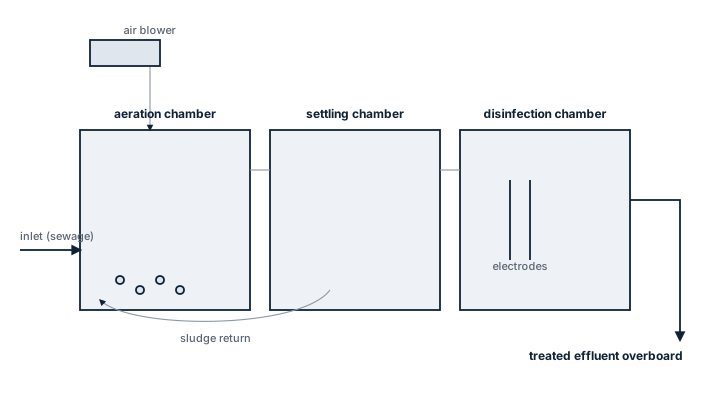
Main components
Aeration or treatment chamber
On biological plants, a series of chambers -- aeration, settling, and often a final disinfection stage -- where an air blower keeps the bacterial culture aerobic and mixed with incoming waste.
Electrolytic cell
On electrochemical plants, a cell with plate or tube electrodes through which seawater or the effluent itself passes, generating disinfectant in situ rather than dosing a stored chemical.
Read the full guide
Comminutor / macerator
A grinding stage ahead of treatment that reduces solids to a size the biological or electrochemical process can handle, and prevents rag and debris from blocking downstream pumps.
Effluent monitoring
A sample point, and on many installations a continuous monitor, for the parameters the discharge standard sets -- typically suspended solids, faecal coliform count and residual chlorine -- checked before the effluent is allowed overboard rather than to a holding tank.
Selection and sizing
- Design population -- crew complement plus passengers where applicable -- against the plant's rated daily flow.
- Peak load pattern: passenger vessels see sharp morning and evening peaks that a plant sized only on average daily flow cannot absorb.
- Trading pattern: a ship spending long periods in port or in special areas needs enough holding capacity or treated-discharge capability to cover restricted zones.
- Power consumption, particularly for electrochemical plants, against the electrical load budget of the vessel.
- Space for retention time in biological designs -- undersizing the tankage is the most common design shortfall.
Regulations and class
MARPOL Annex IV requires an International Sewage Pollution Prevention (ISPP) certificate for ships above the size threshold it sets, backed by an initial and periodic survey of the plant and its discharge arrangements. The effluent standard the plant must meet, and the distance from land at which even treated sewage may be discharged, both come from Annex IV; special areas and some port state requirements are stricter than the baseline. Class surveys check the plant's operating log, the treatment performance against its type approval, and that the discharge piping correctly separates treated discharge from any direct overboard bypass -- a bypass valve left open or unsealed is one of the most common port state control deficiencies found on this equipment.
Typical faults
| Fault | Cause | Consequence |
|---|---|---|
| Biological process fails | Bacterial culture killed by disinfectant or strong cleaning chemicals, or an extended low-load period with no feed | Effluent quality out of spec, weeks needed to re-establish a healthy culture |
| Electrode wear on electrochemical cells | Normal consumption over operating hours, accelerated by low-salinity feed water | Falling disinfection performance, eventually failing effluent monitoring |
| Macerator blockage | Foreign objects such as wet wipes or rags entering the system despite do-not-flush notices | Loss of flow through the plant, backup into the sanitary system |
| Odour and foaming | Overloading beyond design population, or aeration blower undersized or fouled | Crew complaints, and often a sign the treatment is also failing to meet discharge standard |
What to look for in a supplier
- Type approval certificate under MARPOL Annex IV covering the effluent standard actually required for the vessel's trading area.
- Rated capacity matched with margin to the vessel's actual population and peak load pattern, not just average daily flow.
- Spare parts availability for electrodes, blower diaphragms or membranes specific to the model.
- Clear operating and troubleshooting documentation the crew can follow, since this equipment is usually maintained by ship's staff rather than a specialist.
A biological plant that has sat unused during a long yard period needs to be reseeded and given time to re-establish its bacterial culture before sailing -- opening the discharge valve on day one, before the culture has recovered, is how an otherwise sound plant fails its first effluent check after a refit.
Models in this type.
The best-documented model of each manufacturer first, then the next — 45 of 45 models in Sewage Treatment Plant. Every row links to full specifications, documents and service notes.
Manufacturers.
All 31 manufacturers with models of Sewage Treatment Plant. Names with a manufacturer page open it; the others open a search across the full library.
All manufacturersAlso in Oily Water & Waste Systems.
The other equipment types in this category.
One request. A person reads it and replies by e-mail.
Tell us the manufacturer, the model and what you need — a part, a service call, a second opinion. A person reads every request and replies by e-mail.
No details at hand? A photo of the rating plate or the part is enough — simply attach it to the request.
Three things people ask first.
Is Sewage Treatment Plant data free?
Yes. Every model page, every guide and every datasheet for this type is readable without an account. An account adds saved searches and requests, nothing is taken away.
My model is missing — what now?
Send us the nameplate. We identify it by hand, add it to the library, and if you need a part or a service, the request is already on our desk.
Can you source a Sewage Treatment Plant part?
Yes. Tell us the manufacturer, the model and what you need — a person reads every request and replies by e-mail.