"> Cold Room - Equipment Database

Cold Room

medium 2 models total

A ship's cold room is a modular insulated enclosure built from prefabricated panels, holding provisions at a fixed setpoint for weeks between ports with no possibility of a same-day repair call if something fails mid-ocean.

Read more — Cold Room explained

What makes a shipboard cold room different from ashore

A ship's cold room is a modular insulated enclosure, built from prefabricated panels bolted or cammed together, holding provisions at a fixed setpoint for weeks between ports - with no possibility of a same-day repair call if something fails mid-ocean. That drives design choices ashore cold stores rarely need: panels rated for a moving, vibrating structure, door gaskets that survive constant temperature cycling, and refrigeration plant redundancy the shore market treats as optional.
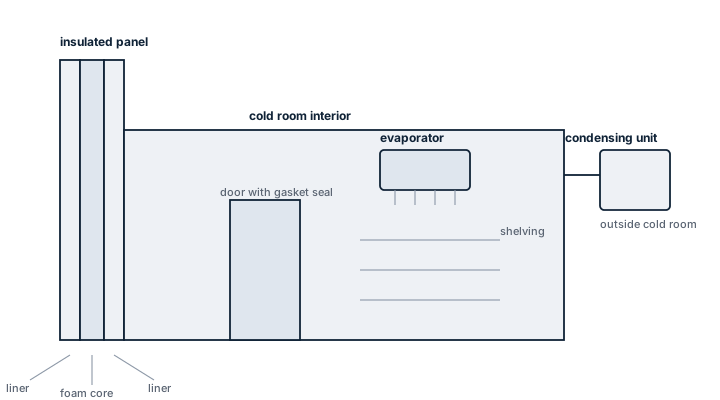
Ship's cold room construction
Cross section of a modular insulated cold room panel wall with door, plus the evaporator unit inside and the condensing unit outside, showing the panel build-up of inner liner, foam core and outer liner.

Main components

Insulated panels

Polyurethane or PIR foam core between steel or aluminium skins, cammed together at panel joints to keep the enclosure airtight and to stop thermal bridging at the seams.

Doors and gaskets

Heavy-duty hinged or sliding doors with heated gaskets on freeze rooms to stop ice bonding the door shut, plus an internal safety release so a crew member cannot be trapped inside.

Evaporator and defrost

Air-cooling evaporator unit inside the room with an electric or hot-gas defrost cycle, since ice buildup on the coil is constant in a freeze room and left unmanaged it blocks airflow and raises the room temperature.

Shelving and drainage

Corrosion-resistant shelving arranged for airflow around stores rather than against the walls, with a floor drain trapped and heated on freeze rooms to stop it icing shut.

Selection and sizing

Room volume is set against crew complement and expected voyage length between provisioning ports, split typically into separate chill, around 0 to 4 degrees C, and freeze, around minus 18 to minus 20 degrees C, compartments since they cannot share one setpoint. Panel insulation thickness is chosen against the ambient and hull temperatures the vessel will actually see, not a single global default - a vessel trading in the tropics needs more insulation thickness than the same room on a short coastal route.

Typical faults

  • Gasket failure or door left ajar - lets warm, humid air in, which then frosts heavily on the evaporator coil and drives the room temperature up in a self-reinforcing cycle.
  • Panel joint seal breakdown - moisture gets into the panel core over time, degrading insulation value gradually and invisibly until the room struggles to hold setpoint under any load.
  • Defrost cycle malfunction - a stuck defrost timer either never clears the coil, icing it solid, or runs too often and wastes cooling capacity.
  • Floor drain trap icing - in a freeze room, without a working heater, blocks drainage and lets meltwater refreeze into a slip hazard.

What to look for in a supplier

  • Panel systems designed for marine vibration and hull movement, not a rebranded ashore cold store product.
  • Documented insulation thickness and refrigerant charge sized against the vessel's actual trading route.
  • Spare gasket, evaporator and defrost heater parts genuinely available for the installed model years after delivery.

Check door gasket condition before checking the compressor - most complaints that the cold room will not hold temperature trace back to a leaking door seal, not the refrigeration plant.

2 manufacturers · 2 models

Isotherm

1
Isotherm Marine Cold Room Panels
Marine Cold Room Panels
Various sizes, 80-150mm thickness · Food Preparation / Cooking · sandwich insulation panel
Type
Cold Room Insulation Panel
Common Failures & Inspection Points
  • Heating, refrigeration or drive-component failure causes poor performance, slow cycles or inability to operate
  • Temperature sensor, thermostat or control faults cause unstable operation or protective shutdown
  • Door seal, hose, drain or valve deterioration causes leakage, heat loss or water accumulation
  • Fan, pump, motor or bearing wear causes abnormal noise, reduced circulation or vibration
  • Electrical, ignition or safety-interlock faults cause failed starts, nuisance trips or error indications
Service: Inspect seals, controls, heaters or refrigeration components, pumps or fans, water and drain connections, ventilation and secure mounting according to the appliance type. Clean grease, lint, scale or food residues from approved areas. Verify safety interlocks and look for heat-damaged wiring or refrigerant leakage. Refer to the manufacturer documentation for the exact figure for temperature, loading and service criteria.
Spare Parts: Carry seals, sensors, fuses, control relays, pump or fan parts, heating or ignition components and appliance-specific consumables.
Strengths
  • High R-value per thickness, reducing energy consumption of refrigeration units
  • Lightweight compared to steel or bulk insulation, aiding vessel weight management
  • Pre‑finished panels with built‑in vapor barrier simplify installation and reduce moisture ingress
  • Corrosion‑resistant skins suitable for the harsh marine environment
  • Modular design allows quick replacement of damaged sections
Weaknesses
  • Joint seals can deteriorate over time, leading to thermal bridging if not maintained
  • Floor panels are vulnerable to impact damage from forklifts or service trolleys
  • Door gaskets may suffer compression set, reducing airtightness
  • Ice can accumulate at panel joints if defrost cycles are irregular
  • Requires regular inspection and maintenance of vapor barrier and seals
Typical Vessels: Cruise shipFerryOffshore support vesselFishing vesselPassenger liner
Decision Guide: Choose if you need a lightweight, high‑efficiency cold‑room solution with easy modular replacement and good moisture protection. Avoid if the installation area experiences heavy mechanical traffic that may damage panels or if budget constraints preclude regular joint‑seal maintenance.
Use Cases: Galley, cold-storage and laundry service on merchant, passenger and offshore vessels.

Westerqvist

1
Marine Cold Room System
Custom sizes · Food Preparation / Cooking · Insulated marine refrigeration compartment
Type
Marine Cold Room System
Common Failures & Inspection Points
  • Heating, refrigeration or drive-component failure causes poor performance, slow cycles or inability to operate
  • Temperature sensor, thermostat or control faults cause unstable operation or protective shutdown
  • Door seal, hose, drain or valve deterioration causes leakage, heat loss or water accumulation
  • Fan, pump, motor or bearing wear causes abnormal noise, reduced circulation or vibration
  • Electrical, ignition or safety-interlock faults cause failed starts, nuisance trips or error indications
Service: Inspect seals, controls, heaters or refrigeration components, pumps or fans, water and drain connections, ventilation and secure mounting according to the appliance type. Clean grease, lint, scale or food residues from approved areas. Verify safety interlocks and look for heat-damaged wiring or refrigerant leakage. Refer to the manufacturer documentation for the exact figure for temperature, loading and service criteria.
Spare Parts: Carry seals, sensors, fuses, control relays, pump or fan parts, heating or ignition components and appliance-specific consumables.
Strengths
  • Marine‑grade stainless steel interior resists corrosion in harsh sea environments
  • Integrated door gasket monitoring simplifies annual maintenance checks
  • Compact modular design fits limited galley spaces on many vessel types
  • Low power consumption compared with larger cargo refrigeration units
  • Complies with IMO D-2 certification for marine refrigeration equipment
Weaknesses
  • Door hinges and magnetic gaskets are wear items that require regular inspection
  • Floor drain can become blocked by defrost water if not cleared routinely
  • Limited cooling capacity; not suitable for large cargo‑hold refrigeration needs
  • Interior lighting may fail and requires spare bulbs or LED retrofit
  • Initial cost higher than basic non‑marine‑grade cold rooms
Typical Vessels: Container shipBulk carrierTankersCruise linerFerryOffshore supply vessel
Certifications: IMO D-2
Decision Guide: Choose if you need a certified, corrosion‑resistant cold storage solution for galley or crew provisions on vessels where space is at a premium and regular maintenance can be scheduled. Avoid if the primary requirement is high‑capacity cargo refrigeration or if budget constraints preclude marine‑grade equipment.
Use Cases: Galley, cold-storage and laundry service on merchant, passenger and offshore vessels.