What to check on a Cooking Range.
A marine cooking range packages hobs, one or more ovens, and often a griddle or hot plate into a single bolted-down unit, built to a different standard than a domestic or even a commercial shoreside range. Pot retainers or raised rims around each burner keep pans from sliding off during roll, the unit is through-bolted to the deck, and every burner or hotplate sits under a fixed fire suppression nozzle as standard rather than as an add-on, because a galley fire on an unbolted or unprotected range is one of…
What makes this type distinct
A marine cooking range packages hobs, one or more ovens, and often a griddle or hot plate into a single bolted-down unit, built to a different standard than a domestic or even a commercial shoreside range. Pot retainers or raised rims around each burner keep pans from sliding off during roll, the unit is through-bolted to the deck, and every burner or hotplate sits under a fixed fire suppression nozzle as standard rather than as an add-on, because a galley fire on an unbolted or unprotected range is one of the more common shipboard fire causes. Fuel is electric on the great majority of merchant ships; gas ranges appear mainly where a specific galley tradition or crew preference justifies the added complexity of LPG storage and bunkering.
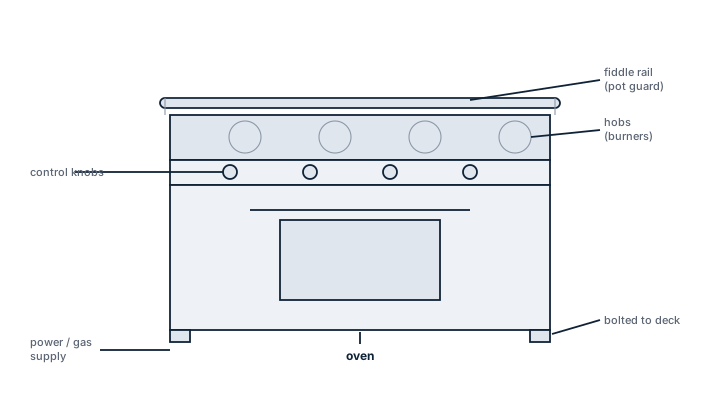
Main components
Hob section
Electric solid plates, induction zones, or gas burners, arranged with pot retainers and individually switched so one burner failing does not take down the whole range.
Oven section
One or two ovens beneath or beside the hob, electric or gas-fired, with door latches strong enough to hold the door shut against rolling rather than just gravity.
Griddle or hot plate
Optional flat cooking surface, often electric, bolted alongside the hob for high-volume breakfast or short-order cooking.
Control panel and safety cut-outs
Individual burner controls, a master isolator, and on gas units a flame failure device per burner that shuts gas if the flame is not detected.
Splash backs and pot rails
Raised rails and splash guards around the whole unit to contain spills and stop pans being displaced sideways in a roll.
Selection and sizing
Range configuration follows the galley's meal service style and crew or passenger count - number of burners, oven capacity, and whether a griddle is needed for the type of catering onboard. Electrical load is checked against the ship's galley switchboard capacity before specifying an induction-heavy configuration, since induction draws differently from resistive elements and can push total galley load higher than an owner expects. Bolt pattern and pot retainer height should match the vessel's stated roll angle for the galley deck, taken from the ship's equipment specification rather than a generic marine rating on the catalogue page.
- Number and type of hob zones against meal service pattern
- Oven capacity and door latch rating for rolling conditions
- Electrical supply voltage, phase, and total galley switchboard headroom
- Pot retainer height and bolt-down arrangement suited to the vessel's motion
- Fixed fire suppression nozzle coverage matched to the range footprint
Regulations and class
Cooking ranges fall under SOLAS Ch. II-2, which requires a fixed fire extinguishing system over deep-fat cooking equipment and ranges in the galley, together with automatic shut-off of fuel or power to the appliance on activation, and a manual stop switch outside the galley. Gas-fired ranges bring additional SOLAS and class requirements for the LPG or CNG storage, piping, and detection system feeding them, treated as a separate approval from the range itself. Electrical installation of the range is inspected as part of the ship's general electrical survey rather than a range-specific class item.
Typical faults
| Fault | Consequence |
|---|---|
| Fixed fire suppression nozzle blocked or out of test | No automatic protection if a pan fire starts on the range |
| Deck bolts loosened by vibration | Range shifts under load, gas or electrical connections strained |
| Flame failure device on a gas burner disabled | Gas continues to flow with no flame, explosion risk in an enclosed galley |
| Oven door latch worn | Door swings open in a roll, hot contents spill |
| Individual burner switch or thermostat failed | Uneven heat or a burner stuck on full power |
What to look for in a supplier
- Fixed fire suppression system pre-approved to match the specific range model and footprint
- Certified bolt-down and pot retainer design tested against the vessel's motion envelope
- Flame failure protection fitted per burner as standard on gas models, not as an option
- Electrical rating matched to the ship's actual supply without relying on a step-down transformer
- Availability of replacement burner switches, thermostats, and door latches without a long parts lead time
Test the manual fire suppression release outside the galley during routine drills, not only the automatic trigger - crew often know the automatic system exists but have never actually pulled the manual release themselves.