What to check on a Fresh Water Generator.
A fresh water generator (FWG) turns seawater into fresh water using one of two working principles: vacuum evaporation or reverse osmosis (RO). The vacuum evaporator is the traditional engine room fit, using a shell-and-tube heat exchanger fed with main engine jacket cooling water at around 80-85°C. Because the evaporation chamber is held under vacuum, water boils at roughly 40-60°C instead of 100°C, so no extra fuel is burned to make it - the heat is otherwise rejected to the sea anyway. RO units instead force seawater through semi-permeable membranes at…
What sets a fresh water generator apart
A fresh water generator (FWG) turns seawater into fresh water using one of two working principles: vacuum evaporation or reverse osmosis (RO). The vacuum evaporator is the traditional engine room fit, using a shell-and-tube heat exchanger fed with main engine jacket cooling water at around 80-85°C. Because the evaporation chamber is held under vacuum, water boils at roughly 40-60°C instead of 100°C, so no extra fuel is burned to make it - the heat is otherwise rejected to the sea anyway. RO units instead force seawater through semi-permeable membranes at high pressure and need dedicated electric pump power, which makes them the default on vessels without enough waste heat, such as many gas carriers, or as a backup unit alongside an evaporator.
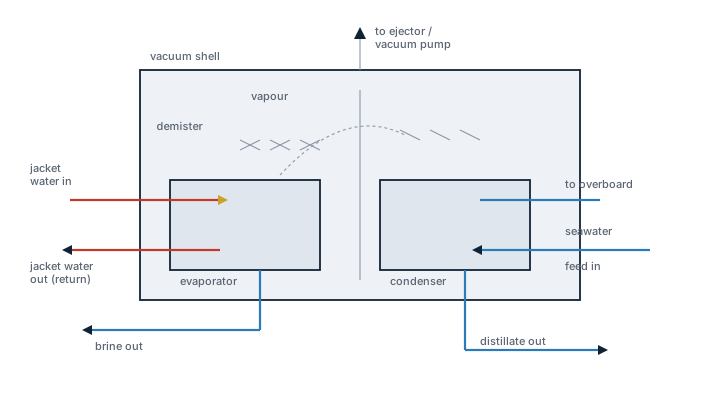
Main components
Evaporator type
- Shell and tube heat exchanger - transfers jacket water heat into the seawater feed under vacuum.
- Vacuum-forming ejector or vacuum pump - maintains the low chamber pressure that allows boiling at reduced temperature.
- Demister / separator - strips droplets of unevaporated brine from the vapour before it reaches the condenser.
- Condenser - cooled by raw seawater, turns the vapour back into distillate.
- Salinity cell - continuously monitors conductivity of the distillate; a dump valve diverts water back to the bilge or feed side if salinity rises above the set point.
RO type
- Cartridge and multi-media pre-filters - remove suspended solids before the membranes.
- High-pressure pump - pushes feedwater across the membrane at typically 55-70 bar for seawater RO.
- Membrane elements - spiral-wound, reject dissolved salts while passing water molecules.
- Energy recovery device - recovers pressure energy from the reject brine stream to cut power consumption.
Selection / Sizing
Capacity is quoted in tonnes per day and sized against crew complement plus any process or cargo washing demand, typically with margin for one unit to cover the ship if a second is fitted. Evaporators depend on jacket water temperature and available flow, so a vessel that spends long periods at low load or at anchor may not make enough heat to run one efficiently, which is where an RO unit or a hybrid arrangement earns its place. Feed seawater temperature also matters: performance drops in cold water because the temperature difference driving evaporation shrinks, and RO membrane flux falls too, so tropical-trade and cold-trade vessels are sized differently for the same nominal output.
Regulations / Class
Potable water produced on board falls under the ship's water quality management as required by flag state and, on passenger and many cargo vessels, the guidance referenced in maritime health regulations for drinking water. Class societies require periodic survey of the pressure parts of evaporators and the piping system, and SOLAS Ch. II-1 requirements on machinery generally apply to the drive and heat exchanger arrangement rather than to potable water quality itself, which sits more with flag and port state health inspections.
Typical faults
| Fault | Consequence |
|---|---|
| Scale build-up on heat exchanger tubes from calcium carbonate | Falling distillate output, needs acid cleaning or manual descaling |
| Ejector or vacuum pump losing suction | Chamber pressure rises, boiling stops, unit trips or output collapses |
| Salinity cell fouled or miscalibrated | Saline water dumped unnecessarily, or worse, contaminated water passed to the potable tank undetected |
| RO membrane fouling or biological growth | Falling permeate flow and rising salt passage, requiring chemical cleaning-in-place |
| Oil contamination of jacket water feed | Coats heat transfer surfaces, output drops sharply and the unit needs opening up |
What to look for in a supplier
- Documented distillate output curves against jacket water temperature and flow, not just a single rated figure.
- Availability of spare tube bundles and gaskets matched to the exact model, not generic equivalents.
- For RO plant, membrane compatibility with common cleaning chemicals and a clear cleaning-in-place procedure.
- Salinity monitoring and alarm integration that matches the vessel's existing potable water monitoring system.
A working evaporator that suddenly stops producing water is almost always a vacuum problem before it is a heat problem - check the ejector condensate and air ejector line before assuming the tubes are scaled.