What to check on a Watermaker.
The term "watermaker" on a ship almost always means a reverse osmosis (RO) unit, as opposed to a flash evaporator or vacuum distillation plant that uses waste heat from the main engine jacket water. An RO watermaker forces seawater through a semi-permeable membrane at 55-70 bar; the membrane rejects dissolved salts and passes fresh water through, with no phase change and no dependence on main engine heat. That makes it the only practical freshwater option when the main engine is stopped, when running on low-temperature cooling water systems that leave…
What Makes a Watermaker Different
The term "watermaker" on a ship almost always means a reverse osmosis (RO) unit, as opposed to a flash evaporator or vacuum distillation plant that uses waste heat from the main engine jacket water. An RO watermaker forces seawater through a semi-permeable membrane at 55-70 bar; the membrane rejects dissolved salts and passes fresh water through, with no phase change and no dependence on main engine heat. That makes it the only practical freshwater option when the main engine is stopped, when running on low-temperature cooling water systems that leave no usable waste heat, or on vessels such as yachts and offshore support vessels that spend long periods at anchor or dynamic positioning.
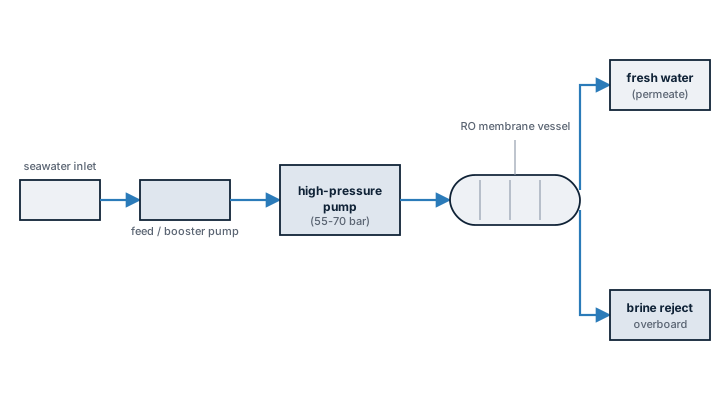
Compared with a flash evaporator, an RO watermaker draws far more electrical power per cubic metre produced but needs no steam or jacket water connection, tolerates lower feed water temperatures, and starts and stops in minutes rather than the half hour or more a vacuum plant needs to stabilise.
Main Components
Sea Water Intake and Pre-filtration
A dedicated sea chest or the general service sea suction feeds a low-pressure booster pump through 20-micron and then 5-micron cartridge filters. Pre-filtration protects the membranes and the high-pressure pump from silt, algae and biofouling debris; a fouled pre-filter is the most common reason for a sudden pressure drop reading on the control panel.
High-Pressure Pump
A positive displacement or centrifugal multistage pump raises feed pressure to the 55-70 bar range needed to overcome the osmotic pressure of seawater (around 25-28 bar) and drive permeate through the membrane. Pump seals and high-pressure plunger seats are the main wear items.
Reverse Osmosis Membrane Elements
Spiral-wound thin-film composite membranes are housed in pressure vessels, typically two to six elements per vessel. Recovery rate -- the fraction of feed water converted to permeate -- is usually set between 20% and 40%; pushing recovery higher concentrates salts and fouling material against the membrane surface and shortens element life.
Energy Recovery Device
Larger units fit a pressure exchanger or Pelton-type turbine that recovers energy from the high-pressure brine reject stream and feeds it back into the feed line, cutting specific power consumption from roughly 8-10 kWh/m3 on older designs to 3-4 kWh/m3 on modern energy-recovery units.
Post-treatment
Permeate leaving the membranes is nearly mineral-free and mildly acidic. A remineralisation or calcite filter and a UV steriliser or chlorine dosing point condition the water before it reaches the potable tank, both for taste and to meet drinking water bacteriological limits.
Selection and Sizing
Capacity is set by crew or passenger complement plus margin for hotel load, galley and laundry, typically 100-150 litres per person per day on a cargo ship and considerably more on a passenger vessel or yacht. Feed water temperature and salinity both affect output: a membrane rated for a 25 degC / 35 ppt reference will produce noticeably less at 10 degC and noticeably more in warm tropical water, so manufacturers publish correction curves rather than a single flow figure.
| Parameter | Typical Range |
|---|---|
| Feed pressure | 55-70 bar |
| Recovery rate | 20-40% |
| Specific energy (with recovery device) | 3-4 kWh/m3 |
| Specific energy (without recovery device) | 8-10 kWh/m3 |
| Product water salinity target | below 500 ppm TDS |
Regulations and Class
Potable water quality is checked against the ship's flag state and port health requirements rather than a single IMO instrument; class societies require the system to be included in the periodic survey of essential auxiliary machinery, and many owners follow WHO drinking water guideline values for residual chlorine and bacteriological counts. Vessels certified under the Maritime Labour Convention must show that potable water capacity and quality meet MLC accommodation standards.
Typical Faults
| Fault | Cause | Consequence |
|---|---|---|
| Falling permeate flow | Membrane fouling or scaling from inadequate pre-treatment | Reduced output, higher energy use per litre |
| Rising salinity of product water | Membrane damage, O-ring failure, or a cracked permeate tube | Product diverted to reject, potentially unsafe if not caught |
| Sudden pressure loss | Clogged pre-filter cartridges | Pump runs against restriction, trips on high differential pressure |
| Biological growth in idle system | Unit left wet and unused for more than a few days without preservation | Irreversible membrane biofouling, early replacement |
What to Look for in a Supplier
- Availability of spare membrane elements and high-pressure pump seal kits in the ports the vessel actually calls at, not just at the factory.
- Documented energy recovery efficiency, not just rated capacity, since running cost over the ship's life dwarfs the purchase price.
- Compatibility of control system with the vessel's existing automation and remote monitoring, where fitted.
- Track record with the feed water conditions of the trading area -- warm biofouling-prone coastal water is a different challenge from cold open ocean.
Never let a watermaker sit full of seawater for more than a few days in port -- flush with fresh water and dose a biocide preservative before any lay-up, or the membranes will need replacing when the engineer who shut it down is long gone.