What to check on a Flash Evaporator.
Most modern freshwater generators are single-effect plate or shell units where seawater picks up heat across a plate or tube surface and boils under vacuum. A flash evaporator works on a different principle: seawater already carrying heat, typically from the main engine jacket cooling circuit or from steam, is fed into a chamber held at a pressure below the water's boiling point for its temperature, so a portion of it flashes instantly into vapour without needing a heat transfer surface at that stage. The water then passes into a second…
What makes a flash evaporator different from a plate-type freshwater generator
Most modern freshwater generators are single-effect plate or shell units where seawater picks up heat across a plate or tube surface and boils under vacuum. A flash evaporator works on a different principle: seawater already carrying heat, typically from the main engine jacket cooling circuit or from steam, is fed into a chamber held at a pressure below the water's boiling point for its temperature, so a portion of it flashes instantly into vapour without needing a heat transfer surface at that stage. The water then passes into a second chamber at a still lower pressure and flashes again, and so on through several stages, extracting more vapour from the same feed at progressively lower pressure and temperature. Because flashing happens in open chambers rather than across a fouling-prone heat exchange surface, flash evaporators tolerate scaling feedwater better over long runs, which is why they remained common on steam-driven ships and larger tonnage even after plate-type units became standard elsewhere.
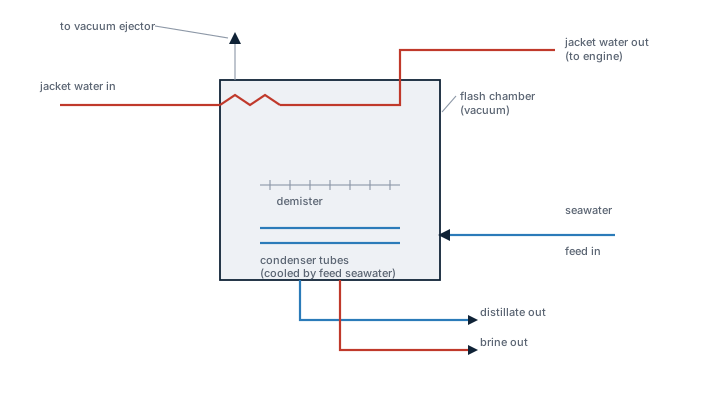
Main components
Flash chambers
A series of stages, each at successively lower pressure, where incoming seawater releases a fraction of its heat as vapour. Two to four stages is typical for shipboard units, more stages giving better fuel economy per tonne of distillate at the cost of size and complexity.
Heat source
Jacket cooling water from the main engine, or low-pressure steam on steam-turbine ships, supplies the initial heat load; an integral heater or preheater raises feed temperature before it enters the first flash stage.
Demister
Mesh pads fitted in each stage to strip entrained seawater droplets from the vapour before it condenses, since droplets carried through raise the salinity of the final distillate.
Condenser and distillate pump
Vapour from each stage condenses against incoming cool seawater, which both recovers heat for efficiency and produces the freshwater output; a distillate pump then transfers the product to the freshwater tanks.
Brine and air ejector
A brine pump discharges the concentrated reject seawater overboard, while an air or steam ejector maintains the vacuum that makes low-temperature flashing possible in the first place.
Selection and sizing
Capacity is set by daily freshwater demand against available waste heat, expressed as tonnes of distillate per day, and against the temperature of the jacket water or steam actually available, since a unit sized on paper for a hot climate route will underperform on a cold-water passage. Number of stages is a trade-off between distillate quantity per unit of heat input and the physical footprint and weight the engine room can accommodate.
Regulations and class
Where the unit supplies drinking water, output quality has to meet potable water standards, which in practice means monitoring distillate salinity continuously and automatically diverting any batch above the set limit back to the brine side rather than into the freshwater tank. Class rules require this diversion function to be demonstrated at survey, not just described.
Typical faults
| Fault | Consequence |
|---|---|
| Demister fouled or damaged | Salt carryover into distillate, tripping the salinometer diversion or, if undetected, contaminating the freshwater tank |
| Air ejector losing vacuum | Flash temperature rises, reducing distillate output and increasing scale formation risk |
| Scale buildup on later, hotter stages despite the open-chamber design | Gradual capacity loss over a season, usually only caught when output no longer meets demand |
| Brine pump seal wear | Reduced brine removal, causing carryover between stages and falling efficiency |
What to look for in a supplier
- Rated output matched against the actual jacket water or steam temperature and flow the vessel provides, not the manufacturer's best-case figure
- Materials selection for seawater service, since flash chambers and demisters see continuous seawater contact and need corrosion-resistant alloys
- An automatic salinity monitoring and diversion system as standard, not an optional extra
- Documented stage-by-stage performance data so a capacity shortfall can be traced to the specific stage losing efficiency
Track distillate output against jacket water temperature over the season rather than judging the unit on a single reading; a flash evaporator that looks underperforming in cold water may be running exactly to its design curve.