What to check on a Plate Evaporator.
A plate-type freshwater generator produces distilled water from seawater by flash evaporation under vacuum, using low-grade heat -- typically 70 to 85°C jacket cooling water drawn from the main engine -- rather than dedicated steam. The vacuum, held by an ejector or a vacuum pump, lowers the boiling point of seawater so evaporation happens at engine cooling water temperature instead of 100°C. What sets the plate type apart from the shell-and-tube evaporator is the heat exchange surface: gasketed or brazed plates instead of a tube bundle. Plates give more heat…
What defines a plate evaporator
A plate-type freshwater generator produces distilled water from seawater by flash evaporation under vacuum, using low-grade heat -- typically 70 to 85°C jacket cooling water drawn from the main engine -- rather than dedicated steam. The vacuum, held by an ejector or a vacuum pump, lowers the boiling point of seawater so evaporation happens at engine cooling water temperature instead of 100°C. What sets the plate type apart from the shell-and-tube evaporator is the heat exchange surface: gasketed or brazed plates instead of a tube bundle. Plates give more heat transfer area per unit volume, respond faster when engine load and cooling water temperature change, and are easier to open up and inspect for scale, but the gasketed versions carry more seals that can leak and the plate pack is less tolerant of thermal shock than a tube bundle.
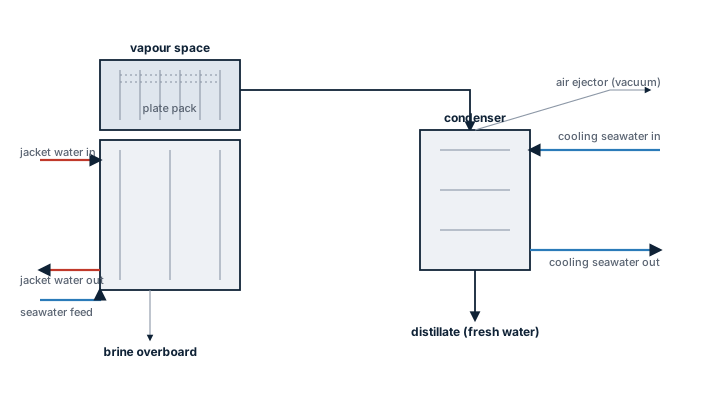
Main components
Plate heat exchanger sections
Usually two plate packs in one shell: an evaporator section heated by jacket water, and a condenser section cooled by seawater, arranged so vapour rising off the evaporator plates condenses on the condenser plates without further pumping.
Vacuum system
A steam or seawater-driven ejector, or an electric vacuum pump on newer units, holds the shell at the vacuum needed for the jacket water temperature available -- the lower the heat source temperature, the deeper the vacuum required.
Salinometer and dump valve
A conductivity sensor on the distillate outlet continuously checks salinity; if it rises above the set point an automatic three-way valve dumps the batch to bilge instead of the potable water tank.
Brine and distillate pumps
The brine pump removes concentrated, unevaporated seawater from the shell; the distillate pump draws off the condensed freshwater. Both run under vacuum conditions, which makes their seals and NPSH margin more demanding than a normal centrifugal pump duty.
Selection and sizing
- Daily freshwater output required against crew and technical water demand, plus a margin for reduced engine load in port.
- Available jacket water temperature and flow at the lowest engine load the vessel regularly operates at, since output falls sharply below a minimum temperature.
- Seawater temperature range for the trading area -- warm seawater reduces the achievable vacuum and therefore output.
- Materials of construction: titanium plates for seawater and vapour-side corrosion resistance, versus lower-cost alloys accepted only in benign trades.
- Space and headroom for opening the plate pack for cleaning without lifting it out of the engine room.
Regulations and class
Potable water produced aboard falls under flag state and port health requirements for drinking water quality, and class rules require the freshwater generator's salinity alarm and automatic dump to potable tank be demonstrated at survey. Where the evaporator draws from the same jacket water circuit as the main engine, class also checks that a fault in the evaporator cannot compromise main engine cooling -- an isolating arrangement or a dedicated heat exchanger loop is required on many designs for exactly this reason.
Typical faults
| Fault | Cause | Consequence |
|---|---|---|
| Falling freshwater output | Scale build-up on the evaporator plates, worse in warm or hard seawater | Reduced heat transfer, eventually output too low to meet demand, requiring plate pack acid cleaning |
| Repeated automatic dump to bilge | Salinometer drift, or brine level too high carrying droplets into the distillate | Loss of produced water, and if the alarm is disabled or ignored, a real high-salinity batch reaching the potable tank |
| Loss of vacuum | Worn ejector nozzle, air leak at a plate gasket, or vacuum pump seal wear | Evaporation stops or output collapses even with normal jacket water temperature |
| Gasket leak between plates | Gasket age-hardening or incorrect tightening torque after cleaning | Cross-contamination between brine and distillate sides, or external leak into the bilge |
What to look for in a supplier
- Plate material certificate (titanium grade) matching the seawater corrosivity expected on the trading route.
- Guaranteed output curve against jacket water temperature and seawater temperature, not just a single nominal figure.
- Gasket spares in the exact plate profile, since gaskets are not universally interchangeable between makers.
- Documented cleaning procedure and access arrangement for opening the plate pack in place.
Output drops noticeably in port whenever the main engine idles at low load -- that is the jacket water temperature falling, not a fault, and running the auxiliary boiler or an electric heater to supplement heat is the normal workaround rather than something to trace as a defect.