OceanSphereEnginesPartsWorkServiceNetworkAdditiveFree accountLog inDEENPL
OceanSphereENGINES
Library Engine Room Freshwater Generators Freshwater Generator / Watermaker
Freshwater Generators

Freshwater Generator / Watermaker

Freshwater generator and watermaker are two different technologies for the same job: a freshwater generator flash-evaporates seawater under vacuum using waste engine heat, while a watermaker forces seawater through a reverse osmosis membrane under high pressure.

475models 29manufacturers
Models

Models in this type.

The 100 models with the most complete data of 475 in Freshwater Generator / Watermaker. Every row links to full specifications, documents and service notes.

Alfa LavalAalborg AQUA-1 Alfa LavalAalborg AQUA-10 Alfa LavalAalborg AQUA-12 Alfa LavalAalborg AQUA-15 Alfa LavalAalborg AQUA-18 Alfa LavalAalborg AQUA-2 Alfa LavalAalborg AQUA-20 Alfa LavalAalborg AQUA-25 Alfa LavalAalborg AQUA-3 Alfa LavalAalborg AQUA-30 Alfa LavalAalborg AQUA-35 Alfa LavalAalborg AQUA-4 Alfa LavalAalborg AQUA-40 Alfa LavalAalborg AQUA-45 Alfa LavalAalborg AQUA-5 Alfa LavalAalborg AQUA-50 Alfa LavalAalborg AQUA-55 Alfa LavalAalborg AQUA-6 Alfa LavalAalborg AQUA-60 Alfa LavalAalborg AQUA-8 Alfa LavalAalborg Compact-1 Alfa LavalAalborg Compact-10 Alfa LavalAalborg Compact-12 Alfa LavalAalborg Compact-15 Alfa LavalAalborg Compact-18 Alfa LavalAalborg Compact-2 Alfa LavalAalborg Compact-20 Alfa LavalAalborg Compact-25 Alfa LavalAalborg Compact-3 Alfa LavalAalborg Compact-30 Alfa LavalAalborg Compact-35 Alfa LavalAalborg Compact-4 Alfa LavalAalborg Compact-40 Alfa LavalAalborg Compact-45 Alfa LavalAalborg Compact-5 Alfa LavalAalborg Compact-50 Alfa LavalAalborg Compact-55 Alfa LavalAalborg Compact-6 Alfa LavalAalborg Compact-60 Alfa LavalAalborg Compact-8 Alfa LavalAalborg JWP-1 Alfa LavalAalborg JWP-10 Alfa LavalAalborg JWP-12 Alfa LavalAalborg JWP-15 Alfa LavalAalborg JWP-18 Alfa LavalAalborg JWP-2 Alfa LavalAalborg JWP-20 Alfa LavalAalborg JWP-25 Alfa LavalAalborg JWP-3 Alfa LavalAalborg JWP-30 Alfa LavalAalborg JWP-35 Alfa LavalAalborg JWP-4 Alfa LavalAalborg JWP-40 Alfa LavalAalborg JWP-45 Alfa LavalAalborg JWP-5 Alfa LavalAalborg JWP-50 Alfa LavalAalborg JWP-55 Alfa LavalAalborg JWP-6 Alfa LavalAalborg JWP-60 Alfa LavalAalborg JWP-8 Alfa LavalAalborg Mini-1 Alfa LavalAalborg Mini-10 Alfa LavalAalborg Mini-12 Alfa LavalAalborg Mini-15 Alfa LavalAalborg Mini-18 Alfa LavalAalborg Mini-2 Alfa LavalAalborg Mini-20 Alfa LavalAalborg Mini-25 Alfa LavalAalborg Mini-3 Alfa LavalAalborg Mini-30 Alfa LavalAalborg Mini-35 Alfa LavalAalborg Mini-4 Alfa LavalAalborg Mini-40 Alfa LavalAalborg Mini-45 Alfa LavalAalborg Mini-5 Alfa LavalAalborg Mini-50 Alfa LavalAalborg Mini-55 Alfa LavalAalborg Mini-6 Alfa LavalAalborg Mini-60 Alfa LavalAalborg Mini-8 Spectra WatermakersMarine Watermaker 2.0 kW Spectra WatermakersCatalina 0.3T Spectra WatermakersCatalina 0.5T Spectra WatermakersCatalina 0.8T Spectra WatermakersCatalina 1.5T Spectra WatermakersCatalina 10T Spectra WatermakersCatalina 12T Spectra WatermakersCatalina 1T Spectra WatermakersCatalina 2T Spectra WatermakersCatalina 3T Spectra WatermakersCatalina 4T Spectra WatermakersCatalina 5T Spectra WatermakersCatalina 8T Spectra WatermakersClark Pump 0.3T Spectra WatermakersClark Pump 0.5T Spectra WatermakersClark Pump 0.8T Spectra WatermakersClark Pump 1.5T Spectra WatermakersClark Pump 10T Spectra WatermakersClark Pump 12T Spectra WatermakersClark Pump 1T
By manufacturer

Manufacturers.

All 29 manufacturers with models of Freshwater Generator / Watermaker. Every name opens a search across the full library.

Related types

Also in Freshwater Generators.

The other equipment types in this category.

Flash EvaporatorPlate EvaporatorReverse OsmosisWatermaker
Knowledge

What to check on a Freshwater Generator / Watermaker.

Two distinct technologies share the "freshwater generator" and "watermaker" names aboard ship, and they work on completely different principles. A vacuum flash-type freshwater generator (FWG) boils seawater at low temperature by dropping the pressure inside an evaporator shell, using waste heat recovered from main engine jacket cooling water, so it produces water essentially for the cost of the electricity running its ejector or vacuum pump. A reverse osmosis (RO) watermaker instead forces seawater at high pressure, commonly 55-70 bar, through semi-permeable membranes that reject dissolved salt, and it needs no…

What sets this type apart

Two distinct technologies share the "freshwater generator" and "watermaker" names aboard ship, and they work on completely different principles. A vacuum flash-type freshwater generator (FWG) boils seawater at low temperature by dropping the pressure inside an evaporator shell, using waste heat recovered from main engine jacket cooling water, so it produces water essentially for the cost of the electricity running its ejector or vacuum pump. A reverse osmosis (RO) watermaker instead forces seawater at high pressure, commonly 55-70 bar, through semi-permeable membranes that reject dissolved salt, and it needs no waste heat source but consumes significant electrical power to drive the high-pressure pump. FWG units depend on the main engine running to have waste heat available, which is why they cannot produce water in port on some vessels; RO units run independently of the propulsion plant and are the standard choice on ships that spend long periods at anchor or alongside.
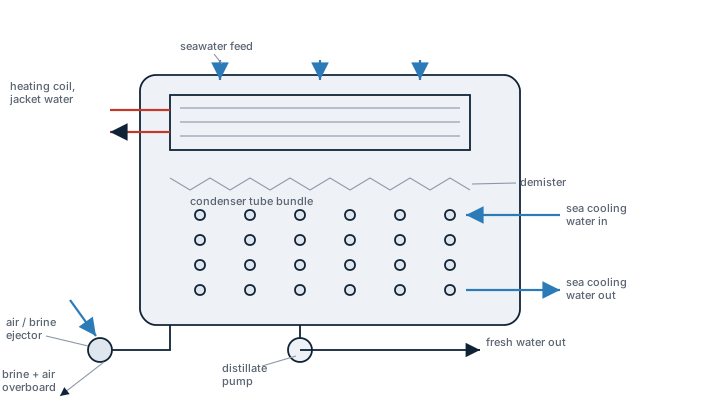
Freshwater generator, flash evaporator working principle
Working schematic of a shell type freshwater generator: seawater feed is flash evaporated under vacuum by the jacket cooling water heating coil, vapour passes a demister onto a sea water cooled condenser tube bundle, distillate is pumped off as fresh water, and an ejector maintains vacuum while discharging brine and air overboard.

Main components

Vacuum flash-type freshwater generator

  • Evaporator shell under vacuum, heated by jacket cooling water through a plate or tube heat exchanger.
  • Condenser section, cooled by seawater, where the flashed vapour condenses back to distillate.
  • Ejector or vacuum pump, maintaining the low pressure that lets seawater boil at 40-70 degrees C instead of 100.
  • Salinometer and dump valve, diverting product water overboard automatically if salinity rises above the set limit.

Reverse osmosis watermaker

  • Pre-filtration stage (cartridge filters, sometimes a media or ultrafiltration pre-treatment) to protect membranes from suspended solids.
  • High-pressure pump, the main power consumer in the system.
  • Membrane pressure vessels containing spiral-wound RO membrane elements.
  • Energy recovery device on larger units, recovering pressure from the reject brine stream to cut power consumption.

Selection and sizing

ParameterFWG (evaporator)RO watermaker
Energy sourcewaste heat plus small electric loadelectric power to high-pressure pump
Typical outputscaled to jacket water heat availablescaled to membrane area and pressure
Feed water sensitivitytolerant of turbidity, sensitive to oil contamination of heating watersensitive to suspended solids and biological fouling of membranes
Operable in port/at anchoronly if an alternative heat source is availableyes, independent of main engine

Regulations and class

Product water quality for drinking purposes must meet the flag state's or WHO-referenced potable water standard, checked by periodic sampling rather than by a single class rule. Class societies review the pressure design of RO high-pressure sections and the vacuum/heat exchanger design of evaporators as part of standard machinery approval; there is no dedicated IMO convention for freshwater generation equipment itself. Where potable water is made near coastal or contaminated water, port state and public health authorities may require the salinometer/dump valve function to be demonstrated at survey.

Typical faults

  • Scaling on evaporator heating surfaces - reduces heat transfer and output over weeks of operation, needing periodic acid cleaning.
  • Membrane fouling or biological growth (RO) - falling permeate flow and rising salt passage, usually from inadequate pre-filtration or a feed pump left idle without flushing.
  • Salinometer drift - an uncalibrated sensor lets off-spec water into the potable tank undetected, or dumps good water needlessly.
  • Vacuum leaks (FWG) - air ingress at shell joints or the ejector raises the boiling point needed and output falls even though heat input is unchanged.

What to look for in a supplier

  • Documented output at the actual jacket water temperature and flow available on the specific engine, not a generic rated figure (for FWG).
  • Membrane element compatibility and availability for the specific pressure vessel, since RO elements are not universally interchangeable (for RO).
  • Materials resistant to seawater corrosion throughout, particularly titanium or cupro-nickel in the evaporator/condenser shell.

Never run a freshwater generator while manoeuvring in coastal or turbid water - silt and pollutants drawn in with the seawater feed foul the plant far faster than open-ocean operation, on both evaporator and RO types.

Search by manufacturer AFRISOWISKASwagelokAlfa Laval S.p.A.MAN Energy SolutionsWärtsiläEndress+HauserABB MarineAlfa LavalMacGregorNovenco MarineCarrier MarineSiemens MarineHeinen & HopmanDaikin Marine
Would you like to know more?

One request. A person answers within 24 hours on working days.

Tell us the manufacturer, the model and what you need — a part, a service call, a second opinion. Our desk asks the right suppliers from a network of over 114,000 companies and comes back with a quote or a sourcing plan, not a search page.

Frequently asked

Three things people ask first.

Is Freshwater Generator / Watermaker data free?

Yes. Every model page, every guide and every datasheet for this type is readable without an account. An account adds saved searches and requests, nothing is taken away.

My model is missing — what now?

Send us the nameplate. We identify it by hand, add it to the library, and if you need a part or a service, the request is already on our desk.

Can you source a Freshwater Generator / Watermaker part?

Yes. Tell us the manufacturer, the model and what you need — our desk asks the right suppliers from a network of over 114,000 companies and comes back with a quote or a sourcing plan.