Ballast Tank Coating
Ballast tank coating is a dedicated epoxy system applied to the worst corrosion environment on a ship: alternating wet and dry cycles, oxygen-rich seawater, and steel surfaces the crew can inspect only at rare tank openings.
What to check on a Ballast Tank Coating.
26 models from Jotun in Ballast Tank Coating. Below: the full model list.
What defines this type
Ballast tank coating is not a hull paint applied to a different substrate — it is a system engineered for the harshest corrosion regime on the ship. The tank sees full immersion in oxygenated seawater at sea, near-total dryness in port, condensation on the underside of the deck plating, and mechanical wear from ballast flow around suction bells and stringers. General cargo hold or external deck coatings are formulated for weathering and abrasion; ballast tank systems are formulated for cyclic wet/dry exposure and cathodic protection compatibility, and they carry a mandatory design life that hull topside paint does not.
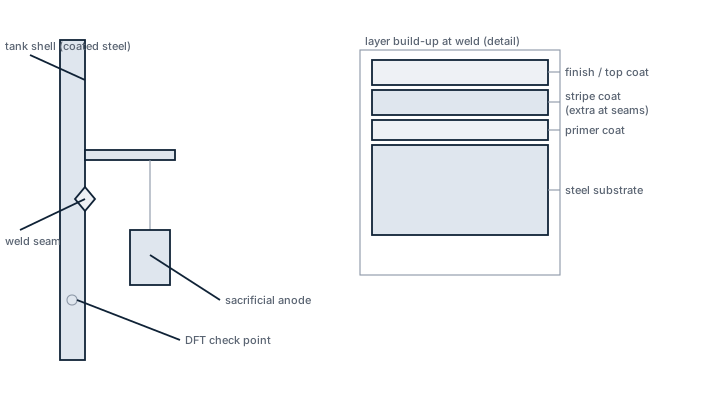
Main components
Surface preparation
Blast cleaning to Sa 2.5 (near-white metal) with an angular profile of 30-75 microns is the baseline; anything less and the epoxy cannot key into the steel and will disbond within the first survey cycle.
Primer / stripe coat
A zinc-rich or epoxy primer goes down first, followed by a stripe coat brushed or rolled onto welds, edges, cut-outs and stiffener toes — the geometry where dry film thickness naturally runs thin and where corrosion starts first.
Read the full guide
Full coat epoxy system
Two or more spray-applied coats of a high-solids epoxy build the system to its specified dry film thickness (DFT), typically light grey or another light colour so that later tank inspections can spot rust bleed and breakdown by eye.
Cathodic protection
Sacrificial zinc or aluminium anodes are hung inside the tank to protect the small percentage of steel the coating inevitably misses — coating and anodes are a paired system, not alternatives.
Selection / Sizing
The variables that matter for a ballast tank system:
| Parameter | Typical range / requirement |
|---|---|
| Total DFT | 320 microns minimum for new construction under IMO PSPC |
| Surface profile | 30-75 microns, angular |
| Topcoat colour | Light colour for inspectability |
| Overcoating window | Coating-specific; exceeding it forces re-blasting before the next coat |
| Application dew point margin | Steel temperature at least 3°C above dew point |
Yard schedule and tank access (double bottom vs. topside ballast tank, manhole size) drive whether spray or airless application with extension lances is used, which in turn affects achievable DFT consistency on stiffener webs.
Regulations / Class
New construction bulk carriers and tankers of 150m and above, and all ships with dedicated seawater ballast tanks, fall under the IMO Performance Standard for Protective Coatings for dedicated seawater ballast tanks (PSPC, resolution MSC.215(82)). PSPC sets minimum DFT, requires a Coating Technical File documenting every stage of surface prep and application, and defines "GOOD" condition as no breakdown or rust for at least five years. Class societies survey coating condition at each special survey and downgrade it to FAIR or POOR based on visible rust and blistering percentage, which then drives thickness-gauging and close-up survey requirements under the IACS harmonised common structural rules for tankers and bulkers.
Typical faults
- Holidays and pinholes — caused by insufficient DFT or contamination on the steel; each one becomes a corrosion cell under immersion.
- Edge and weld breakdown — coating naturally thins over sharp edges and weld toes; without a stripe coat these fail first, years before the flat plating.
- Cathodic disbondment — coating blisters and lifts around anodes when the system is not formulated for cathodic protection compatibility.
- Intercoat delamination — the maximum overcoating interval was exceeded, so the next coat never chemically bonds to the one beneath it.
- Flash rust under coating — steel was coated too soon after blasting in humid conditions, trapping surface rust bloom beneath the film.
What to look for in a supplier
- A PSPC-compliant system with third-party type approval and a documented Coating Technical File template.
- Application supervision by a NACE or FROSIO Level 2 certified coating inspector, not just the applicator's own foreman.
- Batch and mix-ratio traceability for every drum used on the job, tied to the tank it went into.
- A stated overcoating window and recoat interval that the yard's schedule can actually meet.
- Compatibility data with the specific anode alloy fitted, not a generic cathodic protection statement.
A tank that looks perfect from the manhole can still be failing on the underside of the deckhead — always inspect stiffener toes and the boundary near anodes with a torch held at a raking angle, not straight on.
Models in this type.
The best-documented model of each manufacturer first, then the next — 26 of 26 models in Ballast Tank Coating. Every row links to full specifications, documents and service notes.
Manufacturers.
All 23 manufacturers with models of Ballast Tank Coating. Names with a manufacturer page open it; the others open a search across the full library.
All manufacturersAlso in Paint & Coating Systems.
The other equipment types in this category.
One request. A person reads it and replies by e-mail.
Tell us the manufacturer, the model and what you need — a part, a service call, a second opinion. A person reads every request and replies by e-mail.
No details at hand? A photo of the rating plate or the part is enough — simply attach it to the request.
Three things people ask first.
Is Ballast Tank Coating data free?
Yes. Every model page, every guide and every datasheet for this type is readable without an account. An account adds saved searches and requests, nothing is taken away.
My model is missing — what now?
Send us the nameplate. We identify it by hand, add it to the library, and if you need a part or a service, the request is already on our desk.
Can you source a Ballast Tank Coating part?
Yes. Tell us the manufacturer, the model and what you need — a person reads every request and replies by e-mail.