Epoxy Primer
Epoxy primer cures by chemical cross-linking between a resin and a curing agent rather than by solvent evaporation, which gives it the low permeability ballast tank and hull coatings need, but also means mixing ratio, pot life and recoat window all matter more than with a single-pack paint.
What to check on an Epoxy Primer.
74 models from Sherwin-Williams Marine in Epoxy Primer. Below: the full model list.
What Makes an Epoxy Primer Different
Epoxy primer is a two-component coating: a resin and a polyamide or amine curing agent that react chemically once mixed, cross-linking into a dense film rather than simply drying as solvent evaporates the way an alkyd primer does. That cross-linked structure is what gives it low permeability and strong adhesion to correctly prepared steel, and it is why epoxy primer is the standard choice under ballast tank, cargo hold and hull coating systems. It differs from a zinc-rich primer, which protects sacrificially rather than as a barrier, from a shop primer, a thin weldable coating meant only to protect steel during fabrication and not to serve as a system coat, and from surface-tolerant epoxy variants formulated to bond over marginal, hand-tool-cleaned steel rather than a full abrasive blast.
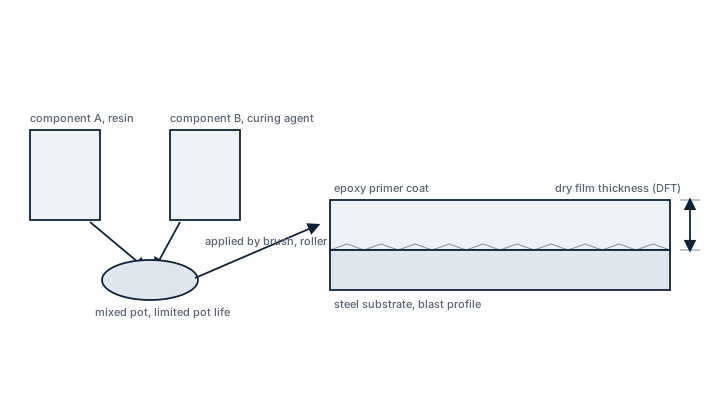
Legend
- component A, resin
- component B, curing agent
- applied by brush, roller or spray
- epoxy primer coat
- dry film thickness (DFT)
- steel substrate, blast profile
- mixed pot, limited pot life
Main Types and Where They Are Used
- Standard epoxy primer – applied over blast-cleaned steel for ballast tanks, cargo holds and the hull under antifouling.
- Surface-tolerant epoxy – formulated for maintenance touch-up on rusted or pitted steel where full re-blasting is not practical.
- Coal tar epoxy – an older formulation still found in service, though largely phased out of new construction for health and VOC reasons.
- Contrast-shaded epoxy primer – pigmented differently from the stripe or topcoat specifically so thin spots and holidays show up during inspection.
Application and Sizing Considerations
Dry film thickness is usually targeted in the range of roughly 100 to 150 microns per coat, with extra stripe coats worked into welds and edges where the film naturally thins. Pot life once the two components are mixed is limited and shortens sharply as ambient temperature rises, so mixed quantities have to match what can actually be applied within that window. Surface preparation grade drives adhesion and service life more than almost any other variable, and there is a defined overcoating window between primer and the next coat: recoat too late and the surface needs re-abrading before the next coat will bond properly.
Regulations and Class
New vessels are covered by the IMO Performance Standard for Protective Coatings for ballast tanks and void spaces, which sets minimum dry film thickness, required surface preparation, and demands that the coating system itself be type-approved and tested against the standard, not just individually compliant products applied in any combination. Class surveyors assess coating condition and breakdown during hull and tank surveys, and the extent of coating breakdown found can directly affect how much close-up survey and thickness measurement is required.
Read the full guide
Typical Faults
| Fault | Consequence |
|---|---|
| Insufficient surface preparation, residual rust or salt | Early adhesion failure and blistering |
| Overcoating outside the recoat window without re-abrading | Intercoat delamination between primer and topcoat |
| Application below minimum temperature or dew point margin | Poor cure, amine blush on the surface, reduced hardness |
| Incorrect mixing ratio or inadequate induction time | Incomplete cure, a soft or tacky film that never fully hardens |
| Thin film at welds and edges (edge effect) | Premature corrosion starting at these high-stress points despite good flat-area coverage |
What to Look for in a Supplier
- A valid Performance Standard for Protective Coatings type-approval certificate where the product is destined for ballast tanks or void spaces.
- A technical data sheet with dry film thickness range, pot life and recoat window matched to the yard or repair conditions expected.
- Batch traceability and clear shelf-life and storage guidance, since epoxy components degrade if stored badly before use.
- Field technical support for application supervision, not only product supply.
Touch-dry is not the same as fully cured; ballast tanks coated with epoxy primer should not be filled until the manufacturer's full cure time has passed, which is longer than the time it takes for the surface to stop feeling tacky.
Models in this type.
The best-documented model of each manufacturer first, then the next — 74 of 74 models in Epoxy Primer. Every row links to full specifications, documents and service notes.
Manufacturers.
All 15 manufacturers with models of Epoxy Primer. Names with a manufacturer page open it; the others open a search across the full library.
All manufacturersAlso in Paint & Coating Systems.
The other equipment types in this category.
One request. A person reads it and replies by e-mail.
Tell us the manufacturer, the model and what you need — a part, a service call, a second opinion. A person reads every request and replies by e-mail.
No details at hand? A photo of the rating plate or the part is enough — simply attach it to the request.
Three things people ask first.
Is Epoxy Primer data free?
Yes. Every model page, every guide and every datasheet for this type is readable without an account. An account adds saved searches and requests, nothing is taken away.
My model is missing — what now?
Send us the nameplate. We identify it by hand, add it to the library, and if you need a part or a service, the request is already on our desk.
Can you source a Epoxy Primer part?
Yes. Tell us the manufacturer, the model and what you need — a person reads every request and replies by e-mail.