Thermal Oil Heater
A thermal oil heater circulates a heat transfer fluid in a closed loop at near-atmospheric pressure instead of raising steam, which lets it reach higher temperatures than a steam boiler without the pressure vessel risk that comes with high-pressure steam.
What to check on a Thermal Oil Heater.
19 models from Alfa Laval Aalborg in Thermal Oil Heater. Below: the full model list.
What Makes This Type Different
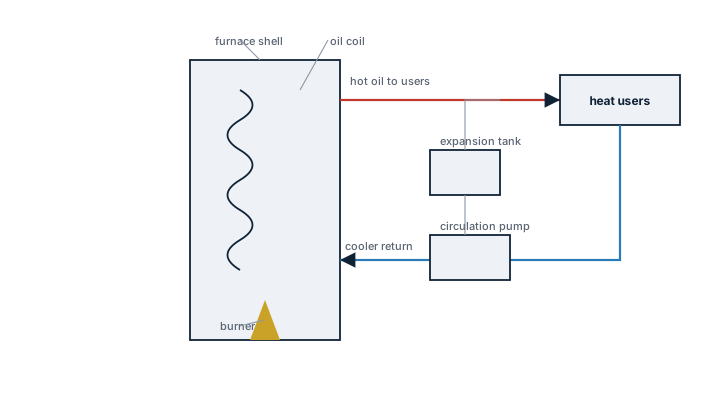
A thermal oil heater does not make steam; it heats a synthetic or mineral heat transfer fluid that is pumped in a closed circuit to the consumers — cargo heating coils, fuel oil heaters, accommodation heating — and returns to the heater to be reheated. Because the fluid stays liquid and the circuit runs at low pressure even at high temperature, the system avoids the pressure vessel constraints of a steam boiler generating the same heat output, and it can reach fluid temperatures that would require very high steam pressure to match. The trade-off is that the system depends entirely on continuous flow: unlike a steam boiler's water, the thermal fluid will locally overheat, degrade and coke inside the heating coil the moment circulation stops while the burner is still firing.
Main Components
Coil and Furnace
The fluid passes through a coiled tube inside the furnace, heated by an oil or gas burner; coil design keeps fluid velocity high enough to prevent local hot spots and film boiling at the tube wall.
Circulating Pump
Runs continuously whenever the burner fires, and is interlocked so the burner cannot operate without confirmed flow — loss of circulation with the burner still firing is the single most damaging fault mode for this equipment.
Read the full guide
Expansion Tank
Vented tank at the top of the system that accommodates the fluid's thermal expansion and allows air and moisture to be driven off, kept under a nitrogen blanket or open to atmosphere depending on the installation.
Heat Transfer Fluid
Synthetic (for example certain aromatic-based fluids) or mineral thermal oil, selected for the required operating temperature and checked periodically for degradation, since a coked or oxidised fluid loses heat transfer performance and can foul the coil.
Consumers and Control Valves
Cargo heating coils, fuel oil heaters and accommodation heating loops, each controlled by a modulating valve that manages heat demand without upsetting the main circulation loop.
Selection and Sizing
- Heat output: sized for the combined peak demand of cargo heating, fuel heating and accommodation heating, with margin for the coldest expected ambient condition.
- Fluid operating temperature: chosen based on the highest required outlet temperature, typically driven by cargo heating requirements on product or chemical tankers.
- Fluid type: synthetic fluids tolerate higher film temperatures than mineral oils, relevant where local hot spots in the coil are a known risk.
- Circulation pump duty: matched to the coil's minimum required velocity across the whole system, not just the heater's own pressure drop.
Regulations and Class
Class rules cover thermal oil heater installations similarly to other fired pressure equipment, requiring flow and low-flow burner interlocks, high-temperature cut-outs, and periodic internal and external inspection intervals for the coil and furnace. Because the fluid is combustible and typically hot, fire protection and leak detection around the unit is checked at survey, and MARPOL and general environmental rules apply to disposal of degraded thermal fluid the same as other oily waste.
Typical Faults
| Fault | Consequence |
|---|---|
| Circulating pump trips or fails with burner still firing | Local fluid overheating and coking inside the coil within minutes |
| Thermal fluid degraded from prolonged overheating | Fouled coil, reduced heat transfer, higher fuel consumption for the same output |
| Air or moisture trapped in the circuit | Pump cavitation, uneven heating, noise in the circulation loop |
| Expansion tank vent blocked | Pressure build-up in a system designed to run near atmospheric pressure |
| Low-flow interlock bypassed or defeated | Loss of the main protection against coil overheating on pump failure |
What to Look for in a Supplier
- Fluid analysis service available, since fluid condition is the main indicator of system health over years of operation.
- Genuine compatibility of any replacement fluid with the existing charge — mixing incompatible fluid types can accelerate degradation.
- Spare coil sections or full coil replacement lead time understood in advance, since coil fouling or a leak takes the whole heater out of service.
Never bypass the low-flow burner interlock, even briefly during troubleshooting — a thermal oil heater with a stalled circulation and a firing burner can coke a coil section badly enough to need replacement within minutes.
Models in this type.
The best-documented model of each manufacturer first, then the next — 19 of 19 models in Thermal Oil Heater. Every row links to full specifications, documents and service notes.
Manufacturers.
All 9 manufacturers with models of Thermal Oil Heater. Names with a manufacturer page open it; the others open a search across the full library.
All manufacturersAlso in Boilers.
The other equipment types in this category.
One request. A person reads it and replies by e-mail.
Tell us the manufacturer, the model and what you need — a part, a service call, a second opinion. A person reads every request and replies by e-mail.
No details at hand? A photo of the rating plate or the part is enough — simply attach it to the request.
Three things people ask first.
Is Thermal Oil Heater data free?
Yes. Every model page, every guide and every datasheet for this type is readable without an account. An account adds saved searches and requests, nothing is taken away.
My model is missing — what now?
Send us the nameplate. We identify it by hand, add it to the library, and if you need a part or a service, the request is already on our desk.
Can you source a Thermal Oil Heater part?
Yes. Tell us the manufacturer, the model and what you need — a person reads every request and replies by e-mail.