What to check on a Auxiliary Boiler.
An auxiliary boiler is a dedicated steam generator, almost always oil-fired, that produces steam independently of the main engine. Where an exhaust gas economiser recovers waste heat from the main engine and only works while the engine is running at a reasonable load, the auxiliary boiler burns fuel on demand and covers steam demand in port, at anchor, during manoeuvring and whenever economiser output falls short of consumers such as fuel oil heating, tank cleaning or accommodation heating. On many ships the auxiliary boiler and the economiser share the same…
What defines an auxiliary boiler
An auxiliary boiler is a dedicated steam generator, almost always oil-fired, that produces steam independently of the main engine. Where an exhaust gas economiser recovers waste heat from the main engine and only works while the engine is running at a reasonable load, the auxiliary boiler burns fuel on demand and covers steam demand in port, at anchor, during manoeuvring and whenever economiser output falls short of consumers such as fuel oil heating, tank cleaning or accommodation heating. On many ships the auxiliary boiler and the economiser share the same steam drum and are operated as a composite boiler, switching automatically between oil firing and exhaust gas heating depending on which source is available.
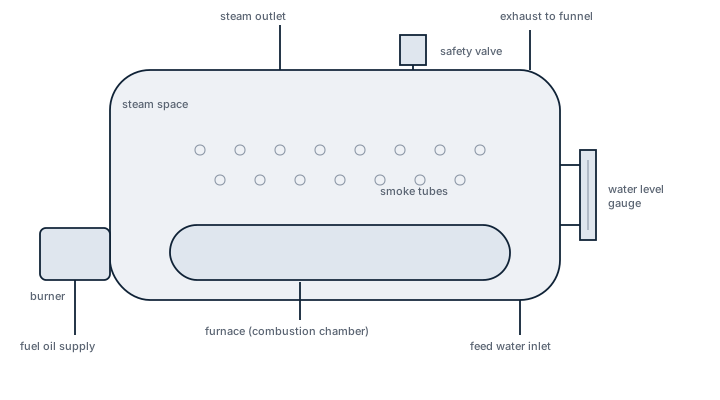
Main components
Furnace and burner
The furnace is the combustion chamber where atomised heavy fuel oil or marine diesel oil burns against a refractory-lined wall. The burner atomises fuel by steam, air or mechanical pressure and includes a flame scanner that shuts the fuel supply within seconds if the flame is lost, preventing an unburnt fuel accumulation that could ignite violently on re-ignition.
Water tube or fire tube bundle
Smaller auxiliary boilers use fire tube construction, where hot gas passes through tubes surrounded by water. Larger installations, particularly composite boilers on tankers, use water tube bundles because they tolerate higher pressures and respond faster to load changes.
Steam drum and mountings
The steam drum separates steam from water and carries the safety valves, water level gauges and the main steam stop valve. Two independent level indications are fitted, one of them usually a remote transmitter feeding the alarm and control system.
Feed water system
A feed pump, feed check valve and de-aerator or cascade tank supply treated water to the drum. Feed water quality control, chloride content, pH, oxygen scavenger dosing, matters as much to boiler life as the mechanical condition of the pressure parts.
Combustion control and safety chain
A programmable burner control unit sequences purge, ignition, flame proving and modulation, and trips the burner on low water level, flame failure, high steam pressure or combustion air fan failure.
Selection and sizing
The design steam output, expressed in kilograms of steam per hour, is set by the largest simultaneous demand: heating heavy fuel oil for the main engine and generators, tank cleaning on tankers, or cargo heating. Working pressure on most auxiliary boilers sits between roughly 7 and 18 bar, chosen to match the heating coils and turbine-driven cargo pumps it may need to feed. Evaporation capacity, not burner size alone, is the figure buyers should compare, since a boiler undersized for peak demand forces the crew to run on reduced fuel heating temperature, which affects viscosity and combustion quality in the main engine.
Regulations and class
Auxiliary boilers fall under class society boiler survey requirements with periodic internal and external examinations, hydraulic testing after major repair, and safety valve accumulation tests. SOLAS Chapter II-2 requires means of shutting off fuel supply from outside the boiler space and independent operation of forced draught fans. Where the boiler burns fuel meeting MARPOL Annex VI sulphur limits, the same fuel changeover and record-keeping rules that apply to the main engine apply here.
Typical faults
| Fault | Consequence |
|---|---|
| Burner tip fouling from poor fuel atomisation | Unstable flame, soot deposits on tube surfaces, falling heat transfer |
| Feed water contamination or low oxygen scavenger dosing | Pitting corrosion and scale on the water side, tube failure over time |
| Refractory cracking in the furnace | Hot spots on the shell, local overheating of the pressure part |
| Safety valve set point drift | Lifting too early, wasting steam, or too late, risking overpressure |
| Flame scanner fouling | Nuisance trips or, worse, failure to detect a genuine flame loss |
What to look for in a supplier
- Class type approval for the pressure part design and the specific fuel grades intended
- Documented water treatment recommendations matched to the feed water quality expected on board
- Availability of spare burner assemblies and refractory material compatible with the furnace geometry
- Reference installations of a similar evaporation capacity on comparable ship types
- Clear access arrangements for tube inspection and soot blowing without extensive dismantling
Log feed water chloride and pH at every watch; a slow drift that goes unnoticed for weeks is what turns into a tube failure during the next survey.