What to check on a Exhaust Gas Boiler.
An exhaust gas boiler, often called an economiser, recovers heat from the main engine's exhaust gas to raise steam, without a burner of its own. That is its defining difference from an oil-fired auxiliary boiler: steam output tracks engine load directly, plentiful at sea on a loaded main engine, and falling away in port or at slow steaming when there is little exhaust heat to recover. Most vessels pair an exhaust gas boiler with an oil-fired boiler, or a composite boiler combining both in one shell, precisely because the exhaust…
What defines an exhaust gas boiler
An exhaust gas boiler, often called an economiser, recovers heat from the main engine's exhaust gas to raise steam, without a burner of its own. That is its defining difference from an oil-fired auxiliary boiler: steam output tracks engine load directly, plentiful at sea on a loaded main engine, and falling away in port or at slow steaming when there is little exhaust heat to recover. Most vessels pair an exhaust gas boiler with an oil-fired boiler, or a composite boiler combining both in one shell, precisely because the exhaust gas unit alone cannot guarantee steam in port.
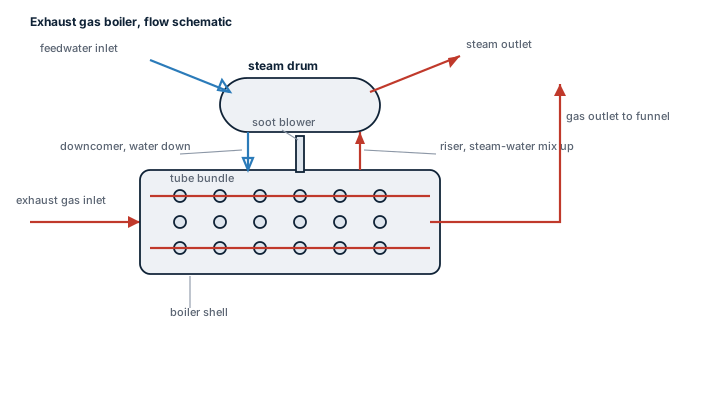
Main components
Gas-side tube bank
Exhaust gas from the main engine passes over a bank of finned or bare tubes; fins increase heat transfer area but also increase the fire and fouling risk from soot deposits, which is the main design trade-off in this component.
Water/steam side
Either a water-tube design, where the exhaust gas passes around tubes carrying water and steam, or a smoke-tube design, where exhaust gas passes through tubes surrounded by the boiler water — water-tube types dominate exhaust gas boiler practice because they handle the soot-fire risk and thermal cycling better.
Soot blowers
Steam or compressed-air soot blowers clear soot deposits from the tube bank on a running schedule; deposits left to build up are both an efficiency loss and, because accumulated soot can ignite, a recognised fire risk specific to this equipment.
Bypass or damper arrangement
A gas-side bypass or damper lets exhaust gas skip the economiser, used to protect the boiler from excessive gas temperature at high engine load or to isolate it for maintenance without shutting down the main engine.
Selection and sizing
- Expected exhaust gas flow and temperature across the main engine's normal operating range, including slow-steaming conditions where flow drops sharply
- Steam demand ashore versus at sea, which decides how much duty the exhaust gas unit needs to cover against the oil-fired boiler
- Water-tube versus smoke-tube design against the vessel's fuel sulphur content and expected soot loading
- Soot blower type and frequency built into the design, not added as an afterthought
Regulations and class
Class societies survey exhaust gas boilers on the same pressure-vessel basis as other boilers, with internal and external examinations and periodic hydraulic testing on the class boiler survey cycle. Because exhaust gas boiler soot fires are a recognised casualty type, class and flag guidance emphasise soot blower operation records and, on many ships, fixed fire-fighting arrangements such as water spray or CO2 dedicated to the economiser space, separate from general engine room protection.
Typical faults
| Fault | Consequence |
|---|---|
| Soot accumulation from irregular soot blowing | Falling heat transfer efficiency and a rising risk of soot fire |
| Soot fire in the tube bank | Tube damage or rupture, and a recognised source of major engine room fires |
| Tube leakage from thermal cycling at fluctuating engine load | Water or steam loss into the gas path, falling boiler pressure |
| Bypass damper stuck or not tested | No way to protect the boiler at high exhaust temperature, or to isolate it for repair without stopping the main engine |
What to look for in a supplier
- Design matched to the actual main engine's exhaust flow and temperature curve, not a generic size-for-power match
- Soot blower system sized and positioned for the specific tube bank geometry supplied
- Class approval documentation for the pressure parts, with material and welding records traceable to the specific unit
Run the soot blowers on schedule even during slow steaming when exhaust heat is low — soot still accumulates at low load, and a cold, sooted tube bank is exactly the condition that ignites once the engine comes back up to normal power.