"> Propeller Shaft - Equipment Database

Propeller Shaft

critical IMO Required 269 models total

The propeller shaft is the last, and most highly loaded, length of shafting in the line — it carries full engine torque plus the propeller's full thrust, and it does so inside a stern tube where inspection means a shaft withdrawal, not a walk-round.

Read more — Propeller Shaft explained

What defines the propeller shaft

The propeller shaft is the outboard-most section of the shaft line, running from the intermediate shaft coupling, through the stern tube, to the propeller boss. It differs from the intermediate shaft in two respects that drive its whole design: it carries the propeller's thrust as well as the engine's torque, and it runs partly or wholly submerged inside the stern tube, sealed against sea water by shaft seals that the rest of the shaft line does not need. Its condition, more than any single engine parameter, sets the survey interval for the whole propulsion train.
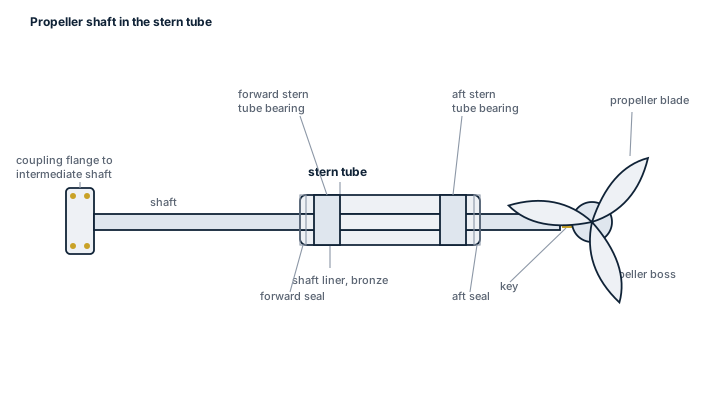
Propeller shaft through the stern tube
Side cross-section of a propeller shaft passing through the stern tube, showing the coupling flange to the intermediate shaft, the bronze shaft liner, forward and aft stern tube bearings and seals, and the propeller keyed onto the shaft end.

Main components

Shaft body and taper or flange

Forged steel shaft, either flanged directly to the propeller boss or, on older and smaller designs, tapered with a key and secured by a large retaining nut — the taper and keyway arrangement is the classic site for fretting and crack initiation and has been largely superseded by keyless, hydraulically fitted flange connections on modern tonnage.

Stern tube bearings

Forward and aft bearings support the shaft inside the stern tube. Oil-lubricated white-metal bearings and water-lubricated rubber or synthetic bearings are the two main families; the choice affects the whole sealing and monitoring arrangement around the shaft.

Shaft seals

Aft seal keeps sea water out of the stern tube, or on water-lubricated designs keeps lubricating water in; forward seal keeps stern tube oil out of the engine room bilge. Seal wear is monitored through oil consumption or leakage rate, not by direct inspection while the shaft is running.

Corrosion protection

Sacrificial anodes and, on many ships, a shaft earthing or grounding brush to bleed off stray currents generated by the rotating shaft in sea water, which otherwise accelerate corrosion and pit the shaft surface at the stern tube.

Selection and sizing

  • Shaft diameter set by class rules from the transmitted torque, material yield strength and a fatigue margin, not by engine power alone
  • Material grade and, where fitted, a corrosion-resistant liner or sleeve over the sections exposed to sea water
  • Bearing type, oil or water lubricated, chosen against maintenance philosophy and, increasingly, environmental restrictions on oil-lubricated stern tubes near sensitive waters
  • Coupling type at the forward end matched to the intermediate shaft and gearbox or engine flange

Regulations and class

Class rules, the IACS UR M-series requirements for shafting, set the minimum shaft diameter, the survey interval for shaft withdrawal or in-water inspection, and the conditions under which that interval can be extended, generally tied to oil sample condition monitoring and bearing clearance history rather than a fixed calendar alone. Water-lubricated stern tubes without oil are subject to separate environmental rules in several coastal states restricting oil-to-sea discharge risk.

Typical faults

FaultConsequence
Fretting or cracking at a taper/keyway connectionProgressive crack growth toward shaft failure, a known cause of catastrophic loss of propulsion
Aft seal wear or damageSea water ingress to the stern tube, contaminating lubricating oil and accelerating bearing wear
Stern tube bearing clearance beyond limitIncreased vibration, further accelerated wear, risk of shaft contact with the bearing
Shaft earthing brush worn or missingStray current corrosion pitting the shaft at the stern tube over time

What to look for in a supplier

  • Class-certified material and NDT records for the specific shaft forging, traceable by serial number
  • Machining tolerances confirmed against the class-approved drawing, not a generic equivalent
  • Ability to support in-water or dry-dock withdrawal work with the correct tooling for the actual coupling type fitted

Track oil sample trends and bearing clearance readings over successive surveys, not just the latest snapshot — a slow trend toward the limit is the warning that a fixed calendar interval will not catch on its own.

5 yr
Class Survey
30 yr
Typical Lifetime

Typical Manufacturers

Wartsila MAN Kawasaki

26 manufacturers · 269 models

WinGD (Winterthur Gas & Diesel)

57
WinGD (Winterthur Gas & Diesel) WinGD X52DF-2.1 Two-Stroke Engine
WinGD X52DF-2.1 Two-Stroke Engine
· dual-fuel low-speed two-stroke
Model Number
X52DF-2.1
Strengths
  • High thermal efficiency (≈48% at design load) for a dual‑fuel configuration
  • Significant NOx and SOx reduction when operating on LNG, meeting IMO Tier III requirements
  • Fuel flexibility – can switch between LNG and MGO without major shutdowns
  • Proven reliability of WinGD’s X‑series platform with long service intervals
  • Compact power‑to‑size ratio compared to older single‑fuel engines
Weaknesses
  • Higher capital cost due to dual‑fuel system and LNG handling equipment
  • Requires LNG bunkering infrastructure, which may be limited on certain routes
  • Increased complexity of fuel management and control systems
  • Larger initial installation footprint than some medium‑speed alternatives
  • Maintenance personnel need specific training for dual‑fuel operation
Typical Vessels: Large container shipsCrude oil tankersProduct tankersCruise linersLNG carriers (as a main engine option)
Certifications: DNVABS
Decision Guide: Choose if: you need high power with low NOx/SOx emissions, have access to LNG bunkering, and value fuel flexibility for future regulatory compliance. Avoid if: the operating profile lacks reliable LNG supply, budget constraints prohibit higher upfront cost, or vessel size limits installation space.
Use Cases: The X52DF-2.1 is typically installed on newbuilds targeting IMO Tier III compliance and 2025+ emission standards, as well as on retrofits of existing high‑capacity vessels where a shift to LNG can deliver fuel cost savings and lower environmental impact. It is favored for long‑haul routes with established LNG bunkering networks.
WinGD (Winterthur Gas & Diesel) WinGD X52DF-S2.0 Two-Stroke Engine
WinGD X52DF-S2.0 Two-Stroke Engine
· low‑speed two‑stroke diesel with electronic fuel injection
Model Number
X52DF-S2.0
Strengths
  • Very high specific fuel consumption (≈ 50 % thermal efficiency) reduces operating costs on long voyages
  • Electronic fuel injection provides precise load control and fast response to speed changes
  • Proven reliability of the WinGD X52 family, with extensive service history in ultra‑large ships
  • Modular construction simplifies major overhauls and component replacement
  • Meets IMO Tier III NOx limits when equipped with after‑treatment (SCR) systems
Weaknesses
  • Large physical size and weight limit installation to very large hulls
  • High capital expenditure compared with medium‑speed or dual‑fuel alternatives
  • Requires high‑grade lubricants and strict maintenance regimes to avoid wear of the piston‑ring system
  • Optimal efficiency is achieved at high load; performance drops noticeably at low loads
  • Skilled engineering crew needed for electronic control diagnostics and tuning
Typical Vessels: VLCC (Very Large Crude Carrier)ULCC (Ultra Large Crude Carrier)Large container ships (> 8,000 TEU)Very large bulk carriers (> 200 k DWT)Large product tankers
Certifications: IMO Type Certificate for marine diesel enginesDNV GL class approvalABS classification approval
Decision Guide: Choose if you need a high‑power, fuel‑efficient main engine for a very large vessel where operating cost over long distances is critical and the ship’s size can accommodate the engine footprint. Avoid if the vessel is smaller, requires dual‑fuel flexibility, or budget constraints make a medium‑speed or gas‑engine solution more appropriate.
Use Cases: The X52DF‑S2.0 is typically installed as the sole propulsion unit on ultra‑large tankers and bulk carriers, providing continuous high‑power output for trans‑ocean voyages. It is also used in some of the world’s biggest container ships where maximum fuel efficiency and proven reliability are paramount.
WinGD (Winterthur Gas & Diesel) WinGD X62DF-2.1 Two-Stroke Engine
WinGD X62DF-2.1 Two-Stroke Engine
· low‑speed dual‑fuel two‑stroke engine
Model Number
X62DF-2.1
Strengths
  • Very high thermal efficiency (~50% LHV) delivering strong specific power for large vessels
  • Dual‑fuel capability provides flexibility to switch between HFO/MDO and LNG, supporting IMO Tier III NOx limits and CO₂ reduction goals
  • Proven WinGD reliability with long service intervals and robust cylinder design
  • Compact length‑to‑power ratio compared with earlier low‑speed families, freeing hull space
  • Integrated common‑rail fuel injection system improves combustion control and reduces emissions
Weaknesses
  • Higher capital cost than a single‑fuel counterpart because of LNG handling equipment and dual‑fuel control systems
  • Requires LNG bunkering infrastructure and on‑board cryogenic storage, limiting suitability for routes without reliable LNG supply
  • Larger overall dimensions and weight relative to medium‑speed engines, which may affect retro‑fit feasibility
  • Increased complexity in operation and maintenance due to dual‑fuel management and high‑pressure fuel systems
Typical Vessels: Ultra Large Container Vessel (ULCV)Very Large Crude Carrier (VLCC) / Suezmax tankerLNG carrier (newbuilds with LNG as cargo or fuel)Large cruise shipBulk carrier (>150 kt)
Certifications: IMO Tier III NOx compliance when operated on LNGDNV GL Dual‑Fuel Approval
Decision Guide: Choose if you need high shaft power with fuel flexibility for future decarbonisation, operate on routes where LNG bunkering is available, and require proven low‑speed engine reliability. Avoid if the vessel’s operating profile lacks LNG supply, budget constraints prohibit the higher upfront cost, or space/weight limits preclude a low‑speed engine installation.
Use Cases: The X62DF‑2.1 is typically installed in newbuilds targeting IMO Tier III compliance and CO₂ reduction, especially on long‑haul container ships, large tankers, and LNG carriers where the ability to run on LNG offers both regulatory and economic benefits. It is also selected for retrofits of existing vessels when a power increase and fuel flexibility are desired and sufficient hull space exists for the engine and associated LNG plant.
WinGD (Winterthur Gas & Diesel) WinGD X62DF-S2.0 Two-Stroke Engine
WinGD X62DF-S2.0 Two-Stroke Engine
· low-speed dual-fuel two-stroke marine engine
Model Number
X62DF-S2.0
Strengths
  • Very high specific power (≈10 MW per cylinder) enables compact installation for large vessels
  • Dual‑fuel capability provides operational flexibility and lower CO₂ emissions when running on LNG
  • Optimised combustion design delivers low specific fuel consumption compared with older low‑speed engines
  • Proven WinGD reliability record with long overhaul intervals (≈20 000 h)
  • Meets IMO Tier III NOₓ limits without requiring after‑treatment in most operating profiles
Weaknesses
  • Higher capital cost than a comparable single‑fuel low‑speed engine
  • Requires LNG bunkering infrastructure and on‑board gas handling systems, adding complexity
  • Control system is more sophisticated, demanding higher crew training and support
  • Initial start‑up and commissioning are longer due to dual‑fuel calibration
  • Limited availability of spare parts for the specific DF configuration in some regions
Typical Vessels: LNG Carrier (e.g., Q‑Max, Q‑Flex)Large Container ShipCruise Vessel using LNGUltra‑large Bulk Carrier with dual‑fuel option
Decision Guide: Choose if you need a high‑power main engine with fuel flexibility to meet strict emission regulations and have access to LNG bunkering. Avoid if budget constraints dominate, the vessel operates on routes without reliable gas supply, or crew expertise for dual‑fuel systems is lacking.
Use Cases: The X62DF‑S2.0 is typically installed as the sole main propulsion engine on new‑build LNG carriers and increasingly on large container or cruise ships that are transitioning to LNG to reduce greenhouse‑gas emissions while retaining long‑range capability.
WinGD (Winterthur Gas & Diesel) WinGD X72DF-2.1 Two-Stroke Engine
WinGD X72DF-2.1 Two-Stroke Engine
· dual-fuel low-speed two-stroke
Model Number
X72DF-2.1
Strengths
  • High fuel efficiency (~50% LHV) reduces operating costs
  • Dual‑fuel capability allows flexible use of diesel or LNG for emissions compliance
  • Designed to meet IMO Tier III NOx limits and support CO₂ reduction strategies
  • Proven WinGD reliability with long service intervals and robust construction
  • Compact power density compared with older low‑speed engines
Weaknesses
  • Higher capital cost than conventional single‑fuel diesel engines
  • Requires LNG bunkering infrastructure and on‑board gas handling systems
  • More complex control and injection system increases training requirements
  • Larger footprint may limit installation in vessels with constrained engine rooms
  • Potential for increased maintenance of gas injectors and related components
Typical Vessels: LNG CarrierContainer ShipCruise VesselBulk CarrierOil Tanker (new builds targeting IMO 2020/ Tier III)
Certifications: IMO Tier IIIDNV
Decision Guide: Choose if you need a propulsion engine that can run on LNG to meet current and future emission regulations, want high thermal efficiency, and have access to LNG bunkering. Avoid if the vessel will operate primarily in regions without reliable LNG supply or if budget constraints prohibit the higher upfront investment.
Use Cases: The X72DF-2.1 is typically installed as the main propulsion engine on newbuilds that are designed for low‑emission operation, such as LNG carriers and large container ships targeting IMO Tier III compliance, as well as cruise liners and bulk carriers seeking fuel flexibility and reduced CO₂ footprints.
WinGD (Winterthur Gas & Diesel) WinGD X72DF-2.2 Two-Stroke Engine
WinGD X72DF-2.2 Two-Stroke Engine
· low‑speed 2‑stroke dual‑fuel engine
Model Number
X72DF-2.2
Strengths
  • Dual‑fuel flexibility allows operation on LNG to meet IMO Tier III CO₂ and NOₓ limits while retaining HFO capability for bunkering flexibility.
  • High specific power (≈70 MW) suitable for very large vessels, providing excellent propulsion efficiency at low RPM.
  • Proven reliability of WinGD’s X‑series platform with long service intervals and extensive global support network.
  • Reduced emissions (NOₓ, SOₓ, CO₂) compared with conventional single‑fuel slow‑speed engines, aiding compliance in emission control areas.
Weaknesses
  • Large physical size and weight require substantial engine room space and structural reinforcement.
  • Higher capital cost and need for LNG fuel handling infrastructure increase upfront investment.
  • Complex dual‑fuel control system can raise maintenance training requirements and spare‑parts inventory complexity.
  • Availability of qualified spare parts may be lower in regions without an established WinGD service base.
Typical Vessels: LNG CarrierVery Large Crude Carrier (VLCC)Container ShipBulk CarrierCruise Ship
Certifications: IMO Tier IIIDNV Class Approval – Dual Fuel
Decision Guide: Choose if the vessel requires high power with dual‑fuel capability to meet strict emission regulations and has access to LNG bunkering. Avoid if the operator lacks LNG infrastructure, budget constraints prohibit higher capital cost, or space limitations prevent installation of a large low‑speed engine.
Use Cases: Main propulsion on new‑build LNG carriers (e.g., Q‑Flex/Q‑Max), ultra‑large crude tankers and next‑generation container ships that target IMO Tier III compliance. Also selected for cruise liners seeking lower emissions while retaining fuel flexibility.
WinGD (Winterthur Gas & Diesel) WinGD X82DF-2.0 Two-Stroke Engine
WinGD X82DF-2.0 Two-Stroke Engine
· low-speed two-stroke dual-fuel
Model Number
X82DF-2.0
Strengths
  • Very high thermal efficiency (>50% at design load)
  • Dual‑fuel operation provides fuel flexibility and significant NOx/SOx reduction when running on LNG
  • Proven reliability of WinGD’s X‑series architecture with long service intervals
  • Compact power density for a low‑speed engine, allowing smaller hull space compared with equivalent medium‑speed units
  • Meets IMO Tier III emission limits without after‑treatment
Weaknesses
  • Higher capital cost than conventional single‑fuel low‑speed engines
  • Requires LNG bunkering infrastructure and on‑board gas handling systems, adding complexity
  • Dual‑fuel control system is more sophisticated, demanding specialised crew training and maintenance expertise
  • Initial start‑up and warm‑up periods are longer when switching between fuels
  • Weight and overall dimensions are larger than comparable medium‑speed diesel alternatives
Typical Vessels: Container ships (10 000–20 000 TEU)Cruise linersLarge bulk carriersOil tankers with emission‑control area requirementsLNG carriers and other gas‑fueled vessels
Certifications: IMO Type Approval – Dual Fuel (LNG) Marine EngineDNVGL Classification – Rules for Classification of Ships, Part 3 – Propulsion MachineryABS Approved for Dual‑Fuel Operation
Decision Guide: Choose if the vessel operates on routes with reliable LNG bunkering or needs to meet strict emission regulations (IMO Tier III, ECA). The engine is ideal when high power output and fuel flexibility are required. Avoid if LNG infrastructure is unavailable, budget constraints dominate, or crew expertise in dual‑fuel systems is lacking.
Use Cases: The X82DF-2.0 is typically installed as the main propulsion unit on newbuilds that target low‑emission operation, such as ultra‑large container ships using LNG as primary fuel, cruise vessels seeking to reduce sulfur and nitrogen oxides, and bulk carriers operating in emission control areas.
WinGD (Winterthur Gas & Diesel) WinGD X92DF-2.0 Two-Stroke Engine
WinGD X92DF-2.0 Two-Stroke Engine
· dual-fuel low-speed two-stroke
Model Number
X92DF-2.0
Strengths
  • High thermal efficiency (≈50 %) reduces fuel consumption
  • Fuel flexibility – runs on LNG and marine diesel oil, supporting decarbonisation strategies
  • Meets IMO Tier III NOx limits without after‑treatment systems
  • Proven reliability from WinGD’s extensive two‑stroke heritage
  • Integrated electronic control system simplifies operation and monitoring
Weaknesses
  • Higher capital cost compared with single‑fuel low‑speed engines
  • Requires LNG bunkering infrastructure and on‑board gas handling equipment
  • Larger physical envelope than comparable medium‑speed diesel units
  • Dual‑fuel components add complexity to maintenance routines
  • Spare‑parts logistics can be more demanding for the gas system
Typical Vessels: Container shipLarge bulk carrierCrude oil tankerProduct tankerCruise liner
Certifications: IMO MARPOL Annex VI Tier III (NOx)DNV GL Dual‑Fuel ApprovalABS Class Approval for dual‑fuel operation
Decision Guide: Choose if the vessel will operate on routes with reliable LNG bunkering, requires high power output and wants to meet future emission regulations. Avoid if LNG supply is uncertain, budget constraints prohibit higher upfront cost, or space limitations prevent installation of the required gas handling plant.
Use Cases: Main propulsion on newbuilds targeting low‑carbon operation—e.g., large container ships, bulk carriers and tankers that will call at LNG‑enabled ports. Also used in retrofits where owners wish to convert existing diesel‑only vessels to dual‑fuel capability for compliance with upcoming emission caps.
WinGD (Winterthur Gas & Diesel) WinGD X92DF-HP-1.0 Two-Stroke Engine
WinGD X92DF-HP-1.0 Two-Stroke Engine
· low-speed 2-stroke dual-fuel engine
Model Number
X92DF-HP-1.0
Strengths
  • Very high thermal efficiency (≈50% LHV) reduces fuel consumption and CO₂ emissions
  • Dual‑fuel capability allows switching between HFO, marine diesel oil and LNG for emission compliance
  • Proven reliability on long‑haul vessels with extensive field service history
  • Integrated electronic control system simplifies engine monitoring and optimisation
Weaknesses
  • Higher capital cost compared with medium‑speed engines of similar power
  • Larger physical footprint requires substantial hull space and robust foundations
  • Requires crew training and certification for dual‑fuel operation and safety handling of gas
  • Spare‑parts logistics can be more demanding for the high‑power variant
Typical Vessels: Ultra Large Container Vessel (ULCV)Very Large Crude Carrier (VLCC)LNG Carrier (dual‑fuel version)Large Bulk CarrierRo‑Ro/Passenger ships requiring high power and fuel flexibility
Certifications: DNV GL class approvalIMO Tier III emission compliance (when operated on gas)ABS classification (standard for WinGD X92 series)
Decision Guide: Choose if you need a very high‑power main engine with best‑in‑class fuel efficiency and the ability to run on LNG or low‑sulphur fuels to meet strict emission caps. Avoid if project budget is tight, vessel size limits installation space, or the operator lacks trained personnel for dual‑fuel safety procedures.
Use Cases: The X92DF-HP-1.0 is typically installed as the main propulsion engine on new‑build ultra‑large container ships, VLCCs and LNG carriers where owners seek to minimise operating costs while complying with IMO Tier III limits in emission control areas. It is also selected for retrofits of existing vessels that require a power boost and fuel flexibility.
WinGD (Winterthur Gas & Diesel) WinGD X82DF-HP-1.0 Two-Stroke Engine
WinGD X82DF-HP-1.0 Two-Stroke Engine
· dual-fuel low-speed 2-stroke
Model Number
X82DF-HP-1.0
Strengths
  • Fuel flexibility – runs on LNG or heavy fuel oil, supporting emission reduction strategies
  • High thermal efficiency typical of WinGD X‑series engines (≈50% at design load)
  • Integrated electronic control reduces crew workload and improves optimisation
  • Proven reliability in large commercial vessels with extensive service history
  • Meets IMO Tier III NOx limits when operated on LNG
Weaknesses
  • Higher capital cost compared with single‑fuel low‑speed engines
  • Requires LNG bunkering infrastructure and onboard gas handling equipment
  • Larger envelope (length/weight) than medium‑speed alternatives for the same power
  • Increased system complexity can raise maintenance planning needs
Typical Vessels: LNG CarrierLarge Container ShipCruise ShipBulk CarrierOil Tanker (newbuilds targeting low‑emission compliance)
Certifications: IMO Tier III (NOx)DNV Class Approval for dual‑fuel operation
Decision Guide: Choose if the vessel requires LNG capability, must meet strict NOx limits, and can accommodate the higher upfront cost and space for gas handling. Avoid if LNG bunkering is unavailable on intended routes or budget constraints preclude the added complexity.
Use Cases: Commonly installed in new‑build LNG carriers and large container ships that aim to reduce carbon footprint and comply with Tier III regulations; also selected for retrofits of existing diesel‑propelled vessels where emission limits demand a dual‑fuel solution.
WinGD (Winterthur Gas & Diesel) WinGD X52DF-A-1.0 Two-Stroke Engine
WinGD X52DF-A-1.0 Two-Stroke Engine
· dual-fuel low-speed two-stroke engine
Model Number
X52DF-A-1.0
Strengths
  • High thermal efficiency typical of slow‑speed two‑stroke designs (≈50 % at design load)
  • Dual‑fuel capability allows operation on LNG for IMO Tier III NOx compliance and fuel flexibility
  • Proven reliability from WinGD’s long heritage in large marine propulsion
  • Large cylinder bore reduces specific wear and extends overhaul intervals
  • Integrated engine control system optimised for both gas and oil firing modes
Weaknesses
  • Higher capital cost than comparable single‑fuel slow‑speed engines
  • Physical size and weight are substantial, requiring robust shaft line support structures
  • Requires onboard LNG storage, vapour handling and gas supply infrastructure
  • More complex control and safety systems increase installation and training effort
  • Optimised for high power ships; less suitable for vessels with limited space or low‑power requirements
Typical Vessels: LNG CarrierLarge Container ShipCruise ShipRo‑Ro/Passenger Ferry (high‑speed variants)Bulk Carrier (very large)
Certifications: IMO Tier III NOxDNVGL Classification – Rules for Dual‑Fuel Engines
Decision Guide: Choose if you need a high‑power main propulsion engine with LNG dual‑fuel capability to meet strict emission regulations and have the space/infrastructure for LNG storage. Avoid if budget constraints, limited hull space, or a preference for medium‑speed engines that can be serviced more easily in ports without LNG facilities.
Use Cases: The X52DF-A-1.0 is typically installed as the main propulsion unit on new‑build LNG carriers and large container vessels where operators seek to reduce NOx emissions while retaining fuel flexibility. It is also selected for cruise ships and very large bulk carriers that aim for IMO Tier III compliance and want to future‑proof against stricter carbon regulations.
WinGD (Winterthur Gas & Diesel) WinGD X52DF-A-S1.0 Two-Stroke Engine
WinGD X52DF-A-S1.0 Two-Stroke Engine
· low-speed dual-fuel 2-stroke engine
Model Number
X52DF-A-S1.0
Strengths
  • High specific fuel consumption efficiency (>50% lower than conventional diesel at design load)
  • Capability to run on LNG, reducing CO₂ and NOₓ emissions and meeting IMO Tier III requirements
  • Proven reliability of WinGD’s X‑series platform with extensive service network worldwide
  • Flexibility to switch between gas and oil fuel quickly for operational resilience
  • Integrated advanced control system that optimises combustion across the full load range
Weaknesses
  • Higher capital cost compared with single‑fuel low‑speed diesel engines
  • Requires LNG storage, handling infrastructure and gas quality monitoring on board
  • Larger envelope (length/height) than comparable medium‑speed alternatives, impacting hull design
  • More complex maintenance procedures due to dual‑fuel components (gas injectors, vapourisers)
  • Potentially longer lead time for spare parts specific to the DF configuration
Typical Vessels: LNG CarrierLarge Container ShipCruise ShipBulk Carrier (dual‑fuel retrofit)Oil Tanker (newbuild with LNG capability)
Certifications: IMO Tier III NOₓ complianceDNV GL class approval for dual‑fuel operationABS classification for low‑speed DF engines
Decision Guide: Choose if: you need a high‑efficiency main engine that can meet strict emission regulations, have access to LNG bunkering and value the operational flexibility of dual‑fuel. Avoid if: project budget is highly constrained, vessel design cannot accommodate LNG tanks, or the intended service profile does not justify the added complexity of gas handling.
Use Cases: The X52DF‑A‑S1.0 is typically installed in newbuild LNG carriers and large container vessels where operators aim to lower fuel costs with LNG while retaining diesel capability for ports lacking gas infrastructure. It is also selected for cruise ships seeking Tier III compliance and for retrofits of existing bulk carriers looking to future‑proof against upcoming emission caps.
WinGD (Winterthur Gas & Diesel) WinGD X62DF-A-1.0 Two-Stroke Engine
WinGD X62DF-A-1.0 Two-Stroke Engine
· dual-fuel low-speed two-stroke engine
Model Number
X62DF-A-1.0
Strengths
  • Very high power density – up to ~80 MW in a single unit
  • Dual‑fuel capability (LNG + HFO) for compliance with IMO Tier II/III and ECA regulations
  • Low specific fuel consumption (~170 g/kWh) improving operating economics
  • Proven reliability – over 10 million operating hours across the WinGD X62 family
  • Modular construction simplifies installation and major‑overhaul maintenance
Weaknesses
  • Large physical size and weight demand robust shaft line and hull reinforcement
  • Higher capital cost, especially when equipped for LNG storage and handling
  • Complex control and fuel‑switching systems require specialised crew training
  • Optimised for low RPM operation; less flexible speed range than medium‑speed engines
  • Infrastructure for LNG bunkering may be unavailable on some routes
Typical Vessels: Ultra Large Container Vessel (ULCV)Very Large Crude Carrier (VLCC)Suezmax TankerLarge Bulk Carrier (>150 k DWT)Cruise Ship (propulsion only)
Certifications: IMO Type ApprovalDNV Class
Decision Guide: Choose if you need a single‑engine solution delivering >70 MW with LNG dual‑fuel flexibility for strict emission regimes and have the hull space for a low‑speed engine. Avoid if vessel size or budget does not justify the large footprint, or if LNG bunkering infrastructure is lacking on intended trade routes.
Use Cases: Main propulsion on new‑build ultra‑large container ships, VLCCs and Suezmax tankers operating in Emission Control Areas; retrofits of existing vessels seeking to add LNG capability while retaining high power output.
WinGD (Winterthur Gas & Diesel) WinGD X62DF-A-S1.0 Two-Stroke Engine
WinGD X62DF-A-S1.0 Two-Stroke Engine
· low-speed 2-stroke dual-fuel diesel
Model Number
X62DF-A-S1.0
Strengths
  • Very high thermal efficiency (>50%) reduces fuel consumption
  • Dual‑fuel capability (MDO/MGO & LNG) offers operational flexibility and lower emissions
  • Proven reliability on ultra‑large vessels with long service intervals
  • Low specific NOx and SOx emissions due to low‑speed operation and fuel flexibility
  • Modular design allows scaling of cylinder count for a wide power range
Weaknesses
  • Large physical size and weight require substantial engine room space
  • Higher upfront capital cost compared with single‑fuel low‑speed engines
  • Dual‑fuel system adds complexity to operation and maintenance
  • Spare‑parts logistics can be challenging for smaller ports
  • Requires crew training on LNG handling and dual‑fuel controls
Typical Vessels: VLCCULCCLarge Container Ship (≥15,000 TEU)LNG CarrierCruise Ship
Certifications: IMO Type ApprovalDNV Class Notation
Decision Guide: Choose if you need very high shaft power on a large vessel and want the flexibility to switch between conventional oil fuel and LNG for emissions compliance or cost optimisation. Avoid if vessel size is limited, budget constraints preclude the higher capital outlay, or operating in regions without reliable LNG bunkering infrastructure.
Use Cases: The X62DF‑A‑S1.0 is typically installed as the main propulsion engine on ultra‑large crude carriers, very large container ships and modern LNG carriers where fuel flexibility and maximum efficiency are critical. It also appears in some cruise ship designs that require high power output with reduced environmental impact.
WinGD (Winterthur Gas & Diesel) WinGD X72DF-A-1.0 Two-Stroke Engine
WinGD X72DF-A-1.0 Two-Stroke Engine
· dual-fuel low-speed two-stroke
Model Number
X72DF-A-1.0
Strengths
  • Very high specific output (up to ~14 MW per cylinder) enabling large total power ratings
  • Dual‑fuel capability provides flexibility to switch between LNG and HFO, reducing fuel cost and emissions
  • Meets IMO Tier III NOx limits without after‑treatment, aiding compliance in Emission Control Areas
  • Proven reliability of WinGD’s X‑series design with long service intervals
  • Optimised for low specific fuel consumption (≈ 176–180 g/kWh) compared with older low‑speed engines
Weaknesses
  • Higher capital cost than conventional single‑fuel low‑speed engines
  • Complex LNG fuel handling and storage systems increase installation space and weight
  • Requires access to reliable LNG bunkering infrastructure, which may be limited on some routes
  • Maintenance personnel need specialised training for dual‑fuel components (e.g., gas injectors)
  • Longer start‑up procedures when switching between fuels can affect operational flexibility
Typical Vessels: LNG CarrierLarge Container ShipCruise ShipVery Large Crude Carrier (VLCC) – retrofit with LNG capabilityBulk Carrier designed for low‑emission operation
Decision Guide: Choose if: you need very high propulsion power, want to future‑proof the vessel with LNG dual‑fuel flexibility, and operate in IMO Tier III or Emission Control Areas where lower NOx emissions are mandatory. Avoid if: the intended trade routes lack reliable LNG bunkering, budget constraints prohibit higher upfront cost, or crew training for dual‑fuel systems is not feasible.
Use Cases: The X72DF‑A‑1.0 is typically installed on newbuilds targeting ultra‑low emission performance, such as next‑generation LNG carriers and large container ships that will operate in strict NOx control zones. It is also selected for retrofits of existing high‑power vessels where a shift to LNG can deliver fuel cost savings and regulatory compliance.
WinGD X82DF-A-1.0 Two-Stroke Engine
· dual-fuel low-speed two-stroke marine engine
Model Number
X82DF-A-1.0
Strengths
  • Fuel flexibility – can run on heavy fuel oil or LNG, enabling compliance with IMO Tier III and future carbon‑reduction targets.
  • Very high specific output (power per cylinder) typical of the X82 series, allowing fewer cylinders for a given power rating.
  • Proven reliability record from long‑term service in large tankers and LNG carriers.
  • Integrated electronic control system (ECS) optimises combustion and reduces emissions.
  • Direct‑drive configuration eliminates gearbox losses, improving overall propulsion efficiency.
Weaknesses
  • Higher capital cost than a comparable single‑fuel low‑speed engine because of dual‑fuel hardware and controls.
  • Requires LNG bunkering infrastructure and on‑board gas handling equipment, adding space and complexity.
  • Maintenance personnel need specific training for dual‑fuel systems and high‑bore cylinders.
  • Larger physical dimensions compared with medium‑speed engines of similar power, limiting installation in vessels with tight engine room constraints.
Typical Vessels: Very Large Crude Carriers (VLCC)Aframax / Suezmax tankersLarge LNG carriersUltra‑large container ships
Certifications: IMO Type Certificate (MSC.1/Circ.736)DNV GL Approval
Decision Guide: Choose if: you need very high propulsion power, want the ability to switch between diesel and LNG for emissions compliance, and have sufficient engine‑room space for a low‑speed direct‑drive unit. Avoid if: the vessel operates on routes without reliable LNG bunkering, budget constraints prohibit higher upfront cost, or the ship design cannot accommodate the engine’s size.
Use Cases: The X82DF‑A‑1.0 is typically installed in new‑build VLCCs and Suezmax tankers that are being future‑proofed for LNG fuel, as well as large LNG carriers where dual‑fuel capability allows operation on boil‑off gas while retaining diesel backup.
WinGD (Winterthur Gas & Diesel) WinGD X52DF-M-S1.0 Two-Stroke Engine
WinGD X52DF-M-S1.0 Two-Stroke Engine
· low-speed 2-stroke diesel
Model Number
X52DF-M-S1.0
Strengths
  • Very high thermal efficiency (≈50 %) resulting in lower fuel consumption per kW·h.
  • Proven reliability on ultra‑large crude carriers and mega container ships with long service intervals.
  • Integrated electronic control system enables precise fuel management and compliance with IMO Tier III NOx limits.
  • Compact power density for its output, allowing smaller engine rooms compared with equivalent multi‑engine setups.
  • Flexibility to run on heavy fuel oil (HFO) or marine diesel oil (MDO) without major hardware changes.
Weaknesses
  • Large physical size and weight require substantial hull space and structural reinforcement.
  • Higher upfront capital cost than medium‑speed diesel alternatives of similar power.
  • Maintenance demands skilled personnel; overhauls are lengthy and costly.
  • Slower transient response compared with gas turbines or electric propulsion, limiting suitability for vessels needing rapid speed changes.
  • Noise and vibration levels are higher than some newer low‑speed designs, requiring additional mitigation measures.
Typical Vessels: VLCCULCCLarge container ships (>10 000 TEU)Bulk carriers (>200 kDWT)Cruise liners
Certifications: IMO Tier III (NOx) complianceDNV GL classification approvalABS class approval
Decision Guide: Choose if you need a single, very high‑power engine for large vessels where fuel efficiency and proven long‑term reliability are paramount. Avoid if the vessel requires fast load changes, ultra‑low emissions beyond Tier III without after‑treatment, or has severe space/weight constraints that favour medium‑speed or electric solutions.
Use Cases: The X52DF‑M‑S1.0 is typically installed as the main propulsion unit on ultra‑large crude carriers, mega container ships, large bulk carriers and cruise ships, where its power output drives a fixed‑pitch or controllable‑pitch propeller through a direct shaft line.
WinGD X62DF-M-1.0 Two-Stroke Engine
· low-speed dual-fuel 2-stroke
Model Number
X62DF-M-1.0
Strengths
  • Dual‑fuel capability (diesel/LNG) enables compliance with IMO Tier III NOx limits and reduces CO₂ emissions when running on gas.
  • High specific fuel consumption efficiency (~173 g/kWh), superior to older low‑speed engines of similar power class.
  • Compact, high‑power‑density design shortens the shaft line and frees up engine room space.
  • WinGD X‑series proven reliability with long service intervals and robust cylinder block construction.
  • Integrated electronic control system allows rapid switching between fuel modes and optimized combustion.
Weaknesses
  • Higher capital expenditure due to LNG handling equipment, gas injectors and on‑board storage requirements.
  • Requires access to LNG bunkering infrastructure; not suitable for routes lacking reliable gas supply.
  • Increased maintenance complexity compared with single‑fuel engines (additional gas system components).
  • Large cylinder dimensions may limit installation in vessels with tight engine‑room constraints.
Typical Vessels: LNG CarrierContainer ShipBulk CarrierCruise ShipRo‑Ro / Passenger Vessel
Certifications: DNV
Decision Guide: Choose if: you need a high‑efficiency propulsion plant that can run on LNG to meet IMO Tier III or future carbon‑reduction targets, and the vessel operates on routes with established LNG bunkering. Avoid if: the operating profile lacks reliable gas supply, budget constraints prohibit the higher upfront cost, or engine‑room space is too limited for a low‑speed dual‑fuel layout.
Use Cases: The X62DF-M-1.0 is typically installed in newbuilds and retrofits where owners seek to future‑proof propulsion against tightening emission regulations—e.g., LNG carriers using boil‑off gas, large container ships on Asia–Europe trades, cruise liners aiming for lower sulfur and NOx emissions, and bulk carriers operating on gas‑friendly routes.
WinGD (Winterthur Gas & Diesel) WinGD X62DF-M-S1.0 Two-Stroke Engine
WinGD X62DF-M-S1.0 Two-Stroke Engine
· low-speed dual-fuel two-stroke
Model Number
X62DF-M-S1.0
Strengths
  • High thermal efficiency (≈50% at design load)
  • Flexibility to run on LNG, diesel or a mix, supporting emission reduction strategies
  • Meets IMO Tier III NOx limits and enables compliance with future carbon regulations
  • Compact power density compared with older low‑speed diesel engines
  • Proven reliability from WinGD’s extensive dual‑fuel fleet experience
Weaknesses
  • Higher capital cost than conventional diesel‑only low‑speed engines
  • Requires LNG bunkering infrastructure and larger cryogenic fuel tanks on board
  • Increased system complexity (dual‑fuel control, gas handling, safety systems)
  • Specialised maintenance skills needed for dual‑fuel components
Typical Vessels: LNG CarrierContainer ShipCruise ShipBulk CarrierOil Tanker (newbuilds targeting low emissions)
Certifications: IMO Tier IIIDNV GL Type Approval
Decision Guide: Choose if the vessel needs LNG capability, must meet strict NOx/CO₂ targets, or seeks higher fuel flexibility and efficiency. Avoid if LNG bunkering is unavailable on intended routes, budget constraints preclude higher upfront cost, or crew lacks dual‑fuel expertise.
Use Cases: The X62DF-M-S1.0 is typically installed in newbuilds designed for low‑emission operation, such as LNG carriers and large container ships, and is also used in retrofits where operators want to convert existing diesel‑only vessels to dual‑fuel capability to future‑proof against tightening environmental regulations.
WinGD (Winterthur Gas & Diesel) WinGD X72DF-M-1.0 Two-Stroke Engine
WinGD X72DF-M-1.0 Two-Stroke Engine
· dual-fuel low-speed two-stroke engine
Model Number
X72DF-M-1.0
Strengths
  • Very high thermal efficiency (~50 %) leading to lower specific fuel consumption
  • Dual‑fuel operation provides flexibility between diesel oil and LNG, aiding compliance with IMO Tier III emissions
  • Compact length‑to‑power ratio compared with older single‑fuel designs, freeing hull space
  • Proven reliability of WinGD’s X‑series platform on ultra‑large vessels
  • Integrated exhaust gas cleaning system (SCR) compatibility for strict emission limits
Weaknesses
  • Higher capital cost and longer lead time than conventional diesel‑only engines
  • Requires LNG bunkering infrastructure and additional onboard cryogenic storage
  • More complex control and monitoring systems increase training requirements for crew
  • Spare‑parts inventory is larger due to dual‑fuel components
  • Maintenance intervals are similar to other low‑speed engines but demand specialised tooling
Typical Vessels: Ultra Large Container Vessels (ULCV)Very Large Crude Carriers (VLCC)Large Bulk Carriers (>150 kt)Liquefied Gas CarriersCruise ships with high power demand
Certifications: DNV class approvalIMO Tier III emission compliance
Decision Guide: Choose if you need a high‑power main engine that can run on both diesel and LNG, must meet IMO Tier III limits, and have sufficient bunkering support. Avoid if the vessel operates on routes without reliable LNG supply, budget constraints prohibit higher upfront cost, or crew expertise for dual‑fuel systems is lacking.
Use Cases: The X72DF-M-1.0 is typically installed as the primary propulsion engine on newbuilds targeting future emission regulations, especially on long‑haul container ships and tankers that can benefit from LNG fuel flexibility. It is also selected for retrofits where a shipowner wants to convert an existing diesel‑only unit to dual‑fuel operation without sacrificing power.
WinGD X82DF-M-1.0 Two-Stroke Engine
· low-speed 2-stroke dual-fuel engine
Model Number
X82DF-M-1.0
Strengths
  • Very high specific fuel consumption efficiency (≈50% thermal efficiency) compared with older low‑speed designs
  • Dual‑fuel operation allows flexible use of diesel or LNG, supporting IMO Tier III NOx limits and sulfur‑free voyages
  • Proven reliability from WinGD’s long history in large marine propulsion applications
  • Modular construction simplifies installation and future upgrades
Weaknesses
  • Higher capital cost than single‑fuel low‑speed engines due to dual‑fuel hardware and control systems
  • Requires LNG bunkering infrastructure and on‑board gas handling equipment, increasing space and weight allocations
  • Complex engine management system demands specialised training for operators and maintenance crews
Typical Vessels: LNG CarrierLarge Container ShipCruise VesselBulk CarrierProduct Tanker
Certifications: DNV GL class approvalIMO Tier III NOx compliance (when operated on LNG)ABS classification
Decision Guide: Choose if the vessel needs high propulsion efficiency, wants to future‑proof against tightening emission rules, or plans to operate on LNG in regions with adequate bunkering. Avoid if LNG supply is uncertain, budget constraints preclude higher upfront cost, or space for gas handling systems is limited.
Use Cases: Main‑propulsion power plant on newbuilds targeting IMO 2020/2025 emission standards, especially LNG carriers and large container ships that can exploit dual‑fuel flexibility to reduce fuel costs and emissions. Also used in retrofits where operators wish to replace older single‑fuel engines with a more efficient, lower‑emission solution.
WinGD (Winterthur Gas & Diesel) WinGD X92DF-M-1.0 Two-Stroke Engine
WinGD X92DF-M-1.0 Two-Stroke Engine
· dual-fuel low-speed two-stroke engine
Model Number
X92DF-M-1.0
Strengths
  • Very high thermal efficiency (~50 % at design load)
  • Fuel flexibility – can run on LNG, diesel or a mix, reducing CO₂ and SOₓ emissions
  • Compliant with IMO Tier III NOₓ limits and future decarbonisation pathways
  • Proven reliability of the X92 platform with long service intervals
  • Large power density per cylinder, suitable for high‑power vessels
Weaknesses
  • Higher capital cost than conventional single‑fuel diesel engines
  • Requires LNG storage, handling and bunkering infrastructure on board
  • More complex control system and maintenance procedures
  • Larger physical footprint and weight compared with some medium‑speed alternatives
  • Spare‑parts logistics can be more demanding for dual‑fuel variants
Typical Vessels: Large container shipsCrude oil & product tankersBulk carriers (>30 kt)LNG carriers (as main propulsion)Cruise ships and offshore support vessels seeking low emissions
Certifications: IMO Type Approval (dual‑fuel)DNV Class approvalABS classification
Decision Guide: Choose if: the vessel targets IMO Tier III or future CO₂ reduction goals, has access to LNG bunkering, requires high power (>20 MW) and values fuel flexibility. Avoid if: budget constraints dominate, space for LNG tanks is unavailable, or operating routes lack reliable LNG supply.
Use Cases: Main propulsion on newbuilds designed for low‑emission operation, retrofits of existing diesel‑only ships converting to dual‑fuel, and vessels operating on mixed fuel corridors where LNG availability varies seasonally.
WinGD (Winterthur Gas & Diesel) WinGD X52-1.1 Two-Stroke Engine
WinGD X52-1.1 Two-Stroke Engine
· low-speed two-stroke marine diesel engine
Model Number
X52-1.1
Strengths
  • Very high specific fuel consumption (≈50% thermal efficiency) reduces operating costs
  • Proven reliability with decades of service in the global fleet
  • Flexibility to burn a wide range of fuels, including heavy fuel oil and low‑sulphur variants
  • Compatible with common after‑treatment systems (SCR, EGR) for IMO Tier II/III compliance
  • Broad rating envelope allows optimisation for different ship sizes and service speeds
Weaknesses
  • Large physical size and weight require substantial engine room space
  • Long warm‑up time compared with medium‑speed or gas turbines
  • Higher NOx emissions without after‑treatment, requiring additional equipment to meet strict regulations
  • Maintenance intervals are longer but more complex due to the size of components
  • Less suited for vessels that need rapid power changes or frequent start/stop cycles
Typical Vessels: Container shipBulk carrierCrude oil tankerProduct tankerLNG carrier (dual‑fuel variants)Cruise liner
Certifications: DNV GL class approvalABS classificationLR (Lloyd's Register) type approvalIMO MARPOL Annex VI Tier II compliance (when equipped with SCR/EGR)
Decision Guide: Choose if you need a high‑efficiency, fuel‑flexible main engine for large vessels where space and weight are available and long‑duration voyages dominate. Avoid if the ship has severe space constraints, requires very fast start‑up or frequent power changes, or must meet the strictest NOx limits without installing additional after‑treatment.
Use Cases: The X52-1.1 is typically installed as the primary propulsion engine on ultra‑large container ships (10 000–20 000 TEU), Panamax and Capesize bulk carriers, and large tankers ranging from 150 000 to 300 000 dwt, providing reliable power for sustained cruising speeds while allowing operators to optimise fuel costs with heavy fuel oil.
WinGD (Winterthur Gas & Diesel) WinGD X52-1.2 Two-Stroke Engine
WinGD X52-1.2 Two-Stroke Engine
· low‑speed two‑stroke diesel
Model Number
X52-1.2
Strengths
  • Very high specific fuel consumption efficiency (~50% thermal efficiency)
  • Fuel flexible – can run heavy fuel oil, marine gasoil and low‑sulphur fuels
  • Proven reliability on long‑haul vessels with extensive service history
  • Integrated cylinder lubrication reduces wear and maintenance intervals
  • Compatible with IMO Tier III NOx reduction systems (e.g., SCR) for emission compliance
Weaknesses
  • Large physical size and weight require substantial engine room space
  • High capital cost compared with medium‑speed alternatives
  • Maintenance still intensive; requires skilled crew and regular overhauls
  • Optimal only for high‑power, large‑tonnage ships – not suited to small vessels
  • Noise and vibration levels higher than some modern low‑speed designs without additional mitigation
Typical Vessels: VLCC (Very Large Crude Carrier)ULCV (Ultra Large Container Vessel)Large LNG carriersBulk carriers >150 kDWTRo‑Ro/Passenger ships of comparable power rating
Certifications: DNVABS
Decision Guide: Choose if you need a proven, high‑power main engine for very large vessels where fuel efficiency and flexibility are paramount, and you have the space and budget for a low‑speed two‑stroke layout. Avoid if the vessel size is modest, capital cost must be minimal, or you prefer a more compact medium‑speed solution.
Use Cases: The X52-1.2 is typically installed on new‑build VLCCs and ULCVs as the primary propulsion unit, often paired with controllable‑pitch propellers and integrated with modern emission‑control packages for long‑haul routes requiring compliance with IMO Tier III standards.
WinGD (Winterthur Gas & Diesel) WinGD X52-S2.0 Two-Stroke Engine
WinGD X52-S2.0 Two-Stroke Engine
· low-speed two-stroke diesel
Model Number
X52-S2.0
Strengths
  • High specific fuel consumption (≈190–200 g/kWh) delivering excellent fuel economy
  • Proven reliability from extensive service on bulk carriers, tankers and container vessels
  • Flexibility in rating – can be configured for IMO Tier II or Tier III with SCR/EGR options
  • Compact power‑to‑size ratio for a low‑speed engine, enabling direct‑drive installations without reduction gears
  • Broad class society approvals (DNV, ABS, LR) facilitating type‑approval processes
Weaknesses
  • Large physical dimensions and weight require substantial hull space and structural reinforcement
  • Higher upfront capital cost compared with medium‑speed or diesel‑electric alternatives
  • Requires high‑quality low‑sulphur fuel or additional after‑treatment systems to meet Tier III limits
  • Long start‑up time and lower operational flexibility for rapid power changes
  • Maintenance intervals are longer but repairs can be more complex due to engine size
Typical Vessels: Bulk CarrierGeneral CargoContainer Ship (feeder class)Product TankerRo‑Ro / Ferry
Certifications: DNV GL Class ApprovalABS Class ApprovalLloyd's Register Class ApprovalIMO Tier II/III Emissions Compliance
Decision Guide: Choose if: you need a direct‑drive, high‑efficiency propulsion solution for vessels in the 8,000–12,000 kW power range and can accommodate the engine’s size; you require proven reliability and class society support. Avoid if: hull space is limited, capital budget is constrained, or rapid load changes are critical – in those cases a medium‑speed diesel or diesel‑electric system may be more suitable.
Use Cases: The X52‑S2.0 is typically installed on mid‑size bulk carriers and product tankers operating on long haul routes where fuel efficiency drives operational cost savings, as well as on feeder container ships where direct drive reduces gear losses and simplifies shaft line layout.
WinGD (Winterthur Gas & Diesel) WinGD X62-1.1 Two-Stroke Engine
WinGD X62-1.1 Two-Stroke Engine
· low-speed two-stroke marine diesel
Model Number
X62-1.1
Strengths
  • Very high specific fuel consumption (≈50% thermal efficiency) reduces operating costs
  • Integrated electronic control system enables precise fuel metering and emissions optimisation
  • Designed for flexible fuel options, including heavy fuel oil and low‑sulphur fuels to meet IMO Tier II/III limits
  • Compact power density compared with older low‑speed designs, freeing hull space
  • Proven reliability from extensive service on large commercial vessels
Weaknesses
  • Large physical footprint and weight require substantial engine room volume
  • Higher capital cost than conventional low‑speed engines of the same rating
  • Complex digital control system demands specialised maintenance training
  • Noise and vibration levels are higher than medium‑speed alternatives, requiring robust mitigation measures
  • Best suited to very large vessels; over‑sized for small or high‑speed craft
Typical Vessels: Ultra Large Container Vessels (ULCV)Very Large Crude Carriers (VLCC)Bulk carriers (>150,000 dwt)LNG carriers (dual‑fuel version)Cruise ships
Certifications: IMO Tier II/III complianceDNV class approvalABS classification
Decision Guide: Choose if you need a high‑efficiency, low‑emission main engine for large, long‑haul vessels and have sufficient hull space for a low‑speed unit. Avoid if the vessel is small to medium size, requires rapid start‑stop capability, or if capital cost and maintenance complexity are primary constraints.
Use Cases: The X62-1.1 is typically installed as the sole main propulsion engine on newbuilds such as 12,000‑TEU container ships, VLCCs, and large bulk carriers, where fuel savings and compliance with stringent emission regulations drive the selection of a state‑of‑the‑art low‑speed diesel.
WinGD (Winterthur Gas & Diesel) WinGD X62-1.2 Two-Stroke Engine
WinGD X62-1.2 Two-Stroke Engine
· low-speed two-stroke diesel
Model Number
X62-1.2
Strengths
  • Thermal efficiency up to ~50% at maximum continuous rating, resulting in low specific fuel consumption
  • IMO Tier III compliance possible with optional exhaust gas recirculation (EGR) – no need for SCR systems
  • Modular 12‑cylinder configuration delivers up to ~80 MW total power, suitable for large vessels
  • Electronic engine control reduces maintenance intervals and enables condition‑based monitoring
  • Reduced CO₂ emissions per kWh compared with earlier low‑speed families
Weaknesses
  • Large physical footprint and high weight limit applicability in retrofit projects with constrained shaft space
  • Higher capital cost than legacy MAN B&W MC or ME series engines
  • Requires high‑quality low‑sulphur fuel unless equipped with additional exhaust treatment (scrubber/EGR)
  • Complex electronic control system demands specialised training and support infrastructure
  • Spare‑part supply chain was initially limited after launch, affecting short‑term availability
Typical Vessels: Container shipBulk carrierOil tankerLiquefied gas carrier (diesel‑only configuration)
Certifications: IMO Tier III (with optional EGR)DNV class approval for low‑speed diesel enginesABS type approvalLloyd's Register notation
Decision Guide: Choose if you need a new‑build propulsion solution with top‑tier fuel efficiency and the ability to meet IMO Tier III emissions without SCR, and have sufficient hull space for a large low‑speed engine. Avoid if you are limited by shaft line dimensions, have a tight budget for capital expenditure, or lack access to specialised electronic‑engine support services.
Use Cases: The X62-1.2 is typically installed in modern 8–10 MW per shaft container vessels and 12–15 MW bulk carriers built by major shipyards aiming for CO₂ reduction targets and compliance with IMO 2020/2030 regulations. It is also selected for new oil‑tankers where high efficiency and low NOx emissions are required.
WinGD (Winterthur Gas & Diesel) WinGD X62-S2.0 Two-Stroke Engine
WinGD X62-S2.0 Two-Stroke Engine
· low-speed two-stroke crosshead marine diesel engine
Model Number
X62-S2.0
Strengths
  • Very high thermal efficiency (≈50% at rated load) resulting in low specific fuel consumption.
  • Modular cylinder construction enables flexible power ratings and easier maintenance.
  • Proven reliability on ultra‑large container ships, cruise liners and LNG carriers.
  • Designed for integration with exhaust gas cleaning systems to meet IMO Tier III emission limits.
  • High specific power (≈2 MW per cylinder) provides compact power density compared with older low‑speed designs.
Weaknesses
  • Large physical size and weight require substantial engine‑room space.
  • Higher capital cost than medium‑speed alternatives.
  • Efficiency drops noticeably at part‑load; best performance is near design speed.
  • Two‑stroke operation demands skilled crew for lubrication and cylinder management.
  • Spare‑parts logistics can be more complex in remote ports compared with widely used medium‑speed engines.
Typical Vessels: Ultra‑large Container ShipCruise ShipLNG Carrier (dual‑fuel version)Large Bulk Carrier (>150 kDWT)Very Large Oil Tanker (>200 kDWT)
Certifications: DNVABSLR
Decision Guide: Choose if you need very high shaft power with best‑in‑class fuel efficiency and can accommodate a large engine room; ideal for vessels that operate mainly at design speed and must meet Tier III emissions. Avoid if the ship runs predominantly at low load, has severe space constraints, or budget limits prohibit the higher upfront cost of a low‑speed two‑stroke plant.
Use Cases: Main propulsion on ultra‑large container vessels (20 000–24 000 TEU), large cruise liners (>150 k GT), LNG carriers using the dual‑fuel variant, and high‑capacity bulk or tanker ships where long‑term fuel savings outweigh the larger initial investment.
WinGD (Winterthur Gas & Diesel) WinGD X72-B Two-Stroke Engine
WinGD X72-B Two-Stroke Engine
· low‑speed two‑stroke marine diesel
Model Number
X72-B
Strengths
  • Very high thermal efficiency (≈50 % at design load) reducing fuel consumption
  • Robust construction with long service intervals, suited to continuous operation on long voyages
  • Flexible fuel options – can run heavy fuel oil and be equipped for dual‑fuel LNG conversion
  • Advanced electronic control system optimises combustion and emissions across the load range
  • Compatible with exhaust gas cleaning systems (scrubbers) to meet IMO Tier III NOx limits
Weaknesses
  • Large physical size and weight require substantial hull space and structural reinforcement
  • High capital cost compared with medium‑speed or smaller low‑speed engines
  • Complexity of the control system demands specialised crew training and maintenance expertise
  • May be oversized for vessels under ~30 000 dwt, limiting applicability to smaller ship types
Typical Vessels: Very Large Crude Carrier (VLCC)Ultra‑Large Crude Carrier (ULCC)Large Bulk CarrierUltra‑Large Container Vessel (ULCV)LNG carrier (when fitted with dual‑fuel conversion)
Certifications: DNV GL approvedABS approved
Decision Guide: Choose if you need very high power for large, long‑haul vessels and prioritize fuel efficiency and emissions compliance. Avoid if vessel size is modest, budget constraints are tight, or you lack crew with experience on low‑speed two‑stroke engines.
Use Cases: The X72‑B is typically installed in the propulsion line of VLCCs, ULCCs, large bulk carriers and mega container ships, where its high output and efficiency support long transoceanic voyages while meeting stringent IMO emission standards.
WinGD (Winterthur Gas & Diesel) WinGD X72-1.2 Two-Stroke Engine
WinGD X72-1.2 Two-Stroke Engine
· low-speed two-stroke diesel
Model Number
X72-1.2
Strengths
  • Very high specific fuel consumption efficiency (≈ 190–200 g/kWh)
  • Proven reliability from extensive service in large ocean‑going vessels
  • Flexibility to operate on a range of fuels, including low‑sulphur and ultra‑low‑sulphur options
  • Modular cylinder design simplifies installation and future upgrades
Weaknesses
  • Large physical size and weight require substantial engine room space
  • High capital cost compared with medium‑speed alternatives
  • Relatively slow transient response to rapid load changes
  • Maintenance intervals are longer but each overhaul is extensive and costly
Typical Vessels: Container shipCrude oil tankerBulk carrierLiquefied natural gas (LNG) carrier (dual‑fuel version)Cruise liner
Certifications: IMO Type Approval
Decision Guide: Choose if you need a high‑power, fuel‑efficient main engine for large ocean‑going vessels and have sufficient hull space for a low‑speed layout. Avoid if vessel size is limited, capital budget is tight, or rapid load‑change capability is a primary requirement.
Use Cases: The X72-1.2 is typically installed as the sole propulsion unit on ultra‑large carriers (≥ 150 000 dwt) and long‑range container ships, where its efficiency translates into significant fuel savings over multi‑year voyages.
WinGD (Winterthur Gas & Diesel) WinGD X82-2.0 Two-Stroke Engine
WinGD X82-2.0 Two-Stroke Engine
· low-speed two-stroke diesel
Model Number
X82-2.0
Strengths
  • Very high specific fuel consumption efficiency (≈50% thermal efficiency) reduces operating costs on long voyages.
  • Flexible fuel options – can run on heavy fuel oil, marine diesel oil and dual‑fuel LNG variants where equipped.
  • Advanced electronic control (ME‑C) provides precise cylinder management, lower emissions and easier diagnostics.
  • Proven reliability in large ocean‑going vessels with extensive field service history from WinGD.
  • Compact power density for a low‑speed engine, allowing shorter shaft lines on very large ships.
Weaknesses
  • Large physical dimensions and weight require substantial hull space and structural reinforcement.
  • Higher capital cost compared with medium‑speed or diesel‑electric alternatives.
  • Longer start‑up time and slower transient response than higher‑speed engines, limiting suitability for vessels needing rapid speed changes.
  • Maintenance demands skilled personnel and specialized tooling; downtime can be costly if support is not readily available.
  • Limited applicability to small or mid‑size ships where the power rating exceeds vessel requirements.
Typical Vessels: Ultra Large Container Vessels (ULCV)Large Crude Oil Tankers (VLCC)Bulk Carriers (>150 kt)LNG carriers (dual‑fuel configuration)Cruise ships and ferries with high power demands
Decision Guide: Choose if: you need a high‑power, fuel‑efficient main propulsion engine for very large, long‑range vessels and can accommodate the size and cost. Avoid if: vessel size is limited, budget constraints are tight, or rapid speed changes are critical to operations.
Use Cases: The X82-2.0 is typically installed as the primary propulsion unit on mega‑size cargo carriers, tankers and cruise ships operating on global routes, where its efficiency and durability translate into lower fuel spend over thousands of nautical miles.
WinGD (Winterthur Gas & Diesel) WinGD X92-1.1 Two-Stroke Engine
WinGD X92-1.1 Two-Stroke Engine
· low-speed 2-stroke diesel
Model Number
X92-1.1
Strengths
  • Very high thermal efficiency (typically >50% at design load)
  • Fuel flexibility – can run on HFO, MDO/MGO and low‑sulphur blends
  • Modular cylinder construction simplifies overhauls and parts logistics
  • Proven reliability in a wide range of merchant vessels
  • Compatible with exhaust gas cleaning systems for IMO Tier III compliance
Weaknesses
  • Large physical footprint and weight require ample engine room space
  • Higher upfront capital cost compared with medium‑speed alternatives
  • Requires skilled engineering crew for optimal operation and maintenance
  • Low rotational speed limits direct drive to high‑pitch propellers only
  • Long lead times for spare parts in remote ports
Typical Vessels: Container shipBulk carrierOil tankerGeneral cargo vessel
Certifications: IMO Type ApprovalDNV GL
Decision Guide: Choose if you need a proven, fuel‑flexible main engine for large merchant ships where high efficiency and low specific fuel consumption are priority. Avoid if the vessel has severe space constraints, requires a high‑speed shaft line, or budget limits preclude the higher capital cost of low‑speed engines.
Use Cases: The X92-1.1 is typically installed as the primary propulsion engine on newbuild container vessels, bulk carriers and tankers ranging from 30 000 to 80 000 dwt, where its modular design eases maintenance during long voyages and its efficiency reduces operating costs over the vessel's life cycle.
WinGD (Winterthur Gas & Diesel) WinGD X52DF-P-1.0 Two-Stroke Engine
WinGD X52DF-P-1.0 Two-Stroke Engine
· dual-fuel low-speed two-stroke engine
Model Number
X52DF-P-1.0
Strengths
  • Very high specific fuel consumption (≈170 g/kWh) leading to lower operating costs
  • Dual‑fuel capability provides flexibility between LNG and MDO, supporting IMO Tier III emission limits
  • Proven reliability on large ocean‐going vessels with long service intervals
  • Compact power density for a low‑speed engine, allowing smaller hull space compared with older designs
  • Integrated electronic control system simplifies start‑up and load management
Weaknesses
  • Higher capital cost than comparable single‑fuel low‑speed engines
  • Requires LNG storage, handling infrastructure and crew training
  • Larger overall length and weight than a similarly rated medium‑speed engine, affecting retrofits
  • Complex fuel‑gas system can increase maintenance planning effort
  • Limited availability of spare parts in remote ports compared with more common single‑fuel models
Typical Vessels: Large LNG carriersUltra‑large container shipsCruise linersVery large crude carriers (VLCC)Bulk carriers over 150 kt
Certifications: IMO Type ApprovalDNV
Decision Guide: Choose if you need dual‑fuel flexibility, want to meet Tier III emission standards and can accommodate LNG infrastructure. Avoid if the operating profile is limited to conventional fuel only, budget constraints dominate, or vessel size prevents installation of the required gas handling systems.
Use Cases: The X52DF-P-1.0 is typically installed as the main propulsion engine on new‑build deep‑sea vessels that aim for low emissions and fuel cost optimisation, especially LNG carriers and large container ships operating on routes with established LNG bunkering networks. It is also selected for retrofits where conversion to dual‑fuel operation is part of a green‑shipping strategy.
WinGD (Winterthur Gas & Diesel) WinGD X62DF-P-1.0 Two-Stroke Engine
WinGD X62DF-P-1.0 Two-Stroke Engine
· 2-stroke low-speed dual-fuel engine
Model Number
X62DF-P-1.0
Strengths
  • Very high specific fuel consumption (≈170 g/kWh), delivering superior fuel efficiency.
  • Dual‑fuel operation allows use of LNG to meet IMO Tier III NOx limits and reduce SOx emissions.
  • Compact power density for its rating, freeing hull space compared with older low‑speed models.
  • Proven WinGD reliability and modular design simplify maintenance and spare‑part logistics.
Weaknesses
  • Higher capital cost than conventional diesel‑only low‑speed engines.
  • Requires LNG bunkering infrastructure and additional on‑board gas handling equipment.
  • More complex control system increases training requirements for crew.
Typical Vessels: Ultra Large Container Vessels (ULCV)Very Large Crude Carriers (VLCC) and Suezmax tankersLNG carriersLarge cruise shipsBulk carriers >150 k DWT
Certifications: DNV class approvalIMO Tier III NOx compliance
Decision Guide: Choose if you need high propulsion efficiency, want to future‑proof against stricter emission regulations, and have access to LNG bunkering. Avoid if the operating routes lack reliable LNG supply or budget constraints prohibit the higher upfront investment.
Use Cases: The X62DF-P-1.0 is typically installed on newbuilds targeting IMO Tier III compliance in Emission Control Areas (ECAs) or on vessels seeking fuel‑flexibility to optimise operating costs on long‑haul routes where LNG bunkering is available.
WinGD (Winterthur Gas & Diesel) WinGD RT-flex50-D Two-Stroke Engine
WinGD RT-flex50-D Two-Stroke Engine
· 2-stroke low-speed dual-fuel engine
Model Number
RT-flex50-D
Strengths
  • High thermal efficiency (~50% at design load)
  • Dual‑fuel operation allows switching between diesel and LNG to meet emission regulations
  • Electronic control (RT‑flex) provides precise fuel metering, fast load response and reduced maintenance intervals
  • Compact power density compared with older low‑speed designs, freeing hull space
  • Meets IMO Tier III NOx limits without after‑treatment
Weaknesses
  • Higher capital cost than single‑fuel low‑speed engines
  • Requires LNG storage and handling infrastructure on board
  • Increased system complexity (dual‑fuel gas supply, high‑pressure injectors)
  • Specialized crew training for dual‑fuel operation and safety procedures
  • Larger physical footprint than medium‑speed alternatives of similar power
Typical Vessels: Large container shipsCruise linersLNG carriers (dual‑fuel configuration)Bulk carriersOffshore support vessels
Certifications: DNV GL class notationIMO Tier III NOx compliance
Decision Guide: Choose if you need a high‑efficiency main engine with the flexibility to run on LNG for emission reduction and future fuel‑price volatility. Avoid if the vessel lacks access to reliable LNG bunkering, budget constraints prohibit higher upfront cost, or crew expertise in dual‑fuel systems is unavailable.
Use Cases: The RT-flex50-D is typically installed as the primary propulsion engine on newbuilds targeting IMO Tier III compliance and lower CO₂ footprints, especially where operators plan a transition to LNG or mixed fuel strategies. It is also used in retrofits of existing vessels seeking to add dual‑fuel capability without sacrificing power output.
WinGD (Winterthur Gas & Diesel) WinGD RT-flex50DF Two-Stroke Engine
WinGD RT-flex50DF Two-Stroke Engine
· low‑speed two‑stroke dual‑fuel engine
Model Number
RT-flex50DF
Strengths
  • Very high specific fuel consumption efficiency (≈ 175–180 g/kWh) compared with conventional HFO engines
  • Dual‑fuel capability allows operation on LNG for IMO Tier III emission compliance and future fuel flexibility
  • Integrated electronic control system (WinGD Flex‑Control) provides precise load management and quick start‑up
  • Proven reliability on large LNG carriers and ultra‑large container ships with long service intervals
  • Compact power density reduces shaft line length and hull space requirements
Weaknesses
  • Higher capital cost than comparable single‑fuel low‑speed engines
  • Requires LNG bunkering infrastructure and cryogenic fuel handling equipment onboard
  • More complex maintenance due to dual‑fuel injection system and high‑pressure gas components
  • Larger overall footprint than medium‑speed diesel alternatives for the same power rating
  • Limited availability of qualified service personnel in some regions
Typical Vessels: LNG Carrier (Q‑Max, Q‑Flex)Ultra‑large Container Ship (> 15 000 TEU)Cruise ShipVery Large Crude Carrier (VLCC) with LNG fuel optionBulk Carrier (> 200 000 dwt)
Certifications: IMO Tier IIIDNV GL Class Notation for Dual‑Fuel EnginesABS Approved Marine Engine
Decision Guide: Choose if: you need high thermal efficiency, future‑proof dual‑fuel operation with LNG, and compliance with strict emission regulations on large vessels. Avoid if: the vessel lacks access to reliable LNG bunkering, budget constraints prohibit higher upfront cost, or crew expertise for dual‑fuel systems is unavailable.
Use Cases: The RT‑flex50DF is typically installed as the main propulsion engine on new‑build LNG carriers and ultra‑large container ships where operators seek to meet IMO Tier III limits while retaining flexibility to switch back to HFO when LNG is not available. It is also used in cruise vessels and large bulk carriers that are transitioning to low‑sulphur or zero‑emission fuel strategies.
WinGD (Winterthur Gas & Diesel) WinGD RT-flex58T-E Two-Stroke Engine
WinGD RT-flex58T-E Two-Stroke Engine
· low-speed two-stroke diesel with electronic fuel injection
Model Number
RT-flex58T-E
Strengths
  • Very high thermal efficiency (~50 %); lower specific fuel consumption than medium‑speed engines
  • Electronic common‑rail injection provides precise load control and reduced emissions (IMO Tier II/III ready)
  • Robust design for long service intervals and high reliability in continuous operation
  • Scalable power – multiple cylinders can be combined to reach 40–80 MW total output
  • Proven track record on ultra‑large container ships, cruise liners and bulk carriers
Weaknesses
  • Large physical size and weight require substantial engine room space
  • Higher capital cost compared with medium‑speed or diesel‑electric alternatives
  • Longer start‑up time; less suited to vessels needing rapid power changes
  • Requires skilled personnel for maintenance of the electronic injection system
  • Limited flexibility for low‑load operation without additional control strategies
Typical Vessels: Ultra‑large container ships (10 000+ TEU)Cruise shipsLarge bulk carriersVLCC tankersLNG carriers (when equipped with dual‑fuel option)
Certifications: IMO Tier II emission compliance (Tier III achievable with SCR retrofit)DNV Class notation for main propulsion machinery
Decision Guide: Choose if you need very high power density, best‑in‑class fuel efficiency and a proven engine that meets strict IMO emission rules. Avoid if vessel size limits engine‑room volume, budget constraints dominate capital expenditure, or rapid start‑up and frequent load changes are critical.
Use Cases: The RT-flex58T‑E is typically installed as the main propulsion unit on large ocean‑going ships where continuous high power is required, often driving a fixed‑pitch or controllable‑pitch propeller directly. It can also serve in integrated electric propulsion schemes as a generator set for vessels demanding both propulsion and substantial hotel load.
WinGD (Winterthur Gas & Diesel) WinGD X35-B Two-Stroke Engine
WinGD X35-B Two-Stroke Engine
· low-speed two-stroke diesel engine
Model Number
X35-B
Strengths
  • Thermal efficiency around 50 % reduces fuel consumption on long voyages
  • Proven reliability from extensive service in large bulk carriers and tankers
  • Compact power‑to‑size ratio simplifies shaft line layout for high‑power ships
  • Meets IMO Tier II/III NOx limits without additional after‑treatment
  • Modular construction eases installation and major overhauls
Weaknesses
  • Large physical dimensions require reinforced foundations and hull integration
  • Higher capital cost compared with medium‑speed alternatives
  • Requires skilled crew for operation, monitoring and maintenance of a two‑stroke system
  • Not available in dual‑fuel (LNG) configuration – limited to oil‑based fuels
  • Optimal only for vessels needing very high power (>15 MW); over‑sized for smaller ships
Typical Vessels: Very Large Crude Carrier (VLCC)Capesize Bulk CarrierUltra Large Container Vessel (ULCV)Large Product TankerLNG carrier (diesel‑only variant only)
Certifications: IMO Type ApprovalDNV
Decision Guide: Choose if: you need a high‑power main engine for long‑range, heavy‑load vessels and value fuel efficiency and proven reliability. Avoid if: the ship is under 15 MW power requirement, budget constraints are critical, or dual‑fuel (LNG) capability is required.
Use Cases: The X35-B is typically installed as the main propulsion engine on VLCCs traversing Asia–Middle East routes, Capesize bulk carriers on iron‑ore trades, and ultra‑large container ships on inter‑continental services where fuel efficiency and endurance are paramount.
WinGD (Winterthur Gas & Diesel) WinGD X40-B Two-Stroke Engine
WinGD X40-B Two-Stroke Engine
· low‑speed two‑stroke dual‑fuel engine
Model Number
X40-B
Strengths
  • High specific power and efficiency suitable for large propulsion requirements
  • Dual‑fuel operation (marine diesel oil or LNG) reduces emissions and fuel cost flexibility
  • Proven reliability from extensive service on LNG carriers and ultra‑large vessels
  • Integrated exhaust gas cleaning system compatibility for IMO Tier III compliance
  • Modular construction simplifies installation and future upgrades
Weaknesses
  • Large physical size and weight limit use to high‑displacement ships
  • Higher capital cost compared with conventional single‑fuel engines
  • Requires specialized LNG fuel handling infrastructure on board
  • Maintenance demands skilled personnel familiar with two‑stroke technology
  • Long lead times for manufacturing and delivery
Typical Vessels: LNG CarrierVery Large Crude Carrier (VLCC)Ultra Large Container Ship (ULCS)Cruise ShipBulk Carrier (large)
Certifications: IMO Type ApprovalDNV GL Class
Decision Guide: Choose if you need high shaft power (>40 MW), want dual‑fuel flexibility to meet stricter emission regulations, and operate a vessel large enough to accommodate the engine footprint. Avoid if the ship size or budget cannot support the engine’s dimensions and upfront cost, or if LNG fuel infrastructure is unavailable.
Use Cases: The X40‑B is typically installed on new‑build LNG carriers for main propulsion, as well as on ultra‑large container ships and cruise liners seeking IMO Tier III compliance through dual‑fuel operation. It also appears in retrofits of large bulk carriers where increased efficiency and emission reduction are priorities.
WinGD (Winterthur Gas & Diesel) WinGD X40DF-1.0 Two-Stroke Engine
WinGD X40DF-1.0 Two-Stroke Engine
· low-speed two-stroke dual-fuel engine
Model Number
X40DF-1.0
Strengths
  • Very high thermal efficiency and low specific fuel consumption compared with medium‑speed engines
  • Dual‑fuel operation provides flexibility to run on diesel, LNG or a mix, helping meet IMO Tier III emission limits
  • Electronic common‑rail injection and advanced control system improve combustion stability and reduce emissions
  • Proven reliability of the WinGD X‑series platform with extensive service history in demanding applications
  • Compact power density for a low‑speed engine, allowing smaller hull space for the same output
Weaknesses
  • Higher capital cost than conventional single‑fuel low‑speed engines due to dual‑fuel hardware and control electronics
  • Requires LNG bunkering infrastructure and on‑board cryogenic storage, adding operational complexity
  • Maintenance personnel need specific training for dual‑fuel systems and electronic injection components
  • Initial start‑up and commissioning are more involved than a standard diesel‑only engine
  • Potentially larger overall footprint when equipped with full LNG handling plant
Typical Vessels: LNG CarrierChemical/TankerContainer ShipCruise VesselOffshore Support Vessel
Certifications: IMO Type ApprovalDNV GL Classification
Decision Guide: Choose if you need high fuel efficiency and the ability to switch between diesel and LNG to meet strict emission regulations or future‑proof against tightening carbon limits. Avoid if your operating routes lack reliable LNG bunkering, budget constraints prohibit the higher upfront cost, or you prefer a simpler single‑fuel power plant.
Use Cases: The X40DF-1.0 is typically installed on newbuilds targeting IMO Tier III compliance in emission control areas, as well as on retrofits where operators want to add LNG capability without sacrificing low‑speed efficiency. It is common in long‑haul container and tanker vessels that benefit from fuel flexibility and reduced CO₂ emissions.
WinGD (Winterthur Gas & Diesel) WinGD X52 Two-Stroke Engine
WinGD X52 Two-Stroke Engine
· low‑speed two‑stroke diesel
Model Number
X52
Strengths
  • High thermal efficiency (~50 % at design load)
  • Dual‑fuel operation enables IMO Tier III compliance on LNG carriers
  • Proven reliability with long service intervals typical of WinGD X‑series engines
  • Compact power density compared with older low‑speed designs
  • Extensive global support network from WinGD
Weaknesses
  • Higher capital cost than conventional single‑fuel low‑speed engines
  • Requires LNG bunkering infrastructure for dual‑fuel mode
  • Large physical footprint and weight demand robust shaft line design
  • Complex electronic control system increases training requirements
  • Spare‑parts inventory can be costly for smaller operators
Typical Vessels: LNG CarrierCruise ShipContainer VesselBulk CarrierOffshore Supply Vessel
Certifications: DNVABSIMO Tier III (via dual‑fuel configuration)
Decision Guide: Choose if you need a high‑efficiency main engine with dual‑fuel flexibility for low emissions and long‑haul vessels. Avoid if the vessel size or budget does not justify the larger footprint and higher upfront cost, or if LNG bunkering is unavailable.
Use Cases: The X52 is commonly installed as the primary propulsion engine on new‑build LNG carriers using boil‑off gas or imported LNG, as well as on cruise ships and large container or bulk carriers seeking fuel flexibility and reduced emissions.
WinGD (Winterthur Gas & Diesel) WinGD X52DF Two-Stroke Engine
WinGD X52DF Two-Stroke Engine
· 2-stroke low-speed dual-fuel engine
Model Number
X52DF
Strengths
  • Dual‑fuel capability allows flexible use of LNG or MGO, reducing fuel cost and CO₂/NOₓ emissions.
  • High specific fuel consumption (≈ 173 g/kWh) gives excellent propulsion efficiency for long voyages.
  • Proven reliability from WinGD’s extensive service history on ultra‑large vessels.
  • Meets IMO Tier III NOx limits without after‑treatment, simplifying compliance.
  • Modular design facilitates installation in new builds and retrofits.
Weaknesses
  • Higher capital cost compared with conventional single‑fuel low‑speed engines.
  • Requires LNG storage, handling and vapourisation plant, increasing space and weight on board.
  • Complex fuel management system demands specialised crew training and maintenance procedures.
  • Spare‑part inventory is larger due to dual‑fuel components (injectors, gas valves).
  • Limited availability of LNG bunkering infrastructure in some regions.
Typical Vessels: LNG CarrierLarge Container ShipCruise ShipBulk Carrier (emission‑sensitive routes)Ro‑Ro/Passenger Ferry
Certifications: IMO Tier III NOx complianceDNV GL Dual Fuel Notation
Decision Guide: Choose if: you need low emissions, have access to LNG bunkering, and can accommodate the higher upfront cost and space for gas handling equipment. Avoid if: operating on routes without reliable LNG supply, budget constraints prohibit dual‑fuel investment, or vessel size limits installation of additional gas plant.
Use Cases: The X52DF is typically installed in new‑build ultra‑large LNG carriers to meet strict emission caps, as well as in retrofitted container and cruise vessels operating on high‑emission routes where fuel flexibility and Tier III compliance are required.
WinGD (Winterthur Gas & Diesel) WinGD X52DF-1.1 Two-Stroke Engine
WinGD X52DF-1.1 Two-Stroke Engine
· low-speed dual-fuel two-stroke engine
Model Number
X52DF-1.1
Strengths
  • Dual‑fuel flexibility – can run on LNG for lower emissions or switch to MDO/HFO when gas is unavailable.
  • High thermal efficiency (~48–50%) leading to reduced fuel consumption and CO₂ per kWh delivered.
  • Meets IMO Tier III NOx limits without requiring SCR when operated on LNG, facilitating compliance in ECAs.
  • Compact power‑to‑size ratio compared with equivalent diesel‑only engines, easing installation in space‑constrained hulls.
  • Proven WinGD platform – commonality of components and service network across the X‑series fleet.
Weaknesses
  • Requires cryogenic LNG storage and handling systems, increasing onboard complexity and initial capital cost.
  • Dual‑fuel control system adds operational complexity and demands specialised crew training.
  • Peak power output is slightly lower than a comparable diesel‑only engine of the same size, which may limit maximum speed for some applications.
  • Availability of reliable LNG bunkering infrastructure is still regional, potentially restricting route flexibility.
Typical Vessels: LNG carrierLPG carrierChemical tankerCruise shipContainer vessel operating in ECAsOffshore supply vessel
Certifications: IMO Tier III (NOx)DNV Class – Dual Fuel approval
Decision Guide: Choose the X52DF‑1.1 if you need LNG capability to meet strict emission regulations, operate frequently in Emission Control Areas, or want future‑proofing for a low‑carbon fuel strategy. Avoid it when LNG bunkering is scarce on your intended routes, budget constraints prohibit the added gas handling plant, or maximum power density is the primary design driver.
Use Cases: The engine is typically installed in newbuilds that target IMO Tier III compliance and aim to reduce CO₂ footprints by using LNG as the main fuel. It is common on modern LNG carriers, cruise ships calling at ports with strict air‑quality rules, and container vessels on Asia–Europe trades where LNG bunkering infrastructure is growing.
WinGD (Winterthur Gas & Diesel) WinGD X52DF-S1.0 Two-Stroke Engine
WinGD X52DF-S1.0 Two-Stroke Engine
· dual-fuel low-speed two-stroke engine
Model Number
X52DF-S1.0
Strengths
  • Very high thermal efficiency (≈50 % at rated load)
  • Dual‑fuel capability allows operation on LNG for lower emissions and on diesel as backup
  • Meets IMO Tier III NOx limits and sulfur‑free operation without exhaust scrubbers
  • Proven reliability of WinGD’s X‑series architecture with long service intervals
  • Compact power‑to‑size ratio suitable for large propulsion shafts
Weaknesses
  • Higher capital cost compared with conventional diesel‑only engines
  • Requires LNG bunkering infrastructure and on‑board gas handling systems
  • More complex control and safety systems increase training requirements
  • Gas injection components have stricter maintenance tolerances
  • Best suited to large vessels; size and weight may be excessive for smaller ships
Typical Vessels: LNG CarrierOil TankerContainer ShipBulk CarrierCruise Vessel (large)
Certifications: IMO Type ApprovalDNV GL Classification
Decision Guide: Choose if you need a high‑power main engine that can meet current and future emission regulations, have access to LNG bunkering, and operate large vessels where fuel flexibility adds commercial value. Avoid if the vessel is small or medium‑size, LNG supply is uncertain, or budget constraints prohibit the higher upfront cost.
Use Cases: The X52DF‑S1.0 is typically installed as the primary propulsion engine on newbuild LNG carriers (Q‑Flex/Q‑Max), dual‑fuel tankers and large container ships aiming to comply with IMO 2020 sulfur limits and future carbon targets, as well as in retrofits where a switch to low‑emission fuel is desired.
WinGD (Winterthur Gas & Diesel) WinGD X62-B Two-Stroke Engine
WinGD X62-B Two-Stroke Engine
· low‑speed two‑stroke diesel
Model Number
X62-B
Strengths
  • Very high thermal efficiency (>50% at rated load)
  • Modular cylinder design allows flexible rating up to ~80 MW per engine
  • Proven reliability on ultra‑large vessels with long service intervals
  • Can run on heavy fuel oil, marine diesel oil and low‑sulphur fuels; meets IMO Tier II/III emissions (with optional SCR)
  • Integrated digital control system (WinGD WIN‑DOX) for optimized performance
Weaknesses
  • Large physical size and weight require substantial engine room space
  • High capital cost compared with medium‑speed alternatives
  • Complex maintenance procedures demand experienced crew and specialised tools
  • May need additional exhaust gas cleaning equipment to meet Tier III in emission control areas
  • Limited suitability for vessels with modest power requirements (<30 MW)
Typical Vessels: Ultra‑large container ships (20k+ TEU)Very large crude carriers (VLCC) and bulk carriers (>200 kt)LNG carriers (Q‑Max, Q‑Flex)Cruise linersLarge Ro‑Ro / ferry vessels
Certifications: IMO Type Approval (MAR​POL Annex VI Tier II/III)ABS Classification approval for X62 seriesDNV GL classification approval for X62 series
Decision Guide: Choose if you need very high shaft power (>50 MW) with best‑in‑class fuel efficiency on a large vessel where engine room volume and capital cost are acceptable. Avoid for smaller or medium‑size ships, for operators prioritising low upfront cost, or when emission control areas require Tier III compliance without the willingness to add SCR/EGCS equipment.
Use Cases: The X62‑B is typically installed as the main propulsion engine on ultra‑large container vessels, VLCCs and LNG carriers where its high output and fuel efficiency reduce operating costs over long voyages. It also powers large cruise ships and mega‑bulk carriers that demand continuous high power for extended periods.
WinGD (Winterthur Gas & Diesel) WinGD X62DF Two-Stroke Engine
WinGD X62DF Two-Stroke Engine
· low-speed dual-fuel 2-stroke
Model Number
X62DF
Strengths
  • Dual‑fuel capability (HFO & LNG) provides operational flexibility
  • High thermal efficiency (~50% at design load) lowers fuel consumption
  • Significantly lower NOx, SOx and CO₂ emissions when running on gas, supporting IMO Tier III compliance
  • Proven reliability of WinGD’s X‑series with long service intervals
  • Modular construction simplifies installation and maintenance
Weaknesses
  • Higher capital cost than single‑fuel low‑speed engines
  • Requires LNG cryogenic storage and vapourising equipment, increasing space and weight
  • More complex control system demands specialized crew training
  • Limited LNG bunkering infrastructure in some regions may restrict operational flexibility
Typical Vessels: LNG CarrierContainer ShipCruise ShipBulk CarrierOil Tanker
Certifications: IMO Tier IIIDNV
Decision Guide: Choose if: vessel operators need low emissions, have access to LNG bunkering, or want fuel flexibility for long voyages; the engine’s high efficiency can offset higher upfront cost. Avoid if: the ship lacks space for LNG tanks, operates primarily in regions without reliable LNG supply, or budget constraints prohibit the premium price.
Use Cases: Installed on new‑build LNG carriers for main propulsion, retrofitted on existing vessels seeking to meet Tier III emission limits, and used in cruise ships adopting LNG as primary fuel.
WinGD (Winterthur Gas & Diesel) WinGD X62DF-1.1 Two-Stroke Engine
WinGD X62DF-1.1 Two-Stroke Engine
· dual-fuel low-speed two-stroke engine
Model Number
X62DF-1.1
Strengths
  • Very high specific power – up to ~12 MW per cylinder, enabling compact installation for multi‑megawatt propulsion plants.
  • Dual‑fuel capability (LNG + HFO) provides operational flexibility and allows compliance with IMO Tier III NOx limits.
  • Proven WinGD platform reliability with long service intervals and extensive global support network.
  • Lower CO₂ emissions per unit of power when operated on LNG, supporting green‑shipping strategies.
  • Integrated electronic control system optimises fuel injection for both fuels, improving efficiency.
Weaknesses
  • Higher capital cost than a comparable single‑fuel engine because of the dual‑fuel hardware and control systems.
  • Requires dedicated LNG bunkering infrastructure and on‑board cryogenic storage, increasing vessel complexity.
  • Larger cylinder dimensions (620 mm bore) can limit suitability for retrofits in vessels with restricted shaft‑line space.
  • Maintenance personnel need specific training for dual‑fuel components such as gas injectors and fuel gas handling systems.
  • Spare‑parts inventory is broader than for a conventional diesel engine, potentially affecting logistics.
Typical Vessels: LNG CarrierUltra‑Large Container Ship (ULCS)Cruise ShipVery Large Crude Carrier (VLCC) – newbuilds targeting low‑emission operationBulk Carrier (newbuilds for Tier III compliance)
Decision Guide: Choose if: you need a high‑power propulsion plant, plan to operate on LNG or a mix of LNG/HFO, and must meet IMO Tier III NOx limits or corporate decarbonisation targets. Avoid if: the operator lacks access to reliable LNG bunkering, budget constraints preclude the higher upfront cost, or the vessel’s existing shaft line cannot accommodate the X62DF‑1.1 dimensions without major redesign.
Use Cases: The X62DF‑1.1 is typically installed on new‑build large vessels where designers want a single engine to deliver both peak power and low emissions – for example, LNG carriers that can run entirely on boil‑off gas, ultra‑large container ships using LNG as the primary fuel, or cruise liners seeking to reduce their carbon footprint while retaining diesel backup capability.
WinGD (Winterthur Gas & Diesel) WinGD X62DF-S1.0 Two-Stroke Engine
WinGD X62DF-S1.0 Two-Stroke Engine
· dual-fuel low-speed two-stroke
Model Number
X62DF-S1.0
Strengths
  • Very high specific fuel consumption (≈50% LHV) – among the most efficient large marine engines
  • Flexibility to switch between LNG and MDO, enabling compliance with IMO Tier III NOx and sulfur caps
  • Proven WinGD platform reliability and extensive global support network
  • Modular cylinder design simplifies maintenance and over‑haul
  • Reduced CO₂ emissions when operated on LNG compared with conventional diesel
Weaknesses
  • Higher capital cost due to dual‑fuel system, gas handling equipment and cryogenic storage
  • Larger installation envelope than a comparable single‑fuel engine
  • Operational complexity – requires trained crew for LNG bunkering and fuel switching
  • Dependence on LNG bunkering infrastructure, which is still limited in many regions
  • Potentially longer start‑up time when transitioning from gas to oil mode
Typical Vessels: Large container shipsBulk carriersTankers (especially product and chemical)Cruise vesselsLNG‑carrying vessels (as main propulsion in newer builds)
Certifications: IMO Tier III NOx complianceDNV Class – Dual‑Fuel approval
Decision Guide: Choose if the vessel will operate on long routes where LNG bunkering is available, you need to meet strict emission regulations and value high fuel efficiency. Avoid if the operating area lacks reliable LNG supply, budget constraints prohibit the higher upfront cost, or space/weight limits preclude the larger engine footprint.
Use Cases: The X62DF‑S1.0 is typically installed as the main propulsion unit on newbuilds targeting low‑emission operation – e.g., ultra‑large container ships sailing Asia–Europe routes, modern bulk carriers complying with IMO 2020, and cruise liners seeking to reduce sulfur and NOx outputs while maintaining long‑range capability.
WinGD (Winterthur Gas & Diesel) WinGD X72 Two-Stroke Engine
WinGD X72 Two-Stroke Engine
· low-speed two-stroke diesel engine
Model Number
X72
Strengths
  • Very high specific fuel consumption (≈50% thermal efficiency) compared with older low‑speed engines
  • Compact length‑to‑power ratio, allowing installation in vessels with tighter engine‑room constraints
  • Fuel flexibility – available in conventional heavy‑fuel oil version and dual‑fuel LNG option
  • Meets IMO Tier III NOx limits when equipped with SCR/EGR exhaust treatment
  • Proven WinGD reliability and modular construction for easier overhauls
Weaknesses
  • Higher capital cost than legacy low‑speed engines of similar power
  • Requires advanced control and monitoring systems, increasing crew training needs
  • Large overall mass still demands robust shaft line and foundation design
  • Initial spare‑parts logistics can be limited in regions without an established WinGD service network
  • Dual‑fuel version adds complexity (LNG storage, vapour handling) to the ship
Typical Vessels: Product tankerChemical tankerSmall bulk carrierCruise shipOffshore supply vesselMedium container ship
Certifications: DNV GL Type ApprovalABS ApprovedLR (Lloyd’s Register) ClassificationIMO Tier III NOx compliance (when equipped with after‑treatment)
Decision Guide: Choose if you need a high‑efficiency, compact low‑speed engine for vessels in the 30–80 kDWT range and want the option of LNG dual‑fuel to meet strict emission regulations. Avoid if budget constraints dominate, the vessel is too small to benefit from the X72’s power class, or the operator prefers a simpler single‑fuel system without advanced after‑treatment.
Use Cases: The X72 is typically installed in new‑build product and chemical tankers (≈30–50 kDWT), cruise ships requiring reliable main propulsion, offshore supply vessels operating in emission‑controlled areas, and medium‑size container or bulk carriers where space savings and fuel flexibility are decisive.
WinGD (Winterthur Gas & Diesel) WinGD X72DF Two-Stroke Engine
WinGD X72DF Two-Stroke Engine
· dual-fuel low-speed two-stroke marine engine
Model Number
X72DF
Strengths
  • Dual‑fuel operation provides flexibility to switch between heavy fuel oil and LNG, reducing emissions and fuel cost volatility.
  • Very high specific fuel consumption (≈50% thermal efficiency) compared with older slow‑speed diesel designs.
  • Robust construction and modular cylinder units simplify installation and maintenance on large vessels.
  • Proven track record in ultra‑large carriers, offering reliable long‑term service life.
  • Integrated electronic control system enables precise combustion management and compliance with IMO Tier III limits.
Weaknesses
  • Higher upfront capital cost than conventional single‑fuel slow‑speed engines due to dual‑fuel hardware and controls.
  • Requires LNG storage infrastructure on board, adding space and weight penalties.
  • Complexity of fuel switching procedures may demand additional crew training.
  • Spare parts inventory is larger because of the combined diesel and gas subsystems.
Typical Vessels: Very Large Crude Carriers (VLCC)LNG carriersUltra‑large container shipsBulk carriers over 150,000 dwt
Certifications: IMO Type ApprovalDNV Class
Decision Guide: Choose if: you need a high‑power main engine with the ability to run on LNG for emission reduction and fuel flexibility on large vessels. Avoid if: the vessel lacks space or budget for LNG tanks, or if operating profiles do not justify dual‑fuel capability.
Use Cases: The X72DF is typically installed as the primary propulsion unit on ultra‑large tankers, LNG carriers, and mega container ships where owners seek to meet stringent emission regulations while maintaining high efficiency over long voyages.
WinGD (Winterthur Gas & Diesel) WinGD X72DF-1.1 Two-Stroke Engine
WinGD X72DF-1.1 Two-Stroke Engine
· dual-fuel low-speed two-stroke
Model Number
X72DF-1.1
Strengths
  • High thermal efficiency (≈50 % at design load) reduces fuel consumption
  • Fuel flexibility – can run on marine diesel oil or liquefied natural gas, enabling emissions reductions
  • Meets IMO Tier III NOx limits and MARPOL Annex VI SOx caps when operated on LNG
  • Proven WinGD reliability with modular cylinder construction for easier maintenance
  • Integrated control system optimised for rapid fuel switching and load handling
Weaknesses
  • Higher capital cost than comparable single‑fuel low‑speed engines
  • Requires LNG bunkering infrastructure and on‑board gas handling equipment
  • Larger envelope (length/height) than some competing medium‑speed alternatives, affecting ship design
  • Complex dual‑fuel control software increases training requirements for crew
  • Limited power range compared with the larger X96 series for ultra‑large vessels
Typical Vessels: Container shipsBulk carriersTankers (especially product and chemical)Cruise linersLNG carriers (as a dual‑fuel option)
Certifications: IMO MARPOL Annex VI Tier III compliance (when LNG operated)DNV Class approval for dual‑fuel operationABS Type Approval for dual‑fuel low‑speed engines
Decision Guide: Choose if: the vessel operates in Emission Control Areas, the owner seeks fuel‑flexibility and lower CO₂/NOx/SOx emissions, and LNG bunkering is available. Avoid if: budget constraints preclude higher upfront cost, LNG supply chain is uncertain, or the required power exceeds the X72DF's maximum rating.
Use Cases: The X72DF‑1.1 is typically installed as the main propulsion engine on newbuilds targeting IMO 2020/2030 emission standards, and on retrofits where operators want to add LNG capability without replacing the entire shaft line. It is common in ships that require a balance of high power (up to ~12 MW per cylinder) and strict environmental performance.
WinGD (Winterthur Gas & Diesel) WinGD X72DF-1.2 Two-Stroke Engine
WinGD X72DF-1.2 Two-Stroke Engine
· dual-fuel low-speed two-stroke engine
Model Number
X72DF-1.2
Strengths
  • Very high specific fuel consumption efficiency (~50% at MCR) reduces operating costs.
  • Flexibility to run on LNG, marine diesel or a mix, enabling compliance with IMO Tier III and ECA regulations.
  • Proven reliability of the WinGD X‑series platform with extensive service history in large vessels.
  • Compact power density compared with equivalent single‑fuel engines, saving shaft line space.
  • Integrated low-NOx combustion technology reduces NOx emissions without after‑treatment.
Weaknesses
  • Higher capital expenditure than conventional single‑fuel diesel engines due to dual‑fuel hardware and control systems.
  • Requires LNG bunkering infrastructure and on‑board cryogenic storage, limiting applicability where LNG is scarce.
  • More complex engine management and fuel handling increase crew training requirements.
  • Dual‑fuel injectors and gas supply components add maintenance complexity and spare‑part inventory.
Typical Vessels: LNG carriers (Q‑Flex/Q‑Max)Large container shipsCruise linersBulk carriers adopting LNG propulsionOffshore supply vessels
Certifications: IMO Type ApprovalDNV GL Class Notation
Decision Guide: Choose if the vessel operator needs low‑emission compliance, has access to reliable LNG bunkering and values fuel flexibility and high efficiency. Avoid if LNG infrastructure is unavailable, budget constraints dominate, or operational simplicity is a higher priority than emission performance.
Use Cases: The X72DF-1.2 is typically installed in newbuilds targeting IMO Tier III/ECA compliance on long‑haul routes where LNG bunkering ports are established, as well as in retrofits of existing vessels that can accommodate cryogenic tanks and dual‑fuel control systems to future‑proof their propulsion.
WinGD (Winterthur Gas & Diesel) WinGD X82-B Two-Stroke Engine
WinGD X82-B Two-Stroke Engine
· low-speed two-stroke marine diesel
Model Number
X82-B
Strengths
  • Very high specific fuel consumption efficiency (≈50% thermal efficiency) reduces operating cost.
  • Robust construction and long overhaul intervals (typically >10 000 h) enhance reliability for ultra‑large vessels.
  • Proven track record on VLCCs, bulk carriers and large container ships with extensive field experience.
  • Compatible with standard large‑diameter propeller shafts, simplifying integration into existing shaft line layouts.
Weaknesses
  • Large physical dimensions and weight require substantial engine room space and structural reinforcement.
  • High initial capital cost compared with medium‑speed or diesel‑electric alternatives.
  • Requires high‑quality fuel handling and regular maintenance to sustain performance; less tolerant of poor‑grade fuels than some newer dual‑fuel designs.
Typical Vessels: Very Large Crude Carrier (VLCC)Ultra Large Container Vessel (ULCV)Large Bulk CarrierRo‑Ro/Passenger ships requiring high shaft power
Decision Guide: Choose if you need a proven, high‑power low‑speed engine for ultra‑large vessels where fuel efficiency and long service intervals are paramount. Avoid if the vessel requires dual‑fuel capability, has severe space constraints, or if capital cost is the primary driver.
Use Cases: The X82‑B is typically installed as the main propulsion unit on VLCCs, large bulk carriers and mega‑container ships, driving a single fixed‑pitch propeller through a heavy‑duty shaft line. It is favored where continuous high power output and low fuel consumption are critical.
WinGD (Winterthur Gas & Diesel) WinGD X82DF-1.0 Two-Stroke Engine
WinGD X82DF-1.0 Two-Stroke Engine
· low-speed two-stroke diesel
Model Number
X82DF-1.0
Strengths
  • Very high thermal efficiency (≈50% at rated load) resulting in lower fuel consumption per kWh.
  • Designed for flexible fuel use – can run on MGO/MDO and be retrofitted to dual‑fuel LNG with modest modifications.
  • Compact modular construction shortens overall shaft line length compared with older low‑speed families.
  • Meets IMO Tier III NOx limits when equipped with standard exhaust gas treatment options.
  • Proven reliability record from WinGD’s extensive fleet experience, with long service intervals.
Weaknesses
  • High capital expenditure relative to medium‑speed alternatives.
  • Large physical footprint requiring substantial engine‑room volume and structural support.
  • Requires highly trained crew for start‑up, monitoring and maintenance of low‑speed two‑stroke systems.
  • Higher vibration and torque ripple than some modern medium‑speed or electric propulsion solutions.
  • Limited suitability for small vessels or retrofit projects where space and weight are constrained.
Typical Vessels: VLCCLR2 TankerBulk CarrierContainer Ship (≥15,000 TEU)Cruise Ship
Certifications: IMO Type CertificateDNV GL Class ApprovalABS Classification
Decision Guide: Choose if you need maximum fuel efficiency and power density for large new‑build tankers or bulk carriers, especially when IMO Tier III compliance is required and the vessel can accommodate a sizable low‑speed engine room. Avoid if budget constraints dominate, the ship size is limited, or an electric/hybrid solution offers better space utilisation.
Use Cases: The X82DF-1.0 is typically installed as the main propulsion unit on new‑build very large crude carriers, LR2 tankers, and high‑capacity bulk carriers where long‑haul fuel economy is critical. It also appears in ultra‑large container ships and cruise vessels that demand a single, high‑power shaft line with proven reliability.
WinGD (Winterthur Gas & Diesel) WinGD X92 Two-Stroke Engine
WinGD X92 Two-Stroke Engine
· low‑speed two‑stroke diesel
Model Number
X92
Strengths
  • Very high specific fuel consumption efficiency (≈50% thermal efficiency)
  • Dual‑fuel capability (HFO/MDO and LNG) enabling IMO Tier III compliance in ECAs
  • Modular cylinder design reduces installation time and facilitates maintenance
  • Integrated electronic control system provides precise load management and diagnostics
  • Compact power‑to‑size ratio compared with previous X84 series
Weaknesses
  • Higher upfront capital cost than conventional single‑fuel low‑speed engines
  • Complex LNG dual‑fuel system requires additional crew training and safety infrastructure
  • Large overall dimensions can limit suitability for retrofits on existing hulls
  • Limited long‑term operational data relative to legacy MAN B&W engine families
  • Maintenance of high‑pressure fuel injection components demands specialized spare parts
Typical Vessels: Ultra Large Container Vessel (ULCV)Very Large Crude Carrier (VLCC)Aframax TankerPanamax Bulk CarrierCruise Ship
Certifications: DNV Class ApprovalABS Type ApprovalIMO Tier III (when operated in dual‑fuel mode)
Decision Guide: Choose if you need maximum fuel efficiency, low emissions and the option to run LNG for compliance with emission control areas on a newbuild large vessel. Avoid if budget constraints dominate, crew expertise in LNG is lacking, or space limitations prevent installation of the engine’s footprint.
Use Cases: The X92 powers new‑build ULCS container ships (e.g., 18 000‑TEU vessels) as the main propulsion unit, and is also installed on dual‑fuel VLCCs operating routes that traverse strict emission control zones, delivering both fuel savings and regulatory compliance.
WinGD (Winterthur Gas & Diesel) WinGD X92-B Two-Stroke Engine
WinGD X92-B Two-Stroke Engine
· low-speed two-stroke diesel engine
Model Number
X92-B
Strengths
  • Very high thermal efficiency (≈48–50%) reducing fuel consumption
  • High power density allows fewer cylinders for a given output
  • Designed to meet IMO Tier II/III emission limits without after‑treatment
  • Proven reliability from WinGD’s long heritage in large ship propulsion
Weaknesses
  • Large physical size and weight require robust shaft line foundations
  • Higher upfront capital cost compared with medium‑speed alternatives
  • Limited fuel flexibility unless ordered as a dual‑fuel variant
  • Maintenance demands skilled personnel familiar with low‑speed two‑stroke engines
Typical Vessels: Container shipBulk carrierOil tankerLiquefied gas carrier (dual‑fuel version)Cruise liner
Certifications: IMO D-2
Decision Guide: Choose if you need maximum fuel efficiency and power density for large vessels where shaft line space can accommodate a low‑speed engine. Avoid if vessel design constraints limit engine size or if a more flexible dual‑fuel system is required without opting for the optional dual‑fuel configuration.
Use Cases: The X92‑B is typically installed as the main propulsion unit on ultra‑large container ships, very large crude carriers and bulk carriers, providing reliable high‑power drive while meeting stringent emission regulations. In dual‑fuel form it also powers LNG carriers where gas bunkering infrastructure exists.
WinGD (Winterthur Gas & Diesel) WinGD X92DF Two-Stroke Engine
WinGD X92DF Two-Stroke Engine
· dual‑fuel low‑speed two‑stroke
Model Number
X92DF
Strengths
  • Very high thermal efficiency (~50 % at design load)
  • Dual‑fuel operation allows switching between diesel and LNG for emissions flexibility
  • Proven reliability on ultra‑large LNG carriers (Q‑Flex/Q‑Max) and cruise ships
  • Meets IMO Tier III NOx limits when running on gas without after‑treatment
  • Modular cylinder design simplifies installation and future upgrades
Weaknesses
  • Large physical footprint and high deadweight compared with medium‑speed alternatives
  • Higher capital cost, especially for the LNG fuel handling system
  • Requires reliable LNG bunkering infrastructure and on‑board cryogenic storage
  • Complex control and monitoring systems increase training requirements
  • Maintenance of dual‑fuel injectors adds to routine service workload
Typical Vessels: LNG Carrier (Q‑Flex, Q‑Max)Cruise ShipLarge Container VesselBulk CarrierOffshore Support Vessel
Certifications: DNVGL Class Approval for Dual‑Fuel EnginesABS Dual‑Fuel Engine CertificationLloyd's Register Type ApprovalIMO Tier III (when operating on LNG)
Decision Guide: Choose if you need very high shaft power, want the flexibility to run on both diesel and LNG, must meet strict NOx emissions limits, and have access to reliable LNG bunkering. Avoid if vessel size or budget cannot accommodate the engine’s large dimensions and higher upfront cost, or if LNG supply is uncertain.
Use Cases: The X92DF powers the main shaft of ultra‑large LNG carriers on long trans‑Atlantic routes, provides clean propulsion for modern cruise ships using LNG as primary fuel, and is increasingly selected for new container and bulk carriers that aim to reduce carbon footprints while retaining high speed and range.

Wärtsilä

54
Wartsila Water Systems Ltd. Wärtsilä 20/20DF Marine Engine
Wärtsilä 20/20DF Marine Engine
· dual-fuel medium‑speed engine
Model Number
Wärtsilä 20/20DF
Strengths
  • Fuel flexibility – operates on LNG, methanol or conventional heavy fuel oil
  • Meets IMO Tier III NOx limits, reducing emissions in Emission Control Areas
  • Proven Wärtsilä reliability and extensive service network
  • Modular design simplifies installation and maintenance on new builds and retrofits
  • Good power‑to‑weight ratio for medium‑speed propulsion applications
Weaknesses
  • Higher upfront cost due to dual‑fuel system and gas handling equipment
  • Requires LNG storage, vapourisation and safety infrastructure onboard
  • Increased operational complexity – fuel management and control tuning needed
  • Potential slight efficiency loss when running on diesel only compared with a dedicated diesel engine
  • Space allocation for gas pipelines, vapourisers and safety systems may limit payload
Typical Vessels: LNG carrierCruise shipFerryOffshore supply vesselContainer ship (mid‑size)Bulk carrier (emission‑sensitive routes)
Certifications: DNV
Decision Guide: Choose if: you need dual‑fuel capability to cut CO2 and NOx, operate in strict Emission Control Areas, or plan a future conversion to low‑carbon fuels. Avoid if: LNG bunkering is unavailable on your routes, budget constraints prohibit the higher capital cost, or vessel space for gas handling equipment is limited.
Use Cases: The 20/20DF is commonly installed as the main propulsion engine on new builds targeting IMO Tier III compliance, such as ferries operating in the Baltic Sea, LNG carriers that can use their cargo fuel for propulsion, and cruise ships seeking to lower emissions while retaining diesel backup. It is also chosen for retrofits where owners want to add LNG capability without replacing the entire shaft line.
Wartsila Water Systems Ltd. Wärtsilä 25 Marine Engine
Wärtsilä 25 Marine Engine
· medium‑speed diesel engine
Model Number
Wärtsilä 25
Strengths
  • High thermal efficiency (≈45%) reduces fuel consumption
  • Flexible installation options: direct drive or via gearbox
  • Meets IMO Tier III emission standards with optional after‑treatment
  • Proven reliability on a wide range of commercial vessels
  • Compact compared with low‑speed engines for the same power class
Weaknesses
  • Higher specific fuel consumption than low‑speed, large‑bore engines at very high loads
  • Physical size and weight larger than high‑speed diesel generators for the same output
  • Requires regular scheduled maintenance (oil changes, valve adjustments)
  • Power range limited to roughly 3–12 MW; not suitable for ultra‑large ships
  • Initial capital cost can be higher than some competing medium‑speed models
Typical Vessels: Container shipBulk carrierRo‑Ro ferryOffshore supply vesselGeneral cargo vessel
Certifications: IMO Tier IIIDNV Class
Decision Guide: Choose if you need a mid‑range power engine (3–12 MW) with high efficiency, proven reliability and compliance with strict emission rules. Avoid if the vessel requires very high power (>12 MW), ultra‑low fuel consumption at full load, or a more compact high‑speed solution.
Use Cases: Commonly installed as the main propulsion engine on newbuilds and retrofits of midsize cargo vessels, ferries and offshore support ships where a balance of efficiency, emissions compliance and reliability is required.
Wartsila Water Systems Ltd. Wärtsilä 31/31DF/31SG Marine Engine
Wärtsilä 31/31DF/31SG Marine Engine
· dual‑fuel low‑speed marine engine
Model Number
Wärtsilä 31/31DF/31SG
Strengths
  • High thermal efficiency (up to ~48%) reduces fuel consumption
  • Flexibility to operate on diesel or LNG supports emission regulations
  • Compact size and power‑to‑weight ratio enables space‑saving installations
  • Fast start‑up and load change capability for dynamic operation
  • Meets IMO Tier III NOx limits and can be configured for EPA Tier 4
Weaknesses
  • Higher upfront capital cost compared with conventional diesel engines
  • Requires LNG bunkering infrastructure and cryogenic fuel handling systems
  • Dual‑fuel control system adds operational complexity and maintenance demand
  • Limited field experience in some vessel classes may affect crew familiarity
  • Potentially higher spare‑parts inventory due to dual‑fuel components
Typical Vessels: Container shipBulk carrierProduct tankerCruise linerOffshore supply vessel
Certifications: IMO Tier IIIDNV
Decision Guide: Choose if you need high efficiency with low‑emission capability and have access to LNG bunkering. Avoid if your operation lacks LNG infrastructure, budget constraints prohibit higher capital cost, or crew expertise in dual‑fuel systems is limited.
Use Cases: The engine is commonly installed on newbuilds targeting IMO Tier III compliance, such as large container ships and bulk carriers operating on routes with established LNG supply chains. It is also selected for cruise vessels seeking reduced emissions while maintaining high power output.
Wartsila Water Systems Ltd. Wärtsilä 32 Marine Engine
Wärtsilä 32 Marine Engine
· medium-speed diesel
Model Number
Wärtsilä 32
Strengths
  • High specific output (up to ~210 kW per litre) enabling compact installation for large vessels
  • Fuel‑flexible – can run on heavy fuel oil, marine diesel oil or low‑sulphur fuels
  • Proven reliability with extensive service network and spare‑parts support worldwide
  • Compatible with exhaust gas cleaning systems to meet IMO Tier II/III emission limits
Weaknesses
  • Large physical size and weight require substantial engine room space
  • Higher upfront capital cost compared with lower‑speed alternatives
  • Requires rigorous maintenance regime to sustain performance and warranty
Typical Vessels: Bulk CarrierTankerContainer ShipRo-Ro VesselCruise Ship
Certifications: IMO Tier IIIMO Tier III (with SCR)DNV GLABS
Decision Guide: Choose if you need high power density, fuel flexibility and proven global support for vessels of 30 000–150 000 dwt. Avoid if space is extremely limited, budget constraints dominate, or a low‑speed engine with lower RPM is preferred.
Use Cases: The Wärtsilä 32 is typically installed as the main propulsion unit on large bulk carriers, tankers and container ships, often paired with controllable‑pitch propellers and integrated into modern shaft line arrangements that include reduction gears and thrust bearings.
Wärtsilä 32 Methanol Marine Engine
· low-speed two-stroke dual-fuel engine
Model Number
Wärtsilä 32 Methanol
Strengths
  • High thermal efficiency typical of low‑speed two‑stroke designs, reducing fuel consumption per kWh
  • Methanol operation delivers near‑zero SOx and CO2 emissions, aiding compliance with IMO Tier III and future carbon regulations
  • Proven Wärtsilä reliability and long service intervals (up to 10,000 hours between major overhauls)
  • Fuel flexibility – can switch between methanol and conventional marine diesel/oil without major hardware changes
  • Integrated engine control system optimized for dual‑fuel operation, simplifying crew training
Weaknesses
  • Larger physical footprint and weight compared with medium‑speed alternatives, impacting hull design
  • Higher upfront capital cost due to dual‑fuel hardware and methanol handling systems
  • Methanol bunkering infrastructure is still limited in many regions, requiring careful route planning
  • Requires additional safety measures (explosion‑proof equipment, ventilation) for methanol storage on board
  • Potentially lower specific power density than comparable diesel engines of the same size
Typical Vessels: RoPax ferriesCruise shipsContainer vessels (large box carriers)Offshore supply and support vesselsNewbuilds targeting IMO 2025 carbon reduction goals
Decision Guide: Choose if you need high power propulsion with a proven low‑speed engine, want to meet strict NOx/CO2 limits using methanol, and have access to reliable methanol bunkering. Avoid if vessel space is at a premium, budget constraints preclude higher capital cost, or the intended trade routes lack methanol supply infrastructure.
Use Cases: The Wärtsilä 32 Methanol is typically installed on new builds or as part of retrofits where operators aim to decarbonise main propulsion while retaining the robustness of low‑speed engines. It is common in ferry and cruise ship projects that operate on regional routes with emerging methanol bunkering, as well as in container ships targeting IMO Tier III compliance for emissions‑intensive trades.
Wartsila Water Systems Ltd. Wärtsilä 34DF Marine Engine
Wärtsilä 34DF Marine Engine
· dual-fuel medium-speed engine
Model Number
Wärtsilä 34DF
Strengths
  • Fuel flexibility – runs on LNG, MDO/MGO or a mix, enabling lower fuel costs and emissions
  • Meets IMO Tier III NOx limits without after‑treatment systems
  • High power density for its size, allowing compact installation in space‑constrained vessels
  • Proven reliability from extensive Wärtsilä service history
  • Reduced CO₂ footprint when operated on LNG
Weaknesses
  • Higher capital cost compared with conventional diesel‑only engines
  • Requires LNG bunkering infrastructure and gas handling equipment onboard
  • More complex control and maintenance of the gas injection system
  • Potential slight efficiency loss when running on heavy fuel oil versus dedicated diesel engines
  • Limited availability of qualified service personnel in some regions
Typical Vessels: LNG carrierCruise shipFerryOffshore supply vesselContainer shipBulk carrier (retrofit)
Certifications: IMO Tier III NOx complianceDNV Class – Dual‑Fuel approval
Decision Guide: Choose if the vessel operates in emission‑controlled areas, has access to LNG bunkering, or requires fuel flexibility for cost/greenhouse‑gas advantages. Avoid if LNG supply is uncertain, budget constraints dominate, or the operator prefers a simpler diesel‑only power plant.
Use Cases: The 34DF is commonly installed on new builds targeting IMO Tier III compliance, such as LNG carriers and cruise ships, and on retrofits of existing vessels seeking to lower emissions while retaining the ability to use conventional fuels when LNG is unavailable.
Wartsila Water Systems Ltd. Wärtsilä 46F/46DF Marine Engine
Wärtsilä 46F/46DF Marine Engine
· medium-speed dual-fuel engine
Model Number
Wärtsilä 46F/46DF
Strengths
  • High specific power and compact size for its output class
  • Dual‑fuel capability (46DF) enables compliance with IMO Tier III emissions and fuel flexibility
  • Proven reliability from extensive global service history
  • Good part‑load efficiency, suitable for variable speed operations
  • Wärtsilä’s integrated digital monitoring (Wärtsilä Fleet Operations Solution) simplifies condition based maintenance
Weaknesses
  • Higher capital cost for the dual‑fuel version and required LNG handling infrastructure
  • Complexity of fuel switching system increases maintenance requirements
  • Physical footprint larger than some low‑speed alternatives, affecting hull design constraints
  • Noise and vibration levels are moderate; additional mitigation may be needed on passenger vessels
Typical Vessels: Container shipBulk carrierProduct tankerLNG carrier (dual‑fuel version)Cruise shipOffshore supply vessel
Certifications: IMO Tier IIIDNVABS
Decision Guide: Choose if you need high power density with the option to run on LNG for strict emission zones, value Wärtsilä’s global support network, and have access to LNG bunkering. Avoid if upfront cost is a primary constraint, LNG infrastructure is unavailable, or hull space limits accommodate only low‑speed engines.
Use Cases: The 46F/46DF series is typically installed as the main propulsion engine on newbuilds that must meet Tier III emission standards in Emission Control Areas, and on retrofits where operators want to switch from HFO to LNG without sacrificing power. It is also used on vessels requiring rapid response to load changes, such as cruise ships and offshore supply vessels.
Wartsila Water Systems Ltd. Wärtsilä 46TS-DF Marine Engine
Wärtsilä 46TS-DF Marine Engine
· medium-speed 4-stroke diesel
Model Number
Wärtsilä 46TS-DF
Strengths
  • High specific fuel consumption (≈45% thermal efficiency) reduces operating cost
  • Modular cylinder design simplifies installation and maintenance
  • Broad fuel flexibility – can run on MGO, HFO and, with retrofit, LNG dual‑fuel
  • Integrated electronic control system enables precise load management and diagnostics
  • Proven reliability in a wide range of commercial vessels
Weaknesses
  • Larger physical footprint than high‑speed engines, requiring more shaft‑line space
  • Higher initial capital cost compared with some competing medium‑speed models
  • Noise and vibration levels are higher than low‑speed two‑stroke alternatives, needing additional mitigation
  • Requires a substantial cooling water system and associated deck arrangements
  • Emissions compliance may need after‑treatment (SCR/EX) to meet IMO Tier III in emission control areas
Typical Vessels: Bulk CarrierContainer ShipProduct TankerGeneral Cargo VesselOffshore Supply Vessel
Decision Guide: Choose if you need a proven, fuel‑flexible engine with high efficiency for vessels in the 8–15 MW power class and have sufficient shaft‑line space. Avoid if ultra‑low emissions are mandatory without additional after‑treatment or if weight/space constraints favor high‑speed engines.
Use Cases: The 46TS-DF is commonly installed as the main propulsion engine on medium‑size bulk carriers, container ships up to 10 000 TEU, and product tankers where fuel cost optimisation and operational reliability are priorities. It also serves as a generator set in dual‑propulsion arrangements for offshore support vessels.
Wartsila Water Systems Ltd. Thrusters Marine Engine
Thrusters Marine Engine
· propeller shaft
Model Number
Thrusters
Wartsila Water Systems Ltd. Waterjets Marine Engine
Waterjets Marine Engine
· Waterjet propulsion
Model Number
Waterjets
Strengths
  • Excellent manoeuvrability and rapid reverse thrust for fast‑response vessels
  • Shallow draft capability because no external propeller or rudder is required
  • Reduced risk of hull fouling and damage from debris or grounding
  • Lower vibration and noise levels, beneficial for passenger comfort and naval stealth
Weaknesses
  • Higher fuel consumption at low to moderate speeds compared with conventional screw propellers
  • Initial capital cost and installation complexity are greater than standard shaft‑line systems
  • Maintenance requires specialised knowledge of high‑pressure pump components
  • Efficiency drops sharply when operating below the design speed envelope
Typical Vessels: High‑speed ferriesPatrol and fast attack craftOffshore supply vessels (OSVs) with shallow‑draft requirementsNaval combatants requiring rapid thrust reversalLuxury cruise yachts that prioritize low vibration
Decision Guide: Choose if the vessel needs high speed, excellent manoeuvrability, or operation in shallow waters where a conventional propeller would be limiting. Avoid if the primary mission is fuel‑efficient cruising at low to moderate speeds, or if budget constraints make the higher upfront cost prohibitive.
Use Cases: Wärtsilä waterjets are commonly installed on fast ferries operating coastal routes, naval patrol boats that require quick acceleration and reverse thrust, offshore supply ships accessing shallow ports, and luxury yachts where reduced vibration and noise are a selling point.
Gears Marine Engine
· marine propulsion shaft
Model Number
Gears
Strengths
  • Proven reliability on a wide range of commercial vessels
  • Modular design simplifies installation and maintenance
  • Full compatibility with Wärtsilä engines and gearboxes
  • Class‑society approved (e.g., DNV, ABS) for main‑propulsion use
Weaknesses
  • Higher purchase price compared with generic shaft suppliers
  • Relatively heavy steel construction may affect overall vessel weight budget
  • Limited to standard sizes; extensive customisation can increase lead time and cost
Typical Vessels: Bulk CarrierTankerContainer ShipGeneral Cargo VesselCruise Ship
Certifications: DNVABS
Decision Guide: Choose if you need a shaft with documented reliability, seamless integration with Wärtsilä propulsion plants, and class‑society approvals. Avoid if project budget is extremely tight or if a lightweight composite shaft is required for special performance criteria.
Use Cases: The Gears propeller shaft is typically installed as the main propulsion line on large commercial vessels such as bulk carriers, tankers and container ships, where robust power transmission and long‑term durability are critical.
Shaft Line Marine Engine
· propeller shaft line
Model Number
Shaft Line
Strengths
  • Proven reliability from Wärtsilä’s long service history in marine propulsion
  • Modular construction simplifies installation and future upgrades
  • Integrated vibration and strain monitoring enables predictive maintenance
  • Global after‑sales support and spare‑parts network
Weaknesses
  • Higher upfront cost compared with some low‑cost generic suppliers
  • Limited publicly available detailed technical data without a specific datasheet
  • Standard steel construction may be heavier than advanced composite alternatives
Typical Vessels: Bulk CarrierContainer ShipGeneral Cargo VesselRo‑Ro Ferry
Decision Guide: Choose if you need a shaft line that integrates with Wärtsilä engine control systems, offers proven long‑term reliability and worldwide support, and where predictive maintenance is a priority. Avoid if budget constraints dominate the decision or if weight savings from advanced composite shafts are essential.
Use Cases: Commonly installed on new builds and major retrofits of medium to large commercial vessels that already use Wärtsilä main engines, especially when owners value condition‑based monitoring and a single‑source supplier for propulsion components.
Exhaust Treatment Marine Engine
· Selective Catalytic Reduction (SCR)
Model Number
Exhaust Treatment
Strengths
  • Proven Wärtsilä reliability and global support network
  • Meets IMO Tier III NOx limits in Emission Control Areas
  • Integrated with engine control for optimized dosing and fuel efficiency
  • Modular design facilitates installation on newbuilds and retrofits
Weaknesses
  • Requires onboard urea (DEF) storage, handling infrastructure and regular replenishment
  • Adds weight and occupies valuable engine‑room space
  • Higher operational cost due to consumable urea and periodic catalyst replacement
  • Complexity of control software may increase commissioning time
Typical Vessels: Container shipBulk carrierTankerCruise linerFerry
Decision Guide: Choose if the vessel must comply with IMO Tier III NOx limits, operates frequently in ECAs, and has sufficient space for urea tanks and system integration. Avoid if space is extremely limited, the operator cannot manage consumable logistics, or a lower‑cost passive solution (e.g., low‑speed engine tuning) is acceptable.
Use Cases: Commonly installed on newbuilds targeting IMO Tier III compliance and retrofitted onto existing vessels operating in high‑density emission control areas such as the North Sea and US coastal zones. Used where operators prefer an active NOx reduction technology with proven performance.
Wärtsilä Forged Steel Shaft 400mm
Forged Steel Shaft 400mm
12000 kW · N/A (mechanical) · Forged steel propeller shaft
Common Failures & Inspection Points
  • Surface cracking from fatigue
  • Corrosion at stern tube area
  • Keyway stress concentration
Service: Class survey mandatory; check for cracks with NDT at tailshaft withdrawal.
Spare Parts: Wärtsilä: Dichtungs-Elemente und Verschleißmesswerkzeuge an Bord vorhalten. Lead time: 4-8 Wochen.
Strengths
  • High tensile strength and fatigue resistance when properly heat‑treated
  • Standardised dimensions simplify integration with Wärtsilä gearboxes and class‑approved stern tubes
  • Proven track record in DNV/ABS‑certified installations worldwide
  • Robust material tolerates high torque transmission for medium‑size vessels
Weaknesses
  • Relatively heavy compared to alloy alternatives, affecting overall shaft line weight budget
  • Surface fatigue cracking reported if inspection intervals are missed
  • Keyway geometry can create stress concentrations leading to premature failure
  • Requires regular NDT and class survey at tail‑shaft withdrawal
Typical Vessels: Product Tanker (10–30 k DWT)Bulk Carrier (20–40 k DWT)Container Ship (up to 5,000 TEU)Offshore Supply VesselGeneral Cargo Ship
Decision Guide: Choose if you need a robust, class‑approved shaft of standard 400 mm size that matches Wärtsilä propulsion gearboxes and can handle medium power ranges. Avoid if vessel weight budget is critical, or if you require a lightweight alloy shaft with reduced stress concentration at the keyway.
Use Cases: Typically installed as the main propeller shaft on medium‑size merchant ships where reliability and compatibility with standard stern tube arrangements are paramount. Commonly found in product tankers, bulk carriers and offshore supply vessels operating under DNV or ABS class societies.
Wärtsilä 14 high-speed engine
· high-speed diesel propulsion shaft
Model Number
Wärtsilä 14
Strengths
  • Optimised geometry for the high rotational speeds of the Wärtsilä 14 engine
  • Compact length and reduced weight compared with low‑speed shaft lines, saving valuable space on board
  • Proven reliability in a wide range of fast vessels (ferries, Ro‑Ro, offshore supply)
  • Standardised interfaces simplify installation and integration with existing Wärtsilä control systems
  • Designed for quick replacement during scheduled maintenance
Weaknesses
  • Higher rotational speed leads to increased bearing wear and more frequent inspections
  • Less fuel‑efficient than low‑speed shaft lines on large, slow‑turning vessels
  • Limited torque capacity makes it unsuitable for very high‑displacement bulk carriers or tankers
  • Vibration levels can be higher if not properly balanced, requiring careful alignment
  • Spare parts inventory may be less common in regions where low‑speed shafts dominate
Typical Vessels: FerryRo‑Ro cargo shipCoastal tankerOffshore supply vesselFast container feeder
Decision Guide: Choose if: you need a compact, high‑speed propulsion line for vessels operating at shaft speeds above 300 rpm, where space and weight savings are critical and the Wärtsilä 14 engine is already selected. Avoid if: the vessel requires very high torque at low rpm (e.g., large bulk carriers, VLCCs) or if fuel efficiency at low speed is the primary driver.
Use Cases: The shaft line is typically installed on fast ferries and coastal vessels that run frequent short trips, as well as offshore supply ships where quick manoeuvrability and a small engine room footprint are essential. It is also used in Ro‑Ro vessels that benefit from higher service speeds while maintaining a single‑engine layout.
Wärtsilä 25 marine engine: Fuel flexible, low-emission power
· 4-stroke dual-fuel medium-speed engine
Model Number
Wärtsilä 25
Strengths
  • Fuel flexibility – runs on MDO, HFO and LNG
  • Low NOx emissions, suitable for IMO Tier II/III compliance when using gas
  • High specific power in a compact footprint, ideal for space‑constrained vessels
  • Proven reliability from extensive Wärtsilä service history
  • Good part‑load efficiency supporting hybrid or variable‑speed operation
Weaknesses
  • Higher capital cost than single‑fuel equivalents
  • Requires LNG bunkering infrastructure and gas handling systems
  • More complex control and maintenance procedures for dual‑fuel operation
  • Power range limited to ~5–11 MW per engine, unsuitable for very large ships
  • Potentially larger exhaust treatment system when operating on heavy fuel oil
Typical Vessels: FerryCoastal container shipOffshore supply vesselRo‑Ro/Passenger shipSmall bulk carrierHybrid cruise vessel
Decision Guide: Choose if you need a medium‑size propulsion unit with fuel flexibility and low emissions, especially for routes where LNG bunkering is available or future emission regulations are a concern. Avoid if the vessel requires very high power output, operates on routes without gas infrastructure, or has strict budget constraints on initial investment.
Use Cases: Commonly installed on short‑sea shipping, LNG‑fueled ferries, offshore support vessels and hybrid propulsion schemes where emissions limits and fuel‑price volatility drive the need for dual‑fuel capability.
Wärtsilä 31 - the most efficient 4-stroke marine engine
· Medium-speed four-stroke diesel engine
Model Number
Wärtsilä 31
Strengths
  • Highest thermal efficiency in its segment (~50% at rated load)
  • Low specific fuel consumption reduces operating costs
  • Flexible fuel capability – can run on diesel, HFO or LNG (dual‑fuel version)
  • Compact size and high power density frees up hull space
  • Meets IMO Tier III NOx limits with optional SCR after‑treatment
Weaknesses
  • Higher upfront capital cost compared with traditional two‑stroke low‑speed engines
  • Requires additional exhaust treatment (SCR) for full Tier III compliance
  • Maintenance intervals are shorter than those of slow‑speed engines
  • Less suited to very large bulk carriers where ultra‑low speed is preferred
  • Relatively newer design – fewer long‑term service histories than older Wärtsilä models
Typical Vessels: Container shipBulk carrierTankerCruise shipLNG carrier (dual‑fuel version)Ro‑Ro ferry
Certifications: IMO Tier IIIDNV class approval
Decision Guide: Choose if: you need high fuel efficiency, compact engine room layout, or flexible fuel options to meet strict emission regulations. Avoid if: the vessel is a very large bulk carrier where ultra‑low speed two‑stroke engines are more economical, or if budget constraints preclude higher capital expenditure for advanced after‑treatment systems.
Use Cases: The Wärtsilä 31 is typically installed on newbuilds targeting IMO Tier III compliance, such as next‑generation container ships and cruise vessels, as well as retrofits where operators seek to cut fuel consumption and gain LNG dual‑fuel capability. It is also favored for Ro‑Ro ferries and LNG carriers that benefit from its compact size and emission performance.
Wärtsilä 32 - diesel engine
· Medium-speed four-stroke diesel
Model Number
Wärtsilä 32
Strengths
  • High power‑to‑weight ratio suitable for a wide range of vessel sizes
  • Fuel flexible – can run on MGO, HFO and optional dual‑fuel (LNG) configurations
  • Meets IMO Tier II emission standards out‑of‑the‑box
  • Proven reliability with extensive service network worldwide
  • Modular design allows easy installation and maintenance
Weaknesses
  • Larger physical footprint compared with newer low‑speed or hybrid solutions
  • Higher specific fuel consumption than the latest ultra‑low speed engines at very high loads
  • Initial capital cost can be higher than some competing medium‑speed families
  • Requires regular medium‑speed maintenance intervals (e.g., overhauls every 12,000–15,000 hrs)
Typical Vessels: Container shipBulk carrierProduct tankerCruise linerOffshore supply vessel
Certifications: IMO Tier IIDNV GL class approvalABS classificationLR (Lloyd's Register) approval
Decision Guide: Choose if you need a versatile medium‑speed engine with proven reliability, fuel flexibility and IMO Tier II compliance for vessels in the 5–30 MW power range. Avoid if your project demands ultra‑low speed high‑efficiency engines, pure electric propulsion or strict weight constraints where newer hybrid solutions are preferred.
Use Cases: The Wärtsilä 32 is typically installed as the main propulsion engine on medium‑size cargo vessels and cruise ships, and also used in auxiliary power generation sets for onboard electricity and hotel loads.
Wärtsilä 32 Methanol Engine
· low-speed two-stroke dual-fuel methanol engine
Model Number
Wärtsilä 32 Methanol
Strengths
  • High thermal efficiency (~50%) comparable to diesel variants
  • Significant reduction in NOx, SOx and CO2 emissions when using methanol
  • Flexibility to operate on methanol or conventional marine fuels (MDO/HFO)
  • Proven Wärtsilä reliability and modular design for newbuilds and retrofits
  • Supports future use of renewable methanol for greener operations
Weaknesses
  • Methanol’s lower energy density requires larger fuel storage volume
  • Requires heated, corrosion‑resistant tanks and additional safety systems
  • Limited global methanol bunkering infrastructure increases logistical risk
  • Potentially higher fuel cost compared with conventional heavy fuel oil
  • Dual‑fuel system adds complexity to engine control and maintenance
Typical Vessels: Container shipBulk carrierProduct tankerCruise linerRo‑Ro / ferry
Decision Guide: Choose if you need a main propulsion engine that meets strict emission targets, want flexibility to shift to low‑carbon methanol, and have or plan for adequate methanol bunkering infrastructure. Avoid if your operation lacks reliable methanol supply, space is at a premium for larger fuel tanks, or the added system complexity outweighs environmental benefits.
Use Cases: Often selected for newbuild vessels targeting IMO 2020 compliance and future carbon‑reduction strategies, as well as retrofits of existing ships where lower emissions are required and methanol bunkering ports are accessible. Common on large commercial carriers and cruise ships seeking to demonstrate green credentials.
Wärtsilä 46F marine engines
· 4-stroke medium-speed diesel
Model Number
Wärtsilä 46F
Strengths
  • Low specific fuel consumption (high efficiency) across a wide power range (≈5–20 MW).
  • Modular construction enables quick overhauls and parts replacement.
  • Meets IMO Tier II emissions out‑of‑the‑box; can be upgraded to Tier III with SCR aftertreatment.
  • Proven reliability on many commercial vessels worldwide.
  • Flexible installation – can be used in both single‑engine and twin‑engine configurations.
Weaknesses
  • Larger footprint and higher weight than comparable low‑speed engines for the same power output.
  • Higher NOx emissions without aftertreatment; SCR retrofit adds cost and space.
  • Primarily diesel‑fuelled – limited dual‑fuel (e.g., LNG) capability.
  • Higher initial capital expenditure versus some newer dual‑fuel platforms.
  • Requires regular major overhauls (~10,000 h), increasing lifecycle maintenance planning.
Typical Vessels: Container shipBulk carrierTankerCruise linerRo‑Ro ferry
Certifications: IMO Tier IIIMO Tier III (with SCR)DNV GL class approval
Decision Guide: Choose the Wärtsilä 46F when you need a proven, fuel‑efficient medium‑speed engine that can meet IMO Tier II emissions and be upgraded to Tier III. Avoid it if space is at a premium, dual‑fuel flexibility is required, or you prefer lower upfront cost low‑speed alternatives.
Use Cases: The 46F series is typically installed on mid‑size commercial vessels such as container ships, bulk carriers, and tankers where fuel efficiency and reliability are paramount. It also appears in cruise ships and Ro‑Ro ferries that benefit from its modular layout and ability to run at higher RPMs for direct propeller drive.
Wärtsilä 20 marine engines
· medium-speed four-stroke diesel
Model Number
Wärtsilä 20
Strengths
  • High power‑to‑weight ratio gives more thrust per unit space
  • Fuel flexible – can run on marine diesel oil (MDO) or heavy fuel oil (HFO)
  • Meets IMO Tier II/III emission standards out of the box
  • Proven reliability with extensive service network worldwide
  • Modular design simplifies installation and maintenance
Weaknesses
  • Specific fuel consumption higher than comparable low‑speed engines
  • Limited to medium power range; not ideal for very large bulk carriers
  • Noise and vibration levels higher than low‑speed counterparts
  • Initial capital cost can be premium compared with older designs
  • Requires more sophisticated engine‑room cooling and exhaust handling
Typical Vessels: ContainerBulk CarrierGeneral CargoRo‑RoFerryOffshore Supply Vessel
Certifications: IMO Type Approval (Marpol Annex VI)DNV Classification
Decision Guide: Choose if you need a compact, high‑power engine for medium‑size vessels where space and emission compliance are critical. Avoid if the vessel is a very large bulk carrier or tanker that benefits more from low‑speed, ultra‑efficient engines.
Use Cases: Commonly installed in newbuilds of mid‑size cargo ships, ferries, and offshore support vessels where engine room volume is at a premium and strict emission regulations apply.
The Wärtsilä 34DF reliable dual fuel marine genset main engine
· medium‑speed dual‑fuel engine
Model Number
Wärtsilä 34DF
Strengths
  • Fuel flexibility – can switch between LNG and conventional heavy fuel oil without loss of power
  • Meets IMO Tier III NOx limits, enabling operation in Emission Control Areas
  • High specific power and quick start‑up compared with traditional low‑speed diesel engines
  • Proven Wärtsilä reliability and integrated control system for easy monitoring
  • Reduced CO₂ emissions when operating on LNG
Weaknesses
  • Higher capital cost than a single‑fuel equivalent
  • Requires LNG bunkering infrastructure and specialised fuel handling equipment
  • Dual‑fuel system adds mechanical complexity and demands specialised maintenance training
  • Larger footprint for the same power output versus a dedicated low‑speed diesel engine
  • Potentially higher spare‑parts inventory due to dual‑fuel components
Typical Vessels: LNG carrierCruise shipFerryOffshore support vesselContainer shipBulk carrier (low‑emission routes)
Certifications: DNVIMO Tier III
Decision Guide: Choose if: you need fuel flexibility, must comply with IMO Tier III or ECA regulations, and have access to LNG bunkering. Avoid if: LNG supply is uncertain, budget constraints dominate, or vessel space is at a premium.
Use Cases: The 34DF is typically installed as the main propulsion engine on medium‑speed vessels that operate in regulated emission zones, or as a high‑efficiency auxiliary genset where dual‑fuel capability provides operational resilience and fuel cost optimisation.
Wärtsilä 46TS-DF dual fuel marine engine
· medium-speed dual-fuel engine
Model Number
Wärtsilä 46TS-DF
Strengths
  • High thermal efficiency across both gas and oil operation modes
  • IMO Tier III compliant emissions, suitable for ECAs
  • Fuel flexibility – can switch between LNG and MDO without major downtime
  • Proven Wärtsilä reliability and extensive global support network
  • Compact power‑to‑weight ratio compared with comparable low‑speed engines
Weaknesses
  • Higher capital cost than a single‑fuel diesel engine of similar rating
  • Requires LNG bunkering infrastructure and on‑board gas handling systems
  • Increased control system complexity for dual‑fuel management
  • Slightly larger envelope than a pure diesel unit when equipped with full LNG plant
Typical Vessels: RoPax ferryCoastal container shipCruise vesselOffshore supply vesselShort sea tanker
Certifications: IMO Tier III (MARPOL Annex VI)DNV GL Dual‑Fuel Engine approval
Decision Guide: Choose if the operator needs low‑emission propulsion, has reliable access to LNG bunkering, and values fuel flexibility for regulatory compliance. Avoid if LNG supply is uncertain, budget constraints dominate, or a simpler single‑fuel solution is preferred.
Use Cases: Widely installed on European short‑sea routes and cruise ships operating in emission control areas, as well as offshore support vessels that require clean operation while maintaining the ability to fall back on diesel when gas is unavailable.
Wärtsilä engines auxiliary systems
· Engine auxiliary system
Model Number
Wartsila Auxiliary Systems
Strengths
  • Designed for seamless integration with Wärtsilä main engines
  • OEM‑level reliability and condition‑monitoring interfaces
  • Modular layout simplifies installation and future upgrades
  • Comprehensive technical support from the manufacturer
Weaknesses
  • Higher purchase price compared with generic third‑party solutions
  • Limited customization outside Wärtsilä’s standard package
  • Spare parts inventory tied to a single supplier
  • May add extra weight relative to minimalistic alternatives
Typical Vessels: TankersBulk carriersContainer shipsCruise linersOffshore supply vessels
Decision Guide: Choose if the vessel already uses Wärtsilä main engines and you need fully compatible, OEM‑supported shaft line and auxiliary equipment with integrated monitoring. Avoid if budget constraints favour lower‑cost third‑party components or if a highly customized solution is required.
Use Cases: Installed on newbuilds or major retrofits where Wärtsilä propulsion is selected, providing reliable lubrication, cooling and condition‑monitoring for the propeller shaft and related auxiliaries.
Customised controllable pitch propeller systems – Wärtsilä
· controllable pitch propeller (CPP)
Model Number
Wärtsilä CPP
Strengths
  • Integrated control logic with Wärtsilä main engines for seamless operation
  • High fuel efficiency over a broad load spectrum thanks to adjustable blade pitch
  • Instantaneous thrust reversal eliminates the need for gear‑changing or reversing gears
  • Reduced vibration and noise, beneficial for passenger vessels and offshore platforms
  • Proven track record on many large commercial and specialized ships
Weaknesses
  • Higher initial capital cost compared with fixed‑pitch propellers
  • Complex hydraulic/electro‑hydraulic actuation system increases maintenance workload
  • Requires specialised spare parts and trained personnel for servicing
  • Retrofit onto existing shaft lines can be limited by space and alignment constraints
  • Longer lead times for manufacturing and delivery of custom blades
Typical Vessels: Cruise shipsRo‑Ro ferriesOffshore supply vessels (OSVs)IcebreakersLNG carriersNaval auxiliary ships
Certifications: DNV GL approvalABS class approvalLR (Lloyd's Register) approval
Decision Guide: Choose if the vessel requires frequent speed changes, rapid reversing, or high maneuverability—e.g., passenger ferries, offshore workboats, ice‑class ships. Avoid if budget is tight, operating profile is steady‑state at a single speed, or the shipyard lacks experience with CPP hydraulic systems.
Use Cases: Wärtsilä CPPs are typically installed on new builds where propulsion flexibility and low vibration are critical, such as cruise liners navigating congested ports, offshore supply vessels shuttling between rigs, and ice‑strengthened ships operating in variable sea conditions. They also appear in retrofits of high‑value passenger ferries seeking improved fuel consumption and maneuverability.
Wärtsilä Fixed Pitch Propellers - FPP
· fixed pitch propeller
Model Number
Wärtsilä FPP
Strengths
  • High hydrodynamic efficiency when operated near the design speed and RPM
  • Simple, rugged construction with low maintenance requirements
  • Proven reliability across a wide range of vessel classes
  • Excellent compatibility with Wärtsilä medium‑ and slow‑speed diesel engines
  • Long service life due to corrosion‑resistant alloys
Weaknesses
  • Performance drops off when the engine operates far from its design point
  • Limited maneuverability compared with controllable‑pitch or azimuth thrusters
  • No on‑the‑fly pitch adjustment; thrust reversal relies on mechanical reversing gear
  • May require a larger diameter to achieve the same thrust as a CP propeller in some applications
  • Less suitable for vessels with highly variable speed profiles
Typical Vessels: Bulk CarrierTankerContainer ShipGeneral Cargo VesselPassenger Ferry
Decision Guide: Choose if the vessel runs at a relatively constant engine speed and power, needs a low‑maintenance, high‑efficiency propeller, and is paired with a Wärtsilä diesel engine. Avoid if frequent speed changes, rapid thrust reversal, or superior maneuverability are required, as a controllable‑pitch or azimuth thruster would be more appropriate.
Use Cases: Wärtsilä FPPs are typically installed on newbuilds and retrofits of bulk carriers, tankers, and container ships where the propulsion plant is designed for fixed RPM operation. They are also favored in ferry services that run on set schedules with predictable speed profiles.
Wärtsilä Built-Up Propellers (BUP)
· built‑up propeller
Model Number
Wärtsilä BUP
Strengths
  • Modular design enables quick replacement of damaged or worn blades without removing the whole propeller.
  • Customizable pitch, diameter and blade count to match vessel speed and power requirements for higher efficiency.
  • Proven track record with major shipowners; compatible with Wärtsilä engine families and control systems.
  • Reduced downtime during maintenance compared with monoblock propellers.
Weaknesses
  • Higher initial procurement cost than standard monoblock propellers.
  • Bolted joints require regular inspection and torque verification to avoid loosening under high loads.
  • Limited to size ranges typically up to ~9 m diameter; very large vessels may need alternative solutions.
  • Potential for increased vibration if blade‑hub alignment is not precisely maintained.
Typical Vessels: Bulk CarrierOil TankerContainer ShipGeneral Cargo VesselOffshore Supply Vessel
Certifications: DNV GLABSLloyd's Register
Decision Guide: Choose if: you need a propeller that can be re‑bladed on‑site, require tailored geometry for fuel efficiency, or operate vessels in the mid‑size range (5–9 m diameter) where downtime cost is critical. Avoid if: budget constraints prohibit higher upfront cost, vessel exceeds the size limits of BUP offerings, or you prefer a monoblock design with fewer inspection points.
Use Cases: Wärtsilä BUPs are commonly installed on mid‑size bulk carriers and tankers where engine‑propeller matching is essential for fuel savings. They are also used on offshore supply vessels that may encounter blade damage from debris, allowing rapid field repairs without returning to dry dock.
Wärtsilä Coastal and Inland Waterway Propellers
· fixed‑pitch marine propeller
Model Number
Wartsila Coastal Propeller
Strengths
  • High hydrodynamic efficiency at low to medium speeds, reducing fuel consumption on short routes.
  • Skewed blade design minimizes cavitation and vibration in shallow water conditions.
  • Robust stainless‑steel or duplex alloy construction resists corrosion from brackish inland waters.
  • Modular hub and shaft interface simplifies installation and maintenance within Wärtsilä shaft‑line packages.
Weaknesses
  • Heavier than aluminum alternatives, which can affect overall vessel weight budget.
  • Diameter range is limited compared with some deep‑sea propeller families; not ideal for very large ocean‑going ships.
  • Higher upfront cost relative to generic off‑the‑shelf propellers from low‑cost manufacturers.
  • Spare‑part logistics are most efficient when the vessel already uses Wärtsilä engine and shaft systems.
Typical Vessels: Coastal bulk carrierRiver bargeShort‑sea ferryInland container feederSmall product tanker
Certifications: IMO D-2DNV GL Type ApprovalABS Approved
Decision Guide: Choose if: the vessel operates primarily in coastal or inland waterways, requires high efficiency at low speeds, and is equipped with Wärtsilä engines or shaft‑line components. Avoid if: the ship is a deep‑sea, high‑speed carrier needing very large diameters, or if budget constraints prioritize lowest initial cost over long‑term fuel savings.
Use Cases: These propellers are commonly fitted on Baltic Sea coastal freighters, Rhine–Main river barges, Mediterranean short‑haul ferries and offshore supply vessels that call at shallow ports. They deliver reliable performance where water depth, maneuverability and fuel economy are critical.
Wärtsilä Modular Waterjets
· modular waterjet propulsion
Model Number
Wartsila Modular Waterjet
Strengths
  • High manoeuvrability and rapid acceleration due to jet thrust vectoring
  • Shallow draft operation – no protruding propeller blades
  • Modular design allows matching of engine power to required thrust and easy re‑configuration
  • Low vibration and noise, beneficial for passenger comfort and naval stealth
Weaknesses
  • Lower propulsive efficiency at low speeds compared with conventional screw propellers
  • Higher initial capital cost and more complex installation
  • Maintenance requires specialised knowledge of jet impeller and nozzle wear parts
  • Limited thrust scaling for very large displacement vessels
Typical Vessels: High‑speed passenger ferryPatrol boat / fast attack craftOffshore supply vessel (OSV)Crew transfer vessel (CTV)Naval littoral combat ship
Certifications: DNVABS
Decision Guide: Choose if the vessel requires high speed (>25 kn), shallow draft, and excellent manoeuvrability such as ferries, patrol boats or offshore service craft. Avoid for low‑speed bulk carriers, tankers or any application where fuel efficiency at cruise speeds below 15 kn is paramount.
Use Cases: Commonly installed on coastal high‑speed ferries operating short routes, naval fast attack and patrol vessels needing rapid response, and offshore supply ships that must operate close to wind‑farm foundations or in shallow waters.
Wärtsilä Midsize waterjets
· waterjet propulsion
Model Number
Wartsila Midsize Waterjet
Strengths
  • Very high manoeuvrability with rapid thrust reversal and steering capability
  • Shallow draft – no protruding propeller blades, suitable for operations in restricted waters
  • Low vibration and noise levels, beneficial for passenger comfort and marine‑life protection
  • No exposed rotating parts, reducing risk of fouling or damage from debris
  • Efficient at high speeds typical of fast ferries and patrol vessels
Weaknesses
  • Lower propulsive efficiency at moderate to low cruising speeds compared with conventional screw propellers
  • Higher upfront capital cost and specialised installation requirements
  • Maintenance of high‑pressure pump seals and bearings can be more complex than for shaft‑driven props
  • Limited thrust capability for very large displacement vessels, restricting maximum vessel size
  • Sensitivity to inlet blockage; requires careful hull design and regular cleaning
Typical Vessels: High‑speed passenger ferriesCoastal patrol boatsOffshore supply & utility vessels (fast workboats)Fast crew transfer vessels (CTVs)Naval fast attack craft
Certifications: IMO Type ApprovalDNV
Decision Guide: Choose if: you need high manoeuvrability, shallow‑draft operation, low noise/vibration and the vessel will operate primarily at high speeds (15+ knots). Avoid if: the primary mission is fuel‑efficient cruising at moderate speed, the vessel exceeds the thrust envelope of midsize waterjets, or budget constraints limit higher capital cost.
Use Cases: Wärtsilä midsize waterjets are commonly installed on fast coastal ferries linking islands and ports, patrol craft that require rapid acceleration and tight turning circles, and offshore supply vessels that need to operate in shallow harbours while maintaining high transit speeds. They are also selected for naval fast attack boats where low acoustic signature is a tactical advantage.
Wärtsilä Single input gear
· single input reduction gear
Model Number
Wartsila Single Input Gear
Strengths
  • High mechanical efficiency (up to ~98%) reducing fuel consumption
  • Modular construction allows easier installation and maintenance
  • Integrated lubrication system with oil filtration for extended bearing life
  • Broad ratio range (typically 2.5:1 to 4.0:1) to match various engine speeds
  • Proven reliability on large merchant vessels, especially when paired with Wärtsilä engines
Weaknesses
  • Relatively heavy compared with direct‑drive solutions
  • Higher upfront capital cost than simpler gear arrangements
  • Designed for single‑engine layouts; no built‑in redundancy for twin‑engine ships
  • Requires precise alignment and regular oil analysis to avoid premature wear
Typical Vessels: VLCCSuezmax tankerPanamax bulk carrierLarge container ship (>8,000 TEU)Cruise ship with low‑speed diesel propulsion
Certifications: ABSDNV GL
Decision Guide: Choose if the vessel uses a low‑speed main engine and needs high torque reduction, proven reliability, and integrated lubrication in a compact package. Avoid if twin‑engine redundancy is required, space or weight constraints are critical, or budget limits preclude higher initial cost.
Use Cases: Main propulsion line of new builds or retrofits on large tankers, bulk carriers, and container ships where a low‑speed diesel engine drives a single propeller; also used in cruise vessels employing similar propulsion layouts.
Wärtsilä Double Input Gear
· dual‑input marine reduction gearbox
Model Number
Wartsila Double Gear
Strengths
  • Allows two engines to drive one propeller, giving operational redundancy without twin shafts
  • Reduces hull resistance and improves fuel efficiency compared with twin‑propeller arrangements
  • Compact layout saves engine room space on large vessels
  • Facilitates flexible loading – one engine can be shut down or run at low load while the other maintains speed
  • Standardised design compatible with Wärtsilä medium‑speed engines
Weaknesses
  • Higher initial capital cost than a single‑input gearbox
  • Increased mechanical complexity and alignment requirements
  • A failure in the gearbox can incapacitate both propulsion inputs simultaneously
  • Limited to power ranges for which Wärtsilä offers double‑input models (typically up to ~30 MW total)
  • Maintenance intervals may be shorter than for a simple single‑input gear
Typical Vessels: Crude oil tankerProduct tankerBulk carrierContainer shipLNG carrier (mid‑size)
Certifications: DNV GLABSLR
Decision Guide: Choose if: you need a single propeller solution with engine redundancy, have limited engine‑room space, and operate vessels where fuel efficiency gains outweigh higher upfront cost. Avoid if: the vessel size or power requirement exceeds the double‑input gearbox rating, or you prefer the simplicity of twin independent shafts for critical operations.
Use Cases: Commonly installed on large tankers and bulk carriers that run two medium‑speed Wärtsilä engines in a combined drive configuration, enabling one‑propeller propulsion while retaining the ability to operate on a single engine during low‑load periods or maintenance.
2-speed gears and gearboxes - Wärtsilä
· 2-speed reduction gearbox
Model Number
Wartsila 2-Speed Gear
Strengths
  • Two discrete gear ratios give significant fuel savings during slow‑steaming and flexibility for high‑speed passages.
  • Proven reliability with Wärtsilä’s long‑standing design heritage and extensive field service history.
  • Modular construction simplifies installation, alignment and routine maintenance.
  • Integrated control system allows seamless shift between speeds without engine shutdown.
  • Compatible with a wide range of medium‑ to high‑power Wärtsilä diesel engines.
Weaknesses
  • Higher initial capital cost compared with single‑speed gearboxes.
  • Larger footprint and weight, requiring more shaft line space.
  • More complex shift control and wear points increase maintenance planning needs.
  • Limited to vessels that can accommodate the required power rating range (typically >10 MW).
  • Potential for increased noise/vibration during gear changes if not properly tuned.
Typical Vessels: Container shipBulk carrierTankerCruise linerRo‑Ro ferryLNG carrier
Certifications: DNV GLABS
Decision Guide: Choose if: the vessel operates a mix of slow‑steaming and occasional high‑speed runs, fuel efficiency and emission reduction are priorities, and space for a two‑speed gearbox is available. Avoid if: budget constraints dominate, the ship’s operational profile does not require speed variation, or shaft line length/space is limited.
Use Cases: Widely deployed on long‑haul container vessels that cruise at low speed to save fuel but need higher speeds for schedule compliance; cruise ships and Ro‑Ro ferries that alternate between economical cruising and rapid maneuvering; bulk carriers and tankers seeking flexibility in port approach versus open‑sea transit.
Wärtsilä Energopac - Wärtsilä Propulsors & Gears
· integrated shaft line system
Model Number
EnergoPac
Strengths
  • Compact, space‑saving layout that fits into tight hull arrangements
  • High mechanical efficiency due to optimized alignment of engine, gearbox and shaft
  • Built‑in vibration damping and condition‑monitoring sensors for predictive maintenance
  • Modular design allows quick installation and easier future upgrades
Weaknesses
  • Higher upfront capital cost compared with conventional separate shaft line solutions
  • Limited to Wärtsilä’s defined power range (typically up to ~15 MW) – not suitable for ultra‑large vessels
  • Requires specialised spare parts and trained service personnel familiar with the EnergoPac family
  • Longer lead times for custom shaft lengths or non‑standard configurations
Typical Vessels: Product TankersOffshore Supply VesselsFerries / Ro‑RoCruise Ships (mid‑size)Container vessels up to 8,000 TEU
Certifications: IMO Type CertificateDNV GL Classification
Decision Guide: Choose if you need a compact, high‑efficiency shaft line with integrated monitoring for vessels where space and fuel savings are critical. Avoid if the vessel requires power beyond the EnergoPac range, has very tight budget constraints, or operates in regions without access to Wärtsilä‑qualified service support.
Use Cases: Commonly installed on product tankers and offshore supply ships to maximise cargo space while reducing fuel consumption; also used on medium‑size ferries where maneuverability and low vibration are important.
GATE RUDDER™ manoeuvring device - Wärtsilä
· gate rudder maneuvering device
Model Number
Wartsila Gate Rudder
Strengths
  • Reduces stopping distance by up to 30% compared with conventional rudders.
  • Provides high low‑speed thrust and turning moment, easing berth handling in tight ports.
  • Integrates directly with the propeller shaft line, eliminating the need for separate thrusters.
  • Can be retrofitted to existing vessels equipped with standard fixed‑pitch propellers.
  • Improves fuel efficiency during maneuvering operations by delivering thrust more effectively.
Weaknesses
  • Higher initial capital cost than a conventional rudder system.
  • Additional moving parts (gate actuation, seals) increase maintenance workload and inspection frequency.
  • Requires compatible shaft geometry and minimum propeller diameter; not suitable for very small vessels.
  • Potential for increased noise or vibration if the gate is not precisely tuned to the propeller.
  • May limit use of certain propeller types (e.g., some controllable‑pitch designs).
Typical Vessels: Aframax TankerPanamax Bulk CarrierContainer Ship (10,000–20,000 DWT)Cruise ShipOffshore Supply Vessel
Certifications: DNV GL Type ApprovalABS Class ApprovalLloyd's Register Classification
Decision Guide: Choose if the vessel operates in congested ports, requires short stopping distances, or needs enhanced low‑speed maneuverability without adding bow thrusters. Avoid if budget constraints are tight, the ship is small with limited shaft space, or the operational profile involves mostly open‑sea cruising where extra thrust at low speed offers little benefit.
Use Cases: The Gate Rudder is typically deployed on large tankers, bulk carriers and cruise ships for precise berthing, emergency stopping, and maneuvering in restricted waterways. It is also used on offshore support vessels that need rapid directional changes during installation or supply operations.
Rotor Sail technology - Wärtsilä
· Flettner rotor sail
Model Number
Wartsila Rotor Sail
Strengths
  • Fuel savings of up to 10–15% on suitable routes
  • Significant CO₂ and NOₓ emission reductions
  • Low mechanical complexity – no moving hydraulic parts in the hull
  • Retrofittable to existing vessels with minimal structural changes
  • Operates continuously when wind conditions are favorable
Weaknesses
  • Requires deck space and may affect cargo layout or stability
  • Performance drops sharply in low‑wind or adverse wind directions
  • Additional electrical power needed for rotor rotation
  • Higher upfront capital cost compared with conventional propellers
  • May need special crew training for operation and monitoring
Typical Vessels: Container shipBulk carrierTankerRo‑Ro vesselCruise liner
Decision Guide: Choose if: you operate on long, wind‑favorable routes and seek measurable fuel cost savings and emission reductions without major hull modifications. Avoid if: deck space is at a premium, the vessel operates mainly in low‑wind regions, or capital expenditure constraints outweigh projected savings.
Use Cases: The Rotor Sail is commonly installed on mid‑size to large merchant vessels that travel trans‑Atlantic or Pacific lanes where steady wind patterns exist. Operators use it as an auxiliary propulsion aid during cruising legs, supplementing main engine power and allowing lower engine loads.
Wärtsilä stern tube solutions
· Integrated stern tube with condition monitoring
Model Number
Wartsila Stern Tube
Strengths
  • Fully integrated bearing, seal and thrust bearing package reduces installation time
  • Built‑in sensor suite enables real‑time wear and temperature monitoring for predictive maintenance
  • Designed for high power shafts (up to 30 MW) with proven reliability in long‑haul vessels
  • Standardised interfaces simplify replacement and spare parts management across Wärtsilä engine families
  • Class approved by major societies, ensuring compliance with DNVGL, ABS and LR rules
Weaknesses
  • Higher capital cost compared with generic off‑the‑shelf stern tubes
  • Installation requires alignment with Wärtsilä propulsion components; limited flexibility for mixed‑vendor setups
  • Proprietary monitoring software may need additional training and licences
  • Spare parts inventory is more specialised, potentially longer lead times in remote ports
Typical Vessels: TankersBulk carriersContainer shipsCruise linersOffshore supply vessels
Certifications: DNVGLABSLloyd's Register
Decision Guide: Choose if: you are installing a new Wärtsilä main engine or upgrading an existing shaft line and want integrated condition monitoring, high reliability and class‑approved components. Avoid if: budget constraints dominate the project, you plan to use non‑Wärtsilä propulsion equipment, or you need a highly generic solution with minimal vendor lock‑in.
Use Cases: Typically fitted on newbuilds where Wärtsilä engines are specified, especially in long‑haul tankers and bulk carriers that benefit from reduced maintenance downtime. Also used in retrofits to replace ageing stern tubes on vessels seeking predictive monitoring capability and improved seal performance.
Wärtsilä thrust bearings
· oil-lubricated marine thrust bearing
Model Number
Wartsila Thrust Bearing
Strengths
  • Very high axial load rating suitable for large propeller shafts
  • Modular design allows easy installation and replacement on‑site
  • Integrated condition‑monitoring sensors enable predictive maintenance
  • Optimised for Wärtsilä engine‑propulsion packages, ensuring seamless system integration
  • Proven track record on a wide range of high‑power vessels
Weaknesses
  • Higher purchase price compared with generic off‑the‑shelf bearings
  • Relatively heavy construction may affect overall shaft line weight budget
  • Designed primarily for Wärtsilä engine installations – limited cross‑manufacturer compatibility
  • Requires a dedicated oil lubrication system and regular oil quality checks
  • Longer lead times for custom size configurations
Typical Vessels: Oil TankerBulk CarrierContainer ShipLNG CarrierRo‑Ro Vessel
Certifications: DNV GLABSLR
Decision Guide: Choose if: you need a high‑capacity thrust bearing for large commercial vessels, already operate Wärtsilä propulsion systems, and value integrated condition monitoring. Avoid if: budget constraints dominate, the vessel uses non‑Wärtsilä engines requiring a different bearing interface, or weight savings are critical.
Use Cases: Deployed on the main propeller shaft of high‑power merchant ships where axial thrust from large slow‑speed or controllable‑pitch propellers must be reliably absorbed; commonly found in new builds and major retrofits of tankers, bulk carriers and container vessels equipped with Wärtsilä diesel engines.
Wärtsilä oil lubricated sterntube bearings
· oil lubricated stern tube bearing
Model Number
Wartsila Oil-Lubricated Stern Tube Bearing
Strengths
  • Low friction and high efficiency compared with water‑lubricated bearings
  • Long service life due to continuous oil lubrication and integrated filtration
  • Modular design simplifies installation and maintenance on new builds or retrofits
  • Suitable for high‑power shafts up to several thousand kW
  • Compatible with standard Wärtsilä shaft line monitoring systems
Weaknesses
  • Requires a dedicated oil supply, filtration and temperature control system
  • Higher initial capital cost than simple water‑lubricated bearings
  • Oil contamination or loss can lead to rapid bearing wear if not monitored
  • Limited suitability for very low‑speed applications where water lubrication is preferred
Typical Vessels: TankersBulk carriersContainer shipsCruise linersOffshore support vessels
Decision Guide: Choose if: the vessel operates at high shaft power, demands low friction and long bearing life, and already has or can accommodate an oil lubrication system. Avoid if: space, weight, or budget constraints preclude a dedicated oil circuit, or the vessel runs at very low shaft speeds where water‑lubricated bearings are more economical.
Use Cases: Commonly installed on new builds and repowering projects for large commercial ships where propulsion efficiency and reliability are critical. Also used in offshore supply vessels that require robust shaft support under variable load conditions.
Wärtsilä water lubricated stern tube bearings
· Water‑lubricated stern tube bearing
Model Number
Wartsila Water-Lubricated Stern Tube Bearing
Strengths
  • Oil‑free operation eliminates environmental discharge and reduces fire hazard
  • Integrated condition monitoring can detect wear or misalignment early
  • Compact design with fewer auxiliary components (no oil pump, tank, filters)
  • Long service intervals when supplied with clean seawater
  • Compatible with a wide range of shaft diameters and thrust loads
Weaknesses
  • Requires high‑quality seawater filtration; fouling can impair performance
  • Higher initial capital cost compared with conventional oil‑lubricated bearings
  • Limited to vessels that can guarantee adequate water flow and temperature control
  • Installation may need modification of existing stern tube arrangements
Typical Vessels: Bulk CarrierOil TankerContainer ShipCruise ShipOffshore Support Vessel
Decision Guide: Choose if the vessel operator prioritises environmental compliance, wants to avoid oil handling and associated maintenance, and can provide reliable seawater filtration. Avoid if water quality cannot be guaranteed, budget constraints limit upfront investment, or the existing stern tube layout would require extensive modification.
Use Cases: Commonly installed on new‑build bulk carriers, tankers and cruise ships where MARPOL regulations demand oil‑free shaft lubrication, as well as retrofits on vessels seeking to reduce maintenance costs and environmental impact.
Wärtsilä Sternguard OLS
· oil-lubricated shaft line
Model Number
Sternguard OLS
Strengths
  • Eliminates water ingress and corrosion by using oil lubrication, extending component life.
  • Extended maintenance intervals (up to several years) reduce dry‑docking frequency.
  • Integrated condition monitoring enables predictive maintenance and lower unplanned downtime.
  • Compact design saves hull space compared with traditional stern tube arrangements.
  • Suitable for a wide range of power ratings up to ~30 MW, covering many commercial vessel classes.
Weaknesses
  • Requires a dedicated oil supply, filtration and temperature‑control system, adding complexity.
  • Higher initial capital cost versus conventional water‑lubricated bearings.
  • Potential oil leakage demands strict containment and environmental safeguards.
  • Retrofit kits are limited for very large shaft diameters (>2.5 m) or extremely high RPM applications.
Typical Vessels: Bulk CarrierOil TankerContainer ShipGeneral Cargo VesselOffshore Support VesselCruise Ship
Decision Guide: Choose if you need low‑maintenance, high‑reliability shaft line solutions and have the space for an oil system; avoid if budget constraints dominate or the vessel operates in conditions where oil viscosity management is problematic.
Use Cases: Commonly installed on new builds of medium to large commercial ships seeking to cut dry‑dock intervals, as well as retrofits on existing vessels aiming to replace water‑lubricated bearings with a more durable oil‑lubricated solution. Frequently used in offshore supply and support vessels where reliability is critical.
Electric propulsion system for ships | Wärtsilä
· Integrated electric motor‑gearbox drive
Model Number
Wartsila Electric Propulsion
Strengths
  • High overall efficiency (up to ~95%) due to direct coupling of motor and propeller shaft
  • Enables flexible power management for hybrid diesel‑electric or pure electric operation
  • Reduced fuel consumption and CO₂ emissions compared with conventional mechanical gearboxes
  • Lower noise and vibration levels, improving crew comfort and meeting stricter acoustic regulations
  • Compact installation footprint frees up valuable hull space
Weaknesses
  • Higher capital cost than traditional diesel‑engine + gearbox arrangements
  • Requires sophisticated power electronics and control systems, increasing integration complexity
  • Dependence on reliable electrical supply and energy storage for full electric mode
  • Limited long‑term operational data in ultra‑large vessels (e.g., >200 000 dwt)
  • Potential need for specialized maintenance training and spare parts inventory
Typical Vessels: Ferry / Ro‑Ro passenger shipsOffshore supply & support vesselsCruise ships with hybrid propulsionLNG carriers using electric drive for low‑speed propellersShort sea container and bulk carriers seeking emission reductions
Decision Guide: Choose if the vessel program targets lower fuel use, CO₂/NOx reduction, flexible hybrid operation, or operates in noise‑sensitive areas. Avoid if budget constraints dominate, the ship requires proven ultra‑large‑scale propulsion with minimal integration risk, or the operator lacks experience with high‑power electric drives.
Use Cases: The system is commonly installed on ferries and offshore support vessels where variable speed and hybrid operation deliver fuel savings, as well as on cruise ships that combine diesel generators with battery banks for quiet, low‑emission cruising in ports. It also appears in LNG carriers using electric drives to run low‑speed propellers efficiently.
Wärtsilä Hybrid Electric Propulsion
· Hybrid electric propulsion
Model Number
Wartsila Hybrid Propulsion
Strengths
  • Fuel consumption can be reduced by up to 30% on variable‑load profiles
  • Significant CO₂, NOₓ and SOₓ emissions reductions, helping meet IMO Tier III and ECA requirements
  • Quiet, low‑vibration operation in electric mode – beneficial for passenger comfort and crew fatigue
  • Operational flexibility: seamless transition between diesel, electric and combined modes
  • Future‑proofing for stricter environmental regulations and potential integration of renewable energy sources
Weaknesses
  • Higher capital expenditure compared with conventional diesel‑only shaft lines
  • Requires dedicated space for battery banks and associated cooling systems
  • Increased system complexity demands specialised crew training and maintenance support
  • Weight penalty from batteries can affect payload capacity on smaller vessels
  • Limited pure‑electric range; effectiveness depends on duty cycle and voyage profile
Typical Vessels: FerryRo‑Ro / Short‑sea container shipOffshore supply vesselCruise ship (hotel load support)Coastal bulk carrier
Certifications: DNV Hybrid Propulsion NotationIMO Type Approval for Hybrid Systems
Decision Guide: Choose if: the vessel operates in emission‑control areas, has a stop‑and‑go or low‑speed duty cycle, can allocate space for batteries and seeks long‑term fuel cost savings. Avoid if: budget constraints prohibit high upfront costs, the ship requires continuous high‑speed operation with limited room for additional equipment, or crew expertise for hybrid systems is unavailable.
Use Cases: The system is commonly installed on ferries and short‑sea cargo vessels that call at ports frequently, allowing electric mode while maneuvering in port. Offshore supply ships use it to run hotel loads electrically during idle periods, reducing fuel burn. Cruise liners employ the hybrid shaft line for quiet propulsion in harbours and to offset peak hotel electricity demand.
Wärtsilä Airguard (Two Pipe) System
· two-pipe oil mist separator
Model Number
Airguard
Strengths
  • Effective removal of oil mist, lowering fire hazard in the shaft tunnel
  • Extends bearing life by keeping ventilation air clean
  • Compact design suitable for new builds and retrofits
  • Low maintenance – filter cartridges are easily accessible
  • Meets class requirements for oil‑mist protection on high‑power vessels
Weaknesses
  • Higher upfront cost compared with simpler single‑pipe venting solutions
  • Requires proper installation and periodic cleaning of filters to maintain performance
  • May add additional piping complexity in confined shaft tunnel spaces
  • Performance can be limited if ventilation flow rates exceed design specifications
Typical Vessels: Crude Oil TankerProduct TankerBulk CarrierContainer ShipLNG/LPG CarrierCruise Ship
Certifications: IMO D-2DNVGL Classification Approval
Decision Guide: Choose if: you need reliable oil‑mist protection for high‑power shaft lines, especially on tankers or vessels with strict fire‑safety class rules. Avoid if: the vessel already has an approved bearing ventilation system that meets fire safety requirements and budget constraints are tight.
Use Cases: The Airguard (Two Pipe) is typically installed in new builds of large tankers, bulk carriers and container ships during construction, and is also a common retrofit during dry‑docking to comply with class society oil‑mist protection rules or to upgrade aging ventilation systems.
Ship propeller solutions – Wärtsilä
· Propeller shaft
Model Number
Propellers
Strengths
  • High tensile strength steel alloys provide excellent durability under heavy loads
  • Modular design allows straightforward integration with Wärtsilä engine and gearbox families
  • Proven track record in commercial vessels, offering reliable long‑term performance
  • Compatibility with Wärtsilä condition monitoring systems for predictive maintenance
Weaknesses
  • Relatively high weight compared with newer composite or lightweight alloy alternatives
  • Standard configurations may limit customization for niche vessel layouts
  • Higher upfront capital cost versus generic off‑the‑shelf shafts
  • Requires precise alignment and installation expertise to achieve optimal performance
Typical Vessels: TankerContainer shipBulk carrierCruise linerOffshore support vessel
Decision Guide: Choose if: you need a proven, high‑strength shaft from an OEM with integrated monitoring and strong after‑sales support; the vessel operates at high power levels where durability is critical. Avoid if: project budget is extremely tight, weight savings are paramount, or a highly customized shaft geometry is required beyond standard Wärtsilä offerings.
Use Cases: Commonly installed on newbuilds and major retrofits for commercial cargo ships and passenger vessels, especially where Wärtsilä main engines are used and long‑term reliability of the propulsion train is a priority.
Wärtsilä 10 Year Airguard seal
· air‑cushion mechanical seal
Model Number
Wärtsilä 10
Strengths
  • Ten‑year service interval reduces dry‑dock time and maintenance costs
  • Air‑cushion design provides excellent protection against water leakage
  • Low friction and wear extend shaft life compared with traditional packing seals
  • Suitable for large‑diameter shafts common on ocean‑going vessels
  • Proven reliability in harsh marine environments
Weaknesses
  • Higher upfront capital cost than conventional packing seals
  • Requires a reliable compressed‑air supply and associated control system
  • Installation is more complex and may need specialised tooling
  • May be oversized for small vessels or low‑power applications
  • Spare parts and service expertise can be limited in remote ports
Typical Vessels: Bulk CarrierOil TankerContainer ShipLNG CarrierRo‑Ro Vessel
Decision Guide: Choose if: you need a long‑interval, low‑maintenance seal for large propeller shafts on high‑value ocean vessels and have access to compressed air. Avoid if: the vessel is small, budget‑constrained, or lacks reliable air supply infrastructure.
Use Cases: Commonly installed on main propulsion lines of large tankers, bulk carriers and container ships where shaft protection and minimal downtime are critical; often paired with high‑power diesel or dual‑fuel engines in deep‑sea service.
Wärtsilä waterjet seals
· Waterjet shaft seal
Model Number
Wartsila Waterjet Seals
Strengths
  • Specifically engineered for Wärtsilä water‑jet units, ensuring optimal fit and performance
  • Low friction design suitable for high‑speed shafts
  • Corrosion‑resistant materials such as stainless steel and PTFE extend service life
  • Modular construction allows relatively quick replacement during scheduled maintenance
Weaknesses
  • Higher purchase price compared with generic mechanical seals
  • Applicable only to Wärtsilä water‑jet shaft dimensions and tolerances
  • Installation requires precise alignment; misalignment can reduce seal life
Typical Vessels: Fast ferriesPatrol boatsOffshore supply vesselsNaval combatantsHigh‑speed workboats
Decision Guide: Choose if you operate a vessel equipped with Wärtsilä water‑jet propulsion and need a seal that matches the OEM design for maximum reliability. Avoid if you are looking for a low‑cost, universal seal or if your shaft dimensions fall outside the Wärtsilä specifications.
Use Cases: These seals are commonly installed on high‑speed craft where water‑jet thrust is required, such as passenger ferries and naval patrol vessels, to maintain watertight integrity of the shaft line while allowing the rotor to spin at several thousand RPM.
Wärtsilä hydraulic equipment
· hydraulic CPP drive
Model Number
Wartsila Hydraulic Equipment
Strengths
  • Integrated design with Wärtsilä main engines for seamless system compatibility
  • High torque density allowing compact installation in limited shaft line spaces
  • Fast and accurate pitch control improves fuel efficiency and maneuverability
  • Proven reliability on a wide range of vessel classes with extensive field service support
Weaknesses
  • Higher initial capital cost compared with mechanical gearboxes
  • Requires regular hydraulic fluid maintenance and leak monitoring
  • Specialist training needed for operation and troubleshooting
  • Potentially larger auxiliary power demand for hydraulic pumps
Typical Vessels: Cruise shipFerryOffshore supply vesselNaval auxiliaryHigh‑speed passenger vessel
Certifications: IMO D-2DNV GL
Decision Guide: Choose if: you need precise, rapid thrust control for a CPP system and already operate Wärtsilä engines, or the vessel requires high maneuverability (e.g., ferries, cruise ships). Avoid if: budget constraints prioritize lower upfront cost, or the operation prefers purely mechanical transmission with minimal hydraulic maintenance.
Use Cases: The equipment is typically installed on vessels that employ controllable‑pitch propellers to achieve quick thrust reversal and fine speed control, such as passenger ferries navigating tight ports, cruise ships requiring smooth maneuvering, and offshore support vessels needing rapid response to dynamic positioning demands.
Wärtsilä EcoControl System
· shaft line monitoring and control system
Model Number
Wartsila Ecocontrol
Strengths
  • Seamless integration with Wärtsilä engine control units for coordinated operation
  • Real‑time condition monitoring enables early fault detection and reduced downtime
  • Fuel‑efficiency optimisation through automated thrust and torque management
  • Modular architecture allows scaling from single shafts to complex multi‑propeller arrangements
  • User‑friendly HMI with customizable dashboards and remote diagnostics
Weaknesses
  • Higher upfront capital cost compared with basic shaft line sensors
  • Requires specialised training for full utilisation of advanced analytics
  • Best performance achieved when paired with Wärtsilä engines; limited compatibility with some third‑party propulsion systems
  • Software updates and licensing may add ongoing operational expenses
Typical Vessels: Container shipBulk carrierTankerRo‑Ro ferryCruise linerOffshore supply vessel
Decision Guide: Choose if: you operate Wärtsilä medium‑speed diesel or dual‑fuel engines, need integrated shaft line monitoring for fuel savings and predictive maintenance, and have budget for a comprehensive control package. Avoid if: the fleet uses mixed engine manufacturers where integration complexity outweighs benefits, or capital constraints preclude the higher initial investment.
Use Cases: EcoControl is typically installed on newbuild vessels equipped with Wärtsilä propulsion plants to provide continuous shaft line health monitoring and automated performance optimisation. It is also used in retrofits of existing ships seeking to upgrade from basic torque sensors to a full condition‑based maintenance regime, especially where fuel efficiency targets are stringent.
Wärtsilä Charging – Marine vessel charging systems
· Marine hybrid battery charger
Model Number
Charging
Strengths
  • Modular and scalable – can be configured from a few hundred kW up to several MW to match vessel battery size.
  • High conversion efficiency (typically >95%) reduces losses during shore‑side or onboard charging.
  • Fully integrated with Wärtsilä control, monitoring and BMS platforms for seamless hybrid operation.
  • Designed to meet IMO MARPOL Annex VI requirements for reduced emissions during port stays.
  • Proven installations on several European ferries and offshore support vessels.
Weaknesses
  • Higher upfront capital cost compared with some generic charger solutions.
  • Physical footprint can be sizable, requiring dedicated space in engine rooms or shore‑side cabinets.
  • Optimal performance depends on using Wärtsilä‑compatible battery management systems; retrofits may need additional engineering.
  • Service network is strongest where Wärtsilä propulsion plants are already present, potentially limiting support in regions dominated by other OEMs.
Typical Vessels: Ro‑Ro passenger ferryCruise shipContainer feederOffshore supply vesselBulk carrier (hybrid retrofit)
Decision Guide: Choose if the vessel already uses Wärtsilä propulsion or control systems, requires a high‑efficiency, scalable charger for large battery banks, and aims to meet IMO shore‑power emission targets. Avoid if budget constraints are paramount, the ship employs a non‑Wärtsilä BMS that cannot be readily integrated, or space for the charger is severely limited.
Use Cases: Typically deployed on hybrid ferries operating short routes with frequent port calls, cruise ships using battery power to run hotel loads while docked, and offshore support vessels that charge batteries from shore power before heading to emission‑controlled areas.
Wärtsilä rudder stock & stabiliser seals
· Mechanical shaft seal
Model Number
Wartsila Rudder Stock Stabiliser Seals
Strengths
  • Designed for high reliability with duplex stainless‑steel or super‑austenitic alloys, giving excellent corrosion resistance.
  • Modular design integrates easily with Wärtsilä propulsion packages and can be fitted with condition‑monitoring sensors.
  • Low friction performance supports high shaft speeds typical of modern high‑speed vessels.
  • Proven track record on passenger ships and offshore support vessels, meeting stringent class requirements.
  • Standardised dimensions simplify replacement and spare‑parts logistics within Wärtsilä’s service network.
Weaknesses
  • Higher upfront cost compared with generic off‑the‑shelf seals.
  • Installation requires alignment tolerances specific to Wärtsilä shaft geometry; retrofits on non‑Wärtsilä shafts can be complex.
  • Lead times for spare units may be longer due to specialised manufacturing.
  • Periodic lubrication and inspection are mandatory to maintain seal integrity, adding maintenance workload.
  • Limited compatibility with alternative propulsion manufacturers without custom adapters.
Typical Vessels: Cruise shipsRo‑Pax ferriesOffshore support vessels (OSV)Naval auxiliary shipsLarge container or bulk carriers equipped with fin stabilisers
Certifications: DNVGL Type ApprovalABS ApprovedLloyd's Register Certification
Decision Guide: Choose if the vessel uses Wärtsilä propulsion or requires a high‑reliability seal with integrated monitoring for passenger or offshore applications. Avoid if budget constraints dominate, the shaft system is from another manufacturer without compatible adapters, or the vessel operates at very low speeds where a simpler seal would suffice.
Use Cases: These seals are installed on the rudder stock of ships that have separate rudders from the propeller shaft and on the rotating shafts of active fin stabilisers to keep water out of the bearing housings while allowing full range of motion. They are common on cruise liners, high‑speed ferries, and offshore supply vessels where passenger comfort and equipment uptime are critical.
Wärtsilä rudder and stabiliser bearings
· oil‑lubricated journal bearing
Model Number
Wartsila Rudder And Stabilizer Bearings
Strengths
  • High load‑carrying capability suitable for large propulsion shafts
  • Integrated lubrication system reduces maintenance intervals
  • Modular design allows easy replacement or retrofit on existing shaft lines
  • Proven track record in Wärtsilä‑engineered vessels with strong after‑sales support
Weaknesses
  • Higher upfront cost compared with generic bearing suppliers
  • Requires precise alignment and specialised installation tools
  • Spare parts may have longer lead times for remote shipyards
  • Limited compatibility with non‑Wärtsilä propulsion layouts without engineering modifications
Typical Vessels: Bulk CarrierOil TankerContainer ShipCruise VesselOffshore Support Vessel
Decision Guide: Choose if: you need a reliable, high‑capacity bearing for combined rudder and stabiliser shafts on large commercial or offshore vessels and value Wärtsilä’s integrated support network. Avoid if: budget constraints dominate the project or the vessel uses a propulsion system that cannot accommodate Wärtsilä’s bearing geometry without extensive redesign.
Use Cases: These bearings are typically installed on new builds or major retrofits where active fin stabilisers are fitted alongside conventional rudders, such as in modern bulk carriers, tankers and cruise ships seeking improved maneuverability and passenger comfort.
Wärtsilä bulkhead restrictor
· Passive watertight shaft seal
Model Number
Wartsila Bulkhead Restrictor
Strengths
  • No power or active control required – operates automatically on pressure differential
  • Compact design fits standard shaft line layouts without major modifications
  • Low maintenance; no moving parts beyond the sealing element
  • Provides class‑approved flood protection meeting SOLAS/DNV requirements
  • Compatible with a wide range of shaft diameters (typically 300–600 mm)
Weaknesses
  • Introduces a pressure drop that can affect cooling water circuits if not sized correctly
  • Requires precise alignment during installation; mis‑alignment can cause premature wear
  • Limited flow capacity – unsuitable for vessels relying on high‑volume shaft‑cooling systems
  • May generate vibration or noise at higher shaft speeds (>300 rpm) if not properly damped
  • Replacement of the restrictor element involves dry‑docking or hot‑work procedures
Typical Vessels: TankerBulk CarrierContainer ShipCruise VesselOffshore Supply Vessel
Certifications: IMO SOLASDNV GL
Decision Guide: Choose if: you need a simple, class‑approved solution to limit flooding from shaft seal failure and have limited space for additional equipment. Avoid if: the vessel relies on high‑flow shaft cooling or operates at very high shaft speeds where the restrictor could cause excessive pressure loss or vibration.
Use Cases: Installed at the engine‑room bulkhead of merchant ships to protect accommodation, cargo or machinery spaces from water ingress after a seal breach; commonly used in double‑hull tankers between cargo and machinery compartments and on cruise ships to safeguard passenger areas.
Wärtsilä Low Loss Concept (LLC) - Electric propulsion system
· Integrated electric propulsion shaft
Model Number
Low Loss Concept
Strengths
  • Up to 5–7 % higher drivetrain efficiency compared with conventional diesel‑mechanical shafts
  • Reduced space and weight thanks to a compact motor‑gearbox integration
  • Lower vibration, noise and emissions – ideal for passenger or environmentally‑sensitive vessels
  • High flexibility in power management; can be paired with multiple generators or energy storage
  • Simplified maintenance due to fewer moving parts and no oil‑lubricated gear sets
Weaknesses
  • Higher capital cost than traditional diesel‑mechanical shaft lines
  • Requires a robust high‑voltage electrical distribution system on board
  • Limited proven track record for ultra‑large (>30 MW) installations compared with conventional gearboxes
  • Specialised spare‑part inventory and training needed for electric motor maintenance
  • Performance can be sensitive to cooling water quality; fouling may affect efficiency
Typical Vessels: LNG carrierCruise shipFerryOffshore support vesselContainer ship (mid‑size, 8–15 MW per shaft)
Certifications: DNV
Decision Guide: Choose if: you need maximum propulsion efficiency, reduced vibration/noise, and have the electrical infrastructure to support high‑power electric drives – especially for passenger vessels, LNG carriers or ships targeting low‑emission certifications. Avoid if: budget constraints dominate, the vessel requires very high shaft power (>30 MW per line) where conventional gearboxes are more proven, or the operator lacks experience with high‑voltage shipboard electrical systems.
Use Cases: The LLC is typically installed on newbuilds that aim for low fuel consumption and strict emission limits, such as LNG carriers using dual‑fuel engines, cruise liners seeking quiet passenger environments, and ferries operating short routes where electric power can be supplied by multiple generators or hybrid batteries. It has also been trialled on offshore supply vessels to enable rapid manoeuvring with minimal acoustic signature.

MAN Energy Solutions

52
MAN Energy Solutions SE MAN G95ME-C10.5
MAN G95ME-C10.5
· modular low‑speed propulsion shaft
Model Number
G95ME-C10.5
Strengths
  • Designed specifically for MAN low‑speed engines – excellent mechanical compatibility
  • Modular design simplifies installation and future upgrades
  • Built‑in vibration and torque monitoring enables predictive maintenance
  • Manufactured from corrosion‑resistant duplex stainless steel for long service life
  • Class‑approved by major societies, ensuring compliance with statutory requirements
Weaknesses
  • Higher upfront cost compared with generic off‑the‑shelf shafts
  • Heavy weight may require additional structural reinforcement on smaller hulls
  • Spare parts and specialized support are primarily available through MAN networks
  • Installation tolerances are tight; requires experienced alignment crew
  • Not sized for ultra‑large vessels needing >15 MW shaft power
Typical Vessels: Handymax bulk carrierProduct tankerMid‑size container ship (up to ~5,000 TEU)Offshore supply vesselCruise ferry
Certifications: DNVABSLR
Decision Guide: Choose if: you need a reliable shaft up to 10.5 MW that matches MAN low‑speed engines, value integrated condition monitoring and class approvals, and operate mid‑size vessels where weight is acceptable. Avoid if: the vessel requires higher power (>15 MW), ultra‑lightweight shafts, or you have strict budget constraints on capital cost.
Use Cases: Commonly installed in newbuilds of bulk carriers, product tankers and medium‑size container ships using MAN low‑speed diesel engines; also used for retrofits where an existing shaft has reached its fatigue limit and a direct replacement with advanced monitoring is desired, especially in corrosive or high‑vibration operating environments.
MAN G90ME-C10.5
· medium‑speed propulsion shaft
Model Number
G90ME-C10.5
Strengths
  • Optimised for direct integration with the MAN G90ME engine series, reducing alignment work
  • Modular bearing arrangement allows easier maintenance and replacement
  • High torque capacity suitable for large commercial vessels (up to ~10 MW per shaft)
  • Class‑approved design (DNV) ensures compliance with major ship classification societies
Weaknesses
  • Relatively heavy compared with some alternative lightweight alloy shafts
  • Higher upfront cost due to MAN proprietary engineering and tooling
  • Spare parts and specialised service may be limited in remote ports
  • Requires precise installation tolerances; misalignment can lead to premature wear
Typical Vessels: Container shipBulk carrierTanker (product, chemical)Cruise liner (mid‑size)Ro‑Ro vessel
Certifications: DNV
Decision Guide: Choose if: you are building a new vessel that will use a MAN G90ME medium‑speed engine and need a shaft line with proven compatibility, high torque capacity, and DNV class approval. Avoid if: the project prioritises minimal weight or low initial cost, or if an electric or hybrid propulsion system is being considered instead of a conventional diesel drive.
Use Cases: The G90ME-C10.5 is typically installed as the main propulsion shaft on newbuilds in the 150 k–250 k deadweight range, such as large bulk carriers and product tankers, where a single MAN medium‑speed engine drives a fixed‑pitch or controllable‑pitch propeller.
MAN G80ME-C10.5
· low‑speed reduction gear
Model Number
G80ME-C10.5
Strengths
  • Very high mechanical efficiency (>98%) reducing fuel consumption
  • Robust design proven on large ocean‑going vessels with long service intervals
  • Integrated real‑time condition monitoring system for predictive maintenance
  • Compact length‑wise layout compared to traditional multi‑stage gearboxes of similar power
  • Flexibility to pair with a wide range of two‑stroke and four‑stroke main engines
Weaknesses
  • High capital cost relative to lower‑power gearbox families
  • Significant weight requiring reinforced foundations and alignment tolerances
  • Requires regular oil analysis and scheduled oil changes due to high power density
  • Installation space still sizable; not ideal for vessels with very tight engine rooms
  • Limited to power range around 8–12 MW – over‑spec for smaller ships
Typical Vessels: Container ship (8 000–12 000 TEU)VLCC tankerBulk carrier (>150 kt)Cruise linerLNG carrier
Certifications: DNV GL Type ApprovalABS ClassificationLR (Lloyd’s Register) Approval
Decision Guide: Choose if: you need a proven, high‑efficiency propulsion line for vessels in the 8–12 MW power class and value integrated condition monitoring. Avoid if: the vessel has severe space or weight constraints, or the required shaft power is well below 8 MW where a smaller gearbox would be more economical.
Use Cases: The G80ME-C10.5 is typically installed as the main propulsion line on large deep‑sea carriers and cruise ships, linking a medium‑speed diesel engine to a fixed‑pitch or controllable‑pitch propeller for sustained long‑haul operations. It is also used in retrofits where upgrading to a more efficient gear set is required.
MAN Energy Solutions SE MAN G80ME-C9.5
MAN G80ME-C9.5
· integrated reduction gear & propeller shaft
Model Number
G80ME-C9.5
Strengths
  • High torsional rigidity suitable for heavy‑load applications
  • Modular design simplifies installation and alignment on new builds
  • Corrosion‑resistant coating (e.g., epoxy/ceramic) extends service life in harsh marine environments
  • Proven track record with MAN engine packages, ensuring compatibility and optimized performance
Weaknesses
  • Higher upfront cost compared with standard separate shaft‑gearbox arrangements
  • Large physical envelope may limit retrofits on vessels with constrained engine room space
  • Spare parts inventory is specific to the G80ME series, potentially increasing lead times for repairs in remote ports
  • Weight of the integrated unit can raise overall vessel weight and affect stability calculations
Typical Vessels: Container shipBulk carrierTankerCruise linerOffshore support vessel
Certifications: DNV
Decision Guide: Choose if: you need a robust, high‑torque shaft that matches MAN medium‑speed engines and value integrated alignment on new builds. Avoid if: budget constraints prioritize lower initial cost, or the vessel has limited engine‑room space that cannot accommodate the unit's dimensions.
Use Cases: The G80ME-C9.5 is commonly installed on newbuilds where MAN diesel engines are specified, especially in vessels requiring reliable high‑power transmission for long voyages—e.g., trans‑Pacific container ships or large bulk carriers operating on fixed schedules.
MAN S90ME-C10.5
· Medium‑speed modular propulsion shaft
Model Number
S90ME-C10.5
Strengths
  • Optimised geometry for low torsional vibration with MAN S90ME‑C series engines
  • Modular construction enables quick on‑site assembly and reduced installation time
  • Integrated bearing housings provide high reliability and ease of maintenance
  • Class‑approved (DNV, ABS) for a wide range of vessel power ranges
  • Compatible with both fixed‑pitch and controllable‑pitch propellers
Weaknesses
  • Designed primarily for MAN S90ME engine family; limited flexibility with other manufacturers' engines
  • Higher upfront cost compared with generic off‑the‑shelf shafts
  • Requires specific alignment tools and specialised installation expertise
  • Spare‑parts inventory tied to MAN’s catalogue, which may affect lead times
  • Overall weight can be higher than custom‑fabricated equivalents for the same power rating
Typical Vessels: Bulk CarrierContainer ShipProduct TankerChemical TankerGeneral Cargo Vessel
Certifications: DNVABS
Decision Guide: Choose if: you are installing a MAN S90ME‑C series medium‑speed engine up to ~10.5 MW and need a shaft with proven vibration performance, modular installation and class approvals. Avoid if: the propulsion system uses a different engine brand, budget constraints prohibit higher upfront costs, or you lack access to specialised alignment services.
Use Cases: The S90ME‑C10.5 is typically deployed on mid‑size bulk carriers, container ships and product/chemical tankers that use MAN medium‑speed engines in the 9–12 MW range, where reliable torque transmission and ease of installation are critical for schedule adherence.
MAN S80ME-C9.5
· high‑strength steel propeller shaft
Model Number
S80ME-C9.5
Strengths
  • Designed for high torque loads typical of >8 MW low‑speed MAN engines
  • Modular design allows custom lengths and easy integration with MAN gearbox packages
  • Corrosion‑resistant surface treatment (e.g., duplex coating) reduces maintenance intervals
  • Fully class‑approved to major classification societies, ensuring compliance with structural standards
  • Optimised for minimal vibration and shaft line alignment tolerance
Weaknesses
  • Relatively heavy compared with newer composite or aluminium alternatives
  • Installation requires precise alignment and specialised lifting equipment
  • Higher upfront cost than standard off‑the‑shelf shafts of lower power rating
  • Limited to vessels that can accommodate the size and bearing arrangement of this shaft series
  • Spare parts and overhaul services are tied to MAN’s global service network, which may affect lead times in remote regions
Typical Vessels: Very Large Crude Carrier (VLCC)Ultra‑Large Container ShipPanamax Bulk CarrierLNG Carrier with MAN low‑speed enginesCruise ship using high‑power propulsion plants
Decision Guide: Choose if: you need a proven, class‑approved shaft for a >8 MW MAN low‑speed engine and value integrated design with MAN gearbox solutions. Avoid if: the vessel power requirement is significantly lower, weight savings are critical, or you prefer a non‑steel (e.g., composite) shaft technology.
Use Cases: The S80ME-C9.5 is typically installed as the main propulsion line on newbuilds that employ MAN 12V28/32 series engines for long‑haul bulk carriers, tankers and large container ships, where reliability and compliance with classification rules are paramount.
MAN Energy Solutions SE MAN S70ME-C10.5
MAN S70ME-C10.5
· medium-speed shaft line
Model Number
S70ME-C10.5
Strengths
  • Rated for up to 10.5 MW, matching many medium‑speed diesel engines
  • Modular construction allows relatively quick installation and replacement
  • MAN’s long track record provides high reliability and low vibration levels
  • Corrosion‑resistant alloy materials extend service life in harsh marine environments
  • Standardised interfaces simplify integration with common engine families
Weaknesses
  • Optimised for medium‑speed applications; not suitable for low‑speed, high‑power ships
  • Higher upfront cost compared with generic off‑the‑shelf shaft solutions
  • Requires specialised alignment and testing equipment during commissioning
  • Spare‑part logistics can be limited to MAN‑approved distributors
  • Weight and length may restrict use in vessels with tight aft space constraints
Typical Vessels: ContainerBulk CarrierGeneral CargoProduct Tanker
Decision Guide: Choose if: you need a proven, high‑torque shaft line for a medium‑speed engine up to ~10.5 MW and value modular maintenance; the vessel has sufficient aft space for the integrated unit. Avoid if: the ship uses low‑speed propulsion, budget constraints preclude premium equipment, or local support for MAN spare parts is unavailable.
Use Cases: The S70ME-C10.5 is commonly installed on mid‑size container ships, bulk carriers and product tankers that operate with medium‑speed diesel main engines (≈9–12 MW). It is favoured where shipyards require a compact shaft line that can be aligned quickly and where long‑term reliability is critical for liner services.
MAN S70ME-C8.5
· Modular marine propulsion shaft
Model Number
S70ME-C8.5
Strengths
  • High strength-to-weight ratio with duplex stainless steel or alloy steel options
  • Integrated vibration damping reduces hull fatigue
  • Standardized coupling interfaces simplify installation and retrofits
  • Optional built‑in condition monitoring sensors for predictive maintenance
  • Class‑approved design compatible with a wide range of vessel power ratings
Weaknesses
  • Higher upfront cost compared with conventional carbon‑steel shafts
  • Heavier than some lightweight alternatives, affecting overall shaft line weight budget
  • Requires specialized alignment tools and trained personnel for installation
  • Spare parts may have longer lead times due to the modular design
  • Limited availability of third‑party repair facilities in remote ports
Typical Vessels: Container shipBulk carrierProduct tankerCruise linerOffshore supply vessel
Decision Guide: Choose if: you need a robust, low‑vibration shaft for medium‑speed engines and value integrated monitoring or easy retrofit capability. Avoid if: budget constraints dominate or the vessel operates in remote regions where specialized installation support is scarce.
Use Cases: The S70ME-C8.5 is commonly installed on newbuilds and major retrofits of mid‑size cargo vessels, cruise ships, and offshore supply vessels where engine power ranges from 4 MW to 10 MW and a high‑reliability shaft line is critical for long voyages.
MAN S65ME-C8.6
· high-strength forged steel propeller shaft
Model Number
S65ME-C8.6
Strengths
  • Optimised geometry for direct coupling with MAN 6S70ME-C8.x engine families
  • High fatigue life due to forged alloy construction and heat treatment
  • Compact length reduces overall shaft line layout space
  • Corrosion‑resistant surface coating compatible with marine environments
Weaknesses
  • Higher procurement cost than generic off‑the‑shelf shafts
  • Spare parts and overhaul services are primarily through MAN service network, limiting local availability
  • Requires precise alignment and balancing; installation tolerances tighter than for standard shafts
  • Limited flexibility for retrofitting to non‑MAN engine installations
Typical Vessels: Crude oil tankerProduct tankerContainer shipBulk carrierLNG carrierCruise liner
Decision Guide: Choose if: the vessel is powered by a MAN low‑speed diesel engine of the 6S70ME series and requires a shaft with proven fatigue performance and compact layout. Avoid if: the propulsion system uses a different engine manufacturer or if budget constraints favour a standard, lower‑cost shaft with broader aftermarket support.
Use Cases: The S65ME-C8.6 is typically installed on newbuilds of large tankers, container vessels and bulk carriers that specify MAN 6S70ME engines, providing reliable torque transmission for high‑power (≈20 MW) propulsion arrangements in long‑haul trade routes.
MAN S60ME-C10.5
· Medium-speed steel propeller shaft
Model Number
S60ME-C10.5
Strengths
  • Designed specifically for MAN engine families, ensuring optimal alignment and coupling compatibility
  • High tensile strength steel construction provides excellent fatigue life under heavy load cycles
  • Modular design allows relatively straightforward installation and maintenance on new‑builds and retrofits
  • Standardised dimensions and connection interfaces simplify spare‑part logistics within the MAN supply chain
Weaknesses
  • Heavier than aluminium or composite alternatives, which may affect overall vessel weight budgeting
  • Higher upfront cost compared with generic off‑the‑shelf shaft solutions
  • Spare parts and technical support are primarily available through MAN networks, limiting third‑party options
  • Limited published performance data for vessels below 10 MW power range
Typical Vessels: Bulk CarrierTankerContainer ShipGeneral Cargo VesselCruise Ship (mid‑size)
Decision Guide: Choose if: you are installing a MAN medium‑speed diesel engine up to ~10 MW and require a shaft line with proven compatibility, high fatigue strength, and integrated support from the manufacturer. Avoid if: vessel weight is a critical constraint, budget is tight, or you prefer a shaft supplied by a non‑MAN supplier for broader market competition.
Use Cases: Commonly fitted as the main propulsion shaft on newbuilds equipped with MAN 12V/16V series engines in the 8–12 MW range, and used in retrofits where an existing shaft must be upgraded to meet higher torque or fatigue‑life requirements.
MAN Energy Solutions SE MAN S60ME-C8.5
MAN S60ME-C8.5
· Medium-speed propulsion shaft
Model Number
S60ME-C8.5
Strengths
  • High torsional rigidity suitable for mid‑size cargo vessels
  • Modular design simplifies installation and maintenance
  • Corrosion‑resistant surface treatment extends service life in harsh marine environments
  • Integrated condition‑monitoring provisions allow predictive maintenance
Weaknesses
  • Relatively heavy compared with some lightweight alloy alternatives
  • Optimised for a specific power band (≈8 MW); not ideal for very high‑power applications
  • Requires precise alignment and skilled installation to avoid vibration issues
  • Higher upfront cost than generic, non‑brand shafts
Typical Vessels: Bulk CarrierContainer ShipProduct TankerGeneral Cargo Vessel
Decision Guide: Choose if: you need a proven MAN‑brand shaft for vessels in the 6–10 MW power range, value integrated monitoring and robust corrosion protection, and are installing or retrofitting a MAN medium‑speed engine. Avoid if: the vessel requires power transmission above 10 MW, weight savings are critical, or budget constraints preclude premium brand components.
Use Cases: Commonly installed on newbuild mid‑size cargo ships and during retrofit projects where a MAN medium‑speed main engine is retained; used in routes with high corrosion risk (e.g., tropical or offshore service) where durability and low maintenance are priorities.
MAN S50ME-C9.7
· Medium-speed propulsion shaft
Model Number
S50ME-C9.7
Strengths
  • High torsional rigidity suitable for 9.7 MW engine output
  • Modular design facilitates installation and alignment on new builds or retrofits
  • Corrosion‑resistant surface treatment (e.g., duplex coating) extends service life in seawater environments
Weaknesses
  • Limited publicly available data on detailed dimensions and weight, requiring direct OEM consultation for fit‑check
  • May require custom bearing housings for specific vessel layouts, adding engineering effort
  • Higher initial cost compared with generic off‑the‑shelf shafts from lower‑spec manufacturers
Typical Vessels: Container shipBulk carrierGeneral cargo vesselRo‑Ro ferry
Decision Guide: Choose if: you need a shaft matched to MAN medium‑speed engines in the ~10 MW range, value proven torsional performance and corrosion protection, and can accommodate custom bearing solutions. Avoid if: budget constraints demand a standard low‑cost shaft or if detailed OEM data is unavailable for your specific hull geometry.
Use Cases: The S50ME-C9.7 is typically installed on new builds or major retrofits where MAN 9.7 MW medium‑speed main engines are selected, such as mid‑size container carriers and bulk carriers requiring reliable power transmission to a fixed‑pitch propeller.
MAN S50ME-C8.5
· High‑strength steel propeller shaft
Model Number
S50ME-C8.5
Strengths
  • Optimised geometry and material for MAN ME‑C series engine torque curves
  • Modular design reduces installation time and spare‑part inventory
  • Factory‑tested fatigue performance meets class requirements
  • Standardised coupling interface simplifies integration with existing shaft lines
Weaknesses
  • Designed for a specific power/torque envelope – not suitable for very high‑power applications
  • Higher initial purchase price than generic, non‑OEM shafts
  • Requires MAN‑approved alignment and installation procedures to retain warranty
Typical Vessels: Product tankerBulk carrierGeneral cargo shipContainer vessel (up to mid‑size classes)
Decision Guide: Choose if: you are installing a MAN medium‑speed engine and value OEM compatibility, reduced lead time, and proven fatigue performance. Avoid if: the vessel operates outside the shaft’s design torque range or budget constraints favour a non‑OEM solution.
Use Cases: The S50ME-C8.5 is commonly deployed on mid‑size commercial vessels where MAN medium‑speed engines are selected for fuel efficiency and reliability, such as product tankers and bulk carriers operating on regional routes.
MAN S46ME-B8.5
· high-strength alloy propeller shaft
Model Number
S46ME-B8.5
Strengths
  • Rated for up to 8.5 MW (≈11,500 kW) continuous power, matching many medium‑speed main engines
  • Duplex corrosion‑resistant coating extends service life in harsh seawater environments
  • Modular flange and keyway configurations simplify installation with MAN gearboxes
  • Optimised weight‑to‑strength ratio reduces overall shaft line mass compared with older steel designs
Weaknesses
  • Higher procurement cost than standard carbon‑steel shafts of similar size
  • Relatively heavy for vessels seeking ultra‑lightweight propulsion packages
  • Length and diameter options are limited to the S46ME series catalogue
  • Requires precise alignment; tolerance stack‑up can increase installation time
Typical Vessels: Container shipBulk carrierProduct tankerCruise liner (mid‑size)Offshore supply vessel
Certifications: DNVABS
Decision Guide: Choose if: you need a shaft that directly matches MAN medium‑speed engines up to 8.5 MW, require robust corrosion protection, and value a modular flange/keyway system for quick installation. Avoid if: project budget is extremely tight, vessel design prioritises minimum weight over durability, or the required shaft length/diameter falls outside the S46ME series catalogue.
Use Cases: The S46ME-B8.5 is typically installed on newbuilds and major retrofits where MAN propulsion plants are specified, such as container vessels of 8 000–12 000 TEU, bulk carriers in the 30 000‑50 000 dwt range, and product tankers needing reliable mid‑size power transmission. It is also favoured for cruise ships and offshore supply vessels that operate continuously in corrosive sea water and demand high availability.
MAN S40ME-B9.5
· Integrated propeller shaft line
Model Number
S40ME-B9.5
Strengths
  • Modular, pre‑aligned design reduces installation time and alignment risk
  • Optimised for low torsional vibration, extending bearing life
  • Compatible with MAN main engines and gearboxes, ensuring system synergy
  • High corrosion‑resistant alloy construction meets major classification standards
  • Standardised spare parts catalogue simplifies maintenance
Weaknesses
  • Higher purchase price compared with generic off‑the‑shelf shafts
  • Limited custom length/diameter options; may not fit niche hull forms
  • Heavy overall mass can affect vessel weight budgeting
  • Spare part lead times can be longer if sourced outside MAN’s primary network
Typical Vessels: Container shipBulk carrierProduct tankerCruise liner (mid‑size)Offshore supply vessel
Certifications: DNV GL Type ApprovalABS Classification
Decision Guide: Choose if you need a proven, low‑vibration shaft line that matches MAN propulsion gear and you value reduced installation risk. Avoid if budget constraints demand the cheapest possible shaft or if your vessel requires non‑standard dimensions not offered by this series.
Use Cases: The S40ME‑B9.5 is typically installed as the main propulsion shaft on vessels in the 8–12 MW power class, where reliability and vibration control are critical – for example on newbuild container ships or bulk carriers using MAN low‑speed engines coupled to a reduction gear.
MAN S35ME-B9
· Medium-speed propulsion shaft
Model Number
S35ME-B9
Strengths
  • Designed as a turnkey solution for MAN medium‑speed engines, ensuring optimal alignment and coupling compatibility
  • High torsional stiffness reduces vibration and prolongs bearing life
  • Corrosion‑resistant alloy construction meets major class society standards
  • Modular design allows relatively quick replacement or upgrade during dry‑dock periods
  • Integrated oil‑tight sealing minimizes water ingress and lubrication loss
Weaknesses
  • Optimized for MAN engine families; may require adapters for other manufacturers' engines
  • Higher upfront cost compared with generic, non‑class‑approved shaft lines
  • Heavy engineering footprint can limit installation space on smaller vessels
  • Requires specialized alignment tools and trained personnel for commissioning
  • Limited power range (typically up to ~15 MW) – not suitable for ultra‑large or low‑speed applications
Typical Vessels: Bulk CarrierContainer ShipProduct TankerGeneral Cargo VesselCruise Ferry
Certifications: DNV GLABSLR (Lloyd's Register)
Decision Guide: Choose if: the vessel is being equipped with a MAN medium‑speed main engine, requires a class‑approved shaft line with high torsional rigidity, and operates in demanding sea‑state conditions where vibration control is critical. Avoid if: the propulsion system uses low‑speed or gas‑turbine engines, budget constraints dominate, or the installation space cannot accommodate the shaft’s dimensions.
Use Cases: The S35ME-B9 is commonly installed on newbuilds and repowering projects where a MAN medium‑speed engine is selected as the main power source. It serves as the direct mechanical link between the engine output and the propeller, often paired with MAN's own thrust bearing and sealing solutions in bulk carriers, container ships, and product tankers operating on long‑haul routes.
MAN G95ME-C10.5-GI
· galvanised alloy propeller shaft
Model Number
G95ME-C10.5-GI
Strengths
  • Optimized torsional stiffness suitable for ~10.5 MW power range
  • Corrosion‑resistant GI coating reduces maintenance intervals
  • Modular design allows straightforward installation and alignment with MAN G95ME gearboxes
  • Proven reliability in MAN‑engineered propulsion systems
  • Integrated bearing supports simplify shaft line layout
Weaknesses
  • Higher material cost compared with standard carbon‑steel shafts
  • Requires precise alignment; installation tolerances are tight
  • Heavier than some alternative lightweight alloy shafts
  • Limited to vessels that match the specific dimensional envelope of the G95ME series
  • Specialised spare parts may be needed for repairs
Typical Vessels: Container shipBulk carrierGeneral cargo vesselRo‑Ro ferry
Decision Guide: Choose if: the vessel uses a MAN G95ME gearbox, requires a shaft rated around 10 MW with high torsional stiffness and corrosion protection, and the design can accommodate the GI jacket dimensions. Avoid if: a lower‑power or ultra‑lightweight shaft is needed, or if cost sensitivity outweighs the benefits of integrated bearing supports.
Use Cases: Commonly installed on newbuild medium‑size container and bulk carriers that employ MAN medium‑speed diesel engines coupled with G95ME gearboxes, where long service intervals and robust torsional performance are critical.
MAN Energy Solutions SE MAN S80ME-C9.5-GI
MAN S80ME-C9.5-GI
· low-speed diesel propeller shaft
Model Number
S80ME-C9.5-GI
Strengths
  • Optimised geometry provides excellent torsional rigidity and reduces vibration transmission to the hull
  • Modular design allows quick installation and alignment with MAN S80ME‑C engine families
  • Corrosion‑resistant coating (e.g., zinc‑aluminium alloy) extends service life in harsh marine environments
  • Integrated bearing and seal system minimises maintenance intervals compared with separate components
  • Fully compatible with MAN's digital monitoring suite for condition based maintenance
Weaknesses
  • Higher upfront cost than generic, non‑engine‑specific shaft lines
  • Limited to vessels equipped with MAN low‑speed engine series; not a drop‑in for other manufacturers
  • Heavy steel construction may require reinforced stern tube structures on smaller ships
  • Proprietary seal and bearing interfaces demand specialised spare parts and tooling
  • Long lead times for custom‑length shafts in low‑volume orders
Typical Vessels: Bulk CarrierContainer ShipTankerGeneral Cargo VesselRo‑Ro Ferry
Decision Guide: Choose if the vessel is powered by a MAN low‑speed diesel engine and you need an integrated shaft line with proven vibration control and condition monitoring. Avoid if the propulsion plant uses a different engine brand, budget constraints dominate, or the ship’s design cannot accommodate the shaft’s weight and dimensions.
Use Cases: Main propulsion shafts on newbuilds and retrofits of large merchant ships that already specify MAN S80ME‑C series engines, especially where high reliability and reduced maintenance are priorities.
MAN S70ME-C10.5-GI
· high-strength steel propeller shaft
Model Number
S70ME-C10.5-GI
Strengths
  • Optimised for direct integration with MAN medium‑speed engines, reducing engineering lead time
  • Heat‑treated steel construction delivers high fatigue strength for heavy‑load service
  • GI (galvanized) coating provides enhanced corrosion resistance in seawater environments
  • Modular coupling system simplifies installation and future maintenance
Weaknesses
  • Higher capital cost than generic, non‑brand specific shafts
  • Spare parts and technical support are primarily routed through MAN’s supply chain
  • Robust construction results in a heavier shaft, potentially affecting overall vessel weight budget
  • Installation may require specialised alignment tools and trained personnel
Typical Vessels: TankerBulk CarrierContainer ShipGeneral Cargo VesselCruise Ship (medium‑speed engine installations)
Decision Guide: Choose if the vessel is being equipped with a MAN medium‑speed diesel engine and you require a shaft line that matches the OEM’s design philosophy, offers proven fatigue performance, and includes corrosion protection. Avoid if budget constraints dominate, the propulsion system is not MAN‑based, or you need a lightweight shaft for ultra‑low‑draft applications.
Use Cases: The S70ME-C10.5-GI is typically installed on newbuild product carriers, bulk carriers and container ships that specify MAN medium‑speed main engines, where reliability and long service intervals are critical. It is also used in retrofits where the existing propulsion layout matches MAN’s shaft geometry standards.
MAN S60ME-C10.5-GI
· Medium-speed marine propulsion shaft line
Model Number
S60ME-C10.5-GI
Strengths
  • Optimised alignment and stiffness for 10 MW class engines, reducing vibration and wear
  • Modular design allows factory assembly and quick installation on new‑build vessels
  • Corrosion‑resistant coating (e.g., duplex or epoxy) extends service intervals
  • Fully class‑approved, ensuring compliance with major societies' structural rules
  • Proven compatibility with MAN B&W ME‑C series engines for seamless power transmission
Weaknesses
  • Higher capital cost compared with generic off‑the‑shelf shaft solutions
  • Designed for a specific power range; not suitable for low‑power or ultra‑high‑power applications
  • Lead time can be longer due to custom engineering and factory assembly
  • Requires matching MAN gearbox and coupling specifications, limiting flexibility with other manufacturers
Typical Vessels: Container shipBulk carrierTankerGeneral cargo vessel
Certifications: DNV GLABS
Decision Guide: Choose if: you are building a new vessel that will use a MAN B&W ME‑C series engine in the 9–12 MW range and need a shaft line with proven fatigue performance, integrated gearbox, and class approval. Avoid if: the propulsion power is outside the 8–13 MW window, you require a low‑cost generic shaft, or you plan to pair the shaft with a non‑MAN engine or gearbox.
Use Cases: The S60ME-C10.5-GI is typically installed as the main propulsion line on newbuild container ships, bulk carriers and tankers of 30 000–80 000 dwt that are equipped with MAN B&W ME‑C series medium‑speed diesel engines, providing reliable power transmission for long‑haul routes.
MAN S50ME-C9.7-GI
· girth-welded steel propeller shaft
Model Number
S50ME-C9.7-GI
Strengths
  • Rated for up to ~9.7 MW (13 000 kW) continuous power, matching MAN S50ME medium‑speed engines
  • Girth‑welded construction gives uniform stress distribution and high torsional rigidity
  • Factory‑aligned coupling interface compatible with MAN S50ME gearboxes reduces installation time
  • Factory applied anti‑corrosion coating compliant with IMO D‑2 shaft material requirements
Weaknesses
  • Limited to medium‑speed engine applications; not suitable for high‑speed or low‑speed diesel propulsion
  • Custom length and bore options can increase lead time compared with generic off‑the‑shelf shafts
  • All‑steel construction adds significant weight relative to lighter alloy alternatives
  • High torsional loads demand regular alignment checks during operation
Typical Vessels: Aframax TankerPanamax Bulk CarrierContainer Ship (up to ~8 000 TEU)General Cargo Vessel
Certifications: IMO D-2
Decision Guide: Choose if you are installing a MAN S50ME series medium‑speed engine up to 9.7 MW and want a shaft that is pre‑engineered for girth‑welded construction with proven material compliance. Avoid if the vessel requires higher power ratings, a lightweight alloy shaft, or an off‑the‑shelf solution with minimal lead time.
Use Cases: Typically fitted on newbuild tankers, bulk carriers and mid‑size container ships that use MAN medium‑speed diesel engines in the 8–10 MW range. The shaft is used where a robust, high‑torsional‑stiffness connection between engine/gearbox and propeller is required, especially in vessels operating long transoceanic voyages with heavy loading cycles.
MAN S60ME-C10.5-GA
· propeller shaft
Model Number
S60ME-C10.5-GA
Strengths
  • Robust steel construction meeting MAN’s long‑service life standards
  • Optimised geometry for reduced torsional vibration at the 10 MW power class
  • Modular design allowing straightforward installation and alignment with MAN gear units
  • Compatibility with a wide range of propeller types (fixed, controllable pitch)
  • Proven track record in MAN‑engineered propulsion packages
Weaknesses
  • Relatively heavy compared with some aluminium or composite alternatives
  • Limited to vessels requiring up to ~10.5 MW shaft power; not suitable for higher‑power ships
  • Higher upfront cost typical of OEM‑specification shafts
  • Requires precise alignment; installation tolerances are tighter than generic shafts
Typical Vessels: Container shipBulk carrierTankerRo‑Ro ferry
Decision Guide: Choose if: the vessel uses a MAN low‑speed engine in the 8–12 MW range, you need an OEM‑matched shaft with proven vibration performance and plan to use MAN gearboxes. Avoid if: the project targets higher power shafts, seeks weight‑critical solutions, or aims for a lower‑cost generic supplier.
Use Cases: Commonly installed on newbuilds where MAN provides a full propulsion package – e.g., mid‑size container vessels (5 000–15 000 TEU), bulk carriers of 30 000–80 000 dwt, and product tankers up to 50 000 dwt. Also retrofitted on ships upgrading to MAN low‑speed engines for improved efficiency.
MAN S50ME-C9.7-GA
· Medium-speed propulsion shaft
Model Number
S50ME-C9.7-GA
Strengths
  • Modular design allows relatively quick installation and length customization
  • Manufactured from high‑tensile steel with corrosion‑resistant coating for long service life
  • Optional built‑in vibration and temperature monitoring integrates with MAN’s remote diagnostics platform
  • OEM compatibility ensures optimal alignment with MAN ME series engines
Weaknesses
  • Higher capital cost than generic, non‑OEM shafts
  • Designed primarily for MAN engine interfaces; less flexible for retrofits on other manufacturers’ power plants
  • Relatively heavy compared with some lightweight alloy alternatives
  • Custom length orders can result in longer lead times
Typical Vessels: Container shipBulk carrierGeneral cargo vesselRo‑Ro ferry
Decision Guide: Choose if: the vessel is a new build powered by MAN medium‑speed engines in the 8–12 MW range and the owner wants OEM‑matched shaft geometry with integrated condition monitoring. Avoid if: the propulsion system uses a different engine brand, weight savings are critical, or budget constraints preclude an OEM solution.
Use Cases: Commonly installed on new builds where MAN ME series engines are specified, such as 9–10 MW container ships and bulk carriers, providing reliable power transmission from engine to propeller while enabling continuous health monitoring through MAN’s digital platform.
MAN Energy Solutions SE MAN S60ME-C10.5-LGIP
MAN S60ME-C10.5-LGIP
· modular marine propulsion shaft
Model Number
S60ME-C10.5-LGIP
Strengths
  • High torsional rigidity suitable for 8–12 MW engine output
  • Corrosion‑resistant coating (duplex/epoxy) extends service life
  • Modular length options simplify installation on different hull forms
  • Designed for seamless integration with MAN S‑series engines
  • Built‑in provisions for on‑board condition monitoring
Weaknesses
  • Optimised mainly for MAN engine families – less flexible for other manufacturers
  • Higher capital cost compared with generic off‑the‑shelf shafts
  • Relatively heavy, requiring robust support structures
  • Spare parts and technical support tied to MAN supply chain
Typical Vessels: ContainerBulk CarrierGeneral CargoRo‑RoFerry
Decision Guide: Choose if the vessel is powered by a MAN medium‑speed engine in the 8–12 MW range and requires a shaft with integrated monitoring and high torsional strength. Avoid if the propulsion plant uses non‑MAN engines, budget constraints dominate, or a lighter, lower‑cost generic shaft is acceptable.
Use Cases: Commonly installed on new builds where the shaft line is designed around MAN S‑series propulsion – e.g., mid‑size container ships, bulk carriers and ro‑ro ferries that need reliable power transmission and condition‑based maintenance capability.
MAN S50ME-C9.7-LGIP
· high‑strength alloy propeller shaft
Model Number
S50ME-C9.7-LGIP
Strengths
  • Optimised for MAN medium‑speed engines, ensuring excellent mechanical compatibility
  • Modular design with built‑in alignment aids reduces installation time
  • Corrosion‑resistant material (e.g., duplex stainless steel) extends service life in harsh marine environments
  • Rated for high torque transmission suitable for 9–12 MW propulsion plants
Weaknesses
  • Higher upfront cost compared with generic off‑the‑shelf shafts
  • Heavy weight may require reinforced stern structure on smaller vessels
  • Limited to the power range around 9.7 MW; not ideal for low‑power applications
  • Requires precise installation tolerances, increasing dockyard labour
Typical Vessels: Container shipBulk carrierProduct tankerGeneral cargo vessel
Decision Guide: Choose if: you are installing a MAN medium‑speed engine in the 9–12 MW class and need a shaft that matches the OEM’s design philosophy, offers high torque capacity and corrosion resistance. Avoid if: the vessel operates at significantly lower power, budget constraints dominate, or you prefer a lighter, less expensive generic shaft solution.
Use Cases: Commonly fitted on new‑build container ships, bulk carriers and product tankers that use MAN medium‑speed diesel engines around 9.7 MW; also used in retrofits where an OEM‑matched shaft line is required to meet class society vibration and alignment criteria.
MAN Energy Solutions SE MAN L21/31
MAN L21/31
· Low-speed propeller shaft
Model Number
L21/31
Strengths
  • High torsional rigidity suitable for high torque applications
  • Modular construction allows relatively quick installation and replacement
  • Corrosion‑resistant alloy coating approved for seawater service
  • Designed to match MAN low‑speed engine families, ensuring optimal alignment
Weaknesses
  • Limited standard length options may require custom fabrication for very large vessels
  • Higher procurement cost compared with generic off‑the‑shelf shafts
  • Heavy overall weight can increase shaft line bearing loads
  • Requires specific MAN alignment tools and procedures for installation
Typical Vessels: Bulk CarrierTankerContainer ShipGeneral Cargo VesselCruise Ship (mid‑size)
Decision Guide: Choose if the vessel uses MAN low‑speed engines and needs a shaft with proven compatibility, high torque capacity, and class‑approved corrosion protection. Avoid if budget constraints dominate or if a non‑MAN engine is installed that would benefit from a more generic shaft solution.
Use Cases: Commonly deployed as the main propulsion shaft on newbuilds equipped with MAN L21/31 series engines, as well as in retrofits where maintaining a continuous, class‑approved shaft line is required for regulatory compliance and operational reliability.
MAN Energy Solutions SE MAN L23/30H
MAN L23/30H
· low-speed propulsion shaft
Model Number
L23/30H
Strengths
  • Modular design allows field assembly and replacement of sections
  • High torsional rigidity suitable for power transmission up to ~30 MW
  • Corrosion‑resistant alloy coating (e.g., duplex stainless) extends service life
  • Integrated vibration and strain monitoring compatible with MAN’s digital platform
Weaknesses
  • Heavy overall mass compared with lightweight composite alternatives
  • Standard length options may require custom fabrication for very long vessels
  • Initial procurement cost higher than basic carbon‑steel shafts
Typical Vessels: VLCC TankerBulk Carrier (Handymax and larger)Container Ship (12,000 TEU class)Cruise Vessel
Decision Guide: Choose if you need a proven, high‑torque shaft for low‑speed diesel propulsion on large commercial vessels and value integrated condition monitoring. Avoid if vessel design prioritises minimal weight or requires non‑standard shaft geometries that exceed the L23/30H catalog range.
Use Cases: The L23/30H is commonly installed in newbuilds of ultra‑large crude carriers, Panamax bulk carriers, and large container ships where a direct‑drive low‑speed engine drives a single fixed‑pitch propeller. It is also retrofitted on existing vessels during major propulsion upgrades to improve reliability and enable predictive maintenance.
MAN L27/38
· low-speed diesel propulsion shaft
Model Number
L27/38
Strengths
  • Optimised geometry provides excellent torsional stiffness for high power transmission
  • Modular design allows custom lengths to match a wide range of vessel layouts
  • Manufactured from MAN‑specified alloy steel with corrosion‑resistant coating, extending service life
  • Fully compatible with MAN L‑series engine couplings and accessories
  • Proven track record on large commercial vessels, facilitating class approvals
Weaknesses
  • Relatively heavy compared with some aluminium or composite alternatives
  • Higher upfront cost due to premium material and engineering standards
  • Installation requires specialised alignment tools and experienced fitters
  • Limited to vessels using MAN low‑speed engine families; not a universal retrofit option
  • Spare parts and repair services are tied to MAN’s supply chain, which may affect lead times
Typical Vessels: Very Large Crude Carrier (VLCC)Ultra Large Crude Carrier (ULCC)Panamax / Post‑Panamax Container ShipCapesize Bulk CarrierCruise Ship with low‑speed diesel main engine
Decision Guide: Choose if: you need a shaft line that matches MAN L‑series low‑speed engines, require high torsional rigidity for >30 MW propulsion, and value long service intervals. Avoid if: budget constraints demand the lowest possible weight or cost, or the vessel uses a different engine manufacturer where a standard generic shaft would suffice.
Use Cases: The L27/38 is typically installed as the main propulsion shaft on large ocean‑going vessels—such as VLCCs, bulk carriers and container ships—that employ MAN low‑speed diesel engines. It is used in new builds and major retrofits where class societies require a certified, high‑strength shaft line.
MAN L28/32H
· high‑torque steel propulsion shaft
Model Number
L28/32H
Strengths
  • Designed specifically for MAN low‑speed engine families, ensuring optimal alignment and load distribution
  • Modular construction with interchangeable sections simplifies installation and future upgrades
  • High torsional stiffness reduces vibration and prolongs bearing life
  • Corrosion‑resistant alloy coating suitable for harsh seawater environments
Weaknesses
  • Relatively heavy compared with some lightweight composite alternatives
  • Higher upfront cost due to premium materials and MAN‑specific engineering
  • Installation requires precise alignment; tolerance for misalignment is limited
  • Limited length options may necessitate custom extensions for very long shaft lines
Typical Vessels: Crude Oil TankerProduct TankerBulk CarrierContainer ShipLNG Carrier
Decision Guide: Choose if: the vessel is powered by a MAN low‑speed diesel engine and requires a proven, high‑torque shaft with integrated bearing support; you value long‑term reliability and vibration control. Avoid if: weight savings are critical, budget constraints dominate, or the propulsion system uses a different engine manufacturer that would not benefit from the MAN‑specific design.
Use Cases: The L28/32H is typically installed as the main propulsion shaft on newbuilds or major retrofits where a MAN low‑speed engine is fitted, such as in large tankers and bulk carriers requiring high power transmission to a fixed‑pitch propeller.
MAN Energy Solutions SE MAN L32/40
MAN L32/40
· high-tensile steel propulsion shaft
Model Number
L32/40
Strengths
  • Designed specifically for MAN engine series, ensuring optimal alignment and coupling compatibility.
  • Modular length configurations simplify installation on a range of vessel sizes.
  • High fatigue strength and corrosion‑resistant coating extend service life under heavy loads.
  • Proven track record in large commercial vessels with extensive field experience.
Weaknesses
  • Relatively high weight compared with aluminium or composite alternatives, impacting overall shaft line mass.
  • Limited flexibility for retrofits on ships that use non‑MAN main engines.
  • Higher upfront cost than generic off‑brand shafts due to OEM engineering and certification support.
Typical Vessels: Crude oil tankerProduct tankerBulk carrierContainer shipCruise liner
Decision Guide: Choose if the vessel is being equipped with a MAN low‑speed diesel engine and requires a shaft line that matches OEM specifications, offers high fatigue resistance, and benefits from proven class approval. Avoid if the project uses a different engine manufacturer, has strict weight constraints, or seeks a lower‑cost generic shaft solution.
Use Cases: The L32/40 is typically installed as the main propulsion shaft on newbuilds or major retrofits of large tankers, bulk carriers and cruise ships that use MAN two‑stroke low‑speed engines, providing a reliable link between the engine output and the propeller while meeting classification society standards.
MAN Energy Solutions SE MAN L32/44CR
MAN L32/44CR
· marine propulsion shaft
Model Number
L32/44CR
Strengths
  • Proven reliability in MAN‑engine installations
  • Standardised dimensions simplify replacement and spares logistics
  • Flange design compatible with MAN coupling standards
  • Corrosion‑resistant steel alloy extends service life in seawater
  • Integrated torque monitoring provisions on many units
Weaknesses
  • Designed for a specific torque/power envelope; not suitable for very low‑power retrofits
  • Heavier than aluminium or composite alternatives, affecting overall shaft line weight
  • Requires matching MAN‑specified bearing housings and seals
  • Higher upfront cost compared with generic off‑the‑shelf shafts
  • Limited flexibility for vessels with unconventional propeller arrangements
Typical Vessels: ContainerBulk CarrierTankerGeneral Cargo
Decision Guide: Choose if: you are fitting a newbuild or major refit that uses MAN medium‑speed engines and need a shaft with proven compatibility, high torsional rigidity and corrosion resistance. Avoid if: the vessel operates at low power levels, requires a lightweight shaft solution, or must integrate with non‑MAN coupling standards.
Use Cases: The L32/44CR is commonly installed on newbuild cargo vessels (e.g., 30–50 kt bulk carriers, container ships, product tankers) equipped with MAN 12‑ to 16‑cylinder medium‑speed diesel engines. It is also used in major retrofits where a direct‑drive shaft line replacement is required while maintaining OEM alignment and monitoring capabilities.
MAN Energy Solutions SE MAN L35/44DF
MAN L35/44DF
· low-speed dual-fuel propulsion shaft
Model Number
L35/44DF
Strengths
  • Optimised geometry for the high torque output of the L35/44DF engine
  • Class‑approved (DNV GL, ABS) with corrosion‑resistant coating
  • Modular length and coupling options to suit different vessel layouts
  • Integrated alignment features reduce installation time
Weaknesses
  • Limited interchangeability – best suited only for MAN L35/44DF installations
  • Higher procurement cost compared with generic shafts
  • Heavy weight requires robust bearing supports
  • Spare‑part logistics tied to MAN supply chain
Typical Vessels: VLCCULCCLNG CarrierLarge Crude Oil TankerBulk Carrier (≥150,000 dwt)
Certifications: DNV GLABS
Decision Guide: Choose if the vessel is equipped with a MAN L35/44DF dual‑fuel low‑speed engine and requires a shaft line that matches the engine's torque curve, class approvals and integrated alignment features. Avoid if the propulsion plant uses a different engine brand or if budget constraints demand a standard off‑the‑shelf shaft.
Use Cases: Main propulsion shaft on ultra‑large crude carriers, LNG carriers and other very large vessels that employ MAN dual‑fuel low‑speed engines for high efficiency and fuel flexibility.
MAN Energy Solutions SE MAN L48/60CR
MAN L48/60CR
· low‑speed propulsion shaft
Model Number
L48/60CR
Strengths
  • Engineered for seamless integration with MAN low‑speed engine families (e.g., 12S90ME‑C)
  • High torsional rigidity and fatigue resistance suitable for high‑power applications
  • Corrosion‑resistant alloy coating reduces maintenance intervals
  • Modular design simplifies installation and alignment on the shaft line
  • Class‑approved by major societies, ensuring compliance with international standards
Weaknesses
  • Relatively heavy compared with some alternative lightweight composite shafts
  • Higher upfront cost due to premium materials and MAN brand engineering
  • Spare parts and repair services may be limited to authorized MAN service centres
  • Requires precise alignment; installation tolerances are tighter than for generic shafts
  • Limited flexibility for retrofits on vessels not originally equipped with MAN engine‑shaft packages
Typical Vessels: Crude oil tankerProduct tankerBulk carrierContainer shipLNG/LPG carrier
Certifications: DNV GLABSLR (Lloyd's Register)
Decision Guide: Choose if the vessel is powered by a MAN low‑speed main engine and requires a shaft with proven high‑torque capacity, class approval, and corrosion resistance. Avoid if budget constraints favour lower‑cost generic shafts, or if the ship uses a non‑MAN propulsion system that would need extensive redesign.
Use Cases: The L48/60CR is typically installed as the main propeller shaft on newbuilds of large ocean‑going tankers, bulk carriers and container vessels equipped with MAN low‑speed diesel engines, where reliable power transmission and compliance with classification societies are critical.
MAN Energy Solutions SE MAN L51/60DF
MAN L51/60DF
· low-speed direct‑coupled propeller shaft
Model Number
L51/60DF
Strengths
  • Optimised torsional rigidity for the high torque of L51/60 engines
  • Modular construction allows relatively easy replacement or refurbishment
  • Corrosion‑resistant coating and bearing arrangement suited to long sea voyages
  • Integrated alignment features reduce installation time on new builds
  • Designed specifically for MAN’s L51/60 engine series, ensuring perfect mechanical compatibility
Weaknesses
  • Heavy overall weight compared with lighter, high‑speed shaft solutions
  • Limited to vessels that use the MAN L51/60 power plant – not a universal fit
  • Higher upfront capital cost than generic off‑the‑shelf shafts
  • Requires precise alignment and specialised installation tools
  • Spare‑part logistics can be constrained in remote ports without MAN support
Typical Vessels: Very Large Crude Carrier (VLCC)Ultra Large Container Vessel (ULCV)Large Bulk Carrier (>150 kDWT)LNG carrier (large regasification units)Ro‑Ro/Passenger ships using MAN low‑speed main engines
Decision Guide: Choose if: the vessel is powered by a MAN L51/60 low‑speed diesel engine, requires maximum torque transmission and long‑term durability, and the project can accommodate the higher initial cost and weight. Avoid if: the propulsion plant uses a different engine brand, power rating is well below the L51/60 range, or weight savings are a primary design driver.
Use Cases: The shaft is typically installed as the main line between the MAN L51/60 engine and a fixed‑pitch or controllable‑pitch propeller on new builds of large tankers, container ships and bulk carriers. It is also retrofitted in ship upgrades where the existing MAN low‑speed engine is retained but a more robust shaft solution is required.
MAN V28/33D
· high-strength steel propeller shaft
Model Number
V28/33D
Strengths
  • Optimised geometry for reduced torsional stress on large diesel engines
  • Integrated flexible coupling reduces shaft line vibrations
  • Designed for easy alignment with MAN low‑speed engine families
  • Compatible with a wide range of bearing and seal configurations
Weaknesses
  • Limited to vessels requiring high torque capacity; not suited for small craft
  • Requires precise installation tolerances, increasing fit‑out time
  • Standard steel construction may need additional corrosion protection in aggressive environments
  • Spare parts and overhaul services are primarily available through MAN service network
Typical Vessels: Very Large Crude Carrier (VLCC)Aframax TankerPanamax Bulk CarrierContainer Ship (>8,000 TEU)
Decision Guide: Choose if: you need a proven, high‑torque shaft for large low‑speed diesel installations and prefer MAN’s integrated coupling solution. Avoid if: the vessel is small, operates in highly corrosive waters without supplemental protection, or you require a lightweight alloy shaft.
Use Cases: The V28/33D is commonly installed on long‑haul tankers and bulk carriers where a single, direct‑drive low‑speed engine powers a large-diameter propeller. It is favoured in newbuild projects that standardise on MAN propulsion packages for reliability and lifecycle support.
MAN V32/40
· low‑speed marine propulsion shaft
Model Number
V32/40
Strengths
  • High torque capacity suitable for large diesel engines (up to ~40 MW)
  • Class‑approved design with proven reliability in long‑haul vessels
  • Modular length options allow flexible installation on various hull forms
  • Integrated bearing housings simplify alignment and maintenance
  • Corrosion‑resistant coating extends service life in harsh seawater environments
Weaknesses
  • Significant weight and size require ample engine room space
  • Higher upfront cost compared with lighter alloy alternatives
  • Installation demands specialized alignment tools and skilled personnel
  • Limited to vessels using compatible MAN low‑speed engine families
  • Long lead times for custom length or configuration orders
Typical Vessels: VLCC (Very Large Crude Carrier)ULCC (Ultra Large Crude Carrier)Large Container ShipBulk CarrierLNG Carrier
Certifications: DNVABSLR
Decision Guide: Choose if: the vessel requires a high‑power, class‑approved shaft for MAN low‑speed engines and has sufficient installation space. Avoid if: the project targets lower power ratings, weight‑critical designs, or prefers alternative propulsion technologies such as electric drives.
Use Cases: The V32/40 is typically installed on newbuilds of large tankers, bulk carriers, and container ships where MAN low‑speed diesel engines are specified, as well as in major retrofits that upgrade to higher power plant configurations.
MAN V32/44CR
· high-strength alloy propeller shaft
Model Number
V32/44CR
Strengths
  • Optimised geometry for minimal vibration and torque ripple when paired with MAN gearboxes
  • Corrosion‑resistant surface treatment (e.g., duplex or epoxy) extends service life in harsh seawater environments
  • Modular length options simplify installation on a range of vessel sizes
  • Class‑approved design ensures compliance with major classification societies' shaft line rules
Weaknesses
  • Higher upfront cost compared with generic off‑the‑shelf shafts
  • Limited flexibility in diameter – specific to the V32/44 series range
  • Requires precise alignment and specialised installation tools
  • Spare parts (e.g., custom couplings) may have longer lead times
Typical Vessels: Bulk CarrierTankerContainer ShipCruise VesselOffshore Supply Vessel
Decision Guide: Choose if: you need a shaft that matches MAN V-type reduction gears, require high torsional stiffness and class‑approved corrosion protection, and operate on vessels where installation precision can be ensured. Avoid if: budget constraints dominate, the vessel uses non‑MAN gearboxes, or flexible/custom length shafts are required.
Use Cases: The V32/44CR is commonly installed on newbuilds and major retrofits of medium‑size merchant ships (10 000–80 000 dwt) where MAN propulsion packages are specified, providing a reliable link between the reduction gear and the propeller for efficient power transmission.
MAN Energy Solutions SE MAN V35/44DF
MAN V35/44DF
· Medium-speed dual-fuel shaft line
Model Number
V35/44DF
Strengths
  • Optimised geometry for direct coupling with MAN V35/44DF engines, ensuring alignment and minimal power loss
  • High‑strength marine‑grade steel provides excellent corrosion resistance in harsh sea water environments
  • Modular length and bearing configurations allow adaptation to a range of hull designs
  • Integrated flexible coupling reduces vibration and protects downstream components
  • Full support from MAN Energy Solutions for spares, maintenance manuals and engineering assistance
Weaknesses
  • Designed exclusively for the V35/44DF engine family – not interchangeable with other manufacturers’ engines
  • Higher capital cost than generic off‑the‑shelf shaft solutions
  • Steel construction results in a relatively heavy shaft line, impacting overall vessel weight budget
  • Custom length orders can entail longer lead times compared to standard stock items
  • Limited publicly documented certification data; class approval must be verified with the shipyard
Typical Vessels: LNG CarrierContainer ShipChemical/TankerCruise Ferry
Decision Guide: Choose if: the vessel is powered by a MAN V35/44DF dual‑fuel engine and you require a shaft line with proven compatibility, high torque capacity and integrated vibration control. Avoid if: the propulsion system uses a different engine make or model, weight savings are critical, or budget constraints preclude a premium OEM solution.
Use Cases: The shaft is commonly installed on newbuild LNG carriers and dual‑fuel container ships where MAN V35/44DF engines are selected for fuel flexibility. It also appears in retrofits of existing vessels converting to dual‑fuel operation, providing a matched propulsion line that simplifies engineering integration.
MAN Energy Solutions SE MAN V48/60CR
MAN V48/60CR
· corrosion‑resistant steel propeller shaft
Model Number
V48/60CR
Strengths
  • Proven reliability with MAN engine packages
  • Modular design simplifies alignment and replacement
  • Corrosion‑resistant coating extends service life in harsh marine environments
  • Compatible with major classification societies' approval criteria
Weaknesses
  • Relatively heavy compared with newer composite shaft concepts
  • Higher upfront cost than standard carbon‑steel shafts
  • Spare parts and specialised tooling may be limited to MAN dealer network
  • Installation requires precise alignment; tolerances are tight
Typical Vessels: TankerBulk CarrierContainer ShipGeneral Cargo VesselOffshore Supply Vessel
Certifications: DNV GLABSLloyd's Register
Decision Guide: Choose if you need a robust, class‑approved shaft that integrates seamlessly with MAN medium‑speed engines and can tolerate high torque loads in corrosive sea water. Avoid if budget constraints prioritize the lowest initial cost or if vessel design calls for ultra‑lightweight composite shafts.
Use Cases: The V48/60CR is typically installed as the main propulsion shaft on newbuilds and retrofits of medium‑speed diesel‑driven merchant vessels, linking the engine output to a fixed‑pitch or controllable‑pitch propeller in ships ranging from 10 000 to 80 000 dwt.
MAN Energy Solutions SE MAN V51/60DF
MAN V51/60DF
· direct‑drive propeller shaft
Model Number
V51/60DF
Strengths
  • Designed to match the torque curve of MAN V‑type medium‑speed engines
  • Modular design allows custom lengths and bearing arrangements
  • Manufactured from corrosion‑resistant alloy steel for marine service life
  • Integrated flexible coupling reduces misalignment stresses
Weaknesses
  • Higher purchase price compared with generic shaft manufacturers
  • Relatively heavy, impacting overall shaft line weight budget
  • Spare parts and specialised support may be limited in remote ports
Typical Vessels: Container shipBulk carrierTankerGeneral cargo vessel
Decision Guide: Choose if the vessel is equipped with a MAN V‑type medium‑speed engine and requires a shaft line that matches its torque characteristics, especially when OEM integration support is valued. Avoid if budget constraints dominate or if a lighter, less costly third‑party shaft can meet the required performance.
Use Cases: Commonly installed on new builds where the main propulsion system is based on MAN V‑series diesel engines, such as mid‑size bulk carriers and container ships operating on long voyages that demand reliable high‑torque transmission.
MAN TCA33
· high-strength steel propeller shaft
Model Number
TCA33
Strengths
  • Optimised torsional rigidity for efficient power transmission
  • Modular construction simplifies installation and maintenance
  • Advanced anti‑corrosion coating extends service life in harsh seawater environments
  • Designed to integrate seamlessly with MAN low‑speed engine families
Weaknesses
  • Higher upfront cost compared with generic off‑the‑shelf shafts
  • Spare parts may have longer lead times due to specialised manufacturing
  • Weight can be significant for vessels where weight savings are critical
  • Limited flexibility for retrofitting on non‑MAN engine installations
Typical Vessels: Container shipCrude oil tankerBulk carrierLiquefied gas carrierCruise liner
Decision Guide: Choose if: you need a shaft that matches MAN low‑speed engine specifications, require high torsional stiffness and long‑term corrosion resistance, and operate under class societies that accept MAN‑approved components. Avoid if: budget constraints dominate, the vessel uses a different engine manufacturer, or rapid spare‑part availability is essential.
Use Cases: The TCA33 is commonly installed on newbuilds of large ocean‐going vessels where MAN low‑speed engines are selected for fuel efficiency, such as ultra‑large container ships and VLCC tankers. It is also used in major retrofits when upgrading to MAN propulsion systems, providing a reliable, class‑approved shaft line.
MAN TCA44
· tapered conical alloy shaft
Model Number
TCA44
Strengths
  • High strength‑to‑weight ratio reduces overall shaft line mass
  • Improved torsional stiffness enhances engine‑propeller coupling performance
  • Corrosion‑resistant coating (e.g., epoxy or duplex) extends service life in seawater
  • Modular design allows relatively quick installation and alignment on MAN medium‑speed engines
  • Class‑approved and widely used on commercial vessels, providing proven reliability
Weaknesses
  • Higher initial purchase price than standard solid shafts of comparable size
  • Limited length/customisation options may require engineering changes for very large ships
  • Requires specialised handling and alignment tools during installation
  • Spare‑part inventory is manufacturer specific, potentially increasing lead times
  • Weight savings are modest on very high‑power applications where shaft mass is already large
Typical Vessels: Container shipBulk carrierProduct tankerGeneral cargo vesselCruise ferry (mid‑size)
Certifications: DNV GLABSLR
Decision Guide: Choose if you need a shaft that delivers high torsional stiffness while saving weight on medium‑speed diesel driven vessels and you value class‑approved, MAN‑compatible equipment. Avoid if budget constraints dominate or the vessel requires an unusually long or custom‑shaped shaft beyond standard TCA44 offerings.
Use Cases: The TCA44 is typically installed as the main propulsion shaft linking a MAN medium‑speed diesel engine to a fixed‑pitch or controllable‑pitch propeller on commercial cargo and passenger ships ranging from 5 MW to 12 MW power class. It is favoured in new builds where weight reduction contributes to overall fuel efficiency.
MAN TCA55
· high-strength alloy propeller shaft
Model Number
TCA55
Strengths
  • Engineered to match MAN medium‑speed diesel engines for optimal torque transmission
  • Modular design allows custom lengths and couplings for various vessel layouts
  • Corrosion‑resistant coating system extends service life in harsh marine environments
  • Proven track record on a wide range of commercial vessels
  • Integrated with MAN’s shaft monitoring solutions for condition based maintenance
Weaknesses
  • Higher upfront cost compared with generic off‑the‑shelf shafts
  • Relatively heavy due to high‑strength material, impacting overall weight budget
  • Limited to power ranges and engine families specified by MAN (less flexible for non‑MAN installations)
  • Requires specialised alignment tools and expertise during installation
Typical Vessels: TankerContainer shipBulk carrierRo‑Ro vesselCruise liner
Decision Guide: Choose if: you are installing a MAN medium‑speed diesel engine and need a shaft with proven compatibility, high torsional strength, and integrated monitoring. Avoid if: budget constraints dominate or the propulsion system uses non‑MAN engines that require a custom‑specification shaft.
Use Cases: Main propulsion shaft for commercial vessels in the 10–20 MW power class, typically installed on tankers, container ships and bulk carriers where MAN engine packages are specified.
MAN Energy Solutions SE MAN TCA66
MAN TCA66
· high-torque propeller shaft
Model Number
TCA66
Strengths
  • High torque capacity suitable for large main engines
  • Modular design facilitates installation and maintenance
  • Designed to integrate seamlessly with MAN gearboxes and propulsion systems
  • Standardized connections reduce engineering lead time
Weaknesses
  • Higher initial cost compared with basic shaft options
  • Large weight may pose challenges in retrofit projects
  • Spare‑part availability can be limited for less common size variants
  • Requires precise alignment, increasing installation complexity
Typical Vessels: Very Large Crude Carrier (VLCC)Ultra Large Container Vessel (ULCV)Bulk CarrierContainer ShipRo‑Ro Ferry
Decision Guide: Choose if the vessel requires a high‑power, robust shaft that matches MAN propulsion gear and can accommodate large torque loads. Avoid if the project has strict weight or space constraints, or if a lower‑cost, lower‑capacity shaft would meet the power requirement.
Use Cases: Commonly installed on newbuild large tankers and bulk carriers as part of the main propulsion line, and used in retrofits where an upgrade to higher engine output is needed while retaining MAN gearbox compatibility.
MAN TCA77
· propeller shaft
Model Number
TCA77
Strengths
  • Modular design allows field assembly and easier replacement of sections.
  • High torsional rigidity suitable for high‑power low‑speed MAN diesel engines.
  • Corrosion‑resistant alloy (e.g., duplex stainless) extends service intervals.
  • Integrated provisions for condition monitoring sensors (vibration, strain).
  • Proven track record on MAN‑powered tankers and container ships.
Weaknesses
  • Higher upfront cost compared with generic OEM shafts.
  • Limited to vessels that match the standard length/diameter series; custom lengths may require engineering lead time.
  • Weight can be substantial, impacting handling during installation.
  • Spare parts inventory must be specific to MAN TCA series.
Typical Vessels: Container shipCrude oil tankerProduct tankerBulk carrierLNG carrier
Decision Guide: Choose if the vessel is equipped with a MAN low‑speed diesel engine and requires a shaft that matches the manufacturer’s design philosophy, offers high torsional strength, and supports integrated condition monitoring. Avoid if budget constraints dominate or if a non‑standard shaft geometry is needed that falls outside the TCA77 series dimensions.
Use Cases: The TCA77 is typically installed as the main propeller shaft on large merchant vessels where MAN engines are specified, forming part of a fully integrated propulsion system that includes MAN gearboxes and controllable‑pitch propellers. It is common in new builds and major retrofits aiming for high reliability and extended maintenance intervals.
MAN TCA88
· high-strength steel propeller shaft
Model Number
TCA88
Strengths
  • Proven reliability on MAN‑powered vessels with extensive service history
  • Integrated vibration and torque monitoring interfaces compatible with MAN Engine Control Systems
  • Corrosion‑resistant alloy and surface treatment suitable for harsh marine environments
  • Modular design simplifies installation and alignment on new builds or retrofits
  • Full documentation and support from MAN Energy Solutions
Weaknesses
  • Higher purchase price compared with generic off‑the‑shelf shafts
  • Spare parts and service primarily through MAN network, which may affect lead times in remote locations
  • Heavy weight can increase overall shaft line mass and require reinforced bearing housings
  • Limited flexibility for non‑MAN engine installations without custom adapters
Typical Vessels: Container shipBulk carrierGeneral cargo vesselRo‑Ro ferryCruise liner
Decision Guide: Choose if: you are installing a MAN main engine or need a shaft with built‑in condition monitoring and proven compatibility with MAN propulsion packages. Avoid if: budget constraints favor lower‑cost generic shafts, or the vessel uses a non‑MAN engine where custom adapters would be required.
Use Cases: The TCA88 is commonly deployed on new builds and major retrofits of medium to large commercial vessels where high power transmission, durability, and integrated monitoring are critical—e.g., container ships equipped with MAN low‑speed diesel engines or cruise liners requiring reliable shaft line performance over long voyages.
MAN TCR12
· high-strength alloy propeller shaft
Model Number
TCR12
Strengths
  • Proven fatigue resistance suitable for high‑power applications
  • Modular design simplifies installation and alignment on new builds or retrofits
  • Corrosion‑resistant surface treatment extends life in harsh marine environments
  • Compatibility with MAN low‑speed diesel engines reduces integration risk
Weaknesses
  • Higher capital cost compared with standard carbon‑steel shafts
  • Requires precise alignment; installation tolerances are tighter than for lower‑spec shafts
  • Spare parts and specialized maintenance may be less readily available in remote ports
  • Weight is greater than some lightweight alternatives, impacting overall shaft line mass
Typical Vessels: Bulk CarrierContainer ShipTankerOffshore Supply VesselCruise Ship
Decision Guide: Choose if the vessel demands high torque capacity, long interval between overhauls, and integration with MAN propulsion systems. Avoid if budget constraints dominate or a lighter, lower‑spec shaft is sufficient for modest power ratings.
Use Cases: The TCR12 is commonly installed as the main propeller drive on medium to large commercial vessels where reliability and durability are critical, especially in new builds using MAN diesel engines or major retrofits requiring upgraded shaft line strength.
MAN TCR14
· high‑tensile alloy steel propeller shaft
Model Number
TCR14
Strengths
  • Designed for high torque transmission with robust torsional stiffness
  • Corrosion‑resistant coating (e.g., duplex stainless or epoxy) suitable for seawater service
  • Modular flange and keyway design simplifies installation and alignment
  • Class‑approved by major classification societies, ensuring compliance with safety standards
Weaknesses
  • Relatively heavy compared with newer composite shaft concepts
  • Installation requires specialized handling equipment and skilled fitters
  • Higher upfront cost than generic off‑the‑shelf shafts
Typical Vessels: Container shipBulk carrierTankerCruise linerOffshore supply vessel
Certifications: DNV GLABSIMO Type Approval
Decision Guide: Choose the MAN TCR14 when you need a proven, high‑torque shaft that integrates seamlessly with MAN engines and gearboxes on large merchant vessels. Avoid it if weight savings are critical or budget constraints preclude a premium class‑approved component.
Use Cases: The TCR14 is typically installed as the main propulsion shaft on ocean‑going cargo ships, tankers and cruise vessels where reliable power transmission and compliance with classification rules are paramount.
MAN TCR16
· high-strength steel propeller shaft
Model Number
TCR16
Strengths
  • Proven reliability backed by MAN's extensive service history in commercial shipping
  • Modular design enables rapid assembly and replacement during maintenance windows
  • High fatigue strength suitable for high‑torque, low‑speed propulsion applications
  • Standardised interface compatible with a wide range of bearings, couplings and stern tube arrangements
  • Integrated keyway system reduces alignment tolerances and simplifies installation
Weaknesses
  • Relatively heavy compared with newer lightweight alloy or composite shaft options
  • Designed for vessels up to mid‑range power levels; not ideal for ultra‑high power or high‑speed craft
  • Higher capital cost than generic, non‑branded shafts
  • Installation requires specialised alignment tools and experienced personnel
  • Limited flexibility for retrofitting on ships that use unconventional stern tube geometries
Typical Vessels: Container shipBulk carrierGeneral cargo vesselRo-Ro ferry
Decision Guide: Choose if: you need a robust, low‑maintenance shaft for medium‑size commercial vessels with conventional stern tube layouts and value MAN's after‑sales support. Avoid if: the vessel operates at very high speeds, requires ultra‑lightweight propulsion components, or budget constraints preclude premium OEM pricing.
Use Cases: The TCR16 is commonly installed on newbuilds and as a replacement shaft during major dry‑dock periods for container ships, bulk carriers and Ro‑Ro ferries operating in liner services where reliability and ease of maintenance are paramount.
MAN TCR18
· low-speed high-torque propeller shaft
Model Number
TCR18
Strengths
  • High torque capacity suitable for very large main engines (up to ~18 MW)
  • Compact length reduces engine‑room space requirements
  • Integrated thrust bearing lowers overall system weight and simplifies alignment
  • Designed for long fatigue life with optimized material selection
  • Standardised connections simplify installation on newbuilds
Weaknesses
  • Higher upfront cost compared with conventional multi‑piece shafts
  • Requires specialised installation and alignment procedures
  • Spare‑part logistics can be limited in remote ports
  • May be over‑engineered for vessels below 30 kt service speed or lower power ratings
Typical Vessels: Container shipBulk carrierOil tanker (LR2)Ro‑Ro vesselLNG carrier
Decision Guide: Choose if: you need a compact, high‑torque shaft for a large low‑speed diesel engine and want reduced installation space and maintenance intervals. Avoid if: the vessel power class is modest, budget constraints dominate, or you lack access to MAN‑approved installation expertise.
Use Cases: The TCR18 is typically installed on newbuild merchant vessels where a direct‑drive configuration from a low‑speed main engine to a single propeller is required, especially in ships with limited aft space such as ultra‑large container carriers and bulk carriers operating at service speeds above 20 kn.
MAN TCR20
· high-strength alloy propeller shaft
Model Number
TCR20
Strengths
  • Proven reliability in MAN‑powered ship installations
  • Modular construction eases installation and future maintenance
  • Optimised geometry reduces vibration and enhances fatigue life
  • Compatible with a wide range of MAN main engines and gearboxes
Weaknesses
  • Higher capital cost than standard carbon‑steel shafts
  • Relatively heavy, impacting overall shaft line mass budget
  • Requires precise alignment; limited tolerance for retrofits on older vessels
  • Spare parts may have longer lead times in remote regions
Typical Vessels: Crude Oil TankerProduct TankerContainer ShipBulk CarrierGeneral Cargo Vessel
Decision Guide: Choose if you need a proven, high‑strength shaft for new builds or major repowers on large commercial ships where vibration control and fatigue life are critical. Avoid if budget constraints dominate, the vessel has strict weight limits, or you require a quick‑change retrofit with limited alignment capability.
Use Cases: The TCR20 is typically installed in newbuilds of tankers, container vessels and bulk carriers equipped with MAN main engines, especially where long service intervals and high power transmission (up to several tens of megawatts) are required.
MAN TCR22
· Modular propeller shaft line
Model Number
TCR22
Strengths
  • High torsional stiffness for efficient power transmission
  • Modular design simplifies installation and maintenance
  • Corrosion‑resistant coating compatible with seawater service
  • Integrated monitoring points for condition based maintenance
Weaknesses
  • Limited availability of spare parts in remote ports compared to more common shaft families
  • Requires precise alignment; installation tolerances are tight
  • Higher upfront cost relative to basic solid‑shaft solutions
Typical Vessels: Bulk CarrierContainer ShipTankerGeneral Cargo VesselOffshore Supply Vessel
Decision Guide: Choose if: you need a high‑performance, modular shaft line for medium to large vessels with demanding torque requirements and want built‑in condition monitoring capability. Avoid if: budget constraints prioritize the lowest initial cost or if spare‑part logistics favor more widely used shaft families.
Use Cases: The TCR22 is typically installed as the main propulsion shaft on ships powered by MAN medium‑speed diesel engines, especially where a robust, maintainable solution is required for long voyages and heavy loading cycles.

Kongsberg

41
Kongsberg DC Switchboard
· DC power distribution switchboard
Model Number
Dc Switchboard
Strengths
  • Modular design allows flexible configuration and easy expansion
  • Integrated real‑time monitoring and diagnostics compatible with Kongsberg control suites
  • High fault tolerance with built‑in redundancy and protective relays
  • Compact footprint compared with traditional DC bus panels
Weaknesses
  • Higher initial capital cost than standard AC switchgear solutions
  • Requires specialised training for installation, commissioning and maintenance
  • Limited to vessels that employ DC propulsion or hybrid electric systems
  • Maximum current rating may be constrained on very high‑power ships
Typical Vessels: FerryCruise shipOffshore supply vesselHybrid cargo carrier
Decision Guide: Choose if the vessel uses DC electric propulsion or a hybrid diesel‑electric plant and you need a compact, monitored distribution system that integrates with Kongsberg control equipment. Avoid if the ship relies solely on AC power distribution, budget is a primary concern, or you lack access to qualified service personnel.
Use Cases: Commonly installed on all‑electric ferries, hybrid cruise ships, offshore support vessels and other platforms where a reliable DC bus supplies propulsion motors, thrusters and high‑power auxiliaries.
Kongsberg Maritime Kamewa propellers
· controllable pitch propeller (CPP)
Model Number
Propellers
Strengths
  • High propulsive efficiency over a broad operating envelope
  • Fine pitch control enables rapid maneuvering and fuel savings
  • Modular hub design simplifies installation and replacement
  • Low cavitation and vibration levels improve hull‑propeller interaction
  • Proven performance on dynamic positioning (DP) and offshore support vessels
Weaknesses
  • Higher capital cost compared with fixed‑pitch propellers
  • More complex hydraulic/electromechanical pitch control system increases maintenance demands
  • Requires dedicated power supply and control electronics
  • Limited to shaft speeds compatible with Kamewa hub geometry
  • Spare parts inventory can be larger due to multiple pitch mechanisms
Typical Vessels: Offshore Supply Vessel (OSV)Dynamic Positioning (DP) vesselAnchor handling tug supply (AHTS)Research and survey shipsHigh‑speed ferries
Decision Guide: Choose if: you need precise thrust control, frequent speed changes, or DP capability; fuel efficiency and low vibration are priorities. Avoid if: budget constraints limit upfront investment, vessel operates at a constant speed where a fixed‑pitch propeller suffices, or maintenance resources for hydraulic pitch systems are limited.
Use Cases: Kamewa CPPs are typically installed on offshore support vessels that require rapid thrust reversal and fine speed control for station‑keeping, as well as on high‑speed ferries where variable loading demands efficient propulsion across a wide speed range.
Kongsberg Maritime Kamewa Adjustable bolted propeller
· adjustable pitch propeller
Model Number
Adjustable Bolted Propeller
Strengths
  • High propulsion efficiency across a wide speed range thanks to variable pitch
  • Retrofit‑friendly bolted installation avoids major shaft modifications
  • Enhanced manoeuvrability and reduced fuel consumption, especially in variable load conditions
  • Robust Kamewa design with proven low vibration and noise characteristics
Weaknesses
  • Higher initial capital cost compared with fixed‑pitch propellers
  • Added mechanical/hydraulic complexity requiring dedicated control and maintenance systems
  • Limited pitch range relative to fully controllable‑pitch units
  • Weight increase may affect overall shaft line dynamics on smaller vessels
Typical Vessels: TankerBulk CarrierContainer ShipCruise VesselOffshore Supply Vessel
Certifications: DNV GL Type ApprovalABS Approved
Decision Guide: Choose if: you need a cost‑effective way to gain variable‑pitch benefits on an existing shaft line, operate vessels with wide speed/load envelopes, or seek fuel‑saving measures without full CP propeller replacement. Avoid if: budget constraints are tight, vessel size limits additional weight, or the operational profile does not justify pitch variability.
Use Cases: Commonly installed during mid‑life upgrades on tankers and bulk carriers to meet stricter emission targets, on cruise ships for better manoeuvring in ports, and on offshore supply vessels where frequent speed changes are required.
Kongsberg Maritime Kamewa Controllable Pitch Propeller
· Controllable Pitch Propeller
Model Number
Controllable Pitch Propeller
Strengths
  • Instantaneous thrust reversal and fine speed regulation for superior maneuverability
  • Improved fuel efficiency on vessels with frequent speed changes or dynamic positioning requirements
  • Reduced need for gearboxes or additional reversing gears, simplifying the drivetrain
  • Lower vibration and noise levels compared with fixed‑pitch propellers at variable loads
Weaknesses
  • Higher capital cost and more complex hydraulic/electro‑hydraulic actuation system
  • Increased maintenance demands on pitch bearing and control mechanisms
  • Limited maximum diameter for a given power rating versus large fixed‑pitch designs
  • Requires integration with vessel control systems and trained personnel
Typical Vessels: Cruise shipFerryOffshore supply vesselNaval frigate / destroyerIcebreaker
Certifications: DNV GL type approvalABS class approvalLloyd's Register approval
Decision Guide: Choose if the vessel needs rapid thrust reversal, frequent speed changes, or dynamic positioning – typical for cruise ships, ferries, OSVs and naval vessels. Avoid if project budget is tight, operational profile is steady‑speed only, or maintenance resources are limited.
Use Cases: Kamewa CPPs are commonly installed on cruise liners for precise docking, high‑speed ferries to switch quickly between ports, offshore supply ships that maintain position while loading, and warships that require rapid reverse thrust during maneuvers.
Kongsberg Maritime Kamewa fixed pitch propeller
· Fixed pitch marine propeller
Model Number
Fixed Pitch Propeller
Strengths
  • High hydrodynamic efficiency across the design speed range
  • Robust construction with low maintenance requirements
  • Proven reliability on a wide variety of commercial vessels
  • Reduced vibration and noise compared to some controllable‑pitch designs
  • Simple installation and integration with fixed‑speed diesel or gas turbines
Weaknesses
  • No thrust reversal capability; requires separate rudder or brake system for stopping
  • Less flexible for vessels that operate over a wide speed range or need frequent speed changes
  • May require a larger diameter to achieve the same thrust as a controllable‑pitch propeller at off‑design conditions
  • Higher fuel consumption when operating far from the design point
  • Limited suitability for high‑maneuverability applications such as tugs or dynamic positioning vessels
Typical Vessels: Bulk CarrierOil TankerContainer ShipGeneral Cargo VesselCruise ShipOffshore Supply VesselFerry
Certifications: DNVABSLR
Decision Guide: Choose if the vessel runs at relatively constant speed and load, where simplicity, low maintenance and high efficiency are priorities. Avoid if frequent thrust reversal, rapid speed changes or high maneuverability are required.
Use Cases: Main propulsion on medium‑to‑large commercial ships equipped with fixed‑speed engines, especially in bulk carriers, tankers and container vessels that operate on set service speeds for long voyages.
Kongsberg Waterjet control systems
· Electronic waterjet steering and thrust control
Model Number
Waterjet Control Systems
Strengths
  • Integrated health monitoring and fault diagnostics reduce downtime.
  • Modular design allows easy replacement of individual modules on‑board.
  • Redundant control channels meet high‑reliability requirements for fast vessels.
  • Compatible with major water‑jet manufacturers (e.g., Rolls‑Royce, Schottel).
  • Proven track record on high‑speed ferries and naval patrol craft.
Weaknesses
  • Higher upfront cost compared with basic mechanical steering gear.
  • Requires specialised training for operation and maintenance.
  • Limited to vessels within the design power envelope of the system (typically up to ~15 MW).
  • Proprietary interface may complicate integration with legacy ship‑control networks.
Typical Vessels: High‑speed passenger ferryNaval patrol boatOffshore supply vessel (high‑speed variant)ROV support craftFast catamaran
Decision Guide: Choose if the vessel demands precise thrust vectoring, real‑time diagnostics and high redundancy for fast‑maneuvering operations. Avoid if budget constraints dominate or the ship already uses a proven mechanical steering system that meets performance needs.
Use Cases: Deployed on coastal high‑speed ferries to enable rapid docking maneuvers, on naval patrol boats for agile tactical movements, and on offshore support vessels requiring quick response to sea state changes while maintaining dynamic positioning.
Kongsberg Steel Waterjet S-4L
· steel waterjet shaft
Model Number
S 4L
Strengths
  • High tensile and torsional strength suitable for high‑power waterjets
  • Excellent corrosion resistance in seawater environments
  • Modular design simplifies installation and maintenance
  • Class‑approved compatibility with Kongsberg waterjet units
Weaknesses
  • Heavier than aluminium or composite alternatives, affecting vessel weight budget
  • Higher material cost compared with standard steel shafts of similar size
  • Requires precise alignment during installation to avoid vibration
  • Limited to vessels that can accommodate the shaft diameter and length
Typical Vessels: High‑speed ferriesPatrol boatsOffshore supply vessels (OSV)Fast crew transfer vessels (FCTV)
Decision Guide: Choose if: you need a robust, class‑approved steel shaft for high‑power waterjet drives and weight is not the primary constraint. Avoid if: vessel design prioritises minimum weight or budget constraints limit the use of premium steel components.
Use Cases: Commonly installed on fast ferries, naval patrol craft, and offshore supply vessels where Kongsberg waterjets are selected for their efficiency and maneuverability, providing a durable drivetrain capable of handling high thrust loads over long service periods.
Kongsberg Steel Waterjet S-4
· Steel waterjet propulsion
Model Number
S 4
Strengths
  • Robust all‑steel construction provides excellent fatigue life in demanding service
  • High corrosion resistance when paired with appropriate coatings, suitable for seawater operation
  • Compact integration with Kongsberg control and monitoring systems
  • Low maintenance due to sealed bearing arrangement
  • Proven performance on a range of high‑speed vessels
Weaknesses
  • Heavier than comparable composite or aluminium waterjet shafts, affecting overall vessel weight budget
  • Limited to the power/flow range for which the S‑4 size is rated; not suitable for very large thrust requirements
  • Initial procurement cost can be higher than alternative manufacturers' offerings
  • Requires precise alignment and installation expertise
Typical Vessels: High‑speed ferriesPatrol boats / Coast Guard vesselsOffshore supply & crew transfer vessels (OCTVs)Fast workboatsNaval littoral combat craft
Decision Guide: Choose if: you need a durable steel‑shaft waterjet for high‑speed service, already use Kongsberg control gear, and weight penalties are acceptable. Avoid if: vessel design is extremely weight‑sensitive or a lower‑cost/composite shaft meets the performance envelope.
Use Cases: The S‑4 is typically installed on fast ferries operating coastal routes, patrol vessels requiring rapid acceleration, and offshore crew transfer craft where reliable thrust and easy integration with Kongsberg propulsion control are critical.
Kongsberg Maritime Kamewa FF-series
· fixed-pitch propeller shaft line
Model Number
Kamewa Ff Series
Strengths
  • Modular design allows easy installation and maintenance
  • High torsional rigidity suitable for high‑power applications
  • Corrosion‑resistant alloys extend service life in harsh marine environments
  • Integrated alignment features reduce installation time
Weaknesses
  • Higher upfront cost compared with generic shaft manufacturers
  • Heavy weight may require additional structural reinforcement on smaller vessels
  • Limited to fixed‑pitch applications; not suitable for controllable‑pitch propeller setups
  • Spare parts availability can be restricted to Kongsberg distributors
Typical Vessels: Bulk CarrierContainer ShipTankerGeneral Cargo Vessel
Decision Guide: Choose if: you need a proven, high‑torque shaft for large commercial vessels and value modularity and corrosion resistance. Avoid if: budget constraints dominate or the vessel requires a lightweight shaft for small craft or a controllable‑pitch propeller system.
Use Cases: The FF-series is commonly installed as the main propulsion shaft on medium to large merchant ships, linking diesel or gas turbine engines to fixed‑pitch propellers in bulk carriers, tankers and container vessels where reliability and high power transmission are critical.
Kongsberg Kamewa A5
· Modular propeller shaft line
Model Number
A5
Strengths
  • High torsional stiffness suitable for heavy‑load applications
  • Integrated condition‑monitoring sensors enable predictive maintenance
  • Modular design simplifies installation and future upgrades
  • Optimised geometry reduces vibration and noise
  • Fully classed for DNV and ABS, ensuring regulatory compliance
Weaknesses
  • Higher upfront cost compared with standard shaft lines
  • Requires specialised alignment tools and trained installers
  • Limited to vessels in the 2 MW‑10 MW power range
  • Spare parts inventory may be larger due to modular components
  • Weight and length can restrict retrofits on smaller hulls
Typical Vessels: Offshore Supply Vessel (OSV)Anchor Handling Tug Supply (AHTS)DP2/DP3 Platform Support VesselWind‑farm Installation VesselSubsea Construction Vessel
Certifications: DNVABS
Decision Guide: Choose if you need a high‑reliability shaft line for DP or heavy‑load offshore work, value integrated monitoring and class approvals, and can accommodate the higher capital cost. Avoid if the vessel is small, budget‑constrained, or operates outside the specified power envelope.
Use Cases: The A5 is typically installed on vessels that perform dynamic positioning, subsea support, or wind‑farm installation where shaft reliability and real‑time health monitoring are critical to mission uptime.
Kongsberg Elegance pod system
· azimuthing electric pod propulsion
Model Number
Elegance Pod System
Strengths
  • 360° thrust vectoring gives superior maneuverability and eliminates the need for rudders or bow thrusters.
  • Integrated motor‑propeller reduces shaft line components, lowering vibration, noise and maintenance points.
  • High propulsive efficiency, especially when combined with hybrid battery systems, leading to fuel savings.
  • Compact installation footprint frees up internal volume for cargo or accommodation.
  • Designed for easy integration with electric power generation and control systems on new builds.
Weaknesses
  • Higher capital cost compared with conventional shaft‑line arrangements.
  • Power rating is limited to the medium‑size range; not suitable for very high‑power (>20 MW) applications.
  • Requires dedicated electrical generation capacity and cooling infrastructure.
  • Specialised pod bearing and seal maintenance may need vendor support, which can be less available in remote ports.
  • Retrofit on existing ships can be complex due to hull modifications and space constraints.
Typical Vessels: Offshore Supply VesselFerryPatrol BoatTugResearch / Survey Vessel
Certifications: DNVGL Type ApprovalABS ClassificationIMO FSS Code approval
Decision Guide: Choose if the vessel demands high maneuverability, low acoustic signature and a compact propulsion layout—e.g., DP‑capable offshore vessels, ferries with frequent docking, or hybrid ships. Avoid if budget constraints dominate, the required shaft power exceeds the pod’s rating, or the ship already has an optimized conventional shaft line that would be costly to replace.
Use Cases: The Elegance pod is commonly installed on newbuild offshore supply vessels for dynamic positioning, on fast ferries to enable rapid docking and reduced vibration, on patrol and tug boats where precise thrust control is critical, and on hybrid cruise or research ships seeking quiet operation and the ability to run on battery power during low‑speed periods.
Kongsberg Direct Electric Drive
· Direct Electric Drive
Model Number
Direct Electric Drive
Strengths
  • Very high overall propulsion efficiency (up to ~97%) due to removal of gearbox losses
  • Reduced space and weight compared with conventional shaft line arrangements
  • Lower noise and vibration, beneficial for passenger comfort and acoustic stealth
  • Wide speed range with precise electronic control, improving maneuverability
  • Integrated condition monitoring enables predictive maintenance
Weaknesses
  • Higher initial capital cost than traditional diesel‑engine + gearbox solutions
  • Requires substantial onboard electrical generation capacity and cooling infrastructure
  • Large motor size may limit installation on vessels with constrained shaft line space
  • Specialized electrical‑maintenance expertise needed for service and repairs
  • Potential electromagnetic interference (EMI) concerns that must be mitigated
Typical Vessels: LNG CarrierCruise ShipFerryOffshore Support VesselNaval Frigate
Decision Guide: Choose if: you need maximum propulsion efficiency, low noise/vibration, and have the electrical power plant to support a high‑power motor; you also value flexible layout and advanced condition monitoring. Avoid if: project budget is tightly constrained, vessel space cannot accommodate the integrated motor, or existing gearbox‑driven systems already meet performance requirements.
Use Cases: Commonly installed on new builds where silent operation and fuel savings are priorities (e.g., cruise ships, LNG carriers) and as retrofits to replace aging gearboxes on offshore vessels seeking efficiency gains.
Kongsberg Promas with nozzle
· ducted propeller
Model Number
Promas with
Strengths
  • Higher propulsive efficiency at low to medium speeds due to nozzle acceleration of flow
  • Reduced cavitation and vibration compared with open‑propeller solutions
  • Compact installation – shaft line length is shortened, freeing aft space
  • Improved maneuverability; better thrust control when combined with CPP or controllable pitch blades
  • Potential fuel savings of 3–7 % on typical offshore duty cycles
Weaknesses
  • Higher upfront cost and added weight from the nozzle structure
  • Increased hydrodynamic drag can limit top‑speed performance on high‑speed hulls
  • Nozzle cleaning and inspection add to routine maintenance workload
  • Design optimisation required; not suitable for all hull forms (e.g., very slender fast ferries)
  • Replacement of the integrated unit may be more complex than a conventional shaft line
Typical Vessels: Offshore Supply VesselPlatform Support VesselFerryTugboatIce‑class support vessel
Certifications: DNV GL class approvalABS class approval
Decision Guide: Choose if: you need high thrust efficiency at low to medium speeds, operate in offshore or ice‑support roles where maneuverability and vibration reduction are critical, and have space constraints aft. Avoid if: the vessel is a high‑speed craft where top speed outweighs low‑speed efficiency, or if budget constraints preclude the higher capital cost of a ducted system.
Use Cases: The PROMAS with nozzle is commonly installed on offshore support vessels that perform dynamic positioning, supply runs to rigs, and ice‑breaker duties. It provides reliable thrust in rough seas while keeping fuel consumption low during long loiter periods. Ferries using short routes also benefit from the improved acceleration and reduced vibration for passenger comfort.
Kongsberg Stabilisation at rest stabilisers
· Active fin stabiliser for at‑rest operation
Model Number
Stabilisation At Rest Stabilisers
Strengths
  • Effective roll damping when the ship is anchored, improving passenger comfort and cargo safety
  • Low power draw compared to conventional active fins because they operate at reduced speeds
  • Can be retrofitted to existing shaft lines without major hull modifications
  • Proven reliability from Kongsberg’s long‑standing marine propulsion portfolio
  • Integrated control system compatible with ship automation platforms
Weaknesses
  • Adds hydrodynamic drag when deployed, slightly increasing fuel consumption during maneuvering
  • Effectiveness diminishes in very high sea states or extreme wind conditions
  • Requires hull penetration and regular maintenance of moving fin mechanisms
  • Higher upfront capital cost than passive anti‑roll tanks
  • Needs dedicated control electronics and operator training
Typical Vessels: Cruise shipFerryOffshore supply vesselYachtLNG carrier (when passenger comfort at berth is required)
Certifications: DNV GL Classification
Decision Guide: Choose if the vessel spends significant time at anchor or low speed and roll control is critical for passenger comfort, cargo safety, or operational stability. Avoid if the ship already uses passive anti‑roll tanks, has limited hull space for fin installation, or operates primarily in very rough seas where active fins provide marginal benefit.
Use Cases: Anchored cruise liners in moderate sea states to reduce motion sickness; offshore supply vessels during loading/unloading at a platform; ferries docked at terminals where passenger comfort is required; luxury yachts moored in harbors with occasional swell.
Kongsberg Stabilisation At Rest (SAR) Ice Class
· shaft‑line vibration damping
Model Number
Stabilisation At Rest Sar Ice Class
Strengths
  • Integrated ice‑class rating suitable for polar operations
  • Active/Passive damping reduces shaft and bearing wear when the propeller is locked or at low rpm
  • Improves crew comfort by lowering onboard noise and vibration levels
  • Designed to interface with Kongsberg control and monitoring systems for easy integration
  • Extends service intervals of bearings and seals in harsh icy environments
Weaknesses
  • Higher upfront cost compared with standard non‑damped shaft lines
  • Limited to specific shaft diameters and power ranges defined by the manufacturer
  • Additional maintenance of damping components (hydraulic/pneumatic) required
  • May require redesign of existing shaft line layout for retrofit projects
  • Weight increase relative to a conventional bare shaft
Typical Vessels: Arctic LNG carriersIce‑class bulk carriersResearch vessels operating in polar regionsIcebreakers and ice‑reinforced offshore supply vesselsDP‑operated platform support ships working in icy waters
Decision Guide: Choose if: you need proven vibration control for a shaft line on an ice‑class vessel, operate frequently at low speed or with the propeller locked, and want to extend bearing life while improving habitability. Avoid if: budget constraints dominate, the vessel does not require ice class certification, or the existing shaft geometry cannot accommodate the SAR system without major redesign.
Use Cases: The SAR Ice Class is typically installed on vessels transiting Arctic routes where propeller lock‑up during ice navigation creates high vibration levels, on DP‑operated ships that remain stationary for extended periods in cold environments, and on research platforms that require quiet operation while conducting scientific measurements.
Kongsberg Neptune retractable stabilisers
· Retractable fin stabiliser system
Model Number
Neptune Retractable Stabilisers
Strengths
  • High roll reduction (up to ~80% at design speed)
  • Retractable fins lower hydrodynamic resistance during cruising
  • Modular, bolt‑on installation fits a wide range of hulls
  • Integrated with ship’s navigation/automation for automatic deployment
  • Proven reliability with hydraulic actuation and low maintenance intervals
Weaknesses
  • Additional weight and deck space required for the fin housings and hydraulics
  • Higher upfront cost compared with fixed‑fin solutions
  • Complex moving parts need regular inspection of seals and actuators
  • Effectiveness drops at very low speeds or when fully retracted
  • Installation may require hull modifications on older vessels
Typical Vessels: Cruise shipPassenger ferryOffshore supply vessel (OSV)Naval patrol / auxiliary shipLarge yacht
Certifications: DNVABS
Decision Guide: Choose if you need strong roll reduction for passenger comfort or cargo safety on vessels that operate across a wide speed range and can benefit from reduced drag when the fins are stowed. Avoid if vessel space is extremely limited, budget constraints dominate, or the ship operates only at very low speeds where fin effectiveness is marginal.
Use Cases: Deployed on cruise liners crossing rough seas to improve passenger comfort, on high‑speed ferries that need roll control during short sea trips yet want minimal drag in transit, and on offshore supply vessels that alternate between fast transits and low‑speed station‑keeping near rigs.
Kongsberg Aquarius retractable stabilisers
· Retractable fin stabilizer
Model Number
Aquarius Retractable Stabilisers
Strengths
  • Effective roll reduction across a wide speed range, improving passenger comfort and cargo safety.
  • Retractable design minimizes hydrodynamic resistance, enhancing fuel efficiency at cruising speeds.
  • Modular installation allows retrofitting on existing vessels with limited hull modifications.
  • Integrated Kongsberg control system provides automatic tuning and diagnostics.
  • Proven reliability with sealed bearings and corrosion‑resistant materials for harsh marine environments.
Weaknesses
  • Higher initial capital cost compared with fixed fin solutions.
  • Requires dedicated hydraulic power supply and associated maintenance.
  • Hull space needed for retraction bays can limit applicability on smaller vessels.
  • Complexity of control and actuation systems adds to crew training requirements.
  • Effectiveness may be lower on very large ships where larger fixed fins are preferred.
Typical Vessels: Cruise shipHigh‑speed ferryOffshore supply vessel (OSV)Naval patrol or frigateLuxury yacht
Decision Guide: Choose if the vessel needs high‑performance roll stabilization while maintaining low drag at cruise speed, especially for passenger comfort or sensitive cargo and when hull space allows a retraction bay. Avoid if budget constraints are tight, the ship operates primarily at very low speeds where static fins suffice, or there is insufficient internal volume for hydraulic equipment.
Use Cases: Commonly installed on modern cruise liners traversing rough seas, high‑speed ferries operating in coastal waters, offshore supply ships working in the North Sea, and naval vessels that require both stealth (retracted) and stability (deployed).
Kongsberg Fin stabilisers
· Active fin stabilizer
Model Number
Fin Stabilisers
Strengths
  • Fast response time with precise electronic control for effective roll reduction
  • Proven reliability from extensive service history on cruise ships and ferries
  • Modular design allows retrofit on existing hulls with minimal structural changes
  • Integrated monitoring system simplifies maintenance planning
  • Low hydraulic power consumption compared with older pneumatic systems
Weaknesses
  • High upfront capital cost and added installation complexity
  • Fin deployment creates additional drag when active, affecting fuel efficiency at low speeds
  • Requires hull penetration and dedicated space in the aft section of the vessel
  • Effectiveness diminishes on very slow‑speed operations or during calm seas
  • Maintenance of hydraulic actuators and seals is required at regular intervals
Typical Vessels: Cruise shipPassenger ferryOffshore supply vesselYacht (large motor yacht)Naval auxiliary vessel
Certifications: DNVABSLR
Decision Guide: Choose if: the vessel operates in high sea‑state regions, passenger comfort or cargo safety is a priority, and class society requires active roll control. Avoid if: the ship is small, low‑speed only, budget constraints dominate, or hull form leaves insufficient space for fin installation.
Use Cases: Kongsberg Fin Stabilizers are typically installed on cruise liners crossing rough Atlantic routes, high‑capacity ferries in the Baltic Sea, offshore support vessels working in the North Sea, and large motor yachts that demand smooth motion for guests.
Kongsberg Steel Waterjet S-3
· steel waterjet propulsion
Model Number
S 3
Strengths
  • Excellent manoeuvrability and rapid reverse thrust capability
  • Shallow draft operation – no protruding propeller blades
  • Reduced underwater noise and cavitation, beneficial for marine life and acoustic stealth
  • High thrust at high vessel speeds, ideal for fast ferries and offshore workboats
Weaknesses
  • Lower propulsive efficiency at low ship speeds compared with conventional screw propellers
  • Higher initial capital cost and more complex installation
  • Maintenance requires specialised knowledge of high‑pressure pump components
  • Fuel consumption can be higher in slow‑speed regimes
Typical Vessels: Fast ferriesOffshore supply vessels (OSV)Patrol and coast guard craftPilot boatsHigh‑speed catamarans
Decision Guide: Choose if: you need high speed, excellent manoeuvrability, shallow‑draft operation, or reduced underwater noise (e.g., fast ferries, patrol vessels). Avoid if: the vessel operates primarily at low speeds, budget constraints are tight, or crew lacks waterjet maintenance expertise.
Use Cases: The S‑3 is typically installed on high‑speed craft that require rapid acceleration and precise handling in confined waters, such as coastal ferry routes, offshore support missions where shallow draft is critical, and naval patrol vessels needing low acoustic signatures.
Kongsberg Propulsion Drive
· propeller shaft
Model Number
Propulsion Drive
Strengths
  • Advanced condition‑monitoring and diagnostics built into the drive unit
  • Modular design allows easy adaptation to different shaft line layouts and propeller types (fixed or controllable pitch)
  • Seamless integration with Kongsberg DP and vessel automation systems for coordinated maneuvering
  • Proven reliability on a range of offshore and commercial vessels
Weaknesses
  • Higher initial capital cost compared with conventional mechanical shafts
  • Requires specialised training for operation and maintenance staff
  • Spare‑part logistics can be longer if the specific drive configuration is not stocked locally
  • Limited third‑party aftermarket support; primarily serviced by Kongsberg
Typical Vessels: Offshore supply vesselAnchor handling tug supply (AHTS)DP‑class platform support shipFerryCruise ship
Decision Guide: Choose if: you need a propulsion system with built‑in monitoring, remote diagnostics and tight integration to DP or vessel automation; you operate vessels where efficiency and reliability outweigh higher upfront cost. Avoid if: budget constraints are critical, your crew lacks training for advanced electronic drives, or you prefer a fully conventional mechanical shaft line with widely available aftermarket support.
Use Cases: The drive is typically installed as the main propulsion unit on offshore support vessels that require precise maneuverability and continuous condition monitoring, as well as on ferries and cruise ships where integrated control reduces crew workload and improves fuel efficiency.
Kongsberg Promas propulsion and manoeuvring system
· Integrated electric propulsion & manoeuvring system
Model Number
Promas propulsion
Strengths
  • Improved fuel efficiency through optimized thrust and reduced hydrodynamic losses
  • Compact, modular layout that saves space and allows flexible arrangement in the engine room
  • Built‑in condition monitoring and diagnostics reduce maintenance downtime
  • Compatible with diesel, hybrid or full electric power sources for future‑proofing
  • Automated pitch and thrust control provides precise manoeuvring and reduced crew workload
Weaknesses
  • Higher initial capital cost compared with conventional fixed‑pitch shaft lines
  • Requires specialised training for operators and maintenance personnel
  • Spare‑part logistics can be more complex, especially in remote ports
  • Integration and commissioning may extend the installation schedule
  • Less suited to very low‑speed, high‑torque applications such as large bulk carriers
Typical Vessels: Offshore supply vesselFerryCruise shipIcebreakerResearch vesselContainer ship
Decision Guide: Choose if: you need high fuel efficiency, flexible engine‑room layout, and advanced manoeuvring control; you plan for hybrid or electric propulsion in the future; you value integrated condition monitoring. Avoid if: budget constraints limit upfront capital expenditure, crew lack training on controllable‑pitch systems, or the vessel operates primarily at very low speeds with high torque requirements.
Use Cases: PROMAS is typically installed on vessels that require both efficient cruising and precise low‑speed handling, such as offshore support ships, ferries operating in congested ports, cruise liners needing smooth passenger comfort, and ice‑class vessels where rapid thrust reversal is critical. It is also favored for new builds targeting reduced emissions through hybrid power arrangements.
Kongsberg Promas Lite
· shaft line condition monitoring system
Model Number
Promas Lite
Strengths
  • Real‑time vibration and temperature data for early fault detection
  • Integrated oil analysis module reduces need for separate sensors
  • Modular design allows installation on newbuilds or retrofits
  • Remote diagnostics via Kongsberg’s maritime cloud platform
  • Proven track record with major liner operators
Weaknesses
  • Higher upfront capital cost compared with basic sensor kits
  • Installation requires multiple sensors and cabling on the shaft line
  • Requires crew training to interpret diagnostic reports
  • Limited benefit for small vessels (<5,000 GT) where shaft loads are low
  • Software licensing fees are recurring
Typical Vessels: TankerContainer shipBulk carrierCruise linerOffshore support vessel
Certifications: DNV GL class approvalABS class approvalLR class approval
Decision Guide: Choose if: you operate high‑value, high‑utilisation vessels where unplanned shaft failures are costly, you need predictive maintenance to extend bearing life, and you have the budget for a comprehensive monitoring package. Avoid if: the vessel is small or low‑speed with minimal shaft line stress, you lack IT infrastructure for remote data handling, or you already have an equivalent class‑approved monitoring system in place.
Use Cases: PROMAS Lite is typically installed on newbuilds of large commercial ships to provide continuous health monitoring of propeller shafts and bearings. It is also used in retrofits on aging fleets to extend component life, reduce maintenance intervals, and support condition‑based maintenance programs mandated by classification societies.
Kongsberg Promas
· integrated propeller shaft line
Model Number
Promas
Strengths
  • Modular design simplifies installation and alignment on new builds or retrofits
  • High torsional rigidity supports large diesel/electric propulsion plants
  • Built‑in vibration and strain monitoring enables predictive maintenance
  • Standardised components reduce spare‑part inventory
  • Proven track record on a wide range of commercial vessels
Weaknesses
  • Higher upfront cost compared with conventional custom‑fabricated shafts
  • Limited length/customisation options may require redesign for very large ships
  • Dependence on Kongsberg technical support for troubleshooting and upgrades
  • Weight can be greater than lightweight aluminium alternatives
  • Integration of monitoring electronics adds complexity to the control system
Typical Vessels: Bulk CarrierOil TankerContainer ShipCruise VesselOffshore Supply Vessel
Decision Guide: Choose if: you need a reliable, high‑performance shaft line with integrated condition monitoring and prefer a proven, modular solution that speeds up installation. Avoid if: project budget is extremely tight, the vessel requires non‑standard shaft lengths, or you want to minimise reliance on a single OEM for critical propulsion components.
Use Cases: The Promas system is typically installed on newbuild commercial ships of 5 000–150 000 dwt where main engine power exceeds 10 MW, as well as on retrofits where downtime must be minimised and predictive maintenance is a priority. It is also favoured for vessels operating in harsh environments that benefit from continuous shaft health monitoring.
Kongsberg Modular non-retractable stabilisers
· Fixed fin stabiliser
Model Number
Modular Non Retractable Stabilisers
Strengths
  • Effective roll reduction at low to moderate vessel speeds
  • Modular design allows tailoring number and size of fins to each hull form
  • No moving parts – lower maintenance and higher reliability than retractable systems
  • Integrated with Kongsberg control & monitoring suite for easy commissioning
  • Proven track record on a wide range of passenger and offshore vessels
Weaknesses
  • Fixed fins generate additional hydrodynamic drag, increasing fuel consumption at higher speeds
  • Less effective than active retractable systems on high‑speed craft
  • Installation requires hull penetration and structural reinforcement
  • May limit maneuverability in very shallow water due to constant fin immersion
  • Higher initial cost compared with simple passive anti‑roll tanks
Typical Vessels: Cruise shipPassenger ferryOffshore supply vesselYacht / superyachtRo‑Ro / slow‑speed container vessel
Certifications: DNV GL class approvalABS classification approvalLloyd's Register approval
Decision Guide: Choose if: you need reliable, low‑maintenance roll control on vessels operating at moderate speeds with sufficient draft and can accept the modest drag penalty. Avoid if: the vessel is a high‑speed craft where drag must be minimised, or operates frequently in very shallow waters requiring retractable fins.
Use Cases: These stabilisers are commonly fitted on passenger ferries traversing rough coastal routes, cruise ships to enhance guest comfort, offshore supply vessels that require steady platforms for deck operations, and large yachts where crew comfort and safety are priorities.
Kongsberg Maritime Kamewa Waterjets
· Kamewa waterjet propulsion
Model Number
Waterjets
Strengths
  • High thrust efficiency at speeds above 20 knots
  • Excellent maneuverability with rapid reversal and vectoring capability
  • Shallow draft – no protruding propeller blades
  • Low vibration and noise, beneficial for passenger comfort and marine life
  • Integrated electronic control system for precise speed/heading management
Weaknesses
  • Reduced fuel efficiency at low speeds compared with conventional propellers
  • Higher upfront capital cost and larger pump power requirements
  • Maintenance of high‑pressure pump and seals can be specialised
  • Sensitivity to foreign object ingestion; requires good inlet protection
  • Limited thrust range for very large displacement vessels
Typical Vessels: High‑speed ferriesPatrol & coast guard craftOffshore supply / crew transfer vesselsNaval fast attack or littoral combat shipsWind‑farm service catamarans
Certifications: DNVABS
Decision Guide: Choose if the vessel needs high speed, shallow draft and superior maneuverability (e.g., ferries, patrol boats, offshore support). Avoid if primary operation is at low cruising speeds where propeller efficiency and lower capital cost are more critical.
Use Cases: Kamewa waterjets are commonly installed on catamaran ferries operating short sea routes, fast crew‑transfer vessels servicing offshore wind farms, coast guard cutters requiring rapid acceleration, and naval littoral combat ships that benefit from shallow‑draft operation and quick thrust reversal.
Kongsberg Low Voltage Drive
· low‑voltage integrated drive
Model Number
Low Voltage Drive
Strengths
  • High overall efficiency (>96%) reduces fuel consumption
  • Compact footprint compared with separate motor and gearbox installations
  • Built‑in condition monitoring and diagnostics for predictive maintenance
  • Designed for DP applications with fast response to control inputs
  • Proven reliability on offshore supply and platform support vessels
Weaknesses
  • Higher capital cost than conventional high‑voltage shaft line solutions
  • Limited to medium power ranges (generally up to ~10 MW); not suitable for very large ships
  • Requires compatible low‑voltage shipboard power distribution infrastructure
  • Specialized installation and commissioning expertise needed
Typical Vessels: Offshore Supply VesselPlatform Support VesselAnchor Handling Tug Supply (AHTS)Research / Survey VesselDP‑class Service Vessel
Decision Guide: Choose if the vessel needs a compact, high‑efficiency propulsion solution with integrated monitoring and DP capability, especially where space and weight are at a premium. Avoid if the required shaft power exceeds the medium‑power range of low‑voltage drives or if budget constraints make the higher upfront cost prohibitive.
Use Cases: Commonly installed on offshore supply and platform support ships to replace traditional motor‑gearbox sets, providing reliable thrust for dynamic positioning while freeing up engine room space. Also used in retrofits where a modern, condition‑monitored drive is desired without major hull modifications.
Kongsberg Jet Control System - Extended
· Controllable pitch propeller (CPP) hydraulic control system
Model Number
Jet Control System Extended
Strengths
  • Fast and accurate pitch response enables tight DP positioning and maneuvering
  • Built‑in diagnostics and remote monitoring reduce downtime
  • Redundant architecture meets high‑availability requirements for offshore vessels
  • Modular design allows integration with existing shaft line instrumentation
  • Extended version adds extra safety functions and higher control bandwidth
Weaknesses
  • Higher capital cost compared with simple fixed‑pitch gearboxes
  • Requires dedicated hydraulic power unit and associated maintenance
  • Complex installation and commissioning demand specialised engineering support
  • Spare parts inventory larger than for conventional shaft line systems
  • Limited benefit on vessels that operate only at constant speed or do not need CPP
Typical Vessels: Offshore Supply VesselPlatform Support VesselAnchor Handling Tug Supply (AHTS)Dynamic Positioning Vessel (DP2/DP3)LNG Carrier with CPP propulsion
Certifications: DNV
Decision Guide: Choose if: the vessel requires precise thrust control for DP, frequent speed/pitch changes, or ice‑class maneuverability; you need integrated diagnostics and redundancy. Avoid if: the ship uses a fixed‑pitch propeller, budget constraints dominate, or hydraulic infrastructure is not already present.
Use Cases: Deployed on offshore support ships performing dynamic positioning near rigs, anchor handling tugs that must reverse quickly, LNG carriers needing rapid thrust reversal for safety, and ice‑class vessels where fast pitch changes improve maneuverability in constrained waters.
Kongsberg Gemini non-retractable stabilisers
· Active fin stabilizer
Model Number
Gemini Non Retractable Stabilisers
Strengths
  • High roll reduction efficiency (up to ~80% in typical sea states)
  • Simplified mechanical layout – no retracting gear, reducing maintenance
  • Integrated Kongsberg control algorithms for fast response and reliability
  • Proven track record on passenger‑comfort vessels and offshore support ships
  • Suitable for continuous operation where stability is required at all speeds
Weaknesses
  • Fixed fins generate permanent hydrodynamic drag, increasing fuel consumption
  • Less suitable for high‑speed vessels where drag penalties are critical
  • Installation requires hull penetration and structural reinforcement
  • Limited retrofit applicability on ships with restricted hull space
  • Higher initial cost compared to basic passive anti‑roll tanks
Typical Vessels: Cruise shipPassenger ferryOffshore supply vesselYacht / superyachtNaval patrol or auxiliary vessel
Decision Guide: Choose if: the vessel operates in consistently rough seas, passenger/crew comfort is a priority, and the design can accommodate fixed fins without excessive speed penalties. Avoid if: maximum fuel efficiency at high speeds is essential, hull space for fixed fin boxes is limited, or a retractable solution would better suit intermittent stability needs.
Use Cases: Installed on cruise liners to minimise passenger motion during long voyages, offshore supply ships transiting the North Atlantic, ferries on irregular sea routes, and luxury yachts where constant comfort outweighs drag concerns.
Kongsberg Electric hybrid propulsion
· Hybrid electric‑diesel shaft line
Model Number
Electric Hybrid Propulsion
Strengths
  • Significant fuel savings through optimized engine loading and pure‑electric operation at low speeds
  • Reduced CO₂, NOₓ and SOₓ emissions to meet IMO Tier III and EEXI requirements
  • Enhanced maneuverability with instant torque from electric motors, beneficial for port operations
  • Modular design enables retrofitting on existing vessels and scalability for different power ratings
Weaknesses
  • Higher capital cost compared with conventional diesel‑only shaft lines
  • Requires dedicated space for batteries or energy storage systems, impacting vessel layout
  • Complex control integration and need for crew training on hybrid operation
  • Potential weight increase due to additional electric motor and power electronics
Typical Vessels: FerryOffshore supply vesselCruise ship (mid‑size)LNG carrier (short‑haul)Icebreaker (research)
Certifications: IMO Type ApprovalDNV Classification
Decision Guide: Choose if the vessel operates frequently at low speeds, requires strict emission compliance, or can benefit from reduced fuel consumption and quieter operation. Avoid if budget constraints dominate, space for batteries is limited, or the operational profile is primarily high‑speed long‑haul where diesel‑only propulsion remains more economical.
Use Cases: The system is commonly installed on short‑range ferries operating in emission‑controlled zones, offshore support vessels that alternate between transit and dynamic positioning, and cruise ships seeking to lower port‑side emissions. It also appears in retrofit projects for older vessels aiming to meet new environmental regulations without a full diesel replacement.
Kongsberg Maritime AS Kongsberg Drilling Drive
Kongsberg Drilling Drive
· high‑torque electric drilling drive
Model Number
Drive
Strengths
  • High mechanical efficiency with minimal energy loss
  • Compact and modular design reduces installation space
  • Integrated control and monitoring system simplifies operation
  • Low maintenance compared with hydraulic alternatives
  • Compatible with dynamic positioning systems for precise drill placement
Weaknesses
  • Higher upfront capital cost than conventional hydraulic drives
  • Requires a dedicated high‑capacity electrical supply infrastructure
  • Limited torque range may not suit ultra‑deep drilling without additional gearing
  • Class approval and certification process can add lead time
  • Specialized spare parts inventory needed for remote offshore locations
Typical Vessels: DrillshipSemi‑submersible drilling rigJack‑up drilling rigFPSO equipped with a drilling module
Certifications: DNV
Decision Guide: Choose if you need a compact, energy‑efficient drive for high‑torque drilling on offshore platforms and can provide the required electrical power infrastructure. Avoid if budget constraints dominate, the vessel lacks suitable power supply, or the project requires torque beyond the standard rating of the unit.
Use Cases: The Drilling Drive is typically installed as a top‑drive replacement on modern drillships and semi‑submersibles to power rotary drilling equipment, enabling precise control during offshore well construction and workover operations.
Kongsberg Aluminium waterjets
· Aluminium waterjet propulsion
Model Number
Aluminium Waterjets2
Strengths
  • High thrust‑to‑weight ratio due to lightweight aluminium construction
  • Excellent maneuverability and rapid thrust response, ideal for fast‑start operations
  • Low vibration and noise levels, beneficial for passenger comfort and acoustic stealth
  • Shallow‑draft capability because no protruding propeller shaft
  • Reduced maintenance compared with traditional screw propellers (no shaft bearings or seals)
Weaknesses
  • Lower propulsive efficiency at low vessel speeds, leading to higher fuel consumption in cruise mode
  • Sensitive to debris and sand ingestion; requires robust intake filtration systems
  • Higher initial capital cost than conventional propeller‑driven shafts for comparable power
  • Limited maximum power rating compared with large‑diameter screw propellers
  • Complex integration with vessel control systems (requires dedicated variable‑speed drive and control software)
Typical Vessels: High‑speed ferriesPatrol boats / fast attack craftOffshore supply vessels (fast crew transfer)Rescue and lifeboat craftRecreational RIBs and sportboats
Certifications: DNVABS
Decision Guide: Choose if the vessel demands high speed, shallow draft, low vibration/noise, or rapid thrust reversal (e.g., ferries, patrol boats). Avoid if the primary operating profile is low‑speed, fuel‑efficiency focused service such as bulk carriers or tankers, or where intake water quality is poor and filtration cannot be guaranteed.
Use Cases: Kongsberg aluminium waterjets are typically installed on high‑speed passenger ferries navigating coastal routes, naval patrol vessels requiring quick acceleration and tight turning circles, offshore crew‑transfer boats that must operate in shallow harbors, and rescue craft where low draft and rapid thrust response are critical.
Kongsberg Steel waterjets
· Steel waterjet propulsion
Model Number
Steel Waterjets
Strengths
  • High thrust density with compact installation footprint
  • Robust all‑steel impeller tolerates abrasive environments and reduces fouling
  • Low acoustic signature and vibration – advantageous for DP and noise‑sensitive operations
  • Excellent maneuverability; steerable nozzle provides rapid thrust vectoring
  • Shallow‑draft capability since no external propeller is exposed
Weaknesses
  • Lower propulsive efficiency at low vessel speeds compared with conventional screw propellers
  • Higher power demand on the drive pump, leading to increased fuel consumption in some regimes
  • Complex high‑pressure sealing and pump maintenance requirements
  • Limited reverse thrust options; requires a reversing pump or bucket system
  • Initial capital cost can be higher than standard shaft lines
Typical Vessels: Harbour tugsOffshore supply vessels (OSV)DP‑class workboatsFire‑fighting and rescue craftHigh‑speed ferries
Decision Guide: Choose if you need high thrust in a shallow‑draft layout, require precise thrust vectoring for DP or maneuverability, operate in abrasive or fouling‑prone waters, and can accommodate the higher pump power. Avoid if fuel efficiency at low speed is paramount, space for a large high‑pressure pump is limited, or budget constraints preclude the higher upfront cost.
Use Cases: Kongsberg steel waterjets are commonly installed on harbour tugs that need rapid directional changes, offshore supply vessels that operate in shallow coastal waters with dynamic positioning, fire‑fighting boats where low noise and quick thrust response are critical, and fast workboats that benefit from reduced hull appendages.
Kongsberg Marine reduction gears
· Marine reduction gear
Model Number
Km_Reduction Gears
Strengths
  • Very high gear efficiency (typically >96%) reducing fuel consumption
  • Modular design enables quick installation and easy maintenance
  • Built‑in condition monitoring system provides real‑time health diagnostics
  • Compact footprint compared with many conventional gear sets
  • Proven reliability on a wide range of commercial vessels
Weaknesses
  • Higher capital cost than standard off‑the‑shelf gear manufacturers
  • Requires Kongsberg‑qualified installation and alignment expertise
  • Spare parts and service support may be limited in remote ports
  • Weight can be greater than some lightweight alternative designs
Typical Vessels: TankerContainer shipBulk carrierCruise linerOffshore supply vesselLNG carrier
Certifications: ABSDNV GL
Decision Guide: Choose if: you need maximum propulsion efficiency, integrated condition monitoring, and a proven track record on large commercial ships. Avoid if: project budget is extremely tight, or the shipyard lacks experience with Kongsberg gear installation and support.
Use Cases: These reduction gears are commonly installed as the main drive for medium‑to‑large merchant vessels where fuel efficiency and reliability are paramount, such as in newbuild tankers, container ships, and offshore support vessels operating on long voyages.
Kongsberg Jet Control System - Compact
· hydraulic CPP control
Model Number
Jet Control System Compact
Strengths
  • Compact footprint suitable for vessels with space constraints
  • Integrated diagnostics and fault monitoring for reduced downtime
  • Fast pitch response time improving manoeuvrability
  • Designed for easy integration with Kongsberg propulsion suites
Weaknesses
  • Maximum power rating lower than larger Kongsberg control units, limiting use on high‑power ships
  • Requires compatible hydraulic supply system; retrofits may need additional piping
  • Limited redundancy options compared to full‑size control cabinets
Typical Vessels: Offshore supply vesselPatrol boatFerryResearch vesselSmall tanker
Decision Guide: Choose if: you need precise CPP control on a vessel where space and weight are at a premium, and the propulsion power falls within the compact system’s rating. Avoid if: the ship requires high‑power thrust, extensive redundancy, or already has an existing larger‑scale control architecture.
Use Cases: Commonly installed on new builds of offshore support vessels and retrofitted onto existing ferries or patrol craft to upgrade manoeuvrability without major structural changes.
Kongsberg JAWS
· Shaft line condition monitoring
Model Number
Jaws
Strengths
  • Integrated vibration, temperature and torque sensors provide continuous health data of the shaft line
  • Modular design allows retrofitting on new builds or existing vessels with minimal mechanical alteration
  • Seamless interface with Kongsberg DP and automation suites simplifies system integration
  • Diagnostic software supports predictive maintenance, reducing unplanned downtime
Weaknesses
  • Higher initial capital cost compared with conventional non‑instrumented shafts
  • Requires compatible Kongsberg control hardware and software licences for full functionality
  • Installation complexity may increase dry‑dock time on retrofit projects
  • Limited third‑party support; service is primarily through Kongsberg network
Typical Vessels: Aframax TankerPanamax Container ShipCruise VesselOffshore Support Vessel
Decision Guide: Choose if: you need continuous shaft health monitoring, have existing Kongsberg automation or DP equipment, and want to implement predictive maintenance programmes. Avoid if: budget constraints preclude the higher upfront cost, the vessel operates with a simple propulsion layout that does not justify advanced monitoring, or you prefer a vendor‑agnostic solution.
Use Cases: Kongsberg JAWS is typically installed on large commercial vessels where shaft line reliability directly impacts schedule and safety, such as long‑haul tankers and container ships, as well as cruise ships with complex propulsion arrangements. It is also used on offshore support vessels that operate in harsh environments and benefit from early fault detection.
Kongsberg MetaPower Quad
· permanent magnet synchronous motor
Model Number
Metapower Quad
Strengths
  • Very high electrical efficiency (typically >95%) reducing fuel consumption
  • Compact and lightweight compared with conventional diesel‑driven shaft lines
  • Low acoustic noise and vibration, improving crew comfort
  • Integrated drive controller simplifies installation and operation
  • Facilitates hybrid or all‑electric vessel concepts for emission reduction
Weaknesses
  • Higher capital cost than traditional diesel engine‑gearbox sets
  • Requires a robust shipboard electrical generation and distribution system
  • Complex power electronics demand specialized maintenance expertise
  • Cooling requirements can add to system complexity on high‑power installations
  • Limited proven track record in very large (>30 MW) applications compared with conventional gearboxes
Typical Vessels: Cruise shipsRoPax ferriesOffshore supply vesselsHybrid container or bulk carriers (retrofit)LNG carriers with electric propulsion
Decision Guide: Choose if the vessel project prioritises high propulsive efficiency, low emissions and can accommodate a sizable electrical power plant; especially suitable for new‑build hybrid or all‑electric ships and retrofits where space savings are valuable. Avoid if budget constraints dominate, the existing power generation capacity is insufficient, or the operator prefers proven conventional diesel‑mechanical shaft lines.
Use Cases: The MetaPower Quad is typically installed in vessels that adopt diesel‑electric or full electric propulsion architectures, such as modern cruise liners seeking reduced fuel burn, RoPax ferries operating on short routes with frequent speed changes, and offshore supply ships requiring precise maneuverability and low acoustic signatures. It is also used in retrofit projects where replacing a traditional engine‑gearbox with an electric motor can free up hull space for additional cargo or passenger amenities.
Kongsberg DC Hybrid Solution
· diesel‑electric hybrid shaft line
Model Number
Dc Hybrid Solution
Strengths
  • Significant fuel consumption reduction (up to 20 % reported) by operating the diesel engine at its most efficient load points
  • Lower emissions (NOx, CO2) through electric assist and ability to meet IMO Tier III requirements in emission control areas
  • Improved maneuverability with instant torque from the electric motor for low‑speed operations and docking
  • Flexibility to run on diesel, battery or a combination, supporting future full‑electric retrofits
  • Integrated control system from Kongsberg provides real‑time power management and diagnostics
Weaknesses
  • Higher initial capital cost compared with conventional single‑propulsion shafts
  • Increased system complexity requiring specialised maintenance training and spare parts inventory
  • Space requirements for power electronics and optional battery banks can be challenging on smaller hulls
  • Weight penalty due to added motor, inverter and cooling equipment may affect payload calculations
  • Performance limited by the rated power of the electric motor; peak loads beyond design rating need diesel‑only operation
Typical Vessels: RoPax ferriesOffshore supply vessels (OSV)Cruise ships (mid‑size)Container feeder vesselsHybrid tugboats
Decision Guide: Choose if: the vessel has a variable power profile with frequent low‑speed operation, regulatory pressure to cut emissions, and budget for higher upfront investment. Avoid if: the ship requires very high peak shaft power beyond the hybrid rating, space is extremely limited, or the operator lacks access to specialised hybrid maintenance support.
Use Cases: The DC Hybrid Solution is commonly installed on ferries that run short routes with many start‑stop cycles, offshore supply ships that alternate between transit and station‑keeping, and cruise vessels seeking to lower fuel burn during hotel load periods. It enables operators to meet stricter emission zones while retaining the reliability of diesel propulsion for long passages.
Kongsberg S-3/CA
· propeller shaft line with integrated condition monitoring
Model Number
S 3 Ca
Strengths
  • Modular design allows quick installation and easy replacement of sections.
  • Integrated condition monitoring reduces unplanned downtime through early fault detection.
  • High torsional stiffness suitable for medium‑power applications (up to ~10 MW).
  • Kongsberg’s proven reliability record in commercial fleets.
  • Compatibility with a wide range of propeller types and bearing arrangements.
Weaknesses
  • Higher initial capital cost compared with basic shaft line kits from generic suppliers.
  • Power rating limited; not ideal for very high‑power (>15 MW) vessels.
  • Requires Kongsberg‑specific monitoring hardware and software, adding complexity.
  • Spare parts inventory may be less common in regions without a Kongsberg service network.
Typical Vessels: Bulk CarrierContainer ShipGeneral Cargo VesselRo‑Ro FerryOffshore Supply Vessel
Decision Guide: Choose if you need a shaft line with built‑in health monitoring, operate vessels in the medium‑power range, and value reduced maintenance intervals. Avoid if budget constraints dominate, the vessel exceeds the power envelope of the S-3/CA, or you prefer a non‑proprietary monitoring solution.
Use Cases: The S-3/CA is commonly installed on newbuild bulk carriers and container ships where operators want continuous shaft health data to optimise maintenance planning. It is also used on offshore supply vessels that require reliable propulsion with minimal unexpected failures.
Kongsberg AC Hybrid Solution
· AC electric hybrid propulsion
Model Number
Ac Hybrid Solution
Strengths
  • Significant fuel consumption reduction through optimized diesel‑electric operation
  • Lower CO₂ and NOₓ emissions, helping meet ECA and IMO Tier III requirements
  • Improved maneuverability and response at low speeds thanks to direct electric drive
  • Reduced vibration and noise compared with pure mechanical shaft lines
  • Seamless integration with Kongsberg’s control and monitoring suite for real‑time performance optimisation
Weaknesses
  • Higher capital cost versus a conventional diesel‑only shaft line
  • Increased system complexity requiring specialised installation and commissioning expertise
  • Additional space needed on board for power electronics, converters and auxiliary generators
  • Weight penalty from the motor, inverter and cooling systems may affect payload calculations
  • Maintenance now covers both mechanical and high‑voltage electrical components
Typical Vessels: FerryOffshore Supply VesselCruise ShipContainer FeederCoastal Service Vessel
Certifications: DNV
Decision Guide: Choose if the vessel operates in emission‑controlled areas, requires fuel savings at variable speeds, or needs enhanced low‑speed maneuverability. Avoid if budget constraints dominate, available machinery space is limited, or the operator prefers a proven all‑diesel solution with minimal electrical expertise.
Use Cases: The AC Hybrid Solution is commonly installed on new builds and retrofits where operators seek to cut fuel costs and meet strict emission regulations—e.g., ferries operating short routes in ECAs, offshore support vessels that alternate between high‑power transit and low‑speed DP work, and cruise ships looking to reduce noise and emissions while docked.
Kongsberg Dual Hybrid Solution
· Hybrid diesel‑electric shaft line
Model Number
Dual Hybrid Solution
Strengths
  • Allows flexible power management – diesel, electric or combined modes
  • Significant fuel consumption and CO₂ emissions reductions in variable‑load profiles
  • Provides redundancy; the electric motor can drive the propeller if the diesel engine is offline
  • Improved maneuverability for low‑speed operations such as port entry and dynamic positioning
  • Compact integration reduces overall shaft line length compared with separate diesel‑electric arrangements
Weaknesses
  • Higher capital cost than a conventional single‑propulsion system
  • Increased system complexity requiring specialised control software and crew training
  • Requires additional space for power electronics and, where used, battery storage
  • Maintenance demands both mechanical and electrical expertise, potentially raising O&M costs
  • Performance benefits are most pronounced on vessels with frequent load variations; steady‑speed ships see less gain
Typical Vessels: Cruise shipRo‑Pax ferryOffshore support vesselLNG carrier (short‑haul)Short‑sea container or bulk carrier operating in emission control areas
Decision Guide: Choose if: you need to meet strict emission regulations, operate frequently in port or low‑speed zones, and have the budget for higher upfront investment. Avoid if: the vessel runs at constant high speed with little load variation, space for hybrid components is limited, or crew lacks electrical propulsion expertise.
Use Cases: The Dual Hybrid Solution is typically installed on vessels that benefit from alternating between diesel power for cruising and electric drive for maneuvering, port stays, or dynamic positioning—e.g., cruise ships reducing emissions in ports, ferries operating short routes with many stops, and offshore supply vessels needing precise low‑speed control.
Kongsberg Km_Reduction Gears
· Marine reduction gearbox
Model Number
Km_Reduction Gears
Strengths
  • High mechanical efficiency (typically >96%) reducing fuel consumption
  • Modular construction allows flexible gear ratios and easy re‑configuration
  • Integrated condition monitoring system for predictive maintenance
  • Compact footprint and low noise/vibration levels
  • Class approved by major societies, ensuring compliance with safety standards
Weaknesses
  • Higher initial capital cost compared with some standard gearboxes
  • Requires specialised training for installation and maintenance
  • Spare‑part logistics can be more complex in remote regions
  • Weight may be greater than lightweight alternatives for very small vessels
  • Integration with existing control systems may need additional engineering
Typical Vessels: Cruise shipsFerriesOffshore supply vesselsLNG carriersContainer shipsTankersNaval auxiliary vessels
Certifications: DNV GLABS
Decision Guide: Choose if you need a high‑efficiency, compact gearbox with built‑in condition monitoring and class approvals for demanding commercial or offshore applications. Avoid if budget constraints dominate the project or if local support for Kongsberg spares and service is limited.
Use Cases: Installed in the main propulsion line of medium to large vessels where space is at a premium and operational efficiency, reliability, and real‑time health monitoring are critical – e.g., between diesel or gas turbine engines and fixed‑pitch propellers on cruise ships, LNG carriers, and offshore supply vessels.

ABB Marine

21
ABB A100-L Marine Turbocharger
· Marine diesel engine turbocharger
Model Number
A100-L
Strengths
  • High aerodynamic efficiency delivering up to 15% fuel savings on matched engines
  • Compact, lightweight design that fits within tight shaft line spaces
  • Robust housing and ceramic‑coated turbine blades for extended service intervals
  • Integrated with ABB’s propulsion control suite for real‑time performance monitoring
Weaknesses
  • Optimised for medium‑speed (500–1000 rpm) engines; not suitable for low‑speed two‑stroke main engines
  • Maximum boost pressure limited to ~2.5 bar, which may be insufficient for high‑power (>10 MW) applications
  • Requires precise matching with engine control software – retrofits can be complex
  • Initial capital cost higher than conventional mechanically driven turbochargers
Typical Vessels: Container shipBulk carrierProduct tankerGeneral cargo vessel
Decision Guide: Choose if: you need a compact, high‑efficiency boost solution for a medium‑speed main engine and plan to integrate with ABB’s propulsion control system. Avoid if: the vessel uses low‑speed two‑stroke engines, requires very high boost pressures, or budget constraints preclude the higher upfront cost.
Use Cases: The A100-L is typically installed on newbuild merchant vessels equipped with medium‑speed diesel main engines (e.g., MAN B&W 6S50ME‑C, Wärtsilä 32) to improve fuel consumption and emissions while fitting within limited shaft line envelope. It is also used in repower projects where space savings and integration with digital monitoring are priorities.
ABB A200-L Marine Turbocharger
· Medium-speed diesel engine turbocharger
Model Number
A200-L
Strengths
  • High efficiency across a wide load range, improving fuel consumption
  • Compact design that fits tight shaft line spaces on modern vessels
  • Proven reliability with long service intervals and low wear rates
  • Integrated bearing housing reduces the need for separate auxiliary components
  • Compatible with major engine manufacturers such as MAN and Wärtsilä
Weaknesses
  • Higher upfront capital cost compared with basic turbocharger designs
  • Requires precise alignment and regular condition monitoring to maintain performance
  • Spare‑part lead times can be longer for vessels operating in remote ports
  • Designed for medium‑speed power ranges only; not suitable for low‑speed two‑stroke engines
Typical Vessels: ContainerBulk CarrierTankerCruise ShipOffshore Support Vessel
Certifications: DNV
Decision Guide: Choose if: you need a high‑efficiency turbocharger for medium‑speed diesel propulsion, space on the shaft line is limited, and long‑term reliability is a priority. Avoid if: the vessel uses low‑speed two‑stroke engines, budget constraints dominate initial equipment cost, or you require a turbocharger with very short lead‑time spare parts in isolated regions.
Use Cases: Typically installed on the main propulsion shaft line of newbuilds equipped with 8,000–12,000 kW medium‑speed diesel engines, where fuel efficiency and emissions compliance are key drivers. Frequently found on container ships, bulk carriers, tankers, cruise liners, and offshore support vessels.
ABB A100-M Marine Turbocharger
· axial‑flow marine turbocharger
Model Number
A100-M
Strengths
  • High aerodynamic efficiency delivering better fuel consumption
  • Compact footprint suitable for space‑constrained engine rooms
  • Robust bearing design with low maintenance intervals
  • Wide surge margin improving engine stability under load changes
Weaknesses
  • Optimised for a limited power range (typically up to ~10 MW per unit)
  • Higher upfront cost compared with basic single‑stage units
  • Requires compatible oil supply and filtration system
  • Potentially higher acoustic noise than low‑speed turbochargers
Typical Vessels: Container shipBulk carrierTankerGeneral cargo vesselCruise liner (medium‑speed propulsion)
Decision Guide: Choose if: you need a reliable, high‑efficiency turbocharger for medium‑speed diesel engines where space is at a premium and low maintenance is valued. Avoid if: the engine power exceeds the A100-M’s design range or you are targeting ultra‑low noise applications without additional mitigation.
Use Cases: The A100-M is commonly installed on new builds of mid‑size cargo vessels and as part of retrofit projects to improve fuel efficiency on existing ships equipped with medium‑speed engines. It is also used in auxiliary power units where compactness and quick response are required.
ABB Marine ABB A200-M Marine Turbocharger
ABB A200-M Marine Turbocharger
· centrifugal marine turbocharger
Model Number
A200-M
Strengths
  • High aerodynamic efficiency leading to lower specific fuel consumption
  • Compact footprint suitable for space‑constrained engine rooms
  • Robust construction with ABB’s proven reliability record
  • Integrated control interface compatible with modern engine management systems
  • Wide operating range that matches many medium‑speed diesel engines
Weaknesses
  • Higher upfront capital cost compared with basic OEM turbochargers
  • Requires precise matching to the specific engine model for optimal performance
  • Spare parts and service may be limited to ABB’s dealer network in some regions
  • Sensitive to inlet fouling; regular cleaning is essential to maintain efficiency
  • May not be the best fit for low‑speed, large‑bore engines where axial designs dominate
Typical Vessels: Container shipBulk carrierTankerCruise linerOffshore support vessel
Decision Guide: Choose if: you need a high‑efficiency, compact turbocharger for medium‑speed diesel propulsion and value ABB’s global service network. Avoid if: budget constraints dominate the purchase decision or the engine is low‑speed/large‑bore where other turbo designs are more appropriate.
Use Cases: The A200-M is typically installed on newbuilds or retrofits to improve main‑propulsion performance of medium‑speed diesel engines, as well as on auxiliary power units where space and fuel efficiency are critical.
ABB Marine ABB TPL Series Marine Turbocharger
ABB TPL Series Marine Turbocharger
· shaft‑line turbocharger
Model Number
TPL
Strengths
  • High aerodynamic efficiency leading to measurable fuel‑savings
  • Compact, robust design suited for harsh marine environments
  • Integrated control interface compatible with ABB propulsion management systems
  • Proven reliability on a wide range of vessel sizes and engine types
  • Global ABB service network simplifies maintenance and spare‑parts logistics
Weaknesses
  • Higher upfront capital cost compared with some generic OEM alternatives
  • Installation requires precise alignment and may need specialised fitters
  • Spare‑part lead times can be longer for remote ports without an ABB depot
  • Performance is sensitive to oil cleanliness; strict maintenance regime required
  • Limited modularity – not as easily up‑scaled for future power upgrades
Typical Vessels: Container shipBulk carrierTankerCruise linerOffshore support vessel
Decision Guide: Choose if: you need a proven, high‑efficiency turbocharger for medium‑speed diesel propulsion and value ABB's integrated control and worldwide service support. Avoid if: budget constraints dominate the procurement decision or the installation schedule cannot accommodate the precise alignment requirements.
Use Cases: The TPL series is typically installed on the main propulsion shaft line of large commercial vessels to improve engine breathing, reduce specific fuel consumption, and help meet IMO Tier III emission limits in emission control areas.
ABB TPS Series Marine Turbocharger
· Integrated marine turbocharger
Model Number
TPS
Strengths
  • High thermal efficiency improves fuel consumption and reduces CO₂ emissions
  • Compact, modular design saves shaft‑line space and simplifies installation
  • Advanced electronic control system enables precise boost pressure management and condition monitoring
  • Robust alloy construction provides long service life in harsh marine environments
Weaknesses
  • Higher upfront cost compared with conventional single‑stage turbochargers
  • Requires dedicated oil supply and filtration system, adding to maintenance complexity
  • Optimised for medium/low‑speed engines; not suitable for high‑speed or small auxiliary engines
  • Replacement parts may have longer lead times due to specialised design
Typical Vessels: Container shipBulk carrierTanker (crude oil, product)Cruise linerLNG carrier
Certifications: DNV GL approvalABS classification
Decision Guide: Choose if: you need a high‑efficiency boost solution for medium‑ or low‑speed main engines, space on the shaft line is limited, and you value integrated electronic control for fuel‑saving strategies. Avoid if: the vessel uses small auxiliary engines, budget constraints preclude higher capital cost, or you prefer a simpler, lower‑maintenance single‑stage turbo system.
Use Cases: The TPS series is typically installed on the main propulsion diesel engine of large commercial vessels to meet stringent emission regulations and achieve fuel‑cost savings. It is common in newbuilds where shaft‑line space optimisation and advanced engine control are priorities, as well as in retrofits aiming to improve existing engine performance.
ABB Marine ABB Power2 800-M Two-Stage Turbocharging
ABB Power2 800-M Two-Stage Turbocharging
· two‑stage turbocharged marine propulsion gearbox
Model Number
Power2 800-M
Strengths
  • High overall efficiency due to two‑stage turbocharging and optimized gear ratios
  • Compact footprint saves valuable engine room space on small to medium vessels
  • Modular design allows quick installation and straightforward maintenance
  • Low vibration and noise levels improve crew comfort and reduce hull fatigue
  • Class‑approved (DNV, ABS) for a wide range of operational profiles
Weaknesses
  • Maximum continuous power limited to roughly 800 kW; not suitable for high‑power ships
  • Higher upfront cost compared with conventional reduction gears of similar rating
  • Requires compatible engine control systems to manage the two‑stage turbocharging
  • Spare‑parts inventory may be less common in remote ports than for legacy gearboxes
Typical Vessels: Coastal ferriesOffshore supply vessels (OSV)Patrol and fast response boatsSmall container feedersCoastal tankers
Certifications: DNV GLABS
Decision Guide: Choose if: you need a high‑efficiency, space‑saving propulsion solution for vessels up to ~800 kW and value low vibration/noise. Avoid if: the vessel requires power above the rating, or you prefer a lower‑cost conventional gearbox with broader spare‑parts availability.
Use Cases: The Power2 800‑M is typically installed on short‑sea and coastal vessels where engine room volume is at a premium—e.g., fast ferries operating tight schedules, offshore support ships that need quick turn‑arounds, and patrol craft requiring rapid acceleration with minimal acoustic signature.
ABB Marine ABB Azipod XO Marine Propulsion Unit
ABB Azipod XO Marine Propulsion Unit
· azimuthing electric pod drive
Model Number
Azipod XO
Strengths
  • Full 360° thrust vectoring gives excellent maneuverability and eliminates the need for rudders or bow thrusters.
  • Eliminates long shaft lines and gearboxes, freeing up hull space and reducing vibration and noise – critical for passenger vessels.
  • Higher propulsive efficiency at a range of speeds due to direct drive and optimized blade geometry.
  • Simplified hull form with reduced wetted surface area, contributing to fuel savings.
  • Integrated electric drive supports dynamic positioning and hybrid/electric power architectures.
Weaknesses
  • High upfront capital cost compared with conventional shaft‑line propulsion.
  • Requires high‑voltage shipboard electrical distribution and specialized control systems.
  • Pod is exposed below the hull, making it vulnerable to impact damage from debris or grounding.
  • Maintenance and repair need specialised facilities and trained personnel; spare parts can be expensive.
  • Power rating limits (typically up to ~20 MW) may not suit very large bulk carriers or ultra‑large tankers.
Typical Vessels: Cruise shipFerryLNG carrierOffshore supply vesselHybrid/electric research vessel
Certifications: DNVIMO Type Approval
Decision Guide: Choose the Azipod XO when you need superior maneuverability, space savings and low vibration – especially for cruise ships, LNG carriers or vessels requiring dynamic positioning. Avoid it if budget constraints dominate, the vessel requires power beyond the pod’s rating, or operating in environments with high risk of hull impact.
Use Cases: The Azipod XO is commonly installed on modern cruise liners to enable tight docking without tugs, on LNG carriers for efficient long‑haul propulsion, and on offshore supply vessels that need precise station‑keeping while reducing onboard noise and vibration.
ABB Marine ABB Azipod XL Marine Propulsion Unit
ABB Azipod XL Marine Propulsion Unit
· azimuthing electric podded propulsion
Model Number
Azipod XL
Strengths
  • Full 360° azimuth provides superior maneuverability and dynamic positioning capability.
  • Eliminates long shaft line, reducing hull resistance and freeing engine‑room space for other systems.
  • Integrated motor reduces vibration and underwater noise, meeting passenger comfort and environmental standards.
  • High propulsive efficiency over a wide speed range thanks to direct drive and controllable‑pitch operation.
  • Redundancy: multiple pods allow continued propulsion if one unit is offline.
Weaknesses
  • Higher upfront capital cost compared with traditional shaft line arrangements.
  • Requires high‑voltage electrical distribution and specialized maintenance facilities.
  • Pod is exposed below the hull, making it vulnerable to grounding or impact damage.
  • Complex retrofitting; most economical for new builds rather than existing ships.
  • Weight concentrated at the stern can affect trim and demands careful ship design.
Typical Vessels: Cruise ShipLNG CarrierContainer VesselBulk CarrierOffshore Support VesselFerry
Certifications: IMO Type ApprovalDNV Class ApprovedABS ApprovedLR (Lloyd's Register) Approved
Decision Guide: Choose the Azipod XL when a vessel needs high maneuverability, low vibration/noise, and space‑saving engine‑room layout—typical for cruise ships, LNG carriers, and vessels requiring dynamic positioning. Avoid if budget constraints dominate, the ship is small or retrofitting an existing hull, or operating environments present high risk of pod impact.
Use Cases: The Azipod XL is commonly installed on large passenger liners, modern LNG carriers, and offshore support ships where precise station‑keeping and reduced acoustic signature are critical. It also appears on new‑build bulk carriers and ferries that benefit from the freed engine‑room volume and improved fuel efficiency.
ABB Marine ABB Azipod DZ Marine Propulsion Unit
ABB Azipod DZ Marine Propulsion Unit
· azimuthing electric pod drive
Model Number
Azipod DZ
Strengths
  • High propulsive efficiency up to ~30 MW per unit with direct‑drive motor
  • Full 360° rotation gives superior maneuverability and dynamic positioning
  • Eliminates stern tube, gearbox and shaft line, freeing engine‑room space
  • Low vibration and noise levels, ideal for passenger vessels
  • Compact layout enables flexible hull design
Weaknesses
  • Significantly higher capital cost than conventional shaft lines
  • Requires high‑voltage electrical distribution and integration expertise
  • Pod bearing and seal maintenance can be specialised and costly
  • Retrofitting on existing ships is limited by hull form and structural constraints
  • Pod is exposed to underwater impact; protective skegs add weight
Typical Vessels: Cruise ShipLNG CarrierIcebreakerOffshore Support VesselFerry
Certifications: DNVABSLR
Decision Guide: Choose the Azipod DZ when a vessel needs high maneuverability, space‑saving propulsion, low vibration/noise and has an electric power architecture to support it. Avoid if project budget is tight, the ship cannot accommodate a pod geometry, or the operator prefers proven conventional shaft line economics.
Use Cases: Commonly installed on new‑build cruise liners for dynamic positioning and passenger comfort, LNG carriers using dual‑fuel engines feeding electric drives, icebreakers requiring thrust in any direction, and offshore supply vessels that need precise station‑keeping.
ABB Marine ABB Azipod CZ Marine Propulsion Unit
ABB Azipod CZ Marine Propulsion Unit
· azimuthing electric pod drive
Model Number
Azipod CZ
Strengths
  • Full 360° steering eliminates need for separate rudders and reduces hull resistance.
  • Compact layout frees up engine‑room space and allows flexible aft‑deck arrangements.
  • Lower vibration and noise levels due to direct‑drive motor in the pod.
  • Improved maneuverability for docking, berthing and dynamic positioning operations.
Weaknesses
  • Higher initial capital cost compared with conventional shaft line solutions.
  • Requires high‑voltage electrical distribution and specialised on‑board power management.
  • Maintenance must be performed by trained ABB service teams; spare parts logistics can be more complex.
  • Power rating is limited relative to larger Azipod XO models, making it unsuitable for very high‑power ships.
Typical Vessels: Fast ferriesRo‑Pax vesselsOffshore supply & support vesselsSmall cruise shipsCoastal container or bulk carriers (up to ~10 MW class)
Certifications: DNVABS
Decision Guide: Choose if you need high maneuverability, space‑saving installation and reduced vibration on a vessel with moderate power demand. Avoid if budget constraints dominate, the ship requires very high propulsion power (>15 MW) or you lack access to specialised electric‑drive support infrastructure.
Use Cases: The Azipod CZ is commonly installed on fast ferries for rapid turn‑around at terminals, offshore supply vessels that require dynamic positioning, and smaller cruise ships where quiet operation and flexible deck layout are priorities. It also appears on coastal bulk or container carriers seeking improved fuel efficiency through a streamlined hull form.
ABB Marine ABB Azipod Ice Class Propulsion Unit
ABB Azipod Ice Class Propulsion Unit
· azimuthing electric pod
Model Number
Azipod ICE
Strengths
  • Full 360° steerability gives superior maneuverability in ice and confined waters
  • Ice‑class reinforcement allows safe operation in Arctic/Antarctic conditions
  • Eliminates traditional shaft line, reducing vibration, noise and hull resistance
  • Compatible with diesel‑electric or hybrid power plants for lower emissions
  • Improved thrust efficiency at low speeds benefits ice breaking and station keeping
Weaknesses
  • Higher capital cost compared with conventional shaft‑line systems
  • Requires specialised maintenance facilities and trained personnel
  • Pod size can impose draft and hull‑form constraints on vessel design
  • Electrical system failure directly impacts propulsion, demanding robust redundancy
  • Spare‑part logistics are more complex for remote polar operations
Typical Vessels: IcebreakerArctic research vesselPolar LNG carrierCruise ship with polar itinerariesOffshore supply vessel operating in ice‑covered seas
Certifications: IMO Polar Code complianceDNV GL Ice Class notation (e.g., ICE‑10, 1A Super)ABS Ice Class notation
Decision Guide: Choose if the vessel will operate regularly in ice‑covered waters, needs high maneuverability and low vibration, or is designed for electric/diesel‑electric power. Avoid if budget constraints dominate, maintenance support for pod systems is unavailable, or hull form limits the installation of a large pod.
Use Cases: The Azipod ICE is typically installed on polar cargo carriers navigating the Northern Sea Route, icebreaker escort vessels, cruise ships sailing to Antarctica, and offshore supply ships supporting Arctic oil & gas platforms. Its ice‑reinforced design enables reliable thrust in thick first‑year ice while providing precise positioning for scientific or drilling operations.
ABB Marine ABB Azipod D Compact Marine Propulsion
ABB Azipod D Compact Marine Propulsion
· Azimuthing electric pod drive
Model Number
Azipod D
Strengths
  • High overall propulsion efficiency due to direct electric drive (≈95% motor‑to‑propeller).
  • Full 360° steerability eliminates rudders and stern thrusters, giving excellent maneuverability in confined ports.
  • Compact pod layout frees internal hull space for cargo or passenger accommodation.
  • Reduced vibration and noise levels improve crew comfort and meet acoustic regulations.
Weaknesses
  • Higher upfront capital cost compared with conventional shaft‑line + propeller arrangements.
  • Requires a compatible diesel‑electric power plant; retrofitting may involve significant system redesign.
  • Specialized maintenance (seal, bearing, motor cooling) needs trained personnel and ABB support services.
  • Thrust rating is limited to medium‑power vessels, making it unsuitable for very high‑power ships.
Typical Vessels: Offshore Supply VesselRo‑Ro FerryPassenger FerrySmall Cruise ShipIce‑Class Support Vessel
Certifications: DNVIMO Type Approval
Decision Guide: Choose the Azipod D when you need high maneuverability, space savings and low vibration for medium‑size vessels with an existing or planned diesel‑electric power system. Avoid it if the vessel requires very high thrust, has a traditional mechanical drive already installed, or budget constraints prohibit the higher capital cost.
Use Cases: The Azipod D is commonly installed on offshore support ships that must berth close to platforms, on fast ferries operating in congested harbours, and on small cruise vessels where passenger comfort and deck space are priorities. Its ice‑class variants are used for polar research or supply missions requiring reliable thrust control in icy waters.
ABB Marine ABB Azipod M Mid-Range Propulsion
ABB Azipod M Mid-Range Propulsion
· podded azimuthing electric drive
Model Number
Azipod M
Strengths
  • 360° steerability eliminates the need for rudders and stern thrusters, improving maneuverability
  • Integrated motor‑propeller design frees up internal hull space and removes shaft line components
  • High propulsive efficiency with reduced vibration and noise, beneficial for passenger comfort and acoustic-sensitive vessels
  • Facilitates dynamic positioning and precise station-keeping without additional thruster installations
Weaknesses
  • Higher capital cost compared with conventional shaft‑line arrangements
  • Maintenance requires specialized facilities and trained personnel; spare‑part logistics can be challenging in remote locations
  • Pod weight and installation loads must be accommodated in hull structure, potentially increasing construction complexity
  • Performance may decline at very low ship speeds due to cavitation risk on the propeller
Typical Vessels: Cruise shipsFerriesOffshore supply vesselsLNG carriersIcebreakersDynamic positioning vessels
Certifications: DNVABSIMO Type Approval
Decision Guide: Choose if the vessel requires high maneuverability, space‑saving propulsion, low vibration/noise and/or dynamic positioning capability. Avoid if budget constraints dominate, the operating region lacks specialized pod maintenance support, or the ship size is too small to justify the added weight and cost of a podded unit.
Use Cases: The Azipod M is commonly installed on cruise liners for superior handling in ports, on LNG carriers where efficient, low‑vibration propulsion is critical, and on offshore support vessels that need precise DP performance. It also sees use on ice‑class ships where the pod’s robust design aids maneuvering in icy waters.
ABB Marine ABB ACS6080 Marine Drive
ABB ACS6080 Marine Drive
· low‑speed propeller shaft line
Model Number
ACS6080
Strengths
  • High torque capacity suitable for large main engines
  • Modular design simplifies installation and future upgrades
  • Integrated condition‑monitoring sensors enable predictive maintenance
  • Proven reliability on long‑haul tankers and bulk carriers
  • Compatibility with a wide range of low‑speed engine outputs
Weaknesses
  • Relatively heavy compared with high‑speed shaft solutions
  • Higher upfront capital cost than standard off‑the‑shelf shafts
  • Designed primarily for low‑speed applications; not optimal for high‑speed diesel or electric drives
  • Requires specialized alignment and installation tools
  • Longer lead times due to custom engineering
Typical Vessels: VLCC tankerAframax tankerLarge bulk carrier (>30,000 dwt)Ultra‑large container shipCruise ship with low‑speed main engine
Decision Guide: Choose if: you need a robust, high‑torque shaft line for low‑speed diesel propulsion on large vessels and value ABB's integrated monitoring and support. Avoid if: the vessel uses high‑speed or electric propulsion, budget constraints dominate, or space/weight limits are critical.
Use Cases: Typically installed as the main propulsion shaft on VLCCs, Aframax tankers, large bulk carriers and cruise ships that run low‑speed two‑stroke diesel engines, where reliability and condition monitoring are paramount.
ABB ACS880 Marine Industrial Drive
· Variable Frequency Drive
Model Number
ACS880-Marine
Strengths
  • High energy efficiency across a wide speed range
  • Modular design simplifies installation and future upgrades
  • Built‑in condition monitoring and fault diagnostics reduce downtime
  • Integrated safety functions (e.g., over‑speed, loss of torque) meet marine standards
  • Compact footprint compared with traditional mechanical gearboxes
Weaknesses
  • Higher upfront capital cost than conventional diesel‑mechanical drives
  • Requires skilled commissioning and integration with ship’s power management system
  • Limited to the power ratings offered in the ACS880 Marine series (up to ~10 MW per unit)
  • Needs dedicated cooling infrastructure on board
  • Complexity may increase overall system weight when multiple units are required
Typical Vessels: Container shipBulk carrierTankerCruise linerOffshore supply vesselFerry
Decision Guide: Choose if the vessel is designed for diesel‑electric or full electric propulsion and needs high efficiency, flexible speed control, and advanced diagnostics. Avoid if budget constraints dominate, the required power exceeds the ACS880 Marine rating, or the operator lacks expertise to manage sophisticated drive systems.
Use Cases: Commonly installed in new builds employing diesel‑electric architecture for main propulsion, retrofits aiming to reduce fuel consumption, and vessels that require precise thrust control such as dynamic positioning ships and azipod‑driven ferries.
ABB ACS580 General-Purpose Marine Drive
· Electric propulsion VFD
Model Number
ACS580-Marine
Strengths
  • High electrical efficiency (up to ~98 %) reducing fuel consumption
  • Integrated motor control and diagnostic functions simplify installation and maintenance
  • Compact footprint compared with traditional gearbox‑driven arrangements
  • Wide, modular power range suitable for medium‑size vessels (≈1–6 MW per unit)
  • Proven reliability on numerous commercial and offshore ships
Weaknesses
  • Limited to medium power ratings; not ideal for very large tankers or cruise ships requiring >10 MW per shaft
  • Higher initial capital cost than conventional mechanical gearboxes
  • Requires shipboard electrical infrastructure (medium‑voltage distribution, cooling) that may add complexity to retrofits
  • Specialized technical support and spares needed for marine‑specific version
Typical Vessels: Container ships (up to ~5 MW per shaft)Bulk carriersProduct tankersOffshore supply vesselsFerries and Ro‑Ro vesselsHybrid or diesel‑electric propulsion retrofits
Decision Guide: Choose if you need a medium‑power, high‑efficiency electric drive with built‑in control and monitoring for newbuilds or hybrid retrofits. Avoid if the vessel requires very high shaft power (>10 MW), has limited electrical space, or budget constraints preclude the higher upfront cost of an electronic drive.
Use Cases: The ACS580 Marine is typically installed in diesel‑electric or full electric propulsion systems on commercial cargo ships and offshore vessels, providing direct motor control for propeller shafts and enabling fuel‑saving strategies such as load‑sharing and dynamic positioning.
ABB Marine ABB MegaDrive-LCI Marine Drive
ABB MegaDrive-LCI Marine Drive
· integrated electric propulsion drive
Model Number
MegaDrive-LCI
Strengths
  • Compact, all‑in‑one layout reduces installation space and simplifies shaft line routing
  • High overall efficiency (typically >95%) lowers fuel consumption and emissions
  • Low vibration and noise due to optimized motor‑gearbox coupling
  • Simplified maintenance with fewer mechanical interfaces and built‑in condition monitoring
  • Designed for dynamic positioning and easy integration with azimuth thrusters
Weaknesses
  • Higher upfront capital cost compared with conventional separate motor‑plus‑gearbox solutions
  • Power rating limited to the MegaDrive‑LCI range (up to ~20 MW), unsuitable for ultra‑large vessels
  • Requires ABB‑specific control and monitoring systems, creating vendor lock‑in
  • Weight of the integrated unit can be a constraint on retrofits where weight savings are critical
  • Limited field experience in some niche vessel types compared with legacy drives
Typical Vessels: Container shipBulk carrierGeneral cargo vesselOffshore support / supply vesselLNG/LPG carrier
Decision Guide: Choose if you need a compact, high‑efficiency drive for newbuild vessels with DP or azimuth‑thruster requirements and are willing to invest in an integrated solution. Avoid if budget constraints dominate, the vessel requires power beyond the MegaDrive‑LCI rating, or retrofitting older ships where weight and system compatibility with existing controls are critical.
Use Cases: Commonly installed on medium‑speed newbuild container and bulk carriers adopting electric propulsion, offshore supply vessels that demand precise thrust control for DP operations, and LNG/LPG carriers seeking reduced emissions through high‑efficiency drives.
ABB Marine ABB AMI Marine Induction Motor
ABB AMI Marine Induction Motor
· low-speed electric propulsion motor
Model Number
AMI (Induction Motor)
Strengths
  • High electrical efficiency (typically >95%) reduces fuel consumption and emissions
  • Robust induction design with no permanent magnets – lower risk of demagnetisation and proven long‑term reliability
  • Low maintenance requirements compared with diesel engines or gearboxes
  • Seamless integration with ABB variable frequency drives for precise speed control
  • Widely accepted by classification societies, facilitating approvals
Weaknesses
  • Relatively large size and weight versus high‑torque density permanent‑magnet alternatives
  • Higher upfront capital cost than conventional diesel propulsion for the same power rating
  • May require a larger shaft tunnel or reinforced hull structure in retrofit projects
  • Torque density is lower than that of emerging hybrid or fuel‑cell drives
Typical Vessels: Container shipBulk carrierTankerCruise linerFerryOffshore supply vessel
Certifications: IMO Type ApprovalDNV ClassificationABS Approved Equipment
Decision Guide: Choose if: you need a proven, low‑maintenance electric propulsion solution with high efficiency and strong classification support; the vessel design can accommodate the motor’s physical dimensions. Avoid if: maximum power density or minimal weight is critical, or if budget constraints favor lower‑cost diesel/mechanical drives.
Use Cases: The AMI motor is typically installed on newbuilds as part of a conventional shaft line with a fixed‑pitch propeller, often paired with ABB’s VFDs for optimal fuel savings. It is also used in retrofits where the existing shaft tunnel can be modified to accept the motor, providing a pathway to decarbonisation without adopting full azimuth thrusters.
ABB Marine ABB AMA Marine Synchronous Motor
ABB AMA Marine Synchronous Motor
· axial‑flux synchronous motor
Model Number
AMA (Synchronous Motor)
Strengths
  • Very high power‑to‑size ratio reduces shaft line length and weight
  • Efficiency up to ~96 % lowers fuel consumption and emissions
  • Direct‑drive capability eliminates intermediate gearboxes, reducing maintenance
  • Low vibration and noise improves crew comfort and hull fatigue life
  • Integrated with ABB’s PowerOne drive for seamless control
Weaknesses
  • Higher upfront capital cost compared with conventional low‑speed diesel engines
  • Requires specialized cooling system (liquid or forced air) that adds complexity
  • Dependence on permanent‑magnet materials may raise concerns about supply chain and recycling
  • Limited field experience for some vessel classes; spare‑parts network still expanding
  • Installation tolerances are tighter than for traditional shaft lines
Typical Vessels: LNG carrierFerry / Ro‑RoOffshore support vesselCruise shipContainer ship (electric propulsion concept)Bulk carrier (new builds with low‑emission mandates)
Decision Guide: Choose if you need a compact, high‑efficiency drive that can shrink the shaft line and support low‑emission targets; especially suitable for new builds or major retrofits where space and weight savings are critical. Avoid if budget constraints dominate, if your crew lacks experience with axial‑flux technology, or if the vessel operates in regions where spare‑parts logistics for this specific motor are not yet established.
Use Cases: The AMA motor is typically deployed in vessels that require direct electric propulsion—e.g., LNG carriers using dual‑fuel engines plus electric drive, ferries operating on short routes with frequent starts/stops, and offshore supply ships needing dynamic positioning. It also appears in green retrofits where diesel generators are replaced or supplemented by high‑efficiency electric drives to meet IMO carbon reduction goals.
ABB Marine ABB Ability Marine Pilot Control
ABB Ability Marine Pilot Control
· Digital shaft line control system
Model Number
Marine Pilot Control
Strengths
  • Remote pilot function enables crew to operate the shaft from any location on board
  • Real‑time condition monitoring and predictive maintenance data are fed into the ABB Ability portal
  • Modular design fits a wide range of low‑speed, medium‑speed and high‑speed engines
  • Seamless integration with existing ABB automation and power electronics suites
  • Standardised communication (e.g., IEC 61850) simplifies system integration
Weaknesses
  • Higher capital cost compared with traditional analogue pilot controls
  • Full functionality relies on the ABB Ability cloud service and associated licences
  • Installation complexity may require specialised ABB engineering support
  • Training needed for crew to use remote‑pilot interface effectively
  • Not suited for vessels that employ azimuth thrusters or podded propulsion
Typical Vessels: TankerBulk CarrierContainer ShipCruise VesselOffshore Supply Vessel
Decision Guide: Choose if: you need remote shaft control, integrated condition monitoring and want to leverage ABB’s cloud analytics on a new‑build or major retrofit. Avoid if: the vessel uses podded/azipod propulsion, budget constraints preclude higher upfront cost, or the operator prefers a simple analogue pilot without cloud connectivity.
Use Cases: Commonly installed on medium‑to‑large commercial ships during new construction or as part of a propulsion upgrade to provide remote piloting, automated start‑stop sequences and data-driven maintenance planning.

Caterpillar / MaK

18
Caterpillar 3508C Marine Propulsion Engine
· medium-speed V‑8 diesel
Model Number
3508C
Strengths
  • High power density – delivers up to ~3 MW in a compact footprint
  • Meets IMO Tier III (EPA 2010) emission standards with optional after‑treatment
  • Integrated electronic control system for precise fuel management and diagnostics
  • Proven reliability from extensive global service network
  • Flexible fuel capability (MDO, MGO, low‑sulphur diesel)
Weaknesses
  • Higher upfront cost compared with older low‑speed engines
  • Requires skilled maintenance personnel familiar with electronic controls
  • Weight and size still significant for very small vessels
  • Limited maximum power ceiling (~3 MW) – not suitable for large bulk carriers or tankers
  • Part‑load efficiency can be lower than some competing 8‑cylinder designs
Typical Vessels: Offshore supply vesselCoastal tankerFerryPatrol boatTugboatSmall container or bulk carrier (up to ~5 000 dwt)
Certifications: IMO Tier IIIABSDNV GL
Decision Guide: Choose if you need a medium‑speed engine with strong power density, modern electronic control and proven IMO Tier III compliance for vessels up to ~5 000 hp. Avoid if the vessel requires very high shaft horsepower (>10 000 hp), ultra‑low weight, or a low‑speed two‑stroke design.
Use Cases: The 3508C is commonly installed as the main propulsion engine on coastal tankers, offshore support vessels, ferries and patrol boats where space is limited but reliable, emissions‑compliant power is required. It also serves as a generator set in hybrid propulsion schemes for short‑sea shipping.
Caterpillar Marine Power Caterpillar 3512C Marine Propulsion Engine
Caterpillar 3512C Marine Propulsion Engine
· medium-speed diesel
Model Number
3512C
Strengths
  • High power density for its size, allowing compact installation on mid‑size vessels
  • Proven reliability with a long service history in commercial marine applications
  • Fuel flexibility – can run on diesel oil or suitably treated heavy fuel oil
  • Advanced electronic governor and monitoring system improves efficiency and reduces operator workload
  • Global Caterpillar support network provides spare parts, training and field service
Weaknesses
  • Larger physical footprint and higher weight per kW compared with low‑speed two‑stroke engines of similar output
  • Emissions are Tier II compliant but may not meet newer Tier III or IMO 2020 requirements without after‑treatment
  • Maintenance intervals (e.g., oil changes, injector service) are shorter than for low‑speed main propulsion units
  • Limited availability of factory‑fitted exhaust gas cleaning systems on this model
  • Initial capital cost can be higher than comparable older medium‑speed designs
Typical Vessels: TugboatsOffshore supply vessels (OSV)Ferries and passenger craft up to 150 m lengthCoastal container or general cargo ships (≤30,000 DWT)Bulk carriers and tankers in the short‑sea trade
Certifications: ABSDNVIMO Tier II emission compliance
Decision Guide: Choose if you need a medium‑speed engine with strong power density, proven reliability and worldwide service support for vessels up to about 30 k DWT. Avoid if the project requires ultra‑low emissions (Tier III) without retrofitting, or if a low‑speed two‑stroke engine would provide better fuel economy for very large ships.
Use Cases: The 3512C is typically installed as the main propulsion unit on tugs, offshore support vessels and short‑sea ferries where space is at a premium but high torque is required. It also appears in auxiliary power applications on larger tankers and container ships, providing both shaft‑line drive and generator set capability.
Caterpillar Marine Power Caterpillar 3512E Marine Propulsion Engine
Caterpillar 3512E Marine Propulsion Engine
· medium-speed V12 diesel
Model Number
3512E
Strengths
  • High power density suitable for vessels requiring 4–5 MW thrust
  • Fuel flexibility – can run on marine diesel oil (MDO) or heavy fuel oil (HFO)
  • Proven reliability with extensive global service network
  • Integrated electronic control system simplifies operation and monitoring
  • Meets IMO Tier II emission standards without mandatory after‑treatment
Weaknesses
  • Physical size and weight require dedicated engine room space
  • Higher upfront capital cost compared with lower‑speed alternatives
  • Maintenance demands skilled personnel and regular scheduled overhauls
  • Not optimal for high‑speed craft that need >1 500 rpm engines
  • Limited power range – unsuitable for very small vessels (<2 MW) or ultra‑large ships (>10 MW)
Typical Vessels: Offshore supply vesselTugboatFerryCoastal bulk carrierPatrol boat
Decision Guide: Choose if you need a reliable, medium‑speed propulsion engine in the 4–5 MW range with good fuel flexibility and compliance with IMO Tier II emissions. Avoid if vessel design limits space for a medium‑size engine, requires very high shaft speeds, or the power requirement falls far outside this engine’s optimal band.
Use Cases: Commonly installed as the main propulsion unit on offshore support ships, tugs, ferries and other coastal vessels; also used in combined propulsion‑generator sets where auxiliary power is needed alongside thrust.
Caterpillar 3516C Marine Propulsion Engine
· Medium-speed V16 diesel
Model Number
3516C
Strengths
  • High power density – delivers several megawatts from a relatively small footprint.
  • Broad rating range (approx. 4.5–7 MW) allows matching to many vessel sizes.
  • Global Caterpillar service network provides rapid parts and on‑site support.
  • Can be equipped with IMO Tier II/III after‑treatment for low emissions.
  • Robust construction gives long intervals between major overhauls (≈10,000 hrs).
Weaknesses
  • Requires reduction gearing for typical propeller speeds, adding weight and space.
  • Higher specific fuel consumption than low‑speed two‑stroke engines at part load.
  • Larger overall length compared with comparable low‑speed units for the same power.
  • Initial capital cost is relatively high.
  • Auxiliary systems (cooling, exhaust after‑treatment) increase installation complexity.
Typical Vessels: ContainerBulk CarrierGeneral CargoRo‑Ro FerryOffshore Supply Vessel
Certifications: ABSDNV GLLloyd's RegisterIMO Tier II (when fitted with appropriate after‑treatment)
Decision Guide: Choose if you need a medium‑speed engine with high power density, flexible rating options and strong worldwide support. Avoid if vessel design favours low‑speed two‑stroke engines for maximum fuel efficiency or if space for reduction gear and auxiliary systems is severely limited.
Use Cases: Commonly installed on mid‑size cargo ships, ferries and offshore supply vessels where quick start‑stop capability, modular power rating and extensive service coverage are valued over the absolute fuel economy of low‑speed engines.
Caterpillar Marine Power Caterpillar 3516E Marine Propulsion Engine
Caterpillar 3516E Marine Propulsion Engine
· Medium-speed V16 diesel
Model Number
3516E
Strengths
  • High power output per unit volume, suitable for vessels requiring strong thrust
  • Integrated electronic governor and monitoring reduces crew workload and improves fuel efficiency
  • Proven reliability with extensive global service network
  • Can be equipped to meet IMO Tier II/III emission standards
Weaknesses
  • Large physical footprint compared with low‑speed two‑stroke alternatives
  • Higher upfront capital cost than some competing medium‑speed engines
  • Requires skilled maintenance personnel familiar with Caterpillar electronic controls
  • Weight and size may limit installation in very small hull forms
Typical Vessels: TugboatOffshore Supply Vessel (OSV)FerryCoastal Container ShipSmall Bulk Carrier
Decision Guide: Choose if you need a compact, high‑power medium‑speed engine with advanced electronic control and proven global support. Avoid if vessel space is extremely limited, budget constraints are primary, or you prefer low‑speed two‑stroke engines for very large ships.
Use Cases: Commonly installed in tugs and offshore supply vessels where rapid acceleration and reliable power are critical, as well as in ferries and coastal cargo ships that operate on short to medium routes with strict emission requirements.
Caterpillar 3606 Marine Propulsion Engine
· Medium-speed four-stroke diesel
Model Number
3606
Strengths
  • High reliability and long service intervals typical of Caterpillar marine engines
  • Extensive global after‑sales support and parts availability
  • Fuel flexibility – can run on low‑sulphur diesel, heavy fuel oil blends, or biodiesel mixes
  • Modular construction simplifies installation and future upgrades
  • Meets modern emission standards (e.g., IMO Tier II) without major retrofits
Weaknesses
  • Higher upfront capital cost compared with some competing medium‑speed units
  • Larger physical footprint than compact high‑power density alternatives
  • Requires regular maintenance of fuel injection and turbo‑charging systems
  • Not as fuel‑efficient at very low loads as large two‑stroke slow‑speed engines
  • May need specific fuel quality controls to avoid injector wear
Typical Vessels: Container shipBulk carrierGeneral cargo vesselOffshore supply vesselFerry
Certifications: IMO Type ApprovalDNV Classification
Decision Guide: Choose if you need a proven medium‑speed engine with strong global support, flexible fuel options and compliance with IMO Tier II emissions. Avoid if the vessel design prioritises ultra‑compact size, ultra‑low fuel consumption at low speeds, or if budget constraints preclude higher initial cost.
Use Cases: The Caterpillar 3606 is commonly installed on mid‑size commercial ships (3–5 MW class) where a direct‑drive shaft line offers simplicity and reliability, such as in container carriers, bulk carriers, and offshore supply vessels operating on medium‑range routes.
Caterpillar Marine Power Caterpillar 3608 Marine Propulsion Engine
Caterpillar 3608 Marine Propulsion Engine
· Medium-speed diesel engine
Model Number
3608
Strengths
  • High power density – delivers ~3,600 hp in a relatively compact package.
  • Proven reliability with extensive global service network and common‑parts compatibility across the Cat marine line.
  • Integrated CAT C30 electronic control system enables precise fuel management and emissions compliance (IMO Tier III).
  • Robust after‑sales support and availability of spare parts worldwide, reducing downtime.
  • Designed for quick start‑up and good low‑speed torque, suitable for tugs and offshore workboats.
Weaknesses
  • Higher upfront capital cost compared with some competing medium‑speed engines.
  • Limited power ceiling; not ideal for large container ships or bulk carriers requiring >5,000 hp per shaft.
  • Requires dedicated cooling water system and may need additional vibration isolation on smaller hulls.
  • Noise and vibration levels are higher than low‑speed two‑stroke options, necessitating extra acoustic treatment in crew areas.
Typical Vessels: TugWorkboatOffshore Supply Vessel (OSV)Coastal Cargo VesselPatrol Boat
Certifications: ABSDNV
Decision Guide: Choose if: you need a compact, high‑power medium‑speed engine for vessels up to ~5,000 hp per shaft, value global service support and emissions‑ready control electronics. Avoid if: the vessel requires very high power (>5,000 hp) or prefers low‑speed two‑stroke engines for maximum fuel efficiency on long voyages.
Use Cases: The 3608 is commonly installed in harbor tugs, offshore supply vessels, and coastal cargo ships where space is at a premium but reliable, responsive propulsion is essential. It also serves patrol and rescue craft that demand rapid acceleration and robust duty cycles.
Caterpillar 3612 Marine Propulsion Engine
· medium-speed V12 diesel
Model Number
3612
Strengths
  • Proven reliability with extensive global Caterpillar service network
  • Modular design simplifies installation and maintenance
  • Fuel flexible – can run on marine diesel oil (MDO) or low‑sulphur fuel
  • Integrated electronic control system enables precise monitoring and diagnostics
  • Meets IMO Tier II emission standards out of the box, with options for Tier III compliance
Weaknesses
  • Larger physical footprint compared with high‑speed engines of similar power
  • Higher initial capital cost than some competing medium‑speed units
  • Weight is relatively high, affecting vessel weight budgeting
  • Requires regular oil changes and scheduled overhauls typical of medium‑speed diesels
Typical Vessels: Offshore supply vesselCoastal tankerFerry / Ro‑RoResearch or survey vesselSmall container ship (up to ~5,000 GT)
Certifications: IMO Tier IIDNV Class ApprovalABS Type Approval
Decision Guide: Choose if you need a dependable medium‑speed engine with strong after‑sales support, moderate power (≈3–6 MW) and built‑in emission compliance for regional or offshore vessels. Avoid if vessel design demands a compact high‑speed unit, ultra‑low emissions without additional aftertreatment, or the lowest possible upfront cost.
Use Cases: The 3612 is typically installed as the main propulsion engine on mid‑size commercial ships where reliability and serviceability are paramount—e.g., offshore supply vessels operating in remote areas, ferries on short routes, and coastal tankers that require flexible fuel options and compliance with Tier II emissions.
Caterpillar Marine Power Caterpillar 3616 Marine Propulsion Engine
Caterpillar 3616 Marine Propulsion Engine
· four-stroke medium-speed diesel
Model Number
3616
Strengths
  • High power output (≈7–10 MW) in a compact footprint compared with comparable slow‑speed engines
  • Caterpillar’s global service network provides rapid parts support and field engineering
  • Electronic common‑rail fuel injection delivers good fuel efficiency and meets IMO Tier II/III emissions
  • Proven reliability on long‑haul tankers, container ships and cruise vessels
  • Flexibility to pair with a range of controllable pitch propellers or fixed‑pitch shafts
Weaknesses
  • Higher specific fuel consumption than optimized low‑speed two‑stroke engines for very large tonnage vessels
  • Initial capital cost can be higher than some competing medium‑speed models
  • Requires regular scheduled maintenance intervals (oil changes, injector servicing) typical of four‑stroke designs
  • Physical size and weight may limit installation on smaller hull forms
Typical Vessels: Container ShipCrude Oil TankerProduct TankerBulk CarrierCruise Ship
Decision Guide: Choose if: you need a high‑power, compact medium‑speed engine with strong after‑sales support and compliance with IMO Tier II/III emissions. Avoid if: the vessel design favors ultra‑low‑speed two‑stroke engines for maximum fuel economy on very large deadweight tonnage ships.
Use Cases: The 3616 is commonly installed as a direct‑drive main engine on long‑range merchant vessels where space constraints and quick turnaround maintenance are critical, such as in newbuild container carriers and modern tankers operating global routes.
Caterpillar C7.1 Marine Propulsion Engine
· medium-speed four-stroke diesel
Model Number
C7.1
Strengths
  • High power density – delivers up to ~3 MW in a relatively compact package
  • Proven reliability with extensive global service network
  • Meets IMO Tier II emissions out‑of‑the‑box; can be equipped for Tier III with SCR after‑treatment
  • Flexible mounting options (direct‑drive or via reduction gear) for various vessel layouts
  • Broad range of accessories and control systems from Caterpillar Marine
Weaknesses
  • Larger footprint and weight compared with newer high‑speed engines of similar output
  • Requires additional after‑treatment hardware to achieve IMO Tier III compliance, adding cost and space
  • Noise and vibration levels higher than some low‑speed alternatives, may need extra mitigation on passenger vessels
  • Initial capital cost can be higher than comparable used engines
Typical Vessels: Harbor tugOffshore supply vesselWorkboat / fire‑fighting boatCoastal ferrySmall container feeder
Certifications: IMO Tier II (standard) / IMO Tier III with SCR optionABS approvalDNV GL class approval
Decision Guide: Choose if you need a proven medium‑speed engine in the 2–3 MW range, value global support and flexibility for reduction‑gear or direct‑drive installations, and can accommodate after‑treatment for Tier III emissions. Avoid if vessel size constraints demand a more compact high‑speed unit, or if ultra‑low emissions are required without additional SCR hardware.
Use Cases: The C7.1 is commonly installed as the main propulsion engine on harbor tugs that require rapid response and high torque, on offshore supply vessels operating short to medium routes, and on workboats where reliability and easy maintenance are critical. It also powers small ferries and coastal tankers where a balance of power and fuel efficiency is needed.
Caterpillar Marine Power Caterpillar C9.3 Marine Propulsion Engine
Caterpillar C9.3 Marine Propulsion Engine
· Medium-speed four-stroke diesel
Model Number
C9.3
Strengths
  • High power density for its size, enabling installation on mid‑size vessels without excessive space penalties.
  • Proven Caterpillar reliability and extensive global service network reduces downtime risk.
  • Meets IMO Tier II emission standards out of the box, helping operators stay compliant with current regulations.
  • Flexible mounting options (direct drive or via reduction gear) suit a range of shaft line layouts.
  • Broad fuel‑type compatibility (diesel, marine gasoil) offers operational flexibility.
Weaknesses
  • Initial capital cost is higher than many comparable two‑stroke low‑speed engines.
  • Physical footprint and weight are larger than some high‑speed alternatives, limiting use on very small hulls.
  • Requires regular medium‑speed maintenance intervals (oil changes, injector service) to sustain performance.
  • Not optimized for ultra‑low RPM applications; may need a reduction gear for slow‑turning propellers, adding complexity.
  • Spare parts inventory can be larger due to the engine’s modular design.
Typical Vessels: Offshore supply vesselTugboatCoastal container shipFerrySmall bulk carrier
Decision Guide: Choose if you need a reliable, medium‑speed propulsion engine with built‑in Tier II emissions compliance and a strong global support network, especially for vessels up to ~150 m LOA where space permits. Avoid if the vessel requires a low‑speed two‑stroke engine for very large power outputs or if budget constraints prioritize lower upfront cost over long‑term serviceability.
Use Cases: The C9.3 is typically installed as the main propulsion unit on mid‑size commercial vessels, providing direct shaft power to fixed‑pitch or controllable‑pitch propellers. It also serves as a prime mover for auxiliary generators in offshore platforms where high reliability and emissions compliance are critical.
Caterpillar C12 Marine Propulsion Engine
· Medium-speed V12 diesel
Model Number
C12
Strengths
  • Proven reliability with over 30 years of field service in marine applications
  • Broad global parts and service support from Caterpillar dealers
  • Good fuel efficiency for a medium‑speed engine, meeting EPA Tier 3/IMO Tier III emissions limits
  • Modular design allows relatively quick overhaul and component replacement
  • Flexible rating options (1,200–2,500 hp) to match various vessel power requirements
Weaknesses
  • Physical size and weight are larger than newer high‑speed or low‑speed alternatives for the same power output
  • Higher initial purchase cost compared with some competing medium‑speed engines
  • Noise and vibration levels higher than modern low‑vibration designs, requiring additional mitigation on crew‑occupied vessels
  • Limited power density makes it less suitable for very space‑constrained installations
Typical Vessels: TugboatOffshore supply vessel (OSV)Coastal ferryPatrol boatWorkboat / crew transfer vesselSmall bulk carrier or feeder container ship
Decision Guide: Choose if you need a proven, medium‑speed diesel with strong after‑sales support for vessels in the 1,200–2,500 hp range and can accommodate its footprint. Avoid if space is at a premium, you require the highest power density, or you are targeting ultra‑low emissions beyond Tier III without additional after‑treatment.
Use Cases: The C12 is commonly installed as the main propulsion engine on tugs, offshore supply vessels, coastal ferries and patrol boats where reliability and ease of maintenance outweigh the need for compact size. It also serves as a robust auxiliary generator in larger ships that require high‑power diesel sets.
Caterpillar Marine Power Caterpillar C18 Marine Propulsion Engine
Caterpillar C18 Marine Propulsion Engine
· 4-stroke V8 diesel
Model Number
C18
Strengths
  • High power density for its size class (≈800‑1300 hp)
  • Extensive worldwide dealer and parts network reduces downtime
  • Proven durability with long service intervals
  • Meets IMO Tier II emissions in most configurations
  • Flexible mounting options for both shaft line and auxiliary installations
Weaknesses
  • Physical size and weight are larger than newer compact engines of similar output
  • Higher initial capital cost compared with some competing manufacturers
  • Limited to mid‑range power; not suitable for high‑power (>2000 hp) applications
  • May require larger cooling system on small hulls
Typical Vessels: WorkboatOffshore supply vesselCoastal ferryPatrol boatSmall tugMedium‑size cargo carrier (≤30 m)
Decision Guide: Choose if you need a reliable, mid‑range diesel propulsion unit with strong global support and Tier II emissions compliance for vessels up to about 30 m. Avoid if the vessel requires higher power (>2000 hp), ultra‑low Tier III emissions in Emission Control Areas, or the smallest possible footprint.
Use Cases: Commonly installed as the main propulsion engine on workboats, offshore supply ships, and short‑range ferries, where dependable performance and easy maintenance are critical. Also used as a generator set for auxiliary power on larger vessels.
Caterpillar Marine Power Caterpillar C32 ACERT Marine Propulsion Engine
Caterpillar C32 ACERT Marine Propulsion Engine
· Medium‑speed ACERT diesel
Model Number
C32 ACERT
Strengths
  • High power density – compact size relative to output
  • ACERT system provides IMO Tier II (and many regions Tier III) emission compliance
  • Broad global service network and proven reliability from Caterpillar
  • Flexible installation: can serve as main engine or high‑speed auxiliary generator
  • Fast start‑up and good transient response for maneuvering vessels
Weaknesses
  • Higher operating RPM (≈1 000–1 200 rpm) requires reduction gearing, adding weight and cost
  • Larger footprint than low‑speed engines of comparable power
  • Maintenance intervals shorter than low‑speed counterparts due to higher speed operation
  • Initial capital cost higher than some competing medium‑speed models
  • Noise and vibration levels higher than low‑speed diesels, requiring additional mitigation
Typical Vessels: Offshore supply vesselsTugboatsCoastal ferriesSmall container ships (≤5 000 DWT)Coastal tankersFishing vesselsCruise ship auxiliary power units
Certifications: IMO Tier II emission complianceABS Type ApprovalDNV Class approval
Decision Guide: Choose if you need a compact, high‑power engine with proven emissions performance and worldwide support, especially for vessels where space is limited or rapid response is required. Avoid if the vessel can accommodate low‑speed, large‑bore engines that offer lower fuel consumption at very high power levels, or if noise/vibration constraints are critical.
Use Cases: The C32 ACERT is commonly installed as the main propulsion unit on medium‑size ferries and offshore support vessels, and as a high‑speed auxiliary generator on cruise ships and larger tankers where rapid load changes are frequent. Its compact size also makes it suitable for retrofits in existing hulls that lack space for larger low‑speed engines.
Caterpillar C175-16 Marine Propulsion Engine
· high-speed four-stroke diesel engine
Model Number
C175-16
Strengths
  • High power‑to‑weight ratio enables compact installation on space‑limited ships
  • Electronic fuel injection and integrated C4.2 control system provide precise torque management and fast start/stop capability
  • Meets IMO Tier II emissions (Tier III with optional SCR) for modern environmental regulations
  • Modular construction simplifies routine maintenance and reduces engine‑room downtime
  • Extensive global dealer network offers strong after‑sales support and parts availability
Weaknesses
  • Higher specific fuel consumption than low‑speed two‑stroke engines in large, slow‑turning vessels
  • Operating speed (~1,000 rpm) may require reduction gearing, adding weight and cost
  • Lifecycle maintenance intervals are shorter than those of low‑speed main engines
  • Initial capital cost is relatively high for the power class
  • Emissions compliance above Tier II requires additional after‑treatment (SCR), increasing system complexity
Typical Vessels: Offshore supply vesselFast ferryCruise ship (propulsion or generator)Medium‑size container ship (<10,000 GT)Tugboat / patrol craft
Decision Guide: Choose if you need a compact, high‑power engine with fast response for vessels under ~10,000 GT where space and weight are at a premium, and you value electronic control and strong dealer support. Avoid if the vessel is a large bulk carrier or container ship where low‑speed two‑stroke engines offer better fuel efficiency and longer overhaul intervals.
Use Cases: The C175‑16 is commonly installed as the main propulsion unit on fast ferries and offshore supply vessels, or as a high‑output generator set on cruise ships and medium‑size cargo carriers where rapid load changes are frequent. It also serves as a prime mover for auxiliary power in hybrid propulsion schemes.
Caterpillar Marine Power Caterpillar C4.4 Marine Auxiliary Engine
Caterpillar C4.4 Marine Auxiliary Engine
· four‑stroke turbocharged diesel
Model Number
C4.4
Strengths
  • High reliability with extensive Caterpillar dealer network worldwide
  • Meets IMO Tier III emissions standards (low NOx) out of the box
  • Compact footprint relative to power output, easing installation in tight engine rooms
  • Straightforward maintenance procedures and widely available spare parts
Weaknesses
  • Higher upfront capital cost compared with many Asian‑made auxiliary engines
  • Weight is greater than some competing low‑weight aluminum block designs
  • Noise and vibration levels are typical of steel‑block diesel engines, may require additional mitigation
Typical Vessels: Offshore supply vesselFerryCruise shipContainer shipTankerFishing vesselYacht
Certifications: IMO Tier III (MARPOL Annex VI)ABSDNV
Decision Guide: Choose if you need a proven, globally supported auxiliary engine that complies with strict emissions rules and can deliver 250‑400 kW of reliable power in a compact package. Avoid if budget constraints dominate or if the vessel requires an ultra‑lightweight auxiliary unit for extreme space‑saving.
Use Cases: Typically installed to drive shipboard generators for hotel loads, emergency power, deck machinery (pumps, winches) and sometimes as part of a diesel‑electric propulsion system on medium‑size commercial vessels.
Caterpillar Marine Power Caterpillar C7.1 Marine Auxiliary Engine
Caterpillar C7.1 Marine Auxiliary Engine
· 4-stroke medium-speed diesel engine
Model Number
C7.1 Aux
Strengths
  • High power‑to‑size ratio – delivers up to 600 HP in a small footprint.
  • Proven reliability with extensive global service network.
  • Meets EPA Tier 2 emissions, reducing NOx and particulates.
  • Quick start/stop capability suitable for intermittent loads.
  • Standardized parts and tooling simplify maintenance.
Weaknesses
  • Higher specific fuel consumption than larger low‑speed engines at full load.
  • Limited maximum output (~600 HP) restricts use on high‑power vessels.
  • Noise and vibration levels higher than some newer hybrid gensets.
  • Requires regular oil changes due to medium‑speed operation.
Typical Vessels: Offshore Supply VesselWorkboat / Utility BoatCoastal FerryTugSmall Bulk Carrier
Decision Guide: Choose if: you need a compact, reliable auxiliary power source for vessels under 2,000 GT with moderate electrical load and want proven service support. Avoid if: the vessel requires >800 HP auxiliary power, ultra‑low emissions (Tier 4), or prefers hybrid/electric solutions.
Use Cases: Commonly installed as a generator set on offshore supply ships, tugs, and coastal ferries to run deck machinery, hotel loads, and emergency power. Also used for low‑speed propulsion assistance on workboats where space is at a premium.
Caterpillar Marine Power Caterpillar C18 Marine Auxiliary Engine
Caterpillar C18 Marine Auxiliary Engine
· Turbocharged 4-stroke diesel
Model Number
C18 Aux
Strengths
  • High power density – delivers up to ~1 MW from a compact V8 package
  • Proven global service network and parts availability from Caterpillar Marine
  • Meets IMO Tier II/III emissions with standard after‑treatment options
  • Robust design with low maintenance intervals (oil change ≈2,000 h)
  • Flexibility to run on marine diesel or low‑sulphur fuel
Weaknesses
  • Relatively heavy for its power output compared with newer low‑speed engines
  • Physical footprint may limit installation in very space‑constrained vessels
  • Higher specific fuel consumption than some modern electronically controlled competitors
  • Requires external after‑treatment (SCR/DPF) to achieve Tier III, adding system complexity
Typical Vessels: Offshore supply vesselFerryCruise shipContainer ship (auxiliary power)Tanker (hotel load)LNG carrier (auxiliary genset)
Certifications: ABSDNV GL
Decision Guide: Choose if you need a reliable, mid‑range auxiliary engine with strong after‑sales support and proven emissions compliance for vessels up to 30 kW hotel load. Avoid if vessel design is extremely weight‑ or space‑sensitive, or if you require the lowest possible specific fuel consumption offered by newer electronically controlled low‑speed engines.
Use Cases: Typically installed as part of a ship’s generator set to supply main electrical power for propulsion auxiliaries, hotel services, and emergency backup. Also used in small vessels where auxiliary shaft drive is required for maneuvering or low‑speed propulsion.

Scana

4
Scana Propeller Shaft 200 unverified
200 mm diameter · forged steel propeller shaft
Shaft type
propeller shaft
Diameter (mm)
200
Material
forged steel
Application
marine shaft line
Strengths
  • High tensile and fatigue strength due to forging process
  • Standard 200 mm size fits a wide range of mid‑size vessels
  • Robust material provides excellent wear and corrosion resistance when properly coated
  • Designed for compatibility with Scana’s integrated shaft line components, simplifying installation
Weaknesses
  • Relatively heavy compared with alloy or composite alternatives
  • Limited to medium power applications; not optimal for high‑speed, high‑power shafts
  • No built‑in condition monitoring sensors – requires separate instrumentation
  • Requires precise alignment and regular inspection to maintain performance
Typical Vessels: Bulk CarrierContainer ShipGeneral Cargo VesselTanker (medium size)Ro‑Ro / Ferry (mid‑range power)
Decision Guide: Choose if: you need a proven, robust shaft for medium‑power merchant vessels and already use Scana shaft line components; budget and reliability are priorities. Avoid if: the vessel requires lightweight high‑speed shafts, integrated sensor suites, or operates at power levels beyond typical mid‑size applications.
Use Cases: Commonly installed as the main propeller shaft linking the reduction gear to the propeller on vessels with propulsion power in the 5–12 MW range, both in new builds and retrofits where standard dimensions simplify engineering and procurement.
Scana Propeller Shaft 300 unverified
300 mm diameter · Forged steel propeller shaft
Shaft type
propeller shaft
Diameter (mm)
300
Material
forged steel
Application
marine shaft line
Strengths
  • High torsional strength and fatigue life due to forging process
  • Standardised dimensions (300 mm) compatible with common marine couplings, bearings and keyways
  • Proven reliability in Scana‑installed vessels worldwide
  • Robust corrosion‑resistant surface treatment typical of Scana shafts
Weaknesses
  • Relatively heavy compared with aluminium or composite alternatives, affecting overall shaft line weight
  • Limited to medium‑power applications; may be oversized for low‑speed, low‑power craft
  • Custom lengths and keyway configurations can entail longer lead times
Typical Vessels: Bulk carrierProduct tankerContainer ship (up to 8 000–10 000 TEU)General cargo vesselOffshore supply vessel
Decision Guide: Choose if you need a robust, high‑strength shaft for medium‑size merchant ships where weight is not the primary constraint and standard marine fittings are required. Avoid if vessel design prioritises minimum shaft line mass, operates at very high RPMs, or demands exotic alloy shafts for extreme power density.
Use Cases: Installed as the main propeller shaft on vessels with conventional low‑speed diesel propulsion, linking the reduction gear to a fixed‑pitch or controllable‑pitch propeller in typical merchant ship shaft lines.
Scana Propeller Shaft 400 unverified
400 mm diameter · forged steel propeller shaft
Shaft type
propeller shaft
Diameter (mm)
400
Material
forged steel
Application
marine shaft line
Strengths
  • High tensile and yield strength due to forging process, suitable for medium‑to‑high power applications
  • Standardised 400 mm diameter eases integration with common couplings, bearings and stern tubes
  • Scana’s long track record provides proven reliability and availability of spare parts
  • Compatible with a wide range of propeller sizes and shaft line configurations
  • Typically supplied with corrosion‑resistant surface treatment (e.g., zinc or epoxy coating) as per client specification
Weaknesses
  • Relatively heavy compared with alloy or composite alternatives, impacting overall shaft line weight
  • Limited to vessels that can accommodate a 400 mm bore; not suitable for small craft or ultra‑large ships requiring larger diameters
  • Installation and alignment require specialised handling equipment due to size and mass
  • Higher upfront cost than generic off‑the‑shelf shafts from low‑cost manufacturers
Typical Vessels: Bulk CarrierProduct TankerContainer Ship (up to ~30 000 DWT)General Cargo VesselCruise Ferry
Decision Guide: Choose if: you need a robust, high‑strength shaft for vessels in the 10–30 kDWT range and value Scana’s reputation for quality and support. Avoid if: vessel design imposes strict weight limits, requires a non‑standard diameter, or budget constraints favour lower‑cost generic shafts.
Use Cases: The shaft is typically installed as part of a newbuild main propulsion line or as a replacement during major retrofits where the existing 400 mm bore and power rating remain unchanged. It is common on ships that use low‑speed diesel engines with direct drive to a fixed‑pitch propeller.
Scana Propeller Shaft 500 unverified
500 mm diameter · Forged steel propeller shaft
Shaft type
propeller shaft
Diameter (mm)
500
Material
forged steel
Application
marine shaft line
Strengths
  • High tensile strength and fatigue resistance due to forging process
  • Standard 500 mm size compatible with many mid‑size vessel propulsion layouts
  • Integrated design aligns with Scana’s complete shaft line product range, simplifying installation
  • Proven material (forged steel) offers excellent corrosion resistance when properly coated
Weaknesses
  • Heavier than comparable alloy or composite shafts, increasing overall engine room weight
  • Limited to low‑ and medium‑speed propulsion; not optimal for high‑speed applications requiring lighter shafts
  • Requires larger bearing housings due to 500 mm diameter, potentially raising installation cost
  • No specific advanced coating mentioned, may need additional surface treatment for harsh environments
Typical Vessels: Bulk CarrierContainer ShipProduct TankerGeneral Cargo VesselOffshore Supply Vessel
Decision Guide: Choose if you need a robust, standard‑size shaft for low- to medium-speed diesel propulsion on mid-size commercial vessels and prefer the reliability of forged steel. Avoid if vessel design prioritises weight savings, high-speed operation, or requires advanced coated alloys.
Use Cases: Installed as the main propeller shaft in conventional shaft lines, linking the reduction gear to the fixed‑pitch or controllable‑pitch propeller on ships such as bulk carriers and tankers operating at service speeds up to ~15 kn.

European Safety Systems

2
A112N, AL112NX, A121, AL121X, A105N, AL105NX, A100, AL100X
· high‑strength alloy propeller shaft
Model Number
TAA00002ZU
Strengths
  • DNV type‑approved, meeting recognised classification society standards
  • Standardised dimensions simplify replacement and spare‑part logistics
  • Designed for medium‑speed diesel main engines common on many merchant vessels
  • Robust double‑shear key and tapered hub provide reliable torque transmission
Weaknesses
  • Rated for a limited power range; not suitable for very high‑power or ultra‑large vessels
  • Requires precise alignment during installation, increasing fit‑out time
  • Higher upfront cost compared with basic, non‑certified shaft options
  • Limited availability of detailed performance data without manufacturer datasheet
Typical Vessels: Container shipBulk carrierGeneral cargo vesselRo‑Ro ferryCoastal tanker
Certifications: DNV GL Type Approval
Decision Guide: Choose if you need a DNV‑approved, off‑the‑shelf shaft that fits standard medium‑speed engine layouts and want quick replacement logistics. Avoid if the vessel requires a custom high‑power shaft beyond the A112N series rating or if budget constraints preclude certified equipment.
Use Cases: Commonly installed in new builds or retrofits of medium‑size merchant ships as part of the main propulsion line, linking the engine output to the propeller while meeting classification society requirements for safety and reliability.
A100, A105N, A112N, A121 series of products approved as an audible signal notification device for use in Category 1, 2, and 3 spaces.
· Audible shaft line alarm
Model Number
161.002/68/0
Strengths
  • USCG type‑approved for use in all three safety categories
  • Compact design suitable for retro‑fit on existing shafts
  • High sound output ensures crew awareness even in noisy engine rooms
  • Low maintenance with solid‑state electronics
Weaknesses
  • Requires dedicated power supply and wiring integration
  • Audible alerts may be less effective on vessels with extreme ambient noise levels
  • Limited diagnostic feedback compared to modern digital monitoring systems
Typical Vessels: Bulk CarrierContainer ShipTankersGeneral Cargo Vessels
Certifications: USCG Type Approval
Decision Guide: Choose if: you need a proven, USCG‑approved audible alarm for shaft line monitoring on existing vessels and prefer a simple, low‑maintenance solution. Avoid if: you require integrated digital diagnostics or remote monitoring capabilities that modern condition‑based systems provide.
Use Cases: Installed on the propeller shaft of merchant ships to provide an immediate audible warning when the shaft begins turning, during start‑up, shutdown, or in case of unexpected rotation, helping prevent accidents in confined engine spaces.

Kajiwara Iron Works Matsunomoto Factory

2
Coil Tube Type Heat Exchangers
· coil tube heat exchanger
Model Number
TAP00002KE
Strengths
  • High heat transfer coefficient due to turbulent flow in coiled tubes
  • Compact footprint suitable for tight shaft line spaces
  • Robust Japanese construction with proven long‑term reliability
  • DNV approved (model TAP00002KE) for marine propulsion applications
  • Low fouling tendency and easy cleaning access
Weaknesses
  • Higher pressure drop compared with plate exchangers, requiring larger pumps
  • Heavier overall weight than some alternative designs
  • Limited to oil‑type fluids; not optimal for aggressive seawater cooling loops
  • Initial purchase cost higher than basic shell‑and‑tube units
Typical Vessels: Bulk CarrierOil TankerContainer ShipCruise VesselOffshore Support Vessel
Certifications: DNV
Decision Guide: Choose if you need a reliable, high‑efficiency oil cooler for main propulsion or gear shafts and require DNV approval; the compact coil design fits well in existing shaft line layouts. Avoid if vessel weight is critical, budget constraints are tight, or the cooling medium is highly corrosive seawater where plate exchangers may be preferable.
Use Cases: Typically installed on the main bearing oil circuit of large diesel‑engine driven ships to remove heat from lubricating oil before it returns to the gearbox, ensuring shaft alignment and prolonging bearing life. Also used in auxiliary gearboxes and high‑power propulsion systems where space is limited but robust cooling is essential.
Heaters, steam or water heated named Pin Tube Type XLV 90/125
· Pin‑tube shaft line heater
Model Number
TAP00000WM
Strengths
  • Proven DNV‑approved design ensures compliance with classification society standards
  • Compact pin‑tube construction provides uniform heating along the shaft length
  • Can be powered by either steam or hot water, offering flexibility to match existing plant equipment
  • Specifically sized for 90 mm and 125 mm shaft diameters (as indicated by XLV 90/125)
  • Low thermal inertia allows relatively quick warm‑up compared with bulk‑type heaters
Weaknesses
  • Requires an external steam or hot‑water source, adding system complexity on vessels without such plant
  • Maximum temperature is limited by the steam/hot‑water supply, less than dedicated electric heaters
  • Pin‑tube assemblies need periodic inspection and cleaning to avoid fouling
  • Adds weight and axial length to the shaft line, which may affect alignment tolerances
  • Not optimal for vessels that operate exclusively in warm climates or lack boiler/heat‑recovery capacity
Typical Vessels: Arctic tankerLNG carrier operating polar routesIcebreaker support vesselOffshore supply vessel in cold regionsContainer ship on northern routes
Certifications: DNV
Decision Guide: Choose if the vessel regularly operates in low‑temperature environments and already has a steam or hot‑water plant to supply heat; the heater provides reliable, uniform shaft warming with proven classification approval. Avoid if the ship lacks an appropriate heat source, operates only in warm waters, or requires higher temperature heating than steam/hot water can provide.
Use Cases: Installed on the propeller shaft of merchant and offshore vessels sailing Arctic or Antarctic routes to prevent ice buildup on the shaft, maintain oil viscosity for bearings, and protect against thermal shock during cold starts. Commonly integrated with existing boiler or waste‑heat recovery systems.

PTG FrioNordica

2
HSET
· high‑strength alloy shaft
Model Number
TAP00001AE
Strengths
  • Very high torsional and bending strength, suitable for high‑power engines
  • Made from marine‑grade stainless or duplex steel offering excellent corrosion resistance
  • Modular design allows length and diameter customization to fit a wide range of vessel layouts
  • Low maintenance due to protective coating and precision machining
  • Certified by DNV for offshore and LNG applications
Weaknesses
  • Higher upfront cost compared with standard carbon‑steel shafts
  • Heavier weight may affect overall shaft line balance on smaller vessels
  • Requires specialized welding/installation procedures, increasing dockyard time
  • Limited stock availability in remote shipyards; lead times can be longer
  • Spare parts (e.g., custom couplings) may need to be ordered specifically
Typical Vessels: LNG CarrierOffshore Support VesselCruise ShipContainer Ship (large)Bulk Carrier (high‑power)
Certifications: DNV
Decision Guide: Choose if: you need a shaft that can handle very high torque, operate in corrosive environments, or require a custom length/diameter for tight installation spaces. Avoid if: budget constraints are critical, the vessel is small with limited space and weight allowances, or you need rapid replacement with standard‑size components.
Use Cases: The HSET shaft is typically installed on vessels that run large low‑speed diesel or dual‑fuel engines, such as LNG carriers and offshore supply ships, where reliability under high loads and resistance to seawater corrosion are paramount. It is also favored for retrofits where a longer or larger‑diameter shaft is required without compromising structural integrity.
TK/HTK, RK/HRK, TOK
· marine propeller shaft
Model Number
TAP00000XU

A.S.T.R.A. REFRIGERANTI

1
HX200-HX300, HX510-HX520
· steel alloy propeller shaft
Model Number
TAP00002K3
Certifications: DNV
Decision Guide: Choose if you need a standard‑size steel propeller shaft compatible with common bearings and couplings. Avoid if you require high‑power, ultra‑low‑speed or special alloy shafts.
Use Cases: Typically installed on medium‑size merchant vessels for main propulsion where space and weight constraints are moderate.

Aeroflex Industries

1
A100, A200
Model Number
TAP000031A
Certifications: DNV
Decision Guide: Choose if: you need a DNV‑approved, off‑the‑shelf propeller shaft line for conventional vessels and prefer a proven supplier. Avoid if: the installation requires non‑standard lengths, special alloy grades, or integrated condition‑monitoring that this model does not explicitly provide.
Use Cases: Typically installed as the main drive shaft on general cargo ships, bulk carriers, tankers and other vessels using a fixed‑pitch propeller where standard dimensions are acceptable.

Alfa Europe

1
S46, S57, S64, S60
· propeller shaft
Model Number
TAP0000145
Strengths
  • DNV class approval (model TAP0000145) ensures compliance with major classification societies
  • High torsional strength and stiffness suitable for high‑power main propulsion
  • Modular design allows easy integration of couplings, bearings and seals
  • Corrosion‑resistant surface treatment extends service life in harsh marine environments
  • Standardised dimensions (S46, S57, S60) simplify spare‑parts logistics
Weaknesses
  • Relatively heavy compared with lightweight alloy alternatives
  • Limited to vessels that require the specific shaft diameters offered
  • Higher upfront cost than generic non‑classed shafts
  • Installation demands precise alignment and skilled fitters
  • Spare parts for less common sizes may have longer lead times
Typical Vessels: Container shipBulk carrierTankerRo‑Ro vesselCruise shipOffshore supply vessel
Certifications: DNV
Decision Guide: Choose if you need a class‑approved, high‑strength main propulsion shaft with proven corrosion protection for medium to large vessels. Avoid if budget constraints favour non‑classed shafts or if the vessel requires a custom diameter not covered by the S46/S57/S60 series.
Use Cases: These shafts are commonly installed on newbuilds and major retrofits where reliability, class approval and long service intervals are critical – for example, main propulsion lines of container ships, bulk carriers and tankers operating in global trade routes.

Alfa Laval

1
M10-FD, M10-FDR
· high-strength steel propeller shaft
Model Number
TAP00001JU
Strengths
  • DNV approved, ensuring compliance with class requirements
  • Modular design simplifies installation and maintenance
  • High corrosion resistance due to Alfa Laval material standards
  • Optimised for low‑speed diesel engine applications
  • Integrated alignment features reduce commissioning time
Weaknesses
  • Higher purchase price compared with generic OEM shafts
  • Limited size range; not suitable for very large high‑power vessels
  • Heavy weight may require reinforced bearing foundations
  • Lead times can be longer due to specialised manufacturing
  • Requires precise alignment; tolerance tighter than some competitors
Typical Vessels: Bulk CarrierTankerContainer ShipGeneral Cargo VesselOffshore Supply Vessel
Certifications: DNV
Decision Guide: Choose if you need a class‑approved shaft with Alfa Laval’s service support for medium‑size merchant vessels and value ease of installation. Avoid if budget constraints dominate, the vessel requires very large diameter shafts, or you prefer a lower‑cost generic OEM solution.
Use Cases: Used as the main propulsion shaft linking the ship's diesel engine to its propeller on conventional shaft‑line vessels; also applied in auxiliary propulsion units where DNV certification and high reliability are required.

BITZER Kühlmaschinenbau

1
Heat Exchanger D108, D159, D216, D298, D368, D500
· brazed plate heat exchanger
Model Number
TAP00002FH
Strengths
  • Very high thermal efficiency per unit volume compared with conventional shell‑and‑tube exchangers
  • Compact, lightweight design saves valuable engine‑room space
  • Stainless‑steel plates provide excellent corrosion resistance for seawater service
  • Modular construction allows easy capacity scaling by adding or removing plate packs
  • Simple cleaning and maintenance – plates can be removed and inspected without dismantling the whole unit
Weaknesses
  • Maximum allowable pressure and temperature are lower than for robust shell‑and‑tube designs
  • Plate fouling can reduce performance if inlet water is not adequately filtered
  • Potential for plate leakage over long service life, requiring periodic inspection
  • Higher upfront cost relative to basic tube‑type exchangers of similar capacity
  • Limited suitability for very high‑capacity cooling duties that exceed the series' size range
Typical Vessels: Bulk CarrierContainer ShipTankerCruise ShipOffshore Supply Vessel
Decision Guide: Choose if you need a high‑efficiency, space‑saving heat exchanger for shaft bearing oil cooling, engine coolant or refrigerant loops on vessels where weight and volume are at a premium. Avoid if the system operates at pressures or temperatures beyond the D‑series limits, or if fouling‑prone water makes frequent cleaning impractical.
Use Cases: Commonly installed as shaft bearing oil coolers, main engine jacket water exchangers, refrigeration cycle condensers/evaporators, and auxiliary coolant loops on modern merchant ships where compactness and corrosion resistance are critical.

FMC Technologies Inc. - Fluid Control

1
Swivel Joint Assemblies, TSI-Plus S10 S50 S100
· oil-filled swivel joint
Model Number
TAD00001AT
Strengths
  • High torque transmission capacity suitable for large propulsion shafts
  • Allows angular misalignment and axial movement, reducing stress on bearings and hull structure
  • Class‑approved (DNV) with proven reliability in long‑haul vessels
  • Compact design simplifies installation and integration into existing shaft lines
Weaknesses
  • Higher initial purchase cost compared with basic rigid couplings
  • Requires periodic oil inspection and maintenance to ensure seal integrity
  • Limited to the shaft size range covered by the S10, S50 and S100 series
  • Weight adds to overall shaft line mass, which may affect vessel balance in smaller ships
Typical Vessels: VLCC TankerLR2 TankerBulk CarrierContainer ShipCruise Ship
Certifications: DNV
Decision Guide: Choose if the vessel needs a class‑approved, high‑torque flexible coupling for large propeller shafts and operates under DNV classification. Avoid if budget constraints dominate, the shaft size falls outside the S10/S50/S100 range, or a simpler rigid coupling meets the operational requirements.
Use Cases: Installed on main propulsion lines of deep‑sea tankers, bulk carriers, container vessels and cruise liners to transmit power from low‑speed diesel engines to the propeller while compensating for hull flexure, shaft misalignment, and axial thrust variations.

Hangzhou Shenshi Energy Conservation Technology

1
High-pressure vaporizer SS-9000WT-B-P
· High-pressure fuel oil vaporizer
Model Number
TAP00002H7
Strengths
  • Fast heating of heavy fuel oil due to high‑pressure steam supply
  • Compact stainless‑steel design saves shaft‑line space
  • High thermal efficiency with low heat loss
  • DNV approved (model TAP00002H7)
  • Built‑in safety interlocks and temperature monitoring
Weaknesses
  • Requires a reliable high‑pressure steam source, adding system complexity
  • Higher upfront cost compared with low‑pressure vaporizers
  • Maintenance of heating elements and pressure seals can be intensive
  • Limited to heavy fuel oil grades; not suitable for marine diesel or LNG
  • Installation may require shaft‑line modifications on existing vessels
Typical Vessels: Bulk CarrierContainer ShipTankerRo‑Ro Ferry
Certifications: DNV
Decision Guide: Choose if the vessel runs heavy fuel oil, has an existing high‑pressure steam system, and needs a compact, efficient vaporizer to meet emission limits. Avoid if the ship uses low‑sulphur marine diesel, LNG, or lacks high‑pressure steam capability.
Use Cases: Installed in the main engine fuel line of large commercial ships to preheat heavy fuel oil before pump suction, ensuring proper atomisation and combustion stability under varying load conditions.

IWS-Monjé Heat Exchangers

1
RGL L/219-XXX, RGL L/273-XXX, RGL L/355-XXX, RGL L/406-XXX, (tube & shell side)
· tube & shell heat exchanger
Model Number
TAP00002C0
Strengths
  • Robust construction using corrosion‑resistant duplex stainless steel suitable for marine environments
  • DNV approved design (model TAP00002C0) ensures compliance with classification society standards
  • Modular layout allows easy integration into existing shaft line cooling circuits
  • High heat transfer efficiency for bearing oil and ventilation water streams
  • Straightforward maintenance with removable tube bundles
Weaknesses
  • Larger footprint compared with compact plate exchangers, impacting tight engine room spaces
  • Higher pressure drop across the shell side may require larger pumps
  • Relatively higher capital cost than standard off‑the‑shelf heat exchangers
  • Limited to specific flow and temperature ranges defined by the RGL series design
Typical Vessels: Bulk CarrierTankerContainer ShipCruise VesselGeneral Cargo
Certifications: DNV
Decision Guide: Choose if you need a proven, DNV‑approved heat exchanger for high‑power shaft line cooling with excellent corrosion resistance and easy serviceability. Avoid if engine room space is extremely limited, budget constraints are tight, or the required flow rates exceed the RGL series design envelope.
Use Cases: Installed in the main engine bearing oil circuit to remove heat generated by propeller shaft bearings, and often coupled with ventilation water cooling loops on large ocean‑going vessels where reliability and classification approval are critical.

Kawasaki

1
Forged Shaft 500mm
20000 kW · N/A (mechanical) · forged steel propulsion shaft
Common Failures & Inspection Points
  • Surface fatigue crack
  • Corrosion pitting
  • Propeller taper fit loosening
Service: Large vessel shaft; hydraulic propeller fitting; withdrawal every 2nd special survey.
Spare Parts: Kawasaki: Dichtungs-Elemente und Verschleißmesswerkzeuge an Bord vorhalten. Lead time: 4-8 Wochen.
Strengths
  • High tensile strength and fatigue resistance due to forging process
  • Standardised dimensions compatible with common hydraulic controllable‑pitch propellers
  • Proven track record on large commercial vessels (tankers, bulk carriers)
  • Ease of inspection during scheduled special surveys
Weaknesses
  • Susceptible to surface fatigue cracking if not regularly inspected
  • Corrosion pitting can develop in aggressive seawater environments
  • Propeller taper‑fit may loosen under high vibration loads
  • Heavy weight compared with newer composite or alloy shaft alternatives
Typical Vessels: Crude oil tankerProduct tankerBulk carrierContainer ship (large, single‑screw)LNG carrier (propulsion line configuration)
Decision Guide: Choose if: you need a robust, high‑strength shaft for a large vessel with hydraulic controllable‑pitch propellers and can commit to the recommended inspection interval. Avoid if: budget constraints favour lighter alloy or composite shafts, or the operating profile involves extreme cyclic loading that exceeds the fatigue design limits of standard forged steel.
Use Cases: Typically installed in the main propulsion line of ocean‑going bulk carriers, tankers and large container ships where a single, hydraulically driven propeller is used. The shaft is withdrawn for detailed examination at every second special survey (≈10 years) to detect fatigue cracks or corrosion before they become critical.

Kelvion Machine Cooling

1
V11, V16, V22, V27, V32
· propeller shaft assembly
Model Number
TAP000011R
Certifications: DNV
Decision Guide: Choose if: you require a DNV‑approved propeller shaft from Kelvion and the V‑series dimensions match your vessel’s design. Avoid if: specific performance data, material grades or size ranges are not documented for your application.

KOBELCO MIG WIRE (Thailand)

1
TG-S50 / I1
· high‑strength steel propeller shaft
Model Number
TAW00002UW
Strengths
  • DNV‑approved design ensures compliance with major classification societies
  • High torsional rigidity suitable for high‑power engines
  • Standardised coupling interfaces simplify installation and alignment
  • Corrosion‑resistant surface treatment extends service life in seawater
Weaknesses
  • Relatively heavy compared with aluminium or composite alternatives
  • Limited to standard length ranges; custom lengths may require special order
  • Higher upfront cost than generic off‑the‑shelf shafts
  • Requires skilled installation and alignment to avoid vibration issues
Typical Vessels: Bulk CarrierTankerContainer ShipGeneral Cargo VesselOffshore Support Vessel
Certifications: DNV
Decision Guide: Choose if you need a robust, class‑approved shaft for high‑power propulsion and value proven durability. Avoid if vessel weight budget is tight or you are seeking a low‑cost, lightweight alternative.
Use Cases: The TG‑S50 / I1 is typically installed as the main propeller shaft on medium‑speed merchant ships, linking the engine output to the propeller while operating under continuous high loads in harsh marine environments.

MacGregor

1
MacGregor EverEst™ advanced technology bearing pads
· Self‑lubricating composite bearing pad
Model Number
Everest Advanced Technology Bearing Pad
Strengths
  • High load capacity suitable for high‑power propulsion shafts
  • Reduced lubrication requirements and longer dry‑run capability
  • Lower vibration and noise transmission to the hull structure
  • Extended maintenance intervals compared with traditional metal bearings
  • Integrated monitoring options available from MacGregor
Weaknesses
  • Higher initial procurement cost than conventional steel bearing plates
  • Limited size range; may not fit very small or unusually large shafts without custom engineering
  • Requires precise alignment and installation tolerances to achieve design life
  • Replacement requires specialized tooling and trained personnel
  • Performance is dependent on correct operating temperature limits
Typical Vessels: Crude oil tankerProduct tankerBulk carrierContainer shipCruise linerOffshore supply vessel
Decision Guide: Choose if: you need a high‑reliability bearing solution for new builds or major retrofits where reduced maintenance and vibration are priorities, and the budget allows for higher upfront cost. Avoid if: the shaft size falls outside the standard range, installation windows are extremely tight, or capital expenditure constraints dominate the project.
Use Cases: EverEst pads are typically installed on main propulsion shafts of large commercial vessels during construction or major overhauls, especially where long dry‑dock periods are undesirable and continuous operation is critical.

MAN

1
Forged Shaft 350mm
8000 kW · N/A (mechanical) · high-strength forged steel propeller shaft
Common Failures & Inspection Points
  • Fretting corrosion at coupling
  • Torsional vibration damage
  • Bearing journal wear
Service: MAN-spec shaft; torsional vibration analysis required at design stage.
Spare Parts: MAN: Dichtungs-Elemente und Verschleißmesswerkzeuge an Bord vorhalten. Lead time: 4-8 Wochen.
Strengths
  • Proven MAN engineering quality and direct compatibility with MAN engine families
  • Robust torsional strength suitable for medium‑power vessels (up to ~10 MW)
  • Standardised coupling interface that simplifies installation on MAN‑specified propulsion lines
  • Class‑approved design, widely accepted by major classification societies
Weaknesses
  • Relatively heavy compared with some alloy or composite alternatives, impacting overall shaft line weight
  • Fretting corrosion at the coupling is a known issue if lubrication/maintenance is inadequate
  • Torsional vibration must be verified during design; improper tuning can lead to fatigue damage
  • Spare‑part availability may be limited outside MAN service networks
Typical Vessels: Product tankerChemical carrierMedium‑size bulk carrierOffshore supply vesselGeneral cargo ship (up to ~30 000 dwt)
Certifications: DNVABS
Decision Guide: Choose if the vessel is equipped with a MAN medium‑speed engine, requires a proven high‑strength shaft line and you have access to MAN’s maintenance support. Avoid if weight savings are critical, the ship operates at very high RPMs, or you lack capability for rigorous torsional vibration analysis and coupling care.
Use Cases: The MAN 350 mm forged propeller shaft is typically installed on vessels that need a reliable, class‑approved shaft line for medium‑speed diesel propulsion—e.g., product tankers transporting refined fuels, chemical carriers handling corrosive cargoes, or offshore support ships where robustness and compatibility with MAN engine packages are paramount.

Rizhao TAYOR Welding Technology

1
SH.S50-6 / M21
· high‑strength alloy steel propulsion shaft
Model Number
TAW000062U
Strengths
  • DNV approved, meeting recognized class standards
  • High tensile strength and fatigue resistance for heavy‑duty applications
  • Corrosion‑resistant surface treatment suitable for seawater environments
  • Standardized dimensions simplify integration with common engine‑propeller arrangements
  • Designed for easy alignment and coupling with conventional shaft line components
Weaknesses
  • Limited to standard shaft line configurations; custom geometry may require redesign
  • Higher unit cost compared with basic carbon‑steel shafts
  • Requires precise installation tolerances to avoid misalignment issues
  • Potential longer lead time from the Chinese manufacturer for large orders
Typical Vessels: Bulk CarrierTankerContainer ShipGeneral Cargo VesselRo‑Ro Ferry
Certifications: DNV
Decision Guide: Choose if you need a proven, class‑approved shaft with high strength and corrosion resistance for medium‑to‑large commercial vessels. Avoid if budget constraints demand the lowest‑cost option or if your vessel requires non‑standard shaft geometry not offered by this model.
Use Cases: Commonly installed in newbuilds and major retrofits of cargo ships where a reliable, class‑approved propeller shaft is required to handle high torque loads and harsh marine conditions. Frequently used on vessels powered by medium‑speed diesel engines ranging from 5 MW to 15 MW.

Shanghai Welding Equipments & Consumables

1
SH. S50-6 / C1 (Rizhao TAYOR Welding Technology Co., Ltd.)
· Welded steel propeller shaft
Model Number
TAW000060S
Strengths
  • DNV class approval (TAW000060S) confirming compliance with fatigue and strength criteria
  • High tensile and fatigue resistance due to controlled welding process
  • Standardized dimensions allow fit‑up on a wide range of vessel propulsion layouts
  • Corrosion‑resistant surface treatment applied at factory
Weaknesses
  • Limited global dealer network; spare parts may require lead time from China
  • Installation requires certified weld inspection and alignment procedures, increasing yard time
  • Typically higher unit cost than comparable forged shafts of the same size
  • No publicly documented USCG or IMO D‑2 certification
Typical Vessels: Bulk CarrierContainer ShipProduct TankerGeneral Cargo Vessel
Certifications: DNV
Decision Guide: Choose if you need a DNV‑approved welded shaft with proven fatigue performance and standard coupling geometry for medium‑size merchant ships. Avoid if your project requires USCG type approval, IMO D‑2 certification, or you prefer locally sourced forged shafts to minimise lead time.
Use Cases: Commonly installed as the main propeller shaft on newbuilds and retrofits of bulk carriers, container vessels and product tankers where a welded construction offers weight savings and class compliance without custom forging.

Shanghai Yanhuang Environmental Technology

1
YH-S60
· propeller shaft
IMO Approved
ja
Model Number
MEDB0000BBW
Strengths
  • IMO type‑approved for global compliance
  • Listed in DNV’s approval database, facilitating class acceptance
  • Standardised dimensions simplify integration on many vessel types
  • Cost‑effective compared with some Western manufacturers
Weaknesses
  • Limited documented long‑term service history outside China
  • After‑sales support and spare‑part network may be less extensive than major global brands
  • May not offer advanced customisation (e.g., special alloy grades or integrated monitoring) that niche suppliers provide
Typical Vessels: Bulk CarrierContainer ShipTankerGeneral Cargo Vessel
Certifications: IMO Type ApprovalDNV
Decision Guide: Choose if you need an IMO‑approved, DNV‑listed propeller shaft at a competitive price for standard merchant vessels and have access to Chinese supply chains. Avoid if your project requires extensive field experience with the specific model, specialised alloy options, or support from a class society other than DNV/IMO.
Use Cases: Commonly installed on new builds or retrofits of medium‑size commercial ships where a conventional steel propeller shaft is required and cost efficiency is a priority.