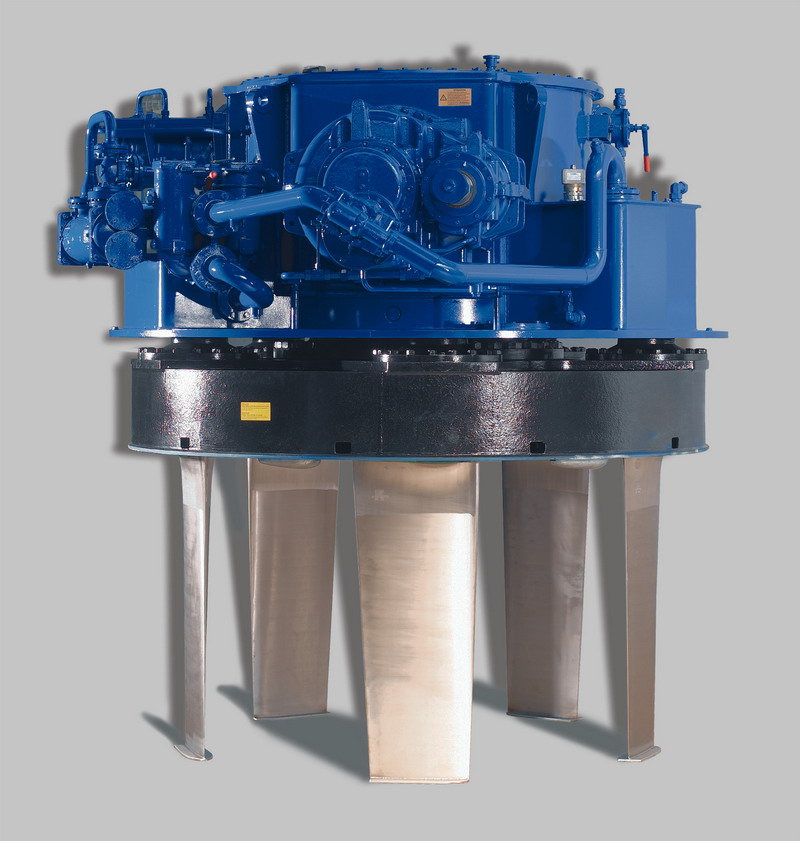
What to check on a Voith Schneider Propeller.
A Voith Schneider Propeller (VSP) is a vertical-axis cycloidal propulsion unit fitted flush with the ship's bottom. A rotor disc carries four to six vertical blades that orbit around a common axis at a fixed depth of immersion. Each blade's angle of attack is varied continuously through the rotation by an internal kinematic control mechanism, so the resultant thrust vector can be set to any direction through 360 degrees, or reduced to zero, without changing rotor speed or reversing the drive. This is the key difference from an azimuth thruster…
What defines a Voith Schneider Propeller
A Voith Schneider Propeller (VSP) is a vertical-axis cycloidal propulsion unit fitted flush with the ship's bottom. A rotor disc carries four to six vertical blades that orbit around a common axis at a fixed depth of immersion. Each blade's angle of attack is varied continuously through the rotation by an internal kinematic control mechanism, so the resultant thrust vector can be set to any direction through 360 degrees, or reduced to zero, without changing rotor speed or reversing the drive. This is the key difference from an azimuth thruster: an azimuth unit changes thrust direction by slewing the whole housing and propeller around a vertical axis, which takes time and gear travel; a VSP changes direction by resetting the blade pitch pattern, which is close to instantaneous. It is also the reason VSP-fitted vessels rarely carry a separate rudder or bow thruster — the unit already gives full omnidirectional thrust.
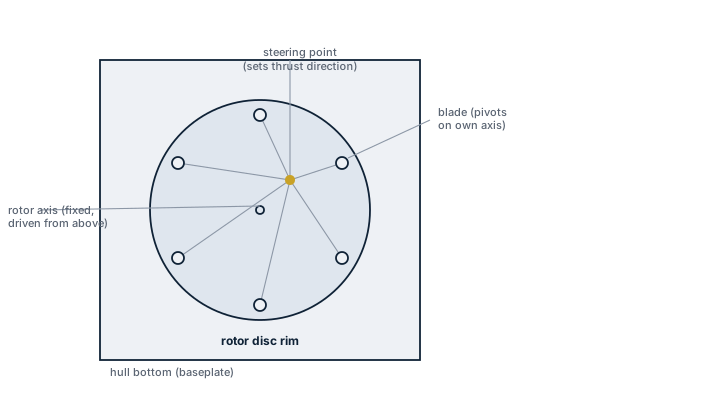
Main components
Rotor disc and blades
The rotor sits in a circular opening in the ship's bottom shell, sealed against the hull. Four to six blades of aerofoil section are mounted on vertical kingposts around the disc's circumference; blade number and chord are matched to the required thrust and to noise/vibration targets.
Control gear (eccentric/scotch yoke mechanism)
A displaceable control point inside the rotor sets the pitch cycle for every blade as it passes through its orbit. Moving this control point changes both the direction and the magnitude of thrust; it is normally actuated hydraulically from the bridge or manoeuvring console.
Main drive and bearings
Power arrives from a diesel engine or electric motor through a vertical or bevel-geared main shaft into the rotor housing. Blade root bearings, the main rotor bearing and the control mechanism bearings all run submerged or in an oil-filled casing and depend on intact seals to keep sea water out.
Seals
Rotating shaft seals between the blade roots and the hull opening, and around the main rotor shaft, are the main barrier against water ingress into the gear casing; their condition is the single most common source of unplanned VSP downtime.
Selection and sizing
A VSP is sized on required bollard pull or free-running thrust, rotor diameter, blade number and permissible draft, since the housing protrudes below the flat of bottom and limits under-keel clearance in shallow water. Typical rotor speeds run from roughly 50 to 90 revolutions per minute depending on unit size, with installed power per unit ranging from a few hundred kilowatts on harbour tugs and ferries to several megawatts on large escort tugs, dredgers and some offshore support vessels. Twin-unit installations are common because they give differential thrust for turning without any rudder at all.
| Selection factor | Why it matters |
|---|---|
| Rotor diameter | Sets maximum thrust and draft penetration below baseline |
| Blade count | Trade-off between thrust smoothness and mechanical complexity |
| Vessel draft | Housing depth limits operation in shallow channels and berths |
| Duty profile | Continuous station-keeping duty wears bearings faster than transit duty |
Regulations and class
Because a VSP combines propulsion and steering in one unit, class societies review it under both propulsion machinery and steering gear rules, and most class societies offer a specific notation for cycloidal propulsion. Where the VSP is the vessel's only means of steering, the redundancy philosophy in SOLAS Ch. II-1 for steering gear is applied by assessing the twin-unit arrangement as the redundant path, since a single mechanical rudder is not fitted. Sea trials normally include a dedicated manoeuvring and crash-stop test programme specific to cycloidal units, and class requires periodic survey of the blade bearings, seals and control mechanism at intervals set by the society's rules for propulsion shafting equivalents.
Typical faults
- Seal failure — sea water enters the gear casing, contaminating the lubricating oil and accelerating bearing wear; usually first detected by a rising water content in routine oil sampling.
- Blade bearing wear — increases mechanical backlash in the pitch-setting linkage, producing vibration and a loss of precision in station-keeping and low-speed manoeuvring.
- Control mechanism wear — an imprecise pitch cycle no longer matches the commanded thrust vector, so the vessel drifts off track even though the console shows the correct setting.
- Blade damage from grounding or debris strike — a bent or nicked blade unbalances the thrust pattern, causing vibration and, in serious cases, forcing a reduction to half power until repair.
What to look for in a supplier
- OEM-sourced blade bearings and seals; tolerances on the pitch mechanism are tight enough that non-genuine parts commonly cause premature wear.
- A service network able to inspect and change blades and seals afloat, without drydocking, since diver or cofferdam access is part of the original design intent.
- Documented sea trial and manoeuvring performance data for the specific rotor size and blade configuration ordered.
- Availability of a spare blade and seal kit sized to the installed unit, held either onboard or at a regional depot.
Log seal condition and gear-casing oil water content at every port call: a seal that starts weeping is the earliest and cheapest warning a VSP gives before bearing damage turns a seal job into a full rotor overhaul.