"> Azimuth Thruster - Equipment Database

Azimuth Thruster

medium 265 models total

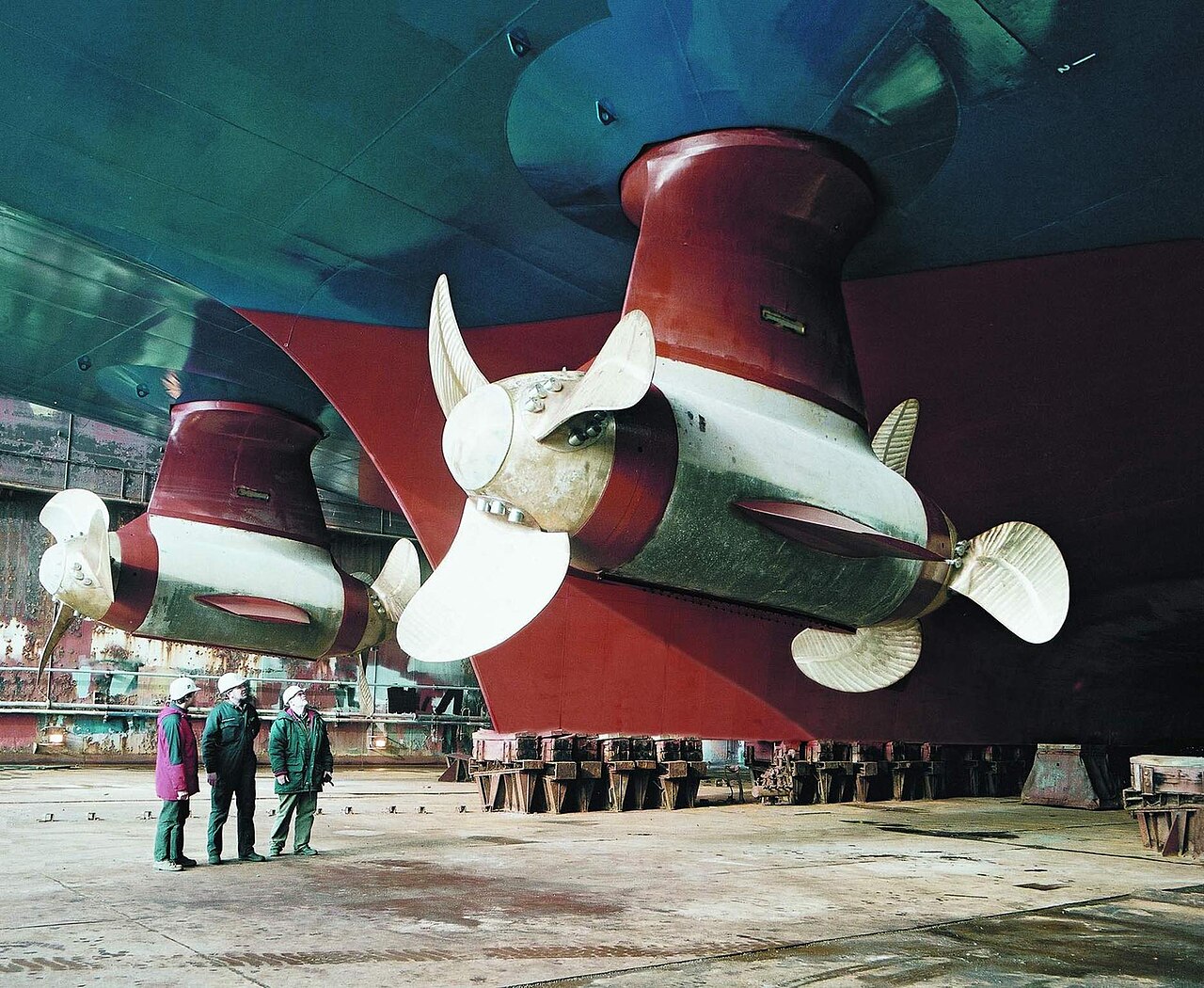
An azimuth thruster steers by rotating its whole propulsion unit through 360 degrees rather than by a rudder behind a fixed shaft line, which removes the rudder but adds a right-angle gear train and a slewing bearing that now carry the vessel's entire manoeuvring load.

Read more — Azimuth Thruster explained

What defines an azimuth thruster

An azimuth thruster combines propulsion and steering in one unit: the propeller, or on Z-drive designs a propeller on the end of a pod, rotates around a vertical axis, so thrust can point in any direction without a rudder. That is its fundamental difference from a conventional shaft line — there is no separate steering gear, but the mechanical price is a right-angle gear drive from the vertical input shaft to the horizontal propeller shaft, plus a slewing bearing and hydraulic steering system that carry loads a fixed shaft line never sees.

Azimuth thruster, cross-section
Cross-section of an azimuth thruster showing the horizontal drive input turned through an upper bevel gear into a vertical shaft, passing through the slewing bearing at the hull, down to a lower bevel gear in the pod housing that drives the propeller shaft, the whole pod able to rotate through 360 degrees.

Main components

Upper (vertical) gearbox

Takes drive from the prime mover, whether a diesel engine through a vertical shaft or, on an electric podded design, an integral motor, and turns it through 90 degrees toward the lower housing.

Lower housing and propeller shaft

Contains the second right-angle gear stage and the propeller shaft with its own bearings and seal arrangement, all inside a submerged, rotating housing — meaning the same corrosion and sealing concerns as a conventional stern tube, but on a unit that also has to rotate freely.

Slewing bearing and steering system

A large-diameter bearing carries the whole unit's thrust and side load while allowing 360-degree rotation, driven by a hydraulic or electric steering system. This bearing and its seal are what most often limit the interval between dry-dockings for inspection.

Seals

Multiple seal stages protect the lower gear housing from sea water at the propeller shaft and protect the slewing interface at the hull penetration; seal failure here floods the unit's oil system, not just the bilge.

Selection and sizing

  • Fixed-pitch versus controllable-pitch propeller on the unit, trading mechanical simplicity against manoeuvring flexibility at low speed
  • Open versus nozzle-shrouded configuration, which changes bollard pull and efficiency at low speed
  • Power transmission path — mechanical drive from a diesel engine versus an integrated electric motor in a pod — driven by the vessel's overall power plant concept
  • Redundancy requirement: dynamic-positioning vessels typically need multiple independent thrusters on separate power sources, which sets the minimum unit count before sizing individual units

Regulations and class

Class societies assign azimuth thrusters under their propulsion and, where fitted for station-keeping, dynamic-positioning notations, with survey intervals for the gear stages, bearings and seals broadly aligned with the vessel's propulsion shaft survey cycle but requiring the unit's own maker-specified oil sampling and bearing clearance checks. DP-class vessels carrying azimuth thrusters as part of their redundancy concept are subject to additional IMO MSC Circular 645/1580 DP class requirements covering independence of thruster power and control systems.

Typical faults

FaultConsequence
Slewing bearing seal wearWater ingress to the steering gear space, corrosion and eventual steering restriction
Lower gear housing oil contaminated with sea waterAccelerated gear and bearing wear, detected through routine oil sampling if done, otherwise through vibration or noise
Hydraulic steering system leakageLoss of azimuth control precision, a direct problem for DP-class vessels holding position
Cathodic protection anodes on the housing depletedAccelerated corrosion of the submerged housing between dry-dockings

What to look for in a supplier

  • Documented oil sampling and condition-monitoring history for the specific unit, not a fleet-average service record
  • Spare seal kits held for the exact model and generation, since seal designs change between production series
  • Service support able to reach the vessel's trading pattern, given that a thruster casualty on a DP vessel is an operational stop, not a deferred maintenance item

Log azimuth thruster oil sample results against the maker's trend limits every time, not only when a problem is suspected — sea water ingress at the lower seal shows up in the oil long before it shows up as noise or vibration.
15 manufacturers · 265 models

Rolls-Royce Marine

31 ✓ 31 verified
Rolls-Royce Marine US 55-P4
US 55-P4 ✓ verified
Application
Tug propulsion - 11 tonnes bollard pull
Common Failures & Inspection Points
  • Area: Überprüfung der Lager- und Wellendichtungen auf Verschleiß, Undichtigkeiten und Verschleisspiele mittels Drucktest und visueller Kontrolle
    Check: Überprüfung der Lager- und Wellendichtungen auf Verschleiß, Undichtigkeiten und Verschleisspiele mittels Drucktest und visueller Kontrolle
  • Area: Prüfung der Zahnradgeometrie (Backlash, Zahnmuster) mit Präzisionsmessinstrumenten zur Erkennung von Verschleiß und Beschädigungen
    Check: Prüfung der Zahnradgeometrie (Backlash, Zahnmuster) mit Präzisionsmessinstrumenten zur Erkennung von Verschleiß und Beschädigungen
  • Area: Kontrolle der Lagerspiele und Toleranzen aller rotierenden Komponenten alle 5-7 Jahre
    Check: Kontrolle der Lagerspiele und Toleranzen aller rotierenden Komponenten alle 5-7 Jahre
  • Area: Ölanalyse und Inspektion des hydraulischen Systems auf Leckagen, Druckverluste und Verschmutzung des Hydraulikfluids
    Check: Ölanalyse und Inspektion des hydraulischen Systems auf Leckagen, Druckverluste und Verschmutzung des Hydraulikfluids
  • Area: Überprüfung der Lagerschalen, Wälzlager und Wellenlager auf Korrosion, Verschleiß und Verschleisspiele
    Check: Überprüfung der Lagerschalen, Wälzlager und Wellenlager auf Korrosion, Verschleiß und Verschleisspiele
  • Area: Kontrolle aller Propdllerblätter und Wellenschäfte auf Risse, Kavitation und mechanische Beschädigungen
    Check: Kontrolle aller Propdllerblätter und Wellenschäfte auf Risse, Kavitation und mechanische Beschädigungen
  • Area: Kontrolle der Azimuthlagerung und des Drehsystems auf Verschleiß, Spiel und einwandfreie 360°-Rotation
    Check: Kontrolle der Azimuthlagerung und des Drehsystems auf Verschleiß, Spiel und einwandfreie 360°-Rotation
  • Area: Überprüfung der Motoren (elektrisch/Diesel), Getriebe und Kupplung auf Unwucht, Vibrationen und Überhitzung während des Betriebs
    Check: Überprüfung der Motoren (elektrisch/Diesel), Getriebe und Kupplung auf Unwucht, Vibrationen und Überhitzung während des Betriebs
  • Area: Allgemeine Überholung und Demontage aller inneren Komponenten alle 5 Jahre mit Erneuerung von Dichtungen, Lagern und Dichtungssätzen
    Check: Allgemeine Überholung und Demontage aller inneren Komponenten alle 5 Jahre mit Erneuerung von Dichtungen, Lagern und Dichtungssätzen

Typ-universelle Inspektionspunkte fuer Shaft Line & Propulsion (verifiziert, 2026-06).

Rolls-Royce Marine US 105-P6
US 105-P6 ✓ verified
Application
Tug propulsion - 17 tonnes bollard pull
Common Failures & Inspection Points
  • Area: Überprüfung der Lager- und Wellendichtungen auf Verschleiß, Undichtigkeiten und Verschleisspiele mittels Drucktest und visueller Kontrolle
    Check: Überprüfung der Lager- und Wellendichtungen auf Verschleiß, Undichtigkeiten und Verschleisspiele mittels Drucktest und visueller Kontrolle
  • Area: Prüfung der Zahnradgeometrie (Backlash, Zahnmuster) mit Präzisionsmessinstrumenten zur Erkennung von Verschleiß und Beschädigungen
    Check: Prüfung der Zahnradgeometrie (Backlash, Zahnmuster) mit Präzisionsmessinstrumenten zur Erkennung von Verschleiß und Beschädigungen
  • Area: Kontrolle der Lagerspiele und Toleranzen aller rotierenden Komponenten alle 5-7 Jahre
    Check: Kontrolle der Lagerspiele und Toleranzen aller rotierenden Komponenten alle 5-7 Jahre
  • Area: Ölanalyse und Inspektion des hydraulischen Systems auf Leckagen, Druckverluste und Verschmutzung des Hydraulikfluids
    Check: Ölanalyse und Inspektion des hydraulischen Systems auf Leckagen, Druckverluste und Verschmutzung des Hydraulikfluids
  • Area: Überprüfung der Lagerschalen, Wälzlager und Wellenlager auf Korrosion, Verschleiß und Verschleisspiele
    Check: Überprüfung der Lagerschalen, Wälzlager und Wellenlager auf Korrosion, Verschleiß und Verschleisspiele
  • Area: Kontrolle aller Propdllerblätter und Wellenschäfte auf Risse, Kavitation und mechanische Beschädigungen
    Check: Kontrolle aller Propdllerblätter und Wellenschäfte auf Risse, Kavitation und mechanische Beschädigungen
  • Area: Kontrolle der Azimuthlagerung und des Drehsystems auf Verschleiß, Spiel und einwandfreie 360°-Rotation
    Check: Kontrolle der Azimuthlagerung und des Drehsystems auf Verschleiß, Spiel und einwandfreie 360°-Rotation
  • Area: Überprüfung der Motoren (elektrisch/Diesel), Getriebe und Kupplung auf Unwucht, Vibrationen und Überhitzung während des Betriebs
    Check: Überprüfung der Motoren (elektrisch/Diesel), Getriebe und Kupplung auf Unwucht, Vibrationen und Überhitzung während des Betriebs
  • Area: Allgemeine Überholung und Demontage aller inneren Komponenten alle 5 Jahre mit Erneuerung von Dichtungen, Lagern und Dichtungssätzen
    Check: Allgemeine Überholung und Demontage aller inneren Komponenten alle 5 Jahre mit Erneuerung von Dichtungen, Lagern und Dichtungssätzen

Typ-universelle Inspektionspunkte fuer Shaft Line & Propulsion (verifiziert, 2026-06).

Rolls-Royce Marine US 105-P9
US 105-P9 ✓ verified
Application
Tug propulsion - 24-25 tonnes bollard pull
Common Failures & Inspection Points
  • Area: Überprüfung der Lager- und Wellendichtungen auf Verschleiß, Undichtigkeiten und Verschleisspiele mittels Drucktest und visueller Kontrolle
    Check: Überprüfung der Lager- und Wellendichtungen auf Verschleiß, Undichtigkeiten und Verschleisspiele mittels Drucktest und visueller Kontrolle
  • Area: Prüfung der Zahnradgeometrie (Backlash, Zahnmuster) mit Präzisionsmessinstrumenten zur Erkennung von Verschleiß und Beschädigungen
    Check: Prüfung der Zahnradgeometrie (Backlash, Zahnmuster) mit Präzisionsmessinstrumenten zur Erkennung von Verschleiß und Beschädigungen
  • Area: Kontrolle der Lagerspiele und Toleranzen aller rotierenden Komponenten alle 5-7 Jahre
    Check: Kontrolle der Lagerspiele und Toleranzen aller rotierenden Komponenten alle 5-7 Jahre
  • Area: Ölanalyse und Inspektion des hydraulischen Systems auf Leckagen, Druckverluste und Verschmutzung des Hydraulikfluids
    Check: Ölanalyse und Inspektion des hydraulischen Systems auf Leckagen, Druckverluste und Verschmutzung des Hydraulikfluids
  • Area: Überprüfung der Lagerschalen, Wälzlager und Wellenlager auf Korrosion, Verschleiß und Verschleisspiele
    Check: Überprüfung der Lagerschalen, Wälzlager und Wellenlager auf Korrosion, Verschleiß und Verschleisspiele
  • Area: Kontrolle aller Propdllerblätter und Wellenschäfte auf Risse, Kavitation und mechanische Beschädigungen
    Check: Kontrolle aller Propdllerblätter und Wellenschäfte auf Risse, Kavitation und mechanische Beschädigungen
  • Area: Kontrolle der Azimuthlagerung und des Drehsystems auf Verschleiß, Spiel und einwandfreie 360°-Rotation
    Check: Kontrolle der Azimuthlagerung und des Drehsystems auf Verschleiß, Spiel und einwandfreie 360°-Rotation
  • Area: Überprüfung der Motoren (elektrisch/Diesel), Getriebe und Kupplung auf Unwucht, Vibrationen und Überhitzung während des Betriebs
    Check: Überprüfung der Motoren (elektrisch/Diesel), Getriebe und Kupplung auf Unwucht, Vibrationen und Überhitzung während des Betriebs
  • Area: Allgemeine Überholung und Demontage aller inneren Komponenten alle 5 Jahre mit Erneuerung von Dichtungen, Lagern und Dichtungssätzen
    Check: Allgemeine Überholung und Demontage aller inneren Komponenten alle 5 Jahre mit Erneuerung von Dichtungen, Lagern und Dichtungssätzen

Typ-universelle Inspektionspunkte fuer Shaft Line & Propulsion (verifiziert, 2026-06).

Rolls-Royce Marine US 155-P12
US 155-P12 ✓ verified
Application
Tug propulsion - 29-35 tonnes bollard pull
Common Failures & Inspection Points
  • Area: Überprüfung der Lager- und Wellendichtungen auf Verschleiß, Undichtigkeiten und Verschleisspiele mittels Drucktest und visueller Kontrolle
    Check: Überprüfung der Lager- und Wellendichtungen auf Verschleiß, Undichtigkeiten und Verschleisspiele mittels Drucktest und visueller Kontrolle
  • Area: Prüfung der Zahnradgeometrie (Backlash, Zahnmuster) mit Präzisionsmessinstrumenten zur Erkennung von Verschleiß und Beschädigungen
    Check: Prüfung der Zahnradgeometrie (Backlash, Zahnmuster) mit Präzisionsmessinstrumenten zur Erkennung von Verschleiß und Beschädigungen
  • Area: Kontrolle der Lagerspiele und Toleranzen aller rotierenden Komponenten alle 5-7 Jahre
    Check: Kontrolle der Lagerspiele und Toleranzen aller rotierenden Komponenten alle 5-7 Jahre
  • Area: Ölanalyse und Inspektion des hydraulischen Systems auf Leckagen, Druckverluste und Verschmutzung des Hydraulikfluids
    Check: Ölanalyse und Inspektion des hydraulischen Systems auf Leckagen, Druckverluste und Verschmutzung des Hydraulikfluids
  • Area: Überprüfung der Lagerschalen, Wälzlager und Wellenlager auf Korrosion, Verschleiß und Verschleisspiele
    Check: Überprüfung der Lagerschalen, Wälzlager und Wellenlager auf Korrosion, Verschleiß und Verschleisspiele
  • Area: Kontrolle aller Propdllerblätter und Wellenschäfte auf Risse, Kavitation und mechanische Beschädigungen
    Check: Kontrolle aller Propdllerblätter und Wellenschäfte auf Risse, Kavitation und mechanische Beschädigungen
  • Area: Kontrolle der Azimuthlagerung und des Drehsystems auf Verschleiß, Spiel und einwandfreie 360°-Rotation
    Check: Kontrolle der Azimuthlagerung und des Drehsystems auf Verschleiß, Spiel und einwandfreie 360°-Rotation
  • Area: Überprüfung der Motoren (elektrisch/Diesel), Getriebe und Kupplung auf Unwucht, Vibrationen und Überhitzung während des Betriebs
    Check: Überprüfung der Motoren (elektrisch/Diesel), Getriebe und Kupplung auf Unwucht, Vibrationen und Überhitzung während des Betriebs
  • Area: Allgemeine Überholung und Demontage aller inneren Komponenten alle 5 Jahre mit Erneuerung von Dichtungen, Lagern und Dichtungssätzen
    Check: Allgemeine Überholung und Demontage aller inneren Komponenten alle 5 Jahre mit Erneuerung von Dichtungen, Lagern und Dichtungssätzen

Typ-universelle Inspektionspunkte fuer Shaft Line & Propulsion (verifiziert, 2026-06).

Rolls-Royce Marine US 155-P14
US 155-P14 ✓ verified
Application
Tug propulsion - 37-42 tonnes bollard pull
Common Failures & Inspection Points
  • Area: Überprüfung der Lager- und Wellendichtungen auf Verschleiß, Undichtigkeiten und Verschleisspiele mittels Drucktest und visueller Kontrolle
    Check: Überprüfung der Lager- und Wellendichtungen auf Verschleiß, Undichtigkeiten und Verschleisspiele mittels Drucktest und visueller Kontrolle
  • Area: Prüfung der Zahnradgeometrie (Backlash, Zahnmuster) mit Präzisionsmessinstrumenten zur Erkennung von Verschleiß und Beschädigungen
    Check: Prüfung der Zahnradgeometrie (Backlash, Zahnmuster) mit Präzisionsmessinstrumenten zur Erkennung von Verschleiß und Beschädigungen
  • Area: Kontrolle der Lagerspiele und Toleranzen aller rotierenden Komponenten alle 5-7 Jahre
    Check: Kontrolle der Lagerspiele und Toleranzen aller rotierenden Komponenten alle 5-7 Jahre
  • Area: Ölanalyse und Inspektion des hydraulischen Systems auf Leckagen, Druckverluste und Verschmutzung des Hydraulikfluids
    Check: Ölanalyse und Inspektion des hydraulischen Systems auf Leckagen, Druckverluste und Verschmutzung des Hydraulikfluids
  • Area: Überprüfung der Lagerschalen, Wälzlager und Wellenlager auf Korrosion, Verschleiß und Verschleisspiele
    Check: Überprüfung der Lagerschalen, Wälzlager und Wellenlager auf Korrosion, Verschleiß und Verschleisspiele
  • Area: Kontrolle aller Propdllerblätter und Wellenschäfte auf Risse, Kavitation und mechanische Beschädigungen
    Check: Kontrolle aller Propdllerblätter und Wellenschäfte auf Risse, Kavitation und mechanische Beschädigungen
  • Area: Kontrolle der Azimuthlagerung und des Drehsystems auf Verschleiß, Spiel und einwandfreie 360°-Rotation
    Check: Kontrolle der Azimuthlagerung und des Drehsystems auf Verschleiß, Spiel und einwandfreie 360°-Rotation
  • Area: Überprüfung der Motoren (elektrisch/Diesel), Getriebe und Kupplung auf Unwucht, Vibrationen und Überhitzung während des Betriebs
    Check: Überprüfung der Motoren (elektrisch/Diesel), Getriebe und Kupplung auf Unwucht, Vibrationen und Überhitzung während des Betriebs
  • Area: Allgemeine Überholung und Demontage aller inneren Komponenten alle 5 Jahre mit Erneuerung von Dichtungen, Lagern und Dichtungssätzen
    Check: Allgemeine Überholung und Demontage aller inneren Komponenten alle 5 Jahre mit Erneuerung von Dichtungen, Lagern und Dichtungssätzen

Typ-universelle Inspektionspunkte fuer Shaft Line & Propulsion (verifiziert, 2026-06).

Rolls-Royce Marine US 205-P18
US 205-P18 ✓ verified
Application
Tug propulsion - 51 tonnes bollard pull
Common Failures & Inspection Points
  • Area: Überprüfung der Lager- und Wellendichtungen auf Verschleiß, Undichtigkeiten und Verschleisspiele mittels Drucktest und visueller Kontrolle
    Check: Überprüfung der Lager- und Wellendichtungen auf Verschleiß, Undichtigkeiten und Verschleisspiele mittels Drucktest und visueller Kontrolle
  • Area: Prüfung der Zahnradgeometrie (Backlash, Zahnmuster) mit Präzisionsmessinstrumenten zur Erkennung von Verschleiß und Beschädigungen
    Check: Prüfung der Zahnradgeometrie (Backlash, Zahnmuster) mit Präzisionsmessinstrumenten zur Erkennung von Verschleiß und Beschädigungen
  • Area: Kontrolle der Lagerspiele und Toleranzen aller rotierenden Komponenten alle 5-7 Jahre
    Check: Kontrolle der Lagerspiele und Toleranzen aller rotierenden Komponenten alle 5-7 Jahre
  • Area: Ölanalyse und Inspektion des hydraulischen Systems auf Leckagen, Druckverluste und Verschmutzung des Hydraulikfluids
    Check: Ölanalyse und Inspektion des hydraulischen Systems auf Leckagen, Druckverluste und Verschmutzung des Hydraulikfluids
  • Area: Überprüfung der Lagerschalen, Wälzlager und Wellenlager auf Korrosion, Verschleiß und Verschleisspiele
    Check: Überprüfung der Lagerschalen, Wälzlager und Wellenlager auf Korrosion, Verschleiß und Verschleisspiele
  • Area: Kontrolle aller Propdllerblätter und Wellenschäfte auf Risse, Kavitation und mechanische Beschädigungen
    Check: Kontrolle aller Propdllerblätter und Wellenschäfte auf Risse, Kavitation und mechanische Beschädigungen
  • Area: Kontrolle der Azimuthlagerung und des Drehsystems auf Verschleiß, Spiel und einwandfreie 360°-Rotation
    Check: Kontrolle der Azimuthlagerung und des Drehsystems auf Verschleiß, Spiel und einwandfreie 360°-Rotation
  • Area: Überprüfung der Motoren (elektrisch/Diesel), Getriebe und Kupplung auf Unwucht, Vibrationen und Überhitzung während des Betriebs
    Check: Überprüfung der Motoren (elektrisch/Diesel), Getriebe und Kupplung auf Unwucht, Vibrationen und Überhitzung während des Betriebs
  • Area: Allgemeine Überholung und Demontage aller inneren Komponenten alle 5 Jahre mit Erneuerung von Dichtungen, Lagern und Dichtungssätzen
    Check: Allgemeine Überholung und Demontage aller inneren Komponenten alle 5 Jahre mit Erneuerung von Dichtungen, Lagern und Dichtungssätzen

Typ-universelle Inspektionspunkte fuer Shaft Line & Propulsion (verifiziert, 2026-06).

Rolls-Royce Marine US 255
US 255 ✓ verified
Application
Tug propulsion - high power offshore applications
Common Failures & Inspection Points
  • Area: Überprüfung der Lager- und Wellendichtungen auf Verschleiß, Undichtigkeiten und Verschleisspiele mittels Drucktest und visueller Kontrolle
    Check: Überprüfung der Lager- und Wellendichtungen auf Verschleiß, Undichtigkeiten und Verschleisspiele mittels Drucktest und visueller Kontrolle
  • Area: Prüfung der Zahnradgeometrie (Backlash, Zahnmuster) mit Präzisionsmessinstrumenten zur Erkennung von Verschleiß und Beschädigungen
    Check: Prüfung der Zahnradgeometrie (Backlash, Zahnmuster) mit Präzisionsmessinstrumenten zur Erkennung von Verschleiß und Beschädigungen
  • Area: Kontrolle der Lagerspiele und Toleranzen aller rotierenden Komponenten alle 5-7 Jahre
    Check: Kontrolle der Lagerspiele und Toleranzen aller rotierenden Komponenten alle 5-7 Jahre
  • Area: Ölanalyse und Inspektion des hydraulischen Systems auf Leckagen, Druckverluste und Verschmutzung des Hydraulikfluids
    Check: Ölanalyse und Inspektion des hydraulischen Systems auf Leckagen, Druckverluste und Verschmutzung des Hydraulikfluids
  • Area: Überprüfung der Lagerschalen, Wälzlager und Wellenlager auf Korrosion, Verschleiß und Verschleisspiele
    Check: Überprüfung der Lagerschalen, Wälzlager und Wellenlager auf Korrosion, Verschleiß und Verschleisspiele
  • Area: Kontrolle aller Propdllerblätter und Wellenschäfte auf Risse, Kavitation und mechanische Beschädigungen
    Check: Kontrolle aller Propdllerblätter und Wellenschäfte auf Risse, Kavitation und mechanische Beschädigungen
  • Area: Kontrolle der Azimuthlagerung und des Drehsystems auf Verschleiß, Spiel und einwandfreie 360°-Rotation
    Check: Kontrolle der Azimuthlagerung und des Drehsystems auf Verschleiß, Spiel und einwandfreie 360°-Rotation
  • Area: Überprüfung der Motoren (elektrisch/Diesel), Getriebe und Kupplung auf Unwucht, Vibrationen und Überhitzung während des Betriebs
    Check: Überprüfung der Motoren (elektrisch/Diesel), Getriebe und Kupplung auf Unwucht, Vibrationen und Überhitzung während des Betriebs
  • Area: Allgemeine Überholung und Demontage aller inneren Komponenten alle 5 Jahre mit Erneuerung von Dichtungen, Lagern und Dichtungssätzen
    Check: Allgemeine Überholung und Demontage aller inneren Komponenten alle 5 Jahre mit Erneuerung von Dichtungen, Lagern und Dichtungssätzen

Typ-universelle Inspektionspunkte fuer Shaft Line & Propulsion (verifiziert, 2026-06).

Rolls-Royce Marine US 305
US 305 ✓ verified
Application
Tug propulsion - 98-106 tonnes bollard pull
Common Failures & Inspection Points
  • Area: Überprüfung der Lager- und Wellendichtungen auf Verschleiß, Undichtigkeiten und Verschleisspiele mittels Drucktest und visueller Kontrolle
    Check: Überprüfung der Lager- und Wellendichtungen auf Verschleiß, Undichtigkeiten und Verschleisspiele mittels Drucktest und visueller Kontrolle
  • Area: Prüfung der Zahnradgeometrie (Backlash, Zahnmuster) mit Präzisionsmessinstrumenten zur Erkennung von Verschleiß und Beschädigungen
    Check: Prüfung der Zahnradgeometrie (Backlash, Zahnmuster) mit Präzisionsmessinstrumenten zur Erkennung von Verschleiß und Beschädigungen
  • Area: Kontrolle der Lagerspiele und Toleranzen aller rotierenden Komponenten alle 5-7 Jahre
    Check: Kontrolle der Lagerspiele und Toleranzen aller rotierenden Komponenten alle 5-7 Jahre
  • Area: Ölanalyse und Inspektion des hydraulischen Systems auf Leckagen, Druckverluste und Verschmutzung des Hydraulikfluids
    Check: Ölanalyse und Inspektion des hydraulischen Systems auf Leckagen, Druckverluste und Verschmutzung des Hydraulikfluids
  • Area: Überprüfung der Lagerschalen, Wälzlager und Wellenlager auf Korrosion, Verschleiß und Verschleisspiele
    Check: Überprüfung der Lagerschalen, Wälzlager und Wellenlager auf Korrosion, Verschleiß und Verschleisspiele
  • Area: Kontrolle aller Propdllerblätter und Wellenschäfte auf Risse, Kavitation und mechanische Beschädigungen
    Check: Kontrolle aller Propdllerblätter und Wellenschäfte auf Risse, Kavitation und mechanische Beschädigungen
  • Area: Kontrolle der Azimuthlagerung und des Drehsystems auf Verschleiß, Spiel und einwandfreie 360°-Rotation
    Check: Kontrolle der Azimuthlagerung und des Drehsystems auf Verschleiß, Spiel und einwandfreie 360°-Rotation
  • Area: Überprüfung der Motoren (elektrisch/Diesel), Getriebe und Kupplung auf Unwucht, Vibrationen und Überhitzung während des Betriebs
    Check: Überprüfung der Motoren (elektrisch/Diesel), Getriebe und Kupplung auf Unwucht, Vibrationen und Überhitzung während des Betriebs
  • Area: Allgemeine Überholung und Demontage aller inneren Komponenten alle 5 Jahre mit Erneuerung von Dichtungen, Lagern und Dichtungssätzen
    Check: Allgemeine Überholung und Demontage aller inneren Komponenten alle 5 Jahre mit Erneuerung von Dichtungen, Lagern und Dichtungssätzen

Typ-universelle Inspektionspunkte fuer Shaft Line & Propulsion (verifiziert, 2026-06).

Rolls-Royce Marine US 355
US 355 ✓ verified
Application
Tug propulsion - 120-125 tonnes bollard pull
Common Failures & Inspection Points
  • Area: Überprüfung der Lager- und Wellendichtungen auf Verschleiß, Undichtigkeiten und Verschleisspiele mittels Drucktest und visueller Kontrolle
    Check: Überprüfung der Lager- und Wellendichtungen auf Verschleiß, Undichtigkeiten und Verschleisspiele mittels Drucktest und visueller Kontrolle
  • Area: Prüfung der Zahnradgeometrie (Backlash, Zahnmuster) mit Präzisionsmessinstrumenten zur Erkennung von Verschleiß und Beschädigungen
    Check: Prüfung der Zahnradgeometrie (Backlash, Zahnmuster) mit Präzisionsmessinstrumenten zur Erkennung von Verschleiß und Beschädigungen
  • Area: Kontrolle der Lagerspiele und Toleranzen aller rotierenden Komponenten alle 5-7 Jahre
    Check: Kontrolle der Lagerspiele und Toleranzen aller rotierenden Komponenten alle 5-7 Jahre
  • Area: Ölanalyse und Inspektion des hydraulischen Systems auf Leckagen, Druckverluste und Verschmutzung des Hydraulikfluids
    Check: Ölanalyse und Inspektion des hydraulischen Systems auf Leckagen, Druckverluste und Verschmutzung des Hydraulikfluids
  • Area: Überprüfung der Lagerschalen, Wälzlager und Wellenlager auf Korrosion, Verschleiß und Verschleisspiele
    Check: Überprüfung der Lagerschalen, Wälzlager und Wellenlager auf Korrosion, Verschleiß und Verschleisspiele
  • Area: Kontrolle aller Propdllerblätter und Wellenschäfte auf Risse, Kavitation und mechanische Beschädigungen
    Check: Kontrolle aller Propdllerblätter und Wellenschäfte auf Risse, Kavitation und mechanische Beschädigungen
  • Area: Kontrolle der Azimuthlagerung und des Drehsystems auf Verschleiß, Spiel und einwandfreie 360°-Rotation
    Check: Kontrolle der Azimuthlagerung und des Drehsystems auf Verschleiß, Spiel und einwandfreie 360°-Rotation
  • Area: Überprüfung der Motoren (elektrisch/Diesel), Getriebe und Kupplung auf Unwucht, Vibrationen und Überhitzung während des Betriebs
    Check: Überprüfung der Motoren (elektrisch/Diesel), Getriebe und Kupplung auf Unwucht, Vibrationen und Überhitzung während des Betriebs
  • Area: Allgemeine Überholung und Demontage aller inneren Komponenten alle 5 Jahre mit Erneuerung von Dichtungen, Lagern und Dichtungssätzen
    Check: Allgemeine Überholung und Demontage aller inneren Komponenten alle 5 Jahre mit Erneuerung von Dichtungen, Lagern und Dichtungssätzen

Typ-universelle Inspektionspunkte fuer Shaft Line & Propulsion (verifiziert, 2026-06).

Rolls-Royce Marine CONTAZ 15
CONTAZ 15 ✓ verified
Application
Passenger/car ferry propulsion with contra-rotating propellers
Common Failures & Inspection Points
  • Area: Überprüfung der Lager- und Wellendichtungen auf Verschleiß, Undichtigkeiten und Verschleisspiele mittels Drucktest und visueller Kontrolle
    Check: Überprüfung der Lager- und Wellendichtungen auf Verschleiß, Undichtigkeiten und Verschleisspiele mittels Drucktest und visueller Kontrolle
  • Area: Prüfung der Zahnradgeometrie (Backlash, Zahnmuster) mit Präzisionsmessinstrumenten zur Erkennung von Verschleiß und Beschädigungen
    Check: Prüfung der Zahnradgeometrie (Backlash, Zahnmuster) mit Präzisionsmessinstrumenten zur Erkennung von Verschleiß und Beschädigungen
  • Area: Kontrolle der Lagerspiele und Toleranzen aller rotierenden Komponenten alle 5-7 Jahre
    Check: Kontrolle der Lagerspiele und Toleranzen aller rotierenden Komponenten alle 5-7 Jahre
  • Area: Ölanalyse und Inspektion des hydraulischen Systems auf Leckagen, Druckverluste und Verschmutzung des Hydraulikfluids
    Check: Ölanalyse und Inspektion des hydraulischen Systems auf Leckagen, Druckverluste und Verschmutzung des Hydraulikfluids
  • Area: Überprüfung der Lagerschalen, Wälzlager und Wellenlager auf Korrosion, Verschleiß und Verschleisspiele
    Check: Überprüfung der Lagerschalen, Wälzlager und Wellenlager auf Korrosion, Verschleiß und Verschleisspiele
  • Area: Kontrolle aller Propdllerblätter und Wellenschäfte auf Risse, Kavitation und mechanische Beschädigungen
    Check: Kontrolle aller Propdllerblätter und Wellenschäfte auf Risse, Kavitation und mechanische Beschädigungen
  • Area: Kontrolle der Azimuthlagerung und des Drehsystems auf Verschleiß, Spiel und einwandfreie 360°-Rotation
    Check: Kontrolle der Azimuthlagerung und des Drehsystems auf Verschleiß, Spiel und einwandfreie 360°-Rotation
  • Area: Überprüfung der Motoren (elektrisch/Diesel), Getriebe und Kupplung auf Unwucht, Vibrationen und Überhitzung während des Betriebs
    Check: Überprüfung der Motoren (elektrisch/Diesel), Getriebe und Kupplung auf Unwucht, Vibrationen und Überhitzung während des Betriebs
  • Area: Allgemeine Überholung und Demontage aller inneren Komponenten alle 5 Jahre mit Erneuerung von Dichtungen, Lagern und Dichtungssätzen
    Check: Allgemeine Überholung und Demontage aller inneren Komponenten alle 5 Jahre mit Erneuerung von Dichtungen, Lagern und Dichtungssätzen

Typ-universelle Inspektionspunkte fuer Shaft Line & Propulsion (verifiziert, 2026-06).

Rolls-Royce Marine CONTAZ 25
CONTAZ 25 ✓ verified
Application
Passenger/car ferry propulsion with shallow-draft capability
Common Failures & Inspection Points
  • Area: Überprüfung der Lager- und Wellendichtungen auf Verschleiß, Undichtigkeiten und Verschleisspiele mittels Drucktest und visueller Kontrolle
    Check: Überprüfung der Lager- und Wellendichtungen auf Verschleiß, Undichtigkeiten und Verschleisspiele mittels Drucktest und visueller Kontrolle
  • Area: Prüfung der Zahnradgeometrie (Backlash, Zahnmuster) mit Präzisionsmessinstrumenten zur Erkennung von Verschleiß und Beschädigungen
    Check: Prüfung der Zahnradgeometrie (Backlash, Zahnmuster) mit Präzisionsmessinstrumenten zur Erkennung von Verschleiß und Beschädigungen
  • Area: Kontrolle der Lagerspiele und Toleranzen aller rotierenden Komponenten alle 5-7 Jahre
    Check: Kontrolle der Lagerspiele und Toleranzen aller rotierenden Komponenten alle 5-7 Jahre
  • Area: Ölanalyse und Inspektion des hydraulischen Systems auf Leckagen, Druckverluste und Verschmutzung des Hydraulikfluids
    Check: Ölanalyse und Inspektion des hydraulischen Systems auf Leckagen, Druckverluste und Verschmutzung des Hydraulikfluids
  • Area: Überprüfung der Lagerschalen, Wälzlager und Wellenlager auf Korrosion, Verschleiß und Verschleisspiele
    Check: Überprüfung der Lagerschalen, Wälzlager und Wellenlager auf Korrosion, Verschleiß und Verschleisspiele
  • Area: Kontrolle aller Propdllerblätter und Wellenschäfte auf Risse, Kavitation und mechanische Beschädigungen
    Check: Kontrolle aller Propdllerblätter und Wellenschäfte auf Risse, Kavitation und mechanische Beschädigungen
  • Area: Kontrolle der Azimuthlagerung und des Drehsystems auf Verschleiß, Spiel und einwandfreie 360°-Rotation
    Check: Kontrolle der Azimuthlagerung und des Drehsystems auf Verschleiß, Spiel und einwandfreie 360°-Rotation
  • Area: Überprüfung der Motoren (elektrisch/Diesel), Getriebe und Kupplung auf Unwucht, Vibrationen und Überhitzung während des Betriebs
    Check: Überprüfung der Motoren (elektrisch/Diesel), Getriebe und Kupplung auf Unwucht, Vibrationen und Überhitzung während des Betriebs
  • Area: Allgemeine Überholung und Demontage aller inneren Komponenten alle 5 Jahre mit Erneuerung von Dichtungen, Lagern und Dichtungssätzen
    Check: Allgemeine Überholung und Demontage aller inneren Komponenten alle 5 Jahre mit Erneuerung von Dichtungen, Lagern und Dichtungssätzen

Typ-universelle Inspektionspunkte fuer Shaft Line & Propulsion (verifiziert, 2026-06).

Rolls-Royce Marine CONTAZ 35
CONTAZ 35 ✓ verified
Application
Shallow-draft vessel propulsion with efficiency gains 10-15%
Common Failures & Inspection Points
  • Area: Überprüfung der Lager- und Wellendichtungen auf Verschleiß, Undichtigkeiten und Verschleisspiele mittels Drucktest und visueller Kontrolle
    Check: Überprüfung der Lager- und Wellendichtungen auf Verschleiß, Undichtigkeiten und Verschleisspiele mittels Drucktest und visueller Kontrolle
  • Area: Prüfung der Zahnradgeometrie (Backlash, Zahnmuster) mit Präzisionsmessinstrumenten zur Erkennung von Verschleiß und Beschädigungen
    Check: Prüfung der Zahnradgeometrie (Backlash, Zahnmuster) mit Präzisionsmessinstrumenten zur Erkennung von Verschleiß und Beschädigungen
  • Area: Kontrolle der Lagerspiele und Toleranzen aller rotierenden Komponenten alle 5-7 Jahre
    Check: Kontrolle der Lagerspiele und Toleranzen aller rotierenden Komponenten alle 5-7 Jahre
  • Area: Ölanalyse und Inspektion des hydraulischen Systems auf Leckagen, Druckverluste und Verschmutzung des Hydraulikfluids
    Check: Ölanalyse und Inspektion des hydraulischen Systems auf Leckagen, Druckverluste und Verschmutzung des Hydraulikfluids
  • Area: Überprüfung der Lagerschalen, Wälzlager und Wellenlager auf Korrosion, Verschleiß und Verschleisspiele
    Check: Überprüfung der Lagerschalen, Wälzlager und Wellenlager auf Korrosion, Verschleiß und Verschleisspiele
  • Area: Kontrolle aller Propdllerblätter und Wellenschäfte auf Risse, Kavitation und mechanische Beschädigungen
    Check: Kontrolle aller Propdllerblätter und Wellenschäfte auf Risse, Kavitation und mechanische Beschädigungen
  • Area: Kontrolle der Azimuthlagerung und des Drehsystems auf Verschleiß, Spiel und einwandfreie 360°-Rotation
    Check: Kontrolle der Azimuthlagerung und des Drehsystems auf Verschleiß, Spiel und einwandfreie 360°-Rotation
  • Area: Überprüfung der Motoren (elektrisch/Diesel), Getriebe und Kupplung auf Unwucht, Vibrationen und Überhitzung während des Betriebs
    Check: Überprüfung der Motoren (elektrisch/Diesel), Getriebe und Kupplung auf Unwucht, Vibrationen und Überhitzung während des Betriebs
  • Area: Allgemeine Überholung und Demontage aller inneren Komponenten alle 5 Jahre mit Erneuerung von Dichtungen, Lagern und Dichtungssätzen
    Check: Allgemeine Überholung und Demontage aller inneren Komponenten alle 5 Jahre mit Erneuerung von Dichtungen, Lagern und Dichtungssätzen

Typ-universelle Inspektionspunkte fuer Shaft Line & Propulsion (verifiziert, 2026-06).

Rolls-Royce Marine AZP085
AZP085 ✓ verified
Application
High-speed vessel pulling thruster - up to 24 knots
Common Failures & Inspection Points
  • Area: Überprüfung der Lager- und Wellendichtungen auf Verschleiß, Undichtigkeiten und Verschleisspiele mittels Drucktest und visueller Kontrolle
    Check: Überprüfung der Lager- und Wellendichtungen auf Verschleiß, Undichtigkeiten und Verschleisspiele mittels Drucktest und visueller Kontrolle
  • Area: Prüfung der Zahnradgeometrie (Backlash, Zahnmuster) mit Präzisionsmessinstrumenten zur Erkennung von Verschleiß und Beschädigungen
    Check: Prüfung der Zahnradgeometrie (Backlash, Zahnmuster) mit Präzisionsmessinstrumenten zur Erkennung von Verschleiß und Beschädigungen
  • Area: Kontrolle der Lagerspiele und Toleranzen aller rotierenden Komponenten alle 5-7 Jahre
    Check: Kontrolle der Lagerspiele und Toleranzen aller rotierenden Komponenten alle 5-7 Jahre
  • Area: Ölanalyse und Inspektion des hydraulischen Systems auf Leckagen, Druckverluste und Verschmutzung des Hydraulikfluids
    Check: Ölanalyse und Inspektion des hydraulischen Systems auf Leckagen, Druckverluste und Verschmutzung des Hydraulikfluids
  • Area: Überprüfung der Lagerschalen, Wälzlager und Wellenlager auf Korrosion, Verschleiß und Verschleisspiele
    Check: Überprüfung der Lagerschalen, Wälzlager und Wellenlager auf Korrosion, Verschleiß und Verschleisspiele
  • Area: Kontrolle aller Propdllerblätter und Wellenschäfte auf Risse, Kavitation und mechanische Beschädigungen
    Check: Kontrolle aller Propdllerblätter und Wellenschäfte auf Risse, Kavitation und mechanische Beschädigungen
  • Area: Kontrolle der Azimuthlagerung und des Drehsystems auf Verschleiß, Spiel und einwandfreie 360°-Rotation
    Check: Kontrolle der Azimuthlagerung und des Drehsystems auf Verschleiß, Spiel und einwandfreie 360°-Rotation
  • Area: Überprüfung der Motoren (elektrisch/Diesel), Getriebe und Kupplung auf Unwucht, Vibrationen und Überhitzung während des Betriebs
    Check: Überprüfung der Motoren (elektrisch/Diesel), Getriebe und Kupplung auf Unwucht, Vibrationen und Überhitzung während des Betriebs
  • Area: Allgemeine Überholung und Demontage aller inneren Komponenten alle 5 Jahre mit Erneuerung von Dichtungen, Lagern und Dichtungssätzen
    Check: Allgemeine Überholung und Demontage aller inneren Komponenten alle 5 Jahre mit Erneuerung von Dichtungen, Lagern und Dichtungssätzen

Typ-universelle Inspektionspunkte fuer Shaft Line & Propulsion (verifiziert, 2026-06).

AZP100 ✓ verified
Application
Pulling thruster for high-speed and offshore vessels
Common Failures & Inspection Points
  • Area: Überprüfung der Lager- und Wellendichtungen auf Verschleiß, Undichtigkeiten und Verschleisspiele mittels Drucktest und visueller Kontrolle
    Check: Überprüfung der Lager- und Wellendichtungen auf Verschleiß, Undichtigkeiten und Verschleisspiele mittels Drucktest und visueller Kontrolle
  • Area: Prüfung der Zahnradgeometrie (Backlash, Zahnmuster) mit Präzisionsmessinstrumenten zur Erkennung von Verschleiß und Beschädigungen
    Check: Prüfung der Zahnradgeometrie (Backlash, Zahnmuster) mit Präzisionsmessinstrumenten zur Erkennung von Verschleiß und Beschädigungen
  • Area: Kontrolle der Lagerspiele und Toleranzen aller rotierenden Komponenten alle 5-7 Jahre
    Check: Kontrolle der Lagerspiele und Toleranzen aller rotierenden Komponenten alle 5-7 Jahre
  • Area: Ölanalyse und Inspektion des hydraulischen Systems auf Leckagen, Druckverluste und Verschmutzung des Hydraulikfluids
    Check: Ölanalyse und Inspektion des hydraulischen Systems auf Leckagen, Druckverluste und Verschmutzung des Hydraulikfluids
  • Area: Überprüfung der Lagerschalen, Wälzlager und Wellenlager auf Korrosion, Verschleiß und Verschleisspiele
    Check: Überprüfung der Lagerschalen, Wälzlager und Wellenlager auf Korrosion, Verschleiß und Verschleisspiele
  • Area: Kontrolle aller Propdllerblätter und Wellenschäfte auf Risse, Kavitation und mechanische Beschädigungen
    Check: Kontrolle aller Propdllerblätter und Wellenschäfte auf Risse, Kavitation und mechanische Beschädigungen
  • Area: Kontrolle der Azimuthlagerung und des Drehsystems auf Verschleiß, Spiel und einwandfreie 360°-Rotation
    Check: Kontrolle der Azimuthlagerung und des Drehsystems auf Verschleiß, Spiel und einwandfreie 360°-Rotation
  • Area: Überprüfung der Motoren (elektrisch/Diesel), Getriebe und Kupplung auf Unwucht, Vibrationen und Überhitzung während des Betriebs
    Check: Überprüfung der Motoren (elektrisch/Diesel), Getriebe und Kupplung auf Unwucht, Vibrationen und Überhitzung während des Betriebs
  • Area: Allgemeine Überholung und Demontage aller inneren Komponenten alle 5 Jahre mit Erneuerung von Dichtungen, Lagern und Dichtungssätzen
    Check: Allgemeine Überholung und Demontage aller inneren Komponenten alle 5 Jahre mit Erneuerung von Dichtungen, Lagern und Dichtungssätzen

Typ-universelle Inspektionspunkte fuer Shaft Line & Propulsion (verifiziert, 2026-06).

Rolls-Royce Marine AZP120
AZP120 ✓ verified
Application
Pulling thruster for offshore and dynamic positioning
Common Failures & Inspection Points
  • Area: Überprüfung der Lager- und Wellendichtungen auf Verschleiß, Undichtigkeiten und Verschleisspiele mittels Drucktest und visueller Kontrolle
    Check: Überprüfung der Lager- und Wellendichtungen auf Verschleiß, Undichtigkeiten und Verschleisspiele mittels Drucktest und visueller Kontrolle
  • Area: Prüfung der Zahnradgeometrie (Backlash, Zahnmuster) mit Präzisionsmessinstrumenten zur Erkennung von Verschleiß und Beschädigungen
    Check: Prüfung der Zahnradgeometrie (Backlash, Zahnmuster) mit Präzisionsmessinstrumenten zur Erkennung von Verschleiß und Beschädigungen
  • Area: Kontrolle der Lagerspiele und Toleranzen aller rotierenden Komponenten alle 5-7 Jahre
    Check: Kontrolle der Lagerspiele und Toleranzen aller rotierenden Komponenten alle 5-7 Jahre
  • Area: Ölanalyse und Inspektion des hydraulischen Systems auf Leckagen, Druckverluste und Verschmutzung des Hydraulikfluids
    Check: Ölanalyse und Inspektion des hydraulischen Systems auf Leckagen, Druckverluste und Verschmutzung des Hydraulikfluids
  • Area: Überprüfung der Lagerschalen, Wälzlager und Wellenlager auf Korrosion, Verschleiß und Verschleisspiele
    Check: Überprüfung der Lagerschalen, Wälzlager und Wellenlager auf Korrosion, Verschleiß und Verschleisspiele
  • Area: Kontrolle aller Propdllerblätter und Wellenschäfte auf Risse, Kavitation und mechanische Beschädigungen
    Check: Kontrolle aller Propdllerblätter und Wellenschäfte auf Risse, Kavitation und mechanische Beschädigungen
  • Area: Kontrolle der Azimuthlagerung und des Drehsystems auf Verschleiß, Spiel und einwandfreie 360°-Rotation
    Check: Kontrolle der Azimuthlagerung und des Drehsystems auf Verschleiß, Spiel und einwandfreie 360°-Rotation
  • Area: Überprüfung der Motoren (elektrisch/Diesel), Getriebe und Kupplung auf Unwucht, Vibrationen und Überhitzung während des Betriebs
    Check: Überprüfung der Motoren (elektrisch/Diesel), Getriebe und Kupplung auf Unwucht, Vibrationen und Überhitzung während des Betriebs
  • Area: Allgemeine Überholung und Demontage aller inneren Komponenten alle 5 Jahre mit Erneuerung von Dichtungen, Lagern und Dichtungssätzen
    Check: Allgemeine Überholung und Demontage aller inneren Komponenten alle 5 Jahre mit Erneuerung von Dichtungen, Lagern und Dichtungssätzen

Typ-universelle Inspektionspunkte fuer Shaft Line & Propulsion (verifiziert, 2026-06).

AZP150 ✓ verified
Application
Large pulling thruster for ultra-high power applications
Common Failures & Inspection Points
  • Area: Überprüfung der Lager- und Wellendichtungen auf Verschleiß, Undichtigkeiten und Verschleisspiele mittels Drucktest und visueller Kontrolle
    Check: Überprüfung der Lager- und Wellendichtungen auf Verschleiß, Undichtigkeiten und Verschleisspiele mittels Drucktest und visueller Kontrolle
  • Area: Prüfung der Zahnradgeometrie (Backlash, Zahnmuster) mit Präzisionsmessinstrumenten zur Erkennung von Verschleiß und Beschädigungen
    Check: Prüfung der Zahnradgeometrie (Backlash, Zahnmuster) mit Präzisionsmessinstrumenten zur Erkennung von Verschleiß und Beschädigungen
  • Area: Kontrolle der Lagerspiele und Toleranzen aller rotierenden Komponenten alle 5-7 Jahre
    Check: Kontrolle der Lagerspiele und Toleranzen aller rotierenden Komponenten alle 5-7 Jahre
  • Area: Ölanalyse und Inspektion des hydraulischen Systems auf Leckagen, Druckverluste und Verschmutzung des Hydraulikfluids
    Check: Ölanalyse und Inspektion des hydraulischen Systems auf Leckagen, Druckverluste und Verschmutzung des Hydraulikfluids
  • Area: Überprüfung der Lagerschalen, Wälzlager und Wellenlager auf Korrosion, Verschleiß und Verschleisspiele
    Check: Überprüfung der Lagerschalen, Wälzlager und Wellenlager auf Korrosion, Verschleiß und Verschleisspiele
  • Area: Kontrolle aller Propdllerblätter und Wellenschäfte auf Risse, Kavitation und mechanische Beschädigungen
    Check: Kontrolle aller Propdllerblätter und Wellenschäfte auf Risse, Kavitation und mechanische Beschädigungen
  • Area: Kontrolle der Azimuthlagerung und des Drehsystems auf Verschleiß, Spiel und einwandfreie 360°-Rotation
    Check: Kontrolle der Azimuthlagerung und des Drehsystems auf Verschleiß, Spiel und einwandfreie 360°-Rotation
  • Area: Überprüfung der Motoren (elektrisch/Diesel), Getriebe und Kupplung auf Unwucht, Vibrationen und Überhitzung während des Betriebs
    Check: Überprüfung der Motoren (elektrisch/Diesel), Getriebe und Kupplung auf Unwucht, Vibrationen und Überhitzung während des Betriebs
  • Area: Allgemeine Überholung und Demontage aller inneren Komponenten alle 5 Jahre mit Erneuerung von Dichtungen, Lagern und Dichtungssätzen
    Check: Allgemeine Überholung und Demontage aller inneren Komponenten alle 5 Jahre mit Erneuerung von Dichtungen, Lagern und Dichtungssätzen

Typ-universelle Inspektionspunkte fuer Shaft Line & Propulsion (verifiziert, 2026-06).

Rolls-Royce Marine AZP-PM 085
AZP-PM 085 ✓ verified
Application
High-speed permanent magnet thruster - 900-1600 kW range
Common Failures & Inspection Points
  • Area: Überprüfung der Lager- und Wellendichtungen auf Verschleiß, Undichtigkeiten und Verschleisspiele mittels Drucktest und visueller Kontrolle
    Check: Überprüfung der Lager- und Wellendichtungen auf Verschleiß, Undichtigkeiten und Verschleisspiele mittels Drucktest und visueller Kontrolle
  • Area: Prüfung der Zahnradgeometrie (Backlash, Zahnmuster) mit Präzisionsmessinstrumenten zur Erkennung von Verschleiß und Beschädigungen
    Check: Prüfung der Zahnradgeometrie (Backlash, Zahnmuster) mit Präzisionsmessinstrumenten zur Erkennung von Verschleiß und Beschädigungen
  • Area: Kontrolle der Lagerspiele und Toleranzen aller rotierenden Komponenten alle 5-7 Jahre
    Check: Kontrolle der Lagerspiele und Toleranzen aller rotierenden Komponenten alle 5-7 Jahre
  • Area: Ölanalyse und Inspektion des hydraulischen Systems auf Leckagen, Druckverluste und Verschmutzung des Hydraulikfluids
    Check: Ölanalyse und Inspektion des hydraulischen Systems auf Leckagen, Druckverluste und Verschmutzung des Hydraulikfluids
  • Area: Überprüfung der Lagerschalen, Wälzlager und Wellenlager auf Korrosion, Verschleiß und Verschleisspiele
    Check: Überprüfung der Lagerschalen, Wälzlager und Wellenlager auf Korrosion, Verschleiß und Verschleisspiele
  • Area: Kontrolle aller Propdllerblätter und Wellenschäfte auf Risse, Kavitation und mechanische Beschädigungen
    Check: Kontrolle aller Propdllerblätter und Wellenschäfte auf Risse, Kavitation und mechanische Beschädigungen
  • Area: Kontrolle der Azimuthlagerung und des Drehsystems auf Verschleiß, Spiel und einwandfreie 360°-Rotation
    Check: Kontrolle der Azimuthlagerung und des Drehsystems auf Verschleiß, Spiel und einwandfreie 360°-Rotation
  • Area: Überprüfung der Motoren (elektrisch/Diesel), Getriebe und Kupplung auf Unwucht, Vibrationen und Überhitzung während des Betriebs
    Check: Überprüfung der Motoren (elektrisch/Diesel), Getriebe und Kupplung auf Unwucht, Vibrationen und Überhitzung während des Betriebs
  • Area: Allgemeine Überholung und Demontage aller inneren Komponenten alle 5 Jahre mit Erneuerung von Dichtungen, Lagern und Dichtungssätzen
    Check: Allgemeine Überholung und Demontage aller inneren Komponenten alle 5 Jahre mit Erneuerung von Dichtungen, Lagern und Dichtungssätzen

Typ-universelle Inspektionspunkte fuer Shaft Line & Propulsion (verifiziert, 2026-06).

AZP-PM 100 ✓ verified
Application
Permanent magnet thruster with electric drive
Common Failures & Inspection Points
  • Area: Überprüfung der Lager- und Wellendichtungen auf Verschleiß, Undichtigkeiten und Verschleisspiele mittels Drucktest und visueller Kontrolle
    Check: Überprüfung der Lager- und Wellendichtungen auf Verschleiß, Undichtigkeiten und Verschleisspiele mittels Drucktest und visueller Kontrolle
  • Area: Prüfung der Zahnradgeometrie (Backlash, Zahnmuster) mit Präzisionsmessinstrumenten zur Erkennung von Verschleiß und Beschädigungen
    Check: Prüfung der Zahnradgeometrie (Backlash, Zahnmuster) mit Präzisionsmessinstrumenten zur Erkennung von Verschleiß und Beschädigungen
  • Area: Kontrolle der Lagerspiele und Toleranzen aller rotierenden Komponenten alle 5-7 Jahre
    Check: Kontrolle der Lagerspiele und Toleranzen aller rotierenden Komponenten alle 5-7 Jahre
  • Area: Ölanalyse und Inspektion des hydraulischen Systems auf Leckagen, Druckverluste und Verschmutzung des Hydraulikfluids
    Check: Ölanalyse und Inspektion des hydraulischen Systems auf Leckagen, Druckverluste und Verschmutzung des Hydraulikfluids
  • Area: Überprüfung der Lagerschalen, Wälzlager und Wellenlager auf Korrosion, Verschleiß und Verschleisspiele
    Check: Überprüfung der Lagerschalen, Wälzlager und Wellenlager auf Korrosion, Verschleiß und Verschleisspiele
  • Area: Kontrolle aller Propdllerblätter und Wellenschäfte auf Risse, Kavitation und mechanische Beschädigungen
    Check: Kontrolle aller Propdllerblätter und Wellenschäfte auf Risse, Kavitation und mechanische Beschädigungen
  • Area: Kontrolle der Azimuthlagerung und des Drehsystems auf Verschleiß, Spiel und einwandfreie 360°-Rotation
    Check: Kontrolle der Azimuthlagerung und des Drehsystems auf Verschleiß, Spiel und einwandfreie 360°-Rotation
  • Area: Überprüfung der Motoren (elektrisch/Diesel), Getriebe und Kupplung auf Unwucht, Vibrationen und Überhitzung während des Betriebs
    Check: Überprüfung der Motoren (elektrisch/Diesel), Getriebe und Kupplung auf Unwucht, Vibrationen und Überhitzung während des Betriebs
  • Area: Allgemeine Überholung und Demontage aller inneren Komponenten alle 5 Jahre mit Erneuerung von Dichtungen, Lagern und Dichtungssätzen
    Check: Allgemeine Überholung und Demontage aller inneren Komponenten alle 5 Jahre mit Erneuerung von Dichtungen, Lagern und Dichtungssätzen

Typ-universelle Inspektionspunkte fuer Shaft Line & Propulsion (verifiziert, 2026-06).

AZP-PM 120 ✓ verified
Application
Permanent magnet L-drive thruster for electric propulsion
Common Failures & Inspection Points
  • Area: Überprüfung der Lager- und Wellendichtungen auf Verschleiß, Undichtigkeiten und Verschleisspiele mittels Drucktest und visueller Kontrolle
    Check: Überprüfung der Lager- und Wellendichtungen auf Verschleiß, Undichtigkeiten und Verschleisspiele mittels Drucktest und visueller Kontrolle
  • Area: Prüfung der Zahnradgeometrie (Backlash, Zahnmuster) mit Präzisionsmessinstrumenten zur Erkennung von Verschleiß und Beschädigungen
    Check: Prüfung der Zahnradgeometrie (Backlash, Zahnmuster) mit Präzisionsmessinstrumenten zur Erkennung von Verschleiß und Beschädigungen
  • Area: Kontrolle der Lagerspiele und Toleranzen aller rotierenden Komponenten alle 5-7 Jahre
    Check: Kontrolle der Lagerspiele und Toleranzen aller rotierenden Komponenten alle 5-7 Jahre
  • Area: Ölanalyse und Inspektion des hydraulischen Systems auf Leckagen, Druckverluste und Verschmutzung des Hydraulikfluids
    Check: Ölanalyse und Inspektion des hydraulischen Systems auf Leckagen, Druckverluste und Verschmutzung des Hydraulikfluids
  • Area: Überprüfung der Lagerschalen, Wälzlager und Wellenlager auf Korrosion, Verschleiß und Verschleisspiele
    Check: Überprüfung der Lagerschalen, Wälzlager und Wellenlager auf Korrosion, Verschleiß und Verschleisspiele
  • Area: Kontrolle aller Propdllerblätter und Wellenschäfte auf Risse, Kavitation und mechanische Beschädigungen
    Check: Kontrolle aller Propdllerblätter und Wellenschäfte auf Risse, Kavitation und mechanische Beschädigungen
  • Area: Kontrolle der Azimuthlagerung und des Drehsystems auf Verschleiß, Spiel und einwandfreie 360°-Rotation
    Check: Kontrolle der Azimuthlagerung und des Drehsystems auf Verschleiß, Spiel und einwandfreie 360°-Rotation
  • Area: Überprüfung der Motoren (elektrisch/Diesel), Getriebe und Kupplung auf Unwucht, Vibrationen und Überhitzung während des Betriebs
    Check: Überprüfung der Motoren (elektrisch/Diesel), Getriebe und Kupplung auf Unwucht, Vibrationen und Überhitzung während des Betriebs
  • Area: Allgemeine Überholung und Demontage aller inneren Komponenten alle 5 Jahre mit Erneuerung von Dichtungen, Lagern und Dichtungssätzen
    Check: Allgemeine Überholung und Demontage aller inneren Komponenten alle 5 Jahre mit Erneuerung von Dichtungen, Lagern und Dichtungssätzen

Typ-universelle Inspektionspunkte fuer Shaft Line & Propulsion (verifiziert, 2026-06).

Rolls-Royce Marine AZP-PM 150
AZP-PM 150 ✓ verified
Application
Large permanent magnet thruster - ultra-high power electric
Common Failures & Inspection Points
  • Area: Überprüfung der Lager- und Wellendichtungen auf Verschleiß, Undichtigkeiten und Verschleisspiele mittels Drucktest und visueller Kontrolle
    Check: Überprüfung der Lager- und Wellendichtungen auf Verschleiß, Undichtigkeiten und Verschleisspiele mittels Drucktest und visueller Kontrolle
  • Area: Prüfung der Zahnradgeometrie (Backlash, Zahnmuster) mit Präzisionsmessinstrumenten zur Erkennung von Verschleiß und Beschädigungen
    Check: Prüfung der Zahnradgeometrie (Backlash, Zahnmuster) mit Präzisionsmessinstrumenten zur Erkennung von Verschleiß und Beschädigungen
  • Area: Kontrolle der Lagerspiele und Toleranzen aller rotierenden Komponenten alle 5-7 Jahre
    Check: Kontrolle der Lagerspiele und Toleranzen aller rotierenden Komponenten alle 5-7 Jahre
  • Area: Ölanalyse und Inspektion des hydraulischen Systems auf Leckagen, Druckverluste und Verschmutzung des Hydraulikfluids
    Check: Ölanalyse und Inspektion des hydraulischen Systems auf Leckagen, Druckverluste und Verschmutzung des Hydraulikfluids
  • Area: Überprüfung der Lagerschalen, Wälzlager und Wellenlager auf Korrosion, Verschleiß und Verschleisspiele
    Check: Überprüfung der Lagerschalen, Wälzlager und Wellenlager auf Korrosion, Verschleiß und Verschleisspiele
  • Area: Kontrolle aller Propdllerblätter und Wellenschäfte auf Risse, Kavitation und mechanische Beschädigungen
    Check: Kontrolle aller Propdllerblätter und Wellenschäfte auf Risse, Kavitation und mechanische Beschädigungen
  • Area: Kontrolle der Azimuthlagerung und des Drehsystems auf Verschleiß, Spiel und einwandfreie 360°-Rotation
    Check: Kontrolle der Azimuthlagerung und des Drehsystems auf Verschleiß, Spiel und einwandfreie 360°-Rotation
  • Area: Überprüfung der Motoren (elektrisch/Diesel), Getriebe und Kupplung auf Unwucht, Vibrationen und Überhitzung während des Betriebs
    Check: Überprüfung der Motoren (elektrisch/Diesel), Getriebe und Kupplung auf Unwucht, Vibrationen und Überhitzung während des Betriebs
  • Area: Allgemeine Überholung und Demontage aller inneren Komponenten alle 5 Jahre mit Erneuerung von Dichtungen, Lagern und Dichtungssätzen
    Check: Allgemeine Überholung und Demontage aller inneren Komponenten alle 5 Jahre mit Erneuerung von Dichtungen, Lagern und Dichtungssätzen

Typ-universelle Inspektionspunkte fuer Shaft Line & Propulsion (verifiziert, 2026-06).

Rolls-Royce Marine UUC 355
UUC 355 ✓ verified
Application
Underwater mountable thruster - drilling rigs, dynamic positioning
Common Failures & Inspection Points
  • Area: Überprüfung der Lager- und Wellendichtungen auf Verschleiß, Undichtigkeiten und Verschleisspiele mittels Drucktest und visueller Kontrolle
    Check: Überprüfung der Lager- und Wellendichtungen auf Verschleiß, Undichtigkeiten und Verschleisspiele mittels Drucktest und visueller Kontrolle
  • Area: Prüfung der Zahnradgeometrie (Backlash, Zahnmuster) mit Präzisionsmessinstrumenten zur Erkennung von Verschleiß und Beschädigungen
    Check: Prüfung der Zahnradgeometrie (Backlash, Zahnmuster) mit Präzisionsmessinstrumenten zur Erkennung von Verschleiß und Beschädigungen
  • Area: Kontrolle der Lagerspiele und Toleranzen aller rotierenden Komponenten alle 5-7 Jahre
    Check: Kontrolle der Lagerspiele und Toleranzen aller rotierenden Komponenten alle 5-7 Jahre
  • Area: Ölanalyse und Inspektion des hydraulischen Systems auf Leckagen, Druckverluste und Verschmutzung des Hydraulikfluids
    Check: Ölanalyse und Inspektion des hydraulischen Systems auf Leckagen, Druckverluste und Verschmutzung des Hydraulikfluids
  • Area: Überprüfung der Lagerschalen, Wälzlager und Wellenlager auf Korrosion, Verschleiß und Verschleisspiele
    Check: Überprüfung der Lagerschalen, Wälzlager und Wellenlager auf Korrosion, Verschleiß und Verschleisspiele
  • Area: Kontrolle aller Propdllerblätter und Wellenschäfte auf Risse, Kavitation und mechanische Beschädigungen
    Check: Kontrolle aller Propdllerblätter und Wellenschäfte auf Risse, Kavitation und mechanische Beschädigungen
  • Area: Kontrolle der Azimuthlagerung und des Drehsystems auf Verschleiß, Spiel und einwandfreie 360°-Rotation
    Check: Kontrolle der Azimuthlagerung und des Drehsystems auf Verschleiß, Spiel und einwandfreie 360°-Rotation
  • Area: Überprüfung der Motoren (elektrisch/Diesel), Getriebe und Kupplung auf Unwucht, Vibrationen und Überhitzung während des Betriebs
    Check: Überprüfung der Motoren (elektrisch/Diesel), Getriebe und Kupplung auf Unwucht, Vibrationen und Überhitzung während des Betriebs
  • Area: Allgemeine Überholung und Demontage aller inneren Komponenten alle 5 Jahre mit Erneuerung von Dichtungen, Lagern und Dichtungssätzen
    Check: Allgemeine Überholung und Demontage aller inneren Komponenten alle 5 Jahre mit Erneuerung von Dichtungen, Lagern und Dichtungssätzen

Typ-universelle Inspektionspunkte fuer Shaft Line & Propulsion (verifiziert, 2026-06).

Rolls-Royce Marine UUC 355 HT
UUC 355 HT ✓ verified
Application
Underwater mountable high-thrust variant - offshore DP
Common Failures & Inspection Points
  • Area: Überprüfung der Lager- und Wellendichtungen auf Verschleiß, Undichtigkeiten und Verschleisspiele mittels Drucktest und visueller Kontrolle
    Check: Überprüfung der Lager- und Wellendichtungen auf Verschleiß, Undichtigkeiten und Verschleisspiele mittels Drucktest und visueller Kontrolle
  • Area: Prüfung der Zahnradgeometrie (Backlash, Zahnmuster) mit Präzisionsmessinstrumenten zur Erkennung von Verschleiß und Beschädigungen
    Check: Prüfung der Zahnradgeometrie (Backlash, Zahnmuster) mit Präzisionsmessinstrumenten zur Erkennung von Verschleiß und Beschädigungen
  • Area: Kontrolle der Lagerspiele und Toleranzen aller rotierenden Komponenten alle 5-7 Jahre
    Check: Kontrolle der Lagerspiele und Toleranzen aller rotierenden Komponenten alle 5-7 Jahre
  • Area: Ölanalyse und Inspektion des hydraulischen Systems auf Leckagen, Druckverluste und Verschmutzung des Hydraulikfluids
    Check: Ölanalyse und Inspektion des hydraulischen Systems auf Leckagen, Druckverluste und Verschmutzung des Hydraulikfluids
  • Area: Überprüfung der Lagerschalen, Wälzlager und Wellenlager auf Korrosion, Verschleiß und Verschleisspiele
    Check: Überprüfung der Lagerschalen, Wälzlager und Wellenlager auf Korrosion, Verschleiß und Verschleisspiele
  • Area: Kontrolle aller Propdllerblätter und Wellenschäfte auf Risse, Kavitation und mechanische Beschädigungen
    Check: Kontrolle aller Propdllerblätter und Wellenschäfte auf Risse, Kavitation und mechanische Beschädigungen
  • Area: Kontrolle der Azimuthlagerung und des Drehsystems auf Verschleiß, Spiel und einwandfreie 360°-Rotation
    Check: Kontrolle der Azimuthlagerung und des Drehsystems auf Verschleiß, Spiel und einwandfreie 360°-Rotation
  • Area: Überprüfung der Motoren (elektrisch/Diesel), Getriebe und Kupplung auf Unwucht, Vibrationen und Überhitzung während des Betriebs
    Check: Überprüfung der Motoren (elektrisch/Diesel), Getriebe und Kupplung auf Unwucht, Vibrationen und Überhitzung während des Betriebs
  • Area: Allgemeine Überholung und Demontage aller inneren Komponenten alle 5 Jahre mit Erneuerung von Dichtungen, Lagern und Dichtungssätzen
    Check: Allgemeine Überholung und Demontage aller inneren Komponenten alle 5 Jahre mit Erneuerung von Dichtungen, Lagern und Dichtungssätzen

Typ-universelle Inspektionspunkte fuer Shaft Line & Propulsion (verifiziert, 2026-06).

Rolls-Royce Marine UUC 405
UUC 405 ✓ verified
Application
Underwater mountable thruster - drilling rig propulsion
Common Failures & Inspection Points
  • Area: Überprüfung der Lager- und Wellendichtungen auf Verschleiß, Undichtigkeiten und Verschleisspiele mittels Drucktest und visueller Kontrolle
    Check: Überprüfung der Lager- und Wellendichtungen auf Verschleiß, Undichtigkeiten und Verschleisspiele mittels Drucktest und visueller Kontrolle
  • Area: Prüfung der Zahnradgeometrie (Backlash, Zahnmuster) mit Präzisionsmessinstrumenten zur Erkennung von Verschleiß und Beschädigungen
    Check: Prüfung der Zahnradgeometrie (Backlash, Zahnmuster) mit Präzisionsmessinstrumenten zur Erkennung von Verschleiß und Beschädigungen
  • Area: Kontrolle der Lagerspiele und Toleranzen aller rotierenden Komponenten alle 5-7 Jahre
    Check: Kontrolle der Lagerspiele und Toleranzen aller rotierenden Komponenten alle 5-7 Jahre
  • Area: Ölanalyse und Inspektion des hydraulischen Systems auf Leckagen, Druckverluste und Verschmutzung des Hydraulikfluids
    Check: Ölanalyse und Inspektion des hydraulischen Systems auf Leckagen, Druckverluste und Verschmutzung des Hydraulikfluids
  • Area: Überprüfung der Lagerschalen, Wälzlager und Wellenlager auf Korrosion, Verschleiß und Verschleisspiele
    Check: Überprüfung der Lagerschalen, Wälzlager und Wellenlager auf Korrosion, Verschleiß und Verschleisspiele
  • Area: Kontrolle aller Propdllerblätter und Wellenschäfte auf Risse, Kavitation und mechanische Beschädigungen
    Check: Kontrolle aller Propdllerblätter und Wellenschäfte auf Risse, Kavitation und mechanische Beschädigungen
  • Area: Kontrolle der Azimuthlagerung und des Drehsystems auf Verschleiß, Spiel und einwandfreie 360°-Rotation
    Check: Kontrolle der Azimuthlagerung und des Drehsystems auf Verschleiß, Spiel und einwandfreie 360°-Rotation
  • Area: Überprüfung der Motoren (elektrisch/Diesel), Getriebe und Kupplung auf Unwucht, Vibrationen und Überhitzung während des Betriebs
    Check: Überprüfung der Motoren (elektrisch/Diesel), Getriebe und Kupplung auf Unwucht, Vibrationen und Überhitzung während des Betriebs
  • Area: Allgemeine Überholung und Demontage aller inneren Komponenten alle 5 Jahre mit Erneuerung von Dichtungen, Lagern und Dichtungssätzen
    Check: Allgemeine Überholung und Demontage aller inneren Komponenten alle 5 Jahre mit Erneuerung von Dichtungen, Lagern und Dichtungssätzen

Typ-universelle Inspektionspunkte fuer Shaft Line & Propulsion (verifiziert, 2026-06).

Rolls-Royce Marine UUC 455
UUC 455 ✓ verified
Application
Underwater mountable thruster - deepwater drilling, dynamic positioning
Common Failures & Inspection Points
  • Area: Überprüfung der Lager- und Wellendichtungen auf Verschleiß, Undichtigkeiten und Verschleisspiele mittels Drucktest und visueller Kontrolle
    Check: Überprüfung der Lager- und Wellendichtungen auf Verschleiß, Undichtigkeiten und Verschleisspiele mittels Drucktest und visueller Kontrolle
  • Area: Prüfung der Zahnradgeometrie (Backlash, Zahnmuster) mit Präzisionsmessinstrumenten zur Erkennung von Verschleiß und Beschädigungen
    Check: Prüfung der Zahnradgeometrie (Backlash, Zahnmuster) mit Präzisionsmessinstrumenten zur Erkennung von Verschleiß und Beschädigungen
  • Area: Kontrolle der Lagerspiele und Toleranzen aller rotierenden Komponenten alle 5-7 Jahre
    Check: Kontrolle der Lagerspiele und Toleranzen aller rotierenden Komponenten alle 5-7 Jahre
  • Area: Ölanalyse und Inspektion des hydraulischen Systems auf Leckagen, Druckverluste und Verschmutzung des Hydraulikfluids
    Check: Ölanalyse und Inspektion des hydraulischen Systems auf Leckagen, Druckverluste und Verschmutzung des Hydraulikfluids
  • Area: Überprüfung der Lagerschalen, Wälzlager und Wellenlager auf Korrosion, Verschleiß und Verschleisspiele
    Check: Überprüfung der Lagerschalen, Wälzlager und Wellenlager auf Korrosion, Verschleiß und Verschleisspiele
  • Area: Kontrolle aller Propdllerblätter und Wellenschäfte auf Risse, Kavitation und mechanische Beschädigungen
    Check: Kontrolle aller Propdllerblätter und Wellenschäfte auf Risse, Kavitation und mechanische Beschädigungen
  • Area: Kontrolle der Azimuthlagerung und des Drehsystems auf Verschleiß, Spiel und einwandfreie 360°-Rotation
    Check: Kontrolle der Azimuthlagerung und des Drehsystems auf Verschleiß, Spiel und einwandfreie 360°-Rotation
  • Area: Überprüfung der Motoren (elektrisch/Diesel), Getriebe und Kupplung auf Unwucht, Vibrationen und Überhitzung während des Betriebs
    Check: Überprüfung der Motoren (elektrisch/Diesel), Getriebe und Kupplung auf Unwucht, Vibrationen und Überhitzung während des Betriebs
  • Area: Allgemeine Überholung und Demontage aller inneren Komponenten alle 5 Jahre mit Erneuerung von Dichtungen, Lagern und Dichtungssätzen
    Check: Allgemeine Überholung und Demontage aller inneren Komponenten alle 5 Jahre mit Erneuerung von Dichtungen, Lagern und Dichtungssätzen

Typ-universelle Inspektionspunkte fuer Shaft Line & Propulsion (verifiziert, 2026-06).

Rolls-Royce Marine UL 1401
UL 1401 ✓ verified
Application
Retractable azimuth thruster - compact shallow draft vessels
Common Failures & Inspection Points
  • Area: Überprüfung der Lager- und Wellendichtungen auf Verschleiß, Undichtigkeiten und Verschleisspiele mittels Drucktest und visueller Kontrolle
    Check: Überprüfung der Lager- und Wellendichtungen auf Verschleiß, Undichtigkeiten und Verschleisspiele mittels Drucktest und visueller Kontrolle
  • Area: Prüfung der Zahnradgeometrie (Backlash, Zahnmuster) mit Präzisionsmessinstrumenten zur Erkennung von Verschleiß und Beschädigungen
    Check: Prüfung der Zahnradgeometrie (Backlash, Zahnmuster) mit Präzisionsmessinstrumenten zur Erkennung von Verschleiß und Beschädigungen
  • Area: Kontrolle der Lagerspiele und Toleranzen aller rotierenden Komponenten alle 5-7 Jahre
    Check: Kontrolle der Lagerspiele und Toleranzen aller rotierenden Komponenten alle 5-7 Jahre
  • Area: Ölanalyse und Inspektion des hydraulischen Systems auf Leckagen, Druckverluste und Verschmutzung des Hydraulikfluids
    Check: Ölanalyse und Inspektion des hydraulischen Systems auf Leckagen, Druckverluste und Verschmutzung des Hydraulikfluids
  • Area: Überprüfung der Lagerschalen, Wälzlager und Wellenlager auf Korrosion, Verschleiß und Verschleisspiele
    Check: Überprüfung der Lagerschalen, Wälzlager und Wellenlager auf Korrosion, Verschleiß und Verschleisspiele
  • Area: Kontrolle aller Propdllerblätter und Wellenschäfte auf Risse, Kavitation und mechanische Beschädigungen
    Check: Kontrolle aller Propdllerblätter und Wellenschäfte auf Risse, Kavitation und mechanische Beschädigungen
  • Area: Kontrolle der Azimuthlagerung und des Drehsystems auf Verschleiß, Spiel und einwandfreie 360°-Rotation
    Check: Kontrolle der Azimuthlagerung und des Drehsystems auf Verschleiß, Spiel und einwandfreie 360°-Rotation
  • Area: Überprüfung der Motoren (elektrisch/Diesel), Getriebe und Kupplung auf Unwucht, Vibrationen und Überhitzung während des Betriebs
    Check: Überprüfung der Motoren (elektrisch/Diesel), Getriebe und Kupplung auf Unwucht, Vibrationen und Überhitzung während des Betriebs
  • Area: Allgemeine Überholung und Demontage aller inneren Komponenten alle 5 Jahre mit Erneuerung von Dichtungen, Lagern und Dichtungssätzen
    Check: Allgemeine Überholung und Demontage aller inneren Komponenten alle 5 Jahre mit Erneuerung von Dichtungen, Lagern und Dichtungssätzen

Typ-universelle Inspektionspunkte fuer Shaft Line & Propulsion (verifiziert, 2026-06).

Rolls-Royce Marine UL 255
UL 255 ✓ verified
Application
Retractable high-power thruster for tugs and offshore support
Common Failures & Inspection Points
  • Area: Überprüfung der Lager- und Wellendichtungen auf Verschleiß, Undichtigkeiten und Verschleisspiele mittels Drucktest und visueller Kontrolle
    Check: Überprüfung der Lager- und Wellendichtungen auf Verschleiß, Undichtigkeiten und Verschleisspiele mittels Drucktest und visueller Kontrolle
  • Area: Prüfung der Zahnradgeometrie (Backlash, Zahnmuster) mit Präzisionsmessinstrumenten zur Erkennung von Verschleiß und Beschädigungen
    Check: Prüfung der Zahnradgeometrie (Backlash, Zahnmuster) mit Präzisionsmessinstrumenten zur Erkennung von Verschleiß und Beschädigungen
  • Area: Kontrolle der Lagerspiele und Toleranzen aller rotierenden Komponenten alle 5-7 Jahre
    Check: Kontrolle der Lagerspiele und Toleranzen aller rotierenden Komponenten alle 5-7 Jahre
  • Area: Ölanalyse und Inspektion des hydraulischen Systems auf Leckagen, Druckverluste und Verschmutzung des Hydraulikfluids
    Check: Ölanalyse und Inspektion des hydraulischen Systems auf Leckagen, Druckverluste und Verschmutzung des Hydraulikfluids
  • Area: Überprüfung der Lagerschalen, Wälzlager und Wellenlager auf Korrosion, Verschleiß und Verschleisspiele
    Check: Überprüfung der Lagerschalen, Wälzlager und Wellenlager auf Korrosion, Verschleiß und Verschleisspiele
  • Area: Kontrolle aller Propdllerblätter und Wellenschäfte auf Risse, Kavitation und mechanische Beschädigungen
    Check: Kontrolle aller Propdllerblätter und Wellenschäfte auf Risse, Kavitation und mechanische Beschädigungen
  • Area: Kontrolle der Azimuthlagerung und des Drehsystems auf Verschleiß, Spiel und einwandfreie 360°-Rotation
    Check: Kontrolle der Azimuthlagerung und des Drehsystems auf Verschleiß, Spiel und einwandfreie 360°-Rotation
  • Area: Überprüfung der Motoren (elektrisch/Diesel), Getriebe und Kupplung auf Unwucht, Vibrationen und Überhitzung während des Betriebs
    Check: Überprüfung der Motoren (elektrisch/Diesel), Getriebe und Kupplung auf Unwucht, Vibrationen und Überhitzung während des Betriebs
  • Area: Allgemeine Überholung und Demontage aller inneren Komponenten alle 5 Jahre mit Erneuerung von Dichtungen, Lagern und Dichtungssätzen
    Check: Allgemeine Überholung und Demontage aller inneren Komponenten alle 5 Jahre mit Erneuerung von Dichtungen, Lagern und Dichtungssätzen

Typ-universelle Inspektionspunkte fuer Shaft Line & Propulsion (verifiziert, 2026-06).

Rolls-Royce Marine UL 355
UL 355 ✓ verified
Application
Retractable ultra-high power thruster - 3700 kW maximum
Common Failures & Inspection Points
  • Area: Überprüfung der Lager- und Wellendichtungen auf Verschleiß, Undichtigkeiten und Verschleisspiele mittels Drucktest und visueller Kontrolle
    Check: Überprüfung der Lager- und Wellendichtungen auf Verschleiß, Undichtigkeiten und Verschleisspiele mittels Drucktest und visueller Kontrolle
  • Area: Prüfung der Zahnradgeometrie (Backlash, Zahnmuster) mit Präzisionsmessinstrumenten zur Erkennung von Verschleiß und Beschädigungen
    Check: Prüfung der Zahnradgeometrie (Backlash, Zahnmuster) mit Präzisionsmessinstrumenten zur Erkennung von Verschleiß und Beschädigungen
  • Area: Kontrolle der Lagerspiele und Toleranzen aller rotierenden Komponenten alle 5-7 Jahre
    Check: Kontrolle der Lagerspiele und Toleranzen aller rotierenden Komponenten alle 5-7 Jahre
  • Area: Ölanalyse und Inspektion des hydraulischen Systems auf Leckagen, Druckverluste und Verschmutzung des Hydraulikfluids
    Check: Ölanalyse und Inspektion des hydraulischen Systems auf Leckagen, Druckverluste und Verschmutzung des Hydraulikfluids
  • Area: Überprüfung der Lagerschalen, Wälzlager und Wellenlager auf Korrosion, Verschleiß und Verschleisspiele
    Check: Überprüfung der Lagerschalen, Wälzlager und Wellenlager auf Korrosion, Verschleiß und Verschleisspiele
  • Area: Kontrolle aller Propdllerblätter und Wellenschäfte auf Risse, Kavitation und mechanische Beschädigungen
    Check: Kontrolle aller Propdllerblätter und Wellenschäfte auf Risse, Kavitation und mechanische Beschädigungen
  • Area: Kontrolle der Azimuthlagerung und des Drehsystems auf Verschleiß, Spiel und einwandfreie 360°-Rotation
    Check: Kontrolle der Azimuthlagerung und des Drehsystems auf Verschleiß, Spiel und einwandfreie 360°-Rotation
  • Area: Überprüfung der Motoren (elektrisch/Diesel), Getriebe und Kupplung auf Unwucht, Vibrationen und Überhitzung während des Betriebs
    Check: Überprüfung der Motoren (elektrisch/Diesel), Getriebe und Kupplung auf Unwucht, Vibrationen und Überhitzung während des Betriebs
  • Area: Allgemeine Überholung und Demontage aller inneren Komponenten alle 5 Jahre mit Erneuerung von Dichtungen, Lagern und Dichtungssätzen
    Check: Allgemeine Überholung und Demontage aller inneren Komponenten alle 5 Jahre mit Erneuerung von Dichtungen, Lagern und Dichtungssätzen

Typ-universelle Inspektionspunkte fuer Shaft Line & Propulsion (verifiziert, 2026-06).

Rolls-Royce Marine TCNS 73/50-180
TCNS 73/50-180 ✓ verified
Application
Swing-up compact thruster for shallow draft vessels
Common Failures & Inspection Points
  • Area: Überprüfung der Lager- und Wellendichtungen auf Verschleiß, Undichtigkeiten und Verschleisspiele mittels Drucktest und visueller Kontrolle
    Check: Überprüfung der Lager- und Wellendichtungen auf Verschleiß, Undichtigkeiten und Verschleisspiele mittels Drucktest und visueller Kontrolle
  • Area: Prüfung der Zahnradgeometrie (Backlash, Zahnmuster) mit Präzisionsmessinstrumenten zur Erkennung von Verschleiß und Beschädigungen
    Check: Prüfung der Zahnradgeometrie (Backlash, Zahnmuster) mit Präzisionsmessinstrumenten zur Erkennung von Verschleiß und Beschädigungen
  • Area: Kontrolle der Lagerspiele und Toleranzen aller rotierenden Komponenten alle 5-7 Jahre
    Check: Kontrolle der Lagerspiele und Toleranzen aller rotierenden Komponenten alle 5-7 Jahre
  • Area: Ölanalyse und Inspektion des hydraulischen Systems auf Leckagen, Druckverluste und Verschmutzung des Hydraulikfluids
    Check: Ölanalyse und Inspektion des hydraulischen Systems auf Leckagen, Druckverluste und Verschmutzung des Hydraulikfluids
  • Area: Überprüfung der Lagerschalen, Wälzlager und Wellenlager auf Korrosion, Verschleiß und Verschleisspiele
    Check: Überprüfung der Lagerschalen, Wälzlager und Wellenlager auf Korrosion, Verschleiß und Verschleisspiele
  • Area: Kontrolle aller Propdllerblätter und Wellenschäfte auf Risse, Kavitation und mechanische Beschädigungen
    Check: Kontrolle aller Propdllerblätter und Wellenschäfte auf Risse, Kavitation und mechanische Beschädigungen
  • Area: Kontrolle der Azimuthlagerung und des Drehsystems auf Verschleiß, Spiel und einwandfreie 360°-Rotation
    Check: Kontrolle der Azimuthlagerung und des Drehsystems auf Verschleiß, Spiel und einwandfreie 360°-Rotation
  • Area: Überprüfung der Motoren (elektrisch/Diesel), Getriebe und Kupplung auf Unwucht, Vibrationen und Überhitzung während des Betriebs
    Check: Überprüfung der Motoren (elektrisch/Diesel), Getriebe und Kupplung auf Unwucht, Vibrationen und Überhitzung während des Betriebs
  • Area: Allgemeine Überholung und Demontage aller inneren Komponenten alle 5 Jahre mit Erneuerung von Dichtungen, Lagern und Dichtungssätzen
    Check: Allgemeine Überholung und Demontage aller inneren Komponenten alle 5 Jahre mit Erneuerung von Dichtungen, Lagern und Dichtungssätzen

Typ-universelle Inspektionspunkte fuer Shaft Line & Propulsion (verifiziert, 2026-06).

Rolls-Royce Marine TCNS 92/62-220
TCNS 92/62-220 ✓ verified
Application
Swing-up thruster for inland waterway and shallow water
Common Failures & Inspection Points
  • Area: Überprüfung der Lager- und Wellendichtungen auf Verschleiß, Undichtigkeiten und Verschleisspiele mittels Drucktest und visueller Kontrolle
    Check: Überprüfung der Lager- und Wellendichtungen auf Verschleiß, Undichtigkeiten und Verschleisspiele mittels Drucktest und visueller Kontrolle
  • Area: Prüfung der Zahnradgeometrie (Backlash, Zahnmuster) mit Präzisionsmessinstrumenten zur Erkennung von Verschleiß und Beschädigungen
    Check: Prüfung der Zahnradgeometrie (Backlash, Zahnmuster) mit Präzisionsmessinstrumenten zur Erkennung von Verschleiß und Beschädigungen
  • Area: Kontrolle der Lagerspiele und Toleranzen aller rotierenden Komponenten alle 5-7 Jahre
    Check: Kontrolle der Lagerspiele und Toleranzen aller rotierenden Komponenten alle 5-7 Jahre
  • Area: Ölanalyse und Inspektion des hydraulischen Systems auf Leckagen, Druckverluste und Verschmutzung des Hydraulikfluids
    Check: Ölanalyse und Inspektion des hydraulischen Systems auf Leckagen, Druckverluste und Verschmutzung des Hydraulikfluids
  • Area: Überprüfung der Lagerschalen, Wälzlager und Wellenlager auf Korrosion, Verschleiß und Verschleisspiele
    Check: Überprüfung der Lagerschalen, Wälzlager und Wellenlager auf Korrosion, Verschleiß und Verschleisspiele
  • Area: Kontrolle aller Propdllerblätter und Wellenschäfte auf Risse, Kavitation und mechanische Beschädigungen
    Check: Kontrolle aller Propdllerblätter und Wellenschäfte auf Risse, Kavitation und mechanische Beschädigungen
  • Area: Kontrolle der Azimuthlagerung und des Drehsystems auf Verschleiß, Spiel und einwandfreie 360°-Rotation
    Check: Kontrolle der Azimuthlagerung und des Drehsystems auf Verschleiß, Spiel und einwandfreie 360°-Rotation
  • Area: Überprüfung der Motoren (elektrisch/Diesel), Getriebe und Kupplung auf Unwucht, Vibrationen und Überhitzung während des Betriebs
    Check: Überprüfung der Motoren (elektrisch/Diesel), Getriebe und Kupplung auf Unwucht, Vibrationen und Überhitzung während des Betriebs
  • Area: Allgemeine Überholung und Demontage aller inneren Komponenten alle 5 Jahre mit Erneuerung von Dichtungen, Lagern und Dichtungssätzen
    Check: Allgemeine Überholung und Demontage aller inneren Komponenten alle 5 Jahre mit Erneuerung von Dichtungen, Lagern und Dichtungssätzen

Typ-universelle Inspektionspunkte fuer Shaft Line & Propulsion (verifiziert, 2026-06).

Rolls-Royce Marine TCNS 120/85-280
TCNS 120/85-280 ✓ verified
Application
Swing-up thruster for maximum power shallow draft
Common Failures & Inspection Points
  • Area: Überprüfung der Lager- und Wellendichtungen auf Verschleiß, Undichtigkeiten und Verschleisspiele mittels Drucktest und visueller Kontrolle
    Check: Überprüfung der Lager- und Wellendichtungen auf Verschleiß, Undichtigkeiten und Verschleisspiele mittels Drucktest und visueller Kontrolle
  • Area: Prüfung der Zahnradgeometrie (Backlash, Zahnmuster) mit Präzisionsmessinstrumenten zur Erkennung von Verschleiß und Beschädigungen
    Check: Prüfung der Zahnradgeometrie (Backlash, Zahnmuster) mit Präzisionsmessinstrumenten zur Erkennung von Verschleiß und Beschädigungen
  • Area: Kontrolle der Lagerspiele und Toleranzen aller rotierenden Komponenten alle 5-7 Jahre
    Check: Kontrolle der Lagerspiele und Toleranzen aller rotierenden Komponenten alle 5-7 Jahre
  • Area: Ölanalyse und Inspektion des hydraulischen Systems auf Leckagen, Druckverluste und Verschmutzung des Hydraulikfluids
    Check: Ölanalyse und Inspektion des hydraulischen Systems auf Leckagen, Druckverluste und Verschmutzung des Hydraulikfluids
  • Area: Überprüfung der Lagerschalen, Wälzlager und Wellenlager auf Korrosion, Verschleiß und Verschleisspiele
    Check: Überprüfung der Lagerschalen, Wälzlager und Wellenlager auf Korrosion, Verschleiß und Verschleisspiele
  • Area: Kontrolle aller Propdllerblätter und Wellenschäfte auf Risse, Kavitation und mechanische Beschädigungen
    Check: Kontrolle aller Propdllerblätter und Wellenschäfte auf Risse, Kavitation und mechanische Beschädigungen
  • Area: Kontrolle der Azimuthlagerung und des Drehsystems auf Verschleiß, Spiel und einwandfreie 360°-Rotation
    Check: Kontrolle der Azimuthlagerung und des Drehsystems auf Verschleiß, Spiel und einwandfreie 360°-Rotation
  • Area: Überprüfung der Motoren (elektrisch/Diesel), Getriebe und Kupplung auf Unwucht, Vibrationen und Überhitzung während des Betriebs
    Check: Überprüfung der Motoren (elektrisch/Diesel), Getriebe und Kupplung auf Unwucht, Vibrationen und Überhitzung während des Betriebs
  • Area: Allgemeine Überholung und Demontage aller inneren Komponenten alle 5 Jahre mit Erneuerung von Dichtungen, Lagern und Dichtungssätzen
    Check: Allgemeine Überholung und Demontage aller inneren Komponenten alle 5 Jahre mit Erneuerung von Dichtungen, Lagern und Dichtungssätzen

Typ-universelle Inspektionspunkte fuer Shaft Line & Propulsion (verifiziert, 2026-06).

Rolls-Royce Marine UUC PM 355
UUC PM 355 ✓ verified
Application
Underwater mountable permanent magnet thruster - DP offshore
Common Failures & Inspection Points
  • Area: Überprüfung der Lager- und Wellendichtungen auf Verschleiß, Undichtigkeiten und Verschleisspiele mittels Drucktest und visueller Kontrolle
    Check: Überprüfung der Lager- und Wellendichtungen auf Verschleiß, Undichtigkeiten und Verschleisspiele mittels Drucktest und visueller Kontrolle
  • Area: Prüfung der Zahnradgeometrie (Backlash, Zahnmuster) mit Präzisionsmessinstrumenten zur Erkennung von Verschleiß und Beschädigungen
    Check: Prüfung der Zahnradgeometrie (Backlash, Zahnmuster) mit Präzisionsmessinstrumenten zur Erkennung von Verschleiß und Beschädigungen
  • Area: Kontrolle der Lagerspiele und Toleranzen aller rotierenden Komponenten alle 5-7 Jahre
    Check: Kontrolle der Lagerspiele und Toleranzen aller rotierenden Komponenten alle 5-7 Jahre
  • Area: Ölanalyse und Inspektion des hydraulischen Systems auf Leckagen, Druckverluste und Verschmutzung des Hydraulikfluids
    Check: Ölanalyse und Inspektion des hydraulischen Systems auf Leckagen, Druckverluste und Verschmutzung des Hydraulikfluids
  • Area: Überprüfung der Lagerschalen, Wälzlager und Wellenlager auf Korrosion, Verschleiß und Verschleisspiele
    Check: Überprüfung der Lagerschalen, Wälzlager und Wellenlager auf Korrosion, Verschleiß und Verschleisspiele
  • Area: Kontrolle aller Propdllerblätter und Wellenschäfte auf Risse, Kavitation und mechanische Beschädigungen
    Check: Kontrolle aller Propdllerblätter und Wellenschäfte auf Risse, Kavitation und mechanische Beschädigungen
  • Area: Kontrolle der Azimuthlagerung und des Drehsystems auf Verschleiß, Spiel und einwandfreie 360°-Rotation
    Check: Kontrolle der Azimuthlagerung und des Drehsystems auf Verschleiß, Spiel und einwandfreie 360°-Rotation
  • Area: Überprüfung der Motoren (elektrisch/Diesel), Getriebe und Kupplung auf Unwucht, Vibrationen und Überhitzung während des Betriebs
    Check: Überprüfung der Motoren (elektrisch/Diesel), Getriebe und Kupplung auf Unwucht, Vibrationen und Überhitzung während des Betriebs
  • Area: Allgemeine Überholung und Demontage aller inneren Komponenten alle 5 Jahre mit Erneuerung von Dichtungen, Lagern und Dichtungssätzen
    Check: Allgemeine Überholung und Demontage aller inneren Komponenten alle 5 Jahre mit Erneuerung von Dichtungen, Lagern und Dichtungssätzen

Typ-universelle Inspektionspunkte fuer Shaft Line & Propulsion (verifiziert, 2026-06).

Brunvoll

24 ✓ 24 verified
PU 74 ✓ verified
Application
Propulsion Azimuth Thruster with Pull Open Propellers
Common Failures & Inspection Points
  • Area: Kontrolle der Oel-/Hydraulikfluessigkeit auf Verschmutzung, Wassereintritt und Viskositaet (monatlich)
    Check: Kontrolle der Oel-/Hydraulikfluessigkeit auf Verschmutzung, Wassereintritt und Viskositaet (monatlich)
  • Area: Kontrolle aller Dichtungen (Shaft Seals, Intermediate Section) auf Lecks und Verschleiß (alle 2,5 Jahre offizielle Inspektion)
    Check: Kontrolle aller Dichtungen (Shaft Seals, Intermediate Section) auf Lecks und Verschleiß (alle 2,5 Jahre offizielle Inspektion)
  • Area: Ueberpruefung der Lagerklaerungen, Zahntragung (Backlash) und Zahnmuster (alle 5 Jahre bei Defekt-Oeffnung)
    Check: Ueberpruefung der Lagerklaerungen, Zahntragung (Backlash) und Zahnmuster (alle 5 Jahre bei Defekt-Oeffnung)
  • Area: Kontrolle von Verschleiß, Korrosion und Beschaedigungen an Propeller, Nabe und Leitfloss
    Check: Kontrolle von Verschleiß, Korrosion und Beschaedigungen an Propeller, Nabe und Leitfloss
  • Area: Kontrolle der Azimuth-Lagereinheit und mechanischen Bremseinrichtungen auf Funktionstuechtigkeit
    Check: Kontrolle der Azimuth-Lagereinheit und mechanischen Bremseinrichtungen auf Funktionstuechtigkeit
  • Area: Reiniging und Ueberpruefung auf Seewassererosion, Fouling und Meeresaufwuchs
    Check: Reiniging und Ueberpruefung auf Seewassererosion, Fouling und Meeresaufwuchs
  • Area: Trockenlauf-Test und Kontrolle auf anomale Vibration, ungewoehnliche Geraeusche oder Temperaturauffaelligkeit
    Check: Trockenlauf-Test und Kontrolle auf anomale Vibration, ungewoehnliche Geraeusche oder Temperaturauffaelligkeit
  • Area: Inspektion und Oelwechsel in Getriebekaesten und ggf. Pruefung auf Zahnversatz nach Belastungsereignissen
    Check: Inspektion und Oelwechsel in Getriebekaesten und ggf. Pruefung auf Zahnversatz nach Belastungsereignissen

Typ-universelle Inspektionspunkte fuer Shaft Line & Propulsion (verifiziert, 2026-06).

PU 84 ✓ verified
Application
Propulsion Azimuth Thruster with Pull Open Propellers
Common Failures & Inspection Points
  • Area: Kontrolle der Oel-/Hydraulikfluessigkeit auf Verschmutzung, Wassereintritt und Viskositaet (monatlich)
    Check: Kontrolle der Oel-/Hydraulikfluessigkeit auf Verschmutzung, Wassereintritt und Viskositaet (monatlich)
  • Area: Kontrolle aller Dichtungen (Shaft Seals, Intermediate Section) auf Lecks und Verschleiß (alle 2,5 Jahre offizielle Inspektion)
    Check: Kontrolle aller Dichtungen (Shaft Seals, Intermediate Section) auf Lecks und Verschleiß (alle 2,5 Jahre offizielle Inspektion)
  • Area: Ueberpruefung der Lagerklaerungen, Zahntragung (Backlash) und Zahnmuster (alle 5 Jahre bei Defekt-Oeffnung)
    Check: Ueberpruefung der Lagerklaerungen, Zahntragung (Backlash) und Zahnmuster (alle 5 Jahre bei Defekt-Oeffnung)
  • Area: Kontrolle von Verschleiß, Korrosion und Beschaedigungen an Propeller, Nabe und Leitfloss
    Check: Kontrolle von Verschleiß, Korrosion und Beschaedigungen an Propeller, Nabe und Leitfloss
  • Area: Kontrolle der Azimuth-Lagereinheit und mechanischen Bremseinrichtungen auf Funktionstuechtigkeit
    Check: Kontrolle der Azimuth-Lagereinheit und mechanischen Bremseinrichtungen auf Funktionstuechtigkeit
  • Area: Reiniging und Ueberpruefung auf Seewassererosion, Fouling und Meeresaufwuchs
    Check: Reiniging und Ueberpruefung auf Seewassererosion, Fouling und Meeresaufwuchs
  • Area: Trockenlauf-Test und Kontrolle auf anomale Vibration, ungewoehnliche Geraeusche oder Temperaturauffaelligkeit
    Check: Trockenlauf-Test und Kontrolle auf anomale Vibration, ungewoehnliche Geraeusche oder Temperaturauffaelligkeit
  • Area: Inspektion und Oelwechsel in Getriebekaesten und ggf. Pruefung auf Zahnversatz nach Belastungsereignissen
    Check: Inspektion und Oelwechsel in Getriebekaesten und ggf. Pruefung auf Zahnversatz nach Belastungsereignissen

Typ-universelle Inspektionspunkte fuer Shaft Line & Propulsion (verifiziert, 2026-06).

PU 93 ✓ verified
Application
Propulsion Azimuth Thruster with Pull Open Propellers
Common Failures & Inspection Points
  • Area: Kontrolle der Oel-/Hydraulikfluessigkeit auf Verschmutzung, Wassereintritt und Viskositaet (monatlich)
    Check: Kontrolle der Oel-/Hydraulikfluessigkeit auf Verschmutzung, Wassereintritt und Viskositaet (monatlich)
  • Area: Kontrolle aller Dichtungen (Shaft Seals, Intermediate Section) auf Lecks und Verschleiß (alle 2,5 Jahre offizielle Inspektion)
    Check: Kontrolle aller Dichtungen (Shaft Seals, Intermediate Section) auf Lecks und Verschleiß (alle 2,5 Jahre offizielle Inspektion)
  • Area: Ueberpruefung der Lagerklaerungen, Zahntragung (Backlash) und Zahnmuster (alle 5 Jahre bei Defekt-Oeffnung)
    Check: Ueberpruefung der Lagerklaerungen, Zahntragung (Backlash) und Zahnmuster (alle 5 Jahre bei Defekt-Oeffnung)
  • Area: Kontrolle von Verschleiß, Korrosion und Beschaedigungen an Propeller, Nabe und Leitfloss
    Check: Kontrolle von Verschleiß, Korrosion und Beschaedigungen an Propeller, Nabe und Leitfloss
  • Area: Kontrolle der Azimuth-Lagereinheit und mechanischen Bremseinrichtungen auf Funktionstuechtigkeit
    Check: Kontrolle der Azimuth-Lagereinheit und mechanischen Bremseinrichtungen auf Funktionstuechtigkeit
  • Area: Reiniging und Ueberpruefung auf Seewassererosion, Fouling und Meeresaufwuchs
    Check: Reiniging und Ueberpruefung auf Seewassererosion, Fouling und Meeresaufwuchs
  • Area: Trockenlauf-Test und Kontrolle auf anomale Vibration, ungewoehnliche Geraeusche oder Temperaturauffaelligkeit
    Check: Trockenlauf-Test und Kontrolle auf anomale Vibration, ungewoehnliche Geraeusche oder Temperaturauffaelligkeit
  • Area: Inspektion und Oelwechsel in Getriebekaesten und ggf. Pruefung auf Zahnversatz nach Belastungsereignissen
    Check: Inspektion und Oelwechsel in Getriebekaesten und ggf. Pruefung auf Zahnversatz nach Belastungsereignissen

Typ-universelle Inspektionspunkte fuer Shaft Line & Propulsion (verifiziert, 2026-06).

PU 105 ✓ verified
Application
Propulsion Azimuth Thruster with Pull Open Propellers
Common Failures & Inspection Points
  • Area: Kontrolle der Oel-/Hydraulikfluessigkeit auf Verschmutzung, Wassereintritt und Viskositaet (monatlich)
    Check: Kontrolle der Oel-/Hydraulikfluessigkeit auf Verschmutzung, Wassereintritt und Viskositaet (monatlich)
  • Area: Kontrolle aller Dichtungen (Shaft Seals, Intermediate Section) auf Lecks und Verschleiß (alle 2,5 Jahre offizielle Inspektion)
    Check: Kontrolle aller Dichtungen (Shaft Seals, Intermediate Section) auf Lecks und Verschleiß (alle 2,5 Jahre offizielle Inspektion)
  • Area: Ueberpruefung der Lagerklaerungen, Zahntragung (Backlash) und Zahnmuster (alle 5 Jahre bei Defekt-Oeffnung)
    Check: Ueberpruefung der Lagerklaerungen, Zahntragung (Backlash) und Zahnmuster (alle 5 Jahre bei Defekt-Oeffnung)
  • Area: Kontrolle von Verschleiß, Korrosion und Beschaedigungen an Propeller, Nabe und Leitfloss
    Check: Kontrolle von Verschleiß, Korrosion und Beschaedigungen an Propeller, Nabe und Leitfloss
  • Area: Kontrolle der Azimuth-Lagereinheit und mechanischen Bremseinrichtungen auf Funktionstuechtigkeit
    Check: Kontrolle der Azimuth-Lagereinheit und mechanischen Bremseinrichtungen auf Funktionstuechtigkeit
  • Area: Reiniging und Ueberpruefung auf Seewassererosion, Fouling und Meeresaufwuchs
    Check: Reiniging und Ueberpruefung auf Seewassererosion, Fouling und Meeresaufwuchs
  • Area: Trockenlauf-Test und Kontrolle auf anomale Vibration, ungewoehnliche Geraeusche oder Temperaturauffaelligkeit
    Check: Trockenlauf-Test und Kontrolle auf anomale Vibration, ungewoehnliche Geraeusche oder Temperaturauffaelligkeit
  • Area: Inspektion und Oelwechsel in Getriebekaesten und ggf. Pruefung auf Zahnversatz nach Belastungsereignissen
    Check: Inspektion und Oelwechsel in Getriebekaesten und ggf. Pruefung auf Zahnversatz nach Belastungsereignissen

Typ-universelle Inspektionspunkte fuer Shaft Line & Propulsion (verifiziert, 2026-06).

Brunvoll PU 115
PU 115 ✓ verified
Application
Propulsion Azimuth Thruster with Pull Open Propellers
Common Failures & Inspection Points
  • Area: Kontrolle der Oel-/Hydraulikfluessigkeit auf Verschmutzung, Wassereintritt und Viskositaet (monatlich)
    Check: Kontrolle der Oel-/Hydraulikfluessigkeit auf Verschmutzung, Wassereintritt und Viskositaet (monatlich)
  • Area: Kontrolle aller Dichtungen (Shaft Seals, Intermediate Section) auf Lecks und Verschleiß (alle 2,5 Jahre offizielle Inspektion)
    Check: Kontrolle aller Dichtungen (Shaft Seals, Intermediate Section) auf Lecks und Verschleiß (alle 2,5 Jahre offizielle Inspektion)
  • Area: Ueberpruefung der Lagerklaerungen, Zahntragung (Backlash) und Zahnmuster (alle 5 Jahre bei Defekt-Oeffnung)
    Check: Ueberpruefung der Lagerklaerungen, Zahntragung (Backlash) und Zahnmuster (alle 5 Jahre bei Defekt-Oeffnung)
  • Area: Kontrolle von Verschleiß, Korrosion und Beschaedigungen an Propeller, Nabe und Leitfloss
    Check: Kontrolle von Verschleiß, Korrosion und Beschaedigungen an Propeller, Nabe und Leitfloss
  • Area: Kontrolle der Azimuth-Lagereinheit und mechanischen Bremseinrichtungen auf Funktionstuechtigkeit
    Check: Kontrolle der Azimuth-Lagereinheit und mechanischen Bremseinrichtungen auf Funktionstuechtigkeit
  • Area: Reiniging und Ueberpruefung auf Seewassererosion, Fouling und Meeresaufwuchs
    Check: Reiniging und Ueberpruefung auf Seewassererosion, Fouling und Meeresaufwuchs
  • Area: Trockenlauf-Test und Kontrolle auf anomale Vibration, ungewoehnliche Geraeusche oder Temperaturauffaelligkeit
    Check: Trockenlauf-Test und Kontrolle auf anomale Vibration, ungewoehnliche Geraeusche oder Temperaturauffaelligkeit
  • Area: Inspektion und Oelwechsel in Getriebekaesten und ggf. Pruefung auf Zahnversatz nach Belastungsereignissen
    Check: Inspektion und Oelwechsel in Getriebekaesten und ggf. Pruefung auf Zahnversatz nach Belastungsereignissen

Typ-universelle Inspektionspunkte fuer Shaft Line & Propulsion (verifiziert, 2026-06).

Brunvoll AUP 63
AUP 63 ✓ verified
Application
Azimuth Thruster with Push Ducted Propellers
Common Failures & Inspection Points
  • Area: Kontrolle der Oel-/Hydraulikfluessigkeit auf Verschmutzung, Wassereintritt und Viskositaet (monatlich)
    Check: Kontrolle der Oel-/Hydraulikfluessigkeit auf Verschmutzung, Wassereintritt und Viskositaet (monatlich)
  • Area: Kontrolle aller Dichtungen (Shaft Seals, Intermediate Section) auf Lecks und Verschleiß (alle 2,5 Jahre offizielle Inspektion)
    Check: Kontrolle aller Dichtungen (Shaft Seals, Intermediate Section) auf Lecks und Verschleiß (alle 2,5 Jahre offizielle Inspektion)
  • Area: Ueberpruefung der Lagerklaerungen, Zahntragung (Backlash) und Zahnmuster (alle 5 Jahre bei Defekt-Oeffnung)
    Check: Ueberpruefung der Lagerklaerungen, Zahntragung (Backlash) und Zahnmuster (alle 5 Jahre bei Defekt-Oeffnung)
  • Area: Kontrolle von Verschleiß, Korrosion und Beschaedigungen an Propeller, Nabe und Leitfloss
    Check: Kontrolle von Verschleiß, Korrosion und Beschaedigungen an Propeller, Nabe und Leitfloss
  • Area: Kontrolle der Azimuth-Lagereinheit und mechanischen Bremseinrichtungen auf Funktionstuechtigkeit
    Check: Kontrolle der Azimuth-Lagereinheit und mechanischen Bremseinrichtungen auf Funktionstuechtigkeit
  • Area: Reiniging und Ueberpruefung auf Seewassererosion, Fouling und Meeresaufwuchs
    Check: Reiniging und Ueberpruefung auf Seewassererosion, Fouling und Meeresaufwuchs
  • Area: Trockenlauf-Test und Kontrolle auf anomale Vibration, ungewoehnliche Geraeusche oder Temperaturauffaelligkeit
    Check: Trockenlauf-Test und Kontrolle auf anomale Vibration, ungewoehnliche Geraeusche oder Temperaturauffaelligkeit
  • Area: Inspektion und Oelwechsel in Getriebekaesten und ggf. Pruefung auf Zahnversatz nach Belastungsereignissen
    Check: Inspektion und Oelwechsel in Getriebekaesten und ggf. Pruefung auf Zahnversatz nach Belastungsereignissen

Typ-universelle Inspektionspunkte fuer Shaft Line & Propulsion (verifiziert, 2026-06).

AUP 74 ✓ verified
Application
Azimuth Thruster with Push Ducted Propellers
Common Failures & Inspection Points
  • Area: Kontrolle der Oel-/Hydraulikfluessigkeit auf Verschmutzung, Wassereintritt und Viskositaet (monatlich)
    Check: Kontrolle der Oel-/Hydraulikfluessigkeit auf Verschmutzung, Wassereintritt und Viskositaet (monatlich)
  • Area: Kontrolle aller Dichtungen (Shaft Seals, Intermediate Section) auf Lecks und Verschleiß (alle 2,5 Jahre offizielle Inspektion)
    Check: Kontrolle aller Dichtungen (Shaft Seals, Intermediate Section) auf Lecks und Verschleiß (alle 2,5 Jahre offizielle Inspektion)
  • Area: Ueberpruefung der Lagerklaerungen, Zahntragung (Backlash) und Zahnmuster (alle 5 Jahre bei Defekt-Oeffnung)
    Check: Ueberpruefung der Lagerklaerungen, Zahntragung (Backlash) und Zahnmuster (alle 5 Jahre bei Defekt-Oeffnung)
  • Area: Kontrolle von Verschleiß, Korrosion und Beschaedigungen an Propeller, Nabe und Leitfloss
    Check: Kontrolle von Verschleiß, Korrosion und Beschaedigungen an Propeller, Nabe und Leitfloss
  • Area: Kontrolle der Azimuth-Lagereinheit und mechanischen Bremseinrichtungen auf Funktionstuechtigkeit
    Check: Kontrolle der Azimuth-Lagereinheit und mechanischen Bremseinrichtungen auf Funktionstuechtigkeit
  • Area: Reiniging und Ueberpruefung auf Seewassererosion, Fouling und Meeresaufwuchs
    Check: Reiniging und Ueberpruefung auf Seewassererosion, Fouling und Meeresaufwuchs
  • Area: Trockenlauf-Test und Kontrolle auf anomale Vibration, ungewoehnliche Geraeusche oder Temperaturauffaelligkeit
    Check: Trockenlauf-Test und Kontrolle auf anomale Vibration, ungewoehnliche Geraeusche oder Temperaturauffaelligkeit
  • Area: Inspektion und Oelwechsel in Getriebekaesten und ggf. Pruefung auf Zahnversatz nach Belastungsereignissen
    Check: Inspektion und Oelwechsel in Getriebekaesten und ggf. Pruefung auf Zahnversatz nach Belastungsereignissen

Typ-universelle Inspektionspunkte fuer Shaft Line & Propulsion (verifiziert, 2026-06).

AUP 84 ✓ verified
Application
Azimuth Thruster with Push Ducted Propellers
Common Failures & Inspection Points
  • Area: Kontrolle der Oel-/Hydraulikfluessigkeit auf Verschmutzung, Wassereintritt und Viskositaet (monatlich)
    Check: Kontrolle der Oel-/Hydraulikfluessigkeit auf Verschmutzung, Wassereintritt und Viskositaet (monatlich)
  • Area: Kontrolle aller Dichtungen (Shaft Seals, Intermediate Section) auf Lecks und Verschleiß (alle 2,5 Jahre offizielle Inspektion)
    Check: Kontrolle aller Dichtungen (Shaft Seals, Intermediate Section) auf Lecks und Verschleiß (alle 2,5 Jahre offizielle Inspektion)
  • Area: Ueberpruefung der Lagerklaerungen, Zahntragung (Backlash) und Zahnmuster (alle 5 Jahre bei Defekt-Oeffnung)
    Check: Ueberpruefung der Lagerklaerungen, Zahntragung (Backlash) und Zahnmuster (alle 5 Jahre bei Defekt-Oeffnung)
  • Area: Kontrolle von Verschleiß, Korrosion und Beschaedigungen an Propeller, Nabe und Leitfloss
    Check: Kontrolle von Verschleiß, Korrosion und Beschaedigungen an Propeller, Nabe und Leitfloss
  • Area: Kontrolle der Azimuth-Lagereinheit und mechanischen Bremseinrichtungen auf Funktionstuechtigkeit
    Check: Kontrolle der Azimuth-Lagereinheit und mechanischen Bremseinrichtungen auf Funktionstuechtigkeit
  • Area: Reiniging und Ueberpruefung auf Seewassererosion, Fouling und Meeresaufwuchs
    Check: Reiniging und Ueberpruefung auf Seewassererosion, Fouling und Meeresaufwuchs
  • Area: Trockenlauf-Test und Kontrolle auf anomale Vibration, ungewoehnliche Geraeusche oder Temperaturauffaelligkeit
    Check: Trockenlauf-Test und Kontrolle auf anomale Vibration, ungewoehnliche Geraeusche oder Temperaturauffaelligkeit
  • Area: Inspektion und Oelwechsel in Getriebekaesten und ggf. Pruefung auf Zahnversatz nach Belastungsereignissen
    Check: Inspektion und Oelwechsel in Getriebekaesten und ggf. Pruefung auf Zahnversatz nach Belastungsereignissen

Typ-universelle Inspektionspunkte fuer Shaft Line & Propulsion (verifiziert, 2026-06).

AUP 93 ✓ verified
Application
Azimuth Thruster with Push Ducted Propellers
Common Failures & Inspection Points
  • Area: Kontrolle der Oel-/Hydraulikfluessigkeit auf Verschmutzung, Wassereintritt und Viskositaet (monatlich)
    Check: Kontrolle der Oel-/Hydraulikfluessigkeit auf Verschmutzung, Wassereintritt und Viskositaet (monatlich)
  • Area: Kontrolle aller Dichtungen (Shaft Seals, Intermediate Section) auf Lecks und Verschleiß (alle 2,5 Jahre offizielle Inspektion)
    Check: Kontrolle aller Dichtungen (Shaft Seals, Intermediate Section) auf Lecks und Verschleiß (alle 2,5 Jahre offizielle Inspektion)
  • Area: Ueberpruefung der Lagerklaerungen, Zahntragung (Backlash) und Zahnmuster (alle 5 Jahre bei Defekt-Oeffnung)
    Check: Ueberpruefung der Lagerklaerungen, Zahntragung (Backlash) und Zahnmuster (alle 5 Jahre bei Defekt-Oeffnung)
  • Area: Kontrolle von Verschleiß, Korrosion und Beschaedigungen an Propeller, Nabe und Leitfloss
    Check: Kontrolle von Verschleiß, Korrosion und Beschaedigungen an Propeller, Nabe und Leitfloss
  • Area: Kontrolle der Azimuth-Lagereinheit und mechanischen Bremseinrichtungen auf Funktionstuechtigkeit
    Check: Kontrolle der Azimuth-Lagereinheit und mechanischen Bremseinrichtungen auf Funktionstuechtigkeit
  • Area: Reiniging und Ueberpruefung auf Seewassererosion, Fouling und Meeresaufwuchs
    Check: Reiniging und Ueberpruefung auf Seewassererosion, Fouling und Meeresaufwuchs
  • Area: Trockenlauf-Test und Kontrolle auf anomale Vibration, ungewoehnliche Geraeusche oder Temperaturauffaelligkeit
    Check: Trockenlauf-Test und Kontrolle auf anomale Vibration, ungewoehnliche Geraeusche oder Temperaturauffaelligkeit
  • Area: Inspektion und Oelwechsel in Getriebekaesten und ggf. Pruefung auf Zahnversatz nach Belastungsereignissen
    Check: Inspektion und Oelwechsel in Getriebekaesten und ggf. Pruefung auf Zahnversatz nach Belastungsereignissen

Typ-universelle Inspektionspunkte fuer Shaft Line & Propulsion (verifiziert, 2026-06).

AUP 105 ✓ verified
Application
Azimuth Thruster with Push Ducted Propellers
Common Failures & Inspection Points
  • Area: Kontrolle der Oel-/Hydraulikfluessigkeit auf Verschmutzung, Wassereintritt und Viskositaet (monatlich)
    Check: Kontrolle der Oel-/Hydraulikfluessigkeit auf Verschmutzung, Wassereintritt und Viskositaet (monatlich)
  • Area: Kontrolle aller Dichtungen (Shaft Seals, Intermediate Section) auf Lecks und Verschleiß (alle 2,5 Jahre offizielle Inspektion)
    Check: Kontrolle aller Dichtungen (Shaft Seals, Intermediate Section) auf Lecks und Verschleiß (alle 2,5 Jahre offizielle Inspektion)
  • Area: Ueberpruefung der Lagerklaerungen, Zahntragung (Backlash) und Zahnmuster (alle 5 Jahre bei Defekt-Oeffnung)
    Check: Ueberpruefung der Lagerklaerungen, Zahntragung (Backlash) und Zahnmuster (alle 5 Jahre bei Defekt-Oeffnung)
  • Area: Kontrolle von Verschleiß, Korrosion und Beschaedigungen an Propeller, Nabe und Leitfloss
    Check: Kontrolle von Verschleiß, Korrosion und Beschaedigungen an Propeller, Nabe und Leitfloss
  • Area: Kontrolle der Azimuth-Lagereinheit und mechanischen Bremseinrichtungen auf Funktionstuechtigkeit
    Check: Kontrolle der Azimuth-Lagereinheit und mechanischen Bremseinrichtungen auf Funktionstuechtigkeit
  • Area: Reiniging und Ueberpruefung auf Seewassererosion, Fouling und Meeresaufwuchs
    Check: Reiniging und Ueberpruefung auf Seewassererosion, Fouling und Meeresaufwuchs
  • Area: Trockenlauf-Test und Kontrolle auf anomale Vibration, ungewoehnliche Geraeusche oder Temperaturauffaelligkeit
    Check: Trockenlauf-Test und Kontrolle auf anomale Vibration, ungewoehnliche Geraeusche oder Temperaturauffaelligkeit
  • Area: Inspektion und Oelwechsel in Getriebekaesten und ggf. Pruefung auf Zahnversatz nach Belastungsereignissen
    Check: Inspektion und Oelwechsel in Getriebekaesten und ggf. Pruefung auf Zahnversatz nach Belastungsereignissen

Typ-universelle Inspektionspunkte fuer Shaft Line & Propulsion (verifiziert, 2026-06).

AUP 115 ✓ verified
Application
Azimuth Thruster with Push Ducted Propellers
Common Failures & Inspection Points
  • Area: Kontrolle der Oel-/Hydraulikfluessigkeit auf Verschmutzung, Wassereintritt und Viskositaet (monatlich)
    Check: Kontrolle der Oel-/Hydraulikfluessigkeit auf Verschmutzung, Wassereintritt und Viskositaet (monatlich)
  • Area: Kontrolle aller Dichtungen (Shaft Seals, Intermediate Section) auf Lecks und Verschleiß (alle 2,5 Jahre offizielle Inspektion)
    Check: Kontrolle aller Dichtungen (Shaft Seals, Intermediate Section) auf Lecks und Verschleiß (alle 2,5 Jahre offizielle Inspektion)
  • Area: Ueberpruefung der Lagerklaerungen, Zahntragung (Backlash) und Zahnmuster (alle 5 Jahre bei Defekt-Oeffnung)
    Check: Ueberpruefung der Lagerklaerungen, Zahntragung (Backlash) und Zahnmuster (alle 5 Jahre bei Defekt-Oeffnung)
  • Area: Kontrolle von Verschleiß, Korrosion und Beschaedigungen an Propeller, Nabe und Leitfloss
    Check: Kontrolle von Verschleiß, Korrosion und Beschaedigungen an Propeller, Nabe und Leitfloss
  • Area: Kontrolle der Azimuth-Lagereinheit und mechanischen Bremseinrichtungen auf Funktionstuechtigkeit
    Check: Kontrolle der Azimuth-Lagereinheit und mechanischen Bremseinrichtungen auf Funktionstuechtigkeit
  • Area: Reiniging und Ueberpruefung auf Seewassererosion, Fouling und Meeresaufwuchs
    Check: Reiniging und Ueberpruefung auf Seewassererosion, Fouling und Meeresaufwuchs
  • Area: Trockenlauf-Test und Kontrolle auf anomale Vibration, ungewoehnliche Geraeusche oder Temperaturauffaelligkeit
    Check: Trockenlauf-Test und Kontrolle auf anomale Vibration, ungewoehnliche Geraeusche oder Temperaturauffaelligkeit
  • Area: Inspektion und Oelwechsel in Getriebekaesten und ggf. Pruefung auf Zahnversatz nach Belastungsereignissen
    Check: Inspektion und Oelwechsel in Getriebekaesten und ggf. Pruefung auf Zahnversatz nach Belastungsereignissen

Typ-universelle Inspektionspunkte fuer Shaft Line & Propulsion (verifiziert, 2026-06).

AUP 125 ✓ verified
Application
Azimuth Thruster with Push Ducted Propellers
Common Failures & Inspection Points
  • Area: Kontrolle der Oel-/Hydraulikfluessigkeit auf Verschmutzung, Wassereintritt und Viskositaet (monatlich)
    Check: Kontrolle der Oel-/Hydraulikfluessigkeit auf Verschmutzung, Wassereintritt und Viskositaet (monatlich)
  • Area: Kontrolle aller Dichtungen (Shaft Seals, Intermediate Section) auf Lecks und Verschleiß (alle 2,5 Jahre offizielle Inspektion)
    Check: Kontrolle aller Dichtungen (Shaft Seals, Intermediate Section) auf Lecks und Verschleiß (alle 2,5 Jahre offizielle Inspektion)
  • Area: Ueberpruefung der Lagerklaerungen, Zahntragung (Backlash) und Zahnmuster (alle 5 Jahre bei Defekt-Oeffnung)
    Check: Ueberpruefung der Lagerklaerungen, Zahntragung (Backlash) und Zahnmuster (alle 5 Jahre bei Defekt-Oeffnung)
  • Area: Kontrolle von Verschleiß, Korrosion und Beschaedigungen an Propeller, Nabe und Leitfloss
    Check: Kontrolle von Verschleiß, Korrosion und Beschaedigungen an Propeller, Nabe und Leitfloss
  • Area: Kontrolle der Azimuth-Lagereinheit und mechanischen Bremseinrichtungen auf Funktionstuechtigkeit
    Check: Kontrolle der Azimuth-Lagereinheit und mechanischen Bremseinrichtungen auf Funktionstuechtigkeit
  • Area: Reiniging und Ueberpruefung auf Seewassererosion, Fouling und Meeresaufwuchs
    Check: Reiniging und Ueberpruefung auf Seewassererosion, Fouling und Meeresaufwuchs
  • Area: Trockenlauf-Test und Kontrolle auf anomale Vibration, ungewoehnliche Geraeusche oder Temperaturauffaelligkeit
    Check: Trockenlauf-Test und Kontrolle auf anomale Vibration, ungewoehnliche Geraeusche oder Temperaturauffaelligkeit
  • Area: Inspektion und Oelwechsel in Getriebekaesten und ggf. Pruefung auf Zahnversatz nach Belastungsereignissen
    Check: Inspektion und Oelwechsel in Getriebekaesten und ggf. Pruefung auf Zahnversatz nach Belastungsereignissen

Typ-universelle Inspektionspunkte fuer Shaft Line & Propulsion (verifiziert, 2026-06).

AUP 135 ✓ verified
Application
Azimuth Thruster with Push Ducted Propellers
Common Failures & Inspection Points
  • Area: Kontrolle der Oel-/Hydraulikfluessigkeit auf Verschmutzung, Wassereintritt und Viskositaet (monatlich)
    Check: Kontrolle der Oel-/Hydraulikfluessigkeit auf Verschmutzung, Wassereintritt und Viskositaet (monatlich)
  • Area: Kontrolle aller Dichtungen (Shaft Seals, Intermediate Section) auf Lecks und Verschleiß (alle 2,5 Jahre offizielle Inspektion)
    Check: Kontrolle aller Dichtungen (Shaft Seals, Intermediate Section) auf Lecks und Verschleiß (alle 2,5 Jahre offizielle Inspektion)
  • Area: Ueberpruefung der Lagerklaerungen, Zahntragung (Backlash) und Zahnmuster (alle 5 Jahre bei Defekt-Oeffnung)
    Check: Ueberpruefung der Lagerklaerungen, Zahntragung (Backlash) und Zahnmuster (alle 5 Jahre bei Defekt-Oeffnung)
  • Area: Kontrolle von Verschleiß, Korrosion und Beschaedigungen an Propeller, Nabe und Leitfloss
    Check: Kontrolle von Verschleiß, Korrosion und Beschaedigungen an Propeller, Nabe und Leitfloss
  • Area: Kontrolle der Azimuth-Lagereinheit und mechanischen Bremseinrichtungen auf Funktionstuechtigkeit
    Check: Kontrolle der Azimuth-Lagereinheit und mechanischen Bremseinrichtungen auf Funktionstuechtigkeit
  • Area: Reiniging und Ueberpruefung auf Seewassererosion, Fouling und Meeresaufwuchs
    Check: Reiniging und Ueberpruefung auf Seewassererosion, Fouling und Meeresaufwuchs
  • Area: Trockenlauf-Test und Kontrolle auf anomale Vibration, ungewoehnliche Geraeusche oder Temperaturauffaelligkeit
    Check: Trockenlauf-Test und Kontrolle auf anomale Vibration, ungewoehnliche Geraeusche oder Temperaturauffaelligkeit
  • Area: Inspektion und Oelwechsel in Getriebekaesten und ggf. Pruefung auf Zahnversatz nach Belastungsereignissen
    Check: Inspektion und Oelwechsel in Getriebekaesten und ggf. Pruefung auf Zahnversatz nach Belastungsereignissen

Typ-universelle Inspektionspunkte fuer Shaft Line & Propulsion (verifiziert, 2026-06).

Brunvoll AR 63
AR 63 ✓ verified
Application
Retractable Azimuth Thruster
Common Failures & Inspection Points
  • Area: Kontrolle der Oel-/Hydraulikfluessigkeit auf Verschmutzung, Wassereintritt und Viskositaet (monatlich)
    Check: Kontrolle der Oel-/Hydraulikfluessigkeit auf Verschmutzung, Wassereintritt und Viskositaet (monatlich)
  • Area: Kontrolle aller Dichtungen (Shaft Seals, Intermediate Section) auf Lecks und Verschleiß (alle 2,5 Jahre offizielle Inspektion)
    Check: Kontrolle aller Dichtungen (Shaft Seals, Intermediate Section) auf Lecks und Verschleiß (alle 2,5 Jahre offizielle Inspektion)
  • Area: Ueberpruefung der Lagerklaerungen, Zahntragung (Backlash) und Zahnmuster (alle 5 Jahre bei Defekt-Oeffnung)
    Check: Ueberpruefung der Lagerklaerungen, Zahntragung (Backlash) und Zahnmuster (alle 5 Jahre bei Defekt-Oeffnung)
  • Area: Kontrolle von Verschleiß, Korrosion und Beschaedigungen an Propeller, Nabe und Leitfloss
    Check: Kontrolle von Verschleiß, Korrosion und Beschaedigungen an Propeller, Nabe und Leitfloss
  • Area: Kontrolle der Azimuth-Lagereinheit und mechanischen Bremseinrichtungen auf Funktionstuechtigkeit
    Check: Kontrolle der Azimuth-Lagereinheit und mechanischen Bremseinrichtungen auf Funktionstuechtigkeit
  • Area: Reiniging und Ueberpruefung auf Seewassererosion, Fouling und Meeresaufwuchs
    Check: Reiniging und Ueberpruefung auf Seewassererosion, Fouling und Meeresaufwuchs
  • Area: Trockenlauf-Test und Kontrolle auf anomale Vibration, ungewoehnliche Geraeusche oder Temperaturauffaelligkeit
    Check: Trockenlauf-Test und Kontrolle auf anomale Vibration, ungewoehnliche Geraeusche oder Temperaturauffaelligkeit
  • Area: Inspektion und Oelwechsel in Getriebekaesten und ggf. Pruefung auf Zahnversatz nach Belastungsereignissen
    Check: Inspektion und Oelwechsel in Getriebekaesten und ggf. Pruefung auf Zahnversatz nach Belastungsereignissen

Typ-universelle Inspektionspunkte fuer Shaft Line & Propulsion (verifiziert, 2026-06).

AR 74 ✓ verified
Application
Retractable Azimuth Thruster
Common Failures & Inspection Points
  • Area: Kontrolle der Oel-/Hydraulikfluessigkeit auf Verschmutzung, Wassereintritt und Viskositaet (monatlich)
    Check: Kontrolle der Oel-/Hydraulikfluessigkeit auf Verschmutzung, Wassereintritt und Viskositaet (monatlich)
  • Area: Kontrolle aller Dichtungen (Shaft Seals, Intermediate Section) auf Lecks und Verschleiß (alle 2,5 Jahre offizielle Inspektion)
    Check: Kontrolle aller Dichtungen (Shaft Seals, Intermediate Section) auf Lecks und Verschleiß (alle 2,5 Jahre offizielle Inspektion)
  • Area: Ueberpruefung der Lagerklaerungen, Zahntragung (Backlash) und Zahnmuster (alle 5 Jahre bei Defekt-Oeffnung)
    Check: Ueberpruefung der Lagerklaerungen, Zahntragung (Backlash) und Zahnmuster (alle 5 Jahre bei Defekt-Oeffnung)
  • Area: Kontrolle von Verschleiß, Korrosion und Beschaedigungen an Propeller, Nabe und Leitfloss
    Check: Kontrolle von Verschleiß, Korrosion und Beschaedigungen an Propeller, Nabe und Leitfloss
  • Area: Kontrolle der Azimuth-Lagereinheit und mechanischen Bremseinrichtungen auf Funktionstuechtigkeit
    Check: Kontrolle der Azimuth-Lagereinheit und mechanischen Bremseinrichtungen auf Funktionstuechtigkeit
  • Area: Reiniging und Ueberpruefung auf Seewassererosion, Fouling und Meeresaufwuchs
    Check: Reiniging und Ueberpruefung auf Seewassererosion, Fouling und Meeresaufwuchs
  • Area: Trockenlauf-Test und Kontrolle auf anomale Vibration, ungewoehnliche Geraeusche oder Temperaturauffaelligkeit
    Check: Trockenlauf-Test und Kontrolle auf anomale Vibration, ungewoehnliche Geraeusche oder Temperaturauffaelligkeit
  • Area: Inspektion und Oelwechsel in Getriebekaesten und ggf. Pruefung auf Zahnversatz nach Belastungsereignissen
    Check: Inspektion und Oelwechsel in Getriebekaesten und ggf. Pruefung auf Zahnversatz nach Belastungsereignissen

Typ-universelle Inspektionspunkte fuer Shaft Line & Propulsion (verifiziert, 2026-06).

AR 80 ✓ verified
Application
Retractable Azimuth Thruster
Common Failures & Inspection Points
  • Area: Kontrolle der Oel-/Hydraulikfluessigkeit auf Verschmutzung, Wassereintritt und Viskositaet (monatlich)
    Check: Kontrolle der Oel-/Hydraulikfluessigkeit auf Verschmutzung, Wassereintritt und Viskositaet (monatlich)
  • Area: Kontrolle aller Dichtungen (Shaft Seals, Intermediate Section) auf Lecks und Verschleiß (alle 2,5 Jahre offizielle Inspektion)
    Check: Kontrolle aller Dichtungen (Shaft Seals, Intermediate Section) auf Lecks und Verschleiß (alle 2,5 Jahre offizielle Inspektion)
  • Area: Ueberpruefung der Lagerklaerungen, Zahntragung (Backlash) und Zahnmuster (alle 5 Jahre bei Defekt-Oeffnung)
    Check: Ueberpruefung der Lagerklaerungen, Zahntragung (Backlash) und Zahnmuster (alle 5 Jahre bei Defekt-Oeffnung)
  • Area: Kontrolle von Verschleiß, Korrosion und Beschaedigungen an Propeller, Nabe und Leitfloss
    Check: Kontrolle von Verschleiß, Korrosion und Beschaedigungen an Propeller, Nabe und Leitfloss
  • Area: Kontrolle der Azimuth-Lagereinheit und mechanischen Bremseinrichtungen auf Funktionstuechtigkeit
    Check: Kontrolle der Azimuth-Lagereinheit und mechanischen Bremseinrichtungen auf Funktionstuechtigkeit
  • Area: Reiniging und Ueberpruefung auf Seewassererosion, Fouling und Meeresaufwuchs
    Check: Reiniging und Ueberpruefung auf Seewassererosion, Fouling und Meeresaufwuchs
  • Area: Trockenlauf-Test und Kontrolle auf anomale Vibration, ungewoehnliche Geraeusche oder Temperaturauffaelligkeit
    Check: Trockenlauf-Test und Kontrolle auf anomale Vibration, ungewoehnliche Geraeusche oder Temperaturauffaelligkeit
  • Area: Inspektion und Oelwechsel in Getriebekaesten und ggf. Pruefung auf Zahnversatz nach Belastungsereignissen
    Check: Inspektion und Oelwechsel in Getriebekaesten und ggf. Pruefung auf Zahnversatz nach Belastungsereignissen

Typ-universelle Inspektionspunkte fuer Shaft Line & Propulsion (verifiziert, 2026-06).

AR 84 ✓ verified
Application
Retractable Azimuth Thruster
Common Failures & Inspection Points
  • Area: Kontrolle der Oel-/Hydraulikfluessigkeit auf Verschmutzung, Wassereintritt und Viskositaet (monatlich)
    Check: Kontrolle der Oel-/Hydraulikfluessigkeit auf Verschmutzung, Wassereintritt und Viskositaet (monatlich)
  • Area: Kontrolle aller Dichtungen (Shaft Seals, Intermediate Section) auf Lecks und Verschleiß (alle 2,5 Jahre offizielle Inspektion)
    Check: Kontrolle aller Dichtungen (Shaft Seals, Intermediate Section) auf Lecks und Verschleiß (alle 2,5 Jahre offizielle Inspektion)
  • Area: Ueberpruefung der Lagerklaerungen, Zahntragung (Backlash) und Zahnmuster (alle 5 Jahre bei Defekt-Oeffnung)
    Check: Ueberpruefung der Lagerklaerungen, Zahntragung (Backlash) und Zahnmuster (alle 5 Jahre bei Defekt-Oeffnung)
  • Area: Kontrolle von Verschleiß, Korrosion und Beschaedigungen an Propeller, Nabe und Leitfloss
    Check: Kontrolle von Verschleiß, Korrosion und Beschaedigungen an Propeller, Nabe und Leitfloss
  • Area: Kontrolle der Azimuth-Lagereinheit und mechanischen Bremseinrichtungen auf Funktionstuechtigkeit
    Check: Kontrolle der Azimuth-Lagereinheit und mechanischen Bremseinrichtungen auf Funktionstuechtigkeit
  • Area: Reiniging und Ueberpruefung auf Seewassererosion, Fouling und Meeresaufwuchs
    Check: Reiniging und Ueberpruefung auf Seewassererosion, Fouling und Meeresaufwuchs
  • Area: Trockenlauf-Test und Kontrolle auf anomale Vibration, ungewoehnliche Geraeusche oder Temperaturauffaelligkeit
    Check: Trockenlauf-Test und Kontrolle auf anomale Vibration, ungewoehnliche Geraeusche oder Temperaturauffaelligkeit
  • Area: Inspektion und Oelwechsel in Getriebekaesten und ggf. Pruefung auf Zahnversatz nach Belastungsereignissen
    Check: Inspektion und Oelwechsel in Getriebekaesten und ggf. Pruefung auf Zahnversatz nach Belastungsereignissen

Typ-universelle Inspektionspunkte fuer Shaft Line & Propulsion (verifiziert, 2026-06).

AR 100 ✓ verified
Application
Retractable Azimuth Thruster
Common Failures & Inspection Points
  • Area: Kontrolle der Oel-/Hydraulikfluessigkeit auf Verschmutzung, Wassereintritt und Viskositaet (monatlich)
    Check: Kontrolle der Oel-/Hydraulikfluessigkeit auf Verschmutzung, Wassereintritt und Viskositaet (monatlich)
  • Area: Kontrolle aller Dichtungen (Shaft Seals, Intermediate Section) auf Lecks und Verschleiß (alle 2,5 Jahre offizielle Inspektion)
    Check: Kontrolle aller Dichtungen (Shaft Seals, Intermediate Section) auf Lecks und Verschleiß (alle 2,5 Jahre offizielle Inspektion)
  • Area: Ueberpruefung der Lagerklaerungen, Zahntragung (Backlash) und Zahnmuster (alle 5 Jahre bei Defekt-Oeffnung)
    Check: Ueberpruefung der Lagerklaerungen, Zahntragung (Backlash) und Zahnmuster (alle 5 Jahre bei Defekt-Oeffnung)
  • Area: Kontrolle von Verschleiß, Korrosion und Beschaedigungen an Propeller, Nabe und Leitfloss
    Check: Kontrolle von Verschleiß, Korrosion und Beschaedigungen an Propeller, Nabe und Leitfloss
  • Area: Kontrolle der Azimuth-Lagereinheit und mechanischen Bremseinrichtungen auf Funktionstuechtigkeit
    Check: Kontrolle der Azimuth-Lagereinheit und mechanischen Bremseinrichtungen auf Funktionstuechtigkeit
  • Area: Reiniging und Ueberpruefung auf Seewassererosion, Fouling und Meeresaufwuchs
    Check: Reiniging und Ueberpruefung auf Seewassererosion, Fouling und Meeresaufwuchs
  • Area: Trockenlauf-Test und Kontrolle auf anomale Vibration, ungewoehnliche Geraeusche oder Temperaturauffaelligkeit
    Check: Trockenlauf-Test und Kontrolle auf anomale Vibration, ungewoehnliche Geraeusche oder Temperaturauffaelligkeit
  • Area: Inspektion und Oelwechsel in Getriebekaesten und ggf. Pruefung auf Zahnversatz nach Belastungsereignissen
    Check: Inspektion und Oelwechsel in Getriebekaesten und ggf. Pruefung auf Zahnversatz nach Belastungsereignissen

Typ-universelle Inspektionspunkte fuer Shaft Line & Propulsion (verifiziert, 2026-06).

AR 105 ✓ verified
Application
Retractable Azimuth Thruster
Common Failures & Inspection Points
  • Area: Kontrolle der Oel-/Hydraulikfluessigkeit auf Verschmutzung, Wassereintritt und Viskositaet (monatlich)
    Check: Kontrolle der Oel-/Hydraulikfluessigkeit auf Verschmutzung, Wassereintritt und Viskositaet (monatlich)
  • Area: Kontrolle aller Dichtungen (Shaft Seals, Intermediate Section) auf Lecks und Verschleiß (alle 2,5 Jahre offizielle Inspektion)
    Check: Kontrolle aller Dichtungen (Shaft Seals, Intermediate Section) auf Lecks und Verschleiß (alle 2,5 Jahre offizielle Inspektion)
  • Area: Ueberpruefung der Lagerklaerungen, Zahntragung (Backlash) und Zahnmuster (alle 5 Jahre bei Defekt-Oeffnung)
    Check: Ueberpruefung der Lagerklaerungen, Zahntragung (Backlash) und Zahnmuster (alle 5 Jahre bei Defekt-Oeffnung)
  • Area: Kontrolle von Verschleiß, Korrosion und Beschaedigungen an Propeller, Nabe und Leitfloss
    Check: Kontrolle von Verschleiß, Korrosion und Beschaedigungen an Propeller, Nabe und Leitfloss
  • Area: Kontrolle der Azimuth-Lagereinheit und mechanischen Bremseinrichtungen auf Funktionstuechtigkeit
    Check: Kontrolle der Azimuth-Lagereinheit und mechanischen Bremseinrichtungen auf Funktionstuechtigkeit
  • Area: Reiniging und Ueberpruefung auf Seewassererosion, Fouling und Meeresaufwuchs
    Check: Reiniging und Ueberpruefung auf Seewassererosion, Fouling und Meeresaufwuchs
  • Area: Trockenlauf-Test und Kontrolle auf anomale Vibration, ungewoehnliche Geraeusche oder Temperaturauffaelligkeit
    Check: Trockenlauf-Test und Kontrolle auf anomale Vibration, ungewoehnliche Geraeusche oder Temperaturauffaelligkeit
  • Area: Inspektion und Oelwechsel in Getriebekaesten und ggf. Pruefung auf Zahnversatz nach Belastungsereignissen
    Check: Inspektion und Oelwechsel in Getriebekaesten und ggf. Pruefung auf Zahnversatz nach Belastungsereignissen

Typ-universelle Inspektionspunkte fuer Shaft Line & Propulsion (verifiziert, 2026-06).

Brunvoll AR 115
AR 115 ✓ verified
Application
Retractable Azimuth Thruster
Common Failures & Inspection Points
  • Area: Kontrolle der Oel-/Hydraulikfluessigkeit auf Verschmutzung, Wassereintritt und Viskositaet (monatlich)
    Check: Kontrolle der Oel-/Hydraulikfluessigkeit auf Verschmutzung, Wassereintritt und Viskositaet (monatlich)
  • Area: Kontrolle aller Dichtungen (Shaft Seals, Intermediate Section) auf Lecks und Verschleiß (alle 2,5 Jahre offizielle Inspektion)
    Check: Kontrolle aller Dichtungen (Shaft Seals, Intermediate Section) auf Lecks und Verschleiß (alle 2,5 Jahre offizielle Inspektion)
  • Area: Ueberpruefung der Lagerklaerungen, Zahntragung (Backlash) und Zahnmuster (alle 5 Jahre bei Defekt-Oeffnung)
    Check: Ueberpruefung der Lagerklaerungen, Zahntragung (Backlash) und Zahnmuster (alle 5 Jahre bei Defekt-Oeffnung)
  • Area: Kontrolle von Verschleiß, Korrosion und Beschaedigungen an Propeller, Nabe und Leitfloss
    Check: Kontrolle von Verschleiß, Korrosion und Beschaedigungen an Propeller, Nabe und Leitfloss
  • Area: Kontrolle der Azimuth-Lagereinheit und mechanischen Bremseinrichtungen auf Funktionstuechtigkeit
    Check: Kontrolle der Azimuth-Lagereinheit und mechanischen Bremseinrichtungen auf Funktionstuechtigkeit
  • Area: Reiniging und Ueberpruefung auf Seewassererosion, Fouling und Meeresaufwuchs
    Check: Reiniging und Ueberpruefung auf Seewassererosion, Fouling und Meeresaufwuchs
  • Area: Trockenlauf-Test und Kontrolle auf anomale Vibration, ungewoehnliche Geraeusche oder Temperaturauffaelligkeit
    Check: Trockenlauf-Test und Kontrolle auf anomale Vibration, ungewoehnliche Geraeusche oder Temperaturauffaelligkeit
  • Area: Inspektion und Oelwechsel in Getriebekaesten und ggf. Pruefung auf Zahnversatz nach Belastungsereignissen
    Check: Inspektion und Oelwechsel in Getriebekaesten und ggf. Pruefung auf Zahnversatz nach Belastungsereignissen

Typ-universelle Inspektionspunkte fuer Shaft Line & Propulsion (verifiziert, 2026-06).

Brunvoll AR 63 Combi
AR 63 Combi ✓ verified
Application
Retractable Azimuth Combi Thruster (Azimuth + Tunnel Thruster)
Common Failures & Inspection Points
  • Area: Kontrolle der Oel-/Hydraulikfluessigkeit auf Verschmutzung, Wassereintritt und Viskositaet (monatlich)
    Check: Kontrolle der Oel-/Hydraulikfluessigkeit auf Verschmutzung, Wassereintritt und Viskositaet (monatlich)
  • Area: Kontrolle aller Dichtungen (Shaft Seals, Intermediate Section) auf Lecks und Verschleiß (alle 2,5 Jahre offizielle Inspektion)
    Check: Kontrolle aller Dichtungen (Shaft Seals, Intermediate Section) auf Lecks und Verschleiß (alle 2,5 Jahre offizielle Inspektion)
  • Area: Ueberpruefung der Lagerklaerungen, Zahntragung (Backlash) und Zahnmuster (alle 5 Jahre bei Defekt-Oeffnung)
    Check: Ueberpruefung der Lagerklaerungen, Zahntragung (Backlash) und Zahnmuster (alle 5 Jahre bei Defekt-Oeffnung)
  • Area: Kontrolle von Verschleiß, Korrosion und Beschaedigungen an Propeller, Nabe und Leitfloss
    Check: Kontrolle von Verschleiß, Korrosion und Beschaedigungen an Propeller, Nabe und Leitfloss
  • Area: Kontrolle der Azimuth-Lagereinheit und mechanischen Bremseinrichtungen auf Funktionstuechtigkeit
    Check: Kontrolle der Azimuth-Lagereinheit und mechanischen Bremseinrichtungen auf Funktionstuechtigkeit
  • Area: Reiniging und Ueberpruefung auf Seewassererosion, Fouling und Meeresaufwuchs
    Check: Reiniging und Ueberpruefung auf Seewassererosion, Fouling und Meeresaufwuchs
  • Area: Trockenlauf-Test und Kontrolle auf anomale Vibration, ungewoehnliche Geraeusche oder Temperaturauffaelligkeit
    Check: Trockenlauf-Test und Kontrolle auf anomale Vibration, ungewoehnliche Geraeusche oder Temperaturauffaelligkeit
  • Area: Inspektion und Oelwechsel in Getriebekaesten und ggf. Pruefung auf Zahnversatz nach Belastungsereignissen
    Check: Inspektion und Oelwechsel in Getriebekaesten und ggf. Pruefung auf Zahnversatz nach Belastungsereignissen

Typ-universelle Inspektionspunkte fuer Shaft Line & Propulsion (verifiziert, 2026-06).

AR 80 Combi ✓ verified
Application
Retractable Azimuth Combi Thruster (Azimuth + Tunnel Thruster)
Common Failures & Inspection Points
  • Area: Kontrolle der Oel-/Hydraulikfluessigkeit auf Verschmutzung, Wassereintritt und Viskositaet (monatlich)
    Check: Kontrolle der Oel-/Hydraulikfluessigkeit auf Verschmutzung, Wassereintritt und Viskositaet (monatlich)
  • Area: Kontrolle aller Dichtungen (Shaft Seals, Intermediate Section) auf Lecks und Verschleiß (alle 2,5 Jahre offizielle Inspektion)
    Check: Kontrolle aller Dichtungen (Shaft Seals, Intermediate Section) auf Lecks und Verschleiß (alle 2,5 Jahre offizielle Inspektion)
  • Area: Ueberpruefung der Lagerklaerungen, Zahntragung (Backlash) und Zahnmuster (alle 5 Jahre bei Defekt-Oeffnung)
    Check: Ueberpruefung der Lagerklaerungen, Zahntragung (Backlash) und Zahnmuster (alle 5 Jahre bei Defekt-Oeffnung)
  • Area: Kontrolle von Verschleiß, Korrosion und Beschaedigungen an Propeller, Nabe und Leitfloss
    Check: Kontrolle von Verschleiß, Korrosion und Beschaedigungen an Propeller, Nabe und Leitfloss
  • Area: Kontrolle der Azimuth-Lagereinheit und mechanischen Bremseinrichtungen auf Funktionstuechtigkeit
    Check: Kontrolle der Azimuth-Lagereinheit und mechanischen Bremseinrichtungen auf Funktionstuechtigkeit
  • Area: Reiniging und Ueberpruefung auf Seewassererosion, Fouling und Meeresaufwuchs
    Check: Reiniging und Ueberpruefung auf Seewassererosion, Fouling und Meeresaufwuchs
  • Area: Trockenlauf-Test und Kontrolle auf anomale Vibration, ungewoehnliche Geraeusche oder Temperaturauffaelligkeit
    Check: Trockenlauf-Test und Kontrolle auf anomale Vibration, ungewoehnliche Geraeusche oder Temperaturauffaelligkeit
  • Area: Inspektion und Oelwechsel in Getriebekaesten und ggf. Pruefung auf Zahnversatz nach Belastungsereignissen
    Check: Inspektion und Oelwechsel in Getriebekaesten und ggf. Pruefung auf Zahnversatz nach Belastungsereignissen

Typ-universelle Inspektionspunkte fuer Shaft Line & Propulsion (verifiziert, 2026-06).

Brunvoll AR 100 Combi
AR 100 Combi ✓ verified
Application
Retractable Azimuth Combi Thruster (Azimuth + Tunnel Thruster)
Common Failures & Inspection Points
  • Area: Kontrolle der Oel-/Hydraulikfluessigkeit auf Verschmutzung, Wassereintritt und Viskositaet (monatlich)
    Check: Kontrolle der Oel-/Hydraulikfluessigkeit auf Verschmutzung, Wassereintritt und Viskositaet (monatlich)
  • Area: Kontrolle aller Dichtungen (Shaft Seals, Intermediate Section) auf Lecks und Verschleiß (alle 2,5 Jahre offizielle Inspektion)
    Check: Kontrolle aller Dichtungen (Shaft Seals, Intermediate Section) auf Lecks und Verschleiß (alle 2,5 Jahre offizielle Inspektion)
  • Area: Ueberpruefung der Lagerklaerungen, Zahntragung (Backlash) und Zahnmuster (alle 5 Jahre bei Defekt-Oeffnung)
    Check: Ueberpruefung der Lagerklaerungen, Zahntragung (Backlash) und Zahnmuster (alle 5 Jahre bei Defekt-Oeffnung)
  • Area: Kontrolle von Verschleiß, Korrosion und Beschaedigungen an Propeller, Nabe und Leitfloss
    Check: Kontrolle von Verschleiß, Korrosion und Beschaedigungen an Propeller, Nabe und Leitfloss
  • Area: Kontrolle der Azimuth-Lagereinheit und mechanischen Bremseinrichtungen auf Funktionstuechtigkeit
    Check: Kontrolle der Azimuth-Lagereinheit und mechanischen Bremseinrichtungen auf Funktionstuechtigkeit
  • Area: Reiniging und Ueberpruefung auf Seewassererosion, Fouling und Meeresaufwuchs
    Check: Reiniging und Ueberpruefung auf Seewassererosion, Fouling und Meeresaufwuchs
  • Area: Trockenlauf-Test und Kontrolle auf anomale Vibration, ungewoehnliche Geraeusche oder Temperaturauffaelligkeit
    Check: Trockenlauf-Test und Kontrolle auf anomale Vibration, ungewoehnliche Geraeusche oder Temperaturauffaelligkeit
  • Area: Inspektion und Oelwechsel in Getriebekaesten und ggf. Pruefung auf Zahnversatz nach Belastungsereignissen
    Check: Inspektion und Oelwechsel in Getriebekaesten und ggf. Pruefung auf Zahnversatz nach Belastungsereignissen

Typ-universelle Inspektionspunkte fuer Shaft Line & Propulsion (verifiziert, 2026-06).

Brunvoll AR 115 Combi
AR 115 Combi ✓ verified
Application
Retractable Azimuth Combi Thruster (Azimuth + Tunnel Thruster)
Common Failures & Inspection Points
  • Area: Kontrolle der Oel-/Hydraulikfluessigkeit auf Verschmutzung, Wassereintritt und Viskositaet (monatlich)
    Check: Kontrolle der Oel-/Hydraulikfluessigkeit auf Verschmutzung, Wassereintritt und Viskositaet (monatlich)
  • Area: Kontrolle aller Dichtungen (Shaft Seals, Intermediate Section) auf Lecks und Verschleiß (alle 2,5 Jahre offizielle Inspektion)
    Check: Kontrolle aller Dichtungen (Shaft Seals, Intermediate Section) auf Lecks und Verschleiß (alle 2,5 Jahre offizielle Inspektion)
  • Area: Ueberpruefung der Lagerklaerungen, Zahntragung (Backlash) und Zahnmuster (alle 5 Jahre bei Defekt-Oeffnung)
    Check: Ueberpruefung der Lagerklaerungen, Zahntragung (Backlash) und Zahnmuster (alle 5 Jahre bei Defekt-Oeffnung)
  • Area: Kontrolle von Verschleiß, Korrosion und Beschaedigungen an Propeller, Nabe und Leitfloss
    Check: Kontrolle von Verschleiß, Korrosion und Beschaedigungen an Propeller, Nabe und Leitfloss
  • Area: Kontrolle der Azimuth-Lagereinheit und mechanischen Bremseinrichtungen auf Funktionstuechtigkeit
    Check: Kontrolle der Azimuth-Lagereinheit und mechanischen Bremseinrichtungen auf Funktionstuechtigkeit
  • Area: Reiniging und Ueberpruefung auf Seewassererosion, Fouling und Meeresaufwuchs
    Check: Reiniging und Ueberpruefung auf Seewassererosion, Fouling und Meeresaufwuchs
  • Area: Trockenlauf-Test und Kontrolle auf anomale Vibration, ungewoehnliche Geraeusche oder Temperaturauffaelligkeit
    Check: Trockenlauf-Test und Kontrolle auf anomale Vibration, ungewoehnliche Geraeusche oder Temperaturauffaelligkeit
  • Area: Inspektion und Oelwechsel in Getriebekaesten und ggf. Pruefung auf Zahnversatz nach Belastungsereignissen
    Check: Inspektion und Oelwechsel in Getriebekaesten und ggf. Pruefung auf Zahnversatz nach Belastungsereignissen

Typ-universelle Inspektionspunkte fuer Shaft Line & Propulsion (verifiziert, 2026-06).

Kongsberg Maritime

18 ✓ 18 verified
RD-AZ-1900 ✓ verified
Application
Direct Electric Drive Azimuth Thruster for offshore energy vessels and ocean research
Common Failures & Inspection Points
  • Area: Inspection of seals and bearing condition at 1,500 operating hour intervals or annually
    Check: Inspection of seals and bearing condition at 1,500 operating hour intervals or annually
  • Area: Electrical connector and control system functional testing
    Check: Electrical connector and control system functional testing
  • Area: Hydraulic system pressure and fluid condition verification
    Check: Hydraulic system pressure and fluid condition verification
  • Area: Propeller and gear condition assessment for wear, pitting, or cracking
    Check: Propeller and gear condition assessment for wear, pitting, or cracking
  • Area: Steering system response and hydraulic steering gear operation tests
    Check: Steering system response and hydraulic steering gear operation tests
  • Area: Marine growth and corrosion inspection on external and underwater surfaces
    Check: Marine growth and corrosion inspection on external and underwater surfaces
  • Area: Lubrication system verification and marine-grade lubricant compatibility check
    Check: Lubrication system verification and marine-grade lubricant compatibility check
  • Area: DNV or class society compliance verification and documentation review
    Check: DNV or class society compliance verification and documentation review

Typ-universelle Inspektionspunkte fuer Shaft Line & Propulsion (verifiziert, 2026-06).

RD-AZ-2300 ✓ verified
Application
Direct Electric Drive Azimuth Thruster with permanent magnet motor technology
Common Failures & Inspection Points
  • Area: Inspection of seals and bearing condition at 1,500 operating hour intervals or annually
    Check: Inspection of seals and bearing condition at 1,500 operating hour intervals or annually
  • Area: Electrical connector and control system functional testing
    Check: Electrical connector and control system functional testing
  • Area: Hydraulic system pressure and fluid condition verification
    Check: Hydraulic system pressure and fluid condition verification
  • Area: Propeller and gear condition assessment for wear, pitting, or cracking
    Check: Propeller and gear condition assessment for wear, pitting, or cracking
  • Area: Steering system response and hydraulic steering gear operation tests
    Check: Steering system response and hydraulic steering gear operation tests
  • Area: Marine growth and corrosion inspection on external and underwater surfaces
    Check: Marine growth and corrosion inspection on external and underwater surfaces
  • Area: Lubrication system verification and marine-grade lubricant compatibility check
    Check: Lubrication system verification and marine-grade lubricant compatibility check
  • Area: DNV or class society compliance verification and documentation review
    Check: DNV or class society compliance verification and documentation review

Typ-universelle Inspektionspunkte fuer Shaft Line & Propulsion (verifiziert, 2026-06).

RD-AZ-2600 ✓ verified
Application
Direct Electric Drive Azimuth Thruster for environmentally sensitive operations and research vessels
Common Failures & Inspection Points
  • Area: Inspection of seals and bearing condition at 1,500 operating hour intervals or annually
    Check: Inspection of seals and bearing condition at 1,500 operating hour intervals or annually
  • Area: Electrical connector and control system functional testing
    Check: Electrical connector and control system functional testing
  • Area: Hydraulic system pressure and fluid condition verification
    Check: Hydraulic system pressure and fluid condition verification
  • Area: Propeller and gear condition assessment for wear, pitting, or cracking
    Check: Propeller and gear condition assessment for wear, pitting, or cracking
  • Area: Steering system response and hydraulic steering gear operation tests
    Check: Steering system response and hydraulic steering gear operation tests
  • Area: Marine growth and corrosion inspection on external and underwater surfaces
    Check: Marine growth and corrosion inspection on external and underwater surfaces
  • Area: Lubrication system verification and marine-grade lubricant compatibility check
    Check: Lubrication system verification and marine-grade lubricant compatibility check
  • Area: DNV or class society compliance verification and documentation review
    Check: DNV or class society compliance verification and documentation review

Typ-universelle Inspektionspunkte fuer Shaft Line & Propulsion (verifiziert, 2026-06).

TCNS/C 75 ✓ verified
Application
Swing-up Retractable Azimuth Thruster for dynamic positioning and vessel maneuvering
Common Failures & Inspection Points
  • Area: Inspection of seals and bearing condition at 1,500 operating hour intervals or annually
    Check: Inspection of seals and bearing condition at 1,500 operating hour intervals or annually
  • Area: Electrical connector and control system functional testing
    Check: Electrical connector and control system functional testing
  • Area: Hydraulic system pressure and fluid condition verification
    Check: Hydraulic system pressure and fluid condition verification
  • Area: Propeller and gear condition assessment for wear, pitting, or cracking
    Check: Propeller and gear condition assessment for wear, pitting, or cracking
  • Area: Steering system response and hydraulic steering gear operation tests
    Check: Steering system response and hydraulic steering gear operation tests
  • Area: Marine growth and corrosion inspection on external and underwater surfaces
    Check: Marine growth and corrosion inspection on external and underwater surfaces
  • Area: Lubrication system verification and marine-grade lubricant compatibility check
    Check: Lubrication system verification and marine-grade lubricant compatibility check
  • Area: DNV or class society compliance verification and documentation review
    Check: DNV or class society compliance verification and documentation review

Typ-universelle Inspektionspunkte fuer Shaft Line & Propulsion (verifiziert, 2026-06).

TCNS/C 100 ✓ verified
Application
Swing-up Retractable Azimuth Thruster for advanced maneuvering and dynamic positioning
Common Failures & Inspection Points
  • Area: Inspection of seals and bearing condition at 1,500 operating hour intervals or annually
    Check: Inspection of seals and bearing condition at 1,500 operating hour intervals or annually
  • Area: Electrical connector and control system functional testing
    Check: Electrical connector and control system functional testing
  • Area: Hydraulic system pressure and fluid condition verification
    Check: Hydraulic system pressure and fluid condition verification
  • Area: Propeller and gear condition assessment for wear, pitting, or cracking
    Check: Propeller and gear condition assessment for wear, pitting, or cracking
  • Area: Steering system response and hydraulic steering gear operation tests
    Check: Steering system response and hydraulic steering gear operation tests
  • Area: Marine growth and corrosion inspection on external and underwater surfaces
    Check: Marine growth and corrosion inspection on external and underwater surfaces
  • Area: Lubrication system verification and marine-grade lubricant compatibility check
    Check: Lubrication system verification and marine-grade lubricant compatibility check
  • Area: DNV or class society compliance verification and documentation review
    Check: DNV or class society compliance verification and documentation review

Typ-universelle Inspektionspunkte fuer Shaft Line & Propulsion (verifiziert, 2026-06).

UUC 305 ✓ verified
Application
Underwater Mountable Azimuth Thruster for offshore drilling rigs and production vessels
Common Failures & Inspection Points
  • Area: Inspection of seals and bearing condition at 1,500 operating hour intervals or annually
    Check: Inspection of seals and bearing condition at 1,500 operating hour intervals or annually
  • Area: Electrical connector and control system functional testing
    Check: Electrical connector and control system functional testing
  • Area: Hydraulic system pressure and fluid condition verification
    Check: Hydraulic system pressure and fluid condition verification
  • Area: Propeller and gear condition assessment for wear, pitting, or cracking
    Check: Propeller and gear condition assessment for wear, pitting, or cracking
  • Area: Steering system response and hydraulic steering gear operation tests
    Check: Steering system response and hydraulic steering gear operation tests
  • Area: Marine growth and corrosion inspection on external and underwater surfaces
    Check: Marine growth and corrosion inspection on external and underwater surfaces
  • Area: Lubrication system verification and marine-grade lubricant compatibility check
    Check: Lubrication system verification and marine-grade lubricant compatibility check
  • Area: DNV or class society compliance verification and documentation review
    Check: DNV or class society compliance verification and documentation review

Typ-universelle Inspektionspunkte fuer Shaft Line & Propulsion (verifiziert, 2026-06).

Kongsberg Maritime UUC 355
UUC 355 ✓ verified
Application
Underwater Mountable Azimuth Thruster for dynamic positioning on offshore platforms
Common Failures & Inspection Points
  • Area: Inspection of seals and bearing condition at 1,500 operating hour intervals or annually
    Check: Inspection of seals and bearing condition at 1,500 operating hour intervals or annually
  • Area: Electrical connector and control system functional testing
    Check: Electrical connector and control system functional testing
  • Area: Hydraulic system pressure and fluid condition verification
    Check: Hydraulic system pressure and fluid condition verification
  • Area: Propeller and gear condition assessment for wear, pitting, or cracking
    Check: Propeller and gear condition assessment for wear, pitting, or cracking
  • Area: Steering system response and hydraulic steering gear operation tests
    Check: Steering system response and hydraulic steering gear operation tests
  • Area: Marine growth and corrosion inspection on external and underwater surfaces
    Check: Marine growth and corrosion inspection on external and underwater surfaces
  • Area: Lubrication system verification and marine-grade lubricant compatibility check
    Check: Lubrication system verification and marine-grade lubricant compatibility check
  • Area: DNV or class society compliance verification and documentation review
    Check: DNV or class society compliance verification and documentation review

Typ-universelle Inspektionspunkte fuer Shaft Line & Propulsion (verifiziert, 2026-06).

UUC 405 ✓ verified
Application
Underwater Mountable Azimuth Thruster for deepwater dynamic positioning
Common Failures & Inspection Points
  • Area: Inspection of seals and bearing condition at 1,500 operating hour intervals or annually
    Check: Inspection of seals and bearing condition at 1,500 operating hour intervals or annually
  • Area: Electrical connector and control system functional testing
    Check: Electrical connector and control system functional testing
  • Area: Hydraulic system pressure and fluid condition verification
    Check: Hydraulic system pressure and fluid condition verification
  • Area: Propeller and gear condition assessment for wear, pitting, or cracking
    Check: Propeller and gear condition assessment for wear, pitting, or cracking
  • Area: Steering system response and hydraulic steering gear operation tests
    Check: Steering system response and hydraulic steering gear operation tests
  • Area: Marine growth and corrosion inspection on external and underwater surfaces
    Check: Marine growth and corrosion inspection on external and underwater surfaces
  • Area: Lubrication system verification and marine-grade lubricant compatibility check
    Check: Lubrication system verification and marine-grade lubricant compatibility check
  • Area: DNV or class society compliance verification and documentation review
    Check: DNV or class society compliance verification and documentation review

Typ-universelle Inspektionspunkte fuer Shaft Line & Propulsion (verifiziert, 2026-06).

UUC 455 ✓ verified
Application
Underwater Mountable Azimuth Thruster for large offshore vessels
Common Failures & Inspection Points
  • Area: Inspection of seals and bearing condition at 1,500 operating hour intervals or annually
    Check: Inspection of seals and bearing condition at 1,500 operating hour intervals or annually
  • Area: Electrical connector and control system functional testing
    Check: Electrical connector and control system functional testing
  • Area: Hydraulic system pressure and fluid condition verification
    Check: Hydraulic system pressure and fluid condition verification
  • Area: Propeller and gear condition assessment for wear, pitting, or cracking
    Check: Propeller and gear condition assessment for wear, pitting, or cracking
  • Area: Steering system response and hydraulic steering gear operation tests
    Check: Steering system response and hydraulic steering gear operation tests
  • Area: Marine growth and corrosion inspection on external and underwater surfaces
    Check: Marine growth and corrosion inspection on external and underwater surfaces
  • Area: Lubrication system verification and marine-grade lubricant compatibility check
    Check: Lubrication system verification and marine-grade lubricant compatibility check
  • Area: DNV or class society compliance verification and documentation review
    Check: DNV or class society compliance verification and documentation review

Typ-universelle Inspektionspunkte fuer Shaft Line & Propulsion (verifiziert, 2026-06).

UUC 505 ✓ verified
Application
Underwater Mountable Azimuth Thruster for maximum power offshore applications
Common Failures & Inspection Points
  • Area: Inspection of seals and bearing condition at 1,500 operating hour intervals or annually
    Check: Inspection of seals and bearing condition at 1,500 operating hour intervals or annually
  • Area: Electrical connector and control system functional testing
    Check: Electrical connector and control system functional testing
  • Area: Hydraulic system pressure and fluid condition verification
    Check: Hydraulic system pressure and fluid condition verification
  • Area: Propeller and gear condition assessment for wear, pitting, or cracking
    Check: Propeller and gear condition assessment for wear, pitting, or cracking
  • Area: Steering system response and hydraulic steering gear operation tests
    Check: Steering system response and hydraulic steering gear operation tests
  • Area: Marine growth and corrosion inspection on external and underwater surfaces
    Check: Marine growth and corrosion inspection on external and underwater surfaces
  • Area: Lubrication system verification and marine-grade lubricant compatibility check
    Check: Lubrication system verification and marine-grade lubricant compatibility check
  • Area: DNV or class society compliance verification and documentation review
    Check: DNV or class society compliance verification and documentation review

Typ-universelle Inspektionspunkte fuer Shaft Line & Propulsion (verifiziert, 2026-06).

UUC PM 355 ✓ verified
Application
Permanent Magnet Motor Underwater Mountable Azimuth Thruster for efficient offshore operations
Common Failures & Inspection Points
  • Area: Inspection of seals and bearing condition at 1,500 operating hour intervals or annually
    Check: Inspection of seals and bearing condition at 1,500 operating hour intervals or annually
  • Area: Electrical connector and control system functional testing
    Check: Electrical connector and control system functional testing
  • Area: Hydraulic system pressure and fluid condition verification
    Check: Hydraulic system pressure and fluid condition verification
  • Area: Propeller and gear condition assessment for wear, pitting, or cracking
    Check: Propeller and gear condition assessment for wear, pitting, or cracking
  • Area: Steering system response and hydraulic steering gear operation tests
    Check: Steering system response and hydraulic steering gear operation tests
  • Area: Marine growth and corrosion inspection on external and underwater surfaces
    Check: Marine growth and corrosion inspection on external and underwater surfaces
  • Area: Lubrication system verification and marine-grade lubricant compatibility check
    Check: Lubrication system verification and marine-grade lubricant compatibility check
  • Area: DNV or class society compliance verification and documentation review
    Check: DNV or class society compliance verification and documentation review

Typ-universelle Inspektionspunkte fuer Shaft Line & Propulsion (verifiziert, 2026-06).

UUC PM 405 ✓ verified
Application
Permanent Magnet Motor Underwater Mountable Azimuth Thruster with variable propeller sizes
Common Failures & Inspection Points
  • Area: Inspection of seals and bearing condition at 1,500 operating hour intervals or annually
    Check: Inspection of seals and bearing condition at 1,500 operating hour intervals or annually
  • Area: Electrical connector and control system functional testing
    Check: Electrical connector and control system functional testing
  • Area: Hydraulic system pressure and fluid condition verification
    Check: Hydraulic system pressure and fluid condition verification
  • Area: Propeller and gear condition assessment for wear, pitting, or cracking
    Check: Propeller and gear condition assessment for wear, pitting, or cracking
  • Area: Steering system response and hydraulic steering gear operation tests
    Check: Steering system response and hydraulic steering gear operation tests
  • Area: Marine growth and corrosion inspection on external and underwater surfaces
    Check: Marine growth and corrosion inspection on external and underwater surfaces
  • Area: Lubrication system verification and marine-grade lubricant compatibility check
    Check: Lubrication system verification and marine-grade lubricant compatibility check
  • Area: DNV or class society compliance verification and documentation review
    Check: DNV or class society compliance verification and documentation review

Typ-universelle Inspektionspunkte fuer Shaft Line & Propulsion (verifiziert, 2026-06).

ARC 0.5 ✓ verified
Application
Arctic Thruster for ice-class vessel propulsion in polar ice conditions
Common Failures & Inspection Points
  • Area: Inspection of seals and bearing condition at 1,500 operating hour intervals or annually
    Check: Inspection of seals and bearing condition at 1,500 operating hour intervals or annually
  • Area: Electrical connector and control system functional testing
    Check: Electrical connector and control system functional testing
  • Area: Hydraulic system pressure and fluid condition verification
    Check: Hydraulic system pressure and fluid condition verification
  • Area: Propeller and gear condition assessment for wear, pitting, or cracking
    Check: Propeller and gear condition assessment for wear, pitting, or cracking
  • Area: Steering system response and hydraulic steering gear operation tests
    Check: Steering system response and hydraulic steering gear operation tests
  • Area: Marine growth and corrosion inspection on external and underwater surfaces
    Check: Marine growth and corrosion inspection on external and underwater surfaces
  • Area: Lubrication system verification and marine-grade lubricant compatibility check
    Check: Lubrication system verification and marine-grade lubricant compatibility check
  • Area: DNV or class society compliance verification and documentation review
    Check: DNV or class society compliance verification and documentation review

Typ-universelle Inspektionspunkte fuer Shaft Line & Propulsion (verifiziert, 2026-06).

Kongsberg Maritime ARC 0.8
ARC 0.8 ✓ verified
Application
Arctic Thruster for heavy ice navigation and icebreaker operations
Common Failures & Inspection Points
  • Area: Inspection of seals and bearing condition at 1,500 operating hour intervals or annually
    Check: Inspection of seals and bearing condition at 1,500 operating hour intervals or annually
  • Area: Electrical connector and control system functional testing
    Check: Electrical connector and control system functional testing
  • Area: Hydraulic system pressure and fluid condition verification
    Check: Hydraulic system pressure and fluid condition verification
  • Area: Propeller and gear condition assessment for wear, pitting, or cracking
    Check: Propeller and gear condition assessment for wear, pitting, or cracking
  • Area: Steering system response and hydraulic steering gear operation tests
    Check: Steering system response and hydraulic steering gear operation tests
  • Area: Marine growth and corrosion inspection on external and underwater surfaces
    Check: Marine growth and corrosion inspection on external and underwater surfaces
  • Area: Lubrication system verification and marine-grade lubricant compatibility check
    Check: Lubrication system verification and marine-grade lubricant compatibility check
  • Area: DNV or class society compliance verification and documentation review
    Check: DNV or class society compliance verification and documentation review

Typ-universelle Inspektionspunkte fuer Shaft Line & Propulsion (verifiziert, 2026-06).

Kongsberg Maritime ARC 1.0
ARC 1.0 ✓ verified
Application
Arctic Thruster for extreme ice conditions and polar operations
Common Failures & Inspection Points
  • Area: Inspection of seals and bearing condition at 1,500 operating hour intervals or annually
    Check: Inspection of seals and bearing condition at 1,500 operating hour intervals or annually
  • Area: Electrical connector and control system functional testing
    Check: Electrical connector and control system functional testing
  • Area: Hydraulic system pressure and fluid condition verification
    Check: Hydraulic system pressure and fluid condition verification
  • Area: Propeller and gear condition assessment for wear, pitting, or cracking
    Check: Propeller and gear condition assessment for wear, pitting, or cracking
  • Area: Steering system response and hydraulic steering gear operation tests
    Check: Steering system response and hydraulic steering gear operation tests
  • Area: Marine growth and corrosion inspection on external and underwater surfaces
    Check: Marine growth and corrosion inspection on external and underwater surfaces
  • Area: Lubrication system verification and marine-grade lubricant compatibility check
    Check: Lubrication system verification and marine-grade lubricant compatibility check
  • Area: DNV or class society compliance verification and documentation review
    Check: DNV or class society compliance verification and documentation review

Typ-universelle Inspektionspunkte fuer Shaft Line & Propulsion (verifiziert, 2026-06).

Kongsberg Maritime ARC 1.2
ARC 1.2 ✓ verified
Application
Arctic Thruster for maximum power polar propulsion - meets Polar Class 2 and Icebreaker 7 standards
Common Failures & Inspection Points
  • Area: Inspection of seals and bearing condition at 1,500 operating hour intervals or annually
    Check: Inspection of seals and bearing condition at 1,500 operating hour intervals or annually
  • Area: Electrical connector and control system functional testing
    Check: Electrical connector and control system functional testing
  • Area: Hydraulic system pressure and fluid condition verification
    Check: Hydraulic system pressure and fluid condition verification
  • Area: Propeller and gear condition assessment for wear, pitting, or cracking
    Check: Propeller and gear condition assessment for wear, pitting, or cracking
  • Area: Steering system response and hydraulic steering gear operation tests
    Check: Steering system response and hydraulic steering gear operation tests
  • Area: Marine growth and corrosion inspection on external and underwater surfaces
    Check: Marine growth and corrosion inspection on external and underwater surfaces
  • Area: Lubrication system verification and marine-grade lubricant compatibility check
    Check: Lubrication system verification and marine-grade lubricant compatibility check
  • Area: DNV or class society compliance verification and documentation review
    Check: DNV or class society compliance verification and documentation review

Typ-universelle Inspektionspunkte fuer Shaft Line & Propulsion (verifiziert, 2026-06).

AZ-PM 2600 ✓ verified
Application
Permanent Magnet Azimuth Thruster with PMSM motor technology
Common Failures & Inspection Points
  • Area: Inspection of seals and bearing condition at 1,500 operating hour intervals or annually
    Check: Inspection of seals and bearing condition at 1,500 operating hour intervals or annually
  • Area: Electrical connector and control system functional testing
    Check: Electrical connector and control system functional testing
  • Area: Hydraulic system pressure and fluid condition verification
    Check: Hydraulic system pressure and fluid condition verification
  • Area: Propeller and gear condition assessment for wear, pitting, or cracking
    Check: Propeller and gear condition assessment for wear, pitting, or cracking
  • Area: Steering system response and hydraulic steering gear operation tests
    Check: Steering system response and hydraulic steering gear operation tests
  • Area: Marine growth and corrosion inspection on external and underwater surfaces
    Check: Marine growth and corrosion inspection on external and underwater surfaces
  • Area: Lubrication system verification and marine-grade lubricant compatibility check
    Check: Lubrication system verification and marine-grade lubricant compatibility check
  • Area: DNV or class society compliance verification and documentation review
    Check: DNV or class society compliance verification and documentation review

Typ-universelle Inspektionspunkte fuer Shaft Line & Propulsion (verifiziert, 2026-06).

AZP C65 ✓ verified
Application
Azipull Carbon Thruster for luxury yacht propulsion (discontinued, but supported)
Common Failures & Inspection Points
  • Area: Inspection of seals and bearing condition at 1,500 operating hour intervals or annually
    Check: Inspection of seals and bearing condition at 1,500 operating hour intervals or annually
  • Area: Electrical connector and control system functional testing
    Check: Electrical connector and control system functional testing
  • Area: Hydraulic system pressure and fluid condition verification
    Check: Hydraulic system pressure and fluid condition verification
  • Area: Propeller and gear condition assessment for wear, pitting, or cracking
    Check: Propeller and gear condition assessment for wear, pitting, or cracking
  • Area: Steering system response and hydraulic steering gear operation tests
    Check: Steering system response and hydraulic steering gear operation tests
  • Area: Marine growth and corrosion inspection on external and underwater surfaces
    Check: Marine growth and corrosion inspection on external and underwater surfaces
  • Area: Lubrication system verification and marine-grade lubricant compatibility check
    Check: Lubrication system verification and marine-grade lubricant compatibility check
  • Area: DNV or class society compliance verification and documentation review
    Check: DNV or class society compliance verification and documentation review

Typ-universelle Inspektionspunkte fuer Shaft Line & Propulsion (verifiziert, 2026-06).

Schottel GmbH

15 ✓ 15 verified
SRP RudderPropeller (100-800 series range) ✓ verified
Application
Main propulsion for low to medium speed vessels, tugs, ferries, offshore vessels - 360-degree steering without separate rudder
Common Failures & Inspection Points
  • Area: Seal and bearing condition inspection - Check for leakage, wear, and mechanical integrity
    Check: Seal and bearing condition inspection - Check for leakage, wear, and mechanical integrity
  • Area: Gearbox tooth pattern and backlash inspection - Verify proper meshing and acceptable clearances
    Check: Gearbox tooth pattern and backlash inspection - Verify proper meshing and acceptable clearances
  • Area: Bearing clearance measurement - Ensure bearings meet specification tolerances
    Check: Bearing clearance measurement - Ensure bearings meet specification tolerances
  • Area: Propeller blade inspection - Check for cracks, pitting, corrosion, or blade deformation
    Check: Propeller blade inspection - Check for cracks, pitting, corrosion, or blade deformation
  • Area: Shaft seal and dynamic pressure testing - Pressure test of intermediate section seals
    Check: Shaft seal and dynamic pressure testing - Pressure test of intermediate section seals
  • Area: Vibration analysis and measurement - Detect early signs of wear through vibration monitoring
    Check: Vibration analysis and measurement - Detect early signs of wear through vibration monitoring
  • Area: Motor insulation testing and electrical integrity - Verify electrical winding condition (for electric units)
    Check: Motor insulation testing and electrical integrity - Verify electrical winding condition (for electric units)
  • Area: Alignment verification and calibration - Dynamic positioning system calibration and thrust vector alignment
    Check: Alignment verification and calibration - Dynamic positioning system calibration and thrust vector alignment

Typ-universelle Inspektionspunkte fuer Shaft Line & Propulsion (verifiziert, 2026-06).

Schottel GmbH SRP 200
SRP 200 ✓ verified
Application
Main propulsion, medium-speed vessels
Common Failures & Inspection Points
  • Area: Seal and bearing condition inspection - Check for leakage, wear, and mechanical integrity
    Check: Seal and bearing condition inspection - Check for leakage, wear, and mechanical integrity
  • Area: Gearbox tooth pattern and backlash inspection - Verify proper meshing and acceptable clearances
    Check: Gearbox tooth pattern and backlash inspection - Verify proper meshing and acceptable clearances
  • Area: Bearing clearance measurement - Ensure bearings meet specification tolerances
    Check: Bearing clearance measurement - Ensure bearings meet specification tolerances
  • Area: Propeller blade inspection - Check for cracks, pitting, corrosion, or blade deformation
    Check: Propeller blade inspection - Check for cracks, pitting, corrosion, or blade deformation
  • Area: Shaft seal and dynamic pressure testing - Pressure test of intermediate section seals
    Check: Shaft seal and dynamic pressure testing - Pressure test of intermediate section seals
  • Area: Vibration analysis and measurement - Detect early signs of wear through vibration monitoring
    Check: Vibration analysis and measurement - Detect early signs of wear through vibration monitoring
  • Area: Motor insulation testing and electrical integrity - Verify electrical winding condition (for electric units)
    Check: Motor insulation testing and electrical integrity - Verify electrical winding condition (for electric units)
  • Area: Alignment verification and calibration - Dynamic positioning system calibration and thrust vector alignment
    Check: Alignment verification and calibration - Dynamic positioning system calibration and thrust vector alignment

Typ-universelle Inspektionspunkte fuer Shaft Line & Propulsion (verifiziert, 2026-06).

Schottel GmbH SRP 460
SRP 460 ✓ verified
Application
Tug propulsion, main propulsion for larger vessels
Common Failures & Inspection Points
  • Area: Seal and bearing condition inspection - Check for leakage, wear, and mechanical integrity
    Check: Seal and bearing condition inspection - Check for leakage, wear, and mechanical integrity
  • Area: Gearbox tooth pattern and backlash inspection - Verify proper meshing and acceptable clearances
    Check: Gearbox tooth pattern and backlash inspection - Verify proper meshing and acceptable clearances
  • Area: Bearing clearance measurement - Ensure bearings meet specification tolerances
    Check: Bearing clearance measurement - Ensure bearings meet specification tolerances
  • Area: Propeller blade inspection - Check for cracks, pitting, corrosion, or blade deformation
    Check: Propeller blade inspection - Check for cracks, pitting, corrosion, or blade deformation
  • Area: Shaft seal and dynamic pressure testing - Pressure test of intermediate section seals
    Check: Shaft seal and dynamic pressure testing - Pressure test of intermediate section seals
  • Area: Vibration analysis and measurement - Detect early signs of wear through vibration monitoring
    Check: Vibration analysis and measurement - Detect early signs of wear through vibration monitoring
  • Area: Motor insulation testing and electrical integrity - Verify electrical winding condition (for electric units)
    Check: Motor insulation testing and electrical integrity - Verify electrical winding condition (for electric units)
  • Area: Alignment verification and calibration - Dynamic positioning system calibration and thrust vector alignment
    Check: Alignment verification and calibration - Dynamic positioning system calibration and thrust vector alignment

Typ-universelle Inspektionspunkte fuer Shaft Line & Propulsion (verifiziert, 2026-06).

Schottel GmbH SRE EcoPeller (90-700 series range)
SRE EcoPeller (90-700 series range) ✓ verified
Application
Electric and hybrid propulsion, ferries, tankers, medium to high-speed vessels - optimized hydrodynamic efficiency
Common Failures & Inspection Points
  • Area: Seal and bearing condition inspection - Check for leakage, wear, and mechanical integrity
    Check: Seal and bearing condition inspection - Check for leakage, wear, and mechanical integrity
  • Area: Gearbox tooth pattern and backlash inspection - Verify proper meshing and acceptable clearances
    Check: Gearbox tooth pattern and backlash inspection - Verify proper meshing and acceptable clearances
  • Area: Bearing clearance measurement - Ensure bearings meet specification tolerances
    Check: Bearing clearance measurement - Ensure bearings meet specification tolerances
  • Area: Propeller blade inspection - Check for cracks, pitting, corrosion, or blade deformation
    Check: Propeller blade inspection - Check for cracks, pitting, corrosion, or blade deformation
  • Area: Shaft seal and dynamic pressure testing - Pressure test of intermediate section seals
    Check: Shaft seal and dynamic pressure testing - Pressure test of intermediate section seals
  • Area: Vibration analysis and measurement - Detect early signs of wear through vibration monitoring
    Check: Vibration analysis and measurement - Detect early signs of wear through vibration monitoring
  • Area: Motor insulation testing and electrical integrity - Verify electrical winding condition (for electric units)
    Check: Motor insulation testing and electrical integrity - Verify electrical winding condition (for electric units)
  • Area: Alignment verification and calibration - Dynamic positioning system calibration and thrust vector alignment
    Check: Alignment verification and calibration - Dynamic positioning system calibration and thrust vector alignment

Typ-universelle Inspektionspunkte fuer Shaft Line & Propulsion (verifiziert, 2026-06).

SRE 340 ✓ verified
Application
Medium-speed electric propulsion
Common Failures & Inspection Points
  • Area: Seal and bearing condition inspection - Check for leakage, wear, and mechanical integrity
    Check: Seal and bearing condition inspection - Check for leakage, wear, and mechanical integrity
  • Area: Gearbox tooth pattern and backlash inspection - Verify proper meshing and acceptable clearances
    Check: Gearbox tooth pattern and backlash inspection - Verify proper meshing and acceptable clearances
  • Area: Bearing clearance measurement - Ensure bearings meet specification tolerances
    Check: Bearing clearance measurement - Ensure bearings meet specification tolerances
  • Area: Propeller blade inspection - Check for cracks, pitting, corrosion, or blade deformation
    Check: Propeller blade inspection - Check for cracks, pitting, corrosion, or blade deformation
  • Area: Shaft seal and dynamic pressure testing - Pressure test of intermediate section seals
    Check: Shaft seal and dynamic pressure testing - Pressure test of intermediate section seals
  • Area: Vibration analysis and measurement - Detect early signs of wear through vibration monitoring
    Check: Vibration analysis and measurement - Detect early signs of wear through vibration monitoring
  • Area: Motor insulation testing and electrical integrity - Verify electrical winding condition (for electric units)
    Check: Motor insulation testing and electrical integrity - Verify electrical winding condition (for electric units)
  • Area: Alignment verification and calibration - Dynamic positioning system calibration and thrust vector alignment
    Check: Alignment verification and calibration - Dynamic positioning system calibration and thrust vector alignment

Typ-universelle Inspektionspunkte fuer Shaft Line & Propulsion (verifiziert, 2026-06).

Schottel GmbH SRE 700
SRE 700 ✓ verified
Application
High-power electric propulsion, large vessels
Common Failures & Inspection Points
  • Area: Seal and bearing condition inspection - Check for leakage, wear, and mechanical integrity
    Check: Seal and bearing condition inspection - Check for leakage, wear, and mechanical integrity
  • Area: Gearbox tooth pattern and backlash inspection - Verify proper meshing and acceptable clearances
    Check: Gearbox tooth pattern and backlash inspection - Verify proper meshing and acceptable clearances
  • Area: Bearing clearance measurement - Ensure bearings meet specification tolerances
    Check: Bearing clearance measurement - Ensure bearings meet specification tolerances
  • Area: Propeller blade inspection - Check for cracks, pitting, corrosion, or blade deformation
    Check: Propeller blade inspection - Check for cracks, pitting, corrosion, or blade deformation
  • Area: Shaft seal and dynamic pressure testing - Pressure test of intermediate section seals
    Check: Shaft seal and dynamic pressure testing - Pressure test of intermediate section seals
  • Area: Vibration analysis and measurement - Detect early signs of wear through vibration monitoring
    Check: Vibration analysis and measurement - Detect early signs of wear through vibration monitoring
  • Area: Motor insulation testing and electrical integrity - Verify electrical winding condition (for electric units)
    Check: Motor insulation testing and electrical integrity - Verify electrical winding condition (for electric units)
  • Area: Alignment verification and calibration - Dynamic positioning system calibration and thrust vector alignment
    Check: Alignment verification and calibration - Dynamic positioning system calibration and thrust vector alignment

Typ-universelle Inspektionspunkte fuer Shaft Line & Propulsion (verifiziert, 2026-06).

Schottel GmbH STP TwinPropeller (100-340 series range)
STP TwinPropeller (100-340 series range) ✓ verified
Application
Ferries, river cruise vessels, passenger ships - twin co-rotating propellers with 360-degree steering
Common Failures & Inspection Points
  • Area: Seal and bearing condition inspection - Check for leakage, wear, and mechanical integrity
    Check: Seal and bearing condition inspection - Check for leakage, wear, and mechanical integrity
  • Area: Gearbox tooth pattern and backlash inspection - Verify proper meshing and acceptable clearances
    Check: Gearbox tooth pattern and backlash inspection - Verify proper meshing and acceptable clearances
  • Area: Bearing clearance measurement - Ensure bearings meet specification tolerances
    Check: Bearing clearance measurement - Ensure bearings meet specification tolerances
  • Area: Propeller blade inspection - Check for cracks, pitting, corrosion, or blade deformation
    Check: Propeller blade inspection - Check for cracks, pitting, corrosion, or blade deformation
  • Area: Shaft seal and dynamic pressure testing - Pressure test of intermediate section seals
    Check: Shaft seal and dynamic pressure testing - Pressure test of intermediate section seals
  • Area: Vibration analysis and measurement - Detect early signs of wear through vibration monitoring
    Check: Vibration analysis and measurement - Detect early signs of wear through vibration monitoring
  • Area: Motor insulation testing and electrical integrity - Verify electrical winding condition (for electric units)
    Check: Motor insulation testing and electrical integrity - Verify electrical winding condition (for electric units)
  • Area: Alignment verification and calibration - Dynamic positioning system calibration and thrust vector alignment
    Check: Alignment verification and calibration - Dynamic positioning system calibration and thrust vector alignment

Typ-universelle Inspektionspunkte fuer Shaft Line & Propulsion (verifiziert, 2026-06).

Schottel GmbH STP 340
STP 340 ✓ verified
Application
Medium to large passenger ferries
Common Failures & Inspection Points
  • Area: Seal and bearing condition inspection - Check for leakage, wear, and mechanical integrity
    Check: Seal and bearing condition inspection - Check for leakage, wear, and mechanical integrity
  • Area: Gearbox tooth pattern and backlash inspection - Verify proper meshing and acceptable clearances
    Check: Gearbox tooth pattern and backlash inspection - Verify proper meshing and acceptable clearances
  • Area: Bearing clearance measurement - Ensure bearings meet specification tolerances
    Check: Bearing clearance measurement - Ensure bearings meet specification tolerances
  • Area: Propeller blade inspection - Check for cracks, pitting, corrosion, or blade deformation
    Check: Propeller blade inspection - Check for cracks, pitting, corrosion, or blade deformation
  • Area: Shaft seal and dynamic pressure testing - Pressure test of intermediate section seals
    Check: Shaft seal and dynamic pressure testing - Pressure test of intermediate section seals
  • Area: Vibration analysis and measurement - Detect early signs of wear through vibration monitoring
    Check: Vibration analysis and measurement - Detect early signs of wear through vibration monitoring
  • Area: Motor insulation testing and electrical integrity - Verify electrical winding condition (for electric units)
    Check: Motor insulation testing and electrical integrity - Verify electrical winding condition (for electric units)
  • Area: Alignment verification and calibration - Dynamic positioning system calibration and thrust vector alignment
    Check: Alignment verification and calibration - Dynamic positioning system calibration and thrust vector alignment

Typ-universelle Inspektionspunkte fuer Shaft Line & Propulsion (verifiziert, 2026-06).

Schottel GmbH SRT RimThruster
SRT RimThruster ✓ verified
Application
Passenger ships, yachts, superyachts - electric propulsion with minimal noise and vibration
Common Failures & Inspection Points
  • Area: Seal and bearing condition inspection - Check for leakage, wear, and mechanical integrity
    Check: Seal and bearing condition inspection - Check for leakage, wear, and mechanical integrity
  • Area: Gearbox tooth pattern and backlash inspection - Verify proper meshing and acceptable clearances
    Check: Gearbox tooth pattern and backlash inspection - Verify proper meshing and acceptable clearances
  • Area: Bearing clearance measurement - Ensure bearings meet specification tolerances
    Check: Bearing clearance measurement - Ensure bearings meet specification tolerances
  • Area: Propeller blade inspection - Check for cracks, pitting, corrosion, or blade deformation
    Check: Propeller blade inspection - Check for cracks, pitting, corrosion, or blade deformation
  • Area: Shaft seal and dynamic pressure testing - Pressure test of intermediate section seals
    Check: Shaft seal and dynamic pressure testing - Pressure test of intermediate section seals
  • Area: Vibration analysis and measurement - Detect early signs of wear through vibration monitoring
    Check: Vibration analysis and measurement - Detect early signs of wear through vibration monitoring
  • Area: Motor insulation testing and electrical integrity - Verify electrical winding condition (for electric units)
    Check: Motor insulation testing and electrical integrity - Verify electrical winding condition (for electric units)
  • Area: Alignment verification and calibration - Dynamic positioning system calibration and thrust vector alignment
    Check: Alignment verification and calibration - Dynamic positioning system calibration and thrust vector alignment

Typ-universelle Inspektionspunkte fuer Shaft Line & Propulsion (verifiziert, 2026-06).

Schottel GmbH SPJ PumpJet
SPJ PumpJet ✓ verified
Application
Shallow-water vessels, passenger vessels, yachts, expedition cruises, specialized vessels - compact flush-mounted design
Common Failures & Inspection Points
  • Area: Seal and bearing condition inspection - Check for leakage, wear, and mechanical integrity
    Check: Seal and bearing condition inspection - Check for leakage, wear, and mechanical integrity
  • Area: Gearbox tooth pattern and backlash inspection - Verify proper meshing and acceptable clearances
    Check: Gearbox tooth pattern and backlash inspection - Verify proper meshing and acceptable clearances
  • Area: Bearing clearance measurement - Ensure bearings meet specification tolerances
    Check: Bearing clearance measurement - Ensure bearings meet specification tolerances
  • Area: Propeller blade inspection - Check for cracks, pitting, corrosion, or blade deformation
    Check: Propeller blade inspection - Check for cracks, pitting, corrosion, or blade deformation
  • Area: Shaft seal and dynamic pressure testing - Pressure test of intermediate section seals
    Check: Shaft seal and dynamic pressure testing - Pressure test of intermediate section seals
  • Area: Vibration analysis and measurement - Detect early signs of wear through vibration monitoring
    Check: Vibration analysis and measurement - Detect early signs of wear through vibration monitoring
  • Area: Motor insulation testing and electrical integrity - Verify electrical winding condition (for electric units)
    Check: Motor insulation testing and electrical integrity - Verify electrical winding condition (for electric units)
  • Area: Alignment verification and calibration - Dynamic positioning system calibration and thrust vector alignment
    Check: Alignment verification and calibration - Dynamic positioning system calibration and thrust vector alignment

Typ-universelle Inspektionspunkte fuer Shaft Line & Propulsion (verifiziert, 2026-06).

Schottel GmbH SPJ 30
SPJ 30 ✓ verified
Application
Shallow-water thruster application
Common Failures & Inspection Points
  • Area: Seal and bearing condition inspection - Check for leakage, wear, and mechanical integrity
    Check: Seal and bearing condition inspection - Check for leakage, wear, and mechanical integrity
  • Area: Gearbox tooth pattern and backlash inspection - Verify proper meshing and acceptable clearances
    Check: Gearbox tooth pattern and backlash inspection - Verify proper meshing and acceptable clearances
  • Area: Bearing clearance measurement - Ensure bearings meet specification tolerances
    Check: Bearing clearance measurement - Ensure bearings meet specification tolerances
  • Area: Propeller blade inspection - Check for cracks, pitting, corrosion, or blade deformation
    Check: Propeller blade inspection - Check for cracks, pitting, corrosion, or blade deformation
  • Area: Shaft seal and dynamic pressure testing - Pressure test of intermediate section seals
    Check: Shaft seal and dynamic pressure testing - Pressure test of intermediate section seals
  • Area: Vibration analysis and measurement - Detect early signs of wear through vibration monitoring
    Check: Vibration analysis and measurement - Detect early signs of wear through vibration monitoring
  • Area: Motor insulation testing and electrical integrity - Verify electrical winding condition (for electric units)
    Check: Motor insulation testing and electrical integrity - Verify electrical winding condition (for electric units)
  • Area: Alignment verification and calibration - Dynamic positioning system calibration and thrust vector alignment
    Check: Alignment verification and calibration - Dynamic positioning system calibration and thrust vector alignment

Typ-universelle Inspektionspunkte fuer Shaft Line & Propulsion (verifiziert, 2026-06).

Schottel GmbH M-Series 210
M-Series 210 ✓ verified
Application
Medium-sized azimuth thruster, modular design for Z-drives, L-drives, ZY-hybrid configurations
Common Failures & Inspection Points
  • Area: Seal and bearing condition inspection - Check for leakage, wear, and mechanical integrity
    Check: Seal and bearing condition inspection - Check for leakage, wear, and mechanical integrity
  • Area: Gearbox tooth pattern and backlash inspection - Verify proper meshing and acceptable clearances
    Check: Gearbox tooth pattern and backlash inspection - Verify proper meshing and acceptable clearances
  • Area: Bearing clearance measurement - Ensure bearings meet specification tolerances
    Check: Bearing clearance measurement - Ensure bearings meet specification tolerances
  • Area: Propeller blade inspection - Check for cracks, pitting, corrosion, or blade deformation
    Check: Propeller blade inspection - Check for cracks, pitting, corrosion, or blade deformation
  • Area: Shaft seal and dynamic pressure testing - Pressure test of intermediate section seals
    Check: Shaft seal and dynamic pressure testing - Pressure test of intermediate section seals
  • Area: Vibration analysis and measurement - Detect early signs of wear through vibration monitoring
    Check: Vibration analysis and measurement - Detect early signs of wear through vibration monitoring
  • Area: Motor insulation testing and electrical integrity - Verify electrical winding condition (for electric units)
    Check: Motor insulation testing and electrical integrity - Verify electrical winding condition (for electric units)
  • Area: Alignment verification and calibration - Dynamic positioning system calibration and thrust vector alignment
    Check: Alignment verification and calibration - Dynamic positioning system calibration and thrust vector alignment

Typ-universelle Inspektionspunkte fuer Shaft Line & Propulsion (verifiziert, 2026-06).

Schottel GmbH M-Series 240
M-Series 240 ✓ verified
Application
Medium-sized azimuth thruster, modular design for Z-drives, L-drives, ZY-hybrid configurations
Common Failures & Inspection Points
  • Area: Seal and bearing condition inspection - Check for leakage, wear, and mechanical integrity
    Check: Seal and bearing condition inspection - Check for leakage, wear, and mechanical integrity
  • Area: Gearbox tooth pattern and backlash inspection - Verify proper meshing and acceptable clearances
    Check: Gearbox tooth pattern and backlash inspection - Verify proper meshing and acceptable clearances
  • Area: Bearing clearance measurement - Ensure bearings meet specification tolerances
    Check: Bearing clearance measurement - Ensure bearings meet specification tolerances
  • Area: Propeller blade inspection - Check for cracks, pitting, corrosion, or blade deformation
    Check: Propeller blade inspection - Check for cracks, pitting, corrosion, or blade deformation
  • Area: Shaft seal and dynamic pressure testing - Pressure test of intermediate section seals
    Check: Shaft seal and dynamic pressure testing - Pressure test of intermediate section seals
  • Area: Vibration analysis and measurement - Detect early signs of wear through vibration monitoring
    Check: Vibration analysis and measurement - Detect early signs of wear through vibration monitoring
  • Area: Motor insulation testing and electrical integrity - Verify electrical winding condition (for electric units)
    Check: Motor insulation testing and electrical integrity - Verify electrical winding condition (for electric units)
  • Area: Alignment verification and calibration - Dynamic positioning system calibration and thrust vector alignment
    Check: Alignment verification and calibration - Dynamic positioning system calibration and thrust vector alignment

Typ-universelle Inspektionspunkte fuer Shaft Line & Propulsion (verifiziert, 2026-06).

Schottel GmbH M-Series 270
M-Series 270 ✓ verified
Application
Medium-sized azimuth thruster, modular design for Z-drives, L-drives, ZY-hybrid configurations
Common Failures & Inspection Points
  • Area: Seal and bearing condition inspection - Check for leakage, wear, and mechanical integrity
    Check: Seal and bearing condition inspection - Check for leakage, wear, and mechanical integrity
  • Area: Gearbox tooth pattern and backlash inspection - Verify proper meshing and acceptable clearances
    Check: Gearbox tooth pattern and backlash inspection - Verify proper meshing and acceptable clearances
  • Area: Bearing clearance measurement - Ensure bearings meet specification tolerances
    Check: Bearing clearance measurement - Ensure bearings meet specification tolerances
  • Area: Propeller blade inspection - Check for cracks, pitting, corrosion, or blade deformation
    Check: Propeller blade inspection - Check for cracks, pitting, corrosion, or blade deformation
  • Area: Shaft seal and dynamic pressure testing - Pressure test of intermediate section seals
    Check: Shaft seal and dynamic pressure testing - Pressure test of intermediate section seals
  • Area: Vibration analysis and measurement - Detect early signs of wear through vibration monitoring
    Check: Vibration analysis and measurement - Detect early signs of wear through vibration monitoring
  • Area: Motor insulation testing and electrical integrity - Verify electrical winding condition (for electric units)
    Check: Motor insulation testing and electrical integrity - Verify electrical winding condition (for electric units)
  • Area: Alignment verification and calibration - Dynamic positioning system calibration and thrust vector alignment
    Check: Alignment verification and calibration - Dynamic positioning system calibration and thrust vector alignment

Typ-universelle Inspektionspunkte fuer Shaft Line & Propulsion (verifiziert, 2026-06).

Schottel GmbH SCP ControllablePropeller
SCP ControllablePropeller ✓ verified
Application
High-power variable pitch propeller systems - specialized drive system for large vessels
Common Failures & Inspection Points
  • Area: Seal and bearing condition inspection - Check for leakage, wear, and mechanical integrity
    Check: Seal and bearing condition inspection - Check for leakage, wear, and mechanical integrity
  • Area: Gearbox tooth pattern and backlash inspection - Verify proper meshing and acceptable clearances
    Check: Gearbox tooth pattern and backlash inspection - Verify proper meshing and acceptable clearances
  • Area: Bearing clearance measurement - Ensure bearings meet specification tolerances
    Check: Bearing clearance measurement - Ensure bearings meet specification tolerances
  • Area: Propeller blade inspection - Check for cracks, pitting, corrosion, or blade deformation
    Check: Propeller blade inspection - Check for cracks, pitting, corrosion, or blade deformation
  • Area: Shaft seal and dynamic pressure testing - Pressure test of intermediate section seals
    Check: Shaft seal and dynamic pressure testing - Pressure test of intermediate section seals
  • Area: Vibration analysis and measurement - Detect early signs of wear through vibration monitoring
    Check: Vibration analysis and measurement - Detect early signs of wear through vibration monitoring
  • Area: Motor insulation testing and electrical integrity - Verify electrical winding condition (for electric units)
    Check: Motor insulation testing and electrical integrity - Verify electrical winding condition (for electric units)
  • Area: Alignment verification and calibration - Dynamic positioning system calibration and thrust vector alignment
    Check: Alignment verification and calibration - Dynamic positioning system calibration and thrust vector alignment

Typ-universelle Inspektionspunkte fuer Shaft Line & Propulsion (verifiziert, 2026-06).

Thrustmaster

12 ✓ 12 verified
TH4000ML L-Drive Azimuthing Thruster ✓ verified
Application
Offshore supply vessels, dynamic positioning
Common Failures & Inspection Points
  • Area: Inspect hydraulic steering system and multi-port swivel assembly for leaks and wear, especially critical for dynamic positioning applications
    Check: Inspect hydraulic steering system and multi-port swivel assembly for leaks and wear, especially critical for dynamic positioning applications
  • Area: Monitor oil condition through particle analysis and moisture testing (sampling interval per classification: 2.5 years, opening interval 5 years)
    Check: Monitor oil condition through particle analysis and moisture testing (sampling interval per classification: 2.5 years, opening interval 5 years)
  • Area: Check seawater seal integrity and cavity drainage to prevent microbial growth from free water accumulation in low-temperature conditions
    Check: Check seawater seal integrity and cavity drainage to prevent microbial growth from free water accumulation in low-temperature conditions
  • Area: Verify proper oil filtration system function and filter element condition to prevent bearing and sealing surface degradation
    Check: Verify proper oil filtration system function and filter element condition to prevent bearing and sealing surface degradation
  • Area: Inspect propeller and nozzle (if equipped) for cavitation damage, cracks, and erosion
    Check: Inspect propeller and nozzle (if equipped) for cavitation damage, cracks, and erosion
  • Area: Test azimuth slewing drive and steering motor function through full 360-degree rotation cycle
    Check: Test azimuth slewing drive and steering motor function through full 360-degree rotation cycle
  • Area: Examine hull attachment points, gearbox mounting, and vibration isolation for signs of cracking or loosening
    Check: Examine hull attachment points, gearbox mounting, and vibration isolation for signs of cracking or loosening
  • Area: Verify variable frequency drive (VFD) electrical connections and electronic control system operation for electric-drive models
    Check: Verify variable frequency drive (VFD) electrical connections and electronic control system operation for electric-drive models

Typ-universelle Inspektionspunkte fuer Shaft Line & Propulsion (verifiziert, 2026-06).

TH5000ML L-Drive Azimuthing Thruster ✓ verified
Application
Offshore drilling, dynamic positioning, semi-submersible rigs
Common Failures & Inspection Points
  • Area: Inspect hydraulic steering system and multi-port swivel assembly for leaks and wear, especially critical for dynamic positioning applications
    Check: Inspect hydraulic steering system and multi-port swivel assembly for leaks and wear, especially critical for dynamic positioning applications
  • Area: Monitor oil condition through particle analysis and moisture testing (sampling interval per classification: 2.5 years, opening interval 5 years)
    Check: Monitor oil condition through particle analysis and moisture testing (sampling interval per classification: 2.5 years, opening interval 5 years)
  • Area: Check seawater seal integrity and cavity drainage to prevent microbial growth from free water accumulation in low-temperature conditions
    Check: Check seawater seal integrity and cavity drainage to prevent microbial growth from free water accumulation in low-temperature conditions
  • Area: Verify proper oil filtration system function and filter element condition to prevent bearing and sealing surface degradation
    Check: Verify proper oil filtration system function and filter element condition to prevent bearing and sealing surface degradation
  • Area: Inspect propeller and nozzle (if equipped) for cavitation damage, cracks, and erosion
    Check: Inspect propeller and nozzle (if equipped) for cavitation damage, cracks, and erosion
  • Area: Test azimuth slewing drive and steering motor function through full 360-degree rotation cycle
    Check: Test azimuth slewing drive and steering motor function through full 360-degree rotation cycle
  • Area: Examine hull attachment points, gearbox mounting, and vibration isolation for signs of cracking or loosening
    Check: Examine hull attachment points, gearbox mounting, and vibration isolation for signs of cracking or loosening
  • Area: Verify variable frequency drive (VFD) electrical connections and electronic control system operation for electric-drive models
    Check: Verify variable frequency drive (VFD) electrical connections and electronic control system operation for electric-drive models

Typ-universelle Inspektionspunkte fuer Shaft Line & Propulsion (verifiziert, 2026-06).

TH6000ML L-Drive Azimuthing Thruster ✓ verified
Application
Offshore supply vessels, dynamic positioning
Common Failures & Inspection Points
  • Area: Inspect hydraulic steering system and multi-port swivel assembly for leaks and wear, especially critical for dynamic positioning applications
    Check: Inspect hydraulic steering system and multi-port swivel assembly for leaks and wear, especially critical for dynamic positioning applications
  • Area: Monitor oil condition through particle analysis and moisture testing (sampling interval per classification: 2.5 years, opening interval 5 years)
    Check: Monitor oil condition through particle analysis and moisture testing (sampling interval per classification: 2.5 years, opening interval 5 years)
  • Area: Check seawater seal integrity and cavity drainage to prevent microbial growth from free water accumulation in low-temperature conditions
    Check: Check seawater seal integrity and cavity drainage to prevent microbial growth from free water accumulation in low-temperature conditions
  • Area: Verify proper oil filtration system function and filter element condition to prevent bearing and sealing surface degradation
    Check: Verify proper oil filtration system function and filter element condition to prevent bearing and sealing surface degradation
  • Area: Inspect propeller and nozzle (if equipped) for cavitation damage, cracks, and erosion
    Check: Inspect propeller and nozzle (if equipped) for cavitation damage, cracks, and erosion
  • Area: Test azimuth slewing drive and steering motor function through full 360-degree rotation cycle
    Check: Test azimuth slewing drive and steering motor function through full 360-degree rotation cycle
  • Area: Examine hull attachment points, gearbox mounting, and vibration isolation for signs of cracking or loosening
    Check: Examine hull attachment points, gearbox mounting, and vibration isolation for signs of cracking or loosening
  • Area: Verify variable frequency drive (VFD) electrical connections and electronic control system operation for electric-drive models
    Check: Verify variable frequency drive (VFD) electrical connections and electronic control system operation for electric-drive models

Typ-universelle Inspektionspunkte fuer Shaft Line & Propulsion (verifiziert, 2026-06).

TH750N Hydraulic Azimuthing Z-Drive Thruster ✓ verified
Application
Inland waterways, dynamic positioning
Common Failures & Inspection Points
  • Area: Inspect hydraulic steering system and multi-port swivel assembly for leaks and wear, especially critical for dynamic positioning applications
    Check: Inspect hydraulic steering system and multi-port swivel assembly for leaks and wear, especially critical for dynamic positioning applications
  • Area: Monitor oil condition through particle analysis and moisture testing (sampling interval per classification: 2.5 years, opening interval 5 years)
    Check: Monitor oil condition through particle analysis and moisture testing (sampling interval per classification: 2.5 years, opening interval 5 years)
  • Area: Check seawater seal integrity and cavity drainage to prevent microbial growth from free water accumulation in low-temperature conditions
    Check: Check seawater seal integrity and cavity drainage to prevent microbial growth from free water accumulation in low-temperature conditions
  • Area: Verify proper oil filtration system function and filter element condition to prevent bearing and sealing surface degradation
    Check: Verify proper oil filtration system function and filter element condition to prevent bearing and sealing surface degradation
  • Area: Inspect propeller and nozzle (if equipped) for cavitation damage, cracks, and erosion
    Check: Inspect propeller and nozzle (if equipped) for cavitation damage, cracks, and erosion
  • Area: Test azimuth slewing drive and steering motor function through full 360-degree rotation cycle
    Check: Test azimuth slewing drive and steering motor function through full 360-degree rotation cycle
  • Area: Examine hull attachment points, gearbox mounting, and vibration isolation for signs of cracking or loosening
    Check: Examine hull attachment points, gearbox mounting, and vibration isolation for signs of cracking or loosening
  • Area: Verify variable frequency drive (VFD) electrical connections and electronic control system operation for electric-drive models
    Check: Verify variable frequency drive (VFD) electrical connections and electronic control system operation for electric-drive models

Typ-universelle Inspektionspunkte fuer Shaft Line & Propulsion (verifiziert, 2026-06).

TH500N Hydraulic Azimuthing Z-Drive Thruster ✓ verified
Application
Inland waterways, small to medium vessels
Common Failures & Inspection Points
  • Area: Inspect hydraulic steering system and multi-port swivel assembly for leaks and wear, especially critical for dynamic positioning applications
    Check: Inspect hydraulic steering system and multi-port swivel assembly for leaks and wear, especially critical for dynamic positioning applications
  • Area: Monitor oil condition through particle analysis and moisture testing (sampling interval per classification: 2.5 years, opening interval 5 years)
    Check: Monitor oil condition through particle analysis and moisture testing (sampling interval per classification: 2.5 years, opening interval 5 years)
  • Area: Check seawater seal integrity and cavity drainage to prevent microbial growth from free water accumulation in low-temperature conditions
    Check: Check seawater seal integrity and cavity drainage to prevent microbial growth from free water accumulation in low-temperature conditions
  • Area: Verify proper oil filtration system function and filter element condition to prevent bearing and sealing surface degradation
    Check: Verify proper oil filtration system function and filter element condition to prevent bearing and sealing surface degradation
  • Area: Inspect propeller and nozzle (if equipped) for cavitation damage, cracks, and erosion
    Check: Inspect propeller and nozzle (if equipped) for cavitation damage, cracks, and erosion
  • Area: Test azimuth slewing drive and steering motor function through full 360-degree rotation cycle
    Check: Test azimuth slewing drive and steering motor function through full 360-degree rotation cycle
  • Area: Examine hull attachment points, gearbox mounting, and vibration isolation for signs of cracking or loosening
    Check: Examine hull attachment points, gearbox mounting, and vibration isolation for signs of cracking or loosening
  • Area: Verify variable frequency drive (VFD) electrical connections and electronic control system operation for electric-drive models
    Check: Verify variable frequency drive (VFD) electrical connections and electronic control system operation for electric-drive models

Typ-universelle Inspektionspunkte fuer Shaft Line & Propulsion (verifiziert, 2026-06).

TH1000N Hydraulic Azimuthing Z-Drive Thruster ✓ verified
Application
Inland waterways, dynamic positioning
Common Failures & Inspection Points
  • Area: Inspect hydraulic steering system and multi-port swivel assembly for leaks and wear, especially critical for dynamic positioning applications
    Check: Inspect hydraulic steering system and multi-port swivel assembly for leaks and wear, especially critical for dynamic positioning applications
  • Area: Monitor oil condition through particle analysis and moisture testing (sampling interval per classification: 2.5 years, opening interval 5 years)
    Check: Monitor oil condition through particle analysis and moisture testing (sampling interval per classification: 2.5 years, opening interval 5 years)
  • Area: Check seawater seal integrity and cavity drainage to prevent microbial growth from free water accumulation in low-temperature conditions
    Check: Check seawater seal integrity and cavity drainage to prevent microbial growth from free water accumulation in low-temperature conditions
  • Area: Verify proper oil filtration system function and filter element condition to prevent bearing and sealing surface degradation
    Check: Verify proper oil filtration system function and filter element condition to prevent bearing and sealing surface degradation
  • Area: Inspect propeller and nozzle (if equipped) for cavitation damage, cracks, and erosion
    Check: Inspect propeller and nozzle (if equipped) for cavitation damage, cracks, and erosion
  • Area: Test azimuth slewing drive and steering motor function through full 360-degree rotation cycle
    Check: Test azimuth slewing drive and steering motor function through full 360-degree rotation cycle
  • Area: Examine hull attachment points, gearbox mounting, and vibration isolation for signs of cracking or loosening
    Check: Examine hull attachment points, gearbox mounting, and vibration isolation for signs of cracking or loosening
  • Area: Verify variable frequency drive (VFD) electrical connections and electronic control system operation for electric-drive models
    Check: Verify variable frequency drive (VFD) electrical connections and electronic control system operation for electric-drive models

Typ-universelle Inspektionspunkte fuer Shaft Line & Propulsion (verifiziert, 2026-06).

OD300 Transom-Mounted Hydraulic Azimuth Thruster ✓ verified
Application
Vessels, barges, dynamic positioning
Common Failures & Inspection Points
  • Area: Inspect hydraulic steering system and multi-port swivel assembly for leaks and wear, especially critical for dynamic positioning applications
    Check: Inspect hydraulic steering system and multi-port swivel assembly for leaks and wear, especially critical for dynamic positioning applications
  • Area: Monitor oil condition through particle analysis and moisture testing (sampling interval per classification: 2.5 years, opening interval 5 years)
    Check: Monitor oil condition through particle analysis and moisture testing (sampling interval per classification: 2.5 years, opening interval 5 years)
  • Area: Check seawater seal integrity and cavity drainage to prevent microbial growth from free water accumulation in low-temperature conditions
    Check: Check seawater seal integrity and cavity drainage to prevent microbial growth from free water accumulation in low-temperature conditions
  • Area: Verify proper oil filtration system function and filter element condition to prevent bearing and sealing surface degradation
    Check: Verify proper oil filtration system function and filter element condition to prevent bearing and sealing surface degradation
  • Area: Inspect propeller and nozzle (if equipped) for cavitation damage, cracks, and erosion
    Check: Inspect propeller and nozzle (if equipped) for cavitation damage, cracks, and erosion
  • Area: Test azimuth slewing drive and steering motor function through full 360-degree rotation cycle
    Check: Test azimuth slewing drive and steering motor function through full 360-degree rotation cycle
  • Area: Examine hull attachment points, gearbox mounting, and vibration isolation for signs of cracking or loosening
    Check: Examine hull attachment points, gearbox mounting, and vibration isolation for signs of cracking or loosening
  • Area: Verify variable frequency drive (VFD) electrical connections and electronic control system operation for electric-drive models
    Check: Verify variable frequency drive (VFD) electrical connections and electronic control system operation for electric-drive models

Typ-universelle Inspektionspunkte fuer Shaft Line & Propulsion (verifiziert, 2026-06).

OD500 Transom-Mounted Hydraulic Azimuth Thruster ✓ verified
Application
Vessels, barges, dynamic positioning
Common Failures & Inspection Points
  • Area: Inspect hydraulic steering system and multi-port swivel assembly for leaks and wear, especially critical for dynamic positioning applications
    Check: Inspect hydraulic steering system and multi-port swivel assembly for leaks and wear, especially critical for dynamic positioning applications
  • Area: Monitor oil condition through particle analysis and moisture testing (sampling interval per classification: 2.5 years, opening interval 5 years)
    Check: Monitor oil condition through particle analysis and moisture testing (sampling interval per classification: 2.5 years, opening interval 5 years)
  • Area: Check seawater seal integrity and cavity drainage to prevent microbial growth from free water accumulation in low-temperature conditions
    Check: Check seawater seal integrity and cavity drainage to prevent microbial growth from free water accumulation in low-temperature conditions
  • Area: Verify proper oil filtration system function and filter element condition to prevent bearing and sealing surface degradation
    Check: Verify proper oil filtration system function and filter element condition to prevent bearing and sealing surface degradation
  • Area: Inspect propeller and nozzle (if equipped) for cavitation damage, cracks, and erosion
    Check: Inspect propeller and nozzle (if equipped) for cavitation damage, cracks, and erosion
  • Area: Test azimuth slewing drive and steering motor function through full 360-degree rotation cycle
    Check: Test azimuth slewing drive and steering motor function through full 360-degree rotation cycle
  • Area: Examine hull attachment points, gearbox mounting, and vibration isolation for signs of cracking or loosening
    Check: Examine hull attachment points, gearbox mounting, and vibration isolation for signs of cracking or loosening
  • Area: Verify variable frequency drive (VFD) electrical connections and electronic control system operation for electric-drive models
    Check: Verify variable frequency drive (VFD) electrical connections and electronic control system operation for electric-drive models

Typ-universelle Inspektionspunkte fuer Shaft Line & Propulsion (verifiziert, 2026-06).

TH200MLR Electric Retractable Azimuth Thruster ✓ verified
Application
Small vessels, retractable through-hull installation
Common Failures & Inspection Points
  • Area: Inspect hydraulic steering system and multi-port swivel assembly for leaks and wear, especially critical for dynamic positioning applications
    Check: Inspect hydraulic steering system and multi-port swivel assembly for leaks and wear, especially critical for dynamic positioning applications
  • Area: Monitor oil condition through particle analysis and moisture testing (sampling interval per classification: 2.5 years, opening interval 5 years)
    Check: Monitor oil condition through particle analysis and moisture testing (sampling interval per classification: 2.5 years, opening interval 5 years)
  • Area: Check seawater seal integrity and cavity drainage to prevent microbial growth from free water accumulation in low-temperature conditions
    Check: Check seawater seal integrity and cavity drainage to prevent microbial growth from free water accumulation in low-temperature conditions
  • Area: Verify proper oil filtration system function and filter element condition to prevent bearing and sealing surface degradation
    Check: Verify proper oil filtration system function and filter element condition to prevent bearing and sealing surface degradation
  • Area: Inspect propeller and nozzle (if equipped) for cavitation damage, cracks, and erosion
    Check: Inspect propeller and nozzle (if equipped) for cavitation damage, cracks, and erosion
  • Area: Test azimuth slewing drive and steering motor function through full 360-degree rotation cycle
    Check: Test azimuth slewing drive and steering motor function through full 360-degree rotation cycle
  • Area: Examine hull attachment points, gearbox mounting, and vibration isolation for signs of cracking or loosening
    Check: Examine hull attachment points, gearbox mounting, and vibration isolation for signs of cracking or loosening
  • Area: Verify variable frequency drive (VFD) electrical connections and electronic control system operation for electric-drive models
    Check: Verify variable frequency drive (VFD) electrical connections and electronic control system operation for electric-drive models

Typ-universelle Inspektionspunkte fuer Shaft Line & Propulsion (verifiziert, 2026-06).

TH300MLR Electric Retractable Azimuth Thruster ✓ verified
Application
Small to medium vessels, retractable through-hull installation
Common Failures & Inspection Points
  • Area: Inspect hydraulic steering system and multi-port swivel assembly for leaks and wear, especially critical for dynamic positioning applications
    Check: Inspect hydraulic steering system and multi-port swivel assembly for leaks and wear, especially critical for dynamic positioning applications
  • Area: Monitor oil condition through particle analysis and moisture testing (sampling interval per classification: 2.5 years, opening interval 5 years)
    Check: Monitor oil condition through particle analysis and moisture testing (sampling interval per classification: 2.5 years, opening interval 5 years)
  • Area: Check seawater seal integrity and cavity drainage to prevent microbial growth from free water accumulation in low-temperature conditions
    Check: Check seawater seal integrity and cavity drainage to prevent microbial growth from free water accumulation in low-temperature conditions
  • Area: Verify proper oil filtration system function and filter element condition to prevent bearing and sealing surface degradation
    Check: Verify proper oil filtration system function and filter element condition to prevent bearing and sealing surface degradation
  • Area: Inspect propeller and nozzle (if equipped) for cavitation damage, cracks, and erosion
    Check: Inspect propeller and nozzle (if equipped) for cavitation damage, cracks, and erosion
  • Area: Test azimuth slewing drive and steering motor function through full 360-degree rotation cycle
    Check: Test azimuth slewing drive and steering motor function through full 360-degree rotation cycle
  • Area: Examine hull attachment points, gearbox mounting, and vibration isolation for signs of cracking or loosening
    Check: Examine hull attachment points, gearbox mounting, and vibration isolation for signs of cracking or loosening
  • Area: Verify variable frequency drive (VFD) electrical connections and electronic control system operation for electric-drive models
    Check: Verify variable frequency drive (VFD) electrical connections and electronic control system operation for electric-drive models

Typ-universelle Inspektionspunkte fuer Shaft Line & Propulsion (verifiziert, 2026-06).

TH500MZN Hydraulic Z-Drive Azimuthing Thruster ✓ verified
Application
Inland waterways towboat operations
Common Failures & Inspection Points
  • Area: Inspect hydraulic steering system and multi-port swivel assembly for leaks and wear, especially critical for dynamic positioning applications
    Check: Inspect hydraulic steering system and multi-port swivel assembly for leaks and wear, especially critical for dynamic positioning applications
  • Area: Monitor oil condition through particle analysis and moisture testing (sampling interval per classification: 2.5 years, opening interval 5 years)
    Check: Monitor oil condition through particle analysis and moisture testing (sampling interval per classification: 2.5 years, opening interval 5 years)
  • Area: Check seawater seal integrity and cavity drainage to prevent microbial growth from free water accumulation in low-temperature conditions
    Check: Check seawater seal integrity and cavity drainage to prevent microbial growth from free water accumulation in low-temperature conditions
  • Area: Verify proper oil filtration system function and filter element condition to prevent bearing and sealing surface degradation
    Check: Verify proper oil filtration system function and filter element condition to prevent bearing and sealing surface degradation
  • Area: Inspect propeller and nozzle (if equipped) for cavitation damage, cracks, and erosion
    Check: Inspect propeller and nozzle (if equipped) for cavitation damage, cracks, and erosion
  • Area: Test azimuth slewing drive and steering motor function through full 360-degree rotation cycle
    Check: Test azimuth slewing drive and steering motor function through full 360-degree rotation cycle
  • Area: Examine hull attachment points, gearbox mounting, and vibration isolation for signs of cracking or loosening
    Check: Examine hull attachment points, gearbox mounting, and vibration isolation for signs of cracking or loosening
  • Area: Verify variable frequency drive (VFD) electrical connections and electronic control system operation for electric-drive models
    Check: Verify variable frequency drive (VFD) electrical connections and electronic control system operation for electric-drive models

Typ-universelle Inspektionspunkte fuer Shaft Line & Propulsion (verifiziert, 2026-06).

TH750MZN Hydraulic Z-Drive Azimuthing Thruster ✓ verified
Application
Inland waterways towboat operations
Common Failures & Inspection Points
  • Area: Inspect hydraulic steering system and multi-port swivel assembly for leaks and wear, especially critical for dynamic positioning applications
    Check: Inspect hydraulic steering system and multi-port swivel assembly for leaks and wear, especially critical for dynamic positioning applications
  • Area: Monitor oil condition through particle analysis and moisture testing (sampling interval per classification: 2.5 years, opening interval 5 years)
    Check: Monitor oil condition through particle analysis and moisture testing (sampling interval per classification: 2.5 years, opening interval 5 years)
  • Area: Check seawater seal integrity and cavity drainage to prevent microbial growth from free water accumulation in low-temperature conditions
    Check: Check seawater seal integrity and cavity drainage to prevent microbial growth from free water accumulation in low-temperature conditions
  • Area: Verify proper oil filtration system function and filter element condition to prevent bearing and sealing surface degradation
    Check: Verify proper oil filtration system function and filter element condition to prevent bearing and sealing surface degradation
  • Area: Inspect propeller and nozzle (if equipped) for cavitation damage, cracks, and erosion
    Check: Inspect propeller and nozzle (if equipped) for cavitation damage, cracks, and erosion
  • Area: Test azimuth slewing drive and steering motor function through full 360-degree rotation cycle
    Check: Test azimuth slewing drive and steering motor function through full 360-degree rotation cycle
  • Area: Examine hull attachment points, gearbox mounting, and vibration isolation for signs of cracking or loosening
    Check: Examine hull attachment points, gearbox mounting, and vibration isolation for signs of cracking or loosening
  • Area: Verify variable frequency drive (VFD) electrical connections and electronic control system operation for electric-drive models
    Check: Verify variable frequency drive (VFD) electrical connections and electronic control system operation for electric-drive models

Typ-universelle Inspektionspunkte fuer Shaft Line & Propulsion (verifiziert, 2026-06).

ABB Marine & Ports

11 ✓ 11 verified
ABB Marine & Ports Azipod XO2100
Azipod XO2100 ✓ verified
Application
High-power open water vessels (ferries, cruise ships)
Common Failures & Inspection Points
  • Area: Vibration analysis and spectral measurement at bearing housings and motor mounts
    Check: Vibration analysis and spectral measurement at bearing housings and motor mounts
  • Area: Oil condition monitoring: viscosity, water content, particle count and contamination levels
    Check: Oil condition monitoring: viscosity, water content, particle count and contamination levels
  • Area: Propeller shaft and azimuth steering seal integrity inspection for leakage
    Check: Propeller shaft and azimuth steering seal integrity inspection for leakage
  • Area: Rolling element bearing clearance and wear analysis
    Check: Rolling element bearing clearance and wear analysis
  • Area: Gear backlash and tooth flank pattern inspection
    Check: Gear backlash and tooth flank pattern inspection
  • Area: Stray current (ICCP) protection system integrity and motor insulation resistance
    Check: Stray current (ICCP) protection system integrity and motor insulation resistance
  • Area: Propeller blade condition, surface erosion and cavitation damage
    Check: Propeller blade condition, surface erosion and cavitation damage
  • Area: Hull-thruster interface structural integrity and mounting bolt torque verification
    Check: Hull-thruster interface structural integrity and mounting bolt torque verification

Typ-universelle Inspektionspunkte fuer Shaft Line & Propulsion (verifiziert, 2026-06).

ABB Marine & Ports Azipod XO2300
Azipod XO2300 ✓ verified
Application
High-power open water vessels (ferries, cruise ships)
Common Failures & Inspection Points
  • Area: Vibration analysis and spectral measurement at bearing housings and motor mounts
    Check: Vibration analysis and spectral measurement at bearing housings and motor mounts
  • Area: Oil condition monitoring: viscosity, water content, particle count and contamination levels
    Check: Oil condition monitoring: viscosity, water content, particle count and contamination levels
  • Area: Propeller shaft and azimuth steering seal integrity inspection for leakage
    Check: Propeller shaft and azimuth steering seal integrity inspection for leakage
  • Area: Rolling element bearing clearance and wear analysis
    Check: Rolling element bearing clearance and wear analysis
  • Area: Gear backlash and tooth flank pattern inspection
    Check: Gear backlash and tooth flank pattern inspection
  • Area: Stray current (ICCP) protection system integrity and motor insulation resistance
    Check: Stray current (ICCP) protection system integrity and motor insulation resistance
  • Area: Propeller blade condition, surface erosion and cavitation damage
    Check: Propeller blade condition, surface erosion and cavitation damage
  • Area: Hull-thruster interface structural integrity and mounting bolt torque verification
    Check: Hull-thruster interface structural integrity and mounting bolt torque verification

Typ-universelle Inspektionspunkte fuer Shaft Line & Propulsion (verifiziert, 2026-06).

ABB Marine & Ports Azipod MO
Azipod MO ✓ verified
Application
Mid-range ferry and RoPax vessels, cruise ships
Common Failures & Inspection Points
  • Area: Vibration analysis and spectral measurement at bearing housings and motor mounts
    Check: Vibration analysis and spectral measurement at bearing housings and motor mounts
  • Area: Oil condition monitoring: viscosity, water content, particle count and contamination levels
    Check: Oil condition monitoring: viscosity, water content, particle count and contamination levels
  • Area: Propeller shaft and azimuth steering seal integrity inspection for leakage
    Check: Propeller shaft and azimuth steering seal integrity inspection for leakage
  • Area: Rolling element bearing clearance and wear analysis
    Check: Rolling element bearing clearance and wear analysis
  • Area: Gear backlash and tooth flank pattern inspection
    Check: Gear backlash and tooth flank pattern inspection
  • Area: Stray current (ICCP) protection system integrity and motor insulation resistance
    Check: Stray current (ICCP) protection system integrity and motor insulation resistance
  • Area: Propeller blade condition, surface erosion and cavitation damage
    Check: Propeller blade condition, surface erosion and cavitation damage
  • Area: Hull-thruster interface structural integrity and mounting bolt torque verification
    Check: Hull-thruster interface structural integrity and mounting bolt torque verification

Typ-universelle Inspektionspunkte fuer Shaft Line & Propulsion (verifiziert, 2026-06).

ABB Marine & Ports Azipod XL 2100
Azipod XL 2100 ✓ verified
Application
High-power cruise and ferry vessels (fuel efficiency focus)
Common Failures & Inspection Points
  • Area: Vibration analysis and spectral measurement at bearing housings and motor mounts
    Check: Vibration analysis and spectral measurement at bearing housings and motor mounts
  • Area: Oil condition monitoring: viscosity, water content, particle count and contamination levels
    Check: Oil condition monitoring: viscosity, water content, particle count and contamination levels
  • Area: Propeller shaft and azimuth steering seal integrity inspection for leakage
    Check: Propeller shaft and azimuth steering seal integrity inspection for leakage
  • Area: Rolling element bearing clearance and wear analysis
    Check: Rolling element bearing clearance and wear analysis
  • Area: Gear backlash and tooth flank pattern inspection
    Check: Gear backlash and tooth flank pattern inspection
  • Area: Stray current (ICCP) protection system integrity and motor insulation resistance
    Check: Stray current (ICCP) protection system integrity and motor insulation resistance
  • Area: Propeller blade condition, surface erosion and cavitation damage
    Check: Propeller blade condition, surface erosion and cavitation damage
  • Area: Hull-thruster interface structural integrity and mounting bolt torque verification
    Check: Hull-thruster interface structural integrity and mounting bolt torque verification

Typ-universelle Inspektionspunkte fuer Shaft Line & Propulsion (verifiziert, 2026-06).

ABB Marine & Ports Azipod ICE 1400
Azipod ICE 1400 ✓ verified
Application
Icebreaking vessels
Common Failures & Inspection Points
  • Area: Vibration analysis and spectral measurement at bearing housings and motor mounts
    Check: Vibration analysis and spectral measurement at bearing housings and motor mounts
  • Area: Oil condition monitoring: viscosity, water content, particle count and contamination levels
    Check: Oil condition monitoring: viscosity, water content, particle count and contamination levels
  • Area: Propeller shaft and azimuth steering seal integrity inspection for leakage
    Check: Propeller shaft and azimuth steering seal integrity inspection for leakage
  • Area: Rolling element bearing clearance and wear analysis
    Check: Rolling element bearing clearance and wear analysis
  • Area: Gear backlash and tooth flank pattern inspection
    Check: Gear backlash and tooth flank pattern inspection
  • Area: Stray current (ICCP) protection system integrity and motor insulation resistance
    Check: Stray current (ICCP) protection system integrity and motor insulation resistance
  • Area: Propeller blade condition, surface erosion and cavitation damage
    Check: Propeller blade condition, surface erosion and cavitation damage
  • Area: Hull-thruster interface structural integrity and mounting bolt torque verification
    Check: Hull-thruster interface structural integrity and mounting bolt torque verification

Typ-universelle Inspektionspunkte fuer Shaft Line & Propulsion (verifiziert, 2026-06).

ABB Marine & Ports Azipod VI1600
Azipod VI1600 ✓ verified
Application
Icebreaking vessels
Common Failures & Inspection Points
  • Area: Vibration analysis and spectral measurement at bearing housings and motor mounts
    Check: Vibration analysis and spectral measurement at bearing housings and motor mounts
  • Area: Oil condition monitoring: viscosity, water content, particle count and contamination levels
    Check: Oil condition monitoring: viscosity, water content, particle count and contamination levels
  • Area: Propeller shaft and azimuth steering seal integrity inspection for leakage
    Check: Propeller shaft and azimuth steering seal integrity inspection for leakage
  • Area: Rolling element bearing clearance and wear analysis
    Check: Rolling element bearing clearance and wear analysis
  • Area: Gear backlash and tooth flank pattern inspection
    Check: Gear backlash and tooth flank pattern inspection
  • Area: Stray current (ICCP) protection system integrity and motor insulation resistance
    Check: Stray current (ICCP) protection system integrity and motor insulation resistance
  • Area: Propeller blade condition, surface erosion and cavitation damage
    Check: Propeller blade condition, surface erosion and cavitation damage
  • Area: Hull-thruster interface structural integrity and mounting bolt torque verification
    Check: Hull-thruster interface structural integrity and mounting bolt torque verification

Typ-universelle Inspektionspunkte fuer Shaft Line & Propulsion (verifiziert, 2026-06).

ABB Marine & Ports Azipod CO
Azipod CO ✓ verified
Application
Compact size (yachts, cruise ships, ferries, tankers, offshore vessels)
Common Failures & Inspection Points
  • Area: Vibration analysis and spectral measurement at bearing housings and motor mounts
    Check: Vibration analysis and spectral measurement at bearing housings and motor mounts
  • Area: Oil condition monitoring: viscosity, water content, particle count and contamination levels
    Check: Oil condition monitoring: viscosity, water content, particle count and contamination levels
  • Area: Propeller shaft and azimuth steering seal integrity inspection for leakage
    Check: Propeller shaft and azimuth steering seal integrity inspection for leakage
  • Area: Rolling element bearing clearance and wear analysis
    Check: Rolling element bearing clearance and wear analysis
  • Area: Gear backlash and tooth flank pattern inspection
    Check: Gear backlash and tooth flank pattern inspection
  • Area: Stray current (ICCP) protection system integrity and motor insulation resistance
    Check: Stray current (ICCP) protection system integrity and motor insulation resistance
  • Area: Propeller blade condition, surface erosion and cavitation damage
    Check: Propeller blade condition, surface erosion and cavitation damage
  • Area: Hull-thruster interface structural integrity and mounting bolt torque verification
    Check: Hull-thruster interface structural integrity and mounting bolt torque verification

Typ-universelle Inspektionspunkte fuer Shaft Line & Propulsion (verifiziert, 2026-06).

ABB Marine & Ports Azipod DO
Azipod DO ✓ verified
Application
Compact open water (cruise, ferry, offshore vessels)
Common Failures & Inspection Points
  • Area: Vibration analysis and spectral measurement at bearing housings and motor mounts
    Check: Vibration analysis and spectral measurement at bearing housings and motor mounts
  • Area: Oil condition monitoring: viscosity, water content, particle count and contamination levels
    Check: Oil condition monitoring: viscosity, water content, particle count and contamination levels
  • Area: Propeller shaft and azimuth steering seal integrity inspection for leakage
    Check: Propeller shaft and azimuth steering seal integrity inspection for leakage
  • Area: Rolling element bearing clearance and wear analysis
    Check: Rolling element bearing clearance and wear analysis
  • Area: Gear backlash and tooth flank pattern inspection
    Check: Gear backlash and tooth flank pattern inspection
  • Area: Stray current (ICCP) protection system integrity and motor insulation resistance
    Check: Stray current (ICCP) protection system integrity and motor insulation resistance
  • Area: Propeller blade condition, surface erosion and cavitation damage
    Check: Propeller blade condition, surface erosion and cavitation damage
  • Area: Hull-thruster interface structural integrity and mounting bolt torque verification
    Check: Hull-thruster interface structural integrity and mounting bolt torque verification

Typ-universelle Inspektionspunkte fuer Shaft Line & Propulsion (verifiziert, 2026-06).

ABB Marine & Ports Azipod CZ
Azipod CZ ✓ verified
Application
Drilling vessels and rigs (high thrust)
Common Failures & Inspection Points
  • Area: Vibration analysis and spectral measurement at bearing housings and motor mounts
    Check: Vibration analysis and spectral measurement at bearing housings and motor mounts
  • Area: Oil condition monitoring: viscosity, water content, particle count and contamination levels
    Check: Oil condition monitoring: viscosity, water content, particle count and contamination levels
  • Area: Propeller shaft and azimuth steering seal integrity inspection for leakage
    Check: Propeller shaft and azimuth steering seal integrity inspection for leakage
  • Area: Rolling element bearing clearance and wear analysis
    Check: Rolling element bearing clearance and wear analysis
  • Area: Gear backlash and tooth flank pattern inspection
    Check: Gear backlash and tooth flank pattern inspection
  • Area: Stray current (ICCP) protection system integrity and motor insulation resistance
    Check: Stray current (ICCP) protection system integrity and motor insulation resistance
  • Area: Propeller blade condition, surface erosion and cavitation damage
    Check: Propeller blade condition, surface erosion and cavitation damage
  • Area: Hull-thruster interface structural integrity and mounting bolt torque verification
    Check: Hull-thruster interface structural integrity and mounting bolt torque verification

Typ-universelle Inspektionspunkte fuer Shaft Line & Propulsion (verifiziert, 2026-06).

ABB Marine & Ports Azipod DZ
Azipod DZ ✓ verified
Application
High-thrust DP applications (drilling, offshore)
Common Failures & Inspection Points
  • Area: Vibration analysis and spectral measurement at bearing housings and motor mounts
    Check: Vibration analysis and spectral measurement at bearing housings and motor mounts
  • Area: Oil condition monitoring: viscosity, water content, particle count and contamination levels
    Check: Oil condition monitoring: viscosity, water content, particle count and contamination levels
  • Area: Propeller shaft and azimuth steering seal integrity inspection for leakage
    Check: Propeller shaft and azimuth steering seal integrity inspection for leakage
  • Area: Rolling element bearing clearance and wear analysis
    Check: Rolling element bearing clearance and wear analysis
  • Area: Gear backlash and tooth flank pattern inspection
    Check: Gear backlash and tooth flank pattern inspection
  • Area: Stray current (ICCP) protection system integrity and motor insulation resistance
    Check: Stray current (ICCP) protection system integrity and motor insulation resistance
  • Area: Propeller blade condition, surface erosion and cavitation damage
    Check: Propeller blade condition, surface erosion and cavitation damage
  • Area: Hull-thruster interface structural integrity and mounting bolt torque verification
    Check: Hull-thruster interface structural integrity and mounting bolt torque verification

Typ-universelle Inspektionspunkte fuer Shaft Line & Propulsion (verifiziert, 2026-06).

ABB Marine & Ports Azipod XO
Azipod XO ✓ verified
Application
High-power open water vessels
Common Failures & Inspection Points
  • Area: Vibration analysis and spectral measurement at bearing housings and motor mounts
    Check: Vibration analysis and spectral measurement at bearing housings and motor mounts
  • Area: Oil condition monitoring: viscosity, water content, particle count and contamination levels
    Check: Oil condition monitoring: viscosity, water content, particle count and contamination levels
  • Area: Propeller shaft and azimuth steering seal integrity inspection for leakage
    Check: Propeller shaft and azimuth steering seal integrity inspection for leakage
  • Area: Rolling element bearing clearance and wear analysis
    Check: Rolling element bearing clearance and wear analysis
  • Area: Gear backlash and tooth flank pattern inspection
    Check: Gear backlash and tooth flank pattern inspection
  • Area: Stray current (ICCP) protection system integrity and motor insulation resistance
    Check: Stray current (ICCP) protection system integrity and motor insulation resistance
  • Area: Propeller blade condition, surface erosion and cavitation damage
    Check: Propeller blade condition, surface erosion and cavitation damage
  • Area: Hull-thruster interface structural integrity and mounting bolt torque verification
    Check: Hull-thruster interface structural integrity and mounting bolt torque verification

Typ-universelle Inspektionspunkte fuer Shaft Line & Propulsion (verifiziert, 2026-06).

Ulstein

7 ✓ 7 verified
Ulstein Aquamaster AZP085
Aquamaster AZP085 ✓ verified
Application
Marine propulsion - ferries, offshore vessels, small tankers
Common Failures & Inspection Points
  • Area: Visual inspection of external surfaces for corrosion, pitting, and marine growth
    Check: Visual inspection of external surfaces for corrosion, pitting, and marine growth
  • Area: Hydraulic system check: fluid levels, pressure settings, hose condition, and for leaks
    Check: Hydraulic system check: fluid levels, pressure settings, hose condition, and for leaks
  • Area: Lubrication inspection: verify proper lubrication of gears, bearings, and rotating joints per manufacturer schedule
    Check: Lubrication inspection: verify proper lubrication of gears, bearings, and rotating joints per manufacturer schedule
  • Area: Electrical systems inspection: cables, connectors, control systems, insulation, and alarm/monitoring functionality
    Check: Electrical systems inspection: cables, connectors, control systems, insulation, and alarm/monitoring functionality
  • Area: Propeller blade condition: inspect for cracks, cavitation damage, and wear
    Check: Propeller blade condition: inspect for cracks, cavitation damage, and wear
  • Area: Seals and bearing housings inspection for water ingress and degradation
    Check: Seals and bearing housings inspection for water ingress and degradation
  • Area: Angular alignment and feedback sensor calibration verification for accurate thrust vectoring
    Check: Angular alignment and feedback sensor calibration verification for accurate thrust vectoring
  • Area: Operating condition monitoring: abnormal vibration, noise levels, temperature, and reduced maneuverability
    Check: Operating condition monitoring: abnormal vibration, noise levels, temperature, and reduced maneuverability

Typ-universelle Inspektionspunkte fuer Shaft Line & Propulsion (verifiziert, 2026-06).

Ulstein Aquamaster AZP100
Aquamaster AZP100 ✓ verified
Application
Marine propulsion - offshore vessels, merchant ships
Common Failures & Inspection Points
  • Area: Visual inspection of external surfaces for corrosion, pitting, and marine growth
    Check: Visual inspection of external surfaces for corrosion, pitting, and marine growth
  • Area: Hydraulic system check: fluid levels, pressure settings, hose condition, and for leaks
    Check: Hydraulic system check: fluid levels, pressure settings, hose condition, and for leaks
  • Area: Lubrication inspection: verify proper lubrication of gears, bearings, and rotating joints per manufacturer schedule
    Check: Lubrication inspection: verify proper lubrication of gears, bearings, and rotating joints per manufacturer schedule
  • Area: Electrical systems inspection: cables, connectors, control systems, insulation, and alarm/monitoring functionality
    Check: Electrical systems inspection: cables, connectors, control systems, insulation, and alarm/monitoring functionality
  • Area: Propeller blade condition: inspect for cracks, cavitation damage, and wear
    Check: Propeller blade condition: inspect for cracks, cavitation damage, and wear
  • Area: Seals and bearing housings inspection for water ingress and degradation
    Check: Seals and bearing housings inspection for water ingress and degradation
  • Area: Angular alignment and feedback sensor calibration verification for accurate thrust vectoring
    Check: Angular alignment and feedback sensor calibration verification for accurate thrust vectoring
  • Area: Operating condition monitoring: abnormal vibration, noise levels, temperature, and reduced maneuverability
    Check: Operating condition monitoring: abnormal vibration, noise levels, temperature, and reduced maneuverability

Typ-universelle Inspektionspunkte fuer Shaft Line & Propulsion (verifiziert, 2026-06).

Ulstein Aquamaster AZP120
Aquamaster AZP120 ✓ verified
Application
Main propulsion for offshore supply vessels and large ferries
Common Failures & Inspection Points
  • Area: Visual inspection of external surfaces for corrosion, pitting, and marine growth
    Check: Visual inspection of external surfaces for corrosion, pitting, and marine growth
  • Area: Hydraulic system check: fluid levels, pressure settings, hose condition, and for leaks
    Check: Hydraulic system check: fluid levels, pressure settings, hose condition, and for leaks
  • Area: Lubrication inspection: verify proper lubrication of gears, bearings, and rotating joints per manufacturer schedule
    Check: Lubrication inspection: verify proper lubrication of gears, bearings, and rotating joints per manufacturer schedule
  • Area: Electrical systems inspection: cables, connectors, control systems, insulation, and alarm/monitoring functionality
    Check: Electrical systems inspection: cables, connectors, control systems, insulation, and alarm/monitoring functionality
  • Area: Propeller blade condition: inspect for cracks, cavitation damage, and wear
    Check: Propeller blade condition: inspect for cracks, cavitation damage, and wear
  • Area: Seals and bearing housings inspection for water ingress and degradation
    Check: Seals and bearing housings inspection for water ingress and degradation
  • Area: Angular alignment and feedback sensor calibration verification for accurate thrust vectoring
    Check: Angular alignment and feedback sensor calibration verification for accurate thrust vectoring
  • Area: Operating condition monitoring: abnormal vibration, noise levels, temperature, and reduced maneuverability
    Check: Operating condition monitoring: abnormal vibration, noise levels, temperature, and reduced maneuverability

Typ-universelle Inspektionspunkte fuer Shaft Line & Propulsion (verifiziert, 2026-06).

Ulstein Aquamaster AZP150
Aquamaster AZP150 ✓ verified
Application
High-power marine propulsion for large offshore and merchant vessels
Common Failures & Inspection Points
  • Area: Visual inspection of external surfaces for corrosion, pitting, and marine growth
    Check: Visual inspection of external surfaces for corrosion, pitting, and marine growth
  • Area: Hydraulic system check: fluid levels, pressure settings, hose condition, and for leaks
    Check: Hydraulic system check: fluid levels, pressure settings, hose condition, and for leaks
  • Area: Lubrication inspection: verify proper lubrication of gears, bearings, and rotating joints per manufacturer schedule
    Check: Lubrication inspection: verify proper lubrication of gears, bearings, and rotating joints per manufacturer schedule
  • Area: Electrical systems inspection: cables, connectors, control systems, insulation, and alarm/monitoring functionality
    Check: Electrical systems inspection: cables, connectors, control systems, insulation, and alarm/monitoring functionality
  • Area: Propeller blade condition: inspect for cracks, cavitation damage, and wear
    Check: Propeller blade condition: inspect for cracks, cavitation damage, and wear
  • Area: Seals and bearing housings inspection for water ingress and degradation
    Check: Seals and bearing housings inspection for water ingress and degradation
  • Area: Angular alignment and feedback sensor calibration verification for accurate thrust vectoring
    Check: Angular alignment and feedback sensor calibration verification for accurate thrust vectoring
  • Area: Operating condition monitoring: abnormal vibration, noise levels, temperature, and reduced maneuverability
    Check: Operating condition monitoring: abnormal vibration, noise levels, temperature, and reduced maneuverability

Typ-universelle Inspektionspunkte fuer Shaft Line & Propulsion (verifiziert, 2026-06).

Ulstein Aquamaster UL 2001 (Retractable)
Aquamaster UL 2001 (Retractable) ✓ verified
Application
Retractable azimuth thruster for offshore vessels
Common Failures & Inspection Points
  • Area: Visual inspection of external surfaces for corrosion, pitting, and marine growth
    Check: Visual inspection of external surfaces for corrosion, pitting, and marine growth
  • Area: Hydraulic system check: fluid levels, pressure settings, hose condition, and for leaks
    Check: Hydraulic system check: fluid levels, pressure settings, hose condition, and for leaks
  • Area: Lubrication inspection: verify proper lubrication of gears, bearings, and rotating joints per manufacturer schedule
    Check: Lubrication inspection: verify proper lubrication of gears, bearings, and rotating joints per manufacturer schedule
  • Area: Electrical systems inspection: cables, connectors, control systems, insulation, and alarm/monitoring functionality
    Check: Electrical systems inspection: cables, connectors, control systems, insulation, and alarm/monitoring functionality
  • Area: Propeller blade condition: inspect for cracks, cavitation damage, and wear
    Check: Propeller blade condition: inspect for cracks, cavitation damage, and wear
  • Area: Seals and bearing housings inspection for water ingress and degradation
    Check: Seals and bearing housings inspection for water ingress and degradation
  • Area: Angular alignment and feedback sensor calibration verification for accurate thrust vectoring
    Check: Angular alignment and feedback sensor calibration verification for accurate thrust vectoring
  • Area: Operating condition monitoring: abnormal vibration, noise levels, temperature, and reduced maneuverability
    Check: Operating condition monitoring: abnormal vibration, noise levels, temperature, and reduced maneuverability

Typ-universelle Inspektionspunkte fuer Shaft Line & Propulsion (verifiziert, 2026-06).

Ulstein Azipull PM-L Drive AZP-PM 120
Azipull PM-L Drive AZP-PM 120 ✓ verified
Application
Permanent magnet L-drive propulsion for ferries and offshore vessels
Common Failures & Inspection Points
  • Area: Visual inspection of external surfaces for corrosion, pitting, and marine growth
    Check: Visual inspection of external surfaces for corrosion, pitting, and marine growth
  • Area: Hydraulic system check: fluid levels, pressure settings, hose condition, and for leaks
    Check: Hydraulic system check: fluid levels, pressure settings, hose condition, and for leaks
  • Area: Lubrication inspection: verify proper lubrication of gears, bearings, and rotating joints per manufacturer schedule
    Check: Lubrication inspection: verify proper lubrication of gears, bearings, and rotating joints per manufacturer schedule
  • Area: Electrical systems inspection: cables, connectors, control systems, insulation, and alarm/monitoring functionality
    Check: Electrical systems inspection: cables, connectors, control systems, insulation, and alarm/monitoring functionality
  • Area: Propeller blade condition: inspect for cracks, cavitation damage, and wear
    Check: Propeller blade condition: inspect for cracks, cavitation damage, and wear
  • Area: Seals and bearing housings inspection for water ingress and degradation
    Check: Seals and bearing housings inspection for water ingress and degradation
  • Area: Angular alignment and feedback sensor calibration verification for accurate thrust vectoring
    Check: Angular alignment and feedback sensor calibration verification for accurate thrust vectoring
  • Area: Operating condition monitoring: abnormal vibration, noise levels, temperature, and reduced maneuverability
    Check: Operating condition monitoring: abnormal vibration, noise levels, temperature, and reduced maneuverability

Typ-universelle Inspektionspunkte fuer Shaft Line & Propulsion (verifiziert, 2026-06).

Azipull Carbon C65 ✓ verified
Application
Lightweight carbon-fiber azimuth thruster for mega-yachts
Common Failures & Inspection Points
  • Area: Visual inspection of external surfaces for corrosion, pitting, and marine growth
    Check: Visual inspection of external surfaces for corrosion, pitting, and marine growth
  • Area: Hydraulic system check: fluid levels, pressure settings, hose condition, and for leaks
    Check: Hydraulic system check: fluid levels, pressure settings, hose condition, and for leaks
  • Area: Lubrication inspection: verify proper lubrication of gears, bearings, and rotating joints per manufacturer schedule
    Check: Lubrication inspection: verify proper lubrication of gears, bearings, and rotating joints per manufacturer schedule
  • Area: Electrical systems inspection: cables, connectors, control systems, insulation, and alarm/monitoring functionality
    Check: Electrical systems inspection: cables, connectors, control systems, insulation, and alarm/monitoring functionality
  • Area: Propeller blade condition: inspect for cracks, cavitation damage, and wear
    Check: Propeller blade condition: inspect for cracks, cavitation damage, and wear
  • Area: Seals and bearing housings inspection for water ingress and degradation
    Check: Seals and bearing housings inspection for water ingress and degradation
  • Area: Angular alignment and feedback sensor calibration verification for accurate thrust vectoring
    Check: Angular alignment and feedback sensor calibration verification for accurate thrust vectoring
  • Area: Operating condition monitoring: abnormal vibration, noise levels, temperature, and reduced maneuverability
    Check: Operating condition monitoring: abnormal vibration, noise levels, temperature, and reduced maneuverability

Typ-universelle Inspektionspunkte fuer Shaft Line & Propulsion (verifiziert, 2026-06).

Voith GmbH

7 ✓ 7 verified
Voith GmbH VRP 38-45
VRP 38-45 ✓ verified
Application
Offshore-Bohrschiffe, Windkraftinstallationsschiffe, dynamische Positionierung
Common Failures & Inspection Points
  • Area: Kontrolle der Propellerschaufeln auf Verschleiß, Risse und Erosion
    Check: Kontrolle der Propellerschaufeln auf Verschleiß, Risse und Erosion
  • Area: Überprüfung des See-Wasser-Gleitlagers auf Verschleiß und Verschmutzung
    Check: Überprüfung des See-Wasser-Gleitlagers auf Verschleiß und Verschmutzung
  • Area: Kontrolle des hydraulischen Schwenksystems und aller Schwenkverbindungen auf Leckagen
    Check: Kontrolle des hydraulischen Schwenksystems und aller Schwenkverbindungen auf Leckagen
  • Area: Inspektion der elektrischen Motor-/Getriebeverbindungen auf Korrosion und Isolationsfehler
    Check: Inspektion der elektrischen Motor-/Getriebeverbindungen auf Korrosion und Isolationsfehler
  • Area: Überprüfung des Öl-/Schmierstoff-Status (für Modelle über 500 kW)
    Check: Überprüfung des Öl-/Schmierstoff-Status (für Modelle über 500 kW)
  • Area: Vibrations- und Lärm-Messungen zur Früherkennung von Lagerschäden
    Check: Vibrations- und Lärm-Messungen zur Früherkennung von Lagerschäden
  • Area: Kontrolle der Antriebswelle und Kupplung auf Verschleiß und Ausrichtung
    Check: Kontrolle der Antriebswelle und Kupplung auf Verschleiß und Ausrichtung
  • Area: Überprüfung aller Dichtungen und dynamischen Dichtungen auf Funktionsfähigkeit
    Check: Überprüfung aller Dichtungen und dynamischen Dichtungen auf Funktionsfähigkeit

Typ-universelle Inspektionspunkte fuer Shaft Line & Propulsion (verifiziert, 2026-06).

Voith GmbH VRP 42-55
VRP 42-55 ✓ verified
Application
Offshore Windkraftinstallationsschiffe, semi-submersible Plattformen, Bohrschiffe
Common Failures & Inspection Points
  • Area: Kontrolle der Propellerschaufeln auf Verschleiß, Risse und Erosion
    Check: Kontrolle der Propellerschaufeln auf Verschleiß, Risse und Erosion
  • Area: Überprüfung des See-Wasser-Gleitlagers auf Verschleiß und Verschmutzung
    Check: Überprüfung des See-Wasser-Gleitlagers auf Verschleiß und Verschmutzung
  • Area: Kontrolle des hydraulischen Schwenksystems und aller Schwenkverbindungen auf Leckagen
    Check: Kontrolle des hydraulischen Schwenksystems und aller Schwenkverbindungen auf Leckagen
  • Area: Inspektion der elektrischen Motor-/Getriebeverbindungen auf Korrosion und Isolationsfehler
    Check: Inspektion der elektrischen Motor-/Getriebeverbindungen auf Korrosion und Isolationsfehler
  • Area: Überprüfung des Öl-/Schmierstoff-Status (für Modelle über 500 kW)
    Check: Überprüfung des Öl-/Schmierstoff-Status (für Modelle über 500 kW)
  • Area: Vibrations- und Lärm-Messungen zur Früherkennung von Lagerschäden
    Check: Vibrations- und Lärm-Messungen zur Früherkennung von Lagerschäden
  • Area: Kontrolle der Antriebswelle und Kupplung auf Verschleiß und Ausrichtung
    Check: Kontrolle der Antriebswelle und Kupplung auf Verschleiß und Ausrichtung
  • Area: Überprüfung aller Dichtungen und dynamischen Dichtungen auf Funktionsfähigkeit
    Check: Überprüfung aller Dichtungen und dynamischen Dichtungen auf Funktionsfähigkeit

Typ-universelle Inspektionspunkte fuer Shaft Line & Propulsion (verifiziert, 2026-06).

VIT 2300-1500 ✓ verified
Application
Megayachten, Offshore-Operationen, Windkraft-Installationsschiffe, dynamische Positionierung
Common Failures & Inspection Points
  • Area: Kontrolle der Propellerschaufeln auf Verschleiß, Risse und Erosion
    Check: Kontrolle der Propellerschaufeln auf Verschleiß, Risse und Erosion
  • Area: Überprüfung des See-Wasser-Gleitlagers auf Verschleiß und Verschmutzung
    Check: Überprüfung des See-Wasser-Gleitlagers auf Verschleiß und Verschmutzung
  • Area: Kontrolle des hydraulischen Schwenksystems und aller Schwenkverbindungen auf Leckagen
    Check: Kontrolle des hydraulischen Schwenksystems und aller Schwenkverbindungen auf Leckagen
  • Area: Inspektion der elektrischen Motor-/Getriebeverbindungen auf Korrosion und Isolationsfehler
    Check: Inspektion der elektrischen Motor-/Getriebeverbindungen auf Korrosion und Isolationsfehler
  • Area: Überprüfung des Öl-/Schmierstoff-Status (für Modelle über 500 kW)
    Check: Überprüfung des Öl-/Schmierstoff-Status (für Modelle über 500 kW)
  • Area: Vibrations- und Lärm-Messungen zur Früherkennung von Lagerschäden
    Check: Vibrations- und Lärm-Messungen zur Früherkennung von Lagerschäden
  • Area: Kontrolle der Antriebswelle und Kupplung auf Verschleiß und Ausrichtung
    Check: Kontrolle der Antriebswelle und Kupplung auf Verschleiß und Ausrichtung
  • Area: Überprüfung aller Dichtungen und dynamischen Dichtungen auf Funktionsfähigkeit
    Check: Überprüfung aller Dichtungen und dynamischen Dichtungen auf Funktionsfähigkeit

Typ-universelle Inspektionspunkte fuer Shaft Line & Propulsion (verifiziert, 2026-06).

VIT 1000-300 ✓ verified
Application
Megayachten, Maneuvering, Positioning
Common Failures & Inspection Points
  • Area: Kontrolle der Propellerschaufeln auf Verschleiß, Risse und Erosion
    Check: Kontrolle der Propellerschaufeln auf Verschleiß, Risse und Erosion
  • Area: Überprüfung des See-Wasser-Gleitlagers auf Verschleiß und Verschmutzung
    Check: Überprüfung des See-Wasser-Gleitlagers auf Verschleiß und Verschmutzung
  • Area: Kontrolle des hydraulischen Schwenksystems und aller Schwenkverbindungen auf Leckagen
    Check: Kontrolle des hydraulischen Schwenksystems und aller Schwenkverbindungen auf Leckagen
  • Area: Inspektion der elektrischen Motor-/Getriebeverbindungen auf Korrosion und Isolationsfehler
    Check: Inspektion der elektrischen Motor-/Getriebeverbindungen auf Korrosion und Isolationsfehler
  • Area: Überprüfung des Öl-/Schmierstoff-Status (für Modelle über 500 kW)
    Check: Überprüfung des Öl-/Schmierstoff-Status (für Modelle über 500 kW)
  • Area: Vibrations- und Lärm-Messungen zur Früherkennung von Lagerschäden
    Check: Vibrations- und Lärm-Messungen zur Früherkennung von Lagerschäden
  • Area: Kontrolle der Antriebswelle und Kupplung auf Verschleiß und Ausrichtung
    Check: Kontrolle der Antriebswelle und Kupplung auf Verschleiß und Ausrichtung
  • Area: Überprüfung aller Dichtungen und dynamischen Dichtungen auf Funktionsfähigkeit
    Check: Überprüfung aller Dichtungen und dynamischen Dichtungen auf Funktionsfähigkeit

Typ-universelle Inspektionspunkte fuer Shaft Line & Propulsion (verifiziert, 2026-06).

VIT 550-110 ✓ verified
Application
Fähren, Bug-Thruster
Common Failures & Inspection Points
  • Area: Kontrolle der Propellerschaufeln auf Verschleiß, Risse und Erosion
    Check: Kontrolle der Propellerschaufeln auf Verschleiß, Risse und Erosion
  • Area: Überprüfung des See-Wasser-Gleitlagers auf Verschleiß und Verschmutzung
    Check: Überprüfung des See-Wasser-Gleitlagers auf Verschleiß und Verschmutzung
  • Area: Kontrolle des hydraulischen Schwenksystems und aller Schwenkverbindungen auf Leckagen
    Check: Kontrolle des hydraulischen Schwenksystems und aller Schwenkverbindungen auf Leckagen
  • Area: Inspektion der elektrischen Motor-/Getriebeverbindungen auf Korrosion und Isolationsfehler
    Check: Inspektion der elektrischen Motor-/Getriebeverbindungen auf Korrosion und Isolationsfehler
  • Area: Überprüfung des Öl-/Schmierstoff-Status (für Modelle über 500 kW)
    Check: Überprüfung des Öl-/Schmierstoff-Status (für Modelle über 500 kW)
  • Area: Vibrations- und Lärm-Messungen zur Früherkennung von Lagerschäden
    Check: Vibrations- und Lärm-Messungen zur Früherkennung von Lagerschäden
  • Area: Kontrolle der Antriebswelle und Kupplung auf Verschleiß und Ausrichtung
    Check: Kontrolle der Antriebswelle und Kupplung auf Verschleiß und Ausrichtung
  • Area: Überprüfung aller Dichtungen und dynamischen Dichtungen auf Funktionsfähigkeit
    Check: Überprüfung aller Dichtungen und dynamischen Dichtungen auf Funktionsfähigkeit

Typ-universelle Inspektionspunkte fuer Shaft Line & Propulsion (verifiziert, 2026-06).

VIT 380-60 ✓ verified
Application
Fähren, Stern-Thruster, Maneuvering
Common Failures & Inspection Points
  • Area: Kontrolle der Propellerschaufeln auf Verschleiß, Risse und Erosion
    Check: Kontrolle der Propellerschaufeln auf Verschleiß, Risse und Erosion
  • Area: Überprüfung des See-Wasser-Gleitlagers auf Verschleiß und Verschmutzung
    Check: Überprüfung des See-Wasser-Gleitlagers auf Verschleiß und Verschmutzung
  • Area: Kontrolle des hydraulischen Schwenksystems und aller Schwenkverbindungen auf Leckagen
    Check: Kontrolle des hydraulischen Schwenksystems und aller Schwenkverbindungen auf Leckagen
  • Area: Inspektion der elektrischen Motor-/Getriebeverbindungen auf Korrosion und Isolationsfehler
    Check: Inspektion der elektrischen Motor-/Getriebeverbindungen auf Korrosion und Isolationsfehler
  • Area: Überprüfung des Öl-/Schmierstoff-Status (für Modelle über 500 kW)
    Check: Überprüfung des Öl-/Schmierstoff-Status (für Modelle über 500 kW)
  • Area: Vibrations- und Lärm-Messungen zur Früherkennung von Lagerschäden
    Check: Vibrations- und Lärm-Messungen zur Früherkennung von Lagerschäden
  • Area: Kontrolle der Antriebswelle und Kupplung auf Verschleiß und Ausrichtung
    Check: Kontrolle der Antriebswelle und Kupplung auf Verschleiß und Ausrichtung
  • Area: Überprüfung aller Dichtungen und dynamischen Dichtungen auf Funktionsfähigkeit
    Check: Überprüfung aller Dichtungen und dynamischen Dichtungen auf Funktionsfähigkeit

Typ-universelle Inspektionspunkte fuer Shaft Line & Propulsion (verifiziert, 2026-06).

Voith GmbH VIP Swing-Out Azimuth Propulsor
VIP Swing-Out Azimuth Propulsor ✓ verified
Application
Dynamische Positionierung, Offshore DP-Operationen, Megayachten, Maneuvering
Common Failures & Inspection Points
  • Area: Kontrolle der Propellerschaufeln auf Verschleiß, Risse und Erosion
    Check: Kontrolle der Propellerschaufeln auf Verschleiß, Risse und Erosion
  • Area: Überprüfung des See-Wasser-Gleitlagers auf Verschleiß und Verschmutzung
    Check: Überprüfung des See-Wasser-Gleitlagers auf Verschleiß und Verschmutzung
  • Area: Kontrolle des hydraulischen Schwenksystems und aller Schwenkverbindungen auf Leckagen
    Check: Kontrolle des hydraulischen Schwenksystems und aller Schwenkverbindungen auf Leckagen
  • Area: Inspektion der elektrischen Motor-/Getriebeverbindungen auf Korrosion und Isolationsfehler
    Check: Inspektion der elektrischen Motor-/Getriebeverbindungen auf Korrosion und Isolationsfehler
  • Area: Überprüfung des Öl-/Schmierstoff-Status (für Modelle über 500 kW)
    Check: Überprüfung des Öl-/Schmierstoff-Status (für Modelle über 500 kW)
  • Area: Vibrations- und Lärm-Messungen zur Früherkennung von Lagerschäden
    Check: Vibrations- und Lärm-Messungen zur Früherkennung von Lagerschäden
  • Area: Kontrolle der Antriebswelle und Kupplung auf Verschleiß und Ausrichtung
    Check: Kontrolle der Antriebswelle und Kupplung auf Verschleiß und Ausrichtung
  • Area: Überprüfung aller Dichtungen und dynamischen Dichtungen auf Funktionsfähigkeit
    Check: Überprüfung aller Dichtungen und dynamischen Dichtungen auf Funktionsfähigkeit

Typ-universelle Inspektionspunkte fuer Shaft Line & Propulsion (verifiziert, 2026-06).

Wartsila

2 ✓ 2 verified
Wärtsilä FS 225/MNR
FS 225/MNR ✓ verified
Application
Azimuth retractable thruster for marine propulsion
Common Failures & Inspection Points
  • Area: Visual inspection of propeller condition and any visible damage, cracks or erosion
    Check: Visual inspection of propeller condition and any visible damage, cracks or erosion
  • Area: Check bearing wear and lubrication level (oil condition and quantity)
    Check: Check bearing wear and lubrication level (oil condition and quantity)
  • Area: Inspection of seals and gearbox for any oil leaks
    Check: Inspection of seals and gearbox for any oil leaks
  • Area: Verification of all fasteners, bolts and connection points for tightness
    Check: Verification of all fasteners, bolts and connection points for tightness
  • Area: Testing of azimuth rotation mechanism for smooth 360-degree movement
    Check: Testing of azimuth rotation mechanism for smooth 360-degree movement
  • Area: Inspection of thrust vector alignment and hydrodynamic performance under load
    Check: Inspection of thrust vector alignment and hydrodynamic performance under load
  • Area: Examination of propeller hub, blades and any cavitation damage
    Check: Examination of propeller hub, blades and any cavitation damage
  • Area: Condition assessment per classification society requirements (5-year or 7.5-year intervals)
    Check: Condition assessment per classification society requirements (5-year or 7.5-year intervals)

Typ-universelle Inspektionspunkte fuer Shaft Line & Propulsion (verifiziert, 2026-06).

ICEPOD2500 ✓ verified
Application
Ice-class azimuthing pulling thruster for ice-breaking research and support vessels
Common Failures & Inspection Points
  • Area: Visual inspection of propeller condition and any visible damage, cracks or erosion
    Check: Visual inspection of propeller condition and any visible damage, cracks or erosion
  • Area: Check bearing wear and lubrication level (oil condition and quantity)
    Check: Check bearing wear and lubrication level (oil condition and quantity)
  • Area: Inspection of seals and gearbox for any oil leaks
    Check: Inspection of seals and gearbox for any oil leaks
  • Area: Verification of all fasteners, bolts and connection points for tightness
    Check: Verification of all fasteners, bolts and connection points for tightness
  • Area: Testing of azimuth rotation mechanism for smooth 360-degree movement
    Check: Testing of azimuth rotation mechanism for smooth 360-degree movement
  • Area: Inspection of thrust vector alignment and hydrodynamic performance under load
    Check: Inspection of thrust vector alignment and hydrodynamic performance under load
  • Area: Examination of propeller hub, blades and any cavitation damage
    Check: Examination of propeller hub, blades and any cavitation damage
  • Area: Condition assessment per classification society requirements (5-year or 7.5-year intervals)
    Check: Condition assessment per classification society requirements (5-year or 7.5-year intervals)

Typ-universelle Inspektionspunkte fuer Shaft Line & Propulsion (verifiziert, 2026-06).

ABB Azipod

52
Azipod VI 1500kW unverified
· 1500.0 kW · podded electric azimuth thruster
Power (kW)
1500
Speed (rpm)
160
Blade count
4
Material
NiAlBz
Strengths
  • Full 360° rotation eliminates need for rudders and stern thrusters, giving excellent maneuverability and station‑keeping.
  • No conventional shaft line reduces vibration, noise and hull penetrations, improving passenger comfort and reducing corrosion risk.
  • Compact layout frees up engine room space; the electric drive can be directly coupled to generators or hybrid energy storage.
  • High thrust efficiency at low speeds makes it well suited for ferries, offshore supply vessels and DP‑operated ships.
  • Integrated motor allows precise thrust vectoring for dynamic positioning and tight docking operations.
Weaknesses
  • Higher upfront capital cost compared with conventional shaft line + propeller arrangements.
  • Maintenance requires specialized pod‑dry‑dock facilities; the in‑pod electric motor is less accessible than a shaft line.
  • Power rating (1.5 MW) may be insufficient for large deep‑sea tankers or high‑speed container ships.
  • Potential risk of water ingress into the pod if seals fail, requiring rigorous inspection regimes.
  • Electrical system complexity demands robust power management and redundancy planning.
Typical Vessels: Coastal passenger ferryOffshore supply vessel (OSV)Workboat / tugSmall cruise ship or expedition vesselHybrid‑propulsion feeder container ship
Certifications: IMO Type ApprovalDNV Class Notation
Decision Guide: Choose if you need high maneuverability, reduced hull penetrations and space savings – e.g., ferries, DP‑capable OSVs or vessels with hybrid electric layouts. Avoid if the project budget cannot accommodate the higher purchase price, if very high shaft power (>3 MW) is required, or if the operator lacks access to pod‑dry‑dock facilities for periodic maintenance.
Use Cases: The Azipod VI 1500 kW is commonly installed on coastal ferries that perform frequent docking cycles, offshore supply vessels that require precise dynamic positioning, and smaller cruise ships where passenger comfort and low vibration are priorities. It also appears on hybrid‑propulsion workboats where the electric drive can be fed from batteries or generators for fuel‑saving operations.
Azipod VI 2000kW unverified
· 2000.0 kW · electric podded azimuth thruster
Power (kW)
2000
Speed (rpm)
160
Blade count
4
Material
NiAlBz
Strengths
  • Full 360° rotation gives superior maneuverability and dynamic positioning capability.
  • Eliminates the conventional shaft line, reducing hull penetrations, vibration and noise transmission to the ship.
  • High propulsive efficiency due to direct drive motor and optimized blade geometry (4‑blade NiAlBz propeller).
  • Compact installation frees up internal volume for cargo or accommodation.
  • Reduced underwater acoustic signature, beneficial for passenger comfort and marine life protection.
Weaknesses
  • Higher capital cost compared with conventional shaft line + propeller arrangements.
  • Requires a dedicated high‑power electrical distribution system and sophisticated control software.
  • Maintenance of pod seals and bearings can be more specialised than for exposed shafts.
  • Limited to the 2 MW power class; not suitable for large tankers or bulk carriers that need >10 MW per propulsor.
  • Availability of spare parts and qualified service personnel may be limited in remote regions.
Typical Vessels: Offshore supply vesselFerry / Ro‑Ro passenger shipSmall cruise shipResearch or ice‑class patrol vessel (up to moderate ice conditions)Workboat with dynamic positioning
Certifications: IMO Type ApprovalDNV GL Classification (Azipod VI series)
Decision Guide: Choose if the vessel needs high maneuverability, a compact propulsion layout and already has an electric power architecture; especially valuable for DP‑operated offshore vessels or passenger ferries where noise reduction is critical. Avoid if budget constraints dominate, the required thrust exceeds 2 MW per unit, or the operating environment demands extreme ice capability beyond the proven limits of this power class.
Use Cases: The Azipod VI 2000 kW is commonly installed on offshore supply vessels for precise station‑keeping during cargo transfer, on short‑sea ferries to enable rapid docking and undocking, and on small cruise ships where quiet, vibration‑free propulsion enhances passenger comfort. It also appears in research vessels that benefit from the ability to thrust in any direction without a conventional rudder.
Azipod VI 3000kW unverified
· 3000.0 kW · azimuthing electric podded propulsion
Power (kW)
3000
Speed (rpm)
160
Blade count
4
Material
NiAlBz
Strengths
  • Integrated motor‑gearbox eliminates shaft line, reducing mechanical losses and hull space requirements.
  • Full 360° rotation gives superior maneuverability and eliminates the need for rudders or stern thrusters.
  • Fixed‑pitch four‑blade propeller (NiAlBz alloy) delivers high thrust efficiency across a wide speed range.
  • Low vibration and noise levels improve passenger comfort and reduce acoustic signature, valuable for cruise ships and offshore vessels.
  • Simplified hull form can lead to modest fuel savings due to reduced wetted surface.
Weaknesses
  • High upfront capital cost compared with conventional shaft line arrangements.
  • Requires high‑voltage shipboard electrical distribution and specialised control systems.
  • Maintenance and repair demand trained pod specialists and dedicated spare‑part logistics.
  • Retrofitting on existing vessels can be complex because of hull penetrations and weight considerations.
  • Potential for cavitation at very low speeds if propeller pitch is not optimised for the specific vessel.
Typical Vessels: Cruise shipsFerries (Ro‑Ro, passenger)Offshore supply vesselsIce‑class research or support shipsMedium‑size container or feeder vessels
Certifications: IMO Type ApprovalDNV
Decision Guide: Choose if: you need high maneuverability, reduced vibration/noise, and want to free up engine‑room space for other systems (e.g., LNG tanks, cargo). Avoid if: project budget is tight, shipyard lacks pod installation experience, or the vessel operates primarily at very low speeds where cavitation risk outweighs benefits.
Use Cases: The Azipod VI 3000 kW is commonly installed on modern cruise liners for precise docking and passenger comfort, on fast ferries to replace conventional shafts with a compact pod, and on offshore support vessels that require dynamic positioning without separate thrusters. Its ice‑class variants are also used on polar research ships where thrust directionality and reliability in harsh conditions are critical.
Azipod VI 4000kW unverified
· 4000.0 kW · podded electric azimuth thruster
Power (kW)
4000
Speed (rpm)
160
Blade count
4
Material
NiAlBz
Strengths
  • High propulsive efficiency (forward‑facing propeller at low rpm)
  • Excellent maneuverability – 360° rotation eliminates need for rudders or bow thrusters
  • Reduced vibration and noise, beneficial for passenger comfort and acoustic-sensitive vessels
  • Space saving in the hull because no long shaft line, gearbox or stern tube required
  • Ice‑class options available on the VI series for polar operations
Weaknesses
  • Higher initial capital cost compared with conventional shaft lines
  • Complex maintenance that requires dry‑dock access to the pod and specialized tooling
  • Weight of the pod can be significant, affecting payload calculations for smaller vessels
  • Limited spare‑part availability in remote regions; lead times may be longer than for standard gearboxes
  • Electrical power distribution system must be designed for high current (4000 kW) which adds to ship‑wide integration complexity
Typical Vessels: Cruise shipsLNG carriersRo‑Ro ferriesOffshore supply vesselsIcebreakers / Polar research vessels
Certifications: DNV GL class approvalABS class approvalIMO Type Approval (MSC.970) for electric propulsion units
Decision Guide: Choose if you need high maneuverability, low vibration/noise, or ice‑class capability and can accommodate the higher upfront cost and specialized maintenance regime. Avoid if the vessel is small to medium size with tight budget constraints, limited access to pod‑maintenance facilities, or if a simple conventional shaft line meets performance requirements.
Use Cases: The Azipod VI 4000 kW is commonly installed on modern cruise liners for quiet operation and precise docking, on LNG carriers where dynamic positioning and low emissions are required, on Ro‑Ro ferries for rapid turn‑around in ports, and on offshore support vessels that need excellent station‑keeping. Ice‑class versions are used on polar research ships and icebreakers to provide thrust in heavy ice conditions.
Azipod VI 5000kW unverified
· 5000.0 kW · podded electric azimuth thruster
Power (kW)
5000
Speed (rpm)
160
Blade count
4
Material
NiAlBz
Strengths
  • Integrated motor‑propeller design gives >95 % propulsion efficiency at 5000 kW
  • Full 360° rotation enables excellent maneuverability and eliminates the need for rudders or stern thrusters
  • Low vibration and noise levels, ideal for passenger vessels and offshore platforms
  • Modular construction allows on‑site replacement of motor or propeller without dry‑docking the hull
  • Ready‑to‑use with DP systems; supports precise dynamic positioning
Weaknesses
  • High capital cost compared with conventional shaft line solutions
  • Requires high‑voltage electrical distribution and specialised power electronics on board
  • Maintenance must be performed in dedicated facilities equipped for pod handling
  • Pod is exposed to hull impacts; grounding or collision can cause costly damage
  • Spare‑part logistics can be challenging in remote ports
Typical Vessels: Cruise shipRoPax ferryOffshore supply vessel (OSV)LNG carrierContainer ship (large, high‑speed designs)
Certifications: DNV classificationIMO Type Approval
Decision Guide: Choose if: you need high maneuverability, low vibration/noise, DP capability, and space savings from eliminating a traditional shaft line. Avoid if: project budget is tight, the vessel will operate in ports with limited access to specialised pod‑maintenance facilities, or the risk of hull impact is unusually high.
Use Cases: The Azipod VI 5000 kW is commonly installed on modern cruise liners for quiet, comfortable passenger environments and rapid port turns; on RoPax ferries to achieve fast docking without tug assistance; and on offshore supply vessels where precise dynamic positioning and quick response are critical. It also appears on LNG carriers seeking reduced hull resistance and improved fuel efficiency.
Azipod VI 6000kW unverified
· 6000.0 kW · azimuthing podded electric propulsion
Power (kW)
6000
Speed (rpm)
160
Blade count
4
Material
NiAlBz
Strengths
  • High propulsive efficiency due to elimination of shaft line losses
  • Full 360° thrust vectoring gives excellent maneuverability and DP capability
  • Reduced vibration and noise, beneficial for passenger comfort on cruise ships
  • Compact layout frees up hull space for cargo or accommodation
  • Integrated motor allows direct electric drive from ship's power plant
Weaknesses
  • Higher upfront capital cost compared with conventional shaft‑line arrangements
  • Maintenance requires specialized pod‑dive facilities and trained personnel
  • Heavy pod weight can affect vessel stability calculations
  • Requires high‑voltage electrical distribution (typically >6 kV) on board
  • Spare‑part lead times may be longer for remote ports
Typical Vessels: Cruise shipFerryLNG carrier (mid‑size)Offshore support vesselContainer feeder
Certifications: IMO Type ApprovalDNV GL class approval
Decision Guide: Choose if the vessel needs high maneuverability, dynamic positioning or low vibration/noise and the operator can invest in electric power infrastructure. Avoid if budget constraints dominate, the shipyard lacks pod‑handling capability, or the vessel operates primarily in ports with limited high‑voltage support.
Use Cases: The Azipod VI 6000 kW is commonly installed on modern cruise ships and ferries to provide quiet, efficient propulsion while freeing up interior volume. It is also used on mid‑size LNG carriers and offshore supply vessels that require precise station‑keeping for DP operations in harsh environments.
Azipod VI 8000kW unverified
· 8000.0 kW · electric azimuth thruster
Power (kW)
8000
Speed (rpm)
160
Blade count
4
Material
NiAlBz
Strengths
  • High maneuverability – 360° rotation eliminates need for rudders or bow thrusters.
  • Reduced vibration and noise due to direct‑drive motor and no gearboxes.
  • Improved fuel efficiency at design speed thanks to optimal propeller loading and electric power management.
  • Compact installation frees up internal hull space; pod can be placed aft without a shaft tunnel.
  • Proven reliability in demanding applications such as cruise ships and ice‑class vessels.
Weaknesses
  • Higher upfront capital cost compared with conventional shaft line + fixed propeller.
  • Requires dedicated high‑power electric distribution system (cables, converters) and space for power electronics on board.
  • Maintenance access is limited to underwater inspections; major repairs often need dry‑dock removal of the pod.
  • Limited availability of spare parts in remote regions compared with traditional gearboxes.
Typical Vessels: Cruise shipLNG carrierOffshore support vessel (OSV)Icebreaker / ice‑class cargo vesselHigh‑speed ferry
Certifications: IMO Type ApprovalDNV Class approval
Decision Guide: Choose if you need superior maneuverability, reduced vibration/noise and are willing to invest in an integrated electric power system. Avoid if project budget is constrained, space for high‑power converters is unavailable, or the vessel operates primarily in regions where pod maintenance support is limited.
Use Cases: The Azipod VI 8000 kW is commonly installed on modern cruise liners for precise docking and passenger comfort, on LNG carriers to meet low‑emission requirements while maintaining high thrust, and on ice‑class vessels where the pod’s robust design handles harsh conditions. It also fits offshore supply ships that require dynamic positioning without separate thrusters.
Azipod VI 10000kW unverified
· 10000.0 kW · electric podded azimuth thruster
Power (kW)
10000
Speed (rpm)
160
Blade count
4
Material
NiAlBz
Strengths
  • Integrated electric drive eliminates shaft line, reducing vibration and noise.
  • Full 360° rotation gives superior maneuverability and dynamic positioning capability.
  • High propulsive efficiency at low rpm due to optimized fixed‑pitch or controllable‑pitch bronze blades.
  • Compact layout frees internal hull space for cargo or accommodation.
  • Proven performance in ice‑class vessels, offering better icebreaking capability.
Weaknesses
  • Higher upfront capital cost compared with conventional shaft line systems.
  • Maintenance requires specialized dry‑dock facilities and trained personnel.
  • Pod housing is exposed to underwater impact; damage can be costly to repair.
  • Retrofitting on existing ships with traditional shafts may be impractical.
  • Weight of the pod must be accommodated in hull design, affecting stability calculations.
Typical Vessels: Cruise shipLNG carrierIcebreaker / Arctic vesselFerryOffshore support vessel
Certifications: IMO Type ApprovalDNV Class Notation (Propulsion)ABS Classification
Decision Guide: Choose if you need high maneuverability, low vibration/noise, integrated electric drive for hybrid or all‑electric power plants, or ice‑class capability. Avoid if budget constraints dominate, the vessel lacks access to specialized dry‑dock facilities, or a retrofit of an existing shaft‑line ship would be required.
Use Cases: The Azipod VI 10000 kW is commonly installed as main propulsion on modern cruise liners for smooth passenger comfort, on LNG carriers where electric drive matches dual‑fuel engines, and on ice‑strengthened ferries or research vessels operating in polar regions. It also serves fast ferries and offshore supply ships that benefit from precise station‑keeping.
Azipod VI 12000kW unverified
· 12000.0 kW · electric podded azimuth thruster
Power (kW)
12000
Speed (rpm)
160
Blade count
4
Material
NiAlBz
Strengths
  • High maneuverability with instant 360° thrust vectoring eliminates need for rudders and stern thrusters
  • Pull‑type propeller design reduces cavitation and improves propulsion efficiency across a wide speed range
  • Space‑saving layout frees up internal hull volume for cargo or passenger amenities
  • Low vibration and noise levels enhance crew comfort and meet stringent acoustic regulations
  • Direct electric drive enables integration with hybrid or all‑electric power systems
Weaknesses
  • Significant upfront capital cost compared with conventional shaft line solutions
  • Requires high‑voltage (typically 6 kV) shipboard electrical distribution and associated safety measures
  • Maintenance access is limited to dry‑dock periods; pod inspections are more complex than shaft lines
  • Single‑unit failure can impact redundancy unless multiple pods are installed
  • Susceptibility to underwater impact damage; protective skirts add weight and cost
Typical Vessels: Cruise shipFerryLNG carrierOffshore support vesselIce‑class research or supply vessel
Decision Guide: Choose if the vessel needs superior maneuverability, space savings and high propulsion efficiency—especially for cruise ships, ferries or ice‑strengthened vessels that benefit from pulling propellers. Avoid if project budget is tightly constrained, the ship lacks a high‑voltage electric distribution system, or redundancy must be achieved without relying on multiple pods.
Use Cases: The Azipod VI 12000 kW is commonly installed on new‑build cruise ships for tight port turns and dynamic positioning, on LNG carriers to meet low‑emission targets while maximizing cargo space, and on ice‑class vessels where the pulling propeller provides better ice‑breaking performance.
Azipod VI 15000kW unverified
· 15000.0 kW · azimuthing electric pod drive
Power (kW)
15000
Speed (rpm)
160
Blade count
4
Material
NiAlBz
Strengths
  • High overall efficiency (up to ~97%) due to direct‑drive motor and optimized blade geometry
  • Full 360° steering provides superior maneuverability and eliminates separate rudders
  • No hull‑penetrating shaft line reduces vibration, noise and maintenance of bearings and seals
  • Compact installation frees up internal volume for cargo or passenger spaces
  • Designed for DP and ice‑class operations with advanced control algorithms
Weaknesses
  • Higher capital cost compared with conventional shaftline + propeller arrangements
  • Large pod diameter can limit retrofits on existing hulls with restricted clearance
  • Requires specialized electrical power electronics and cooling systems, increasing system complexity
  • Maintenance must be performed by trained ABB service teams; spare‑part logistics differ from standard gearboxes
  • Weight of the pod (including motor) is significant, affecting ballast calculations
Typical Vessels: Cruise shipLNG carrierFerry / RoPaxOffshore support vesselIce‑class bulk carrier
Certifications: IMO Type ApprovalDNV
Decision Guide: Choose if you need high maneuverability, low vibration/noise, and the efficiency gains of a direct‑drive pod for vessels >10 MW power. Ideal for new builds where hull space can be optimised or for ice‑class/Dynamic Positioning ships. Avoid if project budget is tightly constrained, retrofitting into a narrow hull, or when local shipyards lack experience with electric pod systems.
Use Cases: The Azipod VI 15000 kW is commonly installed on modern cruise liners to provide smooth passenger comfort and precise docking, on LNG carriers to meet low‑emission requirements while handling large cargo volumes, and on ice‑strengthened bulk carriers where rapid heading changes are essential for navigating icy waters.
Azipod VI 17000kW unverified
· 17000.0 kW · azimuthing electric podded propulsion
Power (kW)
17000
Speed (rpm)
160
Blade count
4
Material
NiAlBz
Strengths
  • Full 360° thrust vectoring gives exceptional maneuverability and eliminates the need for rudders or stern thrusters.
  • Integrated electric drive reduces shaft line complexity, vibration and noise – valuable for passenger comfort on cruise ships.
  • High efficiency at design speed thanks to a four‑blade NiAlBz propeller optimized for 160 rpm operation.
  • Facilitates dynamic positioning (DP) and precise station‑keeping without additional thruster installations.
  • Space‑saving layout frees up internal hull volume for cargo, accommodation or fuel.
Weaknesses
  • High capital cost compared with conventional shaft line + fixed propeller arrangements.
  • Requires a high‑voltage electrical distribution system and sophisticated control electronics.
  • Maintenance access is more complex; pod removal and underwater inspections are time‑consuming.
  • A single‑pod failure can significantly reduce available thrust, affecting redundancy on vessels that rely on one unit per side.
  • Installation demands hull modifications to accommodate the pod tunnel and structural reinforcements.
Typical Vessels: Cruise shipLNG carrier (e.g., Q‑Max class)Icebreaker / Arctic research vesselOffshore supply vessel with DP2/3Large Ro‑Ro ferry
Certifications: IMO Type ApprovalDNV Class approval
Decision Guide: Choose if the vessel needs superior maneuverability, dynamic positioning capability, reduced vibration/noise and space savings – typical for cruise ships, LNG carriers and ice‑class vessels. Avoid if project budget is tight, electrical power infrastructure cannot support high‑voltage pod drives, or redundancy must be achieved through multiple conventional shafts rather than a single pod per side.
Use Cases: The Azipod VI 17000 kW is commonly installed on modern cruise liners for smooth passenger experience and tight port handling, on large LNG carriers to provide both propulsion and steering without separate thrusters, and on ice‑strengthened vessels where rapid thrust reversal aids ice navigation. It also serves offshore support ships that require DP2/3 capability while maintaining a compact hull form.
Azipod VI 20000kW unverified
· 20000.0 kW · podded electric azimuth thruster
Power (kW)
20000
Speed (rpm)
160
Blade count
4
Material
NiAlBz
Strengths
  • Full 360° steerability eliminates the need for rudders and stern thrusters, greatly improving maneuverability and dynamic positioning capability.
  • High power density (20 MW in a compact pod) allows installation on vessels with limited hull space while keeping vibration and noise low for passenger comfort.
  • Direct electric drive reduces mechanical losses compared with traditional shaft‑line gearboxes, leading to better fuel efficiency at design speed.
  • Integrated motor‑propeller layout simplifies the propulsion line, lowering hull resistance and enabling flexible plant layouts (diesel‑electric, LNG‑dual fuel, or hybrid).
Weaknesses
  • Very high upfront capital cost and specialised installation requirements compared with conventional shaft lines.
  • Maintenance requires pod‑dry‑docking facilities and trained ABB service teams; access to the motor inside the pod is more complex than a shaft line.
  • Electrical power system must support high voltage (typically 6.6–11 kV) and large short‑circuit currents, increasing shipboard electrical infrastructure complexity.
  • Cavitation can become an issue at low vessel speeds or during heavy maneuvering if propeller design is not optimised for the specific hull form.
Typical Vessels: Cruise ShipLNG CarrierContainer Vessel (large, high‑speed)Offshore Supply / DP VesselIce‑class Research or Expedition Ship
Certifications: IMO Type Approval for Azipod propulsion unitsDNV GL class notation "Azipod"ABS classification approval
Decision Guide: Choose if: you need superior maneuverability, low vibration/noise for passenger comfort, and have a diesel‑electric or dual‑fuel power plant that can supply high‑voltage electricity. Avoid if: project budget is highly constrained, the ship lacks space for the required electrical generators, or you prefer a proven conventional shaft line with simpler on‑board maintenance.
Use Cases: The Azipod VI 20000 kW is typically installed on new‑build cruise liners to provide smooth, quiet operation and precise docking without tug assistance. It is also used on LNG carriers where the electric drive pairs well with dual‑fuel gensets for emissions reduction, and on offshore supply vessels that require dynamic positioning in harsh environments.
Azipod VI 22000kW unverified
· 22000.0 kW · azimuthing electric podded propulsion
Power (kW)
22000
Speed (rpm)
160
Blade count
4
Material
NiAlBz
Strengths
  • Very high propulsion efficiency due to forward‑facing (pull) propeller design
  • Full 360° thrust vectoring eliminates the need for rudders and stern thrusters, enhancing maneuverability and reducing turning circles
  • Eliminates traditional shaft line, resulting in lower vibration, noise and hull stress – important for passenger comfort on cruise ships
  • Integrated electric drive simplifies power distribution and enables flexible ship‑board layout (diesel‑electric or LNG‑electric)
  • Proven ice‑class capability when equipped with reinforced NiAlBz blades, suitable for polar operations
Weaknesses
  • High capital cost compared with conventional shaft line + propeller arrangements
  • Requires a robust high‑power electrical generation system and sophisticated control software
  • Maintenance is specialised; spare parts and qualified technicians are limited to ABB service hubs
  • Complex installation and alignment procedures increase shipyard time
  • Potential for cavitation at very low speeds if not matched with appropriate propeller pitch
Typical Vessels: Cruise shipsLNG carriers (large capacity)Ice‑class bulk carriers / Arctic supply vesselsOffshore support & DP vesselsHigh‑speed ferries
Certifications: IMO Type Approval (SOLAS) for Azipod VIDNV GL classification (Azipod VI approved)ABS class approval (where applicable)
Decision Guide: Choose if you need maximum propulsion efficiency, excellent maneuverability and reduced vibration/noise – especially on cruise liners, ice‑class vessels or DP offshore ships. Avoid if the vessel lacks sufficient electrical generation capacity, budget constraints prohibit high upfront cost, or you prefer a conventional shaft line for redundancy in remote‑area operations.
Use Cases: The Azipod VI 22000 kW is typically installed as the main propulsion unit on mega cruise liners to provide smooth ride quality and tight turning ability; it also powers large LNG carriers and Arctic bulk carriers where ice‑class performance and DP capability are required, and serves offshore supply vessels that need precise station‑keeping.
Azipod XO 1500kW unverified
· 1500.0 kW · electric azimuth thruster
Power (kW)
1500
Speed (rpm)
160
Blade count
4
Material
NiAlBz
Strengths
  • Full 360° thrust vectoring gives excellent maneuverability and station‑keeping for DP operations.
  • Eliminates the need for a long shaft line, reducing hull vibration and freeing up internal space.
  • Integrated motor‑pod design simplifies installation and allows direct control of propeller speed and pitch.
  • Compact size suitable for medium‑size vessels (OSVs, ferries, ice‑class ships) while delivering 1.5 MW at low rpm (≈160).
  • Proven reliability with ABB’s global support network.
Weaknesses
  • Higher upfront capital cost compared with conventional shaft line + propeller arrangements.
  • Requires dedicated high‑power electric distribution and control electronics on board.
  • Pod seal maintenance can be more specialised than traditional stern tube upkeep.
  • Limited to moderate ship speeds; not optimal for very high‑speed vessels (>20 kn).
  • Weight of the pod may affect vessel stability calculations.
Typical Vessels: Offshore Supply Vessel (OSV)Ferry / Ro‑Ro passenger shipIce‑class tug or icebreakerResearch / Survey vesselSmall cruise ship
Certifications: DNV GL class approval for Azipod XO seriesABS classification notation for electric azimuth thrusters
Decision Guide: Choose if: you need high maneuverability, dynamic positioning capability, space savings and reduced vibration on a vessel up to ~2 MW power. Avoid if: budget constraints dominate, the ship requires very high cruising speeds, or you prefer a fully mechanical shaft line for redundancy.
Use Cases: The Azipod XO 1500 kW is commonly installed on offshore supply vessels operating near platforms where precise positioning is critical, ferries navigating tight harbor approaches, and ice‑strengthened tugs that benefit from thrust in any direction. It also appears on research ships that require quiet operation and rapid heading changes.
Azipod XO 2000kW unverified
· 2000.0 kW · Electric azimuth thruster
Power (kW)
2000
Speed (rpm)
160
Blade count
4
Material
NiAlBz
Strengths
  • High propulsion efficiency thanks to the pulling (forward‑facing) propeller design
  • Full 360° thrust vectoring enables excellent maneuverability and DP capability
  • Eliminates conventional shaft line, reducing vibration, noise and hull penetrations
  • Compact layout frees up internal space for cargo or passenger areas
  • Integrated motor reduces maintenance points compared with mechanical gearboxes
Weaknesses
  • Higher initial capital cost than traditional shaft‑line propulsion
  • Requires specialised dry‑dock facilities and trained personnel for pod inspection/repair
  • Limited in‑service repair options; major faults often need pod removal
  • Potential water ingress risk to the electric motor if sealing is compromised
  • Electrical power supply must be sized for peak 2000 kW demand, affecting plant layout
Typical Vessels: FerryCruise ship (mid‑size)Offshore support vesselDP‑class workboatPatrol / coast guard cutter
Certifications: IMO Type ApprovalDNV GL class approval
Decision Guide: Choose if you need high manoeuvrability, dynamic positioning capability, space savings and low vibration/noise – typical for ferries, cruise ships and offshore support vessels. Avoid if budget constraints dominate, the vessel lacks access to specialised pod‑maintenance facilities, or a simpler conventional shaft line meets performance needs.
Use Cases: The Azipod XO 2000 kW is commonly installed on medium‑size fast ferries for rapid docking, as stern thrusters on cruise ships to enhance port handling, and on offshore supply vessels that require DP2 capability while keeping deck space free for cargo or equipment. It also sees use in ice‑strengthened patrol vessels where compact, robust propulsion is advantageous.
Azipod XO 3000kW unverified
· 3000.0 kW · podded permanent‑magnet electric propulsion
Power (kW)
3000
Speed (rpm)
160
Blade count
4
Material
NiAlBz
Strengths
  • Integrated motor‑propeller eliminates shaft line, reducing vibration and noise
  • Full 360° azimuth steering provides excellent maneuverability and dynamic positioning capability
  • High overall efficiency (≈96%) and compact layout frees up hull space for cargo or passenger areas
  • Low maintenance – no gearboxes or stern tubes; built‑in condition monitoring simplifies servicing
  • Robust pod design suitable for ice‑class or harsh offshore environments
Weaknesses
  • Higher upfront capital cost compared with conventional shaft line + propeller arrangements
  • Requires specialized dockside support and crew training for inspection and repair of the pod
  • Limited retrofitting options on vessels not originally designed for podded propulsion
  • Pod is exposed to underwater impact; damage can be costly to remediate
  • Power rating (3 MW) may be insufficient for very large ships that need >10 MW
Typical Vessels: Cruise shipFerryOffshore supply vesselDynamic positioning vesselIce‑class research vessel
Certifications: DNVABS
Decision Guide: Choose if you need high maneuverability, DP capability, space savings and low vibration for a medium‑size vessel (≈3 MW propulsion). Avoid if budget constraints dominate, the ship requires power well above 3 MW, or retrofitting on an existing hull without pod provisions would be impractical.
Use Cases: The Azipod XO 3000 kW is commonly installed on modern cruise ships and ferries for stern propulsion, on offshore supply vessels that require precise station‑keeping with DP2, and on ice‑class research or polar vessels where compact, robust thrust and steering are essential.
Azipod XO 4000kW unverified
· 4000.0 kW · electric podded azimuth thruster
Power (kW)
4000
Speed (rpm)
160
Blade count
4
Material
NiAlBz
Strengths
  • Very high propulsion efficiency (≈95%) due to permanent‑magnet motor and optimized four‑blade propeller
  • Full 360° thrust vectoring gives excellent maneuverability and dynamic positioning capability
  • Eliminates the traditional shaft line, reducing hull resistance and freeing up internal volume for cargo or accommodation
  • Low vibration and noise levels – advantageous for passenger comfort on cruise ships and ferries
  • Reduced mechanical wear because there are no gearboxes or stern tubes, leading to lower routine maintenance
Weaknesses
  • High capital cost compared with conventional shaft‑line propellers
  • Requires a dedicated electric power generation system (e.g., diesel‑electric or gas‑turbine generators)
  • Complex control and monitoring software increase integration effort on new builds
  • If the pod fails, propulsion loss is total for that unit; redundancy must be provided by additional pods or backup systems
  • Cavitation can become an issue at very high ship speeds (>30 kn) where conventional propellers may perform better
Typical Vessels: Cruise ships (mid‑size)Ro‑Pax ferriesOffshore supply vesselsMid‑size LNG carriersIce‑class research or support vessels
Certifications: DNV GL Type ApprovalABS ClassificationLloyd's Register (LR) ApprovalBureau Veritas (BV) Class
Decision Guide: Choose if the vessel needs high maneuverability, low vibration/noise, space‑saving installation and is powered by an electric drive system. Avoid if budget constraints dominate, the ship requires very high top speed (>30 kn), or a fully redundant mechanical shaft line is preferred.
Use Cases: The Azipod XO 4000 kW is commonly installed on modern cruise ferries for rapid docking and passenger comfort, on offshore support vessels that require dynamic positioning while operating near rigs, and on mid‑size LNG carriers where electric propulsion simplifies integration with gas‑turbine generators. Its compact pod design also suits ice‑class research ships needing robust thrust control in harsh environments.
Azipod XO 5000kW unverified
· 5000.0 kW · electric podded azimuth thruster
Power (kW)
5000
Speed (rpm)
160
Blade count
4
Material
NiAlBz
Strengths
  • High maneuverability – 360° steering eliminates the need for rudders or bow thrusters.
  • Space‑saving layout; no long shaft line, allowing more cargo or accommodation volume.
  • Reduced vibration and noise due to direct drive and absence of gearboxes.
  • Excellent low‑speed efficiency, ideal for dynamic positioning and frequent speed changes.
  • Integrated motor/propeller reduces hull penetrations and associated maintenance.
Weaknesses
  • Higher upfront capital cost compared with conventional shaft line solutions.
  • Requires high‑voltage electrical distribution (typically 6.6 kV), adding complexity to ship’s power system.
  • Pod bearing and seal systems are specialised; failure can lead to costly dry‑dock repairs.
  • Single‑unit redundancy – loss of the pod removes all main propulsion on that side.
  • Weight concentrated in the pod may affect hull vibration characteristics if not properly isolated.
Typical Vessels: Cruise shipsRo‑Pax ferriesOffshore supply vessels (OSV)Icebreakers and polar research vesselsLNG carriers (mid‑size)
Certifications: IMO Type ApprovalDNV GL
Decision Guide: Choose if you need superior maneuverability, space savings, low vibration/noise, or DP capability on a vessel that can accommodate high‑voltage electric power. Avoid if budget constraints dominate, the ship lacks suitable electrical infrastructure, or redundancy through multiple conventional shafts is required.
Use Cases: The Azipod XO 5000 kW is commonly installed on medium‑size cruise ships for precise docking, Ro‑Pax ferries that require rapid turnaround and tight turning circles, offshore supply vessels that need reliable dynamic positioning, and ice‑class vessels where the pod’s robust design handles harsh polar conditions.
Azipod XO 6000kW unverified
· 6000.0 kW · electric podded propulsion
Power (kW)
6000
Speed (rpm)
160
Blade count
4
Material
NiAlBz
Strengths
  • High overall propulsive efficiency (up to ~95%) thanks to integrated motor‑propeller design
  • Full 360° thrust vectoring provides excellent maneuverability and eliminates the need for rudders or stern thrusters
  • Space‑saving – no conventional shaft line, allowing more cargo/passenger space or lower hull form
  • Reduced vibration and noise, beneficial for passenger comfort and acoustic signature
  • Facilitates diesel‑electric or LNG‑dual‑fuel power plants and dynamic positioning
Weaknesses
  • Higher capital cost compared with conventional shaft lines and fixed propellers
  • Requires specialized installation (pod tunnel) and dedicated ABB service support for maintenance
  • Pod housing is exposed to grounding, debris impact and can be costly to repair if damaged
  • Weight of the pod and associated tunnel may affect hull weight distribution on some vessel designs
  • Limited retrofit applicability for older ships not designed for pod integration
Typical Vessels: Cruise shipLNG carrierOffshore supply vesselFerryContainer ship (mid‑size)Ice‑class research vessel
Certifications: IMO Type Approval for Propulsion Pods (MSC.428(98))DNV Class – Propulsion Pod approval
Decision Guide: Choose if you need high maneuverability, reduced vibration/noise, and want to integrate an electric drive system (e.g., diesel‑electric or LNG‑dual‑fuel) while saving shaft‑line space. Avoid if project budget is tightly constrained, the hull form cannot accommodate a pod tunnel, or the vessel will operate in environments with high risk of grounding or debris impact.
Use Cases: The Azipod XO 6000 kW is commonly installed on new‑build cruise liners for smooth passenger experience and precise docking, on LNG carriers where electric propulsion complements dual‑fuel engines, and on offshore support vessels that require DP2/DP3 capability. It is also selected for ice‑class research ships needing robust thrust control in icy waters.
Azipod XO 8000kW unverified
· 8000.0 kW · azimuthing podded propulsion
Power (kW)
8000
Speed (rpm)
160
Blade count
4
Material
NiAlBz
Strengths
  • 360° rotation gives exceptional maneuverability and eliminates the need for rudders or bow thrusters.
  • Integrated electric motor reduces vibration and noise, beneficial for passenger comfort on cruise ships.
  • No hull‑penetrating shaft line lowers risk of water ingress and simplifies hull structure.
  • High power density (8 MW in a compact pod) frees up internal volume for cargo or accommodation.
  • Improved fuel efficiency at design speed due to optimized propeller geometry and direct drive.
Weaknesses
  • Higher initial capital cost compared with conventional shaft‑line propulsion.
  • Maintenance requires specialized tools, training, and spare parts that may not be available at all ports.
  • Pod damage from grounding or collision can lead to costly repairs and vessel downtime.
  • Limited redundancy if only a single pod is installed; failure disables main thrust.
  • Weight of the pod must be accommodated in hull design, potentially affecting stability calculations.
Typical Vessels: Cruise shipLNG carrierOffshore support vessel (DP2/DP3)FerryIce‑class Arctic vessel
Certifications: DNVABSIMO Type Approval
Decision Guide: Choose if: you need high maneuverability, reduced vibration/noise, and space savings for a large passenger or cargo vessel; you have access to specialized maintenance support; the project budget can accommodate higher upfront cost. Avoid if: the operator prefers proven conventional shaft‑line systems with lower capital expense, operates in ports lacking pod‑specific spare parts, or requires multiple independent propulsion lines for redundancy beyond what a single pod provides.
Use Cases: The Azipod XO 8000 kW is typically installed as main propulsion on modern cruise ships and LNG carriers where precise maneuvering in confined harbors is critical. It is also favored on offshore support vessels that require dynamic positioning, and on ice‑class ships operating in polar regions because the pod can be reinforced for ice impact while still delivering high thrust.
Azipod XO 10000kW unverified
· 10000.0 kW · electric azimuth pod
Power (kW)
10000
Speed (rpm)
160
Blade count
4
Material
NiAlBz
Strengths
  • Full 360° thrust vectoring gives excellent maneuverability and eliminates the need for rudders or bow thrusters.
  • High power density (10 MW in a compact pod) reduces hull‑space requirements compared with conventional shaft lines.
  • Integrated motor‑propeller design lowers vibration, noise and fuel consumption, especially at cruise speeds.
  • Designed for ice‑class operation; the robust NiAlBz alloy blades resist impact and cavitation.
  • Simplified underwater hull form improves hydrodynamic efficiency.
Weaknesses
  • High upfront capital cost relative to conventional shaft line arrangements.
  • Requires specialised dockside support and ABB‑approved maintenance facilities for overhauls.
  • Spare‑part logistics can be lengthy; inventory is limited to authorised distributors.
  • Retrofitting older vessels may be constrained by pod weight (≈120 t) and required hull reinforcement.
  • Low‑speed cavitation risk if operated far below design RPM without proper propeller pitch control.
Typical Vessels: Cruise shipLNG carrierLarge ferryOffshore supply vesselIcebreaker
Certifications: IMO Type ApprovalDNV Classification (RP‑5, DNV‑GL)
Decision Guide: Choose if you need high maneuverability, reduced vibration/noise and a compact propulsion solution for vessels >150 m with power requirements around 10 MW – especially cruise liners, LNG carriers or ice‑class ships. Avoid if budget constraints dominate, the vessel is small (<80 m) where a conventional shaft line is more economical, or if your shipyard lacks access to ABB‑approved pod maintenance facilities.
Use Cases: The Azipod XO 10000 kW is typically installed as the main propulsion unit on modern cruise liners (e.g., MSC Meraviglia class), large LNG carriers and ice‑strengthened vessels operating in polar waters, where its thrust vectoring and efficiency deliver operational savings and superior handling.
Azipod XO 12000kW unverified
· 12000.0 kW · azimuthing podded electric propulsion
Power (kW)
12000
Speed (rpm)
160
Blade count
4
Material
NiAlBz
Strengths
  • Integrated motor‑gear‑propeller reduces machinery space and eliminates shaft line vibrations.
  • High propulsive efficiency (≈95 %) at low rpm improves fuel consumption and emissions.
  • Full 360° thrust vectoring gives excellent maneuverability, eliminating the need for bow thrusters on many vessels.
  • Water‑lubricated bearings and permanent‑magnet motor lower maintenance intervals compared with conventional shaft lines.
  • Proven track record on large cruise ships and LNG carriers, supporting high service speeds.
Weaknesses
  • Significantly higher capital cost than conventional shaft line + rudder arrangements.
  • Requires specialised dockside support and spare‑part logistics; downtime can be longer if local expertise is unavailable.
  • Pod size adds to draft and may limit applicability on shallow‑water vessels.
  • Sensitive to water ingress and cavitation; regular inspection of bearing seals is mandatory.
  • Integration with ship's electrical distribution demands high‑voltage infrastructure (typically 6.6 kV), increasing upfront system complexity.
Typical Vessels: Cruise ShipLarge Container VesselLNG CarrierRoPax Ferry
Certifications: DNV GL ClassificationABS ApprovalIMO Type Approval (SOLAS) for podded propulsors
Decision Guide: Choose if you need high thrust at low rpm, superior maneuverability and want to free up engine‑room space – typical for cruise ships, fast container vessels or LNG carriers where fuel efficiency and passenger comfort are priorities. Avoid if the vessel operates in shallow waters, has strict budget constraints, or lacks access to specialised pod maintenance facilities.
Use Cases: The Azipod XO 12 MW is commonly installed on modern cruise liners (e.g., MSC Meraviglia class) to provide smooth, quiet propulsion and precise docking without bow thrusters. It is also fitted on large LNG carriers and high‑speed container ships where the combination of efficiency and maneuverability offsets its higher purchase price.
Azipod XO 15000kW unverified
· 15000.0 kW · podded electric azimuth thruster
Power (kW)
15000
Speed (rpm)
160
Blade count
4
Material
NiAlBz
Strengths
  • High power density – 15 MW delivered in a compact pod without a traditional shaft line.
  • 360° steering provides superior maneuverability and eliminates the need for rudders or stern thrusters.
  • Reduced vibration and acoustic signature, ideal for passenger‑comfort sensitive ships.
  • Engine‑room space is freed because the motor is located in the pod, allowing more flexible layout.
  • Extensive service record on cruise ships, LNG carriers and offshore support vessels.
Weaknesses
  • Significant capital cost compared with conventional shaftline + propeller arrangements.
  • Requires sophisticated power electronics and control software; integration must be carefully managed.
  • Major maintenance (motor or bearing replacement) can only be performed in dry‑dock, limiting accessibility.
  • Exposed propeller is vulnerable to debris impact and grounding damage.
  • Pod weight adds high up‑low moment that must be accounted for in stability calculations.
Typical Vessels: Cruise shipLNG carrierOffshore support vesselFerryIcebreaker (high‑power variants)
Certifications: ABS Type ApprovalDNV GL Classification
Decision Guide: Choose if: you need >10 MW of propulsion on a vessel where maneuverability, space saving and low noise are critical (e.g., cruise ships, LNG carriers, offshore vessels). Avoid if: budget constraints dominate, the ship operates in environments with high debris risk, or you prefer easier on‑board maintenance through conventional shaft lines.
Use Cases: The Azipod XO 15000 kW is typically installed on large passenger liners for precise docking and reduced vibration, on LNG carriers to meet stringent emission and noise limits, and on offshore supply vessels that require omnidirectional thrust for dynamic positioning. It is also used on ice‑class ships where the pod’s high torque aids icebreaking while maintaining maneuverability.
Azipod XO 17000kW unverified
· 17000.0 kW · podded electric azimuth thruster
Power (kW)
17000
Speed (rpm)
160
Blade count
4
Material
NiAlBz
Strengths
  • Very high power density (up to 17 MW) with low rotational speed (~160 rpm), resulting in reduced cavitation and noise
  • Full 360° steerability provides excellent maneuverability and eliminates the need for a conventional rudder and stern gear
  • Integrated electric drive enables flexible ship‑board power distribution and can be coupled with LNG or hybrid energy sources
  • Compact pod layout frees up aft hull space, allowing more cargo or passenger accommodation
  • Proven reliability on large cruise ships and LNG carriers with extensive service history
Weaknesses
  • Higher capital cost compared with conventional shaft line solutions
  • Complex installation and maintenance require specialized training and tooling
  • Pod size can limit applicability in shallow‑draft vessels or ports with tight clearance envelopes
  • Electrical power demand may necessitate larger generators or energy storage systems on smaller ships
  • Failure of the pod affects both propulsion and steering simultaneously
Typical Vessels: Cruise shipLNG carrierIce‑class vesselOffshore support vesselHigh‑speed ferry
Certifications: IMO Type Approval (Azipod XO)DNV GL class notation PSMABS class approvalLR (Lloyd's Register) class approval
Decision Guide: Choose if you need high thrust, superior maneuverability and noise reduction for a large vessel where aft space is at a premium, and you can accommodate the higher upfront cost and electrical power infrastructure. Avoid if the ship operates in very shallow waters, has strict budget constraints, or retrofitting a pod into an existing hull would require extensive structural modifications.
Use Cases: The Azipod XO 17000 kW is commonly installed on modern cruise liners (e.g., MSC Meraviglia class) and large LNG carriers where precise station‑keeping, low vibration, and efficient propulsion are critical. It is also selected for ice‑strengthened vessels operating in polar regions because the pod can be reinforced for ice impact while providing excellent thrust control.
Azipod XO 20000kW unverified
· 20000.0 kW · electric podded azimuth thruster
Power (kW)
20000
Speed (rpm)
160
Blade count
4
Material
NiAlBz
Strengths
  • Very high propulsion efficiency (up to ~95%) thanks to permanent‑magnet motor and optimized blade geometry
  • 360° thrust vectoring gives excellent maneuverability and eliminates the need for rudders or bow thrusters
  • Reduced vibration and underwater noise, beneficial for passenger comfort and marine life protection
  • Compact installation frees up internal hull space; no long shaft line reduces mechanical losses
  • Well suited for LNG carriers and cruise ships where low emissions and precise station‑keeping are required
Weaknesses
  • High capital cost compared with conventional shaft lines or fixed propellers
  • Complex installation and maintenance; requires dry‑dock periods and specialized support equipment
  • Heavy pod adds to vessel draft and may affect stability calculations
  • Requires high‑voltage electrical distribution system on board, increasing overall ship electrification complexity
  • Spare parts and technical expertise are less widely available in remote ports
Typical Vessels: Cruise shipLNG carrierLarge container vesselOffshore support / supply vesselIce‑class vessel
Certifications: IMO Type ApprovalDNV
Decision Guide: Choose if: you need high thrust power (≈20 MW) with superior maneuverability, low vibration/noise, and have the budget for a podded electric drive; especially suitable for cruise ships, LNG carriers, or ice‑class vessels requiring precise station‑keeping. Avoid if: project cost is tightly constrained, vessel size is small to medium where conventional shaft lines are more economical, or you lack access to specialized maintenance facilities.
Use Cases: The Azipod XO 20000 kW is typically installed on large passenger ships and LNG carriers that demand high propulsion power, tight turning circles in ports, and low acoustic signatures. It is also favored for ice‑strengthened vessels where the pod can be rotated to avoid ice impact, and for offshore support ships that need dynamic positioning without additional thrusters.
Azipod XO 22000kW unverified
· 22000.0 kW · azimuthing podded electric propulsion
Power (kW)
22000
Speed (rpm)
160
Blade count
4
Material
NiAlBz
Strengths
  • Very high propulsive efficiency (up to ~95 %) thanks to the forward‑facing propeller and integrated motor
  • Full 360° thrust vectoring gives excellent maneuverability and eliminates the need for rudders or bow thrusters
  • Reduced vibration and acoustic signature, beneficial for passenger comfort on cruise ships
  • Lower overall fuel consumption and emissions when operated at optimal speeds
  • Simplified shaft line – no long propeller shafts, bearings or gearboxes to maintain
Weaknesses
  • Large hull penetration and pod volume require early‑stage design integration; retrofits are costly
  • Higher capital cost compared with conventional shaft line + fixed propeller solutions
  • Maintenance of the submerged motor and bearing system can be more complex, requiring dry‑dock access
  • Susceptible to debris or ice damage in harsh environments if not equipped with additional protection
  • Limited availability of spare parts in remote ports may affect operational continuity
Typical Vessels: Cruise shipLNG carrierOffshore support vesselIce‑class vesselRo‑Pax ferry
Certifications: IMO Type Approval (Azipod)DNV class notation
Decision Guide: Choose if: you need maximum propulsion efficiency, superior maneuverability and low vibration for passenger or high‑value cargo vessels, and can accommodate the pod early in the hull design. Avoid if: budget constraints dominate, space for a large pod is limited, or the vessel will operate primarily in debris‑rich shallow waters where pod protection would be prohibitive.
Use Cases: The Azipod XO 22000 kW is commonly installed on new‑build cruise liners (e.g., MSC Meraviglia class) and LNG carriers to meet stringent fuel‑efficiency and emission targets while providing precise station‑keeping for port operations. It is also selected for ice‑class vessels where the pod’s robust motor and propeller can be fitted with reinforced blades, and for offshore supply ships that require dynamic positioning without separate thruster packages.
Azipod XL 1500kW unverified
· 1500.0 kW · electric azimuth thruster
Power (kW)
1500
Speed (rpm)
160
Blade count
4
Material
NiAlBz
Strengths
  • Full 360° rotation gives excellent maneuverability and dynamic positioning capability
  • Eliminates conventional shaft line, reducing vibration, noise and hull space requirements
  • Compact design suitable for vessels with limited aft space
  • Low maintenance – no bearings or seals in the gear train, motor is sealed within the pod
  • High efficiency due to permanent‑magnet motor and direct drive
Weaknesses
  • Higher upfront capital cost compared with conventional shaft line + propeller
  • Limited to medium power range (≈1.5 MW); not suitable for large high‑speed ships
  • Installation requires specialised pod foundations and integration of electric power supply
  • Pod diameter may restrict use on very narrow hull forms
  • Repair or replacement at sea is more complex than a conventional propeller
Typical Vessels: Offshore Supply VesselFerry / Ro‑RoResearch / Survey vesselIce‑class support shipSmall cruise shipTug (high‑maneuverability variants)
Certifications: DNV
Decision Guide: Choose if you need superior manoeuvrability, DP capability or want to save aft hull space on a medium‑power vessel. Avoid if budget is tight, the required propulsion power exceeds ~2 MW, or the ship’s hull form cannot accommodate the pod diameter.
Use Cases: The Azipod XL 1500 kW is commonly installed on offshore support vessels for dynamic positioning during subsea operations, on ferries for rapid harbour turns and docking without tugs, and on ice‑strengthened research ships that benefit from thrust vectoring in confined or icy waters.
Azipod XL 2000kW unverified
· 2000.0 kW · electric podded azimuth thruster
Power (kW)
2000
Speed (rpm)
160
Blade count
4
Material
NiAlBz
Strengths
  • 360° steering provides exceptional maneuverability for docking and dynamic positioning
  • Eliminates hull penetrations and traditional shafting, reducing vibration and noise
  • High propulsive efficiency at low to medium speeds, improving fuel consumption
  • Compact layout frees up engine‑room space for additional equipment or cargo
  • Integrated motor‑propeller design simplifies power transmission and reduces mechanical losses
Weaknesses
  • Higher capital cost compared with conventional shaft line arrangements
  • Requires a robust shipboard electrical generation system and sophisticated control electronics
  • Pod seal and bearing maintenance can be more complex and require specialized support
  • Added weight low in the hull may affect stability calculations for some vessel designs
  • Limited availability of spare parts in remote ports compared with traditional gearboxes
Typical Vessels: FerryOffshore Supply Vessel (OSV)IcebreakerResearch VesselCruise Ship
Certifications: DNVABS
Decision Guide: Choose if: you need high maneuverability, low vibration/noise, and have sufficient electrical power generation; the vessel benefits from a compact propulsion layout (e.g., ferries, OSVs, ice‑class ships). Avoid if: budget constraints dominate, the ship lacks adequate electric power capacity, or you prefer proven conventional shaft line technology with simpler maintenance logistics.
Use Cases: The Azipod XL 2000 kW is commonly installed on medium‑size ferries for rapid turn‑around in ports, offshore supply vessels that require dynamic positioning and ice‑class capability, and research ships operating in polar regions where maneuverability and low acoustic signature are critical. It also appears on boutique cruise ships seeking quiet operation and flexible interior layout.
Azipod XL 3000kW unverified
· 3000.0 kW · electric azimuth thruster
Power (kW)
3000
Speed (rpm)
160
Blade count
4
Material
NiAlBz
Strengths
  • Full 360° steering eliminates the need for rudders and stern thrusters, giving superior maneuverability and dynamic positioning capability.
  • Integrated motor‑propeller design removes shaft line components, reducing hull space requirements and vibration levels.
  • High propulsion efficiency (up to ~95% motor‑to‑propeller) leads to lower fuel consumption compared with conventional shaft lines of similar power.
  • Compact pod layout allows flexible vessel architecture – useful for passenger decks or cargo handling equipment aft.
  • Proven ABB control system with built‑in fault diagnostics and remote monitoring.
Weaknesses
  • Significantly higher capital cost than a traditional diesel engine + shaft line arrangement.
  • Requires an electric power generation plant (diesel‑electric, gas turbine or hybrid), adding complexity to the ship’s electrical architecture.
  • Pod seal and bearing wear demand specialised maintenance facilities; downtime can be longer if spare parts are not locally available.
  • Weight of the pod (including motor) is higher than a conventional shaft line for the same power rating, affecting ballast calculations.
  • Noise and vibration transmitted through the hull can be higher at certain low‑speed operating points unless mitigated.
Typical Vessels: Cruise shipsRoPax ferriesOffshore supply vessels (OSV)LNG carriers (mid‑size)Ice‑class research or support vessels
Certifications: IMO D-2 Type ApprovalDNV Class notation (e.g., Propulsion – P1)
Decision Guide: Choose if the vessel needs high maneuverability, dynamic positioning, or space‑saving aft layout and can accommodate an electric power plant. Avoid if budget constraints dominate, the operating profile is low‑speed straight‑line cruising where a conventional shaft line offers lower upfront cost, or if the operator lacks access to pod‑maintenance infrastructure.
Use Cases: The Azipod XL 3000 kW is commonly installed on medium‑size cruise ships for stern propulsion, RoPax ferries that require rapid docking and undocking, offshore support vessels that need precise station‑keeping during wind‑farm installation, and ice‑strengthened research ships where 360° thrust aids navigation in constrained waters.
Azipod XL 4000kW unverified
· 4000.0 kW · Electric azimuth thruster
Power (kW)
4000
Speed (rpm)
160
Blade count
4
Material
NiAlBz
Strengths
  • Full 360° rotation gives excellent maneuverability and eliminates the need for rudders or bow thrusters.
  • Integrated motor and propeller eliminate gearbox losses, achieving efficiencies of ~95%.
  • Reduced hull vibration and noise – beneficial for passenger comfort and acoustic-sensitive operations.
  • Compact pod design frees up internal shaft line space and can improve hull form efficiency.
  • Built‑in capability for dynamic positioning (DP) without additional thruster installations.
Weaknesses
  • High upfront capital cost compared with conventional shaft lines or fixed propellers.
  • Requires a dedicated electrical power generation system; retrofits on diesel‑mechanical ships can be complex.
  • Pod size and draft may limit installation on vessels with shallow drafts or restricted hull geometry.
  • Maintenance access is confined to the pod interior, requiring dry‑dock periods for major overhauls.
  • Potential cavitation at very high speeds if not matched to hull form.
Typical Vessels: FerryOffshore Supply Vessel (OSV)Ice‑class vesselCruise ship (small to medium size)Coastal container or bulk carrier
Certifications: DNV
Decision Guide: Choose if the vessel needs high maneuverability, DP capability, low vibration/noise and can accommodate an electric power plant. Avoid if budget constraints dominate, the ship has limited draft clearance, or the existing propulsion layout cannot be economically converted to a pod system.
Use Cases: The Azipod XL 4000 kW is commonly installed on ferries operating short routes with frequent docking, offshore supply vessels that require precise station‑keeping, ice‑strengthened ships needing thrust in all directions, and smaller cruise ships where passenger comfort and maneuverability are priorities.
Azipod XL 5000kW unverified
· 5000.0 kW · electric podded azimuth thruster
Power (kW)
5000
Speed (rpm)
160
Blade count
4
Material
NiAlBz
Strengths
  • 360° thrust vectoring gives excellent maneuverability and eliminates the need for separate bow/stern thrusters.
  • Integrated motor‑propeller reduces vibration and noise, beneficial for passenger comfort on cruise ships and ferries.
  • Space‑saving layout frees up engine room volume for additional cargo or accommodation.
  • High efficiency at design speed when matched with diesel‑electric or hybrid power plants.
  • Reduced mechanical complexity (no long shaft line, bearings, or rudders) lowers routine maintenance tasks.
Weaknesses
  • Higher upfront capital cost compared with conventional shaftline + propeller arrangements.
  • Requires specialized electrical control and diagnostic systems; crew training is essential.
  • Pod bearing wear and seal integrity must be closely monitored; failures can be costly to repair.
  • Spare‑part logistics are more complex, especially for vessels operating in remote regions.
  • Maximum rpm (≈160 rpm) limits suitability for very high‑speed applications where larger propeller diameters are needed.
Typical Vessels: Cruise shipFerry / Ro‑Ro passenger vesselOffshore supply vesselLNG carrier (mid‑size)Ice‑class support vessel
Decision Guide: Choose if you need superior maneuverability, reduced vibration/noise and a compact propulsion layout—especially for cruise ships, ferries or offshore vessels with diesel‑electric power. Avoid if budget constraints dominate, the ship operates at very high speeds, or the operator lacks access to pod‑specific maintenance facilities.
Use Cases: The Azipod XL 5000 kW is commonly installed as the main propulsion unit on modern cruise liners and fast ferries where quick docking and passenger comfort are priorities. It also serves as a DP‑capable thruster on offshore supply ships, providing precise station‑keeping without additional thrusters.
Azipod XL 6000kW unverified
· 6000.0 kW · Electric podded azimuth thruster
Power (kW)
6000
Speed (rpm)
160
Blade count
4
Material
NiAlBz
Strengths
  • Full 360° steering gives exceptional maneuverability and eliminates the need for rudders or bow thrusters.
  • Integrated electric drive reduces mechanical losses and vibration compared with conventional shaft‑line systems.
  • Compact installation frees up hull space and allows flexible vessel layouts, especially on cruise ships and ferries.
  • High efficiency at low rpm (160 rpm) improves fuel consumption in slow‑speed service.
  • Built‑in redundancy options (dual‑motor or twin‑pod configurations) support dynamic positioning and safety requirements.
Weaknesses
  • Higher capital cost than a conventional shaft line with separate engine and propeller.
  • Maintenance requires specialised knowledge and access to the pod interior, increasing dock‑time complexity.
  • Requires high‑voltage electrical distribution on board; retrofitting older vessels can be costly.
  • Potential for water ingress or bearing wear in the sealed motor housing if not monitored closely.
  • Spare parts and support are limited to manufacturers and approved service centres.
Typical Vessels: Cruise shipRo‑Pax ferryOffshore supply vesselIce‑class vesselMedium‑size LNG carrier
Certifications: IMO Type Approval (D‑2)DNV GL class certificationABS classificationUSCG Type Approval (for US‑flagged vessels)
Decision Guide: Choose if: you need high maneuverability, dynamic positioning capability, or want to free up hull space for passenger/ cargo layouts; you have a modern electric power plant and can accommodate the required high‑voltage distribution. Avoid if: budget constraints dominate, the vessel operates at very low speed where conventional propellers are more economical, or existing shaft‑line infrastructure cannot be replaced without major redesign.
Use Cases: The Azipod XL 6000 kW is typically installed on cruise ships and Ro‑Pax ferries for tight port handling and quick turnaround, on offshore supply vessels that require DP capability, and on ice‑strengthened ships where thrust direction control aids navigation in ice. It is also used on medium‑size LNG carriers to combine propulsion with electric power generation.
Azipod XL 8000kW unverified
· 8000.0 kW · azimuthing electric podded propulsion
Power (kW)
8000
Speed (rpm)
160
Blade count
4
Material
NiAlBz
Strengths
  • Full 360° rotation gives excellent maneuverability and dynamic positioning capability.
  • Eliminates conventional shaft line, reducing vibration, noise and hull‑penetrating seals.
  • Integrated motor‑propeller design yields high overall propulsive efficiency (≈ 95%).
  • Compact layout frees up engine‑room space for additional equipment or cargo.
  • Proven in high‑power applications such as cruise ships and LNG carriers.
Weaknesses
  • Higher capital cost compared with conventional shaft line systems.
  • Specialised maintenance of pod bearings, seals and electric motor requires trained personnel.
  • Pod size can limit retrofitting on vessels with restricted hull form or draft.
  • Potential vulnerability to underwater impact; damage may require dry‑dock removal of the pod.
  • Limited availability of spare parts in remote regions.
Typical Vessels: Cruise ShipLNG CarrierContainer Vessel (large, high‑speed)Offshore Support / Supply Vessel
Decision Guide: Choose if you need maximum maneuverability, integrated electric propulsion and space savings for large passenger or gas carriers. Avoid if project budget is tight, vessel design cannot accommodate a podded unit, or the operating area has limited access to specialised pod maintenance facilities.
Use Cases: The Azipod XL 8000 kW is commonly installed on new‑build cruise liners for precise docking and reduced vibration, on LNG carriers where high thrust and low emissions are required, and on offshore support vessels that need dynamic positioning. It is also selected for fast container ships seeking higher propulsive efficiency.
Azipod XL 10000kW unverified
· 10000.0 kW · electric podded propulsion unit
Power (kW)
10000
Speed (rpm)
160
Blade count
4
Material
NiAlBz
Strengths
  • Full 360° steering provides superior maneuverability and eliminates the need for rudders or bow thrusters.
  • Low‑speed (160 rpm) large‑diameter propeller yields high propulsive efficiency and reduced fuel consumption.
  • No shaft line reduces vibration, noise and hull‑borne maintenance costs.
  • Compact integration with diesel‑electric, LNG‑dual‑fuel or hybrid power plants enables flexible ship designs.
  • Proven material (NiAlBz) offers good corrosion resistance for marine environments.
Weaknesses
  • High capital cost compared with conventional shaft line and fixed propeller solutions.
  • Requires sophisticated electrical distribution and control systems, increasing design complexity.
  • Pod weight located below the hull can affect draft and stability calculations.
  • Specialized spare‑part logistics and limited number of approved service yards worldwide.
  • Retrofitting on existing vessels may be constrained by hull form and structural reinforcement needs.
Typical Vessels: Cruise shipsFerriesOffshore supply vessels (OSV)LNG carriers (mid‑size)Ice‑class bulk carriers
Certifications: DNV GL approvalABS classification
Decision Guide: Choose if the vessel demands high maneuverability, low vibration/noise, and can accommodate an electric power plant; especially advantageous for cruise ships, ferries, OSVs and ice‑strengthened vessels. Avoid if budget constraints dominate, the ship design cannot absorb pod weight or volume, or if a proven conventional shaft line is preferred for simplicity.
Use Cases: The Azipod XL 10000 kW is commonly installed on newbuild cruise ships and ferries to provide precise docking capability, on offshore supply vessels that need dynamic positioning without extra thrusters, and on mid‑size LNG carriers where fuel‑efficient electric propulsion reduces emissions. It is also selected for ice‑class bulk carriers operating in polar regions because the pod can be reinforced for ice impact.
Azipod XL 12000kW unverified
· 12000.0 kW · electric podded azimuth thruster
Power (kW)
12000
Speed (rpm)
160
Blade count
4
Material
NiAlBz
Strengths
  • Integrated electric drive eliminates long shaft lines, reducing vibration and noise.
  • Full 360° rotation gives excellent maneuverability for docking and dynamic positioning.
  • Space‑saving layout frees up internal volume for cargo or passenger amenities.
  • High power density (12 MW) suitable for large vessels requiring strong thrust.
  • Reduced mechanical wear because there are no gearboxes or stern tubes.
Weaknesses
  • Significantly higher initial capital cost compared with conventional shaft lines.
  • Complex electrical and control systems require specialised installation and crew training.
  • Single‑unit failure can impact propulsion redundancy unless multiple pods are fitted.
  • Hull modifications for pod integration can be extensive and costly.
  • Cavitation risk at low speeds or high thrust settings may increase propeller wear.
Typical Vessels: Cruise shipsLNG carriers (e.g., Q‑Max class)Icebreakers and polar vesselsOffshore support & supply vesselsFerries with fast‑turning requirements
Certifications: IMO Type ApprovalDNV GL Class notation for Azipod propulsion
Decision Guide: Choose if: you need high maneuverability, space savings, and an integrated electric drive for large vessels such as cruise ships or LNG carriers. Avoid if: budget constraints dominate, you require simple mechanical redundancy, or the vessel design cannot accommodate pod installations without major hull redesign.
Use Cases: The Azipod XL 12000 kW is commonly installed on modern cruise liners to provide smooth, quiet propulsion and precise docking; on large LNG carriers to integrate with electric power distribution for fuel‑efficiency; and on ice‑class vessels where the pod’s thrust vectoring aids in navigating thick ice. It also appears on offshore supply ships that need dynamic positioning capability.
Azipod XL 15000kW unverified
· 15000.0 kW · podded electric azimuth thruster
Power (kW)
15000
Speed (rpm)
160
Blade count
4
Material
NiAlBz
Strengths
  • 15 MW of continuous power in a compact pod – enables very high ship speeds or heavy ice‑breaking capability.
  • 360° rotation gives superior maneuverability; eliminates need for rudders and stern thrusters.
  • Integrated motor‑propeller reduces hull vibration and noise, beneficial for passenger comfort and acoustic-sensitive vessels.
  • Space‑saving layout frees up internal hull volume for cargo or accommodation.
  • Proven track record on large cruise ships, LNG carriers and ice‑class vessels.
Weaknesses
  • High capital cost compared with conventional shaft line + rudder arrangements.
  • Requires high‑voltage shipboard electrical distribution (typically 6.6 kV), adding complexity to the power plant.
  • Maintenance access is more involved; pod must be lifted out of water for major overhauls.
  • Spare‑part logistics can be longer, especially for the specialized motor and bearing assemblies.
  • Weight of the pod (including motor) is significant; may affect hull design and stability calculations.
Typical Vessels: Cruise shipLNG carrierIcebreaker / ice‑class vesselOffshore supply vesselFerry
Certifications: DNV GL Class ApprovalABS Class ApprovalIMO Type Approval for Azipod XL series
Decision Guide: Choose if: you need very high thrust in a compact footprint, exceptional maneuverability, low vibration/noise, or ice‑class capability. Avoid if: project budget is tight, the vessel lacks a high‑voltage electrical system, or the ship size does not justify a podded thruster.
Use Cases: The Azipod XL 15000 kW is commonly installed on large cruise liners (e.g., MSC Meraviglia class), Q‑Max LNG carriers, Arctic icebreakers and advanced offshore support vessels where precise station‑keeping and reduced acoustic signature are critical. It also appears on high‑speed ferries that benefit from rapid turning without conventional rudders.
Azipod XL 17000kW unverified
· 17000.0 kW · podded electric azimuth thruster
Power (kW)
17000
Speed (rpm)
160
Blade count
4
Material
NiAlBz
Strengths
  • Integrated motor‑propeller eliminates shaft line, reducing vibration and noise
  • Full 360° rotation gives superior maneuverability and dynamic positioning capability
  • High efficiency at design speed thanks to low‑speed (≈160 rpm) large‑diameter propeller with four NiAlBz blades
  • Space saving in the hull – no separate engine room for a conventional shaft line
  • Proven on large cruise ships and LNG carriers, offering reliable high‑power operation up to 17 MW
Weaknesses
  • High capital cost compared with conventional shaft lines or twin‑screw arrangements
  • Maintenance requires specialised dry‑dock facilities and ABB‑approved technicians
  • Large pod size can limit retrofit options on existing vessels
  • Dependence on high‑voltage shipboard power distribution (typically 6.6 kV) adds system complexity
  • Potential for water ingress into the motor housing if seals are not properly maintained
Typical Vessels: Cruise shipsLarge LNG carriersFerries (Ro‑Pax)Offshore support vesselsIce‑class research or supply ships
Certifications: IMO Type ApprovalDNV GL Class Notation for Azipod propulsion unitsABS Classification (Azzipod) where applicable
Decision Guide: Choose if you need high thrust with excellent maneuverability, integrated steering, and space‑saving layout for a new build or major conversion. Avoid if budget constraints dominate, the vessel requires multiple redundant shafts for safety, or the hull cannot accommodate the pod dimensions and required power cable routing.
Use Cases: The Azipod XL 17000 kW is typically installed as the main propulsion unit on modern cruise liners to provide smooth, quiet cruising and precise docking without tug assistance. It also serves as a primary thruster on large LNG carriers for efficient forward thrust and as an auxiliary pod on ice‑class vessels where tight turning circles are essential.
Azipod XL 20000kW unverified
· 20000.0 kW · podded electric azimuth thruster
Power (kW)
20000
Speed (rpm)
160
Blade count
4
Material
NiAlBz
Strengths
  • High power density (up to 20 MW) suitable for large vessels
  • Full 360° thrust vectoring eliminates the need for rudders and stern thrusters, improving maneuverability and dynamic positioning
  • Eliminates traditional shaft line, reducing vibration, noise and hull‑penetrating seals
  • Compact installation frees up internal volume for cargo or passenger spaces
  • Proven reliability on cruise ships, LNG carriers and icebreakers
Weaknesses
  • Higher capital cost compared with conventional shaftline + propeller arrangements
  • Complex maintenance requiring specialized tooling and trained personnel
  • Large pod size can limit applicability on vessels with shallow draft or restricted hull form
  • Spare‑part logistics are more demanding due to integrated motor‑propeller design
  • Efficiency drops at very low loads; not ideal for vessels with highly variable speed profiles
Typical Vessels: Cruise shipLNG carrierIcebreakerOffshore support vesselFerry
Certifications: IMO Type ApprovalDNV Class Notation
Decision Guide: Choose if: you need high thrust, 360° steering for tight port manoeuvring or dynamic positioning, and want to eliminate a traditional shaft line. Avoid if: project budget is tightly constrained, vessel draft or hull form cannot accommodate the pod size, or operational profile involves prolonged low‑speed operation where efficiency loss becomes significant.
Use Cases: The Azipod XL 20000 kW is typically installed on large cruise liners for superior passenger comfort and maneuverability, on LNG carriers to provide precise station‑keeping during loading/unloading, and on ice‑class vessels where thrust vectoring aids navigation in heavy ice. It also appears on offshore supply ships that require dynamic positioning without additional thrusters.
Azipod XL 22000kW unverified
· 22000.0 kW · Electric podded azimuth thruster
Power (kW)
22000
Speed (rpm)
160
Blade count
4
Material
NiAlBz
Strengths
  • 22 MW output suitable for large cruise ships and LNG carriers
  • Full 360° rotation gives excellent maneuverability and dynamic positioning capability
  • Eliminates long shaft lines, freeing internal hull space and reducing vibration/noise
  • Integrated electric drive improves overall propulsion efficiency at design speed
  • Proven track record on numerous flagship vessels worldwide
Weaknesses
  • High capital cost compared with conventional shaft‑line arrangements
  • Requires specialised dockside facilities and trained personnel for pod maintenance
  • Large pod diameter can limit installation on smaller hull forms or retrofits
  • External location makes the unit more vulnerable to grounding or impact damage
  • Spare‑part logistics may be challenging in remote ports
Typical Vessels: Cruise shipLNG carrierLarge Ro‑Ro ferryOffshore support vessel (DP2/DP3)Icebreaker (high‑power variants)
Certifications: IMO Type Approval
Decision Guide: Choose if you need very high propulsion power, full azimuth thrust for tight maneuvering or dynamic positioning, and want to save internal hull space while reducing vibration and noise. Avoid if the vessel size is modest, budget constraints are dominant, or your operator lacks access to specialised pod‑maintenance facilities.
Use Cases: The Azipod XL 22000 kW is typically installed as the main propulsion unit on large passenger vessels (cruise ships), high‑capacity LNG carriers, and offshore DP vessels where precise thrust vectoring and space savings are critical. It is also favoured for ice‑class ships that benefit from the pod’s ability to direct thrust independently of hull form.
Azipod CZ 1500kW unverified
· 1500.0 kW · electric podded azimuth thruster
Power (kW)
1500
Speed (rpm)
160
Blade count
4
Material
NiAlBz
Strengths
  • 360° rotatable thrust gives excellent maneuverability and dynamic positioning capability
  • Eliminates the need for a conventional shaft, gearbox and rudder, freeing up hull space
  • Integrated electric motor reduces vibration and noise, improving crew comfort
  • Compact design suitable for vessels with limited aft space or shallow draft
  • Lower mechanical maintenance because there are no bearings or seals in a traditional shaft line
Weaknesses
  • Higher upfront capital cost compared with conventional shaft‑line propulsion
  • Requires high‑voltage electrical distribution and power management systems on board
  • Single unit provides limited redundancy; failure may require vessel to rely on auxiliary thrusters
  • Efficiency can drop at off‑design speeds because the propeller operates at a fixed rpm (≈160 rpm)
  • Specialized maintenance facilities and trained personnel are needed for pod inspections
Typical Vessels: FerryOffshore supply vesselPatrol / coast guard boatResearch vesselSmall cruise ship or expedition yacht
Certifications: DNVABS
Decision Guide: Choose if you need high maneuverability, DP capability, space‑saving aft layout and reduced vibration/noise. Avoid if the project budget is tight, the vessel operates primarily at a single low speed where conventional propellers are more efficient, or if you lack access to pod‑specific maintenance support.
Use Cases: The Azipod CZ 1500 kW is commonly installed on short‑haul ferries for rapid docking, offshore supply vessels that require precise station‑keeping, and patrol boats that benefit from quick turning circles. Its compact footprint also makes it attractive for research ships needing flexible deck arrangements.
Azipod CZ 2000kW unverified
· 2000.0 kW · azimuthing electric pod drive
Power (kW)
2000
Speed (rpm)
160
Blade count
4
Material
NiAlBz
Strengths
  • Integrated motor‑propeller eliminates gearboxes and shafts, reducing mechanical complexity and maintenance.
  • Full 360° azimuth gives excellent maneuverability and enables dynamic positioning without separate thrusters.
  • Low rotational speed (≈160 rpm) improves propulsive efficiency and reduces cavitation noise, beneficial for passenger vessels.
  • Compact layout frees up internal hull space compared with traditional shaft line arrangements.
  • Proven ABB design with extensive service history in ferries and offshore supply ships.
Weaknesses
  • Higher upfront capital cost than conventional shaft‑line propulsion of comparable power.
  • Requires a dedicated electrical generation system (e.g., diesel generators or gas turbines) and associated control infrastructure.
  • Pod size and draft may limit installation on vessels with shallow hull forms or restricted aft space.
  • Impact protection is critical; pods are vulnerable to grounding or collision damage and need reinforced skegs.
  • Specialised dry‑docking procedures and spare‑part logistics can increase lifecycle support costs.
Typical Vessels: Ro‑Pax ferryOffshore supply vessel (OSV)Coastal container shipIce‑class research or patrol vesselSmall cruise ship
Certifications: DNV GL Approved DesignABS Classification Approval
Decision Guide: Choose if the vessel needs high maneuverability, DP capability, reduced vibration/noise and can accommodate a pod‑mounted electric drive. Avoid if budget constraints dominate, hull form cannot accept the pod’s draft/diameter, or the operator prefers conventional shaft line redundancy.
Use Cases: The Azipod CZ 2000 kW is commonly installed on medium‑size ferries operating short sea routes where rapid docking and low acoustic signature are valued, as well as offshore supply vessels that require precise station‑keeping for subsea operations. It is also selected for ice‑strengthened ships because the pod can be rotated to find optimal thrust in broken ice.
Azipod CZ 3000kW unverified
· 3000.0 kW · podded electric azimuth thruster
Power (kW)
3000
Speed (rpm)
160
Blade count
4
Material
NiAlBz
Strengths
  • 360° rotation provides excellent maneuverability and eliminates the need for rudders or bow thrusters.
  • Eliminates long shaft lines and associated vibration, reducing hull‑borne noise and freeing up internal volume.
  • Direct electric drive improves overall propulsion efficiency, especially at low to medium speeds.
  • Compact layout is well suited for vessels with limited aft space such as Ro‑Ro ferries and offshore support ships.
  • Facilitates dynamic positioning (DP) and precise station‑keeping without additional thruster installations.
Weaknesses
  • Higher initial capital cost compared with conventional shaft line + propeller arrangements.
  • Maintenance requires specialized dry‑dock facilities and trained personnel; downtime can be longer.
  • Relies on a high‑voltage electrical distribution system, increasing shipboard wiring complexity.
  • Single‑unit redundancy is limited; loss of the pod removes all propulsion unless a backup system is installed.
Typical Vessels: Ro‑Ro / Passenger FerryOffshore Supply Vessel (OSV)Coastal Container ShipSmall Bulk CarrierIce‑strengthened Research Vessel
Decision Guide: Choose if you need superior maneuverability, DP capability, or want to save aft space by eliminating a conventional shaft line. Avoid if project budget is tight, the vessel lacks a high‑voltage electric power plant, or redundancy with multiple independent shafts is a primary safety requirement.
Use Cases: The Azipod CZ 3000 kW is commonly installed on short‑sea ferries for rapid port entry and exit, offshore support vessels that require precise positioning while conducting subsea work, and ice‑strengthened ships operating in polar regions where thrust direction control aids navigation through ice.
Azipod CZ 4000kW unverified
· 4000.0 kW · electric podded azimuth thruster
Power (kW)
4000
Speed (rpm)
160
Blade count
4
Material
NiAlBz
Strengths
  • Integrated motor‑propeller eliminates hull penetrations, reducing vibration and noise
  • Full 360° rotation gives excellent manoeuvrability and dynamic positioning capability
  • Compact layout frees up internal machinery space compared with conventional shaft lines
  • High propulsive efficiency at design speed (≈ 95% open‑water) thanks to optimized blade geometry
  • Suitable for ice‑class applications; the pod can be reinforced for operation in icy waters
Weaknesses
  • Higher upfront capital cost than a traditional shaft line with separate engine and gearbox
  • Requires high‑voltage electrical distribution and sophisticated control systems on board
  • Single‑unit design limits redundancy; failure of the pod removes both propulsion and steering
  • Heavy underwater mass can affect vessel trim and requires careful weight management
  • Cavitation risk at very low speeds or improper propeller pitch settings
Typical Vessels: Cruise shipFerryLNG carrierOffshore supply vesselIce‑class passenger vessel
Certifications: IMO Type Approval
Decision Guide: Choose if you need maximum manoeuvrability, space savings and low vibration for a new build or major retrofit where electrical power is available. Avoid if budget constraints dominate, redundancy through multiple shafts is required, or the vessel cannot accommodate high‑voltage distribution.
Use Cases: The Azipod CZ 4000 kW is commonly installed as main propulsion on modern cruise ships and fast ferries, providing both forward thrust and precise docking control. It is also favoured for ice‑class passenger vessels and offshore supply ships that need dynamic positioning while maintaining a compact machinery layout.
Azipod CZ 5000kW unverified
· 5000.0 kW · podded electric azimuth thruster
Power (kW)
5000
Speed (rpm)
160
Blade count
4
Material
NiAlBz
Strengths
  • Integrated motor‑propeller eliminates the need for a traditional shaft line, freeing hull space
  • Full 360° steering gives superior maneuverability and enables dynamic positioning
  • High thrust density; 5000 kW unit fits medium‑size vessels while delivering strong propulsion
  • Reduced vibration and noise compared with conventional shaft lines, beneficial for passenger comfort
  • Simplified hull form – no stern tube or rudders required
Weaknesses
  • Higher capital cost than a conventional shaft line and propeller arrangement
  • Requires high‑voltage electrical distribution and sophisticated power electronics on board
  • Maintenance access is more complex; pod must be lifted out of the water for major work
  • Vulnerability to underwater impact or debris because the rotating unit is exposed
  • Limited retrofitting flexibility on vessels not designed for podded propulsion
Typical Vessels: FerryCruise shipOffshore supply vesselIce‑strengthened research vesselMedium‑size container or RoRo ship
Certifications: DNVIMO Type Approval
Decision Guide: Choose if the vessel needs high maneuverability, DP capability, space savings and low vibration (e.g., ferries, cruise ships, offshore support). Avoid if budget constraints dominate, the ship lacks a suitable high‑voltage power system, or the operational profile does not justify the added complexity of a podded unit.
Use Cases: The Azipod CZ 5000 kW is commonly installed on modern ferries for rapid docking and undocking, on cruise ships to provide quiet, vibration‑free propulsion with excellent handling in ports, and on offshore supply vessels that require precise station‑keeping under DP. It is also selected for ice‑strengthened research ships where the pod can be reinforced for light ice contact while still delivering high thrust.
Azipod CZ 6000kW unverified
· 6000.0 kW · podded electric azimuth thruster
Power (kW)
6000
Speed (rpm)
160
Blade count
4
Material
NiAlBz
Strengths
  • High manoeuvrability with full 360° rotation eliminates need for rudders and stern thrusters.
  • Reduced vibration and noise because the motor is directly coupled to the propeller, improving passenger comfort on cruise ships and ferries.
  • Improved hull efficiency – no shaft line, bearings or seals in the ship’s structure reduces drag and frees up internal space.
  • Integrated power electronics allow precise thrust control for dynamic positioning and fuel‑saving operation at variable speeds.
Weaknesses
  • Higher capital cost compared with conventional shaftline + propeller arrangements.
  • Complex maintenance – motor, bearings and pod seals are located underwater and require specialised support vessels or dry‑dock time.
  • Requires a high‑capacity electric power supply (e.g., diesel‑generator set or LNG plant) and sophisticated control systems.
  • Retrofitting on existing hulls can be challenging due to structural reinforcement needs.
Typical Vessels: Cruise shipFerry / Ro‑PaxOffshore supply vessel (OSV)Ice‑class research or support vessel
Certifications: IMO Type ApprovalDNV GL Class Approved
Decision Guide: Choose if the project demands superior manoeuvrability, low vibration/noise and space savings – e.g., passenger vessels, DP‑required offshore ships. Avoid if budget constraints dominate, the vessel is a simple bulk carrier or tanker where conventional shaftline propulsion offers lower cost and easier maintenance.
Use Cases: The Azipod CZ 6000 kW is commonly installed on modern cruise liners for quiet, smooth sailing; high‑speed ferries that need rapid docking without tug assistance; and offshore support vessels that require precise dynamic positioning while operating in confined ports or harsh environments.
Azipod CZ 8000kW unverified
· 8000.0 kW · podded electric azimuth thruster
Power (kW)
8000
Speed (rpm)
160
Blade count
4
Material
NiAlBz
Strengths
  • High propulsion efficiency (up to ~95% motor‑propeller integration) reduces fuel consumption and emissions.
  • Full 360° steerability gives excellent maneuverability for docking, dynamic positioning and ice navigation.
  • Eliminates long shaft lines, reducing vibration, noise and hull‑penetrating bearings – beneficial for passenger comfort.
  • Compact layout frees up internal volume for cargo or accommodation compared with conventional shaft‑line arrangements.
  • Integrated motor allows direct coupling to diesel‑electric, gas‑turbine or fuel‑cell power plants.
Weaknesses
  • Higher capital cost than traditional shaft line + propeller solutions.
  • Requires high‑voltage shipboard electrical distribution (typically 6.6 kV) and associated safety systems.
  • Maintenance access is confined to the pod exterior; internal motor repairs need dry‑dock or specialized hot‑work facilities.
  • Spare‑part logistics can be challenging for vessels operating in remote regions without ABB service hubs.
  • Weight of the pod (including motor, gearless drive and housing) may affect stability calculations on smaller hulls.
Typical Vessels: Cruise shipRo‑Pax ferryLNG carrierOffshore support vesselIce‑class research or supply vessel
Certifications: IMO Type ApprovalDNV Classification
Decision Guide: Choose if you need high maneuverability, low vibration/noise and are planning a diesel‑electric or gas‑turbine power plant that can supply the required voltage. The Azipod CZ is also advantageous for ice‑class vessels where thrust direction control is critical. Avoid if budget constraints dominate, the vessel design cannot accommodate the pod weight/volume, or the ship’s electrical system cannot be upgraded to high‑voltage distribution.
Use Cases: The 8 MW Azipod CZ is installed on modern cruise liners such as MSC Seashore for primary propulsion and on LNG carriers like Alianza where it provides both thrust and dynamic positioning capability. Offshore supply vessels use the unit to achieve precise station‑keeping while reducing hull vibration, and ice‑class research ships employ its 360° steering to navigate through heavy ice fields.
Azipod CZ 10000kW unverified
· 10000.0 kW · podded electric azimuth thruster
Power (kW)
10000
Speed (rpm)
160
Blade count
4
Material
NiAlBz
Strengths
  • Full 360° rotation gives excellent maneuverability and eliminates the need for rudders or bow thrusters.
  • Integrated motor‑propeller layout reduces hull resistance and vibration, improving fuel efficiency and passenger comfort on cruise ships.
  • Space saving: no shaft line, gearbox or stern tube frees up engine room volume for other systems or cargo.
  • High thrust per unit power; suitable for large vessels requiring >10 MW propulsion.
  • Compatible with dynamic positioning and advanced control systems.
Weaknesses
  • Higher upfront capital cost compared with conventional shaft‑line arrangements.
  • Maintenance of the pod bearing and seal system is specialised and can be more expensive than a traditional propeller shaft.
  • If a pod fails, redundancy must rely on additional pods or auxiliary propulsion; loss of one unit significantly reduces available power.
  • Installation requires reinforced hull structures to accommodate the pod loads.
  • Limited experience in some smaller vessel classes may affect crew familiarity.
Typical Vessels: Cruise shipLNG carrierLarge Ro‑Ro ferryOffshore support vesselIcebreaker (selected variants)
Certifications: DNVABSIMO Type Approval
Decision Guide: Choose if: the vessel needs superior maneuverability, low vibration/noise, and space savings for large‑capacity ships such as cruise liners or LNG carriers; dynamic positioning is required. Avoid if: budget constraints dominate, redundancy through multiple conventional shafts is preferred, or the vessel size does not justify the high power rating of a 10 MW pod.
Use Cases: The Azipod CZ 10 000 kW is typically installed as the main propulsion unit on modern cruise ships to enable tight port turns and smooth passenger comfort. It also serves as primary drive on LNG carriers where precise speed control and reduced hull vibration are critical, and on large ferries that benefit from rapid docking maneuvers.
Azipod CZ 12000kW unverified
· 12000.0 kW · electric azimuth thruster
Power (kW)
12000
Speed (rpm)
160
Blade count
4
Material
NiAlBz
Strengths
  • High propulsion efficiency due to integrated motor‑propeller design
  • 360° steerability gives excellent maneuverability and dynamic positioning capability
  • Reduced vibration and noise, ideal for passenger comfort on cruise ships
  • Eliminates traditional shaft line, freeing aft hull space and simplifying layout
  • Built‑in electric drive enables easy integration with hybrid or all‑electric power systems
Weaknesses
  • High capital cost compared with conventional shaft lines
  • Requires substantial onboard electrical generation capacity
  • Specialised maintenance and spare‑part logistics; limited number of approved service centres
  • If a single pod fails, redundancy is reduced unless multiple units are installed
  • Potential cavitation at very high speeds if not properly matched to hull form
Typical Vessels: Cruise shipFerryLNG carrier (large LNG carriers)Offshore support vesselHigh‑speed passenger vessel
Certifications: DNVABS
Decision Guide: Choose if you need high maneuverability, low vibration/noise and want to integrate electric propulsion or hybrid systems; especially suitable for cruise liners and vessels requiring precise station‑keeping. Avoid if budget constraints are tight, the ship lacks sufficient electrical generation capacity, or you prefer a more conventional, lower‑cost shaft line with easier in‑house maintenance.
Use Cases: Main propulsion on modern cruise ships for smooth docking and reduced onboard noise; primary drive on large ferries and LNG carriers where space savings and maneuverability are critical; also used as a high‑power auxiliary thruster on offshore support vessels for dynamic positioning.
Azipod CZ 15000kW unverified
· 15000.0 kW · Electric podded azimuth thruster
Power (kW)
15000
Speed (rpm)
160
Blade count
4
Material
NiAlBz
Strengths
  • High propulsive efficiency across a wide speed range
  • Full 360° azimuthing gives excellent maneuverability and eliminates the need for rudders or bow thrusters
  • Space‑saving layout – no long shaft line, allowing more cargo or passenger space
  • Reduced vibration and noise, beneficial for cruise ships and LNG carriers
  • Facilitates flexible power plant arrangements (diesel‑electric, gas turbine, fuel cell)
Weaknesses
  • Higher initial capital cost compared with conventional shaft lines
  • Requires specialised dry‑dock facilities and trained personnel for maintenance
  • Complex electrical integration and control systems increase design risk
  • Potential vulnerability to underwater impact; pod must be protected in shallow waters
Typical Vessels: Cruise shipLNG carrierLarge container vesselBulk carrierOffshore support vessel
Certifications: DNVABSLR
Decision Guide: Choose if you need maximum maneuverability, space savings and high efficiency for a large vessel with an electric power plant. Avoid if budget constraints or limited access to specialised dry‑dock facilities make the higher lifecycle cost unacceptable.
Use Cases: The Azipod CZ 15 000 kW is commonly installed on modern cruise liners, LNG carriers and ultra‑large container ships where podded propulsion enables flexible layout, low vibration environments and precise station‑keeping for offshore operations.
Azipod CZ 17000kW unverified
· 17000.0 kW · electric podded azimuth thruster
Power (kW)
17000
Speed (rpm)
160
Blade count
4
Material
NiAlBz
Strengths
  • Very high power density (17 MW) suitable for large vessels requiring strong propulsion
  • Full 360° steering eliminates the need for rudders and stern thrusters, improving maneuverability and reducing turning circles
  • Integrated electric drive enables flexible ship‑board power distribution and can be coupled with hybrid or all‑electric plant layouts
  • Low rotational speed (≈160 rpm) reduces cavitation, vibration and noise – advantageous for passenger comfort and acoustic-sensitive vessels
  • Compact pod arrangement frees up internal hull space for cargo or accommodation
Weaknesses
  • Significant upfront capital cost compared with conventional shaft line solutions
  • Requires high‑voltage shipboard electrical infrastructure (typically 6.6–11 kV) and associated protection systems
  • Maintenance access is more complex; major overhauls often need dry‑dock removal of the pod
  • Weight of the pod and its mounting can affect hull stress calculations, limiting use on smaller vessels
  • Supply chain for spare parts and specialized service expertise may be limited in remote regions
Typical Vessels: Cruise shipsLNG carriers (especially LNG‑C)Ice‑class bulk carriers / icebreakersOffshore support vessels (OSVs)High‑speed ferries
Certifications: IMO Type Approval (Azipod series)DNV class notation for Azipod propulsionLloyd's Register (LR) approval for pod installations
Decision Guide: Choose if: you need high thrust and excellent maneuverability, plan an all‑electric or hybrid power plant, operate in ice or noise‑sensitive environments, and have the budget for a premium propulsion system. Avoid if: vessel size is limited, capital cost must be minimal, existing hull design cannot accommodate pod loads, or local maintenance facilities lack Azipod expertise.
Use Cases: The CZ 17000 kW pod is commonly installed on modern cruise liners to provide smooth, quiet propulsion and rapid docking capability; on LNG carriers it supplies the high thrust needed for heavy cargoes while allowing flexible power distribution. Ice‑class vessels benefit from the low‑rpm propeller that reduces ice impact loads, and offshore support ships use the pod for precise station‑keeping without additional thrusters.
Azipod CZ 20000kW unverified
· 20000.0 kW · podded electric azimuth thruster
Power (kW)
20000
Speed (rpm)
160
Blade count
4
Material
NiAlBz
Strengths
  • Very high propulsion efficiency (≈95 % at design point) due to direct drive and low rpm operation
  • Full 360° steerability eliminates rudders and improves maneuverability, especially for docking and dynamic positioning
  • Space‑saving layout – no long shaft line or stern gear, freeing up engine room volume for other systems
  • Reduced vibration and noise levels, beneficial for passenger comfort on cruise ships
  • Robust construction (NiAlBz propeller) suitable for harsh environments including ice and LNG service
Weaknesses
  • High capital cost compared with conventional shaft‑line arrangements
  • Specialised maintenance and spare‑part logistics; requires ABB certified support teams
  • Significant weight at the stern can affect vessel trim and stability if not properly accounted for in design
  • Requires a high‑capacity electrical power supply (typically 6.6–11 kV) and associated cabling infrastructure
  • Potential cavitation issues at very high thrust settings, requiring careful propeller pitch selection
Typical Vessels: Cruise shipLNG carrierIcebreaker / ice‑class vesselOffshore supply vesselLarge Ro‑Ro ferry
Certifications: IMO Type ApprovalDNV GL class notation (POD)
Decision Guide: Choose if you need maximum thrust with excellent maneuverability, low vibration/noise for passenger vessels, and are willing to invest in the higher upfront cost and specialised support. Avoid if the vessel is small‑to‑medium size where the pod’s weight and cost outweigh its benefits, or if maintenance infrastructure for high‑power electric pods is unavailable.
Use Cases: The Azipod CZ 20000 kW is commonly installed on modern cruise liners (e.g., MSC Meraviglia class), large LNG carriers operating in polar regions, ice‑strengthened research vessels, and offshore supply ships that require dynamic positioning. Its high power and azimuth capability make it ideal for vessels that need precise station‑keeping and rapid heading changes.
Azipod CZ 22000kW unverified
· 22000.0 kW · electric podded propulsor
Power (kW)
22000
Speed (rpm)
160
Blade count
4
Material
NiAlBz
Strengths
  • Full 360° azimuth steering gives excellent maneuverability and eliminates the need for rudders or stern thrusters.
  • Gearless design reduces mechanical losses, vibration and noise – advantageous for passenger comfort on cruise ships.
  • Compact layout frees up engine‑room space and can lower overall hull resistance.
  • High power density (22 MW) suitable for large vessels requiring strong thrust at relatively low rpm (≈160 rpm).
  • Integrated motor allows direct electric drive from ship’s generators, facilitating hybrid or LNG‑fuelled power plants.
Weaknesses
  • Significant upfront capital cost compared with conventional shaft lines.
  • Requires a robust high‑capacity electrical distribution system and dedicated control software.
  • Maintenance is specialised; spare parts and skilled technicians may be limited in remote ports.
  • Pod damage from grounding or debris can be costly to repair.
  • Weight of the pod (including motor and housing) adds to vessel displacement, affecting payload calculations.
Typical Vessels: Cruise shipContainer vesselLNG carrierRo‑Ro ferryOffshore supply vessel
Certifications: IMO Type ApprovalDNV Classification
Decision Guide: Choose if the project demands high maneuverability, reduced vibration/noise and space savings, or when a fully electric drive aligns with hybrid/LNG power strategies. Avoid if budget constraints dominate, the operating region lacks access to specialized pod maintenance facilities, or vessel size/power requirements are far below the 22 MW rating.
Use Cases: The Azipod CZ 22000 kW is typically installed on new‑build cruise liners for dynamic positioning and precise docking, on large LNG carriers to improve fuel efficiency and lower emissions, and on high‑speed container ships where maneuverability in congested ports is critical. It also appears in retrofits where shaft‑line replacement offers weight savings and noise reduction.

Schottel

36
Schottel SRP 200kW unverified
· 200.0 kW · direct‑drive azimuth thruster
Power (kW)
200
Speed (rpm)
300
Blade count
4
Material
NiAlBz
Strengths
  • Integrated motor eliminates the traditional shaft line, reducing vibration and alignment issues.
  • Compact footprint allows retrofit on vessels with limited hull space.
  • Four‑blade NiAlBz propeller provides high efficiency and low cavitation at up to 300 rpm.
  • Full 360° rotation gives excellent maneuverability for docking and dynamic positioning.
  • Fewer moving parts result in lower routine maintenance compared with conventional shaft lines.
Weaknesses
  • Maximum continuous power of 200 kW limits use on high‑power tugs or large offshore vessels.
  • Fixed‑pitch propeller reduces flexibility in thrust reversal without additional control systems.
  • Installation may require structural reinforcement and hull modifications to accommodate the pod bearing and motor.
  • Initial capital cost is higher than a conventional shaft line of comparable power.
  • Noise and vibration can be noticeable at full rpm if acoustic isolation is not properly designed.
Typical Vessels: Coastal TugOffshore Supply VesselWorkboatFerry (short‑route)Research / Survey vessel
Certifications: IMO Type ApprovalDNV GL
Decision Guide: Choose the SRP 200 kW when you need a compact, high‑maneuverability thruster for vessels up to ~200 kW and value reduced shaft line complexity. Avoid it on ships requiring higher thrust, variable pitch control, or where installation space for the pod bearing is limited.
Use Cases: The SRP 200 kW is typically installed on coastal tugs, offshore supply boats, and small ferries to provide precise station‑keeping, quick docking, and dynamic positioning in confined ports or offshore platforms. It is also favoured for retrofits where hull space is at a premium.
Schottel SRP 400kW unverified
· 400.0 kW · compact azimuth thruster with integrated motor
Power (kW)
400
Speed (rpm)
300
Blade count
4
Material
NiAlBz
Strengths
  • Small footprint – fits in vessels with limited hull space or retrofits
  • Full 360° rotation gives excellent maneuverability for dynamic positioning and tight‑berth operations
  • Integrated drive reduces mechanical losses compared with traditional shaft‑line arrangements
  • Four‑blade NiAlBz propeller provides good thrust at low to medium speeds
  • Relatively simple installation – no separate gearbox or rudder required
Weaknesses
  • Maximum power (400 kW) limits use on larger, high‑speed vessels
  • Thrust may be lower than that of larger Z‑drive units for the same hull form
  • Maintenance access can be restricted in very confined engine rooms
  • Fuel efficiency drops at higher ship speeds where a conventional fixed propeller is more optimal
Typical Vessels: TugOffshore Supply VesselWorkboatCoastal FerrySmall Bulk Carrier
Decision Guide: Choose if: you need high maneuverability in confined waters, have limited hull space, and require a power range around 400 kW (e.g., tugs, OSVs, workboats). Avoid if: the vessel demands higher thrust or speeds above the optimal range of a low‑power azimuth unit, or if redundancy with multiple larger thrusters is required.
Use Cases: The SRP 400 kW is typically installed on coastal tugs for harbor assistance, offshore supply vessels for dynamic positioning during cargo transfer, workboats that require precise station‑keeping, and small ferries operating in tight ports where rapid directional changes are essential.
Schottel SRP 600kW unverified
· 600.0 kW · azimuth thruster with integrated rudder propeller
Power (kW)
600
Speed (rpm)
300
Blade count
4
Material
NiAlBz
Strengths
  • Compact installation – combines propeller and steering in one unit, saving hull space.
  • High manoeuvrability with 360° rotation, ideal for DP or tight‑harbour operations.
  • Low rotational speed (≈300 rpm) reduces vibration and noise, extending bearing life.
  • Nickel‑aluminium bronze blades give good corrosion resistance in seawater.
  • Proven Schottel reliability and worldwide service network.
Weaknesses
  • Maximum thrust limited to the 600 kW rating; not suitable for high‑speed or heavy‑tug duties.
  • Initial purchase and installation cost higher than a conventional fixed shaft line.
  • Maintenance access can be more involved due to the rotating pod housing.
  • Optimised for vessels with moderate draft; deep‑draft ships may need larger units.
Typical Vessels: Offshore supply vesselWorkboat / utility craftPatrol or coast guard cutterShort‑range ferrySmall tug
Decision Guide: Choose if you need excellent manoeuvrability, DP capability, and a compact propulsion package for vessels up to ~600 kW. Avoid if the vessel requires very high thrust, high cruising speed, or a low‑cost fixed shaft line solution.
Use Cases: The SRP 600 kW is commonly installed on offshore supply ships for dynamic positioning during cargo transfer, on patrol boats for rapid direction changes in confined waters, and on short‑range ferries where space saving and quiet operation are priorities.
Schottel SRP 800kW unverified
· 800.0 kW · azimuthing shaft‑line propulsion
Power (kW)
800
Speed (rpm)
300
Blade count
4
Material
NiAlBz
Strengths
  • Integrated shaft line reduces hull penetrations and simplifies installation
  • 360° rotation provides excellent maneuverability and dynamic positioning capability
  • Relatively compact size fits into limited aft spaces on tugs, OSVs and ferries
  • Four‑blade NiAlBz propeller offers good cavitation resistance at 300 rpm
  • Proven Schottel design with a long service record and global support network
Weaknesses
  • Maximum continuous power limited to ~800 kW; not suitable for high‑power main propulsion on large ships
  • Higher rpm (≈300) may increase noise and vibration compared with low‑speed propellers
  • Requires precise hull integration and alignment of the rotating shaft line
  • Spare parts for the specific SRP series can be less readily available in remote ports
  • Maintenance of the gear and bearing assembly is more frequent than fixed‑pitch shafts
Typical Vessels: TugboatOffshore Supply Vessel (OSV)Workboat / Service craftCoastal ferrySmall container feeder
Certifications: DNVGL Type Approval
Decision Guide: Choose if you need a medium‑power (≤800 kW) propulsion unit that offers full azimuth steering, fits into tight aft spaces and supports dynamic positioning on tugs, OSVs or ferries. Avoid if the vessel requires higher thrust (>1 MW), very low propeller rpm for fuel efficiency, or operates in ice conditions where a dedicated ice‑class thruster is required.
Use Cases: The SRP 800 kW is typically installed on vessels that demand high maneuverability such as harbor tugs performing ship assist, offshore supply vessels maintaining position near rigs, coastal ferries docking frequently, and workboats that need rapid directional changes. Its compact layout also makes it attractive for retrofit projects where hull modifications must be minimal.
Schottel SRP 1000kW unverified
· 1000.0 kW · azimuth thruster
Power (kW)
1000
Speed (rpm)
300
Blade count
4
Material
NiAlBz
Strengths
  • Full 360° steering eliminates the need for separate rudders and bow thrusters, enhancing maneuverability.
  • Integrated motor‑propeller design reduces shaft line length and associated alignment issues.
  • Proven Schottel reliability with low vibration and easy access to gear for maintenance.
  • Compact footprint suitable for retrofits on existing hulls without major structural changes.
  • Four‑blade NiAlBz propeller offers good cavitation resistance and thrust efficiency at the 1000 kW power level.
Weaknesses
  • Maximum continuous power of 1 MW may be insufficient for high‑power tugs or large offshore vessels.
  • Higher initial capital cost compared with conventional fixed shaft line arrangements.
  • Maintenance of gear and bearing assemblies still required; spare parts inventory can be specialised.
  • Noise and vibration at higher rpm can exceed comfort limits on passenger‑focused vessels without additional mitigation.
  • Limited availability of low‑speed (below 150 rpm) variants, restricting use where very slow propeller speeds are desired.
Typical Vessels: TugOffshore Supply VesselWorkboatFirefighting vesselSmall Ro‑Ro ferry
Certifications: DNVABS
Decision Guide: Choose if: you need high maneuverability on a medium‑size vessel, want to save hull space with an integrated steering/propulsion unit, and value Schottel’s service network. Avoid if: the required propulsion power exceeds 1 MW, budget constraints favour a conventional shaft line, or noise limits are extremely stringent without additional mitigation.
Use Cases: The SRP 1000 kW is commonly installed on harbor tugs for precise ship‑assistance work, offshore supply vessels that require dynamic positioning, fire‑fighting boats needing rapid thrust reversal, and small ferries operating in confined ports where tight turning circles are essential.
Schottel SRP 1500kW unverified
· 1500.0 kW · azimuthing propeller
Power (kW)
1500
Speed (rpm)
300
Blade count
4
Material
NiAlBz
Strengths
  • High thrust efficiency from the four‑blade NiAlBz design
  • Compact, shaft‑line layout enables installation in space‑constrained hulls
  • Full 360° rotation gives excellent manoeuvrability and DP capability
  • Proven reliability backed by Schottel’s long service record
  • Modular construction simplifies maintenance and spare‑part logistics
Weaknesses
  • Power rating may be excessive for small vessels, leading to higher fuel use at low loads
  • Installation requires precise shaft alignment and can be time‑consuming
  • Specific 1500 kW spares are less common than standard sizes in remote ports
  • High RPM (≈300) may demand additional cooling or lubrication provisions
Typical Vessels: TugboatOffshore Supply VesselDredgerFerrySmall Container Feeder
Certifications: DNVIMO Type Approval
Decision Guide: Choose if: you need high manoeuvrability, DP capability or a compact thruster for medium‑size vessels where space is limited. Avoid if: the vessel operates primarily at low power levels, installation time and alignment tolerance are critical constraints, or you require a widely stocked spare‑part size in remote locations.
Use Cases: The SRP 1500 kW is typically fitted on DP‑enabled tugs, offshore supply ships, dredgers and ferries that operate in confined ports or need precise station‑keeping. Its compact shaft‑line design makes it a popular retrofit choice for vessels seeking to upgrade manoeuvrability without major hull modifications.
Schottel SRP 2000kW unverified
· 2000.0 kW · azimuth thruster
Power (kW)
2000
Speed (rpm)
300
Blade count
4
Material
NiAlBz
Strengths
  • High thrust‑to‑power ratio thanks to the low‑speed four‑blade NiAlBz propeller
  • Full 360° rotation enables excellent maneuverability and DP capability
  • Compact installation footprint reduces hull space compared with conventional shaft lines
  • Robust corrosion‑resistant material (NiAlBz) suitable for harsh offshore environments
  • Proven reliability on a wide range of offshore service vessels
Weaknesses
  • Higher upfront cost and specialised maintenance compared with traditional fixed propellers
  • Limited to medium power range; not ideal for very large ships requiring >5 MW per unit
  • Requires dedicated control electronics and integration into vessel DP system
  • Potential cavitation/noise at higher rpm if not correctly matched to hull form
  • Installation may need reinforcement of the stern structure due to thrust loads
Typical Vessels: Platform Supply Vessel (PSV)Offshore Support Vessel (OSV)Anchor Handling Tug Supply (AHTS) – medium sizeFerry (short‑run, high maneuverability)Wind‑farm installation vessel
Certifications: DNV Type Approval
Decision Guide: Choose if you need precise 360° steering, DP capability and a compact propulsion package for vessels in the 1.5–2.5 MW power class, especially offshore support or ferry applications. Avoid if vessel size demands higher total installed power, budget constraints preclude specialised thruster costs, or a conventional shaft line meets maneuverability requirements.
Use Cases: The SRP 2000kW is typically fitted on offshore supply vessels for dynamic positioning while offloading cargo, on ferries navigating tight ports, and on wind‑farm installation ships that require rapid heading changes and station‑keeping in variable sea states.
Schottel SRP 2500kW unverified
· 2500.0 kW · azimuth thruster
Power (kW)
2500
Speed (rpm)
300
Blade count
4
Material
NiAlBz
Strengths
  • Full 360° thrust direction eliminates the need for separate rudders and steering gear
  • High maneuverability ideal for dynamic positioning and tight harbor operations
  • Compact installation frees up internal hull space compared with conventional shaft lines
  • Integrated propeller‑rudder design improves efficiency at the designed operating point
  • Robust NiAlBz (nickel‑aluminium bronze) blades resist corrosion in seawater
Weaknesses
  • Higher upfront capital cost than a traditional fixed propeller and shaft line
  • Maintenance access is more complex because gearbox and bearings are housed inside the rotating pod
  • Single unit provides limited redundancy; failure can leave vessel without thrust
  • Off‑design efficiency drops faster than that of a conventional fixed pitch propeller
  • Susceptible to damage from floating debris or grounding due to exposed rotating pod
Typical Vessels: Offshore supply vesselAnchor handling tug supply (AHTS)Coastal ferryWorkboat / crew transfer vesselSmall bulk carrier or container feeder
Certifications: DNV
Decision Guide: Choose if the vessel requires high maneuverability, DP capability, or limited hull space for propulsion machinery. Avoid if budget constraints dominate, redundancy is a primary safety requirement, or the operating profile is largely straight‑line cruising where a conventional shaft line is more economical.
Use Cases: The SRP 2500 kW is commonly installed on offshore support ships that need precise station‑keeping during subsea operations, tugs that must execute rapid turns in confined ports, and ferries that benefit from quick docking maneuvers. Its compact pod allows shallow‑draft designs while delivering the thrust needed for medium‑size cargo vessels operating on short sea routes.
Schottel SRP 3000kW unverified
· 3000.0 kW · azimuth thruster
Power (kW)
3000
Speed (rpm)
300
Blade count
4
Material
NiAlBz
Strengths
  • Full 360° rotation gives excellent maneuverability and station‑keeping for DP operations
  • Compact installation – integrates propulsion and steering in one unit, freeing hull space
  • Proven reliability of Schottel’s gear‑driven design with low vibration at rated speed
  • High thrust at relatively low rpm suits tug, offshore supply and ice‑class vessels
  • Modular maintenance concept allows quick blade or gearbox replacement
Weaknesses
  • Higher upfront cost compared with conventional fixed propellers and rudders
  • Gearbox adds complexity and requires specialised maintenance programmes
  • Limited top‑speed capability; best suited for vessels operating below ~20 knots
  • Control system integration can be demanding on older ships
  • Noise and cavitation may increase if operated near design rpm limits
Typical Vessels: Offshore Supply VesselAnchor Handling Tug Supply (AHTS)Fire‑fighting / Rescue TugDP‑class Platform Support ShipFerry operating in confined ports
Certifications: DNV GL class approvalABS classification approvalLloyd's Register type approval
Decision Guide: Choose if the vessel needs precise low‑speed thrust control, excellent manoeuvrability or dynamic positioning and has space constraints for separate steering gear. Avoid if the primary requirement is high cruising speed, cost minimisation, or if the operator prefers a simpler fixed‑propeller arrangement.
Use Cases: The SRP 3000 kW is typically installed on offshore support vessels that must hold position while drilling or loading, on tugs that require rapid directional changes for ship assist, and on ferries navigating tight harbor approaches where quick turning is essential. It also serves ice‑reinforced ships where robust low‑speed thrust is critical.
Schottel SRP 3500kW unverified
· 3500.0 kW · azimuth thruster
Power (kW)
3500
Speed (rpm)
300
Blade count
4
Material
NiAlBz
Strengths
  • Full 360° steering gives excellent maneuverability and DP capability
  • Compact, shaft‑line‑free installation reduces hull penetrations
  • NiAlBz (nickel‑aluminium bronze) blades provide high cavitation resistance and durability in harsh offshore environments
  • Proven track record on a wide range of offshore and tug vessels
  • Modular design allows relatively straightforward retro‑fit or new‑build integration
Weaknesses
  • Higher capital cost compared with conventional fixed propellers
  • Requires dedicated pod control and monitoring systems, increasing integration effort
  • Pod diameter may limit applicability on smaller hull forms
  • Underwater gear and bearing maintenance is more specialised than for shaft line drives
  • Potentially higher acoustic signature at full thrust, which can be a concern for some naval or research vessels
Typical Vessels: Offshore Supply Vessel (OSV)Anchor Handling Tug Supply (AHTS) vesselDP‑2 platform support vesselMultipurpose offshore workboatIce‑class tug or supply ship
Decision Guide: Choose if you need high thrust at low rpm with full 360° steering for dynamic positioning, tug operations, or ice‑class service. Avoid if vessel size restricts pod diameter, budget constraints dominate, or the operational profile does not require azimuthing thrust.
Use Cases: The SRP 3500 kW is typically installed on offshore supply and anchor handling vessels to provide precise DP control during station‑keeping, on tugs for harbor maneuvering and escort duties, and on ice‑strengthened workboats where robust propeller material and high manoeuvrability are essential.
Schottel SRP 4000kW unverified
· 4000.0 kW · azimuth thruster with integrated rudder
Power (kW)
4000
Speed (rpm)
300
Blade count
4
Material
NiAlBz
Strengths
  • Full 360° thrust vectoring eliminates the need for separate steering gear.
  • Compact installation saves hull space compared to conventional shaft line + rudder.
  • High DP (dynamic positioning) capability due to fast response and precise thrust control.
  • Modular design allows quick replacement of the propeller or motor on‑site.
  • Proven Schottel reliability with a long service history in offshore vessels.
Weaknesses
  • Higher initial purchase price than a conventional fixed propeller + rudder arrangement.
  • Maintenance requires specialised knowledge and tooling for azimuth bearings and seals.
  • Installation demands precise alignment and may need hull reinforcement.
  • Power rating limits suitability to medium‑size vessels; larger ships may require higher‑rated units.
Typical Vessels: Offshore Supply Vessel (OSV)Anchor Handling Tug Supply (AHTS)Dynamic Positioning vesselPlatform Supply VesselFerry
Decision Guide: Choose if you need high manoeuvrability, DP capability and want to save hull space with an integrated steering solution. Avoid if budget constraints dominate or the vessel operates at low speed where a conventional shaft line is more economical.
Use Cases: The SRP 4000 kW is commonly installed on offshore support ships that must hold position next to rigs, perform precise station‑keeping during cargo transfers, and operate in confined ports where tight turning circles are required. It also fits ferries and small cruise vessels needing rapid directional changes.
Schottel SRP 5000kW unverified
· 5000.0 kW · azimuth thruster
Power (kW)
5000
Speed (rpm)
300
Blade count
4
Material
NiAlBz
Strengths
  • High thrust density – 5 MW delivered through a compact hull‑penetrating unit
  • Integrated steering eliminates the need for separate rudders or bow thrusters
  • Low rotational speed (≈300 rpm) improves propeller efficiency and reduces cavitation
  • Suitable for DP2/DP3 applications thanks to rapid thrust vectoring
  • Robust NiAlBz (nickel‑aluminium bronze) blades give good corrosion resistance in seawater
Weaknesses
  • Higher capital cost compared with conventional shaft line + rudder arrangements
  • Complex gear and bearing assemblies increase maintenance skill requirements
  • Spare‑part logistics can be challenging for remote offshore projects
  • Installation requires precise alignment and hull reinforcement, adding dock‑time
  • Noise and vibration at certain load points may need additional mitigation
Typical Vessels: Offshore Supply Vessel (OSV)Anchor Handling Tug Supply (AHTS) vesselDynamic Positioning vessel for subsea workFPSO mooring or turret support unitLarge ocean‑going tug
Decision Guide: Choose if the vessel needs high thrust at low speed, integrated steering, and DP capability in a compact footprint. Avoid if budget constraints dominate, top‑speed performance is critical, or the operator lacks experience with azimuth thruster maintenance.
Use Cases: The SRP 5000kW is commonly installed on offshore support ships for wind‑farm installation, subsea construction, oil‑and‑gas platform supply, and emergency response tugs where precise station‑keeping and strong low‑speed thrust are essential.
Schottel STP 200kW unverified
· 200.0 kW · twin‑propeller azimuth thruster
Power (kW)
200
Speed (rpm)
300
Blade count
4
Material
NiAlBz
Strengths
  • Excellent 360° steering capability for precise ship handling
  • Compact installation footprint suitable for limited hull space
  • High thrust efficiency at low to medium speeds, ideal for tugs and DP workboats
  • Robust nickel‑aluminium bronze blades resist corrosion in marine environments
  • Integrated gear and motor design simplifies maintenance compared with separate units
Weaknesses
  • Maximum power of 200 kW limits use on larger or high‑speed vessels
  • Mechanical gearing can generate higher noise and vibration than direct‑drive azipods
  • Maintenance intervals for bearings and seals may be shorter in harsh offshore service
  • Limited thrust at very low RPMs compared with larger twin‑propeller models
Typical Vessels: Harbour tugOffshore supply vesselFire‑fighting boatDynamic positioning workboatSmall passenger ferry
Decision Guide: Choose if you need a reliable, space‑saving azimuth thruster delivering up to 200 kW for high manoeuvrability on tugs, DP support vessels or fireboats. Avoid if the vessel requires higher thrust, speeds above ~15 knots, or prefers a fully electric direct‑drive system with lower acoustic signature.
Use Cases: The STP 200 kW is commonly installed on harbour tugs for rapid bollard‑pull manoeuvres, offshore supply vessels that need precise station‑keeping, fire‑fighting craft requiring quick directional changes, and small DP‑enabled workboats operating in confined ports or near offshore platforms.
Schottel STP 400kW unverified
· 400.0 kW · direct-drive azimuth thruster
Power (kW)
400
Speed (rpm)
300
Blade count
4
Material
NiAlBz
Strengths
  • High manoeuvrability with 360° thrust direction
  • Compact, integrated motor‑gear‑propeller layout reduces shaft line complexity
  • Good propulsive efficiency at the design point (300 rpm)
  • Low vibration and noise due to direct drive configuration
  • Modular installation – can be fitted as a retrofit or new build
Weaknesses
  • Maximum power limited to 400 kW, unsuitable for high‑power main propulsion
  • Higher shaft speed may increase cavitation risk in shallow water operations
  • Single unit provides less redundancy than twin‑propeller arrangements
  • Thrust output at very low ship speeds can be lower than larger conventional screws
  • Initial capital cost higher than a traditional fixed propeller line of similar power
Typical Vessels: Harbour tugOffshore supply vessel (OSV)Workboat / service craftCoastal ferryPatrol or fast‑response vessel
Decision Guide: Choose the STP 400 kW when you need precise manoeuvring, a compact propulsion package and power up to about 400 kW on vessels with limited aft space. Avoid it for large ocean‑going ships that require higher shaft horsepower or built‑in redundancy from twin screws.
Use Cases: Commonly installed on tugs for bollard pull and harbour manoeuvring, on offshore supply vessels for dynamic positioning, and on short‑range ferries where rapid docking and tight turning circles are essential.
Schottel STP 600kW unverified
· 600.0 kW · azimuth thruster
Power (kW)
600
Speed (rpm)
300
Blade count
4
Material
NiAlBz
Strengths
  • High maneuverability with full 360° rotation, ideal for dynamic positioning and tight berthing.
  • Integrated propulsion‑steering reduces hull penetrations and simplifies deck layout.
  • Relatively high efficiency at low to medium speeds thanks to optimized four‑blade design.
  • Compact size suitable for vessels where space is limited.
Weaknesses
  • Limited maximum power (600 kW) makes it unsuitable for large, high‑speed ships.
  • Higher initial cost and spare‑parts inventory compared with conventional shaft lines.
  • Maintenance requires specialised knowledge of azimuth pod internals.
  • Potential vibration at the rated 300 rpm if not properly mounted.
Typical Vessels: Offshore supply vesselCrew transfer vesselWorkboat / tugFerry (short‑route)DP‑class support ship
Decision Guide: Choose if you need precise maneuvering, DP capability or a compact propulsion package on a vessel under ~2 MW total power. Avoid if the vessel requires higher thrust, long‑range high‑speed service, or if budget constraints preclude the higher upfront cost of an azimuth pod.
Use Cases: Commonly installed on offshore support vessels for station‑keeping, crew transfer ferries operating in congested ports, and small workboats that benefit from rapid directional changes without a separate rudder system.
Schottel STP 800kW unverified
· 800.0 kW · azimuth thruster
Power (kW)
800
Speed (rpm)
300
Blade count
4
Material
NiAlBz
Strengths
  • Direct‑drive eliminates gearbox losses, improving efficiency and reducing vibration
  • Full 360° rotation gives excellent maneuverability and DP capability in tight spaces
  • Compact installation footprint frees hull volume for cargo or equipment
  • Robust NiAlBz propeller material offers good corrosion resistance in seawater
  • Low acoustic signature compared with conventional screw‑propellers
Weaknesses
  • Maximum continuous power limited to ~800 kW; not suitable for high‑thrust applications above 1 MW
  • Higher initial capital cost than a conventional fixed propeller and shaft line
  • Pod bearing wear requires regular inspection and can be costly to replace
  • Single unit provides no redundancy; failure results in total loss of thrust
  • Installation and alignment demand specialised shipyard facilities
Typical Vessels: Offshore Supply VesselPlatform Support VesselWorkboat / Patrol BoatFerry (short‑route)Tug (medium power)
Certifications: DNVABS
Decision Guide: Choose if you need high maneuverability, DP capability or a compact propulsion solution for vessels up to ~1 MW. Avoid if the vessel requires very high thrust (>2 MW), multiple redundant propulsors, or if budget constraints prohibit the higher upfront cost of an azimuth pod.
Use Cases: The STP 800 kW is commonly installed on offshore supply ships for dynamic positioning while transferring cargo to rigs, on short‑haul ferries that need rapid docking and undocking, and on patrol or workboats where tight turning circles are essential. It also serves medium‑size tugs that benefit from omnidirectional thrust without the space penalty of twin conventional screws.
Schottel STP 1000kW unverified
· 1000.0 kW · azimuth thruster
Power (kW)
1000
Speed (rpm)
300
Blade count
4
Material
NiAlBz
Strengths
  • Integrated motor‑gearbox design saves hull space compared with conventional shaft lines
  • Full 360° rotation provides excellent maneuvering and dynamic positioning capability
  • Four‑blade NiAlBz propeller offers high thrust efficiency at the rated 1000 kW power
  • Proven Schottel reliability with a long service history in offshore and workboat markets
  • Easy installation through standardized mounting brackets and control interfaces
Weaknesses
  • Higher upfront cost than a conventional fixed propeller arrangement
  • Maintenance of rotating bearings and seals can be more demanding in harsh marine environments
  • Power rating limits use on larger vessels that require >1500 kW per thruster
  • Requires dedicated cooling and power supply integration, adding system complexity
  • Noise and vibration levels are higher than some low‑speed diesel propeller solutions
Typical Vessels: Offshore Supply VesselHarbour TugWorkboat / Crew Transfer VesselFerry (short routes)Ice‑class support vessel (moderate power)
Decision Guide: Choose if you need high manoeuvrability, a compact propulsion package and moderate power (≈1 MW) for vessels such as tugs, OSVs or ferries. Avoid if the vessel requires very high thrust per unit, redundancy through multiple fixed shafts, or if budget constraints prohibit the higher capital cost of an azimuth unit.
Use Cases: The STP 1000 kW is typically installed on offshore supply ships for precise station‑keeping during cargo transfer, on harbour tugs that require rapid directional changes, and on short‑haul ferries where quick docking manoeuvres are essential. It also appears in ice‑reinforced workboats where a compact, steerable thrust source aids navigation in confined or icy waters.
Schottel STP 1500kW unverified
· 1500.0 kW · azimuth thruster
Power (kW)
1500
Speed (rpm)
300
Blade count
4
Material
NiAlBz
Strengths
  • Integrated steering eliminates the need for separate rudders or bow thrusters, saving hull space.
  • Low rotational speed (≈300 rpm) reduces cavitation and noise, extending propeller life.
  • Four‑blade NiAlBz propeller offers good thrust efficiency across a wide operating range.
  • Compact design suitable for vessels with limited draft or tight aft arrangements.
  • Proven reliability in DP‑class offshore support vessels and tugs.
Weaknesses
  • Higher upfront cost compared with conventional shaft line + rudder setups.
  • Maintenance requires specialised knowledge of pod seals and bearing systems.
  • Limited maximum power (1500 kW) makes it unsuitable for large high‑speed ships.
  • Installation may demand reinforcement of the hull structure around the pod aperture.
Typical Vessels: Offshore Supply VesselAnchor Handling Tug Supply (AHTS)DP Workboat / Platform Support VesselFerryCoastal Patrol Craft
Certifications: DNV GL ClassificationABS ApprovalIMO Type Approval for Azimuth Thrusters
Decision Guide: Choose if: you need precise thrust direction, DP capability, or a compact propulsion solution for vessels with limited aft space. Avoid if: the vessel requires power well above 1500 kW, budget constraints prohibit higher capital cost, or crew lacks experience with pod‑type maintenance.
Use Cases: The STP 1500 is commonly installed on offshore supply ships that must hold position beside rigs, on tugs that need rapid turning circles for berthing assistance, and on short‑range ferries where maneuverability in confined ports outweighs top speed. It also appears on DP‑2 workboats operating near wind farms or oil platforms.
Schottel STP 2000kW unverified
· 2000.0 kW · azimuth thruster
Power (kW)
2000
Speed (rpm)
300
Blade count
4
Material
NiAlBz
Strengths
  • High maneuverability with full 360° thrust vectoring
  • Low rotational speed (300 rpm) reduces cavitation and noise
  • Nickel‑aluminum bronze blades provide excellent corrosion resistance in seawater
  • Compact layout suitable for retrofits on existing hulls
  • Integrated control system compatible with DP2/DP3 configurations
Weaknesses
  • Higher initial purchase price compared with conventional shaft lines
  • Requires dedicated maintenance regime for pod bearings and seals
  • Limited maximum power; not suited for very large vessels needing >3000 kW per thruster
  • Installation may demand structural reinforcement of the hull opening
Typical Vessels: Offshore supply vesselDynamic positioning vesselHarbour tugCrew transfer ferryPatrol boat
Decision Guide: Choose if: you need precise station‑keeping, high maneuverability in confined waters, or DP capability on a medium‑size vessel and can accommodate the higher capital cost. Avoid if: the vessel requires power well above 2 MW per thruster, budget constraints dominate, or space for pod installation is insufficient.
Use Cases: The STP 2000kW is commonly installed on offshore support ships for dynamic positioning during drilling operations, on harbour tugs for rapid turning and thrust reversal, and on crew‑transfer ferries to enable quick docking without tug assistance.
Schottel STP 2500kW unverified
· 2500.0 kW · azimuth thruster
Power (kW)
2500
Speed (rpm)
300
Blade count
4
Material
NiAlBz
Strengths
  • Full 360° thrust vectoring enables excellent maneuverability and dynamic positioning capability.
  • Integrated design reduces hull penetrations and simplifies installation compared with conventional shaft lines.
  • Robust NiAlBz alloy blades offer high wear resistance and long service life at 2500 kW power.
  • Modular construction allows quick replacement of the propeller or gear unit during maintenance.
  • Low vibration and noise levels due to optimized blade geometry and balanced rotating assembly.
Weaknesses
  • Higher upfront capital cost than a fixed conventional shaft line for the same power rating.
  • Rotating seal and bearing systems require specialized maintenance expertise and spare parts inventory.
  • Fuel efficiency can be lower at high ship speeds compared with a fixed propeller optimized for that regime.
  • Limited to vessels where hull form can accommodate the pod diameter and draft of the 2500 kW unit.
  • Control system integration may need additional DP or automation hardware on older ships.
Typical Vessels: Offshore Support Vessel (OSV)TugboatFerryDynamic Positioning vesselResearch / Survey ship
Decision Guide: Choose if the vessel requires precise low‑speed handling, frequent docking maneuvers, or dynamic positioning – especially where hull space is limited and a compact steering solution is needed. Avoid if budget constraints dominate, the vessel operates primarily at high cruising speeds, or the crew lacks experience with azimuth thruster maintenance.
Use Cases: The STP 2500 kW is commonly installed on offshore supply ships for station‑keeping near rigs, tugs that need rapid thrust reversal for ship assist, ferries operating in confined ports, and research vessels that require fine maneuvering during scientific operations.
Schottel STP 3000kW unverified
· 3000.0 kW · azimuth shaftline thruster
Power (kW)
3000
Speed (rpm)
300
Blade count
4
Material
NiAlBz
Strengths
  • High thrust efficiency (up to ~95%) due to integrated propeller‑nozzle design
  • Full 360° maneuverability eliminates the need for separate rudders or bow thrusters
  • Modular construction allows relatively quick installation and on‑site maintenance
  • DP‑ready control interface compatible with most dynamic positioning systems
  • Compact footprint frees up internal volume compared to conventional shaft line + steering gear
Weaknesses
  • Higher capital cost than a traditional fixed propeller plus rudder arrangement
  • Requires specialised installation and alignment expertise on the shipyard
  • Noise and vibration can be higher at full‑power rpm, requiring additional mitigation measures
  • Limited to vessels that can accommodate the azimuth bearing geometry (e.g., certain hull forms)
  • Spare‑part logistics are specific to Schottel; inventory may be more costly for operators
Typical Vessels: Harbour tugOffshore supply vessel (OSV)Anchor handling tug supply (AHTS)Dynamic positioning support vesselFerry or Ro‑Ro with high maneuverability needs
Decision Guide: Choose if you need precise 360° thrust for tight manoeuvring, dynamic positioning capability, and want to save internal space by combining propulsion and steering. Avoid if project budget is highly constrained, the hull cannot accommodate an azimuth bearing, or you prefer a proven conventional shaft‑line + rudder layout with lower upfront cost.
Use Cases: The STP 3000 kW is commonly installed on harbour tugs for ship‑assisting operations, offshore supply vessels that must hold position beside rigs, and ferries operating in confined ports where rapid directional changes are required. It also appears on DP‑class support ships for wind‑farm installation where precise station‑keeping is critical.
Schottel STP 3500kW unverified
· 3500.0 kW · azimuth thruster
Power (kW)
3500
Speed (rpm)
300
Blade count
4
Material
NiAlBz
Strengths
  • High thrust efficiency due to four NiAlBz blades and optimized hydrodynamics
  • Full 360° steering eliminates the need for separate rudders or bow thrusters
  • Compact pod design frees up internal hull space compared with conventional shaft lines
  • Low vibration and noise levels thanks to Schottel’s bearing and propeller geometry
  • Proven reliability in DP‑class offshore support vessels
Weaknesses
  • Higher initial purchase and installation cost than a traditional fixed propeller system
  • Requires specialised maintenance skills for pod bearings and seal systems
  • Single‑unit configuration offers limited redundancy; failure disables the entire propulsion unit
  • Fuel efficiency drops at very low loads compared with conventional slow‑speed shafts
  • Integration complexity with existing ship control and power management systems
Typical Vessels: Offshore Supply Vessel (OSV)Dynamic Positioning (DP) vesselHarbour tugFerryCruise ship auxiliary propulsion
Decision Guide: Choose if you need precise station‑keeping, excellent manoeuvrability and a compact propulsion package for medium‑size vessels. Avoid if budget constraints dominate, redundancy is required through multiple units, or the vessel operates primarily at low power where conventional shafts are more efficient.
Use Cases: The STP 3500 kW is commonly installed on offshore support ships that require DP capability, harbour tugs that need rapid directional changes, and ferries/cruise vessels for tight docking maneuvres. It is also used as an auxiliary thruster on larger ships to enhance low‑speed handling.
Schottel STP 4000kW unverified
· 4000.0 kW · shaft line azimuth thruster
Power (kW)
4000
Speed (rpm)
300
Blade count
4
Material
NiAlBz
Strengths
  • Full 360° thrust vectoring eliminates the need for separate rudders or bow thrusters.
  • Compact installation in a single tunnel saves hull space compared with twin‑propeller arrangements.
  • High propulsive efficiency (up to ~95% at design point) thanks to forward‑facing blade geometry and optimized gear ratio.
  • Integrated steering gear reduces mechanical complexity for DP‑controlled vessels.
  • Proven reliability on offshore support and tug vessels, with a long service record from Schottel.
Weaknesses
  • Gearbox and bearing maintenance are more intensive than in podded electric drives.
  • Requires a relatively wide tunnel; not suitable for hulls with strict beam constraints.
  • Higher initial capital cost versus conventional fixed‑pitch propeller + rudder setups.
  • Noise and vibration can be higher at low speeds if not properly isolated.
  • Limited to vessels that can accommodate the shaft line layout (cannot be retrofitted into all existing designs).
Typical Vessels: Offshore Support Vessel (OSV)Anchor Handling Tug Supply (AHTS)Platform Supply Vessel (PSV)Dynamic Positioning research vesselIce‑class tug or supply ship
Certifications: DNV GL Class ApprovalABS Classification
Decision Guide: Choose if you need precise 360° thrust control for DP operations, have sufficient hull beam for a single azimuth tunnel, and value high propulsive efficiency in a compact package. Avoid if budget constraints prohibit the higher upfront cost, the vessel design cannot accommodate the required tunnel width, or low‑maintenance electric pod drives are preferred.
Use Cases: The STP 4000 kW is commonly installed on offshore supply vessels that perform dynamic positioning while transferring cargo to rigs, on tugboats that require rapid directional changes for ship assist, and on ice‑reinforced support ships operating in polar regions where manoeuvrability and redundancy are critical.
Schottel STP 5000kW unverified
· 5000.0 kW · azimuth thruster
Power (kW)
5000
Speed (rpm)
300
Blade count
4
Material
NiAlBz
Strengths
  • Full 360° steering eliminates the need for separate rudders, improving manoeuvrability.
  • High thrust‑to‑power ratio (≈5 MW) suitable for bollard pull requirements of tugs and offshore vessels.
  • Modular design allows relatively easy on‑site maintenance and blade replacement.
  • Integrated propulsion and steering reduces hull space compared with conventional shaft line + rudder arrangements.
  • Proven Schottel reliability with extensive service history in DP‑enabled ships.
Weaknesses
  • Higher initial purchase and installation cost than a fixed propeller system.
  • Larger hull penetration increases risk of water ingress and requires robust sealing systems.
  • Complex control electronics demand specialised training for operators and maintenance crews.
  • Slightly lower propulsive efficiency at high vessel speeds (>20 kn) compared with conventional fixed‑pitch screws.
  • Noise and vibration levels can be higher, requiring additional mitigation measures on passenger vessels.
Typical Vessels: Anchor Handling Tug Supply (AHTS)Offshore Support Vessel (OSV)Dynamic Positioning vesselFerry / Ro‑RoCoastal tug
Certifications: DNV GL class approvalIMO Type B azimuth thruster certification
Decision Guide: Choose if: you need excellent low‑speed manoeuvrability, DP capability, or high bollard pull in a compact installation. Avoid if: project budget is highly constrained, vessel operates primarily at high cruising speeds, or hull design cannot accommodate the larger tunnel and sealing requirements of an azimuth unit.
Use Cases: The STP 5000kW is commonly installed on offshore supply ships that must hold position while loading rigs, on AHTS tugs that require rapid directional changes during anchor handling, and on short‑sea ferries where tight docking manoeuvres are routine. Its integrated steering makes it attractive for vessels operating in congested ports or harsh weather conditions where precise thrust control is critical.
Schottel SPJ 200kW unverified
· 200.0 kW · azimuth thruster
Power (kW)
200
Speed (rpm)
300
Blade count
4
Material
NiAlBz
Strengths
  • Full 360° steering eliminates the need for separate rudders and improves maneuverability in tight spaces.
  • Compact layout allows installation on vessels with limited engine room space or shallow draft.
  • Nickel‑aluminium bronze blades give good corrosion resistance and low vibration at low speeds.
  • Direct integration of propulsion and steering reduces mechanical complexity compared to conventional shaft lines.
  • Well suited for low‑speed, high‑maneuverability operations such as tugging, offshore support and ferry services.
Weaknesses
  • Maximum continuous power of 200 kW limits use to small to medium workboats; not suitable for larger cargo ships.
  • Higher initial purchase price than a conventional fixed shaft line of comparable power.
  • Maintenance of the rotating pod bearings and gear set requires specialised knowledge and spare parts.
  • Efficiency drops at higher vessel speeds, making it less optimal for long‑haul cruising vessels.
  • Installation may require reinforcement of hull structures to accommodate thrust loads.
Typical Vessels: Harbour tugPilot boatOffshore supply vessel (OSV)Workboat / service craftSmall ferry
Decision Guide: Choose if: you need excellent maneuverability, shallow‑draft capability and compact propulsion for vessels up to ~200 kW (e.g., tugs, pilot boats, offshore support). Avoid if: the vessel requires higher continuous power, high cruising speeds, or you want to minimise upfront cost and specialised maintenance.
Use Cases: The SPJ 200 kW is typically installed on harbour tugs for precise ship‑handling, pilot transfer vessels operating in congested ports, small offshore supply boats that must berth close to platforms, and short‑range ferries serving island routes where shallow water and tight manoeuvring are critical.
Schottel SPJ 400kW unverified
· 400.0 kW · azimuth thruster pod
Power (kW)
400
Speed (rpm)
300
Blade count
4
Material
NiAlBz
Strengths
  • Integrated propulsion and steering reduces hull space and simplifies layout
  • Excellent manoeuvrability ideal for tugs, ferries and DP‑enabled vessels
  • Compact design allows installation on small to mid‑size hulls
  • NiAlBz propeller offers good corrosion resistance in seawater
  • Quick installation and alignment compared with conventional shaft lines
Weaknesses
  • Limited thrust output; not suitable for high‑power applications above ~800 kW
  • Higher unit cost per kW than a traditional fixed‑pitch propeller system
  • Maintenance requires specialised knowledge and access to Schottel service network
  • Potentially higher acoustic signature compared with low‑speed screw props
Typical Vessels: Harbour tugOffshore supply vessel (OSV)Workboat / crew transfer vesselShort‑range passenger ferryPatrol or coast guard craft
Certifications: DNV
Decision Guide: Choose if the vessel needs high manoeuvrability, limited engine room space and integrated steering for power up to about 500 kW – typical of tugs, ferries and DP‑capable workboats. Avoid if the required thrust exceeds the unit’s capability, if cost per kW is a primary driver, or if the operating area lacks ready access to Schottel spare parts and service support.
Use Cases: The SPJ 400 kW is commonly installed on harbour tugs for rapid direction changes, on offshore supply vessels that require dynamic positioning, on short‑haul ferries where quick docking is essential, and on patrol boats needing tight turning circles in confined waters.
Schottel SPJ 600kW unverified
· 600.0 kW · direct‑drive azimuth thruster
Power (kW)
600
Speed (rpm)
300
Blade count
4
Material
NiAlBz
Strengths
  • Compact installation footprint compared with larger shaft line units
  • Full 360° thrust vectoring enables excellent maneuverability and DP capability
  • Direct‑drive design reduces mechanical losses and vibration
  • Four‑blade NiAlBz propeller offers good cavitation resistance at the rated RPM
  • Quick retrofit on existing hulls due to modular mounting
Weaknesses
  • Maximum continuous power of 600 kW limits use on larger or high‑speed vessels
  • Fuel efficiency drops at low load conditions typical for small thrusters
  • NiAlBz blades require regular inspection for wear in abrasive environments
  • Spare‑part logistics can be challenging in remote offshore locations
  • No integrated nozzle option, limiting thrust augmentation for specific tasks
Typical Vessels: Offshore supply vesselAnchor handling tug supply (AHTS)DP‑2 platform support boatWorkboat / fire‑fighting craftHarbour tug (up to medium size)
Decision Guide: Choose if you need a compact, high‑maneuverability thruster for vessels up to ~600 kW with DP capability and limited hull space. Avoid if the vessel requires higher thrust, operates continuously at very low loads, or demands integrated nozzle thrust augmentation.
Use Cases: Commonly installed on offshore support ships for dynamic positioning during drilling or construction operations, as well as on harbour tugs and specialised workboats where tight turning circles and rapid thrust reversal are critical.
Schottel SPJ 800kW unverified
· 800.0 kW · azimuth thruster
Power (kW)
800
Speed (rpm)
300
Blade count
4
Material
NiAlBz
Strengths
  • Full 360° thrust vectoring gives excellent maneuverability and dynamic positioning capability.
  • Compact layout combines motor and propeller, saving shaft line space compared with conventional shaft‑line arrangements.
  • Four‑blade NiAlBz alloy propeller is designed for high efficiency at the rated 300 rpm speed.
  • Low‑speed motor reduces vibration and noise, beneficial for crew comfort and acoustic signature.
  • Proven Schottel design heritage offers a wide support network and spare parts availability.
Weaknesses
  • Higher upfront cost than fixed propeller + rudder solutions.
  • Maintenance requires specialized knowledge of azimuth units (e.g., bearing and seal inspections).
  • Limited to vessels that can accommodate the thrust line geometry; not suitable for very large high‑power ships.
  • Potential cavitation at higher RPMs if operated outside optimal design point.
  • Integration may demand additional control system interfaces for DP or steering.
Typical Vessels: Offshore supply vesselAnchor handling tug supply (AHTS)Workboat / crew transfer vesselFerry (short‑range)Small container or feeder ship
Decision Guide: Choose if the vessel requires high maneuverability, DP capability, or a compact propulsion package for low‑to‑mid power applications. Avoid if budget constraints dominate, the ship class demands very high shaft power (>1 MW) per thruster, or the operational profile does not benefit from 360° thrust.
Use Cases: The SPJ 800 kW is typically installed on offshore support vessels that need precise station‑keeping during subsea operations, tugs that require rapid directional changes, and short‑range ferries where space savings and low noise are priorities. It also appears in feeder container ships where a single azimuth unit can replace a conventional shaft line while providing better handling in confined ports.
Schottel SPJ 1000kW unverified
· 1000.0 kW · azimuth thruster
Power (kW)
1000
Speed (rpm)
300
Blade count
4
Material
NiAlBz
Strengths
  • Full 360° rotation enables excellent maneuverability and dynamic positioning capability.
  • Compact layout integrates motor and gear unit, saving hull space compared to conventional shaft lines.
  • Four‑blade NiAlBz propeller offers good cavitation resistance and corrosion durability in seawater.
  • Direct drive design reduces mechanical losses and vibration levels.
Weaknesses
  • Maximum continuous power limited to ~1 MW; not suitable for high‑power main propulsion on larger vessels.
  • Azimuth bearing and seal systems require regular inspection and skilled maintenance.
  • Higher initial cost per kW compared with conventional fixed propeller arrangements.
Typical Vessels: Offshore supply vesselTugboatFerry (short‑range)Small container or feeder ship (up to ~5,000 DWT)Workboat / service craft
Decision Guide: Choose if you need a compact, high‑maneuverability propulsion unit up to 1 MW for DP, tight berth handling or auxiliary thrust on medium‑size vessels. Avoid if the vessel requires main propulsion power well above 1 MW, or if maintenance resources for azimuth bearings are limited.
Use Cases: The SPJ 1000 kW is typically installed on offshore supply ships and tugs where precise station‑keeping and rapid directional changes are essential, as well as on ferries and small cargo vessels that benefit from a single, space‑saving thruster for both propulsion and maneuvering.
Schottel SPJ 1500kW unverified
· 1500.0 kW · azimuth thruster
Power (kW)
1500
Speed (rpm)
300
Blade count
4
Material
NiAlBz
Strengths
  • Integrated steering eliminates the need for separate rudders or bow thrusters.
  • High thrust efficiency at low to medium ship speeds, suitable for DP operations.
  • Robust NiAlBz propeller material offers good corrosion resistance in seawater.
  • Relatively compact installation footprint frees up internal hull space.
Weaknesses
  • Higher initial cost and maintenance requirements compared with conventional shaft line + rudder setups.
  • Limited to medium‑speed applications; not optimal for high‑speed vessels requiring >20 knots.
  • Requires dedicated hydraulic or electric azimuth drive system, adding complexity.
  • Installation may demand structural reinforcement of the hull skirt.
Typical Vessels: Offshore supply vesselTugboatFerry (short‑range)Workboat / Service craftSmall bulk carrier (≤10 000 dwt)
Decision Guide: Choose the SPJ 1500 kW when you need precise maneuverability, dynamic positioning capability, or limited hull space for propulsion. Avoid it on high‑speed cargo ships where a conventional fixed propeller and rudder provide better efficiency and lower cost.
Use Cases: The thruster is commonly installed on offshore support vessels that require station‑keeping during crane operations, tugs that need rapid directional changes in ports, and short‑range ferries operating in confined waterways. Its 1500 kW rating suits vessels in the 2 000–5 000 ton range needing reliable low‑speed thrust.
Schottel SPJ 2000kW unverified
· 2000.0 kW · azimuth propulsion unit
Power (kW)
2000
Speed (rpm)
300
Blade count
4
Material
NiAlBz
Strengths
  • High maneuverability thanks to full 360° rotation
  • Integrated steering eliminates need for separate rudders or bow thrusters
  • Relatively compact installation envelope suitable for retrofit projects
  • Proven reliability in DP‑2 offshore supply and tug applications
  • Low vibration and noise due to optimized gear design
Weaknesses
  • Higher upfront cost compared with conventional shaft line + rudder arrangements
  • Maintenance of the rotating gearbox and bearing system requires specialised support
  • Limited maximum rpm (≈300 rpm) may restrict top‑speed vessels
  • Requires a tunnel or skeg, affecting hull form and internal volume
Typical Vessels: Offshore Supply VesselDP‑2 TugPlatform Support VesselAnchor Handling Tug Supply (AHTS)Ferry with high maneuverability needs
Certifications: IMO Type ApprovalDNV GL Class Notation
Decision Guide: Choose if you need precise thrust control for dynamic positioning, tight harbor manoeuvring or a compact retrofit solution. Avoid if project budget is highly constrained, vessel speed requirements exceed the thruster’s rpm limit, or hull space cannot accommodate an azimuth tunnel.
Use Cases: The SPJ 2000 kW is typically installed on offshore supply ships operating near oil rigs where DP‑2 capability is required, as well as on harbor tugs that need rapid directional changes and high thrust at low speeds. It also appears in ferries navigating confined ports where quick docking maneuvers are essential.
Schottel SPJ 2500kW unverified
· 2500.0 kW · azimuth thruster
Power (kW)
2500
Speed (rpm)
300
Blade count
4
Material
NiAlBz
Strengths
  • Integrated steering eliminates the need for separate rudders or bow thrusters, saving hull space.
  • High thrust‑to‑power ratio enables excellent manoeuvrability and dynamic positioning capability.
  • Compact shaft‑line layout is well suited to vessels with limited aft space or low draft.
  • NiAlBz propeller material offers good corrosion resistance in seawater and maintains strength at high loads.
Weaknesses
  • Higher upfront cost compared with conventional fixed‑propeller + rudder arrangements.
  • Requires specialised maintenance facilities and trained personnel for the azimuth bearing and gear train.
  • Efficiency drops off more quickly at off‑design speeds than a well‑optimised fixed‑pitch propeller.
  • Installation demands precise alignment; retrofits on existing hulls can be complex.
Typical Vessels: Offshore Supply VesselAnchor Handling Tug Supply (AHTS) – small to medium sizeFerry / Ro‑Ro vesselResearch or survey shipDynamic positioning support vessel
Certifications: DNV
Decision Guide: Choose if: you need high manoeuvrability, DP capability, or have limited aft space and want integrated steering. Avoid if: budget constraints dominate, the vessel operates primarily at a constant cruise speed where a conventional fixed‑pitch propeller is more efficient, or you lack access to specialised maintenance support.
Use Cases: The SPJ 2500 kW is commonly installed on offshore supply vessels for station‑keeping during cargo transfer, on small tugs for precise ship assist, and on ferries that require rapid docking turnaround. It also appears in research ships where tight maneuvering around subsea structures is required.
Schottel SPJ 3000kW unverified
· 3000.0 kW · azimuth thruster
Power (kW)
3000
Speed (rpm)
300
Blade count
4
Material
NiAlBz
Strengths
  • Full 360° rotation gives excellent maneuverability and dynamic positioning capability
  • Integrated motor–propeller design reduces shaft line complexity and vibration
  • Proven Schottel reliability with modular construction for easier installation and replacement
  • High thrust-to-power ratio suitable for vessels requiring strong low‑speed propulsion
  • Compatible with both diesel‑electric and pure electric power systems
Weaknesses
  • Higher initial capital cost compared with conventional shaft line arrangements
  • Requires dedicated pod space and structural reinforcement in the hull
  • Maintenance access can be more complex due to the submerged pod location
  • Limited availability of spare parts in remote ports relative to standard screw propellers
Typical Vessels: Offshore supply vesselAnchor handling tug supply (AHTS)Dynamic positioning research vesselFerry / Ro‑RoSmall container feeder
Certifications: IMO Type Approval D-2DNV GL class approval
Decision Guide: Choose if: you need precise maneuverability, DP capability, or a compact propulsion layout that eliminates traditional shaft lines. Avoid if: project budget is highly constrained, hull space for a pod is limited, or you operate primarily in ports with poor spare‑part logistics.
Use Cases: The SPJ 3000 kW is typically installed on offshore support vessels and DP‑equipped ships where tight maneuvering around rigs or platforms is critical. It also appears on fast ferries that benefit from rapid directional changes without a conventional rudder system.
Schottel SPJ 3500kW unverified
· 3500.0 kW · integrated motor‑gear azimuth thruster
Power (kW)
3500
Speed (rpm)
300
Blade count
4
Material
NiAlBz
Strengths
  • High power density – 3500 kW in a relatively small tunnel footprint
  • Integrated motor/gear reduces mechanical losses and maintenance intervals
  • Excellent manoeuvrability and rapid thrust vectoring for DP operations
  • Four‑blade NiAlBz propeller offers good cavitation resistance and efficiency
  • Proven Schottel design with extensive field experience
Weaknesses
  • Higher upfront capital cost compared with conventional shaft line solutions
  • Tunnel diameter may limit internal hull layout on smaller vessels
  • Requires skilled installation and alignment procedures
  • Noise and vibration can be higher at full‑power rpm if not properly isolated
  • Limited to applications where the vessel can accommodate an azimuth unit
Typical Vessels: Platform Supply Vessel (PSV)Anchor Handling Tug Supply (AHTS)Offshore Support Vessel (OSV)DP‑class workboatsIce‑strengthened tugs (where applicable)
Decision Guide: Choose if: you need high thrust in a compact arrangement, require dynamic positioning or tight manoeuvring capability, and can accommodate the tunnel space. Avoid if: budget constraints dominate, hull form cannot integrate an azimuth unit, or low‑noise operation is critical without additional mitigation.
Use Cases: The SPJ 3500 kW is typically installed on offshore supply vessels for station‑keeping during cargo transfer, on anchor handling tugs for rapid positioning of drilling rigs, and on DP‑enabled workboats that service offshore platforms where precise thrust vectoring reduces reliance on secondary thrusters.
Schottel SPJ 4000kW unverified
· 4000.0 kW · mechanical azimuth thruster
Power (kW)
4000
Speed (rpm)
300
Blade count
4
Material
NiAlBz
Strengths
  • Full 360° rotation provides excellent manoeuvring and dynamic positioning capability.
  • Direct shaft drive eliminates the need for an onboard electric motor, reducing system complexity and initial cost.
  • Compact pod layout fits into existing hull forms, facilitating retrofits on medium‑size vessels.
  • Four‑blade NiAlBz propeller offers good cavitation resistance and efficiency at low rpm.
  • Hydraulic steering and thrust control are compatible with DP2 systems.
Weaknesses
  • Mechanical gear train requires regular maintenance compared with fully electric pods.
  • Limited to relatively low shaft speed, making it less suitable for high‑speed vessels.
  • Requires dedicated shaft line space; may be challenging in very narrow hull sections.
  • Higher noise and vibration levels than electric azimuth units.
  • Spare‑part logistics can be region dependent, affecting downtime.
Typical Vessels: Offshore Supply VesselAnchor Handling Tug Supply (AHTS)DP2 WorkboatMultipurpose VesselFerry
Certifications: DNVABS
Decision Guide: Choose if: you need a robust, mechanically driven azimuth thruster up to 4 MW with proven low‑speed efficiency and DP capability, and have sufficient hull space for the shaft line. Avoid if: ultra‑quiet operation, very high vessel speed, or extremely tight hull volume are primary requirements.
Use Cases: Commonly installed on offshore support vessels, oil‑and‑gas platform supply ships, anchor handling tugs, and DP2 workboats where precise positioning and strong low‑speed thrust are essential.
Schottel SPJ 5000kW unverified
· 5000.0 kW · azimuth pod drive
Power (kW)
5000
Speed (rpm)
300
Blade count
4
Material
NiAlBz
Strengths
  • High thrust‑to‑power ratio suitable for vessels requiring strong propulsion in limited hull space
  • Full 360° rotation gives excellent manoeuvrability and DP capability
  • Integrated variable‑pitch blades allow efficient operation across a wide speed range
  • Proven Schottel design with long service history and extensive global support network
Weaknesses
  • Higher upfront cost compared with conventional fixed shaft line + rudder arrangements
  • Complex gearbox and pod internals increase maintenance skill requirements
  • Spare‑part logistics can be challenging for remote offshore operations
  • Efficiency drops at very low speeds relative to a dedicated low‑speed propeller
Typical Vessels: Offshore Supply Vessel (OSV)Anchor Handling Tug Supply (AHTS)DP2/DP3 WorkboatPlatform Support VesselCruise Ship (mid‑size) with azimuth propulsion
Certifications: IMO Type ApprovalDNV Classification
Decision Guide: Choose if the vessel needs high manoeuvrability, dynamic positioning or a compact installation in limited hull space. Avoid if budget constraints dominate or the operational profile does not require 360° thrust (e.g., simple liner service vessels).
Use Cases: The SPJ 5000 kW is commonly installed on offshore support ships that perform station‑keeping during subsea operations, tow and anchor handling tasks where rapid heading changes are required, and on DP‑enabled platform supply vessels operating in harsh weather conditions.

Kongsberg

22
Aquamaster US 2000mm 4B unverified
· mechanical drive azimuth thruster
Propeller Diameter (mm)
2000
Speed (rpm)
140
Blade count
4
Material
NiAlBz
Strengths
  • 2 m propeller diameter provides high thrust efficiency with reduced cavitation
  • Four‑blade NiAlBz (nickel‑aluminium bronze) propeller offers excellent corrosion resistance and strength
  • Integrated shaft‑line design saves hull space compared with conventional shaft + rudder arrangements
  • Low operating speed (≈140 rpm) enables fine thrust control via variable frequency drives
  • Backed by Rolls‑Royce/Kongsberg global support and proven reliability record
Weaknesses
  • Large propeller diameter requires sufficient hull clearance, limiting installation on smaller vessels
  • Mechanical drive system entails higher routine maintenance than electric podded thrusters
  • Higher weight and structural integration complexity compared with compact azimuth units
  • Typically offered only in fixed‑pitch configuration, reducing flexibility for some DP applications
  • Higher capital cost relative to conventional shaft line propulsion
Typical Vessels: Cruise shipLNG carrierBulk carrierContainer vesselOffshore supply vessel
Certifications: IMO Type Approval
Decision Guide: Choose if you need high thrust for large, deep‑draft vessels with limited space for traditional shaft + rudder, require low‑rpm operation for DP or precise maneuvering, and value the durability of a NiAlBz propeller. Avoid if hull clearance is tight, budget constraints favor smaller thrusters, or you prefer lower‑maintenance electric pod solutions.
Use Cases: Commonly installed as main propulsion on cruise ships and LNG carriers where port manoeuvrability and dynamic positioning are critical, and as auxiliary DP thrusters on offshore supply vessels operating in confined waters.
Aquamaster US 2000mm 5B unverified
· azimuth thruster
Propeller Diameter (mm)
2000
Speed (rpm)
140
Blade count
5
Material
NiAlBz
Strengths
  • Full 360° rotation provides excellent maneuverability and DP capability
  • Compact shaft line eliminates the need for a separate rudder and stern tube
  • High thrust efficiency from five‑blade, NiAlBz propeller at low rpm
  • Integrated steering reduces mechanical complexity on board
  • Proven design for offshore support vessels with high reliability
Weaknesses
  • Higher initial purchase price than conventional fixed shaft lines
  • Requires dedicated power electronics and control system maintenance
  • Installation space constraints due to pod housing and thrust bearing
  • Limited maximum rpm may restrict top‑speed applications
  • Complex fault diagnostics compared with simple propeller‑shaft arrangements
Typical Vessels: Offshore Supply Vessel (OSV)Anchor Handling Tug Supply (AHTS)Dynamic Positioning Support VesselHarbour TugFerry / Ro‑Ro with high maneuverability needs
Decision Guide: Choose if: you need precise station‑keeping, tight turning circles, or DP2/3 capability on a vessel where hull space is limited. Avoid if: budget constraints dominate, the vessel operates at high cruising speeds requiring higher rpm, or you prefer a simpler conventional shaft line.
Use Cases: The US 2000mm 5B is typically installed on offshore support ships for dynamic positioning during drilling or subsea installation, on harbour tugs for rapid docking maneuvers, and on ferries where quick reverse/forward changes are required.
Aquamaster US 2500mm 4B unverified
· azimuth thruster
Propeller Diameter (mm)
2500
Speed (rpm)
140
Blade count
4
Material
NiAlBz
Strengths
  • Large 2500 mm diameter provides high thrust efficiency and lower cavitation risk.
  • Low operating speed (≈140 rpm) reduces wear on bearings and improves fuel economy.
  • Four‑blade NiAlBz propeller offers good bite and smooth thrust transition.
  • 360° steerable unit eliminates the need for separate rudders, enhancing manoeuvrability.
  • Designed for integration with DP systems, supporting high‑precision positioning.
Weaknesses
  • Physical size may limit installation on smaller hulls or retrofit projects.
  • Higher initial capital cost compared with conventional fixed propeller arrangements.
  • Maintenance requires specialised knowledge and access to Rolls‑Royce/Kongsberg service network.
  • Power demand can be significant; requires robust electrical/mechanical supply infrastructure.
  • Spare‑part lead times may be longer than for more common conventional thrusters.
Typical Vessels: Offshore Supply Vessel (OSV)Platform Support VesselDynamic Positioning (DP) vesselAnchor Handling Tug Supply (AHTS) – medium sizeResearch / Survey vessel
Decision Guide: Choose if the vessel needs high thrust at low rpm for precise DP or tight‑harbour manoeuvring and has sufficient hull space for a 2.5 m thruster. Avoid if budget constraints are dominant, the ship’s draft/beam cannot accommodate the unit, or a simpler fixed‑propeller solution meets performance requirements.
Use Cases: Commonly installed on offshore support ships to maintain position alongside oil rigs, to execute rapid side‑ways moves in congested ports, and on DP‑class vessels that require continuous thrust vectoring for station‑keeping during subsea operations.
Aquamaster US 2500mm 5B unverified
· azimuth podded propulsion
Propeller Diameter (mm)
2500
Speed (rpm)
140
Blade count
5
Material
NiAlBz
Strengths
  • Integrated motor–propeller unit eliminates the need for separate gearboxes, reducing mechanical complexity.
  • High thrust‑to‑diameter ratio enables strong bollard pull in a relatively small hull space.
  • Full 360° rotation provides excellent manoeuvrability and is ideal for dynamic positioning (DP) applications.
  • NiAlBz propeller material offers good corrosion resistance and cavitation performance at low to medium RPMs.
  • Compact installation footprint frees up internal volume for cargo or accommodation.
Weaknesses
  • Higher capital cost compared with conventional shaft line + rudder arrangements.
  • Maintenance requires specialised pod‑docking facilities and trained personnel.
  • Limited retrofit space; the pod must be integrated early in the vessel design phase.
  • Sealed bearing wear can become a critical failure point if not monitored closely.
  • Maximum RPM (≈140 rev/min) limits suitability for high‑speed vessels that need higher propeller speeds.
Typical Vessels: Offshore Supply VesselAnchor Handling Tug Supply (AHTS)Dynamic Positioning TugPlatform Supply VesselSmall Ro‑Ro Ferry
Certifications: DNVABSUSCG Type Approval
Decision Guide: Choose if you need precise 360° thrust for DP, tight berth manoeuvring, or a compact propulsion layout on a newbuild. Avoid if budget constraints dominate, the vessel requires high‑speed operation (>20 kn) demanding higher RPMs, or retrofitting into an existing hull with limited space.
Use Cases: The US 2500 mm pod is commonly installed on offshore supply and anchor handling vessels that must hold position beside rigs in harsh seas, as well as DP tugs operating in congested ports where rapid thrust reversal and tight turning circles are essential. It also appears on small ferries that benefit from the pod's maneuverability while maintaining a low draft.
Aquamaster US 3000mm 4B unverified
· integrated electric azimuth thruster
Propeller Diameter (mm)
3000
Speed (rpm)
140
Blade count
4
Material
NiAlBz
Strengths
  • Large 3000 mm propeller provides high thrust efficiency for heavy‑lift operations
  • Nickel‑aluminum bronze blades offer excellent corrosion resistance in seawater
  • Compact underwater layout reduces hull penetration and frees deck space
  • Precise 360° steering ideal for dynamic positioning (DP) applications
  • Low acoustic signature beneficial for offshore and research vessels
Weaknesses
  • Requires significant tunnel/installation volume compared with smaller thrusters
  • Higher upfront capital cost than conventional shaft line solutions
  • Limited suitability for high‑speed craft due to low rpm design
  • Specialised maintenance for the integrated electric motor in marine environments
  • Potentially longer lead times for spare parts specific to the US series
Typical Vessels: Offshore Supply VesselPlatform Supply VesselAnchor Handling Tug Supply (AHTS)DP2/DP3 vesselResearch Vessel
Certifications: DNVGL Type Approval
Decision Guide: Choose if you need high thrust at low speed, precise 360° steering and DP capability on vessels that can accommodate a 3 m propeller tunnel. Avoid if vessel size or draft limits large thruster installations, if budget constraints favour conventional shaft lines, or if the operational profile demands very high top speeds.
Use Cases: The Aquamaster US 3000 mm 4B is typically installed on offshore support ships and DP‑enabled vessels that require strong bollard pull for towing, anchoring, or cargo handling while maintaining fine manoeuvrability in confined ports or near platforms. It is also favoured on research vessels where low noise and precise positioning are critical.
Aquamaster US 3000mm 5B unverified
· compact azimuth thruster
Propeller Diameter (mm)
3000
Speed (rpm)
140
Blade count
5
Material
NiAlBz
Strengths
  • High thrust output in a relatively small installation envelope (3000 mm diameter)
  • Low‑speed operation (140 rpm) reduces cavitation and improves propeller efficiency
  • Nickel‑aluminium bronze blades provide good corrosion resistance and wear life
  • Integrated steering eliminates separate rudder system, simplifying DP control loops
  • Proven design for dynamic positioning and tight‑maneuvering applications
Weaknesses
  • Maximum rpm of 140 limits top ship speed compared with higher‑rpm units
  • Higher initial capital cost than conventional fixed‑pitch propeller arrangements
  • Maintenance access can be more complex due to the azimuth bearing arrangement
  • Power rating is limited to medium‑size vessels; not suitable for very large tankers or cruise ships
Typical Vessels: Offshore Supply VesselPlatform Support VesselAnchor Handling Tug Supply (AHTS)DP2/DP3 vesselFerry (short‑range, high‑maneuverability)
Decision Guide: Choose if: you need a compact, high‑thrust azimuth thruster for DP or tight‑maneuvering on medium‑size offshore/support vessels and value low cavitation performance. Avoid if: the vessel requires very high cruising speeds, extremely high power ratings, or you are constrained by budget for initial equipment cost.
Use Cases: Commonly installed on offshore supply ships performing dynamic positioning during offshore platform operations, tugs maneuvering in confined harbours, and short‑range ferries that require rapid directional changes. The unit’s low rpm and robust blade material make it suitable for harsh marine environments with frequent exposure to debris or mild ice.
Aquamaster US 3500mm 4B unverified
· azimuth thruster
Propeller Diameter (mm)
3500
Speed (rpm)
140
Blade count
4
Material
NiAlBz
Strengths
  • High thrust-to-diameter ratio thanks to the advanced NiAlBz four‑blade propeller
  • Compact shaft line saves hull space and reduces weight compared with conventional shaft lines
  • Fast azimuth response ideal for dynamic positioning (DP) operations
  • Low vibration and cavitation due to optimized blade geometry
  • Integrated electric drive option provides high efficiency and reduced acoustic signature
Weaknesses
  • Large 3.5 m propeller diameter limits installation on smaller hulls or retrofits
  • High power demand requires robust electrical supply and cooling systems
  • Specialized NiAlBz blade maintenance may need vendor‑approved facilities
  • Higher capital cost than conventional fixed‑pitch propeller arrangements
  • Spare‑part logistics can be challenging in remote ports
Typical Vessels: Offshore Supply VesselDynamic Positioning Vessel (DP2/DP3)Cruise ShipLNG CarrierLarge Tug
Certifications: IMO Type ApprovalDNV
Decision Guide: Choose if the vessel requires high maneuverability, DP capability and a compact propulsion package on a large hull. Avoid if space is limited, budget constraints dominate, or the operating profile does not demand rapid azimuth thrust.
Use Cases: Commonly installed on offshore support ships for station‑keeping during wind‑farm installation, drilling rig supply vessels for precise positioning, cruise liners for tight docking maneuvers, and large tankers/tugboats needing enhanced maneuverability in confined ports.
Aquamaster US 3500mm 5B unverified
· electric azimuth thruster
Propeller Diameter (mm)
3500
Speed (rpm)
140
Blade count
5
Material
NiAlBz
Strengths
  • Large low‑speed propeller delivers high thrust per kilowatt, ideal for DP and station‑keeping.
  • Integrated electric motor eliminates gearbox losses and reduces vibration.
  • Five‑blade design provides smooth cavitation‑free operation and lower noise.
  • Full 360° rotation gives excellent maneuverability in tight ports or offshore work areas.
  • Compact pod layout frees internal hull space compared with traditional shaft lines.
Weaknesses
  • 3.5 m propeller diameter requires ample hull clearance; not suitable for vessels with restricted draft or narrow stern sections.
  • Higher upfront capital cost than conventional shaft‑line arrangements.
  • Large bearing and seal assemblies increase maintenance complexity and may need specialised spares.
  • Limited maximum rpm restricts top‑speed applications; best suited to low‑to‑moderate speed vessels.
Typical Vessels: Offshore Supply VesselDynamic Positioning Platform Support ShipAnchor Handling Tug Supply (AHTS)Wind Farm Installation VesselCruise Ship (mid‑size) with DP capability
Certifications: DNV Class ApprovalABS Type ApprovalIMO D-2 Notation
Decision Guide: Choose if the vessel requires high thrust at low speed, precise 360° maneuverability and integrated electric drive for DP or station‑keeping. Avoid if hull geometry cannot accommodate a 3.5 m propeller or if the primary mission demands high cruising speeds.
Use Cases: Commonly installed on offshore support vessels for dynamic positioning of drilling rigs, wind turbine installation platforms, and cruise ships needing tight docking control. Also used on AHTS units where strong bollard pull at low speed is critical.
Aquamaster US 4000mm 4B unverified
· azimuth pod thruster
Propeller Diameter (mm)
4000
Speed (rpm)
140
Blade count
4
Material
NiAlBz
Strengths
  • Integrated electric drive eliminates long shaft lines, reducing hull vibration and noise
  • Full 360° rotation gives excellent maneuverability for dynamic positioning and tight berthing
  • Large 4 m propeller with four blades delivers high thrust at relatively low rpm (≈140 rpm), improving fuel efficiency
  • Compact pod layout frees internal space for cargo or accommodation
  • Proven Rolls‑Royce/Kongsberg reliability and global support network
Weaknesses
  • High initial capital cost compared with conventional shaft line arrangements
  • Complex underwater maintenance; requires specialized dry‑dock facilities and trained technicians
  • Spare‑part logistics can be longer for the pod’s electric motor and bearing assemblies
  • Weight of the pod may limit suitability for smaller hull forms or retrofits where weight distribution is critical
  • Limited retrofit flexibility if existing hull was not designed for pod integration
Typical Vessels: Cruise shipsLNG carriersOffshore supply vessels (OSVs)FerriesLarge container ships
Decision Guide: Choose if the vessel requires high maneuverability, integrated electric propulsion and space‑saving layout—e.g., cruise liners, LNG carriers or DP‑capable offshore vessels. Avoid if budget constraints dominate, the ship is small to medium size where pod weight is prohibitive, or the operator lacks access to specialized pod maintenance facilities.
Use Cases: The US 4000 mm pod is typically installed on new builds that demand precise station‑keeping for offshore operations, fast berthing for passenger ferries, or reduced vibration for luxury cruise ships. It also serves as a propulsion solution for LNG carriers where the large propeller diameter matches the low‑speed, high‑torque profile of liquefied gas transport.
Aquamaster US 4000mm 5B unverified
· azimuth podded thruster
Propeller Diameter (mm)
4000
Speed (rpm)
140
Blade count
5
Material
NiAlBz
Strengths
  • High thrust efficiency from the large-diameter nickel‑aluminium bronze propeller
  • Integrated steering eliminates separate rudders or bow thrusters, improving maneuverability
  • Compact pod frees hull space and reduces vibration and noise levels
  • Low cavitation at design speed (140 rpm) gives reliable performance on offshore support vessels
  • Compatible with Rolls‑Royce/Kongsberg control and monitoring systems
Weaknesses
  • Higher capital cost than conventional shaft line + rudder arrangements
  • Requires specialised maintenance facilities and trained technicians
  • Limited RPM range makes it unsuitable for high‑speed applications
  • Pod size can restrict installation on smaller hulls or retrofits
  • Potential fuel penalty if operated far from the design point
Typical Vessels: Offshore Supply VesselPlatform Support VesselAnchor Handling Tug Supply (AHTS)FerryResearch Vessel
Certifications: DNVABS
Decision Guide: Choose if: you need high thrust at low speed, excellent maneuverability and compact installation for offshore or ferry operations, and have access to specialised pod maintenance. Avoid if: the vessel operates at high speeds, budget constraints limit capital expenditure, or hull space cannot accommodate a large-diameter pod.
Use Cases: The Aquamaster US 4000 mm 5B is typically installed on offshore supply ships, platform support vessels and ferries where precise station‑keeping, dynamic positioning and tight turning circles are required. It is also used on anchor handling tug supply (AHTS) units for enhanced bollard pull and maneuvering in confined ports.
Aquamaster US 4500mm 4B unverified
· compact electric azimuth thruster
Propeller Diameter (mm)
4500
Speed (rpm)
140
Blade count
4
Material
NiAlBz
Strengths
  • Very high thrust per unit tunnel length – ideal for vessels with limited hull space
  • Low rotational speed (≈140 rpm) reduces cavitation and improves propulsive efficiency
  • Four‑blade NiAlBz propeller offers good corrosion resistance and durability in seawater
  • Integrated motor eliminates the need for a separate shaft line, simplifying installation and maintenance
  • Designed for DP applications with fast response and fine thrust control
Weaknesses
  • Large 4.5 m propeller diameter may restrict use on vessels with shallow draft or limited stern clearance
  • Higher capital cost compared with conventional fixed‑pitch propellers of similar power
  • Maintenance of nickel‑aluminium bronze blades requires specialised facilities and spare parts inventory
  • Electrical power demand can be significant; vessel must have adequate generator capacity or hybrid system
  • Noise and vibration at low rpm are still present, requiring additional acoustic mitigation on noise‑sensitive platforms
Typical Vessels: Offshore Support Vessel (OSV)Platform Supply Vessel (PSV)DP2/DP3 Drill ShipWind‑farm Installation VesselFire‑fighting / Rescue Vessel
Certifications: DNV class approvalIMO Type Approval for Dynamic Positioning
Decision Guide: Choose if the vessel needs high thrust in a compact tunnel, operates under DP or requires low cavitation for sensitive offshore work. Avoid if draft or stern‑space constraints prevent accommodation of a 4.5 m propeller, or if project budget cannot absorb the higher upfront cost.
Use Cases: The Aquamaster US 4500 mm 4B is typically installed on DP‑enabled offshore vessels for precise station‑keeping during subsea construction, wind‑farm turbine installation, and drilling operations. Its compact layout also makes it suitable for fire‑fighting or rescue ships that need rapid thrust vectoring in confined harbours.
Aquamaster US 4500mm 5B unverified
· azimuth podded propulsor
Propeller Diameter (mm)
4500
Speed (rpm)
140
Blade count
5
Material
NiAlBz
Strengths
  • High thrust at low rpm reduces cavitation and improves fuel efficiency in slow‑speed operations.
  • Integrated steering provides 360° thrust vectoring, eliminating the need for separate rudders and reducing hull resistance.
  • Compact installation allows flexible placement aft or forward, beneficial for DP‑enabled vessels.
  • Large propeller diameter (4.5 m) gives excellent bollard pull for tugging and offshore support tasks.
  • Proven reliability of Rolls‑Royce/Kongsberg Aquamaster line with extensive service history.
Weaknesses
  • Significant capital cost compared with conventional shaft lines.
  • Complex maintenance requiring specialised facilities and trained personnel; spare‑part lead times can be long.
  • Higher deadweight due to pod housing and internal gearboxes, affecting payload margins on smaller ships.
  • Limited suitability for high‑speed vessels where a fixed propeller may achieve better efficiency.
  • Electrical or hydraulic power supply integration adds system complexity.
Typical Vessels: Platform Supply VesselAnchor Handling Tug Supply (AHTS)Dynamic Positioning Support VesselCruise FerrySmall Container Ship
Decision Guide: Choose if the vessel requires precise maneuverability, 360° thrust for DP operations, or wants to reduce hull resistance with a podded system and can accommodate higher upfront cost and specialised maintenance. Avoid if budget constraints dominate, the ship operates primarily at high transit speeds where conventional fixed propellers are more efficient, or dry‑dock facilities for pod servicing are unavailable.
Use Cases: The US 4500mm 5B is typically installed on offshore support vessels that need strong bollard pull and DP capability, such as platform supply ships and AHTS units. It is also used on cruise ferries and smaller container carriers where enhanced maneuverability in confined ports is a priority.
Aquamaster US 5000mm 4B unverified
· podded azimuth thruster
Propeller Diameter (mm)
5000
Speed (rpm)
140
Blade count
4
Material
NiAlBz
Strengths
  • Large 5 m propeller provides high static thrust for heavy vessels
  • Low operating speed (≈140 rpm) reduces cavitation and noise
  • Four‑blade NiAlBz alloy blades give excellent wear resistance
  • Full 360° steering eliminates need for separate rudders or bow thrusters
  • Compact pod layout frees internal hull space for cargo or accommodation
Weaknesses
  • Higher initial capital cost compared with conventional shaft line systems
  • Complex pod internals require specialised maintenance facilities and training
  • Weight of the pod can affect vessel stability and may limit retro‑fit options
  • Control system integration is more demanding on ship’s automation architecture
  • Limited availability of spare parts in remote ports
Typical Vessels: Cruise shipsOffshore supply vessels (OSV)FerriesLNG carriers (mid‑size)Naval auxiliary and patrol vessels
Certifications: DNVABS
Decision Guide: Choose if you need high thrust at low speed, excellent maneuverability for port operations or dynamic positioning, and are willing to invest in a modern podded propulsion system. Avoid if budget constraints dominate, the vessel requires very high service speeds (>20 kn), or space/weight limitations prevent installation of a large pod unit.
Use Cases: Main propulsion on cruise liners for precise docking without tug assistance; dynamic positioning on offshore support vessels handling subsea installations; ferry services where quick turn‑around and tight maneuvering are essential; mid‑size LNG carriers that benefit from reduced vibration and noise in passenger areas.
Aquamaster US 5000mm 5B unverified
· integrated electric azimuth thruster
Propeller Diameter (mm)
5000
Speed (rpm)
140
Blade count
5
Material
NiAlBz
Strengths
  • High thrust-to-size ratio thanks to the 5 m propeller
  • Integrated motor eliminates separate shaft line, reducing vibration and maintenance
  • Full 360° rotation gives excellent maneuverability and DP capability
  • Robust NiAlBz alloy blades provide good wear resistance in harsh marine environments
  • Proven Rolls‑Royce/Kongsberg reliability and support network
Weaknesses
  • Large physical envelope limits installation on vessels with shallow draft or tight hull spaces
  • Higher power demand compared with smaller thrusters, impacting overall fuel efficiency
  • Complex bearing and seal systems require specialized maintenance expertise
  • Initial capital cost is relatively high for the thrust class
  • Weight and structural loads may necessitate reinforced hull sections
Typical Vessels: Cruise shipsOffshore supply vessels (OSV)DP‑class oil & gas platform support vesselsLarge ferriesLNG carriers with high maneuverability requirements
Decision Guide: Choose if: you need high thrust and precise azimuth control on a large vessel, require DP capability, and have sufficient hull space for a 5 m thruster. Avoid if: draft or hull‑space constraints are critical, the vessel operates at low power levels where a smaller thruster would be more economical, or maintenance facilities lack expertise in large integrated electric units.
Use Cases: The US 5000mm 5B is typically installed on vessels that demand strong maneuvering forces for dynamic positioning, tight port entry/exit, and ice‑class operations. It is common on offshore support ships that must hold position beside rigs, cruise liners docking in congested harbours, and large ferries needing rapid turning ability.
Aquamaster US 5500mm 4B unverified
· gearless azimuth thruster
Propeller Diameter (mm)
5500
Speed (rpm)
140
Blade count
4
Material
NiAlBz
Strengths
  • High thrust efficiency thanks to the large‑diameter, low‑rpm propeller
  • Compact installation footprint ideal for vessels with limited hull space or DP requirements
  • Integrated motor eliminates gearboxes, reducing maintenance and mechanical losses
  • NiAlBz blade material offers excellent corrosion resistance in seawater environments
  • Low vibration and noise levels improve crew comfort and meet acoustic‑sensitive operation standards
Weaknesses
  • Large propeller diameter may be unsuitable for vessels with shallow draft or tight clearance constraints
  • Requires a high‑capacity electrical supply, increasing shipboard power system complexity and cost
  • Higher upfront capital cost compared with conventional fixed‑pitch propeller arrangements
  • Spare parts are specific to Rolls‑Royce/Kongsberg and can have longer lead times
  • Integration with DP control systems adds design and commissioning complexity
Typical Vessels: Offshore Supply Vessel (OSV)Platform Supply Vessel (PSV)Anchor Handling Tug Supply (AHTS) vesselDP Workboat / Dynamic Positioning vesselFire‑fighting or rescue tug
Certifications: DNVABSLloyd's Register
Decision Guide: Choose if you need high thrust efficiency, low noise, and a compact azimuth solution for DP or precise maneuvering on offshore support vessels. Avoid if vessel draft is limited, budget constraints preclude the higher capital cost, or the vessel size does not justify a large‑diameter thruster.
Use Cases: The Aquamaster US 5500 mm 4B is typically installed on offshore support ships that require dynamic positioning, tug and fire‑fighting vessels needing rapid thrust vectoring, and other workboats where space is at a premium but high maneuverability and low acoustic signature are critical.
Aquamaster US 5500mm 5B unverified
· azimuthing podded propulsion
Propeller Diameter (mm)
5500
Speed (rpm)
140
Blade count
5
Material
NiAlBz
Strengths
  • Large‑diameter, low‑rpm propeller delivers high thrust efficiency and reduced cavitation
  • Integrated steerable pod eliminates the need for separate rudders and stern thrusters
  • Nickel‑aluminum bronze blades provide excellent corrosion resistance in seawater
  • Compact installation compared with traditional shaft line + multiple thrusters, saving hull space
  • Well suited for dynamic positioning (DP) applications due to rapid 360° thrust vectoring
Weaknesses
  • Physical size of the 5.5 m pod requires substantial hull volume and structural reinforcement
  • Higher upfront capital cost than conventional shaft line arrangements
  • Specialised maintenance and spare‑part supply chain; fewer local service providers
  • Limited suitability for high‑speed vessels where a smaller, higher‑rpm propeller is preferred
  • Potential integration complexity with existing power‑train layouts
Typical Vessels: Platform Supply Vessel (PSV)Anchor Handling Tug Supply (AHTS)Dynamic Positioning Support ShipOffshore Wind Installation VesselSubsea Construction Vessel
Certifications: DNV GL ApprovalABS ClassificationLloyd's Register Class ApprovalUSCG Type Approval (for selected configurations)
Decision Guide: Choose if the vessel needs high thrust at low rpm, excellent maneuverability and DP capability, and has sufficient hull space for a large pod. Avoid if budget constraints dominate, the ship is small or high‑speed where a compact conventional shaft line is more appropriate, or where local support for podded systems is limited.
Use Cases: The Aquamaster US 5500 mm 5B is typically installed on offshore support vessels that perform station‑keeping during subsea operations, wind‑farm cable laying, and platform supply tasks in harsh sea states. Its robust design and DP‑ready steering make it a common choice for vessels operating near fixed platforms or floating production units.
Aquamaster US 6000mm 4B unverified
· ducted electric azimuth pod
Propeller Diameter (mm)
6000
Speed (rpm)
140
Blade count
4
Material
NiAlBz
Strengths
  • Large 6 m ducted propeller provides high thrust efficiency at low rotational speed
  • Integrated electric drive eliminates gearbox and reduces mechanical complexity
  • Full 360° rotation gives excellent maneuverability, removing the need for separate rudders or bow thrusters
  • Compact pod frees internal hull space for cargo or passenger accommodations
  • Backed by Rolls‑Royce/Kongsberg’s long‑standing marine propulsion reliability
Weaknesses
  • Higher upfront capital cost than conventional shaft line + rudder arrangements
  • Requires substantial shipboard electrical power infrastructure (high‑voltage distribution)
  • Physical size may limit installation on vessels with restricted draft or hull clearance
  • Maintenance needs specialized training and access to proprietary spare parts
  • Limited third‑party service network in remote offshore regions
Typical Vessels: Cruise shipFerryOffshore support vesselMid‑size container shipHandymax bulk carrier
Decision Guide: Choose if: you need high maneuverability, compact propulsion layout and are able to provide the required electrical power; Avoid if: budget constraints dominate, hull geometry limits pod size, or you lack access to specialized support facilities.
Use Cases: The Aquamaster US 6000 mm 4B is typically installed on vessels that benefit from podded propulsion for precise station‑keeping and tight turning circles, such as cruise liners navigating congested ports, ferries with frequent docking maneuvers, offshore supply ships requiring dynamic positioning, and mid‑size cargo carriers seeking hull space optimisation.
Aquamaster US 6000mm 5B unverified
· electric azimuth pod
Propeller Diameter (mm)
6000
Speed (rpm)
140
Blade count
5
Material
NiAlBz
Strengths
  • Large 6 m propeller provides high thrust while operating at low rpm, reducing cavitation risk
  • Integrated electric motor eliminates the need for a conventional shaft line, saving hull space and weight
  • Five‑blade design optimised for efficiency across a wide range of speeds
  • Full 360° azimuth capability gives excellent maneuverability and DP performance
  • Compact pod installation simplifies retrofits on existing vessels
Weaknesses
  • Higher upfront capital cost compared with conventional shaft line solutions
  • Maintenance of the sealed electric motor in a marine environment requires specialised support
  • Large pod diameter may limit applicability on ships with restricted hull clearance or shallow drafts
  • Spare‑part logistics can be more complex due to proprietary components
  • Installation and integration demand detailed engineering studies
Typical Vessels: Offshore Supply Vessel (OSV)Platform Supply Vessel (PSV)Anchor Handling Tug Supply (AHTS)DP2/DP3 Cruise ShipLNG Carrier with DP requirements
Decision Guide: Choose if the vessel needs high thrust at low rpm, precise 360° steering and dynamic positioning capability, and can accommodate a large pod diameter. Avoid if budget constraints dominate, hull form limits pod size, or the operator prefers conventional shaft‑line propulsion for simplicity.
Use Cases: The Aquamaster US 6000mm 5B is typically installed on offshore support vessels and DP‑equipped cruise ships where tight maneuvering in confined ports, offshore rigs, or harsh sea states is required. Its high thrust and low cavitation make it suitable for ice‑class adaptations and long‑duration DP operations.
Aquamaster US 6500mm 4B unverified
· azimuthing electric podded propulsion
Propeller Diameter (mm)
6500
Speed (rpm)
140
Blade count
4
Material
NiAlBz
Strengths
  • Full 360° thrust vectoring eliminates the need for separate rudders, giving excellent maneuverability and DP capability.
  • Integrated motor‑propeller layout reduces hull penetrations and frees up internal space for cargo or accommodation.
  • Fixed‑pitch four‑blade propeller offers good low‑speed efficiency and reduced vibration compared with conventional shaft lines.
  • Standard IMO D‑2 approval simplifies class approval and regulatory compliance.
Weaknesses
  • Higher capital cost than a conventional shaft line with separate rudder.
  • Maintenance requires pod lift or specialized access equipment, increasing downtime if not planned.
  • Maximum RPM is limited (≈140 rpm) which can restrict top‑speed applications.
  • Large diameter pod adds to hull form resistance and may affect stability on smaller vessels.
Typical Vessels: Offshore supply vesselDP‑2/DP‑3 platform support shipCruise ferryLNG carrier (mid‑size)Wind‑farm installation vessel
Certifications: IMO D-2DNV Class notation for podded propulsion
Decision Guide: Choose if the vessel requires high maneuverability, dynamic positioning or a compact propulsion layout and can absorb higher upfront cost. Avoid if the primary requirement is maximum speed, ultra‑low cost, or if the ship’s hull form cannot accommodate a large diameter pod.
Use Cases: The US 6500mm 4B is commonly installed on offshore support vessels that need precise station‑keeping for ROV operations, on cruise ferries where tight docking manoeuvres are routine, and on mid‑size LNG carriers where space savings and reduced vibration are valued.
Aquamaster US 6500mm 5B unverified
· azimuth propulsion unit
Propeller Diameter (mm)
6500
Speed (rpm)
140
Blade count
5
Material
NiAlBz
Strengths
  • Very large 6.5 m propeller delivers high bollard pull for heavy‑displacement ships
  • Low‑speed operation (≈140 rpm) improves propulsive efficiency and reduces cavitation
  • Five‑blade NiAlBz blades give excellent corrosion resistance and lower vibration
  • Integrated steering eliminates the need for separate rudders, enhancing maneuverability
  • Compact pod layout frees up hull space compared with traditional shaft line + rudder
Weaknesses
  • Physical size limits installation to vessels with sufficient beam/hull volume
  • High power demand and associated electrical/mechanical infrastructure increase capital cost
  • Water‑lubricated bearings require strict water quality control and regular inspection
  • Spare‑part logistics can be challenging for remote operators due to the unit’s specialised components
  • Initial purchase price is higher than conventional fixed‑pitch shaft line solutions
Typical Vessels: VLCC / ULCC crude carriersLNG carriers (large LNG tankers)Cruise ships (>200 m length)Offshore supply vessels with DP capabilityFPSO and other offshore production units
Certifications: IMO Type Approval for Azimuth ThrustersDNV GL Class approvalABS classification approval
Decision Guide: Choose if the vessel requires very high thrust and precise maneuverability (e.g., DP‑class tankers, cruise ships, offshore support vessels) and has sufficient hull space for a 6.5 m pod. Avoid if the ship is size‑constrained, budget‑sensitive, or if the operator prefers simpler conventional shaft line arrangements with lower upfront cost.
Use Cases: The Aquamaster US 6500 mm 5B is typically installed on large tankers and cruise liners to provide powerful thrust for berthing in tight ports, as well as on offshore supply vessels and FPSOs where dynamic positioning and station‑keeping are critical. Its high bollard pull and 360° steering make it ideal for vessels that must maintain position under harsh sea conditions.
Aquamaster US 7000mm 4B unverified
· azimuth thruster
Propeller Diameter (mm)
7000
Speed (rpm)
140
Blade count
4
Material
NiAlBz
Strengths
  • Large-diameter propeller provides high thrust efficiency and low cavitation for DP operations.
  • NiAlBz alloy blades give excellent corrosion resistance in harsh seawater environments.
  • Integrated steering eliminates the need for separate rudders, improving maneuverability in tight ports.
  • Modular pod design allows relatively quick removal and overhaul on‑shore or at a shipyard.
  • Proven class approvals (DNV, ABS) simplify certification for new builds.
Weaknesses
  • 7 m diameter requires substantial hull opening and internal space, limiting installation to larger vessels.
  • Low maximum rpm may necessitate reduction gearing for high‑speed applications, adding complexity.
  • Higher capital cost compared with conventional shaft line solutions.
  • Heavy pod weight can affect vessel stability calculations and ballast planning.
  • Spare‑part logistics for the specific 4B gearbox variant can be longer in remote regions.
Typical Vessels: Offshore Supply Vessel (OSV)Anchor Handling Tug Supply (AHTS)Dynamic Positioning Platform Support ShipLarge Harbor TugCruise ship auxiliary propulsion
Certifications: DNVABS
Decision Guide: Choose if the vessel requires high thrust at low rpm, DP capability, and robust corrosion‑resistant blades, and has sufficient hull space for a 7 m pod. Avoid if the ship is size‑constrained, budget‑sensitive, or needs higher shaft speeds that exceed the thruster’s rpm range.
Use Cases: The Aquamaster US 7000 mm 4B is typically installed on offshore support vessels that need precise station‑keeping for drilling rigs, as well as on large tugs and cruise ships where tight maneuvering and redundancy are critical. Its efficiency makes it suitable for long‑duration DP operations in harsh sea states.
Aquamaster US 7000mm 5B unverified
· azimuth thruster
Propeller Diameter (mm)
7000
Speed (rpm)
140
Blade count
5
Material
NiAlBz
Strengths
  • Very high bollard pull thanks to the 7 m propeller diameter and low rpm operation
  • Full 360° thrust vectoring enables excellent maneuverability and dynamic positioning capability
  • Compact shaft line reduces hull penetrations and simplifies internal layout
  • Nickel‑aluminium bronze (NiAlBz) blades give good corrosion resistance and cavitation performance
  • Integrated control system compatible with Rolls‑Royce/Kongsberg DP suites
Weaknesses
  • Higher capital cost compared with conventional fixed shaft line propulsion
  • Complex mechanical arrangement requires specialised maintenance personnel and spare parts inventory
  • Installation demands precise alignment and reinforced hull structure to accommodate the pod load
  • Limited suitability for very small vessels where the pod size becomes a proportionate penalty
  • Potential for increased vibration at higher rpm if not properly tuned
Typical Vessels: Offshore Supply Vessel (OSV)Anchor Handling Tug Supply (AHTS)Drillship / DP‑2/DP‑3 vesselCruise shipLNG carrier with dynamic positioning
Certifications: IMO Type Approval
Decision Guide: Choose if the vessel requires high thrust, precise 360° maneuverability and DP capability – especially for offshore or cruise applications where bollard pull is critical. Avoid if budget constraints dominate, the ship size is too small to justify a 7 m pod, or the operator lacks access to specialised maintenance support.
Use Cases: The Aquamaster US 7000mm 5B is typically installed on large offshore support ships and cruise liners that need strong thrust for station‑keeping in harsh sea states, rapid port turns, and ice‑class maneuvering. It is also favoured on DP‑2/DP‑3 vessels where redundant, instantly reversible thrust is essential.

Steerprop

12
SP 10 unverified
· 1000.0 kW · azimuthing podded propulsor
Power (kW)
1000
Speed (rpm)
250
Blade count
4
Material
NiAlBz
Strengths
  • Integrated steering eliminates the need for a separate rudder system
  • High propulsive efficiency thanks to low‑speed direct drive (250 rpm) and optimized blade geometry
  • Compact installation frees hull space and reduces weight compared with conventional shaft lines
  • 360° thrust vectoring provides excellent maneuverability and supports dynamic positioning
  • Low vibration and noise due to fixed‑pitch design and NiAlBz alloy blades
Weaknesses
  • Higher upfront capital cost than traditional shaft line + rudder arrangements
  • Maintenance requires specialized pod access equipment and trained personnel
  • Power limited to ~1 MW, unsuitable for large vessels that need higher output
  • Fixed‑pitch propeller may be less efficient at off‑design speeds compared with controllable‑pitch options
  • Spare‑part logistics can be challenging in remote ports
Typical Vessels: Offshore Supply VesselAnchor Handling Tug Supply (AHTS)Coastal FerryShort Sea Container ShipWorkboat / Utility Vessel
Decision Guide: Choose if: you need high maneuverability, compact propulsion layout and integrated steering for vessels up to ~1 MW power (e.g., DP‑capable offshore workboats). Avoid if: budget constraints dominate, the vessel requires significantly higher shaft power, or you prefer a conventional shaft line with lower lifecycle maintenance complexity.
Use Cases: The SP10 is typically installed on offshore supply and anchor handling vessels that require precise station‑keeping, as well as on ferries and short‑sea cargo ships where hull space savings and 360° thrust are valuable. It also fits tugs and workboats that need rapid directional changes and high thrust at low speeds.
SP 14 unverified
· 1400.0 kW · mechanical azimuth thruster
Power (kW)
1400
Speed (rpm)
250
Blade count
4
Material
NiAlBz
Strengths
  • Full 360° rotation gives excellent maneuverability and eliminates the need for separate rudders or bow thrusters.
  • Compact installation frees up hull space compared with conventional shaft line + stern tube arrangements.
  • High thrust‑to‑power ratio (≈1400 kW at 250 rpm) suitable for medium‑size vessels requiring dynamic positioning.
  • Integrated steering reduces hydraulic and mechanical complexity of traditional rudder systems.
Weaknesses
  • Higher initial capital cost than a conventional fixed propeller arrangement.
  • Gearbox, bearings and pod seals require specialised maintenance and spare parts inventory.
  • Single‑unit layout offers less redundancy; loss of the thruster means total loss of propulsion.
  • Pod is exposed to underwater debris and grounding impacts, which can increase downtime.
Typical Vessels: Offshore supply vesselWorkboat / tugFerry (short‑sea or river)Container feederSmall product tanker
Certifications: DNV
Decision Guide: Choose if the vessel needs high maneuverability, a compact propulsion layout, or dynamic positioning capability. Avoid if budget constraints dominate, redundancy is required through twin screws, or the operating environment makes pod exposure to debris a major risk.
Use Cases: The SP 14 is commonly installed on offshore supply vessels for station‑keeping beside rigs, on ferries for rapid harbor turns, and on workboats that require precise thrust vectoring in confined waterways. It also appears on small tankers and feeder ships where hull space savings are valuable.
SP 20 unverified
· 2000.0 kW · azimuthing podded propulsor (fixed‑pitch)
Power (kW)
2000
Speed (rpm)
250
Blade count
4
Material
NiAlBz
Strengths
  • Integrated propulsion and steering eliminates the need for separate rudders and stern thrusters
  • High maneuverability and excellent dynamic positioning performance thanks to 360° rotation
  • Low shaft line speed (250 rpm) reduces vibration and noise, improving crew comfort
  • Compact pod frees up internal hull space for cargo or equipment
  • NiAlBz propeller material offers good corrosion resistance and cavitation performance
Weaknesses
  • Higher capital cost compared with conventional shaft‑line + rudder arrangements
  • Maintenance requires specialized pod access facilities and trained personnel
  • Failure of a single pod removes both thrust and steering capability on that side
  • Installation may demand hull reinforcement and integration work
  • Limited propeller pitch flexibility (fixed‑pitch) can affect fuel efficiency at very low speeds
Typical Vessels: Platform Supply Vessel (PSV)Anchor Handling Tug Supply (AHTS)Offshore Support Vessel (OSV)Ice‑class research or supply shipSmall cruise ferry with DP requirements
Certifications: DNVABS
Decision Guide: Choose if: the vessel needs high maneuverability, dynamic positioning, or space‑saving propulsion and can absorb a higher upfront cost. Avoid if: budget constraints dominate, the ship operates primarily in straight‑line service where conventional shaft line is sufficient, or maintenance infrastructure for pod systems is lacking.
Use Cases: The SP20 is commonly installed on offshore support vessels that must hold position beside rigs, maneuver in confined ports, or operate in ice conditions. Its compact design also suits newer ferry concepts and small cruise ships requiring DP capability while maximizing cargo or passenger space.
SP 25 unverified
· 2500.0 kW · azimuth podded propulsion
Power (kW)
2500
Speed (rpm)
250
Blade count
4
Material
NiAlBz
Strengths
  • Integrated steering eliminates the need for separate rudders and stern thrusters, freeing hull space.
  • High maneuverability and rapid azimuth rotation are ideal for dynamic positioning (DP) operations.
  • Low‑speed high‑thrust propeller design delivers good fuel efficiency at typical service speeds of offshore vessels.
  • Pod layout reduces vibration and noise transmitted to the ship structure, improving crew comfort.
  • Modular design allows relatively quick replacement or upgrade of the electric motor or gearbox.
Weaknesses
  • Higher initial capital cost compared with conventional shaft‑line + rudder arrangements.
  • Maintenance of pod seals and bearings requires specialised support facilities and trained personnel.
  • Power rating is limited to the mid‑range (≈2.5 MW); larger vessels may need higher‑rated units.
  • Electrical integration can be complex on ships that are not already diesel‑electric or hybrid.
  • Weight concentrated at the stern may affect trim calculations for small hulls.
Typical Vessels: Platform Supply Vessel (PSV)Offshore Support Vessel (OSV)Anchor Handling Tug Supply (AHTS) – medium sizeDP‑class research or survey vesselsFerry or short‑sea passenger vessel with low to moderate speed
Decision Guide: Choose the SP25 when you need precise maneuvering, DP capability and a compact propulsion layout on a mid‑size offshore or ferry vessel. Avoid it if budget constraints dominate, the vessel requires very high top speeds, or the operator lacks access to pod‑specific maintenance infrastructure.
Use Cases: The SP25 is commonly installed on platform supply vessels for station‑keeping alongside offshore platforms, on DP‑enabled research ships that require tight positioning, and on medium‑size ferries where a single pod can replace a conventional shaft line and stern thruster arrangement.
SP 30 unverified
· 3000.0 kW · azimuth thruster pod
Power (kW)
3000
Speed (rpm)
250
Blade count
4
Material
NiAlBz
Strengths
  • High thrust‑to‑power ratio with efficient low‑speed propeller design
  • Full 360° thrust vectoring eliminates need for rudders and stern thrusters
  • Compact layout reduces hull resistance and allows shallow draft installations
  • Good dynamic positioning (DP) performance thanks to rapid response and precise control
  • Robust nickel‑aluminium bronze blades provide excellent corrosion resistance in seawater
Weaknesses
  • Higher upfront capital cost compared with conventional shaft line + rudder arrangements
  • Requires specialised maintenance facilities for pod access and gearbox servicing
  • Limited power range – not suitable for very large vessels that need >5 MW per unit
  • External pod is exposed to debris or ice impact, increasing risk of damage in harsh environments
  • Integration complexity may lengthen installation schedule on new builds
Typical Vessels: Offshore Supply Vessel (OSV)Anchor Handling Tug Supply (AHTS) – medium sizeDynamic Positioning Platform Support VesselsFerries and Ro‑Ro vessels requiring tight turning circlesCoastal tugs
Certifications: DNV
Decision Guide: Choose if: you need high manoeuvrability, DP capability, or a shallow‑draft propulsion solution for vessels up to ~150 m length and 3 MW per unit. Avoid if: budget constraints dominate, the vessel requires power well above 3 MW per thruster, or operating in environments with heavy debris/ice where pod protection is critical.
Use Cases: The SP30 is commonly installed on offshore supply ships that service oil & gas platforms, DP‑enabled wind‑farm installation vessels, and medium‑size ferries navigating congested ports. Its rapid thrust direction change makes it ideal for precise station‑keeping during offshore operations and tight docking maneuvers.
SP 35 unverified
· 3500.0 kW · direct‑drive podded azimuth thruster
Power (kW)
3500
Speed (rpm)
250
Blade count
4
Material
NiAlBz
Strengths
  • Full 360° steering eliminates the need for separate rudders and reduces hull space requirements
  • Low rpm (≈250 rpm) fixed‑pitch propeller provides high thrust efficiency and reduced vibration
  • Integrated unit simplifies installation on vessels with limited draft or beam constraints
  • Excellent maneuverability and DP capability, ideal for offshore support and ferry operations
  • NiAlBz blades give good corrosion resistance in seawater and ice‑prone environments
Weaknesses
  • Higher capital cost compared with conventional shaft line arrangements
  • Maintenance requires pod‑specific facilities and trained personnel; access can be limited
  • Single‑unit redundancy is lower than twin‑screw configurations for critical offshore work
  • Potential risk of water ingress into the pod if seals fail, requiring strict inspection regimes
  • Limited availability of spare parts in remote ports compared with more common conventional gearboxes
Typical Vessels: Platform Supply Vessel (PSV)Offshore Support Vessel (OSV)FerryResearch / Survey vesselIce‑class small cargo ship
Certifications: DNV GL Class Notation PU (Propulsion Unit)ABS Approved for Azimuth Thrusters
Decision Guide: Choose if you need high maneuverability, dynamic positioning and a compact propulsion layout on vessels with limited hull space or shallow draft. Avoid if budget constraints dominate, redundancy is paramount, or the operating area lacks support infrastructure for pod‑type maintenance.
Use Cases: The SP35 is commonly installed on offshore supply ships that require precise station‑keeping alongside rigs, ferries docking at short berths, and research vessels operating in ice‑prone waters where a robust fixed‑pitch propeller offers reliability.
SP 40 unverified
· 4000.0 kW · Permanent magnet electric azimuth thruster
Power (kW)
4000
Speed (rpm)
250
Blade count
4
Material
NiAlBz
Strengths
  • High propulsion efficiency thanks to direct‑drive motor and ducted propeller design
  • Compact layout frees up engine room space compared with traditional shaft lines
  • Excellent maneuverability and precise thrust vectoring, ideal for DP2 operations
  • Low vibration and noise due to elimination of gearboxes and reduction gears
Weaknesses
  • Higher initial capital cost than conventional shaft‑line arrangements
  • Requires sophisticated electrical control and monitoring systems
  • Maintenance focus shifts to motor windings and power electronics, which may need specialised support
  • Limited to the designed RPM range; not suitable for very high‑speed applications
Typical Vessels: Offshore Supply Vessel (OSV)Anchor Handling Tug Supply (AHTS) vesselDynamic Positioning (DP2/DP3) vesselsFerry and Ro‑Ro craft with tight aft space constraintsIce‑class support vessels
Certifications: DNV
Decision Guide: Choose if you need high thrust in a compact package, require precise DP control, or want to free up hull volume for cargo. Avoid if project budget cannot accommodate the higher upfront cost, if vessel operates at very high speeds, or if the operator lacks experience with electric pod maintenance.
Use Cases: The SP 40 is commonly installed on offshore support ships that need rapid station‑keeping while offloading supplies, on tugs that require strong lateral thrust for maneuvering in ports, and on ferries where aft space is limited but high manoeuvrability is required. It is also selected for vessels operating in ice or harsh environments because the ducted design offers some protection to the propeller.
SP 45 unverified
· 4500.0 kW · ducted azimuth pod
Power (kW)
4500
Speed (rpm)
250
Blade count
4
Material
NiAlBz
Strengths
  • Integrated propulsion and steering eliminates the need for separate rudders and gearboxes
  • High thrust efficiency at low speeds, ideal for DP operations and station‑keeping
  • Robust NiAlBz (nickel‑aluminium bronze) propeller offers excellent corrosion resistance in seawater
  • Compact installation frees up engine room space and reduces overall hull length
  • Good ice‑class capability when fitted with a protective duct
Weaknesses
  • Higher capital cost compared with conventional shaft line + rudder arrangements
  • Requires specialised maintenance facilities and trained personnel
  • Spare‑part supply chain is more limited, especially in remote ports
  • Maximum vessel speed may be lower than with larger open propellers on high‑speed ships
  • Potential for increased noise/vibration if mounting and alignment are not optimal
Typical Vessels: Offshore Supply VesselPlatform Supply VesselDP2/Dynamic Positioning VesselFerryIce‑class vessel
Certifications: DNV
Decision Guide: Choose if you need high maneuverability, integrated steering, DP capability and a compact propulsion package—especially for offshore workboats, ferries or ice‑operating ships. Avoid if budget constraints dominate, the vessel operates at high cruising speeds where conventional shaft lines are more efficient, or support infrastructure for pod maintenance is unavailable.
Use Cases: Commonly installed on offshore supply vessels for precise station‑keeping beside rigs, DP‑enabled wind‑farm installation ships, ferries navigating tight harbor approaches, and ice‑strengthened vessels operating in Arctic waters where the ducted propeller provides protection against ice impact.
SP 55 unverified
· 5500.0 kW · integrated electric azimuth thruster
Power (kW)
5500
Speed (rpm)
250
Blade count
4
Material
NiAlBz
Strengths
  • High thrust efficiency due to direct‑drive permanent‑magnet motor
  • Compact tunnel layout compared with conventional shaft line systems
  • Low vibration and noise levels, beneficial for crew comfort and acoustic-sensitive operations
  • Full 360° rotation enables precise dynamic positioning (DP2/3) capabilities
  • Four‑blade bronze propeller offers good cavitation resistance at low rpm
Weaknesses
  • Higher upfront capital cost than conventional shaft line arrangements
  • Requires specialized spare parts and service expertise, which can be limited in remote ports
  • Power electronics add complexity to installation and commissioning
  • Large tunnel diameter may limit applicability on vessels with constrained hull space
Typical Vessels: Offshore Support Vessel (OSV)Platform Supply Vessel (PSV)Anchor Handling Tug Supply (AHTS)DrillshipFloating Production Storage and Offloading unit (FPSO)
Certifications: DNVGL-OS-C101 class approvalIMO Type Approval for Azimuth Thrusters
Decision Guide: Choose if the vessel requires high thrust at low rpm, precise DP capability, and benefits from reduced vibration/noise. Avoid if budget constraints dominate or hull geometry cannot accommodate the required tunnel size.
Use Cases: Commonly installed on offshore installation and supply vessels that perform dynamic positioning for subsea work, as well as drillships and FPSOs needing reliable thrust reversal and fine manoeuvring in congested waters.
SP 60 unverified
· 6000.0 kW · rim-driven azimuth thruster
Power (kW)
6000
Speed (rpm)
250
Blade count
4
Material
NiAlBz
Strengths
  • Integrated motor eliminates shaft line, reducing vibration and maintenance needs
  • Compact installation footprint suitable for DP‑controlled vessels
  • High thrust efficiency at low rpm (≈250 rpm) with four‑blade NiAlBz propeller for reduced cavitation
  • Optional ice‑class reinforcement available for polar operations
  • Improved maneuverability with 360° rotation and rapid thrust reversal
Weaknesses
  • Higher upfront capital cost compared with conventional shaft‑driven thrusters
  • Specialised spare‑part supply chain; longer lead times for motor or hub components
  • Thermal management of the high‑power rim‑drive requires careful system integration
  • Limited long‑term field data relative to legacy propeller‑shaft units
Typical Vessels: Offshore Supply Vessel (OSV)Anchor Handling Tug Supply (AHTS)DP2/DP3 Platform Support VesselIce‑class research or supply shipFerry / Ro‑Ro with dynamic positioning
Decision Guide: Choose if: you need high thrust at low rpm, compact DP‑compatible installation, reduced vibration/noise and optional ice reinforcement. Avoid if: budget constraints dominate, you prefer a proven conventional shaft line, or the vessel lacks infrastructure for rim‑drive cooling.
Use Cases: The SP 60 is typically installed on offshore support vessels that require precise station‑keeping in harsh sea states, such as DP‑controlled platform supply ships, ice‑class research vessels operating in polar regions, and high‑speed ferries where low vibration and compact thruster layout are critical.
SP 70 unverified
· 7000.0 kW · azimuthing podded propulsion unit
Power (kW)
7000
Speed (rpm)
250
Blade count
4
Material
NiAlBz
Strengths
  • High manoeuvrability – 360° thrust vectoring eliminates the need for separate rudders or bow thrusters.
  • Low shaft speed (≈250 rpm) reduces cavitation and improves propeller efficiency at high thrust levels.
  • Integrated steering and propulsion saves hull space and simplifies layout compared with conventional shaft lines.
  • Designed for DP2 operations; provides rapid response and precise positioning for offshore workboats.
  • Compact pod design lowers vibration and noise transmitted to the ship’s structure.
Weaknesses
  • Higher capital cost than a conventional shaft line with separate steering gear.
  • Maintenance requires specialised dockside facilities and trained personnel for pod internals.
  • Single‑unit failure eliminates redundancy that twin‑screw arrangements can offer.
  • Bearing and seal wear at the pod housing can lead to costly overhauls if not monitored closely.
  • Limited retrofit options on existing vessels with narrow stern sections.
Typical Vessels: DP2 Platform Supply VesselOffshore Wind Farm Installation ShipIce‑class Support VesselMid‑size Cruise ShipAnchor Handling Tug Supply (AHTS) vessel
Certifications: DNVIMO Type Approval
Decision Guide: Choose the SP70 if you need high thrust at low rpm, integrated steering for tight manoeuvring, and DP2 capability on a compact hull. Avoid it when budget constraints prohibit the higher upfront cost, when vessel redundancy is critical, or when your shipyard lacks the specialised facilities required for pod maintenance.
Use Cases: The SP70 is commonly installed on offshore support vessels that perform dynamic positioning during subsea operations, wind turbine installation where precise station‑keeping is essential, ice‑class ships navigating polar routes, and cruise ships requiring excellent port handling without additional thrusters.
SP 80 unverified
· 8000.0 kW · azipod podded propulsion
Power (kW)
8000
Speed (rpm)
250
Blade count
4
Material
NiAlBz
Strengths
  • High thrust and power density in a compact pod – suitable for vessels requiring strong maneuverability.
  • Full 360° steering eliminates conventional shaft line, rudders and stern thrusters, freeing up aft deck space.
  • Low‑speed propeller operation reduces cavitation, vibration and noise – beneficial for passenger comfort and acoustic-sensitive environments.
  • Integrated electric or diesel‑electric drive options simplify power distribution on DP‑class ships.
  • Pod can be serviced with the unit lifted out of the water, reducing dock‑side maintenance time.
Weaknesses
  • Higher initial capital cost compared with traditional shaft line + rudder arrangements.
  • Complex pod bearing and seal systems demand specialised maintenance expertise and spare parts inventory.
  • Limited to relatively low propeller rpm; may require reduction gearing for high‑speed diesel engines, adding weight.
  • Pod diameter and draft can be larger than a conventional screw, affecting hull form in shallow‑water vessels.
  • Failure of the pod’s steering actuator or thrust control can affect both propulsion and maneuvering simultaneously.
Typical Vessels: Offshore Supply Vessel (OSV)Platform Supply Vessel (PSV)Anchor Handling Tug Supply (AHTS)Ice‑class support vesselCruise ship / ferry with dynamic positioning
Decision Guide: Choose if: you need high thrust and precise maneuverability for DP operations, want to free up aft deck space, or operate in noise‑sensitive environments (e.g., cruise, offshore). Avoid if: budget constraints prohibit the higher upfront cost, vessel draft is severely limited, or your crew/maintenance base lacks experience with podded propulsion systems.
Use Cases: The SP 80 is commonly installed on modern offshore support vessels that require dynamic positioning and tight maneuvering around rigs, as well as on cruise ships where reduced vibration and noise are a priority. It is also selected for ice‑strengthened vessels operating in polar regions because the pod can be built to ice class specifications.

Veth Propulsion

9
Veth VL-200 unverified
· 200.0 kW · azimuth thruster
Power (kW)
200
Speed (rpm)
300
Blade count
4
Material
NiAlBz
Strengths
  • Compact integration of propulsion and steering in a single unit
  • High manoeuvrability thanks to full‑circle rotation
  • NiAlBz blade material offers good corrosion resistance and wear life
  • Relatively low rotational speed (300 rpm) reduces vibration and noise
  • Suitable for vessels with limited aft space
Weaknesses
  • Maximum power of 200 kW may be insufficient for larger or high‑speed ships
  • Azimuth bearing and steering gear require specialised maintenance
  • Efficiency drops off‑design when operating at very low thrust angles
  • Control system integration can be complex on older vessels
Typical Vessels: Offshore Supply VesselTugboatFerryResearch / Survey VesselDynamic Positioning Workboat
Decision Guide: Choose if: you need a compact, 200 kW propulsion unit with full‑circle steering for vessels under 150 m LOA that operate in confined ports or require DP capability. Avoid if: higher thrust is required, the vessel operates at high speeds, or you prefer a conventional shaft line to minimise control system complexity.
Use Cases: The VL-200 is typically installed on offshore support ships and harbor tugs where precise positioning and tight turning circles are essential, such as dynamic‑positioned supply vessels, coastal ferries docking frequently, and research ships conducting station‑keeping operations.
Veth VL-400 unverified
· 400.0 kW · Four‑blade NiAlBz azimuth thruster
Power (kW)
400
Speed (rpm)
300
Blade count
4
Material
NiAlBz
Strengths
  • Compact 400 kW package suitable for vessels with limited engine room space
  • Low rotational speed (300 rpm) reduces cavitation and noise
  • Four‑blade NiAlBz propeller offers high corrosion resistance and long service life
  • Full 360° thrust vectoring gives excellent maneuverability and dynamic positioning capability
  • Relatively simple fixed‑pitch design eases installation and commissioning
Weaknesses
  • Maximum power of 400 kW may be insufficient for larger ships or high‑speed applications
  • Fixed‑pitch blades limit fine thrust control compared with controllable‑pitch options
  • Azimuth bearing wear can require periodic inspection and specialized maintenance
  • Limited global dealer network for Veth Propulsion could affect spare‑part lead times
  • No documented certifications (e.g., IMO D‑2, USCG) confirmed for this specific model
Typical Vessels: Coastal tankerOffshore supply vesselWorkboat / tugFerryResearch or survey vessel
Decision Guide: Choose the VL-400 if you need a compact, corrosion‑resistant azimuth thruster delivering up to 400 kW with reliable 360° maneuverability for medium‑size vessels such as offshore supply ships or ferries. Avoid it when higher power (>500 kW), variable‑pitch thrust control, or proven class certifications are mandatory.
Use Cases: The VL-400 is typically installed on vessels that require precise station‑keeping and tight turning circles, such as DP‑class offshore supply vessels operating near platforms, ferries docking in confined ports, and research ships needing low‑noise propulsion for acoustic surveys.
Veth VL-600 unverified
· 600.0 kW · azimuth thruster
Power (kW)
600
Speed (rpm)
300
Blade count
4
Material
NiAlBz
Strengths
  • 600 kW power rating fits well on offshore support ships, tugs and ferries
  • Low rotational speed (300 rpm) helps reduce cavitation and noise
  • Four‑blade design offers balanced thrust and good maneuverability
  • NiAlBz blade material provides enhanced corrosion resistance in seawater
Weaknesses
  • Higher power may be unnecessary for small craft, leading to lower fuel efficiency
  • Azimuth units require more complex steering gear and control electronics than fixed propellers
  • Installation space and hull penetration are larger than for conventional shaft lines
  • NiAlBz alloy can be costlier to procure and repair compared with standard steel
Typical Vessels: Offshore Supply VesselAnchor Handling Tug Supply (AHTS)Coastal FerryWorkboat / Utility vessel
Decision Guide: Choose if you need high maneuverability, 360° thrust and corrosion‑resistant blades for medium‑power applications such as offshore support or tug duties. Avoid if the vessel is small, speed‑critical, or budget constraints make a simpler fixed propeller more appropriate.
Use Cases: The VL-600 is commonly installed on vessels that require precise station‑keeping, dynamic positioning or rapid directional changes, e.g., during offshore platform supply operations, anchor handling, or short‑range ferry services where tight docking maneuvers are frequent.
Veth VL-800 unverified
· 800.0 kW · azimuth thruster
Power (kW)
800
Speed (rpm)
300
Blade count
4
Material
NiAlBz
Strengths
  • High power density – 800 kW delivered at a low 300 rpm reduces cavitation risk.
  • Corrosion‑resistant NiAlBz blade material extends propeller life in harsh marine environments.
  • Integrated steering eliminates the need for separate rudders and reduces hull penetrations.
  • Compact unit size is well suited to vessels with limited aft space.
  • Provides full 360° thrust vectoring, ideal for DP and tight‑maneuvering operations.
Weaknesses
  • Higher upfront capital cost than conventional fixed shaft line arrangements.
  • Azimuth bearing and seal maintenance are more complex and may require specialized support.
  • Requires integration with a dedicated control system and crew training.
  • Spare‑part availability can be limited in regions without an established Veth service network.
Typical Vessels: Offshore Supply VesselDynamic Positioning VesselTugboatFerryCoastal Patrol Craft
Decision Guide: Choose if: you need high maneuverability, DP capability, or limited aft space and are willing to invest in integrated control systems. Avoid if: budget constraints dominate the project or the vessel operates primarily on straight‑line cruising where a conventional shaft line is more economical.
Use Cases: The VL‑800 is commonly installed on offshore support ships for station‑keeping during drilling operations, on tugs for precise harbor maneuvers, and on ferries to enable rapid docking and undocking in confined ports. Its 360° thrust makes it valuable wherever tight turning circles or dynamic positioning are required.
Veth VL-1000 unverified
· 1000.0 kW · azimuth propulsion
Power (kW)
1000
Speed (rpm)
300
Blade count
4
Material
NiAlBz
Strengths
  • Full 360° steering eliminates the need for separate rudders and bow thrusters.
  • NiAlBz alloy blades provide high corrosion resistance in seawater environments.
  • Low‑speed (300 rpm) operation reduces cavitation risk and improves propulsive efficiency.
  • Compact integration of motor, gearbox and propeller simplifies installation on medium‑size vessels.
Weaknesses
  • Maximum continuous power limited to 1 000 kW may be insufficient for larger ships requiring higher thrust.
  • Azimuth bearing and steering gear require regular inspection and specialized maintenance.
  • Spare parts availability could be constrained if Veth Propulsion has a limited global service network.
  • Higher initial cost compared with conventional fixed‑pitch propeller systems of similar power.
Typical Vessels: Offshore supply vesselTugboatDP workboatCoastal ferryResearch vessel
Decision Guide: Choose if: you need high maneuverability and DP capability on vessels up to ~10 MW total installed power, operate in corrosive seawater where alloy durability matters, and can accommodate specialized maintenance. Avoid if: the ship requires thrust beyond 1 000 kW per unit, you prefer widely supported OEMs with extensive spare‑part networks, or budget constraints preclude higher upfront costs.
Use Cases: The VL-1000 is typically installed on offshore support ships for dynamic positioning during drilling operations, on tugs for harbor assistance and ship‑to‑ship transfers, and on coastal ferries where rapid directional changes improve docking efficiency.
Veth VL-1200 unverified
· 1200.0 kW · azimuth thruster
Power (kW)
1200
Speed (rpm)
300
Blade count
4
Material
NiAlBz
Strengths
  • High power output (1200 kW) in a compact unit
  • Low rotational speed (300 rpm) reduces cavitation and noise
  • Four‑blade propeller offers good thrust efficiency across a range of speeds
  • NiAlBz alloy provides enhanced corrosion and wear resistance for marine environments
Weaknesses
  • No publicly documented certification status (IMO, USCG, DNV, etc.)
  • Limited field experience; operational history appears sparse
  • Exotic NiAlBz material may require specialised maintenance procedures
  • Integration may demand specific shaft‑line arrangements not standard on older vessels
Decision Guide: Choose if you need a high‑power, low‑rpm azimuth thruster and are prepared to verify certification and support requirements with the manufacturer. Avoid if your project demands proven class approvals or extensive in‑service data.
Use Cases: Typically considered for offshore supply vessels, DP‑capable workboats, and new builds where compact, high‑thrust maneuvering is a priority, provided that certification can be confirmed.
Veth VL-1500 unverified
· 1500.0 kW · 4‑blade NiAlBz azimuth thruster
Power (kW)
1500
Speed (rpm)
300
Blade count
4
Material
NiAlBz
Strengths
  • High thrust density from 1500 kW at only 300 rpm, enabling strong low‑speed push/pull capability
  • Four‑blade NiAlBz propeller provides good cavitation resistance and durability in harsh marine environments
  • Azimuth rotation gives 360° steering for superior maneuverability and station‑keeping
  • Compact shaft line reduces hull tunnel space compared with conventional shaft lines
Weaknesses
  • Requires a relatively large tunnel or skeg to accommodate the rotating pod, limiting installation on very narrow hull forms
  • Gearless designs can be costlier to procure and install than traditional fixed‑pitch shafts
  • Maintenance of the rotating bearing and sealing system adds complexity compared with conventional shaft lines
  • Limited published performance data may require additional sea trials for DP certification
Typical Vessels: Offshore supply vesselDP‑class tugboatFerry / Ro‑Ro passenger shipCruise ship auxiliary propulsionContainer feeder with high maneuverability needs
Decision Guide: Choose if you need a compact, high‑thrust unit that provides full 360° steering for dynamic positioning or tight‑harbor operations. Avoid if hull space is extremely limited, budget constraints preclude the higher upfront cost of an azimuth pod, or if you require proven class‑certified performance data without additional testing.
Use Cases: The VL-1500 is typically installed on vessels that demand precise station‑keeping and rapid directional changes, such as offshore platform supply ships performing DP operations, harbor tugs handling large tankers, and ferries navigating congested ports. Its low‑rpm design also suits cruise ships where quiet operation and reduced vibration are valued.
Veth VL-2000 unverified
· 2000.0 kW · Azimuth thruster
Power (kW)
2000
Speed (rpm)
300
Blade count
4
Material
NiAlBz
Strengths
  • High thrust density from the 2 MW motor enables strong bollard pull for large vessels.
  • Full 360° rotation eliminates the need for a conventional rudder and stern thruster, simplifying hull design.
  • NiAlBz (nickel‑aluminium bronze) blades offer excellent corrosion resistance and cavitation performance in seawater.
  • Integrated motor‑propeller unit reduces shaft line length and associated vibration.
  • Suitable for DP operations thanks to rapid thrust vectoring.
Weaknesses
  • Relatively high power rating can lead to increased electrical load management requirements on board.
  • Specialized installation and alignment procedures may increase dry‑dock time compared with conventional shaft lines.
  • Spare‑part availability can be limited for smaller manufacturers, potentially extending repair lead times.
  • Initial acquisition cost is typically higher than a standard fixed propeller arrangement.
  • Maintenance of the azimuth bearing and sealing system requires skilled personnel.
Typical Vessels: Offshore supply vesselPlatform support vesselFerryCruise ship (mid‑size)Ice‑class research vessel
Decision Guide: Choose if: you need high maneuverability, DP capability, or a compact propulsion package for vessels where stern space is at a premium. Avoid if: the ship’s power system cannot accommodate a 2 MW electric load, spare‑part logistics are critical, or budget constraints favor conventional shaft lines.
Use Cases: The VL-2000 is commonly installed on offshore support ships that must hold position beside rigs, on ferries requiring rapid docking and undocking, and on cruise vessels where tight port manoeuvring is essential. Its robust blade material also makes it attractive for ice‑class or high‑salinity environments.
Veth VL-2500 unverified
· 2500.0 kW · azimuth thruster
Power (kW)
2500
Speed (rpm)
300
Blade count
4
Material
NiAlBz
Strengths
  • High thrust output (2.5 MW) suitable for medium‑size vessels requiring strong maneuverability.
  • Four‑blade NiAlBz propeller offers good cavitation resistance and corrosion protection in seawater.
  • Integrated steering eliminates the need for separate rudders or stern thrusters, reducing hull penetrations.
  • Moderate rotational speed (≈300 rpm) helps keep vibration and noise levels lower than high‑speed alternatives.
Weaknesses
  • Azimuth pod adds mechanical complexity and requires a dedicated control system integration.
  • Initial capital cost is higher than conventional shaft line arrangements.
  • Maintenance of the rotating bearing and seal assemblies can be more demanding than fixed shafts.
  • Space requirements for the pod may limit installation on vessels with constrained hull forms.
Typical Vessels: Offshore Supply VesselPlatform Support VesselDynamic Positioning‑equipped vesselCruise ferryMedium‑size tug
Decision Guide: Choose the VL-2500 when a ship needs high maneuverability, DP capability, and integrated steering in a compact package. Avoid it if project budgets are tight, hull space is limited, or the operator prefers simpler conventional shaft line systems.
Use Cases: The VL-2500 is commonly installed as the main propulsion unit on modern offshore support vessels that must hold position near rigs, perform precise berthing maneuvers, and operate efficiently in confined ports. It also fits cruise ferries where quick turnaround and tight docking are required.

IHC Marine

7
IHC Azimuth 500kW unverified
· 500.0 kW · azimuth thruster
Power (kW)
500
Speed (rpm)
250
Blade count
4
Material
NiAlBz
Strengths
  • Provides 360° thrust vectoring for excellent maneuverability on small‑to‑medium vessels.
  • Integrated steering eliminates the need for separate rudders and reduces hull openings.
  • NiAlBz alloy construction offers good corrosion resistance in marine environments.
  • Relatively low installation space compared with conventional shaft line + rudder arrangements.
  • Quick retrofit capability for vessels that require enhanced handling without major redesign.
Weaknesses
  • Maximum power of 500 kW limits use to smaller ships; not suitable for large tankers or container vessels.
  • Higher upfront cost than a fixed propeller and conventional steering gear.
  • Rotating seals and bearings add maintenance complexity compared with static shafts.
  • Potential cavitation at high RPMs if operated near design limits.
  • Single‑unit layout provides less redundancy; failure of the pod removes both propulsion and steering.
Typical Vessels: TugOffshore Supply VesselWorkboatCoastal FerrySmall Bulk or Cargo Carrier
Decision Guide: Choose if: you need high maneuverability on a vessel under ~5,000 t deadweight, limited shaft‑line space, and are willing to accept higher capital cost for integrated steering. Avoid if: the ship requires >500 kW per propulsor, demands multiple redundant propulsion lines, or operates in regimes where cavitation risk is critical.
Use Cases: The IHC Azimuth 500 kW is typically installed on tugs, offshore supply ships, and coastal ferries that operate in confined ports, harbors, or offshore platforms where precise positioning and rapid directional changes are essential. It is also used on workboats that need a compact propulsion solution without sacrificing steering authority.
IHC Azimuth 1000kW unverified
· 1000.0 kW · azimuth propulsion
Power (kW)
1000
Speed (rpm)
250
Blade count
4
Material
NiAlBz
Strengths
  • Provides up to 1 MW of power suitable for medium‑size ships and offshore workboats
  • Full 360° rotation gives excellent maneuverability and DP capability
  • Compact direct‑drive layout reduces mechanical losses compared with gear‑driven shafts
  • NiAlBz alloy propeller offers high corrosion resistance in seawater environments
  • Integrated control interface is compatible with common bridge and DP consoles
Weaknesses
  • Higher initial purchase price than conventional fixed‑pitch shaft line solutions
  • Requires specialised IHC spare parts and maintenance expertise
  • Noise and vibration levels can be higher than low‑rpm fixed‑pitch propellers
  • Limited speed range due to direct‑drive at 250 rpm may need careful hull‑propeller matching
  • Installation footprint can be larger than traditional stern thrusters on some vessel layouts
Typical Vessels: Offshore Supply VesselAnchor Handling Tug Supply (AHTS)Dynamic Positioning WorkboatFerryCoastal Container Feeder
Decision Guide: Choose if the vessel needs high maneuverability, DP capability and a compact 1 MW propulsion unit with corrosion‑resistant propeller material. Avoid if budget constraints are tight, the shipyard lacks experience with azimuth pod installation, or the operational profile favours lower noise and vibration levels of conventional shaft lines.
Use Cases: The thruster is typically installed on offshore support vessels that must hold position while conducting subsea operations, on tugs that require rapid directional changes, and on ferries operating in confined ports where precise handling is essential. It is also used on DP‑equipped workboats for wind farm installation and maintenance.
IHC Azimuth 1500kW unverified
· 1500.0 kW · rotating azimuth thruster
Power (kW)
1500
Speed (rpm)
250
Blade count
4
Material
NiAlBz
Strengths
  • Full 360° thrust direction gives excellent low‑speed manoeuvrability and dynamic positioning capability.
  • Compact pod design frees up internal hull space compared with shaft line + rudder arrangements.
  • Integrated motor‑propeller unit reduces mechanical losses and eliminates the need for a separate gearbox.
  • Improved propulsive efficiency at moderate speeds due to optimized blade geometry (4‑blade NiAlBz alloy).
  • Quick installation and alignment – the pod is bolted directly to the hull.
Weaknesses
  • Higher upfront capital cost than conventional shaft line + rudder solutions.
  • Maintenance access can be more complex; requires specialised dry‑dock procedures for pod removal.
  • Pod housing is exposed to impact damage from debris or grounding.
  • Power rating (1.5 MW) may be insufficient for large, high‑speed vessels that need >3 MW per thruster.
  • Cavitation risk at very high RPMs if not matched with proper hull form.
Typical Vessels: Offshore supply vesselDP‑class workboatFerrySmall tanker (product/chemical)Cruise ship auxiliary thruster
Decision Guide: Choose if the vessel requires high manoeuvrability, dynamic positioning or limited internal space for propulsion machinery. Avoid if budget constraints dominate, the required thrust exceeds 1.5 MW per unit, or the operating profile involves frequent high‑speed transits where conventional shaft lines are more economical.
Use Cases: The IHC Azimuth 1500 kW is commonly installed on offshore supply vessels for precise station‑keeping during cargo transfer, on ferries to reduce turning circles in congested ports, and as auxiliary thrusters on cruise ships for docking assistance. It also appears on small product tankers that need tight maneuvering in restricted waterways.
IHC Azimuth 2000kW unverified
· 2000.0 kW · azimuth pod
Power (kW)
2000
Speed (rpm)
250
Blade count
4
Material
NiAlBz
Strengths
  • Integrated propulsion and steering reduces hull space and simplifies layout
  • High thrust efficiency at low rpm (250 rpm) improves fuel consumption
  • Four‑blade NiAlBz propeller offers good cavitation resistance and durability
  • Provides full 360° thrust vectoring for excellent maneuverability and DP capability
  • Compact design suitable for retrofits on existing hulls
Weaknesses
  • Higher upfront cost compared with conventional shaft line + rudder arrangements
  • Maintenance access can be more complex due to pod positioning below the waterline
  • Single‑unit redundancy may be insufficient for vessels requiring multiple independent propulsion lines
  • Limited top speed potential on high‑speed hull forms because of rpm ceiling
Typical Vessels: Offshore Supply VesselPlatform Support VesselDP2/DP3 WorkboatHarbour TugMedium‑size Cruise Ship (auxiliary propulsion)
Decision Guide: Choose if: you need high maneuverability, dynamic positioning, or limited hull space and are willing to invest in a compact pod system. Avoid if: budget constraints dominate, the vessel requires multiple independent shafts for redundancy, or the design calls for very high service speeds.
Use Cases: Commonly installed on offshore supply and platform support vessels for station‑keeping during cargo operations, on DP‑enabled workboats for precise positioning near rigs, and on harbour tugs where rapid thrust reversal and tight turning circles are essential.
IHC Azimuth 3000kW unverified
· 3000.0 kW · Azimuth thruster
Power (kW)
3000
Speed (rpm)
250
Blade count
4
Material
NiAlBz
Strengths
  • Four‑blade nickel‑aluminium bronze (NiAlBz) propeller offers excellent corrosion resistance in seawater.
  • Integrated motor/gearbox delivers high thrust efficiency for a 3000 kW rating.
  • Full 360° rotation enables superior manoeuvrability and DP capability.
  • Compact shaft line design fits into limited hull spaces on offshore and service vessels.
  • Proven IHC engineering reputation for reliability in harsh marine environments.
Weaknesses
  • High power rating leads to increased fuel consumption compared with lower‑power units.
  • Complex mechanical arrangement can result in longer maintenance intervals and higher spare‑part costs.
  • Heavy overall unit weight may affect vessel stability calculations.
  • Limited availability of field service support in remote regions.
  • Installation requires precise alignment of shaft line and hydraulic systems.
Typical Vessels: Offshore Supply VesselDynamic Positioning PlatformAnchor Handling Tug Supply (AHTS)Multipurpose WorkboatCoastal Container/Feeder
Decision Guide: Choose if: you need high thrust at 3000 kW with full 360° steering for DP or tight‑maneuvering operations, and you value corrosion‑resistant NiAlBz blades. Avoid if: vessel weight budget is critical, operating in remote areas without ready IHC support, or a lower‑power thruster would meet the propulsion requirement.
Use Cases: The unit is typically installed on offshore supply vessels for dynamic positioning during offshore construction, on AHTS ships for precise anchor handling, and on multipurpose workboats that require rapid directional changes in confined ports or harbours.
IHC Azimuth 4000kW unverified
· 4000.0 kW · azimuth thruster
Power (kW)
4000
Speed (rpm)
250
Blade count
4
Material
NiAlBz
Strengths
  • High installed power (4 MW) suitable for DP2/DP3 operations
  • Integrated steering eliminates the need for rudders and separate steering gear
  • Four‑blade NiAlBz propeller offers good cavitation resistance and durability
  • Compact pod layout frees aft deck space for cargo or equipment
  • Proven track record on offshore support and tug vessels
Weaknesses
  • Higher capital cost compared with conventional shaft line arrangements
  • Requires hull reinforcement and structural modifications to accommodate the pod
  • Maintenance of gear, bearings and sealing systems is more complex than fixed propellers
  • Pod diameter may limit installation on smaller or narrow‑beam vessels
  • Fuel efficiency can be lower at low speeds when compared with a well‑matched fixed pitch propeller
Typical Vessels: Offshore supply vesselDP tug / towboatAnchor handling tug supply (AHTS)Platform support vesselResearch or survey vessel
Certifications: DNVABS
Decision Guide: Choose if you need high thrust with precise maneuverability for DP operations, have sufficient aft space and hull strength to install a rotating pod, and can justify the higher upfront cost. Avoid if vessel size or draft limits pod installation, budget constraints are tight, or low‑speed fuel efficiency is a primary concern.
Use Cases: The Azimuth 4000kW is typically installed on offshore supply ships and DP tugs that require rapid directional changes while maintaining station‑keeping near rigs or platforms. It is also used on anchor handling vessels where high bollard pull and tight turning circles are essential for safe mooring operations.
IHC Azimuth 5000kW unverified
· 5000.0 kW · Electric azimuth thruster
Power (kW)
5000
Speed (rpm)
250
Blade count
4
Material
NiAlBz
Strengths
  • Full 360° thrust vectoring enables superior manoeuvrability and dynamic positioning.
  • Integrated motor‑propeller eliminates conventional shaft line, reducing hull penetrations and vibration.
  • NiAlBz alloy blades provide good cavitation resistance and long service life at 250 rpm.
  • Compact pod design frees internal space for cargo or accommodation.
  • Well suited to vessels requiring frequent low‑speed operations such as tugs and offshore support ships.
Weaknesses
  • Higher capital cost compared with traditional fixed propeller shafts.
  • Requires sophisticated control and monitoring systems, increasing crew training needs.
  • Spare‑part logistics can be more complex for the pod unit in remote ports.
  • Potentially higher specific fuel consumption at very low loads due to electric motor characteristics.
  • Installation demands precise alignment and may need hull reinforcement.
Typical Vessels: Offshore support vesselDP‑class platform supply vesselHarbour tugCruise ship (stern thruster)Ferry
Decision Guide: Choose if the vessel needs high manoeuvrability, dynamic positioning capability, or wants to minimise hull penetrations. Avoid if budget constraints dominate, the operation is limited to low‑speed, low‑power regimes, or existing shaft‑line infrastructure cannot be readily modified.
Use Cases: The thruster is commonly installed on DP‑enabled offshore supply vessels for station‑keeping during wind‑farm installation, on harbour tugs for precise ship assist, and as stern azimuth units on cruise ships to improve docking manoeuvres.