PWC / Jet Boat Engine (Petrol/SI)
Personal watercraft and small jet boats run petrol spark-ignition engines driving a waterjet pump directly, a different fuel, ignition and emissions regime from the diesel compression-ignition engines that dominate the rest of the propulsion category.
Read more — PWC / Jet Boat Engine (Petrol/SI) explained ▾
What sets PWC and jet boat engines apart
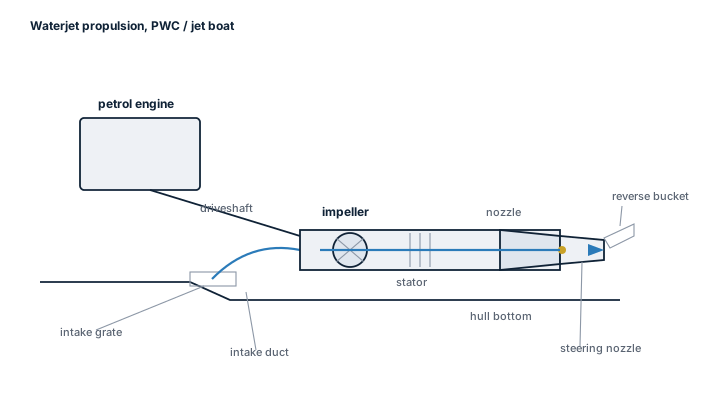
Personal watercraft and small jet boats use spark-ignition (SI) petrol engines coupled directly to an axial-flow waterjet pump, not a propeller shaft. That single design choice separates this category from almost everything else under propulsion: fuel is petrol rather than diesel, ignition is by spark plug rather than compression, and thrust is generated by an impeller accelerating a jet of water through a nozzle rather than by a propeller working in open water. The engine itself is closely related to an automotive or motorcycle unit, marinised for a wet, saltwater-adjacent environment and mounted horizontally or near-horizontally in a small, sealed engine bay.
Main components
Engine block and induction
Typically a two- or four-stroke, two- to four-cylinder petrol engine, naturally aspirated or supercharged in performance models, with electronic fuel injection standard on current production. Two-stroke units, once common for their power-to-weight ratio, have largely disappeared from new craft under emissions rules.
Waterjet pump and drive coupling
The engine drives an impeller through a splined coupling; the impeller forces water through a venturi and steering nozzle, and reverse is achieved with a gate that redirects the jet rather than by reversing the engine. There is no gearbox, propeller or shaft seal in the conventional sense, which removes one common failure point but makes impeller-to-liner clearance the equivalent maintenance item.
Cooling
Raw-water cooling drawn from the jet intake, routed through the engine block and exhaust, with no separate seawater pump — the same impeller that provides propulsion also supplies cooling water, so a fouled intake grate affects both at once.
Electrical and safety systems
Includes a lanyard-type engine cut-off switch, a spark arrestor where required by the operating area, and on newer models electronic throttle control integrated with off-throttle steering assistance.
Selection and sizing
- Power output matched to hull weight and intended use — leisure, rescue tender or high-speed patrol duty
- Naturally aspirated versus supercharged, trading fuel consumption against top-end power
- Emission family certification valid for the waters and flag the craft operates under
- Impeller pitch matched to hull and intended load, since the wrong pitch loads the engine incorrectly across its rev range
Regulations and class
In United States waters, engines are certified under EPA 40 CFR Part 1045 (Marine Spark-Ignition Engines), which sets the emission family and durability testing the engine must meet before sale; other markets apply equivalent recreational craft directive emission rules. Classification society coverage is rare for pure PWC and jet boat propulsion outside of a workboat or rescue-craft application, where the engine then falls under the class rules for that vessel's small-craft category rather than a dedicated propulsion class notation.
Typical faults
| Fault | Consequence |
|---|---|
| Debris ingested at the intake grate | Impeller damage and simultaneous loss of cooling water |
| Worn impeller-to-liner clearance | Falling thrust and top speed despite a healthy engine |
| Fuel system left wet over a lay-up period | Injector fouling and hard starting from stale petrol |
| Cut-off lanyard clip missing or bypassed | Engine cannot be stopped remotely if the operator is thrown clear |
What to look for in a supplier
- Emission family certificate matching the specific engine serial, not just the model line in general
- Impeller and wear-ring parts stocked for the exact pump generation, since these are wear items with no universal fit
- Documented marinisation of an automotive-derived block, including corrosion protection on the coolant and exhaust path
Flush the cooling and exhaust passages with fresh water after every saltwater run — the same jet-driven raw-water circuit that cools the engine is the fastest route for salt to seize an impeller shaft overnight.
Typical Manufacturers
13 manufacturers · 271 models
Yamaha Motor Co., Ltd.
106
Bombardier Recreational Products
90
Kawasaki
32
MSR Engines s. r. o
14
Mercury Marine
9


Jinhua Zhenqi Motion Apparatus
7
Gibbs Sports Amphibians
4
Belassi
2
Jiujiang Hison Motor Boat Manufacturing
2
MARINE POWER
2
Albert Weber Manufacturing
1
Aquanami
1
Tennessee Propulsion Products
1
Who can you trust with this job?
Brand coverage, certificates and contact routes for maritime suppliers.
Open network →Sanctions and the shadow fleet
Ownership, insurance and class records on ageing tankers under sanctions.
18 reports →Sourcing this part?
One request. You get suppliers who actually carry it, not a search page.
Request parts →Can't read the plate?
Photograph it. We identify make and model.
Try it →Who can you trust with this job?
Brand coverage, certificates and contact routes for maritime suppliers.
Open network →Sourcing this part?
One request. You get suppliers who actually carry it, not a search page.
Request parts →Sanctions and the shadow fleet
Ownership, insurance and class records on ageing tankers under sanctions.
18 reports →Can't read the plate?
Photograph it. We identify make and model.
Try it →