What to check on a Intermediate Shaft.
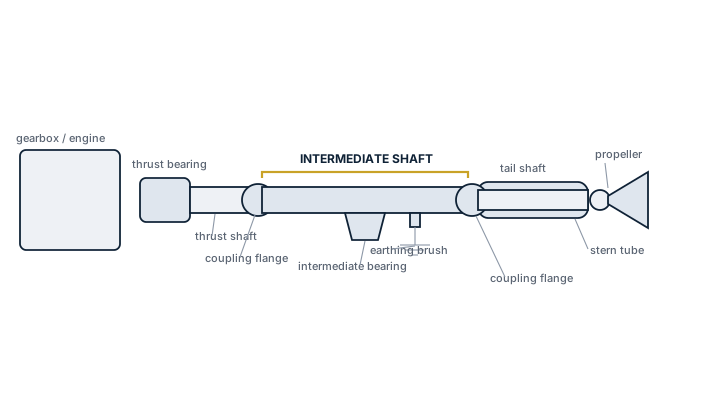
A propulsion shaft line is not one uniform bar of steel. The thrust shaft, immediately after the gearbox or engine flywheel, carries the propeller's axial thrust into the thrust bearing and hull. The tail shaft, at the far end, passes through the stern tube and carries the propeller itself, so it sees bending moment from the overhung weight and is wetted at its aft end. Between them runs one or more intermediate shafts, supported on plain bearings, whose only job is to transmit torque in a straight, well-aligned line. Because…
What sets this section of the shaft line apart
A propulsion shaft line is not one uniform bar of steel. The thrust shaft, immediately after the gearbox or engine flywheel, carries the propeller's axial thrust into the thrust bearing and hull. The tail shaft, at the far end, passes through the stern tube and carries the propeller itself, so it sees bending moment from the overhung weight and is wetted at its aft end. Between them runs one or more intermediate shafts, supported on plain bearings, whose only job is to transmit torque in a straight, well-aligned line. Because it carries no thrust and is not exposed to seawater, an intermediate shaft's failure modes are almost entirely about alignment, bearing condition and coupling integrity rather than corrosion or thrust bearing wear.
Main components
- Shaft body – a forged steel bar, often bored through its length so the material can be ultrasonically inspected from the inside as well as the outside, and to save weight on long shaft lines.
- Couplings – integral forged flanges, shrink-fit flangeless couplings, or keyed couplings on older tonnage. Flangeless shrink-fit designs are now preferred because they remove the keyway stress concentration that used to be a common crack origin.
- Intermediate bearings – white-metal lined plummer blocks supporting the shaft at intervals set by the alignment calculation, either oil-bath lubricated with a ring or disc oiler, or force-fed from a system pump on larger installations.
- Bearing temperature and vibration monitoring – resistance temperature sensors embedded in the white metal, feeding the alarm system, since a rising bearing temperature is usually the first sign of misalignment or lubrication failure.
Selection and sizing
Diameter is not a free choice: it comes out of a calculation based on transmitted power, shaft speed, material yield and tensile strength, and a minimum factor set by the classification society's rules. The same calculation sets the minimum bore diameter if the shaft is hollow. Bearing spacing is fixed by a whirling and alignment calculation that keeps the shaft's natural bending frequency away from running speed and keeps bearing reaction loads within the white metal's allowable pressure.
Regulations and class
Classification society rules (the IACS Unified Requirements for shafting are the common reference) set the minimum shaft diameter formula and the required non-destructive testing of forgings before entry into service. Intermediate shafts themselves do not usually carry the fixed five-year tailshaft withdrawal survey that applies to the tail shaft's stern tube seals, but they are examined at intermediate and special surveys for coupling condition, bearing wear and alignment, and class approval is needed for any repair weld or re-machining of a coupling face.
Typical faults
| Fault | Consequence |
|---|---|
| Misalignment after main engine or gearbox overhaul | Uneven bearing loading, elevated bearing temperature, and accelerated white metal wear |
| Fretting corrosion at keyed coupling faces | Crack initiation at the keyway root, historically a major cause of shaft failure on older keyed designs |
| Bearing oil ring or disc slipping or seizing | Starved lubrication and rapid bearing overheating, sometimes reaching the point of white metal wipe-out |
| Loose or corroded coupling bolts | Progressive fretting between flange faces, eventually producing measurable backlash and vibration |
What to look for in a supplier
- Forging certificates showing the ultrasonic and material test results, matched to the classification society covering the vessel
- A coupling design compatible with the existing shaft line rather than a mismatched bolt pattern or flange thickness
- Machining tolerances on coupling faces and bearing journals stated against a recognised standard, not just "as fitted"
- Willingness to support the alignment calculation for the specific vessel rather than supplying to a generic length
After any work that disturbs the engine or gearbox seating, check intermediate bearing temperatures over the first hours of running rather than trusting a cold alignment check alone; thermal growth of the engine structure can quietly pull the line out of tolerance once everything is warm.