Azimuth Thruster
An azimuth thruster steers by rotating its whole propulsion unit through 360 degrees rather than by a rudder behind a fixed shaft line, which removes the rudder but adds a right-angle gear train and a slewing bearing that now carry the vessel's entire manoeuvring load.
What to check on an Azimuth Thruster.
4 models from Wärtsilä in Azimuth Thruster. Below: the full model list.
What defines an azimuth thruster
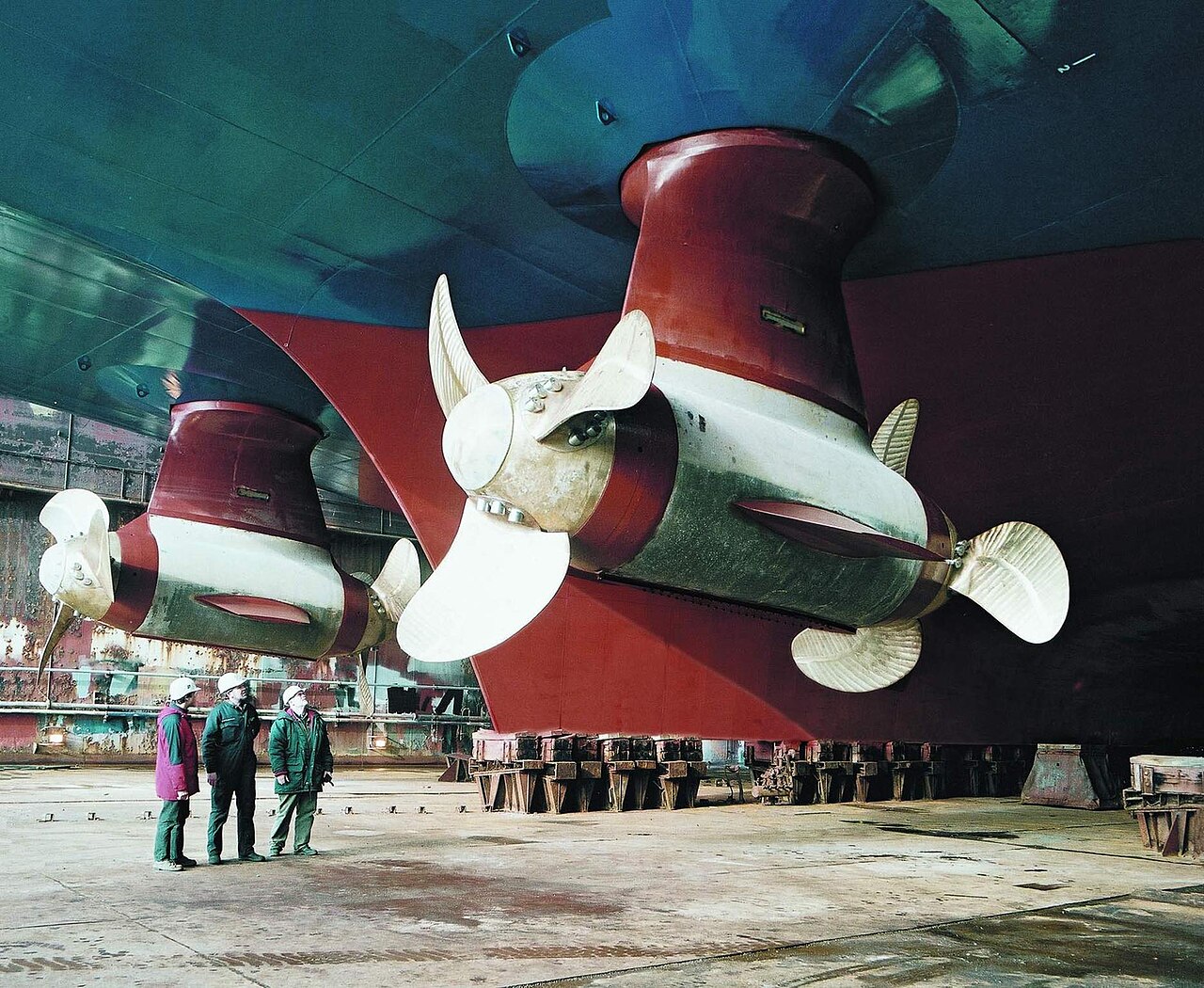
An azimuth thruster combines propulsion and steering in one unit: the propeller, or on Z-drive designs a propeller on the end of a pod, rotates around a vertical axis, so thrust can point in any direction without a rudder. That is its fundamental difference from a conventional shaft line — there is no separate steering gear, but the mechanical price is a right-angle gear drive from the vertical input shaft to the horizontal propeller shaft, plus a slewing bearing and hydraulic steering system that carry loads a fixed shaft line never sees.

Main components
Upper (vertical) gearbox
Takes drive from the prime mover, whether a diesel engine through a vertical shaft or, on an electric podded design, an integral motor, and turns it through 90 degrees toward the lower housing.
Lower housing and propeller shaft
Contains the second right-angle gear stage and the propeller shaft with its own bearings and seal arrangement, all inside a submerged, rotating housing — meaning the same corrosion and sealing concerns as a conventional stern tube, but on a unit that also has to rotate freely.
Read the full guide
Slewing bearing and steering system
A large-diameter bearing carries the whole unit's thrust and side load while allowing 360-degree rotation, driven by a hydraulic or electric steering system. This bearing and its seal are what most often limit the interval between dry-dockings for inspection.
Seals
Multiple seal stages protect the lower gear housing from sea water at the propeller shaft and protect the slewing interface at the hull penetration; seal failure here floods the unit's oil system, not just the bilge.
Selection and sizing
- Fixed-pitch versus controllable-pitch propeller on the unit, trading mechanical simplicity against manoeuvring flexibility at low speed
- Open versus nozzle-shrouded configuration, which changes bollard pull and efficiency at low speed
- Power transmission path — mechanical drive from a diesel engine versus an integrated electric motor in a pod — driven by the vessel's overall power plant concept
- Redundancy requirement: dynamic-positioning vessels typically need multiple independent thrusters on separate power sources, which sets the minimum unit count before sizing individual units
Regulations and class
Class societies assign azimuth thrusters under their propulsion and, where fitted for station-keeping, dynamic-positioning notations, with survey intervals for the gear stages, bearings and seals broadly aligned with the vessel's propulsion shaft survey cycle but requiring the unit's own maker-specified oil sampling and bearing clearance checks. DP-class vessels carrying azimuth thrusters as part of their redundancy concept are subject to additional IMO MSC Circular 645/1580 DP class requirements covering independence of thruster power and control systems.
Typical faults
| Fault | Consequence |
|---|---|
| Slewing bearing seal wear | Water ingress to the steering gear space, corrosion and eventual steering restriction |
| Lower gear housing oil contaminated with sea water | Accelerated gear and bearing wear, detected through routine oil sampling if done, otherwise through vibration or noise |
| Hydraulic steering system leakage | Loss of azimuth control precision, a direct problem for DP-class vessels holding position |
| Cathodic protection anodes on the housing depleted | Accelerated corrosion of the submerged housing between dry-dockings |
What to look for in a supplier
- Documented oil sampling and condition-monitoring history for the specific unit, not a fleet-average service record
- Spare seal kits held for the exact model and generation, since seal designs change between production series
- Service support able to reach the vessel's trading pattern, given that a thruster casualty on a DP vessel is an operational stop, not a deferred maintenance item
Log azimuth thruster oil sample results against the maker's trend limits every time, not only when a problem is suspected — sea water ingress at the lower seal shows up in the oil long before it shows up as noise or vibration.
Models in this type.
The best-documented model of each manufacturer first, then the next — 4 of 4 models in Azimuth Thruster. Every row links to full specifications, documents and service notes.
Manufacturers.
All 19 manufacturers with models of Azimuth Thruster. Names with a manufacturer page open it; the others open a search across the full library.
All manufacturersAlso in Shaft Line & Propulsion.
The other equipment types in this category.
One request. A person reads it and replies by e-mail.
Tell us the manufacturer, the model and what you need — a part, a service call, a second opinion. A person reads every request and replies by e-mail.
No details at hand? A photo of the rating plate or the part is enough — simply attach it to the request.
Three things people ask first.
Is Azimuth Thruster data free?
Yes. Every model page, every guide and every datasheet for this type is readable without an account. An account adds saved searches and requests, nothing is taken away.
My model is missing — what now?
Send us the nameplate. We identify it by hand, add it to the library, and if you need a part or a service, the request is already on our desk.
Can you source a Azimuth Thruster part?
Yes. Tell us the manufacturer, the model and what you need — a person reads every request and replies by e-mail.