FM-200/Novec System
FM-200 (HFC-227ea) and Novec 1230 are clean agent gases that extinguish fire by removing heat rather than displacing oxygen, so unlike CO2 flooding a space dosed with either agent stays breathable for the short evacuation time these systems are designed around.
What to check on a FM-200/Novec System.
43 models from Tyco / Johnson Controls in FM-200/Novec System. Below: the full model list.
What makes a clean agent system different from CO2
Both FM-200 and Novec 1230 work primarily by physical heat absorption rather than oxygen displacement, so the design concentration used to extinguish a fire, typically in the range of six to nine percent by volume, remains within limits considered survivable for the short time needed to evacuate. This is the key difference from a CO2 flooding system, which extinguishes by reducing oxygen concentration to a level that also cannot support human life, and therefore demands stricter evacuation and lock-out procedures before discharge. Clean agents are stored as a liquefied gas under pressure and discharge in seconds, filling the protected space uniformly through a network of nozzles.
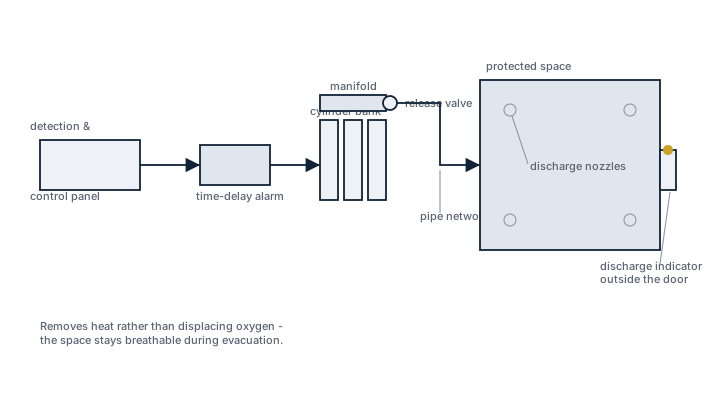
Legend
- protected space
- manifold
- release valve
- discharge nozzles
- cylinder bank
- detection & control panel
- time-delay alarm
- pipe network
- discharge indicator outside the door
Main components
Agent storage cylinders
Pressurised cylinders hold the liquefied agent with a nitrogen superpressurisation charge; cylinder pressure is checked periodically as the main indicator of agent retention.
Detection and control panel
Cross-zoned smoke or heat detection triggers an alarm sequence with a time delay before automatic release, giving personnel a window to evacuate or abort the discharge.
Read the full guide
Distribution piping and nozzles
Fixed pipework sized by hydraulic calculation delivers agent to nozzles positioned to achieve uniform concentration throughout the protected space within the required discharge time, generally around ten seconds.
Manual release and abort stations
A manual pull station allows immediate discharge, while an abort station lets an occupant hold off automatic release if the space is occupied and the alarm is being investigated.
Space integrity features
Automatic dampers or shutdowns close ventilation openings and stop fans before discharge, since agent concentration cannot be held if the space keeps exchanging air with the outside.
Selection and sizing
Agent quantity is calculated from the protected space's net volume, the required design concentration for the agent and the fire risk class present, with a margin for the space's enclosure integrity (leakage through cable and pipe penetrations). Novec 1230 requires a larger stored liquid volume than FM-200 for the same protected volume, which affects cylinder room space and weight, a real consideration on smaller vessels.
Regulations and class
SOLAS Chapter II-2 and the IMO Fire Safety Systems (FSS) Code govern fixed gas fire-extinguishing systems, including agent quantity, discharge time and alarm sequencing, with the specific chapter applied depending on the protected space and its size. Flag and class requirements call for periodic weighing or pressure checks of cylinders and functional testing of the detection and release sequence, since these agents are also subject to environmental phase-out schedules that affect long-term parts and refill availability.
Typical faults
- Low cylinder pressure or agent loss - a slow valve or fitting leak reduces the stored quantity below the calculated design amount, so a real discharge would not reach extinguishing concentration.
- Space integrity loss - new cable runs or ventilation modifications after the original design create leak paths that let agent concentration fall below the effective level before the fire is out.
- Detection system false alarms or failures - dust or oil mist fouling smoke detectors either triggers nuisance discharges or, if desensitised in response, delays real detection.
- Damper or fan interlock failure - if ventilation does not shut down automatically on discharge, agent concentration is diluted continuously and never reaches design level.
- Neglected abort station testing - an abort function that has not been tested may not work when actually needed, forcing an unnecessary full discharge during routine work in the space.
What to look for in a supplier
- System design calculations matched to the actual as-built space volume and enclosure, not a generic per-cubic-metre estimate.
- Cylinder refill and testing service available in the ship's trading area, given that agent and cylinder testing has specific handling requirements.
- Clear guidance on the agent's long-term regulatory status, since environmental rules on fluorinated gases continue to evolve and affect future availability.
- Documented compatibility with the ship's existing detection and alarm panel if only part of the system is being renewed.
Room integrity, not agent quantity on paper, decides whether a clean agent system actually extinguishes a fire - treat every new penetration through a protected space's boundary as a system modification that needs sign-off.
Models in this type.
The best-documented model of each manufacturer first, then the next — 43 of 43 models in FM-200/Novec System. Every row links to full specifications, documents and service notes.
Manufacturers.
All 6 manufacturers with models of FM-200/Novec System. Names with a manufacturer page open it; the others open a search across the full library.
All manufacturers in the libraryAlso in Fixed Fire Suppression.
The other equipment types in this category.
Write to us about this model — the answer comes by e-mail.
Name the make and the model and what the job is: a spare, a service call, a second opinion on a data sheet. We answer by e-mail.
No details at hand? A photo of the rating plate or the part is enough — simply attach it to the request.
Questions that come up with this equipment.
Is FM-200/Novec System data free?
Yes. Every model page, every guide and every datasheet for this type is readable without an account. An account adds saved searches and requests, nothing is taken away.
My model is missing — what now?
Send us the nameplate. We identify it by hand, add it to the library, and if you need a part or a service, the request is already on our desk.
Can you source a FM-200/Novec System part?
Yes. Tell us the manufacturer, the model and what you need — a person reads every request and replies by e-mail.