What to check on a CO2 Fixed Fire System.
A CO2 fixed fire system extinguishes by smothering rather than cooling: it displaces oxygen in the protected space until combustion can no longer sustain itself, typically requiring the CO2 concentration to reach around 30-40 percent by volume depending on the space and cargo. This is different from a water mist or sprinkler system, which extinguishes mainly by cooling, and from a foam system, which blankets a liquid surface. Because the same mechanism that starves a fire of oxygen also asphyxiates a person, CO2 systems are fitted only in normally unmanned…
What sets a CO2 fixed fire system apart
A CO2 fixed fire system extinguishes by smothering rather than cooling: it displaces oxygen in the protected space until combustion can no longer sustain itself, typically requiring the CO2 concentration to reach around 30-40 percent by volume depending on the space and cargo. This is different from a water mist or sprinkler system, which extinguishes mainly by cooling, and from a foam system, which blankets a liquid surface. Because the same mechanism that starves a fire of oxygen also asphyxiates a person, CO2 systems are fitted only in normally unmanned spaces such as engine rooms, cargo pump rooms and paint lockers, with strict release procedures.
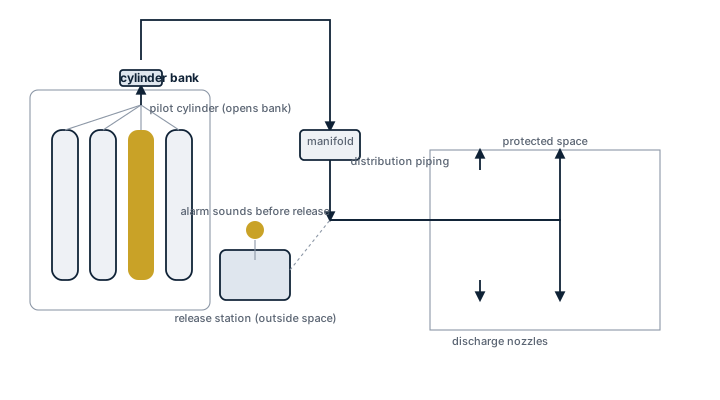
Main components
Cylinder bank
Liquid CO2 is stored under its own vapour pressure in a bank of steel cylinders in a dedicated room, sized by total protected volume and, on some ships, split between a main and reserve bank.
Distribution piping and nozzles
Fixed pipework runs from the cylinder bank manifold to discharge nozzles positioned to flood the protected space evenly, sized so the required concentration is reached within the time set by the system's design standard.
Release arrangement
Release is deliberately a two-stage manual action: opening the space's boundary and ventilation dampers, then operating a separate release lever, with a time-delayed alarm and audible warning before gas actually discharges, giving anyone inside time to evacuate.
Detection and alarm
Fixed detection in the protected space (smoke, heat, or flame detectors depending on the risk) triggers the fire alarm and readies the system, though release itself normally remains a manual crew decision rather than fully automatic.
Regulations and class requirements
Fixed gas fire-extinguishing systems are governed by SOLAS Chapter II-2 and detailed in the IMO Fire Safety Systems (FSS) Code, which sets minimum CO2 quantity per protected volume, discharge time, piping design, and the mandatory pre-discharge alarm sequence. Cylinders are weighed or otherwise checked for content loss at intervals set by class and the FSS Code, commonly during each survey cycle, and a loss beyond the allowed tolerance requires the cylinder to be recharged.
Typical faults
- Slow CO2 loss through a cylinder valve seal — bank shows correct pressure on a quick check but is under-charged by weight, giving less than the design concentration
- Corroded or damaged distribution piping — gas escapes before reaching the intended nozzles, delaying or preventing the fire from being smothered
- Boundary or ventilation dampers not closing fully — released gas leaks out and the space never reaches extinguishing concentration
- Release lever or Bowden cable seized — crew cannot operate the system quickly when it is actually needed
- Pre-discharge alarm disabled or ignored — loss of the warning time meant to clear personnel from the space
What to look for in a supplier
- System sizing calculation matching the actual protected volume, not a generic figure carried over from a sister ship
- FSS Code compliant pre-discharge alarm and time delay arrangement
- Cylinder weighing or level-checking method the crew can realistically carry out on board
- Documented piping design confirming discharge time and nozzle coverage for the space
- Service support able to recharge and pressure-test cylinders locally rather than requiring a full bank exchange abroad
Treat every CO2 release drill as if the space were occupied: confirm the muster count before anyone touches the release lever, not after, because the gas gives no second chance once discharged.