OceanSphereEnginesPartsWorkServiceNetworkAdditiveFree accountLog inDEENPL
OceanSphereENGINES
Library Navigation Position & Heading GPS Receiver
Position & Heading

GPS Receiver

A marine GPS receiver reports position only; it says nothing about heading unless paired with a second antenna for GNSS compass mode, which is why SOLAS still requires an independent, non-GNSS means of fixing position.

97models 20manufacturers
Models

Models in this type.

The 97 models with the most complete data of 97 in GPS Receiver. Every row links to full specifications, documents and service notes.

FurunoGP-150D FurunoGP-170 BeiDou FurunoGP-170 FISH FurunoGP-170 GLONASS FurunoGP-170 Galileo FurunoGP-170 Multi-GNSS FurunoGP-170 NAV FurunoGP-170D FurunoGP-1870F FurunoGP-1871F FurunoGP-1971F FurunoGP-32 FurunoGP-33 FurunoGP-33 SBAS FurunoGP-39 Multi-GNSS FurunoGP-39 WAAS FurunoSC-130 FurunoSC-33 FurunoSC-50 Kongsberg MaritimeDPS-116 Kongsberg MaritimeSeatex DPS-200 Kongsberg MaritimeSeatex DPS-232 Kongsberg MaritimeSeatex DPS-300 Kongsberg MaritimeSeatex MRU5+ Kongsberg MaritimeSeatex Seapath 130 Kongsberg MaritimeSeatex Seapath 130+ Kongsberg MaritimeSeatex Seapath 230 Kongsberg MaritimeSeatex Seapath 330 Kongsberg MaritimeSeatex Seapath 330+ Kongsberg MaritimeSeatex Seapath 380 Kongsberg MaritimeSeatex Seapath 380+ Kongsberg MaritimeSeatex Seapath 430 JRC (Japan Radio Co)JLR-21 JRC (Japan Radio Co)JLR-31 JRC (Japan Radio Co)JLR-4340 JRC (Japan Radio Co)JLR-4341 SBAS JRC (Japan Radio Co)JLR-7700MKII JRC (Japan Radio Co)JLR-7800 JRC (Japan Radio Co)JLR-7800 SBAS JRC (Japan Radio Co)JLR-7900 JRC (Japan Radio Co)JLR-7900 DGNSS JRC (Japan Radio Co)JLR-7900 GLONASS JRC (Japan Radio Co)JLR-7900 Multi-GNSS Hemisphere GNSSA222 Hemisphere GNSSA325 Hemisphere GNSSA631 Hemisphere GNSSV200 Hemisphere GNSSV320 Hemisphere GNSSV500 Hemisphere GNSSVS1000 Hemisphere GNSSVS330 Hemisphere GNSSVector V113D Hemisphere GNSSVega 34 SimradHS80A SimradHS90 SimradMX-521B SimradMX-610 SimradMX575D SimradMX610 Mk2 SimradMX612A SimradMX612B SimradVECTOR V104 SimradVECTOR V114 Garmin MarineGHP-12 Garmin MarineGHP-20 Garmin MarineGHP-Reactor 40 Garmin MarineGNX 120 Garmin MarineGNX 130 Garmin MarineGPS 19x HVS Garmin MarineGPS 24xd Trimble MarineDPS 232 Trimble MarineDPS 232 PRO Trimble MarineGPA-017S Trimble MarineMPS-865 Trimble MarineSPS-461 Trimble MarineSPS-855 Leica GeosystemsMX-575C-Dual Leica GeosystemsMX521A Leica GeosystemsMX612 WärtsiläPrecis Heading 100 WärtsiläPrecis Heading 200 WärtsiläPrecis Heading 300 uflexdownloadarea23112S - B00034901 uflexdownloadarea23565g - B00041701 uflexdownloadarea23566J - B00041601 Topcon MarineB210 Topcon MarineHiPer VR d160001GNSS NAVIGATOR d160001GP-170 McMurdoFast Find 220 digitalyachtGPS105 furunolegacyproductsGP-170 gmeSAILOR jrcdiscontinuedproductsJUE-95SA lorenzATOM 9/ATOM 12 sailorthranethraneSAILOR 4352A/SAILOR 4338A seasofsolutionsmcmurdokannadFastFind CREW1
By manufacturer

Manufacturers.

All 20 manufacturers with models of GPS Receiver. Every name opens a search across the full library.

Related types

Also in Position & Heading.

The other equipment types in this category.

Echo SounderGPS / DGPSGPS/GNSSGPS/GNSS ReceiverGyrocompassMagnetic CompassMagnetic Compass (TMC)Rate of Turn IndicatorSpeed LogSpeed Log (Correlation)Speed Log (Doppler / EM)Speed Log (Doppler)
Knowledge

What to check on a GPS Receiver.

A marine GPS receiver decodes signals from the US GPS constellation and, on most modern sets, also from GLONASS, Galileo and BeiDou, giving a fused multi-constellation fix rather than relying on GPS alone. It answers one question only: where is the antenna right now. It does not tell the bridge which way the bow points -- that is the gyrocompass's job -- and it does not replace a second, independent means of fixing position, which SOLAS still requires precisely because a single GNSS source can fail or be spoofed without…

What sets this receiver apart from other position sources

A marine GPS receiver decodes signals from the US GPS constellation and, on most modern sets, also from GLONASS, Galileo and BeiDou, giving a fused multi-constellation fix rather than relying on GPS alone. It answers one question only: where is the antenna right now. It does not tell the bridge which way the bow points -- that is the gyrocompass's job -- and it does not replace a second, independent means of fixing position, which SOLAS still requires precisely because a single GNSS source can fail or be spoofed without warning.
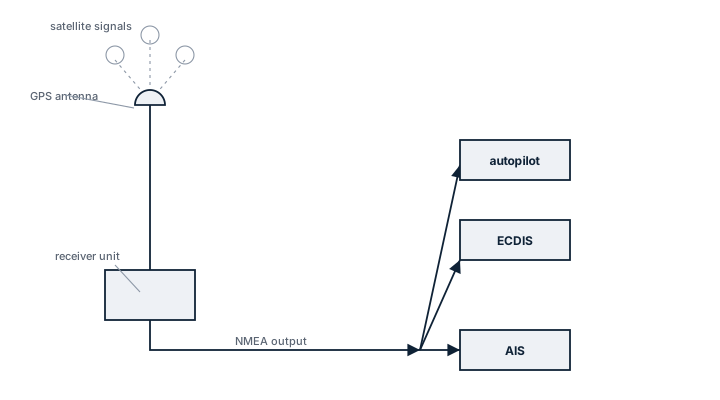
GPS receiver signal path
A masthead GPS antenna receives satellite signals and feeds a receiver unit, which distributes an NMEA position output to the ECDIS, autopilot and AIS.

Main components

Antenna

A dome-mounted active antenna with integral low-noise amplifier, positioned with a clear sky view away from radar scanners and funnel exhaust, which otherwise degrade signal-to-noise ratio.

Receiver / processing unit

Tracks 12 to 30+ satellite channels simultaneously, computes a weighted position solution, and applies differential corrections where available (SBAS such as EGNOS or WAAS, or a local DGPS beacon feed).

Output interfaces

NMEA 0183 or NMEA 2000 serial output feeding ECDIS, AIS, VDR and autopilot in parallel; many bridges wire two receivers into a changeover or voting arrangement so a single antenna fault does not blind every downstream system at once.

Selection criteria

  • Number of tracked constellations and channels -- more channels shorten re-acquisition time after a mast shadow or heavy roll.
  • Update rate, typically 1 Hz for standard navigation, higher for dynamic positioning feeds.
  • Differential correction support (SBAS, RTK) where the trade requires metre-level or sub-metre accuracy, for example dredging or offshore support work.
  • Output protocol compatibility with the existing ECDIS and VDR interface list.

Regulations and class

SOLAS Chapter V requires vessels to carry a receiver for a global navigation satellite system, or terrestrial radio navigation system, appropriate to the voyage, and to maintain a means of determining position that does not depend solely on one GNSS. Class societies survey the installation as part of the navigation equipment audit rather than as a standalone item, checking that the antenna position and cabling match the approved drawing and that backup arrangements are functional.

Typical faults

  • Antenna cable corrosion at the deck gland, causing intermittent signal loss that looks like a satellite outage rather than a wiring fault.
  • Loss of differential correction when the vessel moves out of SBAS or beacon coverage, degrading accuracy without triggering an alarm on older receivers.
  • Multipath error near steel superstructure or containers, producing a stable but wrong fix that the receiver reports with high confidence.
  • Firmware not updated for GPS week-number rollover, which can jump the reported date and confuse logging systems.

What to look for in a supplier

  • Type approval certificate matching the flag state and class society of the vessel, not just a generic marine label.
  • Documented output protocol list so integration with the existing ECDIS and AIS does not need a separate converter.
  • Availability of spares and firmware updates well beyond the initial warranty period, given typical fit life of ten years or more.

Two receivers from the same manufacturer and the same antenna run are still a single point of failure if they share a mast position and a power supply -- route the second antenna and cable separately if the redundancy is meant to mean anything during a storm or a mast strike.

Search by manufacturer AFRISOWISKASwagelokAlfa Laval S.p.A.MAN Energy SolutionsWärtsiläEndress+HauserABB MarineAlfa LavalMacGregorNovenco MarineCarrier MarineseimiSiemens MarineHeinen & Hopman
Would you like to know more?

One request. A person answers within 24 hours on working days.

Tell us the manufacturer, the model and what you need — a part, a service call, a second opinion. Our desk asks the right suppliers from a network of over 114,000 companies and comes back with a quote or a sourcing plan, not a search page.

Frequently asked

Three things people ask first.

Is GPS Receiver data free?

Yes. Every model page, every guide and every datasheet for this type is readable without an account. An account adds saved searches and requests, nothing is taken away.

My model is missing — what now?

Send us the nameplate. We identify it by hand, add it to the library, and if you need a part or a service, the request is already on our desk.

Can you source a GPS Receiver part?

Yes. Tell us the manufacturer, the model and what you need — our desk asks the right suppliers from a network of over 114,000 companies and comes back with a quote or a sourcing plan.