What to check on a Echo Sounder.
Position and heading equipment tells the bridge where the ship is and which way it points; the echo sounder tells the bridge something neither can: the depth directly beneath the hull at this instant. Charted depths are a survey from the past, sometimes recent, sometimes not, and channels silt, shift and get dredged between surveys. The echo sounder is the only piece of standard bridge equipment that measures the present condition of the seabed rather than referencing a database or a satellite constellation, which is why it stays relevant on…
What sets the echo sounder apart within position and heading equipment
Position and heading equipment tells the bridge where the ship is and which way it points; the echo sounder tells the bridge something neither can: the depth directly beneath the hull at this instant. Charted depths are a survey from the past, sometimes recent, sometimes not, and channels silt, shift and get dredged between surveys. The echo sounder is the only piece of standard bridge equipment that measures the present condition of the seabed rather than referencing a database or a satellite constellation, which is why it stays relevant on ships that otherwise navigate almost entirely by electronic chart and GNSS position.
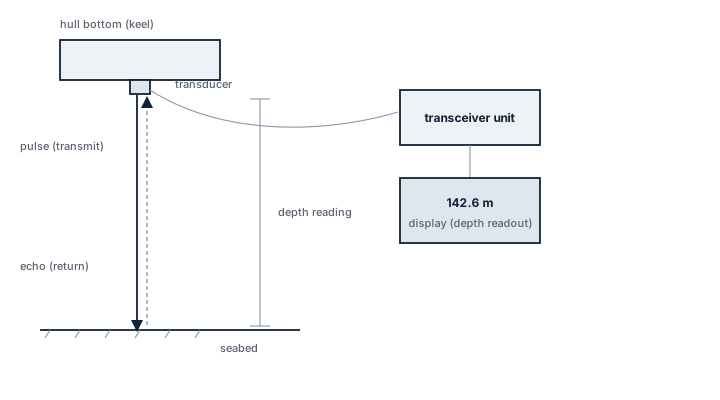
Main components
Transducer
Mounted through the hull, usually near the bow or amidships away from propeller and bow thruster turbulence, the transducer sends a sound pulse downward and times the return echo off the seabed. Placement matters: a transducer in aerated water from a thruster or in the ship's own wake gives noisy or false readings regardless of how good the electronics above deck are.
Transceiver and display unit
Converts transducer signal timing into a depth reading, displayed as a digital figure, an analogue trace, or both. Many units log a continuous depth trace on a chart recorder or digital log, useful for identifying a gradually shoaling bottom rather than relying on single instantaneous readings.
Alarm setting
A settable shallow-water alarm that alerts the bridge team when depth falls below a threshold set for the current draft and passage plan, the main practical safety function of the unit during pilotage and coastal passage.
Selection and sizing
| Variable | Why it matters |
|---|---|
| Operating frequency | Higher frequencies give better resolution in shallow water; lower frequencies penetrate further for deep-water sounding |
| Range | Coastal and port operation needs fine resolution in shallow ranges; some vessel types also need deep-water capability |
| Transducer type and mounting | Through-hull versus in-hull tank-mounted, chosen based on hull form and dry-docking constraints |
| Integration | Output format needs to match what the ECDIS, VDR and alarm system expect to receive it correctly |
Regulations and class
SOLAS Ch. V requires an echo sounding device on ships of a certain size as part of the mandatory navigational equipment carriage requirements, and IMO performance standards set minimum requirements for accuracy, range and the shallow-water alarm function. Class societies verify the fit against the ship's navigational equipment list at survey, and the unit's output typically also needs to be recorded by the Voyage Data Recorder where fitted.
Typical faults
- Transducer face fouled by marine growth or coated over during hull painting - readings become unreliable or stop entirely, often not noticed until a passage into shallow water actually needs the instrument.
- False shallow or erratic readings from aerated water when manoeuvring with thrusters or in following seas - mistaken for a genuine hazard, or worse, dismissed as noise when a genuine shoal is also present.
- Alarm threshold left at a default setting rather than updated for the ship's current draft and the passage plan's under-keel clearance margin - an alarm that triggers too late to matter, or so often it gets ignored.
- Depth reading referenced to the transducer rather than corrected for the ship's draft, leading the bridge team to misjudge actual under-keel clearance by the transducer's depth below the waterline.
What to look for in a supplier
- Type approval confirming compliance with the applicable IMO performance standard for echo sounding equipment
- Transducer options suited to the hull form and whether dry-docking access is available for a through-hull fitting
- Output interface compatible with the ship's ECDIS and VDR without a separate conversion device
- Serviceability of the transducer without a full dry-dock where the design allows it, reducing downtime for maintenance
Cross-check the echo sounder against charted depth every time it is practical to do so, not only when something looks wrong - a transducer that has drifted out of calibration gives a confident, wrong number, and confidence is exactly what makes a bad reading dangerous.
