What to check on a Rate of Turn Indicator.
A gyrocompass or heading sensor reports where the bow is pointing at any instant. A rate of turn indicator (ROTI) reports the rate of change of that heading, typically in degrees per minute, a different and complementary piece of information. During a turn in a narrow channel or a collision-avoidance manoeuvre, watching the rate of turn is often more useful than watching the heading number itself, because it shows immediately whether the rudder action is producing the turn rate intended and whether the turn needs to be checked before overshooting…
What Makes a Rate of Turn Indicator Different
A gyrocompass or heading sensor reports where the bow is pointing at any instant. A rate of turn indicator (ROTI) reports the rate of change of that heading, typically in degrees per minute, a different and complementary piece of information. During a turn in a narrow channel or a collision-avoidance manoeuvre, watching the rate of turn is often more useful than watching the heading number itself, because it shows immediately whether the rudder action is producing the turn rate intended and whether the turn needs to be checked before overshooting. Some vessels combine rate of turn with a maximum-turn-rate alarm to warn against excessive heel or a manoeuvre beyond the vessel's stability limits.
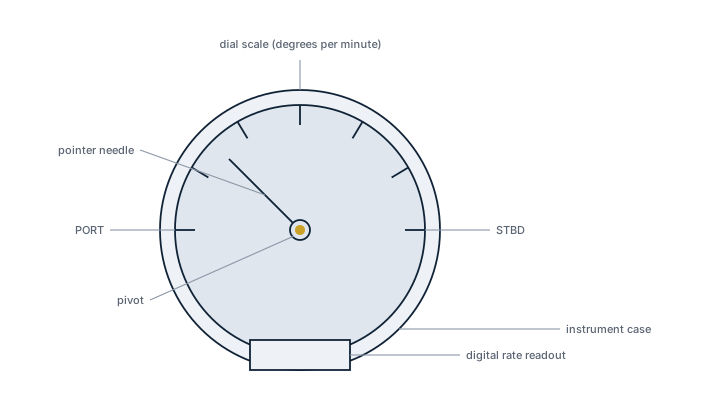
Main Components
Rate Sensor
Most modern ROTIs derive rate of turn directly from the ship's gyrocompass or inertial heading sensor by differentiating the heading signal electronically, rather than using a separate mechanical sensor; some standalone units use their own rate gyro.
Display
A dial or digital display calibrated in degrees per minute, commonly with a range around plus or minus 30 to 90 degrees per minute, mounted where it is visible to the officer of the watch during manoeuvring, typically alongside or integrated into the conning display.
Alarm Function
Where fitted, a settable high-rate alarm alerts the bridge team if the turn rate exceeds a preset threshold, useful as a check against an unintended excessive turn from an autopilot fault or steering gear issue.
Data Output
On integrated bridge systems the rate of turn signal feeds the electronic chart display and radar/ARPA for predicted vector display and is logged by the voyage data recorder.
Selection and Sizing
Selection is less about a numerical sizing calculation than about integration: the ROTI must be compatible with the ship's existing heading source, gyrocompass or satellite compass, and data bus, commonly NMEA 0183 or 2000 on smaller vessels, or a proprietary bridge system bus on larger integrated bridges, and its display range and update rate must suit the vessel's manoeuvring characteristics -- a fast ferry with rapid heading changes needs a higher update rate than a slow-turning bulk carrier.
| Parameter | Typical Value |
|---|---|
| Display units | Degrees per minute |
| Typical display range | +/-30 to +/-90 deg/min |
| Data interface | NMEA 0183/2000 or bridge system bus |
Regulations and Class
SOLAS Chapter V requires a rate of turn indicator on vessels of 50,000 gross tonnage and above, and it is a common fit on smaller vessels even where not mandated, because of its value during pilotage and manoeuvring. Where fitted, it must meet IMO performance standards for shipborne rate of turn indicators and carry type approval consistent with the vessel's other navigation equipment; class societies check its integration and correct function as part of the navigation equipment survey.
Typical Faults
| Fault | Cause | Consequence |
|---|---|---|
| Erratic or jumping reading | Noisy or degraded heading sensor signal feeding the rate calculation | Unreliable manoeuvring information during pilotage |
| Frozen display | Data bus interface fault or loss of heading source signal | Officer of the watch loses turn-rate reference, must rely on heading alone |
| False high-rate alarms | Alarm threshold set too low for the vessel's normal manoeuvring rates | Alarm fatigue, crew starts ignoring the alarm |
| Mismatch with radar predicted vector | Configuration error in the data feed to the ARPA | Confusing or contradictory manoeuvring display during collision avoidance |
What to Look for in a Supplier
- Confirmed compatibility with the vessel's existing heading sensor and bridge data bus before ordering, since a mismatched interface is the most common integration failure.
- Type approval consistent with the vessel's other navigation equipment and flag state requirements.
- Display readability at the actual mounting position, including in direct sunlight if bridge-wing visible.
- Support for firmware or configuration updates if the unit integrates into a wider bridge system.
Cross-check the rate of turn reading against a stopwatch and the compass repeater during a full swing at sea trial or annual test -- a ROTI that is quietly a few degrees per minute off is far more dangerous than one that has failed outright, because nobody notices until a tight manoeuvre goes wrong.