What to check on a Speed Log (Doppler / EM).
This entry covers two distinct sensing principles that both end up as a speed reading on the bridge. The Doppler log sends an acoustic pulse toward the seabed or into the water column and measures the frequency shift of the return, the same principle a police radar uses to read a car's speed. The electromagnetic (EM) log has no acoustic component at all: a small sensor projecting through the hull generates a magnetic field, and the ship's motion through the water induces a voltage proportional to speed, the same principle…
What makes this type
This entry covers two distinct sensing principles that both end up as a speed reading on the bridge. The Doppler log sends an acoustic pulse toward the seabed or into the water column and measures the frequency shift of the return, the same principle a police radar uses to read a car's speed. The electromagnetic (EM) log has no acoustic component at all: a small sensor projecting through the hull generates a magnetic field, and the ship's motion through the water induces a voltage proportional to speed, the same principle as an EM flow meter in a pipe. Both differ from the correlation log by not needing to track a repeating seabed pattern, which makes them usable at greater depths and in open ocean where correlation logs fall back to water-track mode.
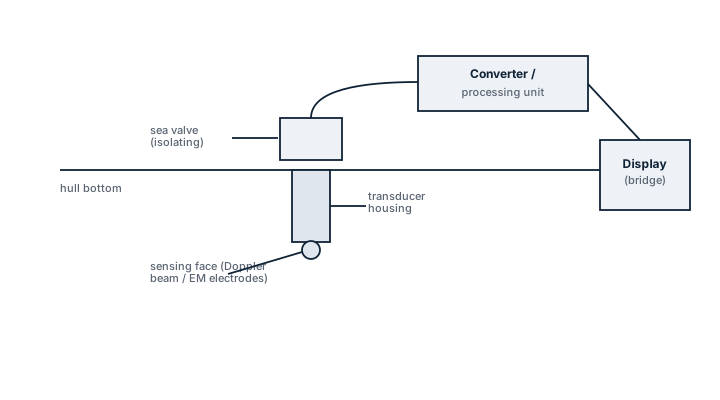
Main components
Doppler transducer
A hull-mounted acoustic transducer, often multi-beam, that transmits at an angle to the hull and receives the Doppler-shifted return either from the seabed (bottom track, giving speed over ground) or from suspended particles in the water column (water track, giving speed through water).
EM sensor probe
A retractable or fixed probe housing the coil and electrodes, mounted through a sea valve so it can be withdrawn for cleaning or replacement without drydocking.
Signal processor
Converts the raw frequency shift or induced voltage into a calibrated speed value, and switches between bottom-track and water-track modes on the Doppler variant.
Display and NMEA interface
Feeds speed data to radar, ECDIS, the engine performance monitoring system, and the voyage data recorder.
Selection / sizing
- Operating depth range: Doppler bottom track typically works to a few hundred metres; beyond that it reverts to water track with lower accuracy against ground.
- Vessel type: EM logs are common on ferries and smaller vessels needing frequent, low-maintenance readings; Doppler logs dominate on larger merchant tonnage needing both over-ground and through-water data.
- Retractability of the sensor, important where hull cleaning or antifouling schedules require removing the probe without dry-docking.
- Number of beams on the Doppler unit, which affects whether athwartships (docking) speed is available alongside fore-aft speed.
Regulations / Class
SOLAS Ch. V requires an approved means of indicating speed and distance on vessels above the size threshold set by the chapter, and both Doppler and EM logs satisfy this where type-approved. Class societies require periodic verification against a measured distance or GPS ground speed, and the sea valve and probe are subject to hull penetration survey requirements at drydocking.
Typical faults
| Fault | Cause | Consequence |
|---|---|---|
| EM probe fouling | Marine growth or paint residue on the sensor face | Zero-offset drift, speed reads consistently high or low |
| Doppler bottom-track dropout | Water too deep for the beam to reach and return from the seabed | Automatic switch to water track, losing over-ground accuracy |
| Aeration under the hull | Heavy seas, light ballast condition | Signal noise, intermittent or erratic speed output |
| Sea valve leakage | Worn gland seal around the retractable probe | Ingress requiring emergency retraction and valve closure |
What to look for in a supplier
- Confirmed type approval covering the SOLAS speed and distance indicator requirement.
- Retractable housing design that matches the vessel's existing sea valve, if replacing rather than newbuild.
- Availability of dual-axis output where docking manoeuvres need athwartships speed.
- Spare probe or sensor element stocked separately from the electronics, since the wetted part wears faster than the processor.
Confirm whether the displayed figure is bottom track or water track before relying on it close to a berth. An EM or Doppler log defaulting to water track will not show the current-driven set that bottom track would catch.