What to check on a Magnetic Compass.
A magnetic compass aligns itself with the earth's magnetic field using nothing but a pivoted card carrying its own magnets, floating in liquid inside a gimballed bowl. It needs no power supply, no satellite signal, and no gyro spin-up time, which is why SOLAS keeps it mandatory as the one heading reference that survives a total blackout or a failure of every electronic system on the bridge at once. A gyrocompass is more accurate and gives a true heading directly; the magnetic compass gives a magnetic heading that has to…
What sets the magnetic compass apart
A magnetic compass aligns itself with the earth's magnetic field using nothing but a pivoted card carrying its own magnets, floating in liquid inside a gimballed bowl. It needs no power supply, no satellite signal, and no gyro spin-up time, which is why SOLAS keeps it mandatory as the one heading reference that survives a total blackout or a failure of every electronic system on the bridge at once. A gyrocompass is more accurate and gives a true heading directly; the magnetic compass gives a magnetic heading that has to be corrected for variation and deviation before it matches the chart.
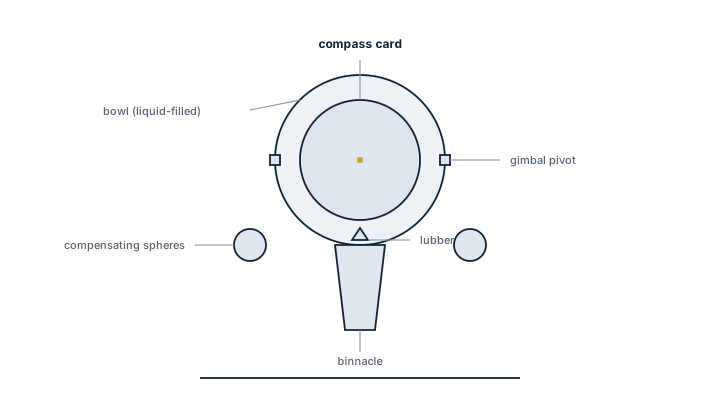
Main components
Compass card and bowl
The card carries a set of small magnets fixed to its underside, pivoting on a jewelled bearing at the centre of a bowl filled with a mixture of distilled water and alcohol (or white spirit on older sets) chosen for a low freezing point and to dampen card oscillation.
Gimbal and binnacle
The bowl sits in a gimbal ring so it stays level as the ship rolls and pitches, mounted in a binnacle built from non-magnetic material such as brass, aluminium or wood so the housing itself does not distort the reading.
Correctors
Fore-and-aft and athwartship permanent magnets, a heeling magnet, quadrantal spheres and a Flinders bar are fitted around the binnacle to cancel out the ship's own magnetism, both permanent (hard iron) and induced (soft iron), that would otherwise deflect the card away from true magnetic north.
Azimuth ring and transmitting element
An azimuth mirror or ring lets the officer of the watch take bearings of terrestrial objects or celestial bodies, and many installations add a transmitting magnetic compass (TMC) or fluxgate sensor that repeats the heading electronically to the autopilot and other bridge equipment as a backup heading source independent of the gyro.
Selection and positioning
- Card diameter, commonly around 200 mm for a bridge standard compass, trades sensitivity against readability.
- Position matters more than the instrument itself: the standard compass sits as high and as far from steel masses, cabling and electrical equipment as practicable, typically on a platform above the wheelhouse.
- Liquid mixture is chosen for the trading area's expected temperature range, since a mixture that is fine in the tropics can partly freeze on a North Atlantic winter crossing.
- Steering compass, or a periscope repeater viewing the standard compass, needs a clear sightline from the helm position.
Regulations and class
SOLAS Chapter V requires ships to carry a properly adjusted standard magnetic compass, or another means independent of any power supply to determine heading, regardless of what electronic heading systems are also fitted. A deviation table, compiled after the compass is swung by a licensed compass adjuster, must be kept current and rechecked whenever the ship undergoes significant steel work near the compass, a major cargo change on a ship carrying steel or magnetic cargo, or after a long lay-up.
Typical faults
| Fault | Cause | Consequence |
|---|---|---|
| Bubble in the bowl | Temperature change or a failed liquid seal | Card motion becomes sluggish or erratic, reading harder to take accurately |
| Card sticking or dragging | Worn or corroded pivot jewel | False or lagging heading indication, worst during course changes |
| Deviation drift | Correctors shifted or steel work carried out nearby without re-swinging | Heading error grows unnoticed until cross-checked against gyro or GPS course |
| Liquid discolouration | Ageing mixture or contamination | Card harder to read, particularly at night |
What to look for in a supplier
- Precision of the pivot jewel and gimbal bearings, since this is what determines long-term card steadiness.
- Liquid mixture correctly specified for the vessel's trading area.
- Ability to provide a certified compass adjustment and deviation card after installation or major repair.
- Spares for the azimuth ring, periscope and any fitted transmitting element.
Re-swing the compass after any significant steel work near the binnacle, not just at the scheduled interval — deviation shifts with the ship's structure, not with the calendar.