What to check on a Gyrocompass.
A gyrocompass seeks true north using a fast-spinning rotor whose axis is made to align with the earth's rotational axis through gravity and precession control, rather than sensing the earth's magnetic field the way a magnetic compass does. That makes it immune to magnetic variation, deviation from the ship's own steel and electrical equipment, and the polar regions where a magnetic compass becomes unreliable. It differs from a satellite compass, which derives heading from the phase difference between multiple GNSS antennas and needs no spin-up time but depends entirely on…
What defines this type
A gyrocompass seeks true north using a fast-spinning rotor whose axis is made to align with the earth's rotational axis through gravity and precession control, rather than sensing the earth's magnetic field the way a magnetic compass does. That makes it immune to magnetic variation, deviation from the ship's own steel and electrical equipment, and the polar regions where a magnetic compass becomes unreliable. It differs from a satellite compass, which derives heading from the phase difference between multiple GNSS antennas and needs no spin-up time but depends entirely on satellite signal availability. Most SOLAS vessels still carry a gyrocompass as the primary heading reference specifically because it is self-contained and does not depend on an external signal.
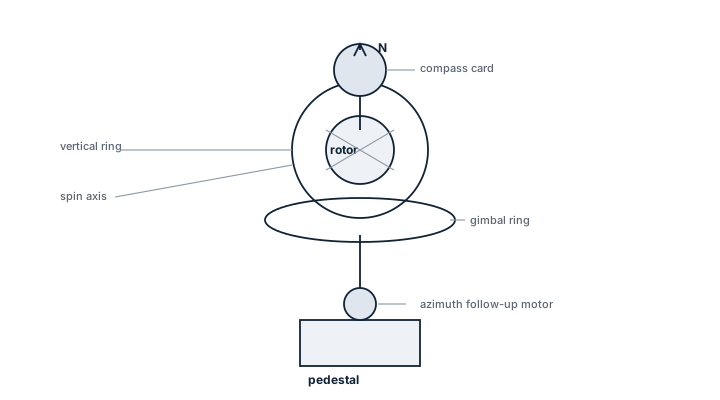
Main components
Sensitive element
The spinning rotor itself, suspended so it is free to precess, forms the north-seeking element. Modern units use a fibre-optic or ring-laser gyro in place of a mechanically spinning mass, reaching the same north-seeking result through a different physical principle, though the term gyrocompass is still applied to both.
Follow-up and repeater system
A servo system keeps the compass card or digital output aligned with the sensitive element and distributes the heading signal to repeaters on the bridge wings, radar, autopilot and VDR.
Correction circuits
Speed and latitude error correction compensates for the systematic heading error a gyrocompass develops from the ship's own speed and course relative to the earth's rotation, applied automatically from speed log and latitude input.
Power supply
Runs from the ship's emergency-backed supply, since a heading reference loss during an emergency is exactly when it is needed most.
Selection and sizing
There is no capacity sizing question as with a pump or a compressor; the choice is between spinning-mass and optical (fibre-optic or ring-laser) gyro technology, and between single-unit and dual-redundant installations required on larger or higher-class vessels.
- Settling time to reach a stable heading after start-up, relevant for turnaround time in port
- Accuracy specification, typically within a fraction of a degree, against the vessel's navigation class requirements
- Number of repeaters and interfaces needed across bridge, radar, ECDIS, autopilot and VDR
- Redundancy requirement, since some flag and class notations call for a second independent heading source
Regulations and class
SOLAS Chapter V requires ships of 500 gross tonnage and upwards to carry a gyrocompass or other means to determine and display heading, with the specific requirement depending on ship size and type. IMO performance standards for gyrocompasses set accuracy and settling-time requirements that a type-approved unit must meet. Class societies verify the installation, power supply arrangement and interface to other mandatory equipment during new-building survey and periodic surveys thereafter.
Typical faults
| Fault | Cause | Consequence |
|---|---|---|
| Persistent heading error | Speed/latitude correction not updated or speed log input faulty | Small but real course error, worse at high latitude or high speed |
| Repeater disagreement with master compass | Follow-up servo drift or a failed repeater synchro | Bridge wing or radar shows a different heading than the master unit |
| Long or failed settling after start | Bearing wear on older spinning-mass units, or a fault in the optical gyro element | Delayed departure while waiting for the compass to settle, or reliance on a secondary reference |
| Loss of heading signal to autopilot | Interface or wiring fault between gyrocompass and autopilot | Autopilot drops to standby, requiring manual steering |
What to look for in a supplier
- Type approval certificate matching current IMO performance standards
- Settling time and accuracy figures suited to the vessel's operating profile, not just the minimum standard
- Interface compatibility with the existing ECDIS, radar and autopilot without a gateway workaround
- Service support able to reach the vessel's trading area for calibration and repair
Before condemning a gyrocompass for heading error, check the speed log input first, since a stuck or wrong speed feed produces exactly the same symptom as a genuine gyro fault.