Submerged Cargo Pump
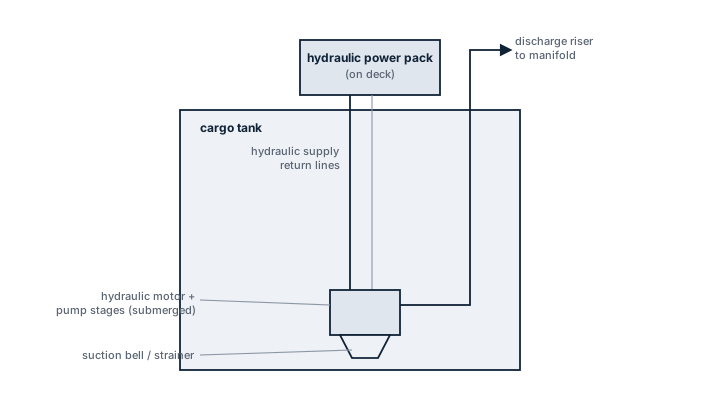
A submerged, Framo-type pump puts the whole drive down in the tank as a hydraulic motor coupled straight to the pump stages, with no line shaft, the opposite of a deepwell pump's deck-mounted electric motor. That keeps electrics out of the tank but makes preventing hydraulic oil from reaching the cargo a design problem of its own.
Read more — Submerged Cargo Pump explained ▾
What sets a submerged pump apart
A submerged cargo pump, the type most associated with the Framo system, puts the whole drive unit down in the tank with the pump itself: a hydraulic motor, fed by oil pumped down from a power pack on deck, sits directly above or alongside the centrifugal stages at the tank bottom, with no long line shaft running the height of the tank. That is the opposite arrangement to a deepwell pump, which keeps an electric motor on deck and drives the stages through a shaft supported by product-lubricated bearings all the way down. Removing the line shaft removes its bearings and alignment issues, and because the drive is hydraulic rather than electric, pump speed and therefore flow rate can be varied smoothly by throttling hydraulic oil flow rather than needing a separate frequency converter. The trade-off is that hydraulic oil is now circulating through lines that run down into the cargo tank, so preventing that oil from ever mixing with the cargo becomes a design requirement in its own right.
Main components
Hydraulic power pack
An electric motor on deck drives a hydraulic pump, building the flow and pressure that is distributed to one or more submerged pump units through a manifold. A single power pack commonly supplies several tanks, giving the arrangement some redundancy if one power pack fails.
Supply and return lines
Hydraulic oil travels down to the submerged unit and back through dedicated piping run inside the tank, typically double-walled or otherwise arranged so a line failure cannot let hydraulic oil escape directly into the cargo or vice versa.
Submerged pump unit
The hydraulic motor and centrifugal pump stages form a single compact unit at the tank bottom, connected to deck only by the hydraulic lines, a discharge riser pipe and control or monitoring cables, with no rotating shaft passing through open cargo space.
Selection and sizing
| Parameter | What it decides |
|---|---|
| Hydraulic pressure and flow available from the power pack | Sets maximum achievable pump speed and therefore capacity |
| Number of pump units per power pack | Trades redundancy against deck space and piping complexity |
| NPSH at minimum tank level | Limits stripping depth before cavitation, similar to a deepwell pump |
| Variable speed range | Allows one pump size to cover both high-rate discharge and slow, controlled stripping |
Regulations and class
Wetted materials and cargo compatibility follow the same IBC Code cargo list logic as any other cargo pump on chemical tankers, and class rules for hydraulic piping running through cargo tanks require arrangements, generally double containment or an equivalent barrier, that prevent hydraulic oil and cargo from mixing in the event of a single line failure, following IMO guidance issued after incidents where hydraulic oil contaminated cargo. Class surveys examine the hydraulic system's pressure testing and leakage monitoring records alongside the pump's own performance record.
Typical faults
- Shaft seal wear on the submerged hydraulic motor letting hydraulic oil leak into the cargo, a contamination event that can condemn an entire tank's cargo
- Hydraulic line fatigue cracking from vibration where lines are not adequately clamped over their full run down the tank
- Power pack overheating under sustained high-flow discharge if the oil cooler is undersized or fouled
- Cavitation from throttling the pump too aggressively at low tank level instead of reducing hydraulic flow
What to look for in a supplier
- Documented double containment or equivalent barrier arrangement for hydraulic lines through the cargo tank
- Leakage monitoring or oil-in-cargo detection fitted to the system, not left as an assumed feature
- Interchangeability of submerged pump units across the fleet's tank sizes to simplify spares holding
- Service history and hydraulic oil specification matched to the temperature range of the cargoes actually carried
Treat any unexplained hydraulic oil level drop on the power pack as a cargo contamination risk first and a pump fault second; by the time oil shows up in a cargo sample, it has usually been leaking for a while.
1 manufacturers · 10 models
Framo
10
- Hydraulic motor seal leak
- Impeller wear/erosion
- Cofferdam oil leak into cargo
- Hydraulic hose burst
- High flow capacity (125 m³/h) in a compact submerged unit
- Hydraulic drive provides smooth variable speed control without electrical wiring in the cargo space
- Submerged impeller reduces cavitation and improves suction lift, especially with low‑head cargo tanks
- Proven class‑approved design with long service intervals (impeller inspection every 5 years)
- Integrated cofferdam isolates hydraulic oil from cargo, meeting environmental requirements
- Hydraulic system adds complexity – seal leaks, hose bursts and oil quality monitoring are required
- Impeller wear/erosion can be accelerated with abrasive or high‑viscosity cargos
- Cofferdam pressure testing every 2.5 years adds maintenance overhead
- Higher initial capital cost compared with electric cargo pumps
- Potential for hydraulic oil leakage into cargo if cofferdam fails
- Hydraulic motor bearing failure
- Impeller erosion from cargo
- Cofferdam seal leak
- HPU overheating
- Compact installation – the pump sits in the cargo tank, saving deck space.
- Hydraulic drive eliminates electrical equipment in hazardous zones, meeting safety regulations.
- Low suction lift and reduced cavitation risk compared with external centrifugal pumps.
- Cofferdam design allows periodic leak‑tight testing without removing the pump.
- Proven track record on product and chemical tankers worldwide.
- Hydraulic system adds complexity; HPU overheating is a known failure mode.
- Impeller erosion can occur with abrasive or high‑viscosity cargoes.
- Bearing wear in the hydraulic motor requires regular monitoring.
- Capacity limited to ~200 m³/h – not suitable for very large crude carriers.
- Cofferdam seal leaks may develop and require specialized repair.
- Hydraulic motor seal failure
- Impeller cavitation damage
- Cofferdam pressure loss
- Bearing wear
- High flow capacity (≈300 m³/h) in a compact submerged installation
- Hydraulic drive eliminates the need for high‑power electric motors on deck
- Excellent suction performance, suitable for high‑viscosity crude oils
- Robust construction with interchangeable impeller modules for easy repair
- Low deck space requirement, freeing up cargo area
- Hydraulic system adds complexity and requires regular oil monitoring
- Seal wear on the hydraulic motor is a common failure mode
- Impeller cavitation can occur if inlet NPSH is insufficient
- Cofferdam pressure loss may reduce pump efficiency over time
- Bearing wear demands scheduled overhaul intervals
- Motor bearing failure
- Impeller erosion
- Cofferdam oil contamination
- HPU capacity insufficient
- High flow capacity (≈400 m³/h) suitable for VLCC cargo operations
- Hydraulic drive eliminates the need for high‑power electric motors in the cargo space
- Submerged impeller reduces cavitation and provides good suction lift from low tank levels
- Compact installation within the tank cofferdam saves deck space
- Proven track record on large crude carriers
- Motor bearing wear reported in long‑term service
- Impeller erosion when handling high‑abrasive crude grades
- Cofferdam oil contamination can cause pump shutdowns
- Hydraulic Power Unit (HPU) may be undersized for peak demand on some vessels
- Limited redundancy if only a single SD‑400 is fitted per cargo tank
- Hydraulic motor overheating
- Impeller blade erosion
- Cofferdam integrity failure
- Vibration from cavitation
- Very high flow rate (≈500 m³/h) suitable for ULCC/VLCC loading and discharge cycles
- Hydraulic drive provides smooth, variable speed control and lower vibration than diesel‑motor drives
- Submerged design with integrated cofferdam protects the impeller from external damage and reduces leak risk
- Proven reliability on large crude carriers; compatible with heavy‑viscosity crudes
- Compact arrangement within the cargo tank space compared to surface pumps of similar capacity
- Hydraulic motor can overheat if cooling or oil circulation is inadequate
- Impeller blades are prone to erosion when handling high‑abrasive crude oils, requiring regular inspection
- Cofferdam integrity must be closely monitored; failure can lead to costly repairs and downtime
- Higher initial capital cost and more complex installation than simpler diesel‑driven surface pumps
- Area: Piston bearing wear and axial/radial shaft clearance: Leads to vibrations and damage to mechanical seals (shaft labyrinth seal).
- Area: Cofferdam-Flüssigkeitsansammlung (Leck-Diagnostik): Kleine Leckagen bis ca. 0.5 L/Tag hydraulisches Öl sind normal (Wellendichtung), höhere Mengen deuten auf Ve
- Area: Mechanical Seal Ausfallmodi: Hydraulische Ölschieber-Versiegelung verhindert Öl-Fracht-Vermischung; Cargo-Doppel-Lippendichtung schützt Hydraulik vor Cargo-Eind
- Area: Wear ring wear (Wear Ring wear): Dependent on cargo type and operating hours. Shows itself through poor stripping performance and parallel pump problem
- Area: Hydraulic motor failures: Insufficient lubrication, contamination or overload lead to local hotspots and bearing failure at over-temperature operation (>design
Inspektions-/Wartungspunkte der Framo SB-Serie (serien-universell, framo.com + marineengineeringonline, 2026-06).
- Area: Piston bearing wear and axial/radial shaft clearance: Leads to vibrations and damage to mechanical seals (shaft labyrinth seal).
- Area: Cofferdam-Flüssigkeitsansammlung (Leck-Diagnostik): Kleine Leckagen bis ca. 0.5 L/Tag hydraulisches Öl sind normal (Wellendichtung), höhere Mengen deuten auf Ve
- Area: Mechanical Seal Ausfallmodi: Hydraulische Ölschieber-Versiegelung verhindert Öl-Fracht-Vermischung; Cargo-Doppel-Lippendichtung schützt Hydraulik vor Cargo-Eind
- Area: Wear ring wear (Wear Ring wear): Dependent on cargo type and operating hours. Shows itself through poor stripping performance and parallel pump problem
- Area: Hydraulic motor failures: Insufficient lubrication, contamination or overload lead to local hotspots and bearing failure at over-temperature operation (>design
Inspektions-/Wartungspunkte der Framo SB-Serie (serien-universell, framo.com + marineengineeringonline, 2026-06).
- Area: Piston bearing wear and axial/radial shaft clearance: Leads to vibrations and damage to mechanical seals (shaft labyrinth seal).
- Area: Cofferdam-Flüssigkeitsansammlung (Leck-Diagnostik): Kleine Leckagen bis ca. 0.5 L/Tag hydraulisches Öl sind normal (Wellendichtung), höhere Mengen deuten auf Ve
- Area: Mechanical Seal Ausfallmodi: Hydraulische Ölschieber-Versiegelung verhindert Öl-Fracht-Vermischung; Cargo-Doppel-Lippendichtung schützt Hydraulik vor Cargo-Eind
- Area: Wear ring wear (Wear Ring wear): Dependent on cargo type and operating hours. Shows itself through poor stripping performance and parallel pump problem
- Area: Hydraulic motor failures: Insufficient lubrication, contamination or overload lead to local hotspots and bearing failure at over-temperature operation (>design
Inspektions-/Wartungspunkte der Framo SB-Serie (serien-universell, framo.com + marineengineeringonline, 2026-06).
- Area: Piston bearing wear and axial/radial shaft clearance: Leads to vibrations and damage to mechanical seals (shaft labyrinth seal).
- Area: Cofferdam-Flüssigkeitsansammlung (Leck-Diagnostik): Kleine Leckagen bis ca. 0.5 L/Tag hydraulisches Öl sind normal (Wellendichtung), höhere Mengen deuten auf Ve
- Area: Mechanical Seal Ausfallmodi: Hydraulische Ölschieber-Versiegelung verhindert Öl-Fracht-Vermischung; Cargo-Doppel-Lippendichtung schützt Hydraulik vor Cargo-Eind
- Area: Wear ring wear (Wear Ring wear): Dependent on cargo type and operating hours. Shows itself through poor stripping performance and parallel pump problem
- Area: Hydraulic motor failures: Insufficient lubrication, contamination or overload lead to local hotspots and bearing failure at over-temperature operation (>design
Inspektions-/Wartungspunkte der Framo SB-Serie (serien-universell, framo.com + marineengineeringonline, 2026-06).
- Area: Piston bearing wear and axial/radial shaft clearance: Leads to vibrations and damage to mechanical seals (shaft labyrinth seal).
- Area: Cofferdam-Flüssigkeitsansammlung (Leck-Diagnostik): Kleine Leckagen bis ca. 0.5 L/Tag hydraulisches Öl sind normal (Wellendichtung), höhere Mengen deuten auf Ve
- Area: Mechanical Seal Ausfallmodi: Hydraulische Ölschieber-Versiegelung verhindert Öl-Fracht-Vermischung; Cargo-Doppel-Lippendichtung schützt Hydraulik vor Cargo-Eind
- Area: Wear ring wear (Wear Ring wear): Dependent on cargo type and operating hours. Shows itself through poor stripping performance and parallel pump problem
- Area: Hydraulic motor failures: Insufficient lubrication, contamination or overload lead to local hotspots and bearing failure at over-temperature operation (>design
Inspektions-/Wartungspunkte der Framo SB-Serie (serien-universell, framo.com + marineengineeringonline, 2026-06).