"> Inert Gas Generator (N₂) - Equipment Database

Inert Gas Generator (N₂)

high 6 models total

A chemical tanker inerts cargo tanks with nitrogen produced on board rather than boiler or auxiliary-engine flue gas, because combustion products would react with or contaminate sensitive cargoes; membrane or pressure swing adsorption units strip oxygen from compressed air down to the purity the cargo requires.

Read more — Inert Gas Generator (N₂) explained

What sets this system apart

Crude and product tankers commonly inert their tanks with flue gas drawn from the boiler or a combustion-type inert gas generator burning marine diesel oil, because the cargo tolerates traces of SOx, CO2 and soot. Chemical tankers carrying IBC Code products cannot take that route: many cargoes react with combustion by-products or simply cannot carry the contamination risk. Instead they generate nitrogen on board by separating it from compressed air, either across hollow-fibre membranes or through pressure swing adsorption (PSA) over carbon molecular sieve beds. The gas produced is inert by being oxygen-depleted, not by combustion chemistry, so it leaves no soot, no acid gas and no moisture load beyond what the air dryer removes upstream.
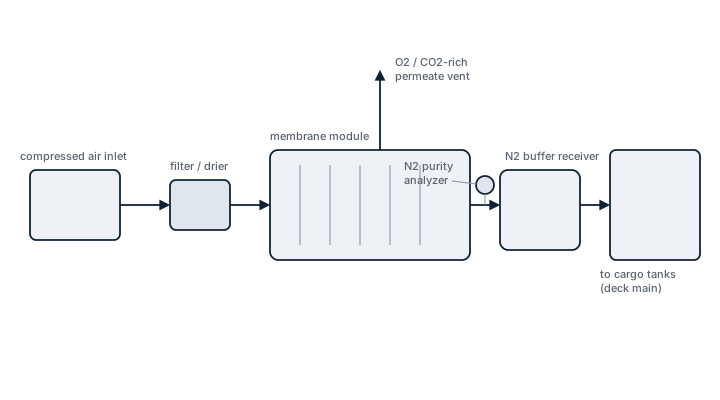
Nitrogen inert gas generator, process flow
Flow diagram of a membrane nitrogen generator: compressed air is filtered, passed through hollow-fibre membrane modules that vent the oxygen and carbon dioxide-rich permeate, and the nitrogen-rich product is buffered before delivery to the cargo tank deck main.

Main components

Air supply train

A dedicated compressor feeds an air receiver, followed by coalescing pre-filters that strip oil aerosol and particulate before the air reaches the separation stage. Oil carryover is the single biggest threat to membrane life and PSA bed performance, so filter condition is checked far more often than most crews expect.

Separation stage

Membrane units pass dried, filtered air along bundles of hollow fibres; oxygen and water vapour permeate through the fibre wall faster than nitrogen, leaving a nitrogen-enriched stream at the bundle outlet. PSA units instead adsorb oxygen onto carbon molecular sieve in one vessel while a second vessel desorbs under vacuum or reduced pressure, switching beds roughly every one to two minutes.

Control and delivery

An oxygen analyzer on the product stream feeds a purity control valve that vents off-spec gas overboard until the set point is met, and a buffer receiver smooths flow to the tank mains distribution valve.

Selection criteria

ParameterWhy it matters
Flow rate (Nm3/h)Must match the fastest planned discharge rate plus tank breathing during loading
Purity (% O2)Most inerting duties accept below 8% O2; some reactive cargoes need below 2%, which usually forces a PSA choice over membrane
TurndownPort stays and slow steaming call for low continuous flow without losing purity
Footprint and weightRetrofit projects on existing tonnage are often limited by space more than by required capacity

Regulations and class

The IBC Code sets out which product groups require tank atmosphere control and to what oxygen level, and the ship's Certificate of Fitness lists the inerting requirement by cargo. Class treats the generator as essential cargo machinery: the oxygen analyzer is proven against a calibration gas at set intervals, and pressure vessels and safety valves in the air and product lines fall under periodic survey.

Typical faults

FaultConsequence
Oil carryover past a saturated coalescing filterMembrane fibres foul and purity falls gradually, often unnoticed until the analyzer alarms
PSA valve actuator stickingBed switching timing drifts, one bed over-adsorbs and product purity swings
Oxygen analyzer left uncalibratedTank atmosphere is logged as compliant while the actual oxygen content is out of specification
Undersized or saturated air dryerMoisture reaches the membrane or sieve bed and degrades separation efficiency over time

What to look for in a supplier

  • Purity held across the full turndown range, not only at rated flow
  • Filter element consumption rate and local availability of spares
  • Documented performance on the specific cargo range the vessel trades, since reactive cargoes may need tighter purity than the generator's default setting
  • Analyzer type and its calibration gas requirement, since some sensors need a supply the vessel cannot easily source in every port

A membrane system that has sat idle for days often needs close to an hour of purge running before the purity reading stabilises; starting cargo operations straight off a cold start is a common way to load an under-inerted tank without the alarm ever tripping.

4000h
Service Interval

Typical Manufacturers

Parker Atlas Copco

3 manufacturers · 6 models

Wärtsilä

4
Wärtsilä N2Gen-50 Nitrogen Generator unverified
50 Nm³/h · N₂
Inert Gas System
nitrogen_membrane
Capacity (Nm³/h)
50
N2 purity pct
>99%%
Membrane-type nitrogen generator
Wärtsilä N2Gen-100 Nitrogen Generator unverified
100 Nm³/h · N₂
Inert Gas System
nitrogen_membrane
Capacity (Nm³/h)
100
N2 purity pct
>99%%
Membrane-type nitrogen generator
Wärtsilä N2Gen-200 Nitrogen Generator unverified
200 Nm³/h · N₂
Inert Gas System
nitrogen_membrane
Capacity (Nm³/h)
200
N2 purity pct
>99%%
Membrane-type nitrogen generator
Wärtsilä N2Gen-500 Nitrogen Generator unverified
500 Nm³/h · N₂
Inert Gas System
nitrogen_membrane
Capacity (Nm³/h)
500
N2 purity pct
>99%%
Membrane-type nitrogen generator

Atlas Copco Marine

1
Atlas Copco Atlas Copco NGP+ Nitrogen Generator
Atlas Copco NGP+ Nitrogen Generator
800 Nm³/h at 97% N₂ · Marine Equipment · oil‑free screw compressor with PSA carbon molecular sieve
Common Failures & Inspection Points
  • Carbon molecular sieve degradation
  • Switching valve seat wear
  • Dew point sensor malfunction
Service: CMS replacement every 8-10 years. Switching valve overhaul every 16000 hrs.
Spare Parts: Atlas Copco: Spare parts per manufacturer. Lead time: 3-8 weeks. Keep seals and valve inserts on board.
Strengths
  • Provides continuous N₂ supply without the need for liquid nitrogen deliveries
  • High nitrogen purity (≥99.5%) meeting IMO IG requirements
  • Compact, modular design suitable for limited engine‑room space
  • Low operating cost and reduced emissions compared with diesel‑driven generators
  • Integrated control system simplifies monitoring and alarm handling
Weaknesses
  • Requires periodic carbon molecular sieve replacement (≈8–10 years) and valve overhaul (≈16 000 h)
  • Higher initial capital expenditure than simple diesel‑driven IG generators
  • Performance can be affected by extreme ambient temperature or high humidity
  • Power demand adds to overall ship electrical load
Typical Vessels: Crude oil tankerProduct tankerChemical tankerLNG carrier (auxiliary inert gas)Offshore supply vessel with cargo tanks
Certifications: IMO Inert Gas System approvalDNV class notation for IG systems
Decision Guide: Choose if: the vessel operates long voyages, has limited space for liquid nitrogen storage, and seeks lower fuel‑cost operation of its inert gas system. Avoid if: power margin is tight, the ship will operate in very humid climates that accelerate CMS wear, or budget constraints prevent the higher upfront cost.
Use Cases: The NGP+ is typically installed on newbuild crude and product tankers to meet IMO IG regulations, and it is also used for retrofits of older vessels replacing aging diesel‑driven generators. It serves as a reliable source of nitrogen for cargo tank inerting, reducing dependence on shore‑supplied liquid nitrogen.

Parker

1
Parker Parker N₂-6000 Nitrogen Generator
Parker N₂-6000 Nitrogen Generator
600 Nm³/h at 95% N₂ · Marine Equipment · membrane nitrogen generator with oil‑free screw compressor
Common Failures & Inspection Points
  • Membrane module fouling
  • Air compressor oil carryover
  • O₂ sensor drift
Service: Replace membrane modules every 5-7 years. Pre-filter change every 2000 hrs.
Spare Parts: Parker: Spare parts per manufacturer. Lead time: 3-8 weeks. Keep seals and valve inserts on board.
Strengths
  • Delivers up to 99.9% nitrogen purity suitable for IMO D‑2 inert gas requirements
  • Compact modular design allows installation in limited engine‑room spaces
  • Oil‑free compression reduces contamination risk and simplifies maintenance
  • Automated control system with real‑time O₂ monitoring enhances safety
  • Proven track record on new‑build and retrofitted tankers
Weaknesses
  • Membrane modules are prone to fouling and must be replaced every 5–7 years
  • Air‑compressor oil carryover can occur if pre‑filters are not changed regularly (≈2000 hrs)
  • O₂ sensor drift requires periodic calibration to maintain purity guarantees
  • Maximum flow capacity may be insufficient for very large crude carriers requiring >6000 Nm³/h
  • Higher upfront capital cost compared with simple air‑blowers
Typical Vessels: Crude oil tankerProduct tankerChemical tankerLPG carrier (inert gas equipped)Retrofit of existing tankers
Certifications: IMO D-2USCG Type ApprovalDNV Classification approval
Decision Guide: Choose if: you need a reliable, high‑purity nitrogen source for IMO‑approved inert gas systems on tankers and have space constraints that favor a compact membrane unit. Avoid if: the vessel requires flow rates beyond the N₂‑6000’s capacity or you cannot commit to the scheduled membrane replacement and filter maintenance regime.
Use Cases: The N₂‑6000 is typically installed on new‑build crude and product tankers of 30 000–80 000 DWT, as well as on retrofitted vessels where a compact, low‑maintenance inert gas solution is required. It is also used on chemical carriers that demand strict oxygen limits for cargo safety.