Composite Boiler
A composite boiler combines an oil-fired furnace and an exhaust gas heating surface inside one shell, so it can raise steam from the main engine's waste heat while under way and switch to oil firing in port or at low load, without running two separate boiler units.
What to check on a Composite Boiler.
9 models from Mihara in Composite Boiler. Below: the full model list.
What sets a composite boiler apart
A pure exhaust gas economiser only makes steam when the main engine is running hard enough to produce useful exhaust heat, and a pure oil-fired boiler needs its own furnace and burner regardless of engine load. A composite boiler puts both heat sources inside a single pressure vessel: exhaust gas tubes pass through the same steam and water space as the oil-fired section, so the vessel automatically draws steam from whichever source is available, cutting fuel consumption at sea and giving full steam-raising capability in port.
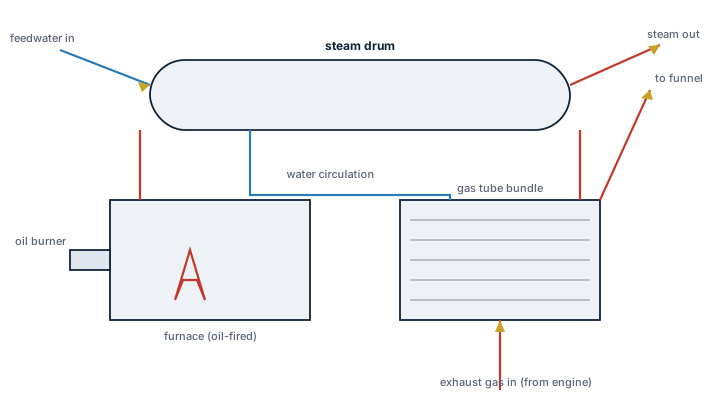
Legend
- feedwater in
- steam drum
- steam out
- to funnel
- water circulation
- gas tube bundle
- oil burner
- furnace (oil-fired)
- exhaust gas in (from engine)
Main components
Oil-fired section
A furnace with a rotary or pressure-jet burner, refractory lining and its own combustion air fan, functioning as a conventional smoke tube or water tube boiler section.
Exhaust gas section
A bank of gas tubes or a gas-side casing routed from the main engine exhaust, arranged so soot blowing and gas-side cleaning can be carried out without shutting down the oil-fired side.
Read the full guide
Common steam drum
Both heat sources feed the same steam and water space, so water level control and safety valves cover the composite unit as a single system rather than two.
Soot blowers and gas dampers
Fitted to the exhaust gas passages to control gas-side fouling, with dampers to isolate the exhaust gas section when the main engine is stopped or when its heat is not needed.
Selection and sizing
- Steam demand at sea versus in port, since the split between the two heat sources drives the balance of exhaust gas heating surface against oil-fired capacity.
- Main engine exhaust gas temperature and flow at normal service load, which sets how much of the steam demand the exhaust section can cover unaided.
- Working pressure needed by cargo heating, fuel heating or accommodation services.
- Space and weight in the funnel casing, since routing exhaust gas through the boiler adds backpressure that the main engine maker must approve.
Regulations and class
Class rules cover the pressure vessel design, safety valve capacity and periodic internal and hydraulic testing exactly as for any steam boiler, with the composite unit surveyed as one vessel. SOLAS Ch. II-2 requirements for boiler room fire protection and fuel oil supply arrangements apply to the oil-fired section. Exhaust gas backpressure introduced by the gas-side tube bank is subject to the main engine maker's approved limit and is checked at commissioning and after major gas-side cleaning.
Typical faults
| Fault | Consequence |
|---|---|
| Soot and unburnt deposits building up on exhaust gas tubes | Falling exhaust steam output and rising engine backpressure |
| Uneven water circulation between the two heating sections | Local overheating and tube wastage where circulation is weakest |
| Burner left in poor combustion trim | Carbon build-up on the oil-fired section, reduced efficiency, smoke |
| Gas damper seized or not fully closing | Uncontrolled gas-side cooling, condensation and acid corrosion when the engine is stopped |
What to look for in a supplier
- Class-approved pressure vessel design documentation covering both heat sources as a single approved unit.
- Confirmed compatibility of the exhaust gas backpressure with the specific main engine model fitted.
- Soot blower and gas-side access design that allows cleaning without a full boiler shutdown.
- Spares commonality between the oil-fired burner components and other boilers already on board, where possible.
Log exhaust gas outlet temperature from the boiler alongside engine load, not just boiler pressure, since a rising outlet temperature at constant load is usually the first sign of gas-side fouling long before steam output visibly drops.
Models in this type.
The best-documented model of each manufacturer first, then the next — 9 of 9 models in Composite Boiler. Every row links to full specifications, documents and service notes.
Manufacturers.
All 7 manufacturers with models of Composite Boiler. Names with a manufacturer page open it; the others open a search across the full library.
All manufacturers in the libraryAlso in Boilers.
The other equipment types in this category.
Write to us about this model — the answer comes by e-mail.
Name the make and the model and what the job is: a spare, a service call, a second opinion on a data sheet. We answer by e-mail.
No details at hand? A photo of the rating plate or the part is enough — simply attach it to the request.
Questions that come up with this equipment.
Is Composite Boiler data free?
Yes. Every model page, every guide and every datasheet for this type is readable without an account. An account adds saved searches and requests, nothing is taken away.
My model is missing — what now?
Send us the nameplate. We identify it by hand, add it to the library, and if you need a part or a service, the request is already on our desk.
Can you source a Composite Boiler part?
Yes. Tell us the manufacturer, the model and what you need — a person reads every request and replies by e-mail.