Sludge Separator
A sludge separator is not a purifier doing double duty; it is a dedicated centrifuge fed by the sludge tank itself, concentrating the oily residue that purifiers and clarifiers already discarded so that as little as possible has to be landed or incinerated.
What to check on a Sludge Separator.
12 models from AFRISO in Sludge Separator. Below: the full model list.
What sets a sludge separator apart from a purifier or clarifier
A fuel or lube oil purifier separates clean oil from water and solids in the main flow; a clarifier removes solids alone from oil that has already had its water content dealt with elsewhere. A sludge separator does neither of those jobs directly. It is fed from the sludge tank, where purifier and clarifier discharges, tank drainings and bilge oil residues already accumulate, and its purpose is to concentrate that mixture further, recovering any usable oil and reducing the volume of waste that ultimately has to be landed ashore or burned in the incinerator. On many vessels it is a smaller, simpler centrifuge than the main purifiers, sometimes run only periodically rather than continuously.
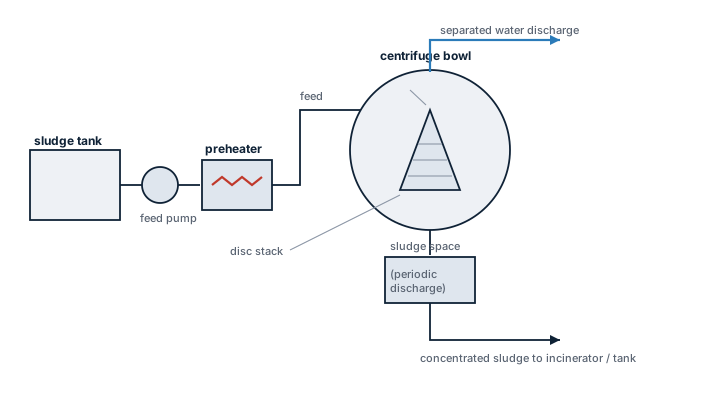
Main components
Bowl and disc stack
A vertical centrifugal bowl with a disc stack spins the sludge feed at several thousand rpm, throwing the denser water and solids fraction outward while lighter recovered oil moves toward the centre outlet.
Self-cleaning mechanism
Most sludge separators use a self-cleaning bowl that periodically opens to discharge accumulated solids without stopping the machine, since sludge feed carries far more solid content than a normal purifier feed.
Read the full guide
Feed and heating arrangement
A feed pump draws from the sludge tank through a heater, since sludge is viscous and needs to be brought to 80-90 degrees C or higher for effective separation.
Control unit
A dedicated control panel sequences feed, water flush and discharge cycles, and on older machines this is a simple timer rather than a sensing system.
Selection and sizing
- Throughput matched to the vessel's expected sludge generation rate, which scales with main engine size and purifier duty cycle, not with fuel consumption alone.
- Solids handling capacity of the bowl, since sludge composition varies far more than clean fuel or lube oil.
- Compatibility with the existing sludge tank heating and piping arrangement on a retrofit.
Regulations and class
Disposal of separated sludge falls under MARPOL Annex I, which requires accurate entries in the Oil Record Book for any sludge generated, transferred, incinerated or landed ashore, and prohibits discharge overboard except in narrowly defined circumstances. Port State Control inspections routinely check sludge tank soundings against Oil Record Book entries and against separator running hours, since a mismatch is one of the most common findings leading to detention. Class rules require periodic survey of the separator as rotating machinery, alongside the purifiers it serves.
Typical faults
| Fault | Cause | Consequence |
|---|---|---|
| Excessive vibration | Unbalanced bowl from uneven solids build-up | Bearing damage, unplanned machine stop |
| Sludge tank level not falling | Blocked suction strainer or worn feed pump | Tank overflow risk, forces manual disposal workaround |
| Frequent self-cleaning discharges | Feed temperature too low for effective separation | High water consumption for flushing, faster wear |
| Oil Record Book discrepancy | Running hours not logged against actual sludge processed | Port State Control detention risk |
What to look for in a supplier
- Bowl and disc stack spares held in a size that matches the vessel's actual sludge feed rate, not a generic catalogue figure.
- A control unit that logs running hours and cycle counts automatically, supporting Oil Record Book reconciliation.
- Service support experienced with sludge-specific wear patterns rather than only clean-oil purifier maintenance.
Log separator running hours against sludge tank soundings every watch, not just at bunkering; a quiet gap between the two is exactly what a Port State Control officer checks first, and it is far easier to explain in real time than three months later.
Models in this type.
The best-documented model of each manufacturer first, then the next — 12 of 12 models in Sludge Separator. Every row links to full specifications, documents and service notes.
Manufacturers.
All 6 manufacturers with models of Sludge Separator. Names with a manufacturer page open it; the others open a search across the full library.
All manufacturersAlso in Separators & Purifiers.
The other equipment types in this category.
One request. A person reads it and replies by e-mail.
Tell us the manufacturer, the model and what you need — a part, a service call, a second opinion. A person reads every request and replies by e-mail.
No details at hand? A photo of the rating plate or the part is enough — simply attach it to the request.
Three things people ask first.
Is Sludge Separator data free?
Yes. Every model page, every guide and every datasheet for this type is readable without an account. An account adds saved searches and requests, nothing is taken away.
My model is missing — what now?
Send us the nameplate. We identify it by hand, add it to the library, and if you need a part or a service, the request is already on our desk.
Can you source a Sludge Separator part?
Yes. Tell us the manufacturer, the model and what you need — a person reads every request and replies by e-mail.