"> Bilge Water Separator (OWS 15ppm) - Equipment Database

Bilge Water Separator (OWS 15ppm)

critical IMO Required 7 models total

The 15 ppm limit in MARPOL Annex I is measured at the overboard discharge under way, not in a tank sample — an OWS that tests clean on a bench can still fail underway if its oil content monitor and automatic stopping device are not correctly interfaced.

Read more — Bilge Water Separator (OWS 15ppm) explained

What this type is

A 15 ppm oily water separator treats bilge water collected in machinery spaces so that any overboard discharge contains no more than 15 parts per million of oil, the limit set by MARPOL Annex I for discharge outside special areas. It differs from a fuel or lube oil purifier in both purpose and design: an OWS handles a dirtier, more variable feed — bilge water mixed with detergents, rust, and emulsified oil — and must prove compliance continuously via an in-line oil content monitor, not just produce a generally cleaner output.
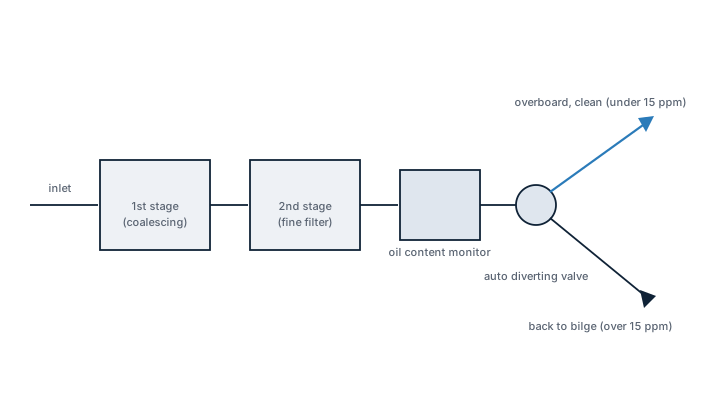
Bilge water separator (15 ppm OWS) flow
Flow through a 15 ppm bilge water separator: inlet to a first coalescing stage, a second fine filter stage, the oil content monitor at the outlet, and an automatic diverting valve sending clean water overboard or oily water back to the bilge.

Main components

  • First-stage separator — typically gravity/coalescing separation that removes the bulk of free oil before the water reaches finer treatment.
  • Second-stage / fine separation — coalescer plates, membrane, or flotation stage that brings oil content down toward the 15 ppm target.
  • Oil content monitor (OCM/ODM) — a continuous in-line analyser, separately certified, that measures the treated water and triggers the automatic stopping device if the limit is exceeded.
  • Automatic stopping device — stops the overboard discharge (usually by diverting to a holding tank) automatically the moment the OCM reads over 15 ppm, without needing operator action.
  • Bilge alarm and sample valves — support monitoring and periodic verification of the system's performance.

Selection and sizing

Capacity is set by the machinery space bilge volume and the engine room's typical oil-in-water challenge, expressed as throughput in cubic metres per hour. The separator technology (gravity/coalescer, membrane, or combined) affects how well it copes with emulsified oil from detergents and cleaning chemicals, which is often the harder problem than free oil.

Separator typeHandles emulsified oilTypical fit
Gravity/coalescerLimitedOlder/simple installations
Coalescer + fine filtrationModerateCommon modern retrofit
Membrane-basedGoodWhere emulsified challenge is high

Regulations and class

MARPOL Annex I, Regulation 14, sets the 15 ppm discharge limit and requires the OWS, OCM and automatic stopping device combination on ships of 400 GT and above, built to the standards in IMO resolution MEPC.107(49) for equipment installed on or after 2005 (earlier equipment may remain under MEPC.60(33)). Class and flag surveys check type approval certificates for both the separator and the OCM, verify the automatic stopping/diverting function actually operates, and review the Oil Record Book Part I entries against the equipment's logged performance.

Typical faults

  • OCM sensor fouled by oil film or scale, giving a falsely low reading that lets an over-limit discharge pass undetected.
  • Automatic stopping device bypassed or manually overridden — a serious deficiency and, if done to defeat the system, a MARPOL violation with direct exposure for those involved.
  • Coalescer media saturated or channelled, so separation efficiency drops even though the unit still runs and passes water.
  • Detergent or cleaning chemical use in the bilge creating an emulsion the separator was not designed to break, overwhelming the system intermittently.

What to look for in a supplier

  • Type approval for both the separator and the OCM to the applicable MEPC resolution, matched to the vessel's build/retrofit date.
  • Demonstrated performance against emulsified oil, not just free oil, if the vessel uses bilge cleaning chemicals regularly.
  • Spare parts and coalescer media availability on the vessel's trading routes.
  • Clear commissioning test documentation for the automatic stopping device function specifically.

Never treat the automatic stopping device as an inconvenience to be worked around — it is the component port state control and flag investigators check first after any oil discharge finding, and its integrity is what separates a deficiency from a prosecution.

2000h
Service Interval
5 yr
Class Survey
15 yr
Typical Lifetime

Typical Manufacturers

RWO Alfa Laval DVZ Compass

4 manufacturers · 7 models

Alfa Laval

4
Alfa Laval PureBilge 5.0
PureBilge 5.0
5.0 m3/h · 2.2 kW · Bilge water (oily) · centrifugal‑membrane bilge water separator
Common Failures & Inspection Points
  • Area: Schuessel-/Teller-Erosion
    Check: Paring-Disc, Top-Disc, Schlammportale auf matte Flecken/Auswaschung pruefen; Erosionstiefe >0,2 mm (Bowl/Kappe) bzw. >0,5 mm (andere) = Austausch.
  • Area: Dichtungsringe
    Check: Lecks an Deckel/Verschraubung/Schlammauslauf; Dichtungsringe (EPDM) alle 6000-8000 h tauschen, nur Originalteile.
  • Area: Kugellager
    Check: Vibration/Geraeusch pruefen; Lager alle 12000-16000 h paarweise tauschen, korrekt schmieren; bei Vibration Durchsatz NICHT erhoehen.
  • Area: Riemen & Kupplung
    Check: Riemen alle 3000 h (Spannung lt. Hersteller), Risse/Verschleiss; Kupplung auf axiales Spiel (>0,5 mm = Fehler), Korrosion.
  • Area: Stromaufnahme/Verschmutzung
    Check: Stromaufnahme Soll/Ist ueberwachen; Schuessel bei Stillstand reinigen; Vorfiltration + Schmierung pruefen; Schlammvolumen begrenzen.

Universelle Inspektions-/Wartungspunkte fuer Alfa-Laval-Tellerseparatoren (modellunabhaengig gueltig, verifiziert aus Alfa-Laval-Doku + premiersepservices, 2026-06). Per-Modell-Specs NICHT auto-gefuellt (kein erfundener Wert).

Service: Membrane-based system; backflush membranes per schedule.
Spare Parts: Alfa Laval: O-Ring-Satz und Betriebswasserventil an Bord vorhalten. Lead time: 2-6 Wochen je nach Hersteller.
Strengths
  • Achieves ≤15 ppm oil in water, meeting IMO Annex I standards
  • Small footprint and modular design suitable for retrofits
  • Integrated back‑flushable membrane provides fine polishing without additional equipment
  • Robust Alfa Laval bowl construction with low vibration levels
  • Relatively low power consumption compared to larger centrifugal units
Weaknesses
  • Higher capital cost than basic centrifuge‑only separators
  • Membrane modules require periodic replacement and back‑flush maintenance
  • Performance can degrade if sludge load exceeds design limits, requiring pre‑filtration
  • Spare parts (e.g., EPDM seals, bearing kits) must be sourced as original Alfa Laval components
Typical Vessels: TankerBulk carrierContainer shipOffshore supply vesselCruise liner
Certifications: IMO D‑2 Type Approval
Decision Guide: Choose if you need a compact, high‑efficiency OWS that delivers the strict 15 ppm limit and can be installed where space is limited. Avoid if budget constraints prohibit the higher upfront cost or if the vessel routinely handles very high sludge concentrations that exceed the PureBilge 5.0’s design capacity.
Use Cases: Typically installed in engine rooms and bilge tanks of new‑builds or retrofitted vessels to replace older gravity separators, especially where regulatory compliance, space constraints, and low vibration are critical factors.
Alfa Laval EPC-50 unverified
· bilge water
Separator Type
oily_water_separator
Flow Rate (m³/h)
5.0
Medium
bilge water
Ppm limit
15
Common Failures & Inspection Points
  • Area: Schuessel-/Teller-Erosion
    Check: Paring-Disc, Top-Disc, Schlammportale auf matte Flecken/Auswaschung pruefen; Erosionstiefe >0,2 mm (Bowl/Kappe) bzw. >0,5 mm (andere) = Austausch.
  • Area: Dichtungsringe
    Check: Lecks an Deckel/Verschraubung/Schlammauslauf; Dichtungsringe (EPDM) alle 6000-8000 h tauschen, nur Originalteile.
  • Area: Kugellager
    Check: Vibration/Geraeusch pruefen; Lager alle 12000-16000 h paarweise tauschen, korrekt schmieren; bei Vibration Durchsatz NICHT erhoehen.
  • Area: Riemen & Kupplung
    Check: Riemen alle 3000 h (Spannung lt. Hersteller), Risse/Verschleiss; Kupplung auf axiales Spiel (>0,5 mm = Fehler), Korrosion.
  • Area: Stromaufnahme/Verschmutzung
    Check: Stromaufnahme Soll/Ist ueberwachen; Schuessel bei Stillstand reinigen; Vorfiltration + Schmierung pruefen; Schlammvolumen begrenzen.

Universelle Inspektions-/Wartungspunkte fuer Alfa-Laval-Tellerseparatoren (modellunabhaengig gueltig, verifiziert aus Alfa-Laval-Doku + premiersepservices, 2026-06). Per-Modell-Specs NICHT auto-gefuellt (kein erfundener Wert).

Alfa Laval EPC-60 unverified
· bilge water
Separator Type
oily_water_separator
Flow Rate (m³/h)
7.5
Medium
bilge water
Ppm limit
15
Common Failures & Inspection Points
  • Area: Schuessel-/Teller-Erosion
    Check: Paring-Disc, Top-Disc, Schlammportale auf matte Flecken/Auswaschung pruefen; Erosionstiefe >0,2 mm (Bowl/Kappe) bzw. >0,5 mm (andere) = Austausch.
  • Area: Dichtungsringe
    Check: Lecks an Deckel/Verschraubung/Schlammauslauf; Dichtungsringe (EPDM) alle 6000-8000 h tauschen, nur Originalteile.
  • Area: Kugellager
    Check: Vibration/Geraeusch pruefen; Lager alle 12000-16000 h paarweise tauschen, korrekt schmieren; bei Vibration Durchsatz NICHT erhoehen.
  • Area: Riemen & Kupplung
    Check: Riemen alle 3000 h (Spannung lt. Hersteller), Risse/Verschleiss; Kupplung auf axiales Spiel (>0,5 mm = Fehler), Korrosion.
  • Area: Stromaufnahme/Verschmutzung
    Check: Stromaufnahme Soll/Ist ueberwachen; Schuessel bei Stillstand reinigen; Vorfiltration + Schmierung pruefen; Schlammvolumen begrenzen.

Universelle Inspektions-/Wartungspunkte fuer Alfa-Laval-Tellerseparatoren (modellunabhaengig gueltig, verifiziert aus Alfa-Laval-Doku + premiersepservices, 2026-06). Per-Modell-Specs NICHT auto-gefuellt (kein erfundener Wert).

Alfa Laval EPC-80 unverified
· bilge water
Separator Type
oily_water_separator
Flow Rate (m³/h)
10.0
Medium
bilge water
Ppm limit
15
Common Failures & Inspection Points
  • Area: Schuessel-/Teller-Erosion
    Check: Paring-Disc, Top-Disc, Schlammportale auf matte Flecken/Auswaschung pruefen; Erosionstiefe >0,2 mm (Bowl/Kappe) bzw. >0,5 mm (andere) = Austausch.
  • Area: Dichtungsringe
    Check: Lecks an Deckel/Verschraubung/Schlammauslauf; Dichtungsringe (EPDM) alle 6000-8000 h tauschen, nur Originalteile.
  • Area: Kugellager
    Check: Vibration/Geraeusch pruefen; Lager alle 12000-16000 h paarweise tauschen, korrekt schmieren; bei Vibration Durchsatz NICHT erhoehen.
  • Area: Riemen & Kupplung
    Check: Riemen alle 3000 h (Spannung lt. Hersteller), Risse/Verschleiss; Kupplung auf axiales Spiel (>0,5 mm = Fehler), Korrosion.
  • Area: Stromaufnahme/Verschmutzung
    Check: Stromaufnahme Soll/Ist ueberwachen; Schuessel bei Stillstand reinigen; Vorfiltration + Schmierung pruefen; Schlammvolumen begrenzen.

Universelle Inspektions-/Wartungspunkte fuer Alfa-Laval-Tellerseparatoren (modellunabhaengig gueltig, verifiziert aus Alfa-Laval-Doku + premiersepservices, 2026-06). Per-Modell-Specs NICHT auto-gefuellt (kein erfundener Wert).

Compass

1
Compass CPS-B 5.0
CPS-B 5.0
5.0 m3/h · 1.5 kW · Bilge water (oily) · oil‑water coalescing separator
Common Failures & Inspection Points
  • Filter element blocking
  • Oil content alarm
  • Discharge valve leak
Service: Compact unit; change filter elements when differential pressure high.
Spare Parts: Compass: O-Ring-Satz und Betriebswasserventil an Bord vorhalten. Lead time: 2-6 Wochen je nach Hersteller.
Strengths
  • Small footprint – fits in confined engine‑room spaces
  • Integrated differential‑pressure sensor alerts when filters are loading
  • Simple manual filter change procedure
  • Meets MARPOL Annex I OWS 15 ppm requirement
Weaknesses
  • Filter elements can become blocked quickly under high oil loads
  • Oil‑content alarm may trigger frequently if filtration is not optimal
  • Reported discharge‑valve leaks require regular inspection
  • Limited capacity for vessels with very large bilge volumes
Typical Vessels: Coastal tankerOffshore supply vesselTugboatFishing vesselSmall to medium general cargo ship
Decision Guide: Choose if: you need a space‑saving OWS that can be serviced manually and you operate vessels with moderate bilge oil loads. Avoid if: your vessel generates high volumes of oily bilge water, requires fully automated discharge control, or you cannot tolerate frequent filter changes.
Use Cases: Installed in engine rooms where space is at a premium to continuously treat bilge water and ensure compliance with MARPOL Annex I during normal operations and port stays.

DVZ

1
DVZ OWS-COM 5
OWS-COM 5
5.0 m3/h · 1.5 kW · Bilge water (oily) · gravity coalescer bilge water separator
Common Failures & Inspection Points
  • Coalescer media saturation
  • Oil monitor sensor contamination
  • Solenoid valve stuck
Service: Gravity-coalescer type; drain collected oil regularly.
Spare Parts: DVZ: O-Ring-Satz und Betriebswasserventil an Bord vorhalten. Lead time: 2-6 Wochen je nach Hersteller.
Strengths
  • Passive operation – no external power required for separation
  • Meets IMO‑MARPOL 15 ppm OWS limit out of the box
  • Integrated oil‑monitor sensor provides real‑time compliance data
  • Compact, modular unit simplifies installation on space‑constrained vessels
  • Simple maintenance: media can be replaced and oil drain is manually collected
Weaknesses
  • Coalescer media can become saturated, reducing efficiency if not serviced regularly
  • Oil‑monitor sensor prone to fouling in high‑particulate bilge water
  • Solenoid valve may stick, requiring periodic inspection
  • Limited flow capacity compared with powered centrifugal or membrane OWS units
  • Manual oil drainage required; not fully continuous discharge
Typical Vessels: Coastal tankerOffshore support vesselFerryGeneral cargo shipSmall to medium bulk carrier
Decision Guide: Choose if: you need a low‑cost, low‑maintenance separator that meets the 15 ppm requirement and have limited space or power availability. Avoid if: your vessel generates high bilge flow rates, requires fully continuous discharge without manual oil collection, or operates in environments where media fouling is extreme.
Use Cases: The OWS-COM 5 is typically installed on vessels with moderate bilge water production to ensure MARPOL Annex I compliance. It is favoured on offshore supply ships, ferries and coastal tankers where space and power are at a premium and periodic manual oil drainage is acceptable.

RWO

1
RWO SKIT/S-DEB 5.0
SKIT/S-DEB 5.0
5.0 m3/h · 1.5 kW · Bilge water (oily) · Centrifugal Separator
Common Failures & Inspection Points
  • 15 ppm monitor drift/failure
  • Coalescer element fouling
  • 3-way valve malfunction
  • Emulsified oil bypass
Service: Replace coalescer element annually; calibrate 15ppm monitor per MEPC guidelines.
Spare Parts: RWO: O-Ring-Satz und Betriebswasserventil an Bord vorhalten. Lead time: 2-6 Wochen je nach Hersteller.
Strengths
  • High efficiency in oil separation
  • Compact design for space-saving installation
  • Compliance with international maritime regulations for bilge water discharge
  • Annual maintenance is relatively straightforward with the replacement of the coalescer element
  • Calibration of the 15 ppm monitor is guided by MEPC guidelines for consistency
Weaknesses
  • 15 ppm monitor drift or failure can lead to non-compliance
  • Coalescer element fouling can reduce efficiency and require more frequent replacement
  • 3-way valve malfunction can disrupt the separation process
  • Emulsified oil can bypass the separator, affecting its overall performance
Typical Vessels: TankerContainerBulk CarrierGeneral Cargo
Certifications: IMO D-2
Decision Guide: Choose if you need a reliable and compact bilge water separator that meets international standards. Avoid if your vessel frequently encounters emulsified oil or if you lack regular maintenance schedules for the coalescer element and monitor calibration.
Use Cases: Typically deployed on various types of vessels that require efficient bilge water treatment to comply with maritime regulations, especially in areas with strict environmental protection laws.