Brazed Plate Heat Exchanger
A brazed plate heat exchanger fuses its plates into one sealed block, giving a compact, high-efficiency unit with no gaskets to fail - but that same construction means it cannot be opened for mechanical cleaning or plate replacement, unlike its gasketed cousin.
What to check on a Brazed Plate Heat Exchanger.
35 models from Danfoss in Brazed Plate Heat Exchanger. Below: the full model list.
What distinguishes this exchanger type
Brazed plate heat exchangers stack corrugated stainless steel plates and join them permanently with a copper or nickel braze under vacuum, creating a single rigid block with no elastomer gaskets between plates. This gives a smaller footprint and higher heat transfer per unit volume than a gasketed plate exchanger for the same duty, because there is no gasket thickness wasting space and no gasket failure mode. The trade-off is fixed: the unit cannot be opened, re-plated or mechanically brushed out. Once fouled beyond what chemical cleaning removes, or once a plate perforates, the whole block is scrapped and replaced.
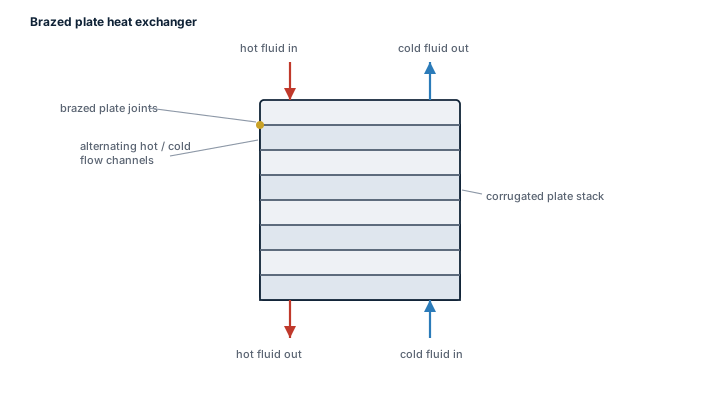
Legend
- hot fluid in
- cold fluid out
- brazed plate joints
- alternating hot / cold flow channels
- corrugated plate stack
- hot fluid out
- cold fluid in
Main components
Plate pack
Chevron-corrugated stainless steel plates, typically AISI 316, brazed at every contact point to form two separate flow channels that alternate hot and cold fluid without ever touching.
Braze filler
Copper braze is standard for water and oil duties; nickel braze is used where copper would corrode, such as with ammonia refrigerant or some chemical cargoes. Braze material selection is a compatibility decision, not a cost decision.
Read the full guide
End plates and connections
Thicker end plates carry the inlet and outlet ports, usually threaded or flanged, and give the block its mechanical rigidity under pressure.
Selection and sizing
- Duty (kW) and the temperature approach between the two fluids drive the required plate area and number of plates.
- Design pressure and pressure drop across the plate pack, since a unit sized only for duty and not for allowable pressure loss will starve the pump circuit.
- Braze material matched to both fluids in contact - copper for fresh water and lube oil, nickel where ammonia or chlorides are present.
- Connection size and orientation to match existing pipework without adding reducers that add pressure drop.
Regulations and class
Brazed plate exchangers used in class-relevant systems, such as engine cooling or fuel heating, fall under the classification society's rules for pressure vessels and heat exchangers and require a design approval or type approval certificate plus material certificates for the plates and connections. Units in refrigeration or ammonia service are additionally subject to the applicable pressure equipment requirements for that refrigerant class. There is no periodic internal survey possible on a brazed unit since it cannot be opened; class instead relies on external pressure testing and performance monitoring.
Typical faults
| Fault | Cause | Consequence |
|---|---|---|
| Falling heat transfer over time | Scaling or biofouling inside the sealed channels | Circuit runs hotter than design; cannot be mechanically cleaned, only chemically flushed or replaced |
| Cross-contamination between circuits | Plate perforation from erosion, corrosion or a braze defect | One fluid leaks into the other - critical if one side is fresh water and the other is oil or coolant with additives |
| External leak at end connections | Gasket failure at the flange, not the brazed core itself | Usually repairable without replacing the block |
| Rising pressure drop | Partial blockage or fouling narrowing the flow channels | Pump works harder, flow to the cooled circuit drops |
What to look for in a supplier
- Braze material confirmed correct for both fluids, in writing, not assumed from the previous unit.
- Design pressure and test pressure certificates matching the original specification.
- Dimensional match of connections and mounting feet to avoid re-piping.
- Chemical cleaning guidance appropriate to the fouling expected in that circuit, since the wrong cleaning agent can attack the braze.
Because a brazed plate exchanger cannot be inspected internally, trend the approach temperature and pressure drop over time - a slow rise is the only early warning before a plate lets go.
Models in this type.
The best-documented model of each manufacturer first, then the next — 35 of 35 models in Brazed Plate Heat Exchanger. Every row links to full specifications, documents and service notes.
Manufacturers.
All 8 manufacturers with models of Brazed Plate Heat Exchanger. Names with a manufacturer page open it; the others open a search across the full library.
All manufacturers in the libraryAlso in Heat Exchangers.
The other equipment types in this category.
Write to us about this model — the answer comes by e-mail.
Name the make and the model and what the job is: a spare, a service call, a second opinion on a data sheet. We answer by e-mail.
No details at hand? A photo of the rating plate or the part is enough — simply attach it to the request.
Questions that come up with this equipment.
Is Brazed Plate Heat Exchanger data free?
Yes. Every model page, every guide and every datasheet for this type is readable without an account. An account adds saved searches and requests, nothing is taken away.
My model is missing — what now?
Send us the nameplate. We identify it by hand, add it to the library, and if you need a part or a service, the request is already on our desk.
Can you source a Brazed Plate Heat Exchanger part?
Yes. Tell us the manufacturer, the model and what you need — a person reads every request and replies by e-mail.