"> Freshwater Generator (Evaporator) - Equipment Database

Freshwater Generator (Evaporator)

medium 3 models total

A freshwater generator makes drinking and boiler water from seawater by boiling it under vacuum at a low temperature, low enough that waste heat from the main engine's jacket cooling water alone is normally sufficient to do the evaporating, without needing a dedicated heat source.

Read more — Freshwater Generator (Evaporator) explained

What defines this type

A freshwater generator, commonly called an evaporator, produces freshwater from seawater by distillation under vacuum, and the vacuum is the defining feature: it lowers the boiling point of seawater to roughly 40-60°C, low enough that the main engine's jacket cooling water, which would otherwise just be rejected overboard through the heat exchanger, can supply all the heat needed. This is what separates it from a reverse osmosis plant, which uses membrane filtration under high pressure rather than a phase change, needs no heat source but does need significant electrical power for the high-pressure pump.
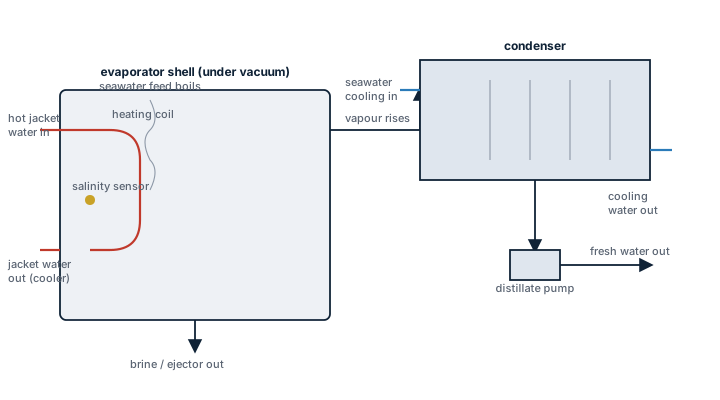
Freshwater generator (evaporator)
Section through a vacuum freshwater generator showing hot jacket cooling water heating seawater in the evaporator shell, the vapour rising to a seawater-cooled condenser, distillate leaving through a pump, and the concentrated brine being ejected.

Main components

Evaporator shell

A vessel where feed seawater flows over a heating element carrying jacket cooling water and boils under the vacuum maintained inside the shell.

Heating element

A plate or tube bundle transferring heat from the jacket cooling water to the boiling seawater, without the two streams mixing.

Demister and separator

A mesh or vane arrangement that strips entrained seawater droplets out of the rising vapour before it reaches the condenser, since carried-over droplets would salt-contaminate the product water.

Condenser

Cools the vapour back to liquid freshwater using a separate cooling seawater stream, and its outlet feeds the distillate pump that delivers product water to the tank.

Ejector or vacuum pump

Maintains the shell's vacuum, either a seawater-driven ejector or an electrically driven vacuum pump, and also extracts non-condensable gases that would otherwise reduce heat transfer efficiency.

Salinometer

Continuously monitors product water conductivity and automatically dumps the output to bilge or feed tank rather than the freshwater tank if salinity exceeds the set limit.

Selection and sizing

Capacity is set against the ship's daily freshwater consumption for the crew complement and any process use such as boiler make-up, with margin for the fact that output falls when jacket water temperature or engine load drops, for instance during manoeuvring or slow steaming. Single-effect units are simplest and match most cargo ships' needs; multi-effect or vapour-compression designs recover more heat per unit of seawater processed but add complexity that is only worth it where freshwater demand is high relative to available waste heat, such as on large passenger ships.

Regulations and class

Freshwater intended for drinking falls under the ship's potable water quality requirements, which in practice means the evaporator's salinometer alarm and automatic diversion function are checked at survey, along with the general condition of the pressure and vacuum parts as heat exchange equipment. There is no dedicated SOLAS chapter for evaporators as such; they are covered under the general machinery and potable water provisions the flag state applies.

Typical faults

FaultCauseConsequence
Falling freshwater outputScale build-up on the heating element from seawater minerals precipitating at the boiling surfaceReduced heat transfer and lower daily production, worsening progressively if not descaled
Product water intermittently saltyDemister fouled or damaged, allowing seawater carry-over into the vapour streamRepeated automatic dumps of product water, reducing net output even when the salinometer is working correctly
Loss of vacuumAir ingress through a worn gasket or a failing ejector/vacuum pumpBoiling point rises, and available jacket water heat may no longer be sufficient to sustain production
Sudden drop in output during manoeuvringReduced main engine load lowering jacket cooling water temperatureExpected behaviour rather than a fault, but often reported as one by crew unfamiliar with the dependency

What to look for in a supplier

  • Heating element material suited to the ship's typical seawater conditions, since scaling rates vary significantly with water temperature and salinity on the trading routes involved
  • Rated output specified at a realistic jacket water temperature and engine load, not only at maximum continuous rating
  • Salinometer and control system compatible with the ship's existing potable water monitoring, or supplied as a complete matched set
  • Availability of gaskets, demister pads and ejector nozzles as consumable spares, since these wear faster than the shell or heating element itself

Track daily output against jacket water temperature, not against a fixed target — a genuine efficiency loss from scaling shows up as reduced output at the same jacket temperature, which a simple daily log makes obvious well before the unit fails to meet demand.

Technical drawings & plates

Historical engineering archive — public domain sources, cited per plate. Principles shown remain valid; always consult the OEM manual for model-specific data.

Distillation-Evaporation and Condensation.
Engineman 3, NAVPERS 10539, U.S. Navy (1957) — public domain
Model X-1 vapor compression distilling unit.
Engineman 3, NAVPERS 10539, U.S. Navy (1957) — public domain
Model X-1 distilling unit with heat exchanger.
Engineman 3, NAVPERS 10539, U.S. Navy (1957) — public domain
Section through (Kirkaldy) Evaporator.
Tompkins, Marine Engineering — a text-book (1917) — public domain
Weir Mercantile Evaporator Plant.
Tompkins, Marine Engineering — a text-book (1917) — public domain
Weir Evaporator Feed Regulator for Destroyers.
Tompkins, Marine Engineering — a text-book (1917) — public domain
Morison Evaporator.
Morison Evaporator.
Tompkins, Marine Engineering — a text-book (1917) — public domain
Weir Distilling Condenser, Vacuum Type.
Tompkins, Marine Engineering — a text-book (1917) — public domain
Vapor compression distilling plant.
Machinist's Mate 3, NAVPERS 10522, U.S. Navy (1958) — public domain
Internal construction of a Soloshell distilling plant.
Machinist's Mate 3, NAVPERS 10522, U.S. Navy (1958) — public domain
Vapor feed heater.
Vapor feed heater.
Machinist's Mate 3, NAVPERS 10522, U.S. Navy (1958) — public domain
Weir type level controller.
Machinist's Mate 3, NAVPERS 10522, U.S. Navy (1958) — public domain
An air ojector.
An air ojector.
Machinist's Mate 3, NAVPERS 10522, U.S. Navy (1958) — public domain
Tube-nest drain regulator.
Machinist's Mate 3, NAVPERS 10522, U.S. Navy (1958) — public domain
Evaperator tubing.
Evaperator tubing.
Machinist's Mate 3, NAVPERS 10522, U.S. Navy (1958) — public domain
4000h
Service Interval
20 yr
Typical Lifetime

Typical Manufacturers

Alfa Laval Sasakura Nirex

3 manufacturers · 3 models

Alfa Laval

1
JWP-26-C80
26 t/day · 1.5 kW · Seawater → Freshwater · Plate-type freshwater generator
Technical Specifications
Design Pressure M-Line
>10 bar (145 psi)
Marine Engine Room Modelle
T6 (DN60, 800 kW) bis T35 (DN350, 35.000 kW)
Marine FSRU Modelle
TS45, T45, T50 (DN450-500, 45.000-55.000 kW)
Temperaturbereich Standard
0–180°C (depending on model)
FSRU Temperaturbereich
-50 bis 150°C
Plattentypen
Chevron, Gemini Doppelwand, FlexFlow™
Product Lines
  • M-Line (High Pressure Series: M3, M6, M10, M15)
  • T-Series (Industrial: T2, T5, T6, T8, T10, T20, T25)
  • AQ-Series (HVAC: AQ1, AQ2, AQ3, AQ4, AQ10)
  • Marine Line (Engine Room: T6-T35; FSRU: TS45, T45, T50)
  • Baseline (Competitive Line)
  • Hygienic Line (Premium)
Heat Exchanger Type
Alfa Laval Gasketed Plate Heat Exchangers (GPHE)
Common Failures & Inspection Points
  • Area: Gasket wear and embrittlement
    Check: Inspect seals visually for cracks, hardening, swelling and discoloration; verify material compatibility with process fluids; check ClipGrip™ fastening. Aging symptoms and loss of elasticity are replacement indicators.
  • Area: Clamping dimension and tightness (Tightening Dimension A)
    Check: Verify A-dimension per manufacturer specifications with caliper (metallic contact required). Keep bolts clean and lubricated. Avoid over-tightening. Perform regular re-tightening after operating hours. At too low A-dimension, pressure loss and leakage are to be expected.
  • Area: Fouling and scale formation on plate surfaces
    Check: Monitor pressure differential across heat exchanger (increase indicates deposits). Check heat duty versus design value. Optimize CIP intervals after performance audits. Deposits generate higher pump load (energy waste up to 8,000 kWh/year possible).
  • Area: Plate corrosion and cracks / breakthroughs
    Check: After disassembly, inspect plate surfaces for local measurements (pitting), cracks and perforation corrosion. Verify material compatibility with process fluid. Observe fatigue cracks especially at corners and transitions. When perforation occurs, plate is unrecoverable and must be replaced.
  • Area: Pressure test and tightness inspection
    Check: After disassembly and cleaning, perform hydrostatic test per data sheet. Test pressure typically 1.5× operating pressure. Check external and internal leakage at all connections and plate edges. Document findings.
  • Area: Plate sequence and alignment (5-point alignment)
    Check: After opening, verify plate sequence and honeycomb pattern (corrected chevron patterns must alternate). Activate/validate 5-point alignment system for larger units. Offset or misplacement leads to short-circuiting and reduced heat duty.

Type-universal inspection points for Alfa Laval Gasketed Plate Heat Exchangers (GPHE) (Alfa Laval, 2026-06). Per-model specs not auto-populated.

Service: Plate-type FWG; acid-clean plates when output drops; do not run in port.
Spare Parts: Alfa Laval: Dichtungssatz an Bord vorhalten. Platten-Reinigungschemikalien bevorraten. Lead time: 2-6 Wochen.
Strengths
  • High heat‑transfer coefficient due to gasketed plate design, delivering efficient evaporation at modest pressure (≥10 bar).
  • Compact and lightweight compared with shell‑and‑tube evaporators, saving valuable engine‑room space.
  • Modular plate stack allows capacity scaling by adding or removing plates without major redesign.
  • Easy access for cleaning and gasket replacement, supporting routine maintenance schedules.
  • Proven Alfa Laval corrosion‑resistant materials suitable for seawater service.
Weaknesses
  • Gasket wear and hardening require regular inspection; failure can lead to leaks and loss of performance.
  • Susceptible to fouling and scaling if seawater pretreatment is inadequate, increasing pressure drop.
  • Maximum design pressure limited to ~10 bar, unsuitable for very high‑pressure applications.
  • Not intended for continuous operation while in port due to discharge regulations (service note).
  • Plate corrosion or pitting can necessitate costly plate replacement.
Typical Vessels: Container shipTankerBulk carrierCruise linerOffshore supply vessel
Decision Guide: Choose if you need a compact, high‑efficiency freshwater generator for medium to large merchant vessels and can commit to regular gasket inspection and cleaning. Avoid if the installation lacks easy access for maintenance, requires pressures above 10 bar, or must operate continuously while in port where discharge limits apply.
Use Cases: Installed in engine rooms of commercial ships as part of a seawater desalination loop, typically paired with vacuum pumps and condensers to supply crew and cargo water needs on long voyages. Frequently used on vessels where space is at a premium and high freshwater output is required.

Nirex

1
Nirex NIRO-3
NIRO-3
15 t/day · 1.1 kW · Seawater → Freshwater · Plate-type evaporator heat exchanger
Common Failures & Inspection Points
  • Evaporator plate fouling
  • Vacuum pump failure
  • Salinity sensor drift
Service: Smaller unit for auxiliary heat source; operates at 40-50 deg C JW temp.
Spare Parts: Nirex: Dichtungssatz an Bord vorhalten. Platten-Reinigungschemikalien bevorraten. Lead time: 2-6 Wochen.
Strengths
  • Small footprint – fits in limited engine room spaces
  • Low steam/heat demand makes it suitable for auxiliary boilers
  • Quick start‑up and shutdown compared with larger multi‑effect plants
  • Simple mechanical design facilitates routine inspection
Weaknesses
  • Plate fouling can reduce heat transfer efficiency if not cleaned regularly
  • Vacuum pump reliability is a known weak point, requiring spare parts on board
  • Salinity sensor drift may affect water quality monitoring and needs frequent calibration
  • Limited production capacity – not intended for primary freshwater supply
Typical Vessels: Platform Supply Vessel (PSV)Offshore Support VesselSmall TankerResearch VesselCoastal Cargo Ship
Decision Guide: Choose if you need a compact, low‑capacity freshwater generator for auxiliary or standby use on vessels with limited engine‑room space and an existing heat source. Avoid if the vessel requires high‑volume desalination as primary water supply or if operational reliability of vacuum systems cannot be guaranteed.
Use Cases: The NIRO-3 is commonly installed as a backup to larger multi‑effect desalination plants, providing fresh water during low load periods, maintenance shutdowns, or emergency situations where the main plant is offline. It is also used on vessels that only occasionally need freshwater, such as offshore support ships that operate short trips between ports.

Sasakura

1
Sasakura VS-300
VS-300
30 t/day · 2.2 kW · Seawater → Freshwater · Flash-type evaporator
Common Failures & Inspection Points
  • Scale buildup on evaporator tubes
  • Brine ejector failure
  • Distillate pump seal leak
Service: Flash-type evaporator; descale with citric acid at <35 ppm salinity.
Spare Parts: Sasakura: Dichtungssatz an Bord vorhalten. Platten-Reinigungschemikalien bevorraten. Lead time: 2-6 Wochen.
Strengths
  • Compact footprint ideal for space‑constrained installations
  • Rapid start‑up and shutdown compared to multi‑stage systems
  • Relatively low power consumption for its capacity range
  • Simple mechanical layout facilitating routine maintenance
Weaknesses
  • Susceptible to scale buildup on evaporator tubes if water treatment is inadequate
  • Brine ejector can fail under high‑load or corrosive conditions
  • Distillate pump seal leaks reported in field service
  • Requires regular descaling with citric acid, adding operational overhead
Typical Vessels: Coastal cargo vesselsFerriesOffshore supply shipsWorkboatsSmall tankers
Decision Guide: Choose if: you need a compact, quick‑response freshwater generator on a vessel with moderate water demand and can commit to regular descaling and pump maintenance. Avoid if: the ship operates in high‑scale seawater environments, requires ultra‑low‑maintenance equipment, or has very high daily fresh‑water consumption that exceeds the VS-300’s capacity.
Use Cases: The VS-300 is typically installed on vessels where space and weight are at a premium but a reliable source of potable water is required, such as coastal ferries, offshore supply vessels, and small tankers operating in temperate waters. It is favored for short‑to‑medium voyages where frequent maintenance windows are available.