What to check on a Lube Oil Cooler.
A lube oil cooler removes the heat picked up by circulating oil as it lubricates bearings, pistons, gears and turbochargers, holding the oil within a viscosity band the engine builder specifies rather than at any fixed temperature. Unlike a jacket water or charge air cooler, the tolerance for fouling and leakage runs the other way too: any seawater or freshwater ingress into the oil side ruins the lubricant's properties long before it damages a bearing outright, so the cooler's internal integrity matters as much as its thermal duty.
What makes a lube oil cooler different from other engine heat exchangers
A lube oil cooler removes the heat picked up by circulating oil as it lubricates bearings, pistons, gears and turbochargers, holding the oil within a viscosity band the engine builder specifies rather than at any fixed temperature. Unlike a jacket water or charge air cooler, the tolerance for fouling and leakage runs the other way too: any seawater or freshwater ingress into the oil side ruins the lubricant's properties long before it damages a bearing outright, so the cooler's internal integrity matters as much as its thermal duty.
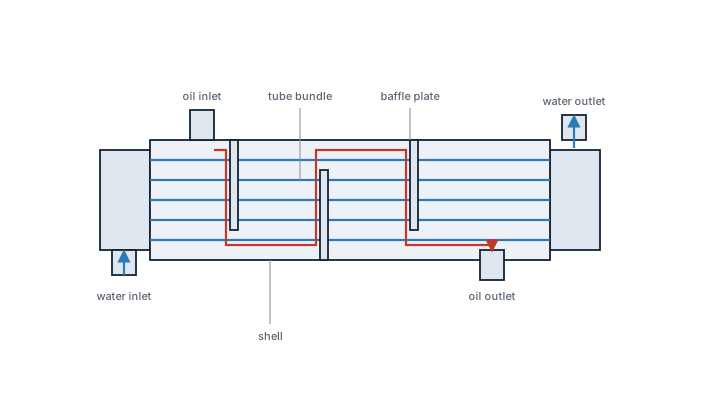
Main components
Plate pack (plate type coolers)
Gasketed or fully welded stainless steel or titanium plates form alternating oil and cooling water channels. Gasketed packs allow disassembly for mechanical cleaning; fully welded and brazed packs resist higher pressure and are more compact but must be chemically cleaned or replaced.
Shell and tube bundle (shell-and-tube type)
A tube bundle, usually cupro-nickel or titanium for seawater service, sits inside a shell through which oil flows around the tubes. Tube bundles can be pulled for cleaning and individual tubes plugged if they leak, which is why many main engine coolers still use this older design despite its larger footprint.
Thermostatic control valve
A three-way valve bypasses part of the oil flow around the cooler to hold outlet temperature steady across load changes, protecting against over-cooling that would raise oil viscosity and pumping losses at low load.
Zinc anodes and vents
Sacrificial anodes on the water side limit galvanic corrosion; air vents at the highest points let trapped air escape so the full heat transfer area stays wetted.
Selection and sizing
Duty is set by the oil flow rate at rated engine output and the heat rejection figure from the engine builder's heat balance, not by oil cooler size alone. Cooling water inlet temperature, often 32-38 degrees C design maximum for tropical service, and the allowable oil outlet temperature, typically 45-55 degrees C depending on the lubricant grade, fix the required surface area. Material choice on the water side follows the cooling medium: titanium or cupro-nickel for raw seawater, plain steel acceptable only on closed freshwater circuits.
Regulations and class
- No IMO instrument sets oil cooler design directly; class society rules for periodic survey of machinery require the cooler to be pressure tested and included in the engine's planned maintenance and survey scheme.
- Class surveyors check for oil-in-water or water-in-oil evidence at each survey, since a leaking cooler is treated as a machinery damage item, not routine wear.
- IACS Unified Requirements cover the design pressure and testing of heat exchangers in essential systems, including hydrostatic test pressure typically at 1.5 times design pressure.
Typical faults
| Fault | Consequence |
|---|---|
| Gasket or tube leakage, water side into oil side | Emulsified lubricant, loss of film strength, bearing wear |
| Biofouling or scaling on raw water side | Reduced heat transfer, rising oil temperature under load |
| Thermostatic valve stuck open or closed | Oil runs too cold, raising pumping load, or too hot |
| Depleted zinc anodes left unreplaced | Accelerated pitting corrosion of tubes or end covers |
What to look for in a supplier
- Material certificates for plates or tubes matching the specified cooling water type, not a generic substitute.
- Hydrostatic test certificate at the correct design pressure for both oil and water sides.
- Gasket compound rated for the specific lubricant in service, since some synthetic oils attack standard elastomers.
- Availability of spare plate packs or replacement tube bundles matched to the original footprint, to avoid a full cooler change-out later.
A rising oil-out temperature at unchanged load is worth checking on the water side first; a fouled raw water strainer upstream of the cooler is a far more common cause than the cooler itself failing.