EPIRB
An EPIRB is a satellite distress beacon that a crew activates, or that floats free and self-activates, in an abandon-ship situation, transmitting the vessel's identity and, via GPS, its position to the Cospas-Sarsat satellite system so a rescue coordination centre can be alerted within minutes rather than hours.
Read more — EPIRB explained ▾
What defines an EPIRB
An Emergency Position Indicating Radio Beacon (EPIRB) is a self-contained satellite distress beacon, carried as required GMDSS and SOLAS life-saving equipment, that transmits on 406 MHz to the Cospas-Sarsat satellite system when activated. It differs from a Search and Rescue Transponder (SART), which is a radar-reflecting device used to guide a rescue unit to a liferaft once search has already narrowed the area, and from an AIS-SART, which broadcasts a position on AIS rather than through satellite. The EPIRB's role is the first alert: getting the vessel's identity and position to a Rescue Coordination Centre as fast as possible after abandon-ship, before any surface search begins.
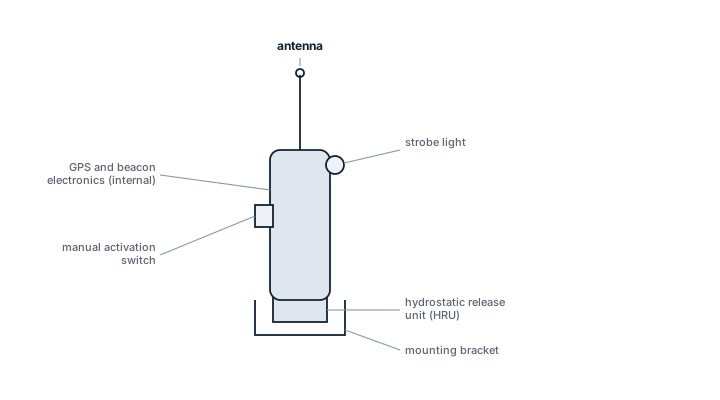
Main components
406 MHz transmitter
Transmits a digitally coded distress message including the vessel's unique identification (MMSI-derived hex code) to Cospas-Sarsat satellites, repeating at a fixed interval until manually switched off or battery exhaustion.
Integrated GPS receiver
Modern EPIRBs include an internal GPS receiver that encodes position into the 406 MHz message, cutting the time to an accurate fix from the tens of minutes a Doppler-only satellite fix needs down to close to immediate.
121.5 MHz homing signal
A separate low-power homing transmission that search and rescue units use for final approach once in the vicinity, distinct from the 406 MHz distress alert channel.
Float-free bracket (hydrostatic release)
A hydrostatic release unit (HRU) frees the EPIRB automatically at a shallow depth if the vessel sinks with no one able to launch it manually, so the beacon activates and floats clear even in an uncontrolled loss.
Battery
A sealed primary battery with a manufacturer-stated shelf life and a separate, shorter operating life once activated, both marked on the unit and tracked against replacement due dates.
Selection and sizing
Category and mounting depend on vessel type and area of operation: a float-free, automatically activating EPIRB in a hydrostatic release bracket is standard on SOLAS cargo and passenger vessels, while a manually deployed category II unit is more common on smaller craft. Selection points are GPS integration (essentially standard on current models), battery operating life after activation (commonly rated at 48 hours minimum), and coding to the correct vessel identity in the unit's programmed message, which must be re-programmed whenever the vessel's MMSI or call sign changes, such as after a change of flag or owner.
Regulations and class
SOLAS Ch. IV requires an EPIRB as part of the GMDSS fit for the vessel's sea area of operation, and Ch. III requires it as abandon-ship equipment mounted for float-free release where applicable. The beacon must be type approved to Cospas-Sarsat and IMO performance standards, registered with the relevant national beacon registry against the vessel's identity and an emergency contact, and this registration must be kept current — an EPIRB registered to a previous owner or an old contact number materially slows a rescue response. Battery replacement and full functional testing, including hydrostatic release unit replacement, follow manufacturer-set intervals and are checked at every radio and safety equipment survey.
| Requirement | Detail |
|---|---|
| Frequency | 406 MHz distress alert, 121.5 MHz homing |
| Minimum battery operating life | Typically 48 hours after activation |
| HRU replacement | Per manufacturer date, commonly every 2 years |
| Registration | National beacon registry, kept current with vessel identity |
Typical faults
- Expired hydrostatic release unit — an out-of-date HRU may not release the beacon at all, defeating the entire float-free function; this is a frequent survey finding because the date is easy to overlook against the beacon's own battery date.
- Outdated registration — a beacon registered to a previous vessel name, owner or contact number delays a Rescue Coordination Centre's ability to identify the vessel and its emergency contacts.
- Battery expiry — an EPIRB past its battery due date may still self-test as passing but not hold full rated operating life if actually activated.
- Bracket corrosion or fouling — paint overspray, corrosion or a poorly maintained bracket can jam the beacon in its cradle, preventing float-free release even with a valid HRU.
What to look for in a supplier
- Current Cospas-Sarsat type approval and, where relevant, the specific national or flag administration approval required.
- Integrated GPS as standard, since the reduction in time-to-fix is significant for search and rescue response.
- Clear battery and HRU expiry dates and a straightforward replacement/exchange programme through the maker's service network.
- Support for re-registration and re-coding when the vessel's identity changes, not just supply of the physical unit.
Check the registration database entry, not just the beacon itself, at every safety equipment survey: an EPIRB in perfect working order registered to the wrong contact still sends rescuers looking for the wrong vessel.
Typical Manufacturers
2 manufacturers · 25 models
Jotron
19
- Battery voltage drop
- HRU mechanism corrosion
- Strobe light failure
- Integrated GPS provides accurate location (±100 m) without external antenna
- Robust, watertight housing meets IMO D‑2 and USCG type‑approval standards
- Long service life battery (up to 5 years) with annual self‑test capability
- Automatic water‑activation eliminates reliance on crew action in emergencies
- Battery voltage can drop over time, requiring careful monitoring before expiry
- HRU (hydraulic release unit) corrosion is a known issue; replacement required every 2 years
- Strobe light may fail, reducing visual signalling capability
- Manual activation requires removal of safety pin, which some crews find cumbersome
- Battery end-of-life
- Water ingress to casing
- Radar pulse generator degradation
- Integrated EPIRB and SART in one compact unit reduces installation space
- Automatic water‑activated switch ensures rapid alert without manual action
- Annual self‑test complies with GMDSS maintenance requirements
- Robust, impact‑resistant housing designed for harsh marine environments
- Long‑life sealed lithium battery (≈5 years) meets IMO Class A EPIRB standards
- Battery is non‑serviceable; unit must be replaced at end‑of‑life
- Documented cases of water ingress into the casing if seals degrade
- Radar pulse generator may lose output power over time, reducing SART range
- Higher upfront cost compared with separate basic EPIRB or SART units
- No AIS integration; limited to 406 MHz satellite transmission
- Battery aging
- Float-free housing issues
- GPS acquisition time in heavy weather
- Integrated AIS transmission gives precise coordinates to nearby vessels and shore stations
- Long standby battery life (96 h) meets SOLAS requirements for continuous readiness
- Robust cold‑weather performance – tested down to -30 °C without loss of function
- Float‑free housing automatically activates on water immersion, eliminating manual steps
- GPS acquisition can be delayed in heavy sea state or poor satellite geometry
- Float‑free mechanism has reported occasional failure after prolonged storage
- Battery replacement interval is limited; aging reduces activation time and signal strength
- Unit weight and size are larger than some ultra‑compact AIS SART competitors
- ATEX certification renewal
- Battery life in cold
- Antenna connector
- Intrinsic safety (ATEX) allows installation in explosive zones such as cargo tanks
- Waterproof housing suitable for harsh marine environments
- Compact design with integrated antenna connector simplifies installation
- 5 W power output meets SOLAS GMDSS voice‑communication requirements
- Proven reliability on tanker fleets
- ATEX certification must be renewed periodically, adding maintenance overhead
- Battery performance degrades in low‑temperature conditions
- Antenna connector reported to develop loose contacts over time
- Limited to 5 W output; not ideal where extended range is required
- Lacks built‑in DSC or AIS functionality found on newer multi‑function radios
- Battery expiry tracking
- Rubber seal degradation
- Channel selector issues
- Combined VHF and EPIRB reduces equipment count on lifeboats
- Waterproof construction suitable for harsh marine environments
- SOLAS‑pack certification ensures compliance with international safety standards
- Low power (5 W) conserves battery life while providing adequate range for survival craft
- Simple annual inspection of battery and seal
- Battery expiry must be tracked manually; no built‑in monitoring
- Rubber seals can degrade over time, requiring regular replacement
- Channel selector mechanism has reported reliability issues
- Limited transmission power (5 W) may not meet the needs of larger vessels
- Manual activation required for EPIRB function
- Sensor drift
- Alarm escalation timing
- Interface with bridge alarm
- Three‑stage alarm escalation meets IMO SOLAS requirements
- Norwegian build quality with proven cold‑weather reliability
- IMO approved (Stage 3) for vessels of all sizes
- Modular design simplifies installation on existing bridge consoles
- Sensor drift can develop over time, requiring periodic recalibration
- Alarm escalation timing may be inconsistent on some bridge integrations
- Interface compatibility issues reported with certain legacy alarm panels
- Limited built‑in self‑test diagnostics compared with newer competitors
- Battery cycle management
- HRU in cold conditions
- Float-free bracket test
- Built‑in GPS provides accurate position without needing an external antenna
- Proven cold‑weather performance; tested for Arctic conditions
- Float‑free bracket and hydrostatic release unit (HRU) meet SOLAS requirements
- Long battery life (up to 5 years) with automatic self‑test function
- IMO GMDSS compliant, USCG Type Approved
- Battery cycle management can be problematic if not regularly serviced
- HRU may become sluggish in extreme cold, requiring more frequent testing
- Float‑free bracket test must be performed periodically to maintain certification
- Unit size and weight are larger than some newer low‑profile EPIRBs
- Battery management
- Telescope antenna damage in storage
- Annual test procedure
- Meets SOLAS requirement for EPIRB/SART equipment
- Long battery standby life of up to 96 hours
- Demonstrated reliability in low‑temperature conditions (Norwegian radar SART service note)
- Standard 9 GHz frequency compatible with most SAR radars
- Compact design suitable for installation on a wide range of vessels
- Battery management can be problematic, requiring careful monitoring and replacement
- Telescope‑type antenna is prone to damage if stored improperly
- Annual functional test procedure is time‑consuming and must follow strict GMDSS guidelines
- Limited to 9 GHz operation; vessels using alternative SART frequencies need additional equipment
- Visibility sensor calibration
- Timer circuit failure
- Horn relay issues
- Combines AIS‑SART and fog signal in a single hull‑mounted package, saving space and wiring complexity.
- Automatic activation via calibrated visibility sensor ensures continuous COLREG compliance without crew intervention.
- Marine‑grade, GMDSS‑approved construction designed for harsh sea environments.
- Self‑test function allows routine verification of AIS‑SART and horn operation from the bridge.
- Standardised mounting and wiring interfaces simplify installation on new builds or retrofits.
- Visibility sensor can drift over time, requiring regular calibration to avoid false activations or missed fog signals.
- Reported timer circuit failures may lead to delayed horn activation if not inspected periodically.
- Horn relay issues have been noted in field service reports, necessitating spare parts inventory.
- Integrated design means a failure in one function (e.g., sensor) can affect the whole unit’s reliability.
- Higher upfront cost compared with separate stand‑alone EPIRB/AIS‑SART and fog horn units.
- Battery expiry
- HRU degradation
- GPS acquisition delay
- Strobe LED failure
- Integrated GPS provides accurate position to SAR authorities
- Hydrostatic Release Unit (HRU) enables automatic activation on immersion
- 48 hour battery life after activation gives ample time for rescue operations
- Norwegian engineering noted for reliability and full GMDSS compliance
- Compact design suitable for a wide range of vessel installations
- Battery must be replaced every 5 years; expiry can render the unit inoperative
- HRU recommended replacement after 2 years due to degradation risk
- GPS acquisition delay may postpone initial transmission
- Strobe LED failures have been reported, affecting visual signaling
- Battery duration (48 h) is shorter than some competing EPIRBs offering 72 h
- Battery degradation
- Antenna breakage
- GPS lock failure
- Dual function (AIS SART + EPIRB) reduces equipment count on board
- Automatic AIS transmission provides real‑time position to nearby vessels and SAR assets
- 5‑year sealed lithium battery life meets GMDSS requirements
- Robust Norwegian design with self‑test diagnostics
- Meets SOLAS AIS‑SART performance standards
- Battery capacity degrades after the 5‑year service interval, requiring replacement
- Antenna can be vulnerable to mechanical damage if mishandled
- GPS lock may fail in extreme latitudes or dense signal obstruction
- Higher unit cost compared with a stand‑alone EPIRB or AIS‑SART
- Component wear due to operating hours and environmental conditions
- Corrosion due to seawater/salt air exposure
- Electronics/control failure due to moisture or vibration
- Service interval overrun causes premature failure
- Component wear due to operating hours and environmental conditions
- Corrosion due to seawater/salt air exposure
- Electronics/control failure due to moisture or vibration
- Service interval overrun causes premature failure
- Component wear due to operating hours and environmental conditions
- Corrosion due to seawater/salt air exposure
- Electronics/control failure due to moisture or vibration
- Service interval overrun causes premature failure
- Component wear due to operating hours and environmental conditions
- Corrosion due to seawater/salt air exposure
- Electronics/control failure due to moisture or vibration
- Service interval overrun causes premature failure
- Component wear due to operating hours and environmental conditions
- Corrosion due to seawater/salt air exposure
- Electronics/control failure due to moisture or vibration
- Service interval overrun causes premature failure
- Component wear due to operating hours and environmental conditions
- Corrosion due to seawater/salt air exposure
- Electronics/control failure due to moisture or vibration
- Service interval overrun causes premature failure
- Component wear due to operating hours and environmental conditions
- Corrosion due to seawater/salt air exposure
- Electronics/control failure due to moisture or vibration
- Service interval overrun causes premature failure
- Component wear due to operating hours and environmental conditions
- Corrosion due to seawater/salt air exposure
- Electronics/control failure due to moisture or vibration
- Service interval overrun causes premature failure
Jotron Skipper
6
- Component wear due to operating hours and environmental conditions
- Corrosion due to seawater/salt air exposure
- Electronics/control failure due to moisture or vibration
- Service interval overrun causes premature failure
- Meets IMO and DNV approval standards
- Long battery life (up to 48 hours)
- Compact design for easy installation
- Automatic activation in emergency situations
- Component wear due to operating hours and environmental conditions
- Corrosion risk from seawater/salt air exposure
- Electronic/ control failure due to moisture or vibration
- Potential for premature failure if maintenance intervals are exceeded
- Component wear due to operating hours and environmental conditions
- Corrosion due to seawater/salt air exposure
- Electronics/control failure due to moisture or vibration
- Service interval overrun causes premature failure
- Component wear due to operating hours and environmental conditions
- Corrosion due to seawater/salt air exposure
- Electronics/control failure due to moisture or vibration
- Service interval overrun causes premature failure
- Component wear due to operating hours and environmental conditions
- Corrosion due to seawater/salt air exposure
- Electronics/control failure due to moisture or vibration
- Service interval overrun causes premature failure
- Component wear due to operating hours and environmental conditions
- Corrosion due to seawater/salt air exposure
- Electronics/control failure due to moisture or vibration
- Service interval overrun causes premature failure
- Component wear due to operating hours and environmental conditions
- Corrosion due to seawater/salt air exposure
- Electronics/control failure due to moisture or vibration
- Service interval overrun causes premature failure