What to check on a Inmarsat-C.
Inmarsat-C differs from the other GMDSS elements in one key way: it is a data terminal, not a voice radio. Where MF/HF and VHF sets carry the officer's spoken distress call, Inmarsat-C sends structured digital messages - distress alerts, telex, Enhanced Group Calling (EGC) safety broadcasts such as SafetyNET and NAVTEX-style warnings, and general ship-to-shore correspondence - over the Inmarsat geostationary satellite network, which gives it near-global coverage except at the poles above roughly 76° latitude. Because it is store-and-forward rather than real-time voice, a message reaches shore even through…
What sets Inmarsat-C apart from other GMDSS equipment
Inmarsat-C differs from the other GMDSS elements in one key way: it is a data terminal, not a voice radio. Where MF/HF and VHF sets carry the officer's spoken distress call, Inmarsat-C sends structured digital messages - distress alerts, telex, Enhanced Group Calling (EGC) safety broadcasts such as SafetyNET and NAVTEX-style warnings, and general ship-to-shore correspondence - over the Inmarsat geostationary satellite network, which gives it near-global coverage except at the poles above roughly 76° latitude. Because it is store-and-forward rather than real-time voice, a message reaches shore even through a temporary blocked signal, queued and resent automatically, which is one reason it remains mandatory GMDSS carriage on sea areas A1-A3 despite newer broadband satellite systems being available for general communication.
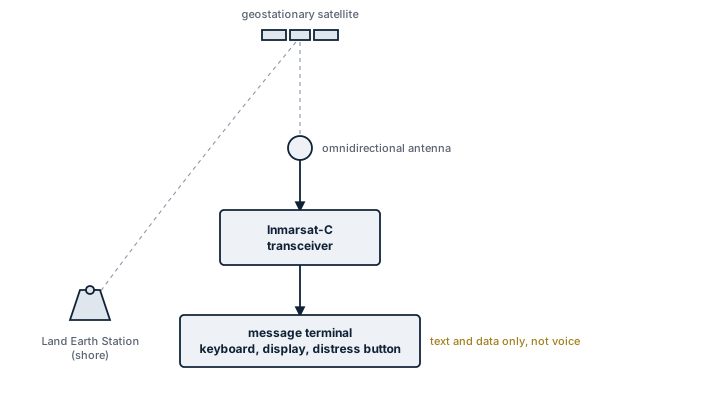
Main components
- Above-decks unit (antenna) - an omnidirectional antenna, unlike the stabilised parabolic antennas used by broadband VSAT systems, since Inmarsat-C does not need to track a satellite precisely for its low data rate.
- Below-decks transceiver unit - handles modulation, encoding and the message queue, connected to the bridge terminal.
- Distress alert button - a dedicated, protected activation point that sends a pre-formatted distress message including the last known position without requiring the operator to compose anything under pressure.
- Data terminal / keyboard and display - for composing and reading messages, telex traffic and EGC broadcasts.
- Dedicated GMDSS battery supply - required so the terminal remains operable if ship's main and emergency power both fail.
Selection / Sizing
There is little sizing choice in the usual sense - the terminal is selected for type approval matching the vessel's GMDSS sea area, and the antenna is positioned for unobstructed sky view in all directions since it is omnidirectional. The main practical decision is how many terminals to fit: SOLAS requires the equipment to be usable from the position from which the ship is normally navigated, and larger vessels sometimes fit a second unit or a remote alert panel on the bridge wing or in the GMDSS radio room for redundancy.
Regulations / Class
Inmarsat-C carriage is mandated under SOLAS Ch. IV as part of GMDSS equipment for sea areas A1, A2 and A3, either as the primary satellite communication fit or alongside MF/HF DSC depending on the areas a vessel actually trades in. It must be maintained to meet the SOLAS requirement for either duplication of equipment, shore-based maintenance, or at-sea maintenance capability, and radio surveys check its distress alerting function specifically, not just general operability. IMO performance standards for Inmarsat-C equipment set the technical requirements terminals must meet for type approval.
Typical faults
| Fault | Consequence |
|---|---|
| Antenna cable or connector corrosion | Weak or lost satellite link, intermittent message failure |
| Battery backup not tested or degraded | Unit fails during a mains power loss, exactly when distress alerting may be needed most |
| Position input not connected or GPS feed lost | Distress alert transmits without a valid position, defeating its main purpose |
| Operator unfamiliarity with distress alert procedure | Delay or error activating the alert in a genuine emergency |
| Software/firmware not updated for MMSI or satellite ocean region changes | Registration mismatches or message routing failures |
What to look for in a supplier
- Current type approval valid for the vessel's flag and GMDSS sea area.
- Confirmed integration with the ship's GPS feed so distress messages carry an accurate position automatically.
- Service agreement covering GMDSS-specific maintenance intervals, not just general electronics servicing.
Test the distress alert function only through the manufacturer's designated test mode, never by actually keying the live distress button - accidental live activations are a recurring cause of false alerts that tie up rescue coordination resources.