What to check on a AIS Transponder.
AIS is not primarily a distress or alerting system like the rest of the GMDSS suite; it is a continuous, automatic identification and position broadcast that other vessels and VTS stations receive without any request. Where radar shows a target's presence and rough movement, AIS gives its exact identity, destination, cargo status and rate of turn, refreshed every few seconds for a moving vessel and less often at anchor. Class A units, mandatory on SOLAS vessels, transmit at higher power and shorter reporting intervals than the Class B units fitted…
What Sets AIS Apart
AIS is not primarily a distress or alerting system like the rest of the GMDSS suite; it is a continuous, automatic identification and position broadcast that other vessels and VTS stations receive without any request. Where radar shows a target's presence and rough movement, AIS gives its exact identity, destination, cargo status and rate of turn, refreshed every few seconds for a moving vessel and less often at anchor. Class A units, mandatory on SOLAS vessels, transmit at higher power and shorter reporting intervals than the Class B units fitted on smaller craft, and use a different, more robust access scheme on the AIS VHF channels.
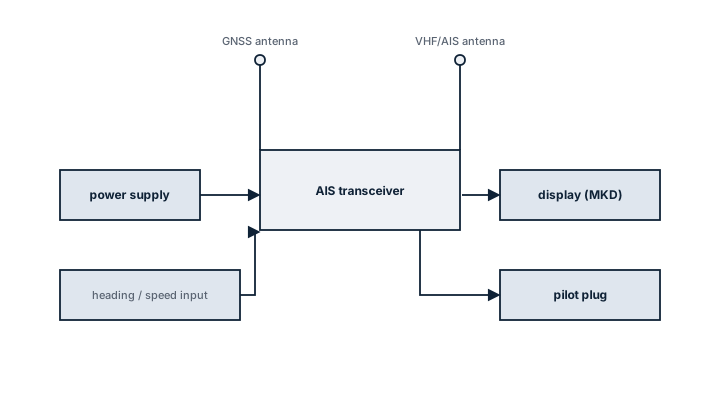
Main Components
VHF Transceiver Module
Operates on the two dedicated AIS VHF channels, transmitting and receiving simultaneously using time-division access so multiple vessels share the channel without constant collisions.
GNSS Position Receiver
An internal or external GPS/GNSS receiver supplies position, course over ground and speed; many installations use a dedicated AIS GPS antenna independent of the ship's main navigation GPS for redundancy.
Minimum Keyboard Display (MKD) or Integration Unit
Lets the operator enter voyage data such as destination, ETA and cargo status, and displays received target data where no separate ECDIS overlay exists.
Pilot Plug
A standardized connector giving a boarding pilot's portable unit direct access to the ship's AIS data feed, required on SOLAS vessels.
Selection and Sizing
- Class A versus Class B: Class A is mandatory for SOLAS cargo ships and passenger ships regardless of size; Class B suits smaller non-convention craft
- Integration path: standalone MKD versus data feed into ECDIS and radar overlay
- Redundant GNSS antenna placement clear of masking by funnel or superstructure
Regulations and Class
SOLAS Ch. V requires AIS on all passenger ships and on cargo ships of 300 gross tonnage and above on international voyages, and 500 gross tonnage and above domestically. The transponder must transmit continuously except where the master judges it a security risk, in which case switching off is logged. Class surveys check the pilot plug is live and the static voyage data entered matches the vessel's actual particulars.
Typical Faults
| Fault | Consequence |
|---|---|
| GNSS antenna cable degraded or masked by structure | Position dropout or frozen target shown to other vessels, a collision-avoidance hazard |
| Static data left from a previous voyage or charter | Wrong destination, draft or cargo status broadcast, misleading VTS and other traffic |
| Transponder switched off and forgotten after a security stand-down | Vessel becomes invisible to AIS-dependent traffic separation and VTS monitoring |
| Pilot plug wiring fault | Boarding pilot cannot access live AIS data on the portable unit |
What to Look for in a Supplier
- Confirmed interface compatibility with the ship's existing ECDIS and radar for overlay
- Correct Class A or Class B unit for the vessel's actual SOLAS status, not the cheaper option by default
- Support for MMSI and static data programming as part of commissioning, not left to the crew
Check the static voyage data every time the ship changes trade or charter - an AIS transponder broadcasting last month's destination is a routine finding at PSC inspection and undermines trust in everything else it reports.