What to check on a AIS Transponder (Class A).
Class A is the mandatory SOLAS variant of AIS, distinct from the Class B units fitted voluntarily on smaller and leisure craft. It transmits at higher power, on a fixed higher-priority reporting schedule tied to the vessel's speed and course change rate, as often as every two seconds when manoeuvring, out to every ten seconds at anchor or slow speed, and carries a larger mandatory data set including vessel name, IMO number, call sign, dimensions, cargo type and destination. This higher reporting rate and data completeness is what makes Class…
What Sets This Type Apart
Class A is the mandatory SOLAS variant of AIS, distinct from the Class B units fitted voluntarily on smaller and leisure craft. It transmits at higher power, on a fixed higher-priority reporting schedule tied to the vessel's speed and course change rate, as often as every two seconds when manoeuvring, out to every ten seconds at anchor or slow speed, and carries a larger mandatory data set including vessel name, IMO number, call sign, dimensions, cargo type and destination. This higher reporting rate and data completeness is what makes Class A the reference other traffic and VTS rely on for collision avoidance and traffic management, rather than a supplementary tracking aid.
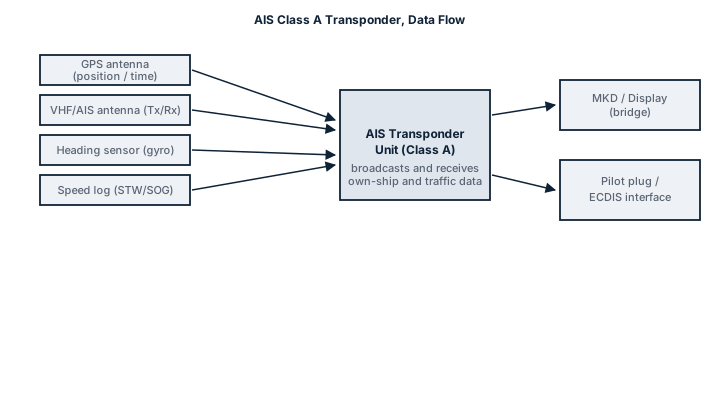
Main Components
VHF transceiver
Two VHF channels dedicated to AIS carry the traffic using a self-organising time-division scheme, so units share the channel without a central controller.
Data processing unit
Assembles static data, entered once, such as vessel name and IMO number, voyage data, entered each trip, such as destination and draught, and dynamic data taken continuously from sensors, into the standard AIS message set.
Sensor interfaces
Position and time from GPS, heading from gyrocompass, rate of turn from a rate-of-turn indicator where fitted, and speed from the log; a Class A set with a missing or faulty sensor input will broadcast that field as not available rather than fail outright.
Minimum Keyboard and Display (MKD)
The bridge unit used to enter voyage data, view nearby traffic and, on some installations, send short safety-related text messages.
Selection and Sizing
There is little sizing in the conventional sense for a mandatory transponder; the practical selection points are as follows.
- Integration with the ship's existing radar/ECDIS so AIS targets overlay correctly rather than requiring a standalone display.
- Number and quality of sensor interfaces supported, since a unit fed poor heading or position data degrades the accuracy of what it broadcasts to everyone else.
- Long-range AIS capability where fitted, allowing shore authorities to poll the vessel's position over satellite in some traffic schemes.
- Ease of correcting static and voyage data before departure, since stale destination or draught data is a common and avoidable deficiency.
Regulations and Class
SOLAS Chapter V Regulation 19 mandates Class A AIS for the applicable ship categories and sizes engaged on international voyages. AIS may only be switched off at the master's discretion where continued operation would compromise the safety or security of the ship, and that decision must be recorded in the log. Equipment requires type approval to the relevant IMO/ITU performance standards, and MMSI, call sign and IMO number must match the vessel's official registration exactly; mismatches are a common finding at port state control.
Typical Faults
| Fault | Cause | Consequence |
|---|---|---|
| Incorrect static data | Vessel name, call sign or IMO number entered wrongly at commissioning and never corrected | Port state control deficiency; confusion for other traffic and VTS identifying the vessel |
| Stale voyage data | Destination and ETA not updated after departure | Misleading information broadcast to shore authorities and nearby traffic |
| Position offset | GPS antenna position not correctly entered relative to the AIS reference point | Other vessels' collision-avoidance plots show the ship in the wrong place relative to its actual outline |
| Silent transponder | Antenna, cable or transceiver fault not obvious from the MKD alone | Vessel invisible to AIS-dependent traffic despite appearing to operate normally on the bridge |
What to Look for in a Supplier
- Type approval certificate current for the flag state and covering the specific hardware revision offered.
- Confirmed sensor compatibility list matching the ship's existing gyrocompass, GPS and log interfaces.
- Support for correcting static data without a full reflash, since name or call sign changes do happen.
- Firmware update history, given how often AIS message standards and channel management have been revised.
Check the static and voyage data on the MKD against the ship's actual particulars at the start of every voyage; a wrong destination or draught broadcast to every AIS receiver in range is a five-minute fix that too often sits uncorrected for months.