Inmarsat-C Terminal
Inmarsat-C is the narrowband, store-and-forward satellite terminal that forms the core GMDSS data link for Sea Area A3. It sends and receives short text messages and distress alerts, not voice, and that narrow scope is exactly what makes it reliable.
Read more — Inmarsat-C Terminal explained ▾
What sets Inmarsat-C apart
Inmarsat-C is a low-bit-rate, store-and-forward data terminal — it has no voice capability and no real-time IP connection. What it does, it does reliably: distress alerting, Maritime Safety Information reception through SafetyNET, and routine telex-style messaging, all over a small, low-power antenna that needs no active stabilisation. That narrow function set is the deliberate difference from FleetBroadband or a VSAT system: Inmarsat-C is built to keep working with minimal power and a simple omnidirectional antenna even when the ship cannot spare the power or space for a stabilised broadband dish.
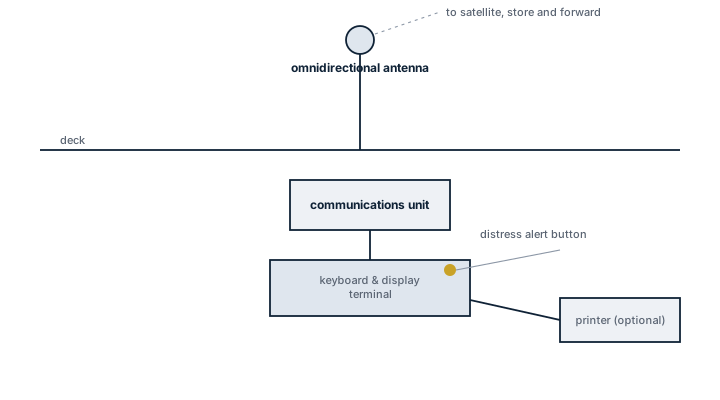
Main components
Antenna unit
A small omnidirectional antenna, usually a dome no larger than a dinner plate, mounted with a clear view of the sky. Unlike FleetBroadband or VSAT antennas it needs no gyro-stabilised tracking mount.
Below-deck transceiver
Handles message composition, store-and-forward transmission, and the distress alert function, normally interfaced to a dedicated GMDSS keyboard and printer or display.
Distress alert button
A guarded button, usually protected by a cover, that sends a distress alert with position from an integrated or interfaced GPS directly to a Rescue Coordination Centre without needing the operator to compose a message.
SafetyNET receiver function
Receives Maritime Safety Information, including navigational warnings, weather warnings and SAR information, broadcast to defined ocean regions or smaller NAVAREA and METAREA zones.
Selection / Sizing
| Parameter | What it drives |
|---|---|
| Sea area of operation | A3 vessels typically carry Inmarsat-C as their satellite GMDSS terminal |
| Integration with GPS | Position must feed automatically into distress alerts; a terminal without a live GPS interface fails this basic function |
| Number of terminals fitted | SOLAS cargo ships generally require two independent means of distress alerting, which may mean Inmarsat-C plus a second, different system |
Regulations / Class
SOLAS Chapter IV lists Inmarsat-C, or equivalent, as an accepted GMDSS terminal for Sea Area A3, covering distress alerting, MSI reception via SafetyNET, and general communications. The terminal and its GPS interface are checked at the annual radio survey, along with the distress alert test procedure, which must be carried out using the test call facility rather than a live distress transmission. It must be listed on the ship's Safety Radio Certificate.
Typical faults
- GPS interface cable disconnected during other bridge work — distress alerts transmit without position, which delays rescue response.
- Distress button cover missing — accidental activation risk, a common finding at survey and a source of false alerts.
- MMSI not updated after a change of ownership or flag — alerts reach the wrong RCC or are misidentified.
- Printer paper or consumables not stocked — MSI messages received but never read because nobody checks the terminal daily.
What to look for in a supplier
- Confirms the terminal is on the current list of type-approved GMDSS equipment for your flag state.
- Provides a straightforward GPS interface compatible with your existing bridge navigation equipment.
- Supports remote MMSI reprogramming without requiring a full service visit for a simple registration change.
Test the distress alert function using the designated test call, not a live alert, and log every test — an RCC that receives an untested, unexplained distress signal from your MMSI will not assume it was a drill.
3 manufacturers · 7 models
Furuno
3JRC
2- Antenna obstruction, tracking fault or damaged radome causes loss of satellite lock, poor signal quality or repeated connection drops
- Modem, terminal or network-interface failure causes unavailable data or voice services despite normal ship power
- Power-supply or UPS faults cause terminal rebooting, blank displays or complete service loss
- Cabling, connector or Ethernet faults cause intermittent connectivity or loss of interfaces to ship systems
- Configuration, registration or service-provider problems prevent log-in or message transfer even when hardware tests appear normal