What to check on a Navtex Receiver (GMDSS).
Most GMDSS equipment exists to send or receive a distress alert. Navtex does neither. It is a passive, automatic receiver for Maritime Safety Information, or MSI: navigational warnings, gale and storm warnings, search and rescue information and similar broadcasts sent by coast stations on a fixed schedule. The watchkeeper does not have to do anything for a message to arrive; the receiver filters incoming traffic by station identity and subject code and stores or prints only what has not been deliberately excluded. That passive, filtered design is the whole point…
What Sets Navtex Apart
Most GMDSS equipment exists to send or receive a distress alert. Navtex does neither. It is a passive, automatic receiver for Maritime Safety Information, or MSI: navigational warnings, gale and storm warnings, search and rescue information and similar broadcasts sent by coast stations on a fixed schedule. The watchkeeper does not have to do anything for a message to arrive; the receiver filters incoming traffic by station identity and subject code and stores or prints only what has not been deliberately excluded. That passive, filtered design is the whole point: a bridge team on a busy watch should not have to actively monitor a channel to know a navigational warning has been issued for the area they are about to enter. English-language broadcasts run on 518 kHz internationally, with 490 kHz used for national-language broadcasts in many areas, and 4209.5 kHz used in tropical regions where MF propagation is less reliable.
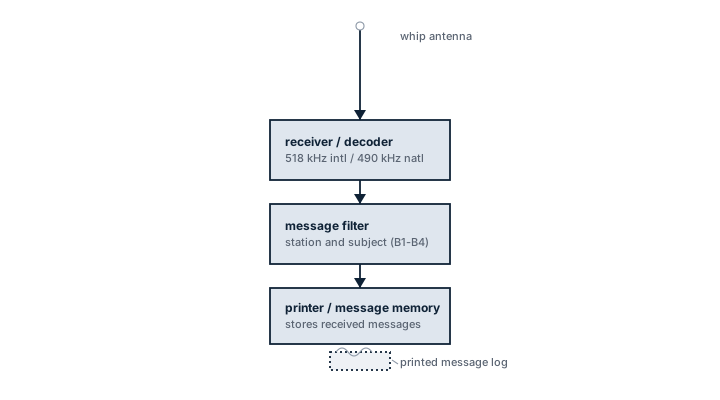
Main Components
Receiver Unit
Tuned to the Navtex frequencies, decoding the narrow-band direct-printing signal into readable text messages.
Antenna
A dedicated whip antenna separate from the ship's other MF and HF antennas, since a shared or poorly matched antenna is a common cause of weak reception.
Message Filter
Software that selects which station identifiers and which subject codes, such as navigational warnings, meteorological warnings or SAR information, are actually stored or printed, suppressing everything else.
Display or Printer
Older units use a dedicated thermal printer; many current installations display messages on screen and store them digitally, with some integrated directly into the ship's ECDIS or integrated navigation system.
Power Supply
GMDSS requires a reserve power source so the receiver keeps working through a mains interruption, not only while the main supply is available.
Selection and Sizing
There is little to size in the traditional sense; the real selection questions are integration and capacity. A standalone unit works, but integration with the ship's INS or ECDIS lets warnings appear directly where the watchkeeper is already looking. Message storage capacity matters for keeping a usable log, and reserve power duration has to meet the requirement for the ship's area of operation.
Regulations and Class
SOLAS chapter IV, the GMDSS chapter, requires a Navtex receiver for MSI reception on ships operating within Navtex coverage, generally sea areas A1 and A2. The receiver must carry type approval to the relevant IMO performance standard, which governs correct decoding and message filtering by station and subject code, and it must be backed by the reserve power source GMDSS requires.
Typical Faults
- Corroded or damaged antenna connection - weakens reception, especially at the edge of a coast station's range, so messages are missed rather than obviously failing.
- Misconfigured message filter - genuine warnings get suppressed, or the log fills with irrelevant traffic that buries the messages that matter.
- Printer paper or ribbon exhausted unnoticed - on older thermal units, messages are received but never actually produced for anyone to read.
- Degraded battery backup - the receiver drops out during a mains interruption, leaving a gap in the MSI record right when it may matter most.
- Outdated station data - firmware that has not kept pace with station list changes can misidentify or fail to decode some broadcasts.
What to Look For in a Supplier
- Current IMO type approval matching the ship's GMDSS sea area of operation.
- Integration compatible with the bridge's existing INS or ECDIS if consolidated alerting is wanted.
- Message storage adequate to support an audit trail after an incident.
- Battery backup that actually meets the GMDSS reserve source duration, not a nominal figure.
- A filter configuration interface simple enough that the crew can verify it is set correctly, not just accept factory defaults.
Check the station and subject-code filter settings after every crew change, not only at commissioning - a Navtex quietly filtering out navigational warnings is far more dangerous than one that is obviously switched off.