What to check on a Flexible Coupling.
54 models from vulkan in Flexible Coupling. Below: the full model list.
What sets a flexible coupling apart
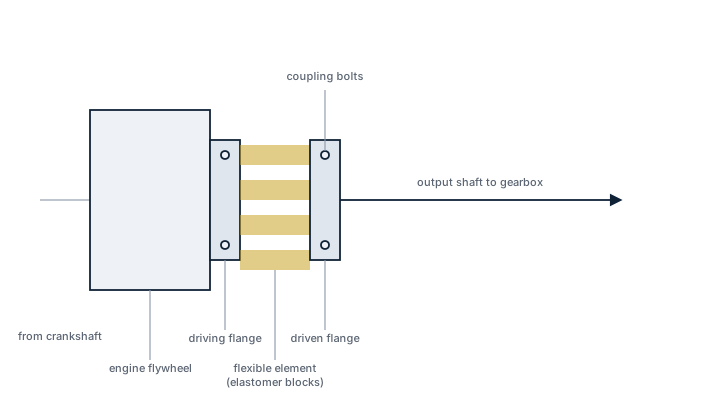
A torsionally flexible coupling sits between the engine and the rest of the shaft line, usually right at the engine flywheel or between engine and gearbox, and its job is to absorb torsional vibration and angular misalignment rather than simply transmit torque. A rigid flange coupling, by contrast, assumes the two shafts it joins are already close to perfectly aligned and torsionally compatible; it is fine further down a shaft line between two already-flexible sections, but it cannot be used straight off a diesel engine's crankshaft, where torque pulses from each cylinder firing would otherwise be passed straight into the gearbox and propeller shaft. The flexible coupling's rubber or steel-disc elements twist slightly under each torque pulse and damp it, which is what keeps the shaft line's torsional natural frequencies clear of the engine's normal running speed range.
Read the full guide
Main components
Flexible element
Rubber-block or rubber-bushing couplings use pre-compressed rubber elements between metal segments to give both torsional flexibility and some vibration damping through internal hysteresis. Steel-disc couplings use thin flexing steel discs instead, giving high torque capacity and no rubber to age, at the cost of less inherent damping.
Hub flanges and bolting
Two hub flanges, one keyed or shrunk onto the engine flywheel or output shaft and one onto the driven shaft, sandwich the flexible elements and are held together with fitted bolts torqued to a specified value; correct bolt tension is what keeps the joint from working loose under cyclic torque.
Torque limiter or shear pin
Some couplings include a deliberately weaker element, a shear pin or friction-slip section, designed to fail or slip before an overload event, such as a fouled propeller, damages the engine or gearbox.
Selection and sizing
Coupling selection is driven by the shaft line's torsional vibration behaviour, not just by torque capacity:
- Nominal and peak torque capacity, with margin for the engine's maximum continuous rating plus transient loads
- Torsional stiffness and damping, since these figures feed directly into the ship's torsional vibration calculation and determine whether a barred speed range is needed
- Permissible misalignment, angular, radial and axial, matched to the actual installation tolerances achievable at the engine seating
Regulations and class
Class societies require a torsional vibration analysis of the complete shaft line, from engine crankshaft to propeller, before the coupling is approved, and the coupling manufacturer's stiffness and damping data are a direct input to that calculation. Where the analysis shows a resonance within the normal operating range, class will impose a barred speed range that the engine must pass through quickly rather than run in continuously, and the coupling forms part of the survey scope at each shaft line examination.
Typical faults
- Rubber elements hardening and cracking from oil contamination or sustained overheating, gradually shifting the coupling's torsional stiffness and moving the resonance point
- Bolts loosening under cyclic load when not torqued or locked correctly at installation, leading to fretting and eventual failure
- Undetected misalignment from engine seating settlement, showing up as uneven wear across the flexible elements
- Wrong stiffness selection at the newbuilding stage producing a barred speed range that falls inside the ship's normal service speed
What to look for in a supplier
- Full torsional stiffness and damping data for the exact coupling size, supplied in the format class societies require for the vibration calculation
- Rubber compound rated for the expected engine room temperature and any oil mist exposure
- Availability of flexible elements as a separate spare, so the whole coupling does not need replacing for a routine element change
- Track record on comparable engine and gearbox combinations, since torsional behaviour is installation-specific
A coupling that looks fine on the outside can already have degraded torsional stiffness; if running speeds start drifting into a range that used to be barred, treat it as a shaft line problem, not a governor problem.