What to check on a MF/HF Radio.
2 models from global in MF/HF Radio. Below: the full model list.
What Sets MF/HF Apart
MF/HF radio covers the distance gap that VHF cannot close and the polar gap that geostationary satellite systems cannot cover. Where VHF is line-of-sight and drops out beyond roughly 20-30 nautical miles, MF (1.6-4 MHz) and HF (4-27 MHz) signals travel by ground wave and sky wave, bouncing off the ionosphere to reach hundreds or thousands of miles. This makes the set the primary GMDSS tool for sea areas A3 and A4, and the backup for A1/A2 vessels operating far offshore. Unlike Inmarsat terminals, MF/HF needs no satellite subscription and keeps working at latitudes above 70-76 degrees where geostationary coverage becomes marginal or unusable.
Read the full guide
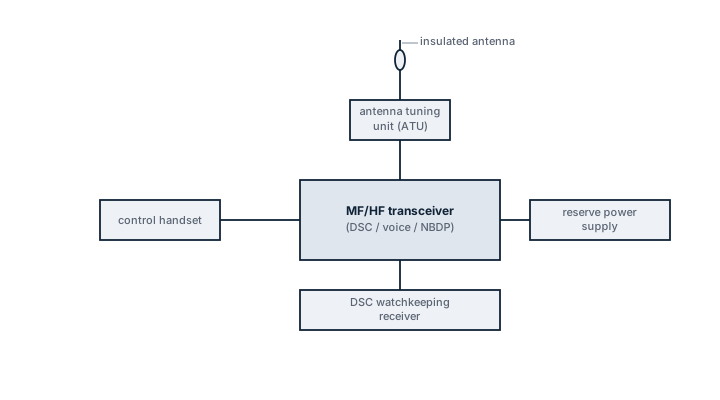
Main Components
Transceiver
The core unit generates and receives on the assigned distress, safety and working frequencies. It carries the DSC controller as an integrated module in most modern sets rather than a separate box.
Antenna Tuning Unit (ATU)
MF/HF whip or backstay antennas are electrically short relative to the transmitted wavelength, so an ATU matches impedance automatically each time the frequency changes. A failed ATU is the single most common reason a set transmits with high VSWR and low effective power.
Antenna
Usually an insulated backstay or a dedicated whip, kept clear of the VHF and radar antennas to limit mutual interference, with a solid, low-resistance ground plane connection to the hull.
DSC Watchkeeping Receiver
A separate scanning receiver continuously monitors 2187.5 kHz and the HF DSC distress and calling channels, independent of whether the operator is using the set for other traffic.
Selection and Sizing
- Transmitter power: typically 150 W PEP for smaller vessels, up to 250 W PEP for larger ocean-going ships
- Sea area rating: A3 fit is common; A4 (polar) operation needs full HF band coverage plus a working NBDP/telex capability
- Number of installed antennas and available deck space for the ATU and ground plane
- Integration with the ship's DSC alerting and GMDSS console, and available 24V/220V power redundancy
Regulations and Class
SOLAS Ch. IV sets the GMDSS carriage requirement by sea area; A3 vessels need MF/HF DSC capability unless they carry two independent Inmarsat terminals instead, and A4 vessels need it regardless. Class societies require an annual survey of the radio installation and verification against the ship's GMDSS Radio Log, and a battery-backed reserve source of energy able to power the set for a defined endurance period is mandatory.
Typical Faults
| Fault | Consequence |
|---|---|
| Corroded antenna feed or ground strap | High VSWR, ATU cannot tune, reduced or lost transmit range |
| ATU relay contacts worn from cycling | Set locks on one frequency band or fails to tune at all |
| DSC watch receiver software fault | Distress calls on other vessels go unanswered without the crew noticing |
| Reserve battery undercharged or aged | Set drops out during a mains power failure, exactly when needed most |
What to Look for in a Supplier
- Type approval covering the vessel's actual GMDSS sea area, not just a general marine radio certificate
- Documented VSWR and output power test results at handover, not just a visual inspection
- Spare ATU relay and antenna coupler parts held in stock, since these fail more often than the transceiver itself
- Experience integrating the set with the bridge's existing DSC alerting console
If the DSC watch receiver has not logged a self-test alarm in months, do not assume it is fine - test it deliberately, because a silent failure here means the ship stops listening for distress traffic without anyone knowing.