Stern Ramp
A stern ramp is hinged at the transom and loads straight in from the quay or linkspan, unlike an angled quarter ramp; where it also closes a hull opening below the freeboard deck it doubles as a watertight or weathertight closing appliance, not just a driving surface.
What to check on a Stern Ramp.
108 models from ALMAC Marine in Stern Ramp. Below: the full model list.
What Sets a Stern Ramp Apart
A stern ramp is mounted across the transom and swings down to meet the quay, linkspan or another ship's ramp in a direct line with the vehicle deck. That straight-through geometry is the whole point: a quarter ramp is offset to one side because the berth or the ship's stern shape does not allow a straight approach, and a bow ramp or visor serves the same purpose at the opposite end of the ship, usually behind a separate weathertight bow door. Where a stern ramp forms part of the shell plating below the freeboard deck, it is not just cargo-handling gear, it is a hull closing appliance, and that changes how it is built, tested and monitored.
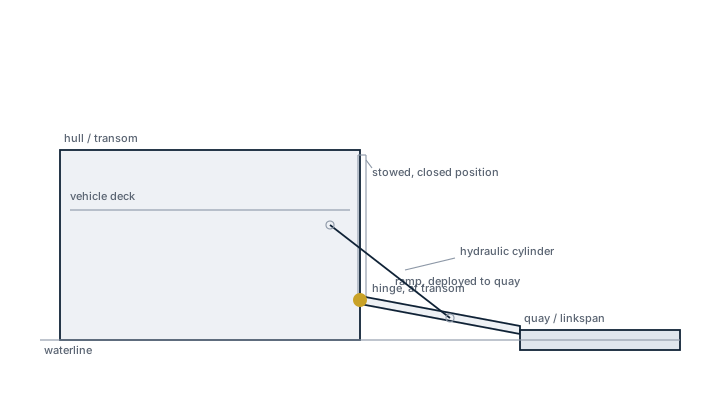
Legend
- hull / transom
- stowed, closed position
- vehicle deck
- hydraulic cylinder
- hinge, at transom
- ramp, deployed to quay
- quay / linkspan
- waterline
Main Components
- Ramp platform – stressed steel plate, often with a hinged flap or extending apron at the outboard end to bridge tidal range and quay height differences.
- Hinge and pintle arrangement – carries the ramp's weight and the vehicle loads crossing it back into the ship's structure.
- Hydraulic lifting cylinders – raise and lower the ramp; on larger ramps working in pairs with synchronising valves to keep the ramp level.
- Suspension wires or chains – found on older or lighter designs as a backup or primary lift path instead of direct cylinder connection.
- Locking devices – cleats or wedges that take the sea-going load off the hydraulics once the ramp is stowed, so the cylinders are not the only thing holding it shut.
- Hydraulic power pack and local/remote control station.
- Position indicators and interlocks – feed ramp-open/closed status to the bridge, and on some ships block propulsion or gangway use until the ramp is confirmed closed and locked.
Selection and Sizing
Sizing starts with the heaviest axle load the ramp must carry repeatedly, not the vehicle's total weight, since a concentrated axle or outrigger load governs plate thickness and stiffening. Ramp angle has to stay within the ground clearance and articulation limits of the trailers and mobile cargo actually used on the route, which is why maximum tidal range at the intended berths is checked before ramp length is fixed. Width is set by lane configuration on the deck below, and steel grade and corrosion allowance need to account for constant wetting, road salt and ballast splash rather than dry cargo-hold conditions.
Regulations and Class
Where the ramp forms part of a hull opening below the freeboard deck, SOLAS Chapter II-1 closing appliance requirements apply, including position indication at the navigating bridge and, following the ferry losses that drove the current rules, television surveillance or equivalent monitoring of the ramp seal area on many RoRo ships. Class societies require periodic operational testing and survey of the hydraulic system, locking devices and indicators, and IACS unified requirements cover the closing devices on hull openings of this kind. A ramp used purely as an internal or dry-deck access with no hull opening role is surveyed as cargo gear rather than a closing appliance, which is a lighter regime.
Read the full guide
Typical Faults
- Hydraulic cylinder seal leakage – causes slow ramp creep and loss of load holding, risking an uncontrolled drop during cargo operations.
- Corroded or worn hinge pins – introduce play and misalignment that can bind the ramp partway through travel.
- Worn locking devices – leave the ramp resting on the hydraulics alone at sea, with water ingress risk if a cylinder then fails.
- Position sensor failure – gives a false closed indication on the bridge, defeating the purpose of the SOLAS interlock.
- Wheel-track wear or cracking – concentrated axle loads eventually pit or crack the plating along the running lines, a structural rather than cosmetic issue.
What to Look for in a Supplier
- Documented experience with ramps of this size and closing-appliance status, not just generic hydraulic lifting gear.
- Class type approval for the closing device where the ramp seals a hull opening.
- Availability of standard cylinder seal kits and pins as spares, rather than one-off machined parts.
- Ability to provide a load test certificate covering the ramp's full range of motion, not a single static position.
Before the first cargo call, cycle the ramp through its full range under a representative load, not just empty, and check the locking devices actually engage before relying on the hydraulics alone overnight.
Models in this type.
The best-documented model of each manufacturer first, then the next — 100 of 108 models in Stern Ramp. Every row links to full specifications, documents and service notes.
Manufacturers.
All 11 manufacturers with models of Stern Ramp. Names with a manufacturer page open it; the others open a search across the full library.
All manufacturers in the libraryAlso in RoRo Equipment.
The other equipment types in this category.
Write to us about this model — the answer comes by e-mail.
Name the make and the model and what the job is: a spare, a service call, a second opinion on a data sheet. We answer by e-mail.
No details at hand? A photo of the rating plate or the part is enough — simply attach it to the request.
Questions that come up with this equipment.
Is Stern Ramp data free?
Yes. Every model page, every guide and every datasheet for this type is readable without an account. An account adds saved searches and requests, nothing is taken away.
My model is missing — what now?
Send us the nameplate. We identify it by hand, add it to the library, and if you need a part or a service, the request is already on our desk.
Can you source a Stern Ramp part?
Yes. Tell us the manufacturer, the model and what you need — a person reads every request and replies by e-mail.