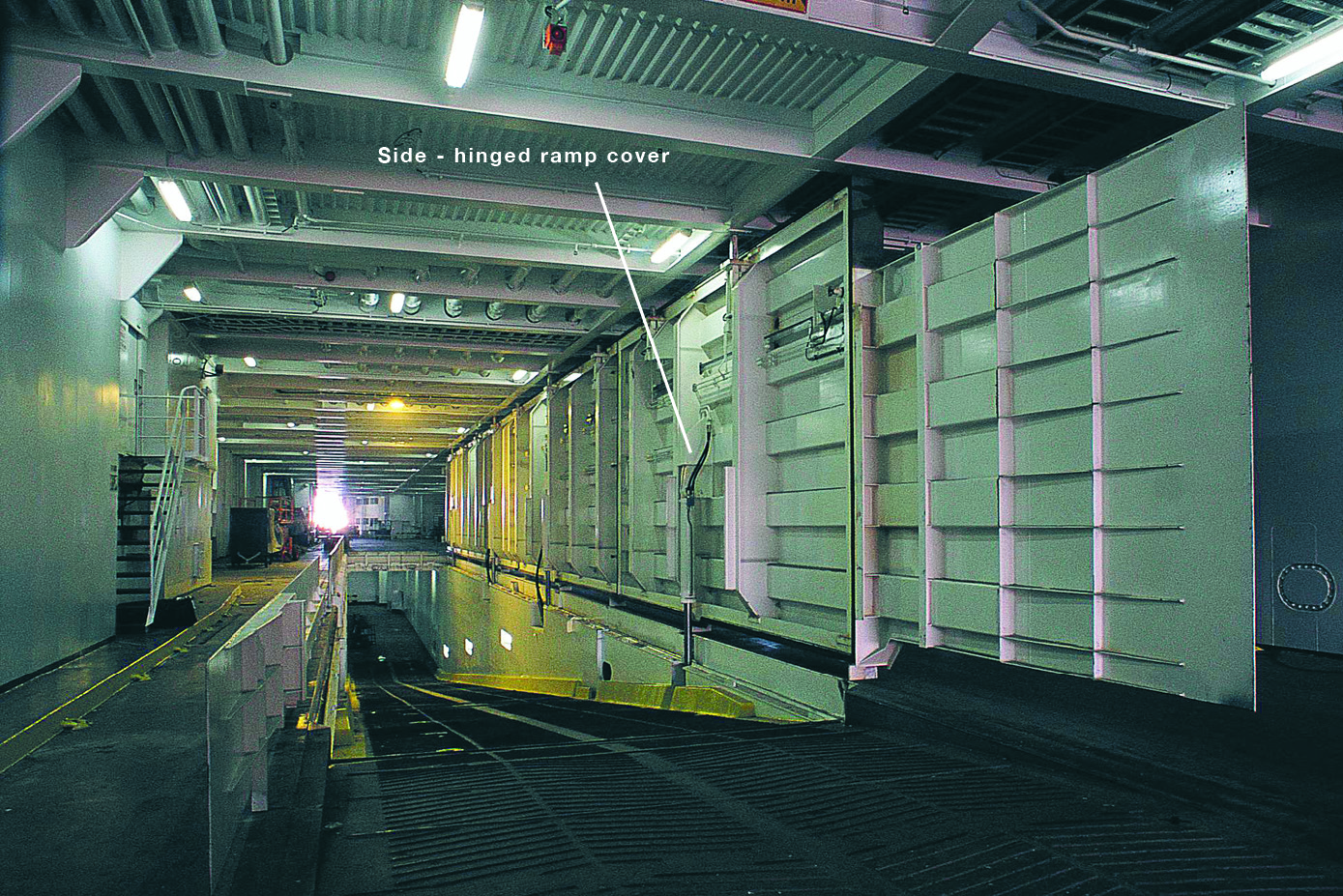
Internal Ramp
An internal ramp connects two cargo decks inside the ship rather than the ship to the shore, and unlike a stern or side ramp it never needs watertight closure - its job is purely structural, moving vehicles between decks quickly enough not to become the bottleneck in a RoRo ship's turnaround.
Read more — Internal Ramp explained ▾
What sets an internal ramp apart
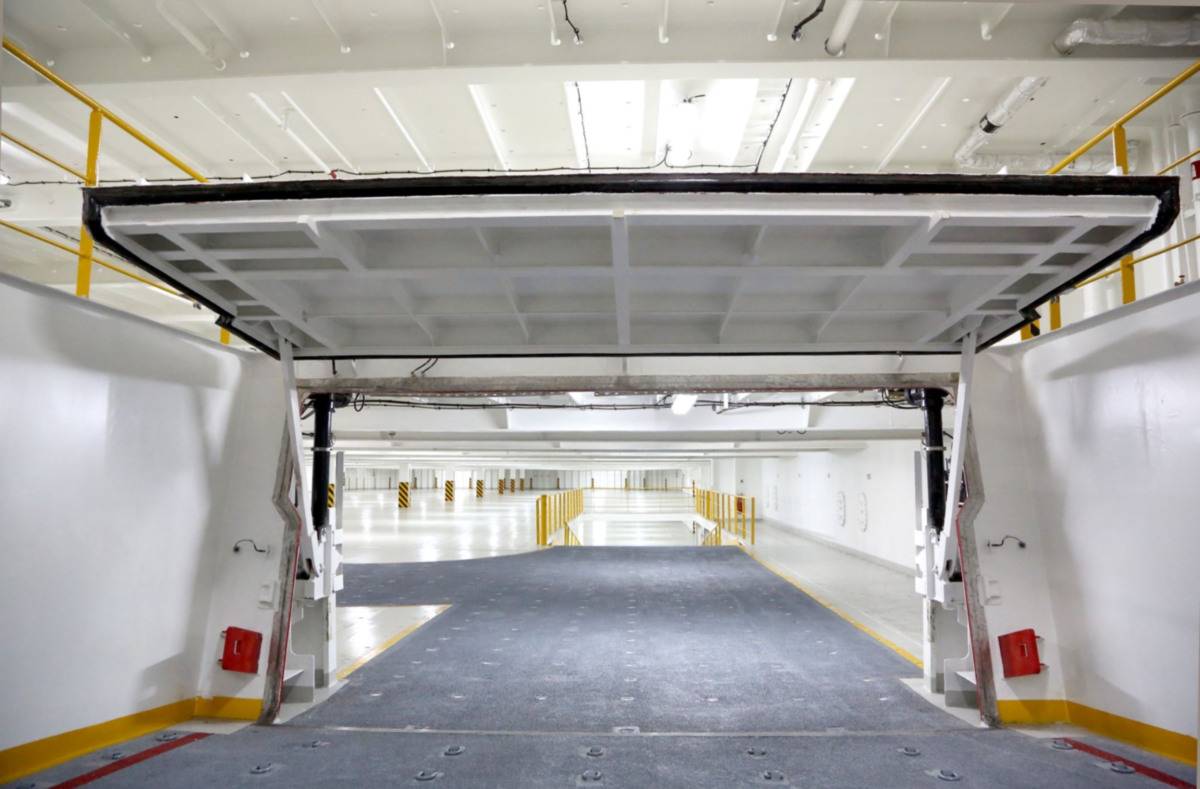
Stern, bow and side ramps all cross the ship's shell and must close watertight; an internal ramp sits entirely inside the hull, linking one cargo deck to the one above or below it, and is judged purely on structural capacity and traffic flow rather than sealing. Some are fixed inclines built into the ship's structure, others are hoistable or hinged so they can be raised clear of the deck below when that space is needed for taller cargo. On large car carriers, the internal ramp network, not the shore ramp, is usually what limits how fast a full load of vehicles can be driven aboard.

Main components
Ramp deck structure
An inclined steel deck, stiffened underneath by girders sized for the axle loads and traffic density the ship's cargo plan expects on that route between decks.
Hinge and lifting arrangement
On movable designs, pivot points at the upper end and a hydraulic or wire lifting system at the lower end, allowing the ramp to fold up against the deckhead above.
Locking supports
Fixed props or pins that carry the working load once the ramp is lowered, so the lifting gear is not left holding vehicle traffic loads continuously.
Surface treatment
A non-slip deck coating or pattern plate, since the ramp incline combines with ship motion at sea and wet tyres in port to create a real slip hazard for drivers and stevedores.
Selection and sizing
| Parameter | Relevance |
|---|---|
| Incline angle | Steeper ramps save deck length but limit the ground clearance of vehicles that can use them |
| Load rating | Must match the heaviest vehicle class the deck it serves is designed to carry |
| Fixed vs movable | Movable ramps trade flexibility in deck height for added hydraulics and maintenance |
| Width and traffic pattern | Single or dual-lane ramps set how fast a deck can be loaded or cleared |
Regulations and class
Internal ramps are assessed under class structural rules as part of the RoRo deck system, sized for the vehicle loading the deck plan specifies, with fatigue considerations for the constant traffic they carry over the ship's life. Because they are enclosed within the hull they do not fall under the watertight door provisions of SOLAS Chapter II-1 that apply to shell openings, but class surveys still check the structure, locking supports and, on movable ramps, the lifting mechanism for wear and correct operation.
Typical faults
- Locking support wear - worn pins or props let the ramp settle slightly under load, transferring repeated shock into the hinge and lifting gear instead of the fixed structure.
- Corrosion under the deck coating - trapped moisture beneath a worn non-slip surface corrodes the plate from underneath while the top still looks serviceable.
- Hinge seizure on movable ramps - infrequent operation lets salt and grime dry into the pivot, and the ramp resists the first lift after a long period in one position.
- Surface wear at the transition edge - the join between ramp and adjacent deck takes the highest impact loading from vehicle axles and wears faster than the rest of the ramp.
What to look for in a supplier
- Structural certification tied to the actual vehicle mix and traffic density the deck plan specifies
- Non-slip surface system with a known service life and a straightforward re-coating procedure
- For movable ramps, independent locking supports rather than reliance on hydraulic pressure to hold position
- Reference installations on comparable RoRo tonnage, since ramp geometry has to work with the specific deck heights of the ship
Inspect the transition edge between the ramp and the fixed deck at every opportunity - it takes the worst combination of impact and wear on the whole ramp system and is where cracking typically starts first.
4 manufacturers · 19 models
MacGregor
6
- Antriebsart
- Hydraulic (double cylinder with ball bearing at ends) or electric (15–50% more efficient than hydraulic)
- Decksysteme
- Feste Rampen, hubbare Rampen, 4-stöckige hebbare Autodeck-Paneele (COREX Sandwichbauweise ca. 1/3 der Tiefe, 50% Gewichtseinsparung)
- Zugangssysteme
- Bugrüstung (Bugtüren, Liftable Bulwarks), Heck-Rampen (gerade/Viertelrampen), Seitentüren (oben/unten gehängt), innere Rampen
- Dichtung
- Sliding rubber seals against stainless steel compression rods; sealing force over 7 PSI N₂ pressure internally tested, to be checked annually
- Verriegelung
- Hydraulische Keile mit speziell konstruierten Scharnieren (Hochheben vor Öffnen für Auto-Cleats), semi-automatische Sperrmechanismen
- Betriebsstandards
- IMO SOLAS Reg. II-2/20 für Schiffe; monatliche systematische Kontrolle erforderlich (Scharniere, Dichtungen, Verriegelungen, Hydraulikanlage, Alarm/Anzeigen)
- MacGregor Stern Ramps
- MacGregor Bow Doors & Visors
- MacGregor Side Doors
- MacGregor Quarter Ramps
- MacGregor Liftable Car Decks
- MacGregor Hoistable Decks
- TTS Electrically-Operated Equipment
- Pusnes Loading Systems
- Hatlapa Deck Machinery
- Area: Hydraulic cylinder corrosion and wear on piston rodsCheck: Perform visual inspection for rust, pitting, scratches and unevenness on rod and cylinder body. Measure with caliper to check wear limits. Check chrome surface for gloss (gloss on one side only = bending). Check for leakage.
- Area: Seal and compression rod integrity (rubber wear, water ingress)Check: Check seal for wear, embrittlement and cracks. Check compression rods for scratches and corrosion. Perform N2 pressure test (maintain 7 PSI internally; annual inspection required). Check for water ingress in hinge area.
- Area: Hinge wear, lubrication and ball bearing corrosionCheck: Inspect main and end hinges for wear, contamination and freedom of movement. Check spherical ball bearings for wear and corrosion. Perform lubrication per manufacturer specifications. Check for leakage and missing bearing pins.
- Area: Hydraulic locking wedges and semi-automatic locking mechanisms (loss of function, wear)Check: Test hydraulic wedges under pressure (movement, holding, leakage). Check lock positions and auto-cleats (lift/open function). Test manual hand pumps. Check all lock fasteners for wear and deformation.
- Area: Wire ropes and supports (fatigue, fractures, wear)Check: Perform visual inspection for wear patterns, contamination, corrosion, color loss. Check for dents, scratches, crushing, kink marks. Rotate and check for continuous fractures. Inspect regularly before and after operations. Mark replaced ropes.
- Area: Weather tightness of ramp opening and bulkhead integrityCheck: Inspect rubber seal along entire bulkhead opening (wear, cracks, embrittlement). Check stainless steel compression rods for smooth surface (prevent water ingress). Detect leakage through pressure test or visual inspection (water stains). Inspect ruckling deformation of bulkhead frame.
Typ-universelle Inspektions-/Wartungspunkte fuer RoRo Equipment (MacGregor + DNV/OSHA, 2026-06). Per-Modell-Specs NICHT auto-gefuellt.
- Antriebsart
- Hydraulic (double cylinder with ball bearing at ends) or electric (15–50% more efficient than hydraulic)
- Decksysteme
- Feste Rampen, hubbare Rampen, 4-stöckige hebbare Autodeck-Paneele (COREX Sandwichbauweise ca. 1/3 der Tiefe, 50% Gewichtseinsparung)
- Zugangssysteme
- Bugrüstung (Bugtüren, Liftable Bulwarks), Heck-Rampen (gerade/Viertelrampen), Seitentüren (oben/unten gehängt), innere Rampen
- Dichtung
- Sliding rubber seals against stainless steel compression rods; sealing force over 7 PSI N₂ pressure internally tested, to be checked annually
- Verriegelung
- Hydraulische Keile mit speziell konstruierten Scharnieren (Hochheben vor Öffnen für Auto-Cleats), semi-automatische Sperrmechanismen
- Betriebsstandards
- IMO SOLAS Reg. II-2/20 für Schiffe; monatliche systematische Kontrolle erforderlich (Scharniere, Dichtungen, Verriegelungen, Hydraulikanlage, Alarm/Anzeigen)
- MacGregor Stern Ramps
- MacGregor Bow Doors & Visors
- MacGregor Side Doors
- MacGregor Quarter Ramps
- MacGregor Liftable Car Decks
- MacGregor Hoistable Decks
- TTS Electrically-Operated Equipment
- Pusnes Loading Systems
- Hatlapa Deck Machinery
- Area: Hydraulic cylinder corrosion and wear on piston rodsCheck: Perform visual inspection for rust, pitting, scratches and unevenness on rod and cylinder body. Measure with caliper to check wear limits. Check chrome surface for gloss (gloss on one side only = bending). Check for leakage.
- Area: Seal and compression rod integrity (rubber wear, water ingress)Check: Check seal for wear, embrittlement and cracks. Check compression rods for scratches and corrosion. Perform N2 pressure test (maintain 7 PSI internally; annual inspection required). Check for water ingress in hinge area.
- Area: Hinge wear, lubrication and ball bearing corrosionCheck: Inspect main and end hinges for wear, contamination and freedom of movement. Check spherical ball bearings for wear and corrosion. Perform lubrication per manufacturer specifications. Check for leakage and missing bearing pins.
- Area: Hydraulic locking wedges and semi-automatic locking mechanisms (loss of function, wear)Check: Test hydraulic wedges under pressure (movement, holding, leakage). Check lock positions and auto-cleats (lift/open function). Test manual hand pumps. Check all lock fasteners for wear and deformation.
- Area: Wire ropes and supports (fatigue, fractures, wear)Check: Perform visual inspection for wear patterns, contamination, corrosion, color loss. Check for dents, scratches, crushing, kink marks. Rotate and check for continuous fractures. Inspect regularly before and after operations. Mark replaced ropes.
- Area: Weather tightness of ramp opening and bulkhead integrityCheck: Inspect rubber seal along entire bulkhead opening (wear, cracks, embrittlement). Check stainless steel compression rods for smooth surface (prevent water ingress). Detect leakage through pressure test or visual inspection (water stains). Inspect ruckling deformation of bulkhead frame.
Typ-universelle Inspektions-/Wartungspunkte fuer RoRo Equipment (MacGregor + DNV/OSHA, 2026-06). Per-Modell-Specs NICHT auto-gefuellt.
- Antriebsart
- Hydraulic (double cylinder with ball bearing at ends) or electric (15–50% more efficient than hydraulic)
- Decksysteme
- Feste Rampen, hubbare Rampen, 4-stöckige hebbare Autodeck-Paneele (COREX Sandwichbauweise ca. 1/3 der Tiefe, 50% Gewichtseinsparung)
- Zugangssysteme
- Bugrüstung (Bugtüren, Liftable Bulwarks), Heck-Rampen (gerade/Viertelrampen), Seitentüren (oben/unten gehängt), innere Rampen
- Dichtung
- Sliding rubber seals against stainless steel compression rods; sealing force over 7 PSI N₂ pressure internally tested, to be checked annually
- Verriegelung
- Hydraulische Keile mit speziell konstruierten Scharnieren (Hochheben vor Öffnen für Auto-Cleats), semi-automatische Sperrmechanismen
- Betriebsstandards
- IMO SOLAS Reg. II-2/20 für Schiffe; monatliche systematische Kontrolle erforderlich (Scharniere, Dichtungen, Verriegelungen, Hydraulikanlage, Alarm/Anzeigen)
- MacGregor Stern Ramps
- MacGregor Bow Doors & Visors
- MacGregor Side Doors
- MacGregor Quarter Ramps
- MacGregor Liftable Car Decks
- MacGregor Hoistable Decks
- TTS Electrically-Operated Equipment
- Pusnes Loading Systems
- Hatlapa Deck Machinery
- Area: Hydraulic cylinder corrosion and wear on piston rodsCheck: Perform visual inspection for rust, pitting, scratches and unevenness on rod and cylinder body. Measure with caliper to check wear limits. Check chrome surface for gloss (gloss on one side only = bending). Check for leakage.
- Area: Seal and compression rod integrity (rubber wear, water ingress)Check: Check seal for wear, embrittlement and cracks. Check compression rods for scratches and corrosion. Perform N2 pressure test (maintain 7 PSI internally; annual inspection required). Check for water ingress in hinge area.
- Area: Hinge wear, lubrication and ball bearing corrosionCheck: Inspect main and end hinges for wear, contamination and freedom of movement. Check spherical ball bearings for wear and corrosion. Perform lubrication per manufacturer specifications. Check for leakage and missing bearing pins.
- Area: Hydraulic locking wedges and semi-automatic locking mechanisms (loss of function, wear)Check: Test hydraulic wedges under pressure (movement, holding, leakage). Check lock positions and auto-cleats (lift/open function). Test manual hand pumps. Check all lock fasteners for wear and deformation.
- Area: Wire ropes and supports (fatigue, fractures, wear)Check: Perform visual inspection for wear patterns, contamination, corrosion, color loss. Check for dents, scratches, crushing, kink marks. Rotate and check for continuous fractures. Inspect regularly before and after operations. Mark replaced ropes.
- Area: Weather tightness of ramp opening and bulkhead integrityCheck: Inspect rubber seal along entire bulkhead opening (wear, cracks, embrittlement). Check stainless steel compression rods for smooth surface (prevent water ingress). Detect leakage through pressure test or visual inspection (water stains). Inspect ruckling deformation of bulkhead frame.
Typ-universelle Inspektions-/Wartungspunkte fuer RoRo Equipment (MacGregor + DNV/OSHA, 2026-06). Per-Modell-Specs NICHT auto-gefuellt.
- Antriebsart
- Hydraulic (double cylinder with ball bearing at ends) or electric (15–50% more efficient than hydraulic)
- Decksysteme
- Feste Rampen, hubbare Rampen, 4-stöckige hebbare Autodeck-Paneele (COREX Sandwichbauweise ca. 1/3 der Tiefe, 50% Gewichtseinsparung)
- Zugangssysteme
- Bugrüstung (Bugtüren, Liftable Bulwarks), Heck-Rampen (gerade/Viertelrampen), Seitentüren (oben/unten gehängt), innere Rampen
- Dichtung
- Sliding rubber seals against stainless steel compression rods; sealing force over 7 PSI N₂ pressure internally tested, to be checked annually
- Verriegelung
- Hydraulische Keile mit speziell konstruierten Scharnieren (Hochheben vor Öffnen für Auto-Cleats), semi-automatische Sperrmechanismen
- Betriebsstandards
- IMO SOLAS Reg. II-2/20 für Schiffe; monatliche systematische Kontrolle erforderlich (Scharniere, Dichtungen, Verriegelungen, Hydraulikanlage, Alarm/Anzeigen)
- MacGregor Stern Ramps
- MacGregor Bow Doors & Visors
- MacGregor Side Doors
- MacGregor Quarter Ramps
- MacGregor Liftable Car Decks
- MacGregor Hoistable Decks
- TTS Electrically-Operated Equipment
- Pusnes Loading Systems
- Hatlapa Deck Machinery
- Area: Hydraulic cylinder corrosion and wear on piston rodsCheck: Perform visual inspection for rust, pitting, scratches and unevenness on rod and cylinder body. Measure with caliper to check wear limits. Check chrome surface for gloss (gloss on one side only = bending). Check for leakage.
- Area: Seal and compression rod integrity (rubber wear, water ingress)Check: Check seal for wear, embrittlement and cracks. Check compression rods for scratches and corrosion. Perform N2 pressure test (maintain 7 PSI internally; annual inspection required). Check for water ingress in hinge area.
- Area: Hinge wear, lubrication and ball bearing corrosionCheck: Inspect main and end hinges for wear, contamination and freedom of movement. Check spherical ball bearings for wear and corrosion. Perform lubrication per manufacturer specifications. Check for leakage and missing bearing pins.
- Area: Hydraulic locking wedges and semi-automatic locking mechanisms (loss of function, wear)Check: Test hydraulic wedges under pressure (movement, holding, leakage). Check lock positions and auto-cleats (lift/open function). Test manual hand pumps. Check all lock fasteners for wear and deformation.
- Area: Wire ropes and supports (fatigue, fractures, wear)Check: Perform visual inspection for wear patterns, contamination, corrosion, color loss. Check for dents, scratches, crushing, kink marks. Rotate and check for continuous fractures. Inspect regularly before and after operations. Mark replaced ropes.
- Area: Weather tightness of ramp opening and bulkhead integrityCheck: Inspect rubber seal along entire bulkhead opening (wear, cracks, embrittlement). Check stainless steel compression rods for smooth surface (prevent water ingress). Detect leakage through pressure test or visual inspection (water stains). Inspect ruckling deformation of bulkhead frame.
Typ-universelle Inspektions-/Wartungspunkte fuer RoRo Equipment (MacGregor + DNV/OSHA, 2026-06). Per-Modell-Specs NICHT auto-gefuellt.
- Antriebsart
- Hydraulic (double cylinder with ball bearing at ends) or electric (15–50% more efficient than hydraulic)
- Decksysteme
- Feste Rampen, hubbare Rampen, 4-stöckige hebbare Autodeck-Paneele (COREX Sandwichbauweise ca. 1/3 der Tiefe, 50% Gewichtseinsparung)
- Zugangssysteme
- Bugrüstung (Bugtüren, Liftable Bulwarks), Heck-Rampen (gerade/Viertelrampen), Seitentüren (oben/unten gehängt), innere Rampen
- Dichtung
- Sliding rubber seals against stainless steel compression rods; sealing force over 7 PSI N₂ pressure internally tested, to be checked annually
- Verriegelung
- Hydraulische Keile mit speziell konstruierten Scharnieren (Hochheben vor Öffnen für Auto-Cleats), semi-automatische Sperrmechanismen
- Betriebsstandards
- IMO SOLAS Reg. II-2/20 für Schiffe; monatliche systematische Kontrolle erforderlich (Scharniere, Dichtungen, Verriegelungen, Hydraulikanlage, Alarm/Anzeigen)
- MacGregor Stern Ramps
- MacGregor Bow Doors & Visors
- MacGregor Side Doors
- MacGregor Quarter Ramps
- MacGregor Liftable Car Decks
- MacGregor Hoistable Decks
- TTS Electrically-Operated Equipment
- Pusnes Loading Systems
- Hatlapa Deck Machinery
- Area: Hydraulic cylinder corrosion and wear on piston rodsCheck: Perform visual inspection for rust, pitting, scratches and unevenness on rod and cylinder body. Measure with caliper to check wear limits. Check chrome surface for gloss (gloss on one side only = bending). Check for leakage.
- Area: Seal and compression rod integrity (rubber wear, water ingress)Check: Check seal for wear, embrittlement and cracks. Check compression rods for scratches and corrosion. Perform N2 pressure test (maintain 7 PSI internally; annual inspection required). Check for water ingress in hinge area.
- Area: Hinge wear, lubrication and ball bearing corrosionCheck: Inspect main and end hinges for wear, contamination and freedom of movement. Check spherical ball bearings for wear and corrosion. Perform lubrication per manufacturer specifications. Check for leakage and missing bearing pins.
- Area: Hydraulic locking wedges and semi-automatic locking mechanisms (loss of function, wear)Check: Test hydraulic wedges under pressure (movement, holding, leakage). Check lock positions and auto-cleats (lift/open function). Test manual hand pumps. Check all lock fasteners for wear and deformation.
- Area: Wire ropes and supports (fatigue, fractures, wear)Check: Perform visual inspection for wear patterns, contamination, corrosion, color loss. Check for dents, scratches, crushing, kink marks. Rotate and check for continuous fractures. Inspect regularly before and after operations. Mark replaced ropes.
- Area: Weather tightness of ramp opening and bulkhead integrityCheck: Inspect rubber seal along entire bulkhead opening (wear, cracks, embrittlement). Check stainless steel compression rods for smooth surface (prevent water ingress). Detect leakage through pressure test or visual inspection (water stains). Inspect ruckling deformation of bulkhead frame.
Typ-universelle Inspektions-/Wartungspunkte fuer RoRo Equipment (MacGregor + DNV/OSHA, 2026-06). Per-Modell-Specs NICHT auto-gefuellt.
- Antriebsart
- Hydraulic (double cylinder with ball bearing at ends) or electric (15–50% more efficient than hydraulic)
- Decksysteme
- Feste Rampen, hubbare Rampen, 4-stöckige hebbare Autodeck-Paneele (COREX Sandwichbauweise ca. 1/3 der Tiefe, 50% Gewichtseinsparung)
- Zugangssysteme
- Bugrüstung (Bugtüren, Liftable Bulwarks), Heck-Rampen (gerade/Viertelrampen), Seitentüren (oben/unten gehängt), innere Rampen
- Dichtung
- Sliding rubber seals against stainless steel compression rods; sealing force over 7 PSI N₂ pressure internally tested, to be checked annually
- Verriegelung
- Hydraulische Keile mit speziell konstruierten Scharnieren (Hochheben vor Öffnen für Auto-Cleats), semi-automatische Sperrmechanismen
- Betriebsstandards
- IMO SOLAS Reg. II-2/20 für Schiffe; monatliche systematische Kontrolle erforderlich (Scharniere, Dichtungen, Verriegelungen, Hydraulikanlage, Alarm/Anzeigen)
- MacGregor Stern Ramps
- MacGregor Bow Doors & Visors
- MacGregor Side Doors
- MacGregor Quarter Ramps
- MacGregor Liftable Car Decks
- MacGregor Hoistable Decks
- TTS Electrically-Operated Equipment
- Pusnes Loading Systems
- Hatlapa Deck Machinery
- Area: Hydraulic cylinder corrosion and wear on piston rodsCheck: Perform visual inspection for rust, pitting, scratches and unevenness on rod and cylinder body. Measure with caliper to check wear limits. Check chrome surface for gloss (gloss on one side only = bending). Check for leakage.
- Area: Seal and compression rod integrity (rubber wear, water ingress)Check: Check seal for wear, embrittlement and cracks. Check compression rods for scratches and corrosion. Perform N2 pressure test (maintain 7 PSI internally; annual inspection required). Check for water ingress in hinge area.
- Area: Hinge wear, lubrication and ball bearing corrosionCheck: Inspect main and end hinges for wear, contamination and freedom of movement. Check spherical ball bearings for wear and corrosion. Perform lubrication per manufacturer specifications. Check for leakage and missing bearing pins.
- Area: Hydraulic locking wedges and semi-automatic locking mechanisms (loss of function, wear)Check: Test hydraulic wedges under pressure (movement, holding, leakage). Check lock positions and auto-cleats (lift/open function). Test manual hand pumps. Check all lock fasteners for wear and deformation.
- Area: Wire ropes and supports (fatigue, fractures, wear)Check: Perform visual inspection for wear patterns, contamination, corrosion, color loss. Check for dents, scratches, crushing, kink marks. Rotate and check for continuous fractures. Inspect regularly before and after operations. Mark replaced ropes.
- Area: Weather tightness of ramp opening and bulkhead integrityCheck: Inspect rubber seal along entire bulkhead opening (wear, cracks, embrittlement). Check stainless steel compression rods for smooth surface (prevent water ingress). Detect leakage through pressure test or visual inspection (water stains). Inspect ruckling deformation of bulkhead frame.
Typ-universelle Inspektions-/Wartungspunkte fuer RoRo Equipment (MacGregor + DNV/OSHA, 2026-06). Per-Modell-Specs NICHT auto-gefuellt.