What to check on a Fixed-Pitch Propeller.
1 models from Twin Disc in Fixed-Pitch Propeller. Below: the full model list.
What sets the fixed-pitch propeller apart
A fixed-pitch propeller (FPP) has its blade angle set once, during casting and machining, for one design speed and load condition. There is no hydraulic hub, no pitch-control oil system and no slip ring assembly running through the shaft — which is exactly why it remains the default choice for the large majority of the world fleet. The cost of that simplicity is flexibility: to go astern, the engine itself must reverse (direct-reversing diesels) or a reversing/reduction gearbox must reverse the output shaft, and efficiency away from the design point — light running, towing, or heavy weather — falls off faster than on a controllable-pitch unit that can re-pitch to match the load.
Read the full guide
Main components
Hub and blades
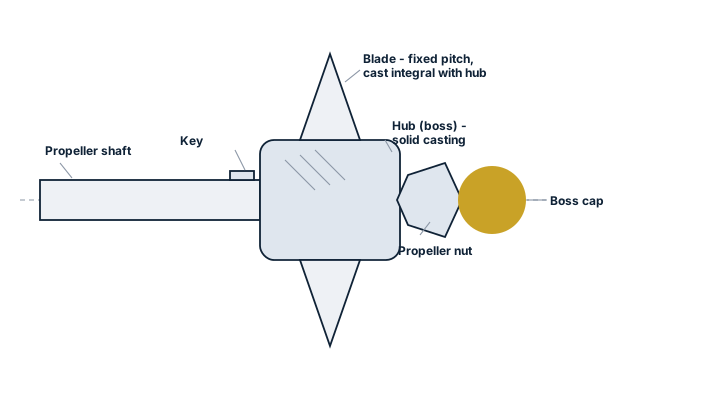
Blades are cast as one piece with the hub, or separately cast and bolted/keyed to it on larger propellers to ease casting and allow individual blade replacement after damage. Blade number (typically 3 to 6) trades off efficiency against vibration and cavitation-induced hull excitation — fewer blades are more efficient, more blades run smoother.
Shaft fit
The propeller mounts on a taper at the aft end of the tailshaft, historically keyed and increasingly keyless, secured by a large retaining nut and locked against rotation by friction from a calculated interference fit. A keyless fit relies entirely on that calculated push-up length and pressure being achieved and recorded during fitting.
Material
Nickel-aluminium-bronze (Nibral) is the standard material for its corrosion resistance and strength; stainless steel and cast iron appear on smaller or specialised craft. Ice-class propellers use thicker blade sections and tougher alloys to survive ice impact loads that a standard open-water design is not calculated for.
Selection and sizing
- Diameter and pitch matched to the engine's power/RPM curve and the hull's resistance curve at design speed — an undersized or mismatched propeller leaves the engine unable to reach rated power (light running) or overloads it (heavy running)
- Expanded area ratio (blade area relative to disc area), which sets the cavitation margin at a given loading
- Blade number, chosen partly for efficiency and partly to avoid exciting hull or shafting natural frequencies
- Skew (blade sweep) used on many modern designs to reduce pressure-pulse induced hull vibration and noise
Regulations and class
Class societies require submission and approval of the propeller design calculation (blade root stress, material properties) before manufacture, and issue a certificate against material test results from the casting. Periodic survey includes visual inspection of blades at each dry-docking for erosion, cavitation damage and cracks, and the propeller is removed as part of the tailshaft withdrawal survey interval, where the shaft taper and key (if fitted) are also examined.
Typical faults
| Cause | Consequence |
|---|---|
| Cavitation from operating outside the design loading (overload, wrong pitch for the hull) | Progressive erosion of blade tips and trailing edges, loss of efficiency, eventual blade thinning requiring repair |
| Grounding contact or debris/net impact | Bent or chipped blade tips, resulting imbalance causing shaft and stern tube vibration |
| Keyless taper fit push-up not achieved or recorded correctly at fitting | Propeller creep on the shaft under load, eventually loosening and risking loss of the propeller |
| Repair welding or blade straightening without re-balancing | Persistent hull vibration even though the visible damage appears fixed |
What to look for in a supplier
- Class-approved design calculation on file for the specific vessel and loading condition, not a stock catalogue propeller resized by rule of thumb
- Material mill certificates traceable to the specific casting
- Dynamic balancing certificate delivered with the propeller, with balancing grade stated
- Demonstrated capability for blade repair and re-balancing, since most propeller work over a ship's life is repair rather than replacement
A new vibration that appears after any grounding, net snag or dry-dock propeller repair should be treated as a balance problem until proven otherwise — running on a damaged or poorly repaired propeller accelerates shaft bearing and stern tube seal wear well beyond the propeller itself.
