What to check on a Marine Drive Systems & Accessories.
16 models from Vetus in Marine Drive Systems & Accessories. Below: the full model list.
What Makes This Type
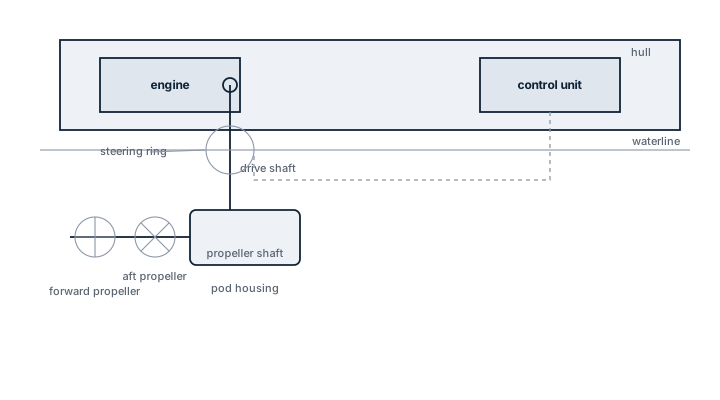
This grouping covers integrated pod-type drive systems, such as Volvo Penta's IPS, and their control and accessory equipment, as distinct from a conventional shaft, stern tube and rudder arrangement. A pod drive turns the whole lower unit to steer, using forward-facing, contra-rotating propellers instead of a single aft-facing propeller behind a rudder. This changes the hydrodynamics enough to reduce fuel consumption and improve low-speed handling on the planing and semi-displacement hulls these systems are mostly fitted to, which is the main reason owners choose it over a conventional shaft line on this size of vessel. The electronic control layer, marketed as EVC (Electronic Vessel Control) on Volvo Penta systems, ties engine management, drive steering, joystick docking control and trim into one system rather than the separate mechanical linkages a conventional installation uses.
Read the full guide
Main Components
- Drive unit / pod: the steerable lower unit housing the gear train and propeller shafts, bolted through the hull bottom and rotated by an electro-hydraulic steering actuator.
- Contra-rotating propeller set: two propellers on concentric shafts turning in opposite directions, which recovers rotational energy that a single propeller loses and reduces cavitation at a given loading.
- Electronic Vessel Control (EVC) / Engine Management System (EMS): the electronic layer integrating throttle, steering, trim and joystick control across single or multiple drives.
- Engine mounts and flexible couplings: isolate hull-borne vibration from the engine, sized and rated for the specific engine weight and power, not a generic rubber mount.
- Trim and steering actuators: electro-hydraulic units that angle the drive for steering and adjust running trim, drawing on the vessel's hydraulic supply.
Selection and Sizing
Pod drives are matched to the engine's power output and the hull's displacement and planing characteristics, since the manufacturer specifies drive models against defined power bands rather than offering a continuously variable size range. Multi-engine, multi-drive installations depend on the EVC or EMS software supporting the specific number and layout of drives fitted, including joystick docking, which needs all drives and the bow thruster, where fitted, on the same control bus. Mount selection depends on engine weight, torque characteristics and the vibration isolation the hull structure needs, and is not interchangeable between engine models without re-checking the rated load.
Typical Faults
| Fault | Consequence |
|---|---|
| Anode depletion on the drive unit's underwater housing | Accelerated galvanic corrosion of the pod and propeller shafts once the anode is consumed |
| Steering actuator seal wear | Hydraulic fluid loss and sluggish or asymmetric steering response between drives |
| Engine mount degradation | Increased vibration transmitted to the hull, and in advanced cases misalignment between engine and drive coupling |
| EVC/EMS software or sensor fault | Loss of joystick docking control or throttle synchronisation between multiple drives, forcing a fallback to manual single-drive operation |
| Contra-rotating propeller shaft seal failure | Water ingress into the drive housing, contaminating the gear oil and risking bearing damage |
What to Look for in a Supplier
- Confirmed compatibility of any accessory, mount or control module with the exact drive model and software version fitted, since these systems are tightly matched by the OEM.
- Anode and seal kit availability sized to the specific drive unit rather than a generic marine anode.
- Diagnostic software or interface access for the EVC/EMS layer, without which fault-finding beyond swapping parts becomes very difficult.
Check drive unit anodes on a fixed calendar interval, not by eye at haul-out - galvanic corrosion on a pod drive progresses inside the housing before it becomes visible on the exterior.