Plate Heat Exchanger
A plate heat exchanger stacks thin corrugated plates to pack far more heat transfer area into a given footprint than a shell-and-tube unit of the same duty, at the cost of being far more sensitive to gasket condition and fouling between the narrow plate gaps.
What to check on a Plate Heat Exchanger.
11 models from Twin Disc in Plate Heat Exchanger. Below: the full model list.
What sets a plate heat exchanger apart
A plate heat exchanger builds its heat transfer surface from a stack of thin, corrugated metal plates clamped together (gasketed type) or permanently bonded (brazed or fully welded type), with hot and cold fluid running in alternating narrow channels between them. Compared with a shell-and-tube exchanger of the same duty, the plate design packs several times more surface area into the same volume because the corrugation pattern creates turbulence at low flow velocity, which improves heat transfer without needing long tube runs. The trade-off is channel width: gaps between plates are typically only a few millimetres, so the design is far less tolerant of solids, scale or fibrous debris than a tube bundle, and a gasketed unit depends entirely on gasket condition to stay leak-tight between the plate pack and between the fluid circuits.
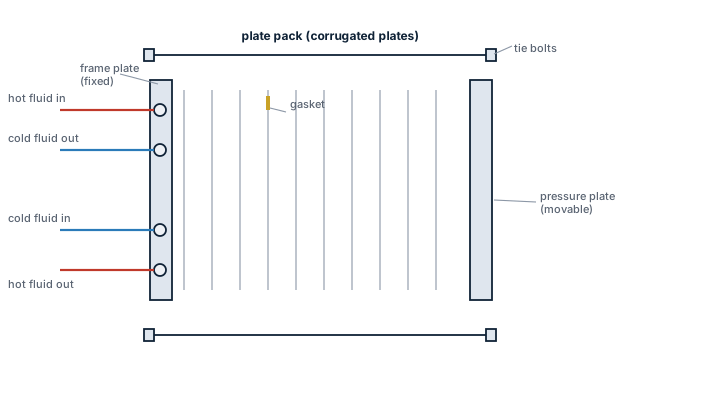
Legend
- Tie bolts
- Plate pack (corrugated plates)
- Gasket (channel seal)
- Hot fluid in
- Cold fluid out
- Pressure plate (movable)
- Cold fluid in
- Hot fluid out
- Frame plate (fixed)
- Counter-flow channels
Main components
Plate pack
Pressed stainless steel or titanium plates with a herringbone or chevron corrugation pattern that sets the flow path and turbulence level; plate thickness and corrugation depth are chosen for the pressure and duty.
Gaskets (gasketed type)
Elastomer gaskets, glued or clip-fitted into a groove around each plate, seal the fluid channels and route flow between ports. Gasket material (NBR, EPDM, Viton) is selected for the fluid and temperature; the wrong gasket compound in a fuel or lube oil circuit degrades quickly.
Read the full guide
Frame, carrying bar and tightening bolts
The frame clamps the plate pack to a specified compressed thickness; under-tightening lets gaskets leak, over-tightening deforms plates and shortens gasket life.
Brazed or welded pack (compact type)
Copper-brazed or fully welded plate packs eliminate gaskets entirely, giving a smaller, higher-pressure-rated unit that cannot be opened for mechanical cleaning, only backflushed or chemically cleaned.
Selection and sizing
- Duty and approach temperature - the closer the required approach temperature between the two fluids, the more plates or the larger the area needed.
- Pressure rating - gasketed units typically handle up to around 25 bar; brazed and welded types reach substantially higher.
- Fouling tendency of the fluid - seawater cooling duty favours a gasketed, openable design for periodic mechanical cleaning; clean closed-loop duty suits brazed units.
- Materials - titanium plates for raw seawater service resist chloride pitting far better than stainless steel.
- Connection size and plate count - determines physical footprint against available engine room space.
Regulations and class
Plate heat exchangers used in essential services (main engine cooling, fuel heating for combustion) fall under the class society's pressure vessel and piping rules for design pressure, material certification and pressure testing before delivery. Where the exchanger separates a fuel or lube system from a cooling water system, class rules typically require the design to prevent internal cross-contamination or to allow leak detection between circuits, since a failed plate or gasket can let fuel into cooling water or vice versa. There is no IMO convention specific to the plate exchanger type itself; requirements come through the classification society's machinery rules for the system the exchanger is part of.
Typical faults
| Fault | Consequence |
|---|---|
| Gasket hardening or shrinkage with age | inter-plate leakage, cross-contamination between fluid circuits |
| Fouling/scaling in narrow channels | rising pressure drop and falling heat transfer, often mistaken for pump wear |
| Plate corrosion pitting (wrong material for seawater) | through-wall leaks, seawater ingress into the clean circuit |
| Incorrect re-assembly after opening for cleaning | plates out of sequence change the flow path and duty is lost even though the unit looks intact |
What to look for in a supplier
- Material certificates for plates matching the actual fluid, especially titanium confirmation for seawater duty.
- Gasket compound datasheet matching the fluid and maximum operating temperature, not a generic default.
- Availability of individual replacement plates and gaskets for the exact plate pattern, since plate packs are not interchangeable between makers.
Before reassembling a gasketed plate exchanger after cleaning, check the plates go back in the original sequence and orientation - a swapped plate changes the flow pattern and the unit can look assembled correctly while badly underperforming.
Models in this type.
The best-documented model of each manufacturer first, then the next — 11 of 11 models in Plate Heat Exchanger. Every row links to full specifications, documents and service notes.
Manufacturers.
All 43 manufacturers with models of Plate Heat Exchanger. Names with a manufacturer page open it; the others open a search across the full library.
All manufacturers- DASCO Co., Ltd.1
- Donghwa Entec (South Korea)1
- E. Prang & Co. Apparatebau GmbH & Co.KG1
- Framo Fusa AS1
- Funke52
- GEA81
- Hangzhou Shenshi Energy Conservation Technology Co., Ltd.1
- Hisaka47
- Hydroniq Coolers AS2
- INDUSTRIAS TECNICAS DE GALICIA, S.A.1
- IWS-Monjé Heat Exchangers GmbH1
- Jiangsu Baode Heat Exchanger Co., Ltd.1
Also in Heat Exchangers.
The other equipment types in this category.
One request. A person reads it and replies by e-mail.
Tell us the manufacturer, the model and what you need — a part, a service call, a second opinion. A person reads every request and replies by e-mail.
No details at hand? A photo of the rating plate or the part is enough — simply attach it to the request.
Three things people ask first.
Is Plate Heat Exchanger data free?
Yes. Every model page, every guide and every datasheet for this type is readable without an account. An account adds saved searches and requests, nothing is taken away.
My model is missing — what now?
Send us the nameplate. We identify it by hand, add it to the library, and if you need a part or a service, the request is already on our desk.
Can you source a Plate Heat Exchanger part?
Yes. Tell us the manufacturer, the model and what you need — a person reads every request and replies by e-mail.