Centrifugal Fan
A centrifugal fan turns the airstream through about ninety degrees, using an impeller and volute to build static pressure that an axial fan cannot deliver — the default choice wherever air has to fight long ductwork, dampers or filters.
What to check on a Centrifugal Fan.
66 models from Vortice Marine in Centrifugal Fan. Below: the full model list.
What sets a centrifugal fan apart
A centrifugal fan draws air in along the impeller's axis and throws it out radially into a volute casing shaped to slow the air down and convert velocity into static pressure. That geometry is what separates it from an axial fan, which simply pushes air straight through in the same direction it enters. The trade-off is size and airflow per swept area: a centrifugal fan is bulkier for the same volume flow, but it holds its pressure rise against resistance far better. On board that makes it the natural choice wherever air has to travel through long ductwork runs, fire dampers, grease filters or cargo hold trunking rather than straight out a bulkhead opening.
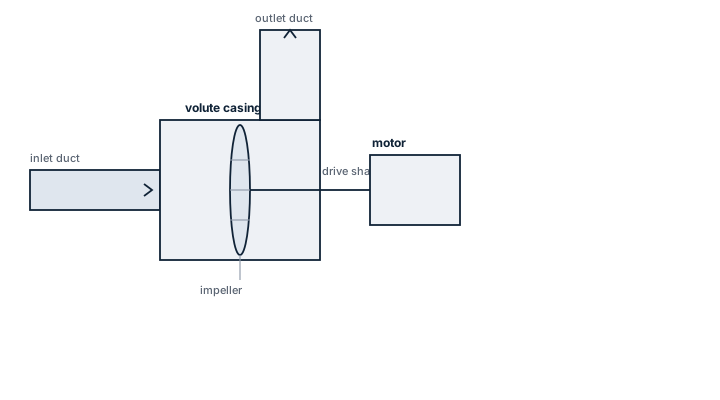
Legend
- outlet duct
- volute casing
- inlet duct
- motor
- drive shaft
- impeller
Main components
Impeller
Forward-curved, backward-curved or radial blades welded or riveted to a hub. Blade shape decides the fan's pressure-flow curve and how it behaves if the system resistance changes unexpectedly.
Volute casing
A scroll-shaped housing that converts the impeller's kinetic energy into static pressure and directs discharge into the ductwork. Casing gauge and coating are chosen for the air being moved — clean supply air versus greasy galley exhaust versus salt-laden intake.
Read the full guide
Drive arrangement
Direct-coupled fans run the impeller straight off the motor shaft; belt-driven fans isolate the motor from the airstream and allow speed changes by pulley swap, useful where the motor cannot be certified for the exhaust atmosphere.
Bearings and shaft seal
Grease-lubricated ball or roller bearings carry the impeller load; a shaft seal keeps contaminated air from tracking along the shaft into the bearing housing.
Selecting the right fan
- Duty point: required volume flow in m³/h plotted against the system's total static pressure in Pa, not just the fan's free-air rating.
- Blade type: backward-curved impellers are the most efficient and self-limit motor power as resistance rises; forward-curved units are compact for a given flow but draw more power if ductwork resistance drops; radial blades tolerate dust, grease and fume-laden air without fouling as quickly.
- Casing material: galvanized or coated steel for general HVAC, stainless or heavily coated steel for galley exhaust and salt-laden intake air.
- Speed control: fixed speed with balancing dampers, or a variable-frequency drive where the duty varies with occupancy or cargo hold ventilation demand.
Regulations / Class
SOLAS Ch. II-2 governs ventilation serving machinery spaces and galleys: fans must be capable of being stopped from a position outside the space they serve, and galley exhaust fans need accessible grease filters plus a fire damper at the boundary. Class societies require periodic functional testing of these remote stops and of fire dampers during survey, and cargo hold ventilation fans on certain cargo types are covered by class notations for hold atmosphere control.
Typical faults
| Fault | Cause | Consequence |
|---|---|---|
| Vibration increase | Grease or salt build-up unbalancing the impeller | Bearing wear accelerates, mounting bolts work loose |
| Reduced airflow | Belt slip or stretched belt on belt-driven units | Under-ventilated space, condensation or heat build-up |
| Motor overload trip | Damper left closed or duct blockage downstream | Fan runs against dead head, motor overheats and trips |
| Casing corrosion | Coating breakdown in galley or salt-air exhaust duty | Air leakage past the casing and eventual structural failure |
What to look for in a supplier
- A factory test certificate showing the actual flow/pressure/power curve, not just a catalogue curve.
- Vibration grade stated against a recognised shipboard rotating-machinery standard.
- Coating or material specification matched to the intended duty, not a generic finish.
- Standard bearing sizes that can be sourced from any marine bearing supplier, not a proprietary part.
A fan that has quietly lost ten percent of its flow to a partly fouled impeller rarely trips an alarm — it just lets the space it serves run a little warmer or a little damper until someone notices the real cause months later.
Models in this type.
The best-documented model of each manufacturer first, then the next — 66 of 66 models in Centrifugal Fan. Every row links to full specifications, documents and service notes.
Manufacturers.
All 23 manufacturers with models of Centrifugal Fan. Names with a manufacturer page open it; the others open a search across the full library.
All manufacturersAlso in Ventilation.
The other equipment types in this category.
One request. A person reads it and replies by e-mail.
Tell us the manufacturer, the model and what you need — a part, a service call, a second opinion. A person reads every request and replies by e-mail.
No details at hand? A photo of the rating plate or the part is enough — simply attach it to the request.
Three things people ask first.
Is Centrifugal Fan data free?
Yes. Every model page, every guide and every datasheet for this type is readable without an account. An account adds saved searches and requests, nothing is taken away.
My model is missing — what now?
Send us the nameplate. We identify it by hand, add it to the library, and if you need a part or a service, the request is already on our desk.
Can you source a Centrifugal Fan part?
Yes. Tell us the manufacturer, the model and what you need — a person reads every request and replies by e-mail.